The effects of climate change and new building mandates aimed at carbon reduction may help transform the forestry industry in California and spur new business opportunities.
Policymakers and land stewards are rethinking forestry, shifting the focus to restoration, resilience, and regeneration. They are starting to think about how to manage the piles of unusable wood that are left behind in the forest to rot or burn after a vegetation management project or a sawmill has taken the usable timber.
James Hanson, business services manager for the Mother Lode Workforce Development Board in Sonora, sees economic opportunity in this shift.
“People are starting to figure out what you can do with the remainder of the tree that has a value to it,“ Hanson said. “When all the grants go away, private industry can help incentivize the continued maintenance of the forest in a sustainable manner. As a workforce and economic development district, we are supporting this shift, and we are open to all kinds of partners and collaborations to make this happen.”
The mass timber industry offers a profitable alternative for wood that has historically been left behind, opening the door to a new generation of entrepreneurs. Mass timber utilizes overgrown small-diameter trees, transforming them into value-added engineered wood products.
“Using small trees, trees from fuels reduction/restoration projects, processing trees in a way that allows them to be used in larger pieces is environmentally responsible,” said Erin Kelly, department chair and professor of forestry, fire and range land management at Cal Poly Humboldt.
Washington Lawmakers Revive Olympics Wilderness Legislation
U.S. Senator Patty Murray (D-WA) and U.S. Representative Emily Randall (D, WA-06) reintroduced the Wild Olympics Wilderness & Wild and Scenic Rivers Act. The legislation would permanently protect more than 126,500 acres of Olympic National Forest as wilderness and 19 rivers and their major tributaries—a total of 464 river miles—as Wild and Scenic Rivers.
The legislation would set aside the first new wilderness on Olympic National Forest in over four decades and the first-ever protected wild and scenic rivers on the Olympic Peninsula.
Murray worked with local and regional timber interests to remove any currently viable timber base from the proposal to ensure the legislation would have no impact on existing timber jobs, according to his office.
However, Travis Joseph, president and CEO of the American Forest Resource Council, an advocacy group for the forest products industry, disputed that assessment. While marginal changes have been made to the legislation, most of the industry’s concerns have not been addressed, he contended.
“Wild Olympics proponents have made false claims that this wilderness bill is noncontroversial and does not impact working forests,” said Joseph. “By definition, wilderness explicitly bans — forever — sciencebased active forest management that can help achieve important conservation goals.”
Editor: Tim Cox, tim@forestnet.com
Contributing Editors: Mary Bullwinkel, Tyler Freres, David Grim, Dawn Killough
Send both OLD and NEW Circulation information to: TimberWest Magazine Attn: Subscriptions P.O. Box 9058, Fargo, ND 58106 subscribetw@forestnet.com
CEO: Anthony Robinson – arobinson@forestnet.com Phone: (778) 991-3500
PUBLISHER’S EDITORIAL STATEMENT: TimberWest reports on the logging and lumber segment of the forest industry in the Western United States with emphasis on the states of AK, WA, OR, ID, MT and CA, providing current information on timber harvesting techniques, sawmill operations, news, legislation, events, people and products pertinent to this market.
TIMBERWEST (USPS #024858) is published bi-monthly (Jan/ Feb, Mar/Apr, May/Jun, Jul/Aug, Sept/Oct, Nov/Dec) by TimberWest Publications, LLC, 300 Admiral Way, Suite 105, Edmonds, WA, 98020. Periodicals postage paid at Edmonds, WA and at additional mailing offices. Copyright 2025. All rights reserved. Subscription rates to qualified subscribers are Free and all non-qualified subscriptions in U.S. are $22 per year payable in advance. Canada $35 (U.S.). Other $60 (U.S.). Single copies paid in advance $4. Company affiliation, title, date and signature must appear on subscription forms. Publisher reserves the right to refuse non-industry subscriptions and advertising. All other advertising is accepted at the discretion of the publisher. Publisher does not assume any responsibility for the contents of any advertisement and all representations or warranties made in such advertising are those of the advertiser and not of the publisher. Back issues, if available, $4 each. Directory and Calendar issue $10 each.
Advertising created by TimberWest Publications, LLC is the sole property of TimberWest Publications, LLC and may not be copied or reproduced without the express written permission of the publisher.
Canadian Publication Mail Product Sales Agreement #40740074. Return Undeliverable Canadian Addresses to P.O. Box 86670 Stn. Main, North Vancouver, BC V7L 4L2
Printed in Canada at Mitchell Press
POSTMASTER: Please send address changes to TimberWest Magazine, P.O. Box 9058, Fargo, ND 58106 Printed on FSC®certified paper.
(continued on page 6)
(continued from page 4)
Thinning Forests Aids Mitigation of Drought
Thinning forests, generally undertaken to reduce dangers from wildfire and restore the forest to a more natural state, also can create more mountain runoff to mitigate drought effects in the central Sierra Nevada region that relies on snowpack.
Researchers at the University of NevadaReno found that the quantity of additional water produced by thinned forests can be so significant that it might provide further incentive for forest managers to undertake prescribed burning or tree-removal using heavy equipment and hand crews with chainsaws.
Water yields from thinned forests can be increased by 8-14 percent during drought years, according to the study.
That increased water would be particularly valuable, especially in drought years, to farmers and cities in central California and northern Nevada who rely on Sierra snowpack for much of their water supply.
When forests are thinned, either through prescribed burning or mechanical removal, less rain and snow is intercepted and lost
in the tree canopy, and more reaches the ground. Snow and rain captured by the tree canopy is likely to evaporate while snow and rain that reaches the ground is more likely to feed water to streams.
At the same time, removal of some large trees reduces the demand for water. Fewer trees, after all, require less water, and thus runoff increases.
The research did not examine financial considerations but focuses exclusively on the amounts of water generated by thinned forests.
Environmentalists Sue Over Fire Retardant
An environmental group made up of current and former U.S. Forest Service employees filed a federal lawsuit against the agency, alleging its continued use of aerial fire retardants violates the Endangered Species Act.
The lawsuit, filed in U.S. District Court in Montana, also names two other federal agencies — the Fish and Wildlife Service and the National Marine Fisheries Service — as violating the Administrative Procedure Act.
Those agencies are responsible for studying proposed actions that might affect species listed under the Endangered Species
Act or habitat that those plants and animals rely on.
The group alleges that both agencies issued biological opinions that were scientifically flawed.
Bill Would Aid New Mills in Montana
About a year after the most recent announcement of a Montana sawmill closure, state lawmakers passed a bill creating a low-interest loan program for companies reopening a mill in an effort to boost Montana’s economy and forest health.
Missoula County’s two largest wood products facilities — Pyramid Mountain Lumber in Seeley Lake and Roseburg Forest Products in Missoula — announced in March 2024 plans to close, affecting about 250 employees.
The Missoula Economic Partnership has worked to find a company to take over the former Pyramid Mountain Lumber sawmill for more than a year, said Grant Kier, the partnership’s president and CEO. The economic development organization supported House Bill 876 as a “piece of the puzzle, not the whole solution,” said Kier.
“It’s important to recognize this money is part of a whole suite of tools we’ll try to bring to the table to make financing more favorable and appealing to someone if they’re willing to invest in a sawmill in western Montana,” he said. “At the end of the day, it’s probably enough to send a really strong signal to somebody that the state government is really supportive of the industry and wants to see investments.”
HB 876, also known as the Sawmill Revitalization Act, sets aside $6 million for loans administered by the state Board of Investments. Any money not spent by June 30, 2027, will be transferred back to the capital development long-range building account. The bill awaits Gov. Greg Gianforte’s signature.
Pacific Legal Foundation Endorses U.S. Land Sales
The House Natural Resources Committee included a provision in the budget reconciliation package allowing federal public land sales in Nevada and Utah.
In March, Interior Secretary Doug Burgum and Housing and Urban Development Secretary Scott Turner announced a partnership to “identify underutilized federal lands suitable for residential development, streamline land transfer processes and promote
policies that increase the availability of affordable housing.”
However, the proposed provision has sparked pushback from some members of Congress and environmental activists.
The provision represents a vital step toward restoring Americans’ ability to use their abundant natural resources to advance freedom, and it would represent a welcome challenge to the executive branch public lands abuse, said the Pacific Legal Foundation
For decades, federal property ownership has resulted in the erosion of Americans’ ability to harness the abundant natural resources with which our nation has been blessed. The U.S. possesses the world’s largest combined reserves of oil, natural gas, and coal. American forests could sustainably produce timber for generations. Mineral deposits contain critical materials essential for everything from smartphones to renewable energy technology.
However, these resources remain largely inaccessible under a federal management regime that is increasingly divorced from congressional intent and constitutional limits.
Federal agencies control more than 640 million acres of public property — nearly 30 percent of all American land. In Western states, federal ownership approaches 80 percent. Distant bureaucrats with shifting political priorities control the economic destiny of entire communities.
The proposed land sales—covering less than 1 percent of federal holdings in Nevada and Utah—represent a modest but vital step toward a better federal land policy.
Millions Exposed to Bad Air from Wildfire Smoke
The impact of wildfire smoke on people has changed rapidly over the last century. Rapid expansion of housing developments into landscapes that naturally burn, coupled with climate change, created the perfect storm. More people are exposed to dangerous air quality during wildfires that are increasingly more extreme.
Around 44 million people around the world are exposed to unhealthy air quality every year due to wildfires alone, according to a recent paper published in the peer-reviewed journal Atmospheric Environment. An additional 4 million people have at least one day of exposure to air quality considered hazardous to health.
These exposures, the researchers estimated, cause more than 670,000 premature
deaths annually, more than one-third among women and young children.
Vulnerable communities, including the elderly, children, those with health comorbidities, and outdoor workers in agriculture, construction, and natural resource management, often face higher rates of smoke exposure
So, balancing human and forest health is increasingly a dilemma for forest managers
Grants to Support Hauling Hazardous Forest Fuels
The U.S. Department of Agriculture announced $23 million in grants to support transporting hazardous fuels – such as dead or downed trees – from national forests to processing facilities
(continued on page 8)
Unwanted vegetation? We have the right tool – or AX – for the job. Choose from our full line of Battle Ax ® forestry mulchers for skid steers, excavators and prime movers, or our new stump grinder and brush cutter attachments. Find your match at Loftness.com
FORESTRY MULCHERS
(continued from page 7)
Through the U.S. Forest Service’s Hazardous Fuels Transportation Program, the grants will reduce the hazardous fuels that pose wildfire threats to communities, critical infrastructure and recreation areas.
“Removing hazardous fuels not only reduces wildfire risk but also creates opportunities for businesses and workers in the wood products industry,” said Agriculture Secretary Brooke Rollins. “These grants also reflect the Forest Service’s dedication to active forest management, and we will continue working to keep our forests productive, sustainable, and safe for future generations.”
The Hazardous Fuels Transportation Program aims to help businesses, non-profits, and state, local and tribal governments make use of the dead trees, fallen branches, and dense undergrowth which would go to waste or fuel catastrophic wildfires.
The Forest Service will accept applica-
This work directly supports President Trump’s Executive Order on increasing domestic timber production as well as Secretary Rollins’ direction to have the Forest Service ramp up active forest management on national forests to improve forest health, reduce wildfire risk, and support rural prosperity.
Report Cites Threats To Oregon Forests
Drought, insect pests, and tree diseases continue to be the biggest threats to Oregon’s trees
A new report on the health of Oregon’s forests is based on an extensive aerial survey completed last year by the state Department of Forestry (ODF) and the U.S. Forest Service.
“A large part of this report is devoted to looking at the impact from climate change, specifically drought,” said state forest entomologist Christine Buhl. “Drought is often
Online Safety Training For Yarding Available
The Oregon Fatality Assessment and Control Evaluation (OR-FACE) Program, in collaboration with Jeff Wimer (retired Oregon State University logging safety consultant), has developed a free, self-guided, online Oregon Yarding and Loading Safety Training.
Adapted from the 1993 Oregon OSHA Yarding and Loading Handbook, the new online training is intended to supplement the essential training offered by employers. It is designed for those working in the logging industry and covers essential topics, such as: types of yarding systems, recommendations for rigging, procedures for rigging crews, and more!
The training includes:
– Industry-relevant examples based on real-world safety issues
– Self-paced, online learning modules
– Short, micro-learning modules
– Downloadable resources for on-the-job use
A Spanish version of the training is being developed and will be available soon for free.
To learn more about the online training program or to access it, visit: www.supportiveworkplaces.org/oregon yardingandloadingsafetytraining.
paired with rising temperatures, and together these are often the underlying causes for tree mortality across our landscape. Drought reduces tree growth and increases susceptibility to insect pests and some diseases, which healthy trees may otherwise resist or tolerate.”
Buhl said the report also measures other causes of trees being injured or killed, such as insect pests, diseases, storms, and wildfires.
Last year a record 1.9 million acres were affected by wildfire
Areas hardest hit by drought, such as the eastern foothills of the Cascades and some parts of northeastern Oregon, saw the largest amount of non-wildfire tree damage — some 2.26 million acres.
Budget Cuts Target Forest Service
Forest management and U.S. Forest Service operational expenditures drop under President Donald Trump’s proposed budget for the Oct. 1 fiscal year.
Compared to the current year’s budget, National Forest System management spending would decrease by $392 million across the U.S.
The proposed NFS management budget reduces salaries and expenses by $342 million and saves an additional $50 million by eliminating funding for the Collaborative Forest Landscape Restoration program and reducing funding for recreation, vegetation and watershed management as well as land management regulation.
The proposal “fully supports” Executive Order 14225 — which calls for immediate expansion of timber production and improved forest management — “and the administration’s goal of restoring federalism by empowering states to assume a greater role in managing forest lands,” according to a summary by the president’s Office of Management and Budget.
The requested funding level “supports the highest priorities in forest management including timber sales, hazardous fuels removal, mineral extraction, grazing, and wildlife habitat management.”
A reduction of $391 million is proposed for Forest Service operations. The budget reduces funding for expenses including salaries and facility leases “to streamline the agency’s management structure and rightsize their real property footprint,” in line with the goal to increase state authority over land management, according to OMB.
Meet the TimberWest Editorial Team
TIMBERWEST MAGAZINE
is celebrating 50 years serving the forestry industry in 2025. In a series of articles this year, we are introducing members of the dedicated team behind the magazine.
Anthony Robinson acquired TimberWest Publications in 2019; at the time he was associate publisher of Logging & Sawmilling Journal and had a leadership role in both magazines. He holds the title of CEO, and his wife, Hannah, serves as associate publisher.
In this issue we focus on the people who provide the editorial content for TimberWest.
Tim Cox was named editor of TimberWest in the fall of 2022. He has written about the forest products industry and edited trade journals for the industry for more than two decades. In the past Cox also provided marketing communications for Caterpillar’s logging equipment division. His career experience also includes working as a reporter and editor for newspapers as well as a newsman for United Press International; his journalism career includes by-lines in The Washington Post and other newspapers. Cox also provides writing services for Prison Discipleship Ministry, a nonprofit organization that sends staff and volunteers into jails and prisons to minister to inmates. In his free time he enjoys practicing and playing electric guitar.
Editorial content for TimberWest also is provided by three writers.
Dawn Killough is a freelance writer based in Oregon and has written for TimberWest for several years. She also writes about the construction industry and provides writing services for software companies, contractors, and product manufacturers. Killough enjoys spending time with her cats, reading mysteries, traveling, country western dancing, and teaching line dancing.
Mary Bullwinkel, who lives in the Redwood Region of northern California, has written for TimberWest for 13 years and has extensive experience writing about the forest products industry. She also provides writing services to the Oregon Logging Conference and the Pacific Logging Congress. Bullwinkel is a past president of the Redwood Region Logging Conference, the only woman to hold the post since it was founded in 1937. She was the public affairs manager for Pacific Lumber Company for 14 years during the so-called ‘timber wars.’ In her spare time Bullwinkel enjoys gardening, photography, and watching and attending baseball games.
Andrea Watts lives in Washington and has written for TimberWest for more than 10 years. She holds bachelor degrees in English and forestry as well as a master’s in forestry. Watts also provides writing and editing services for the Society of Northwest Foresters Northwest Office and the U.S. Forest Service, among other clients. Her hobbies include reading, managing family forest land with her family, running, spending time with friends, and spoiling her two cats.
The magazine’s previous editor was Diane Mettler, who also was a contributor to Logging & Sawmilling Journal She left TimberWest in 2022 to accept the position of executive director of the Pacific Logging Congress and the Olympic Logging Congress.
Tim Cox
Dawn Killough
Diane Mettler
Andrea Watts
Mary Bullwinkel
New Mexico Family Company Expands into Forestry, Logging
Lovato Group Business Units Rely Heavily on Cat Equipment
By Mary Bullwinkel
SAPELLO, NEW MEXICO –
The success of the Lovato Group, which is comprised of a logging company and two other familyowned and operated businesses, is based on a simple premise: Don’t just work hard. Work smart and work efficiently.
Lovato Group’s newest business unit, AGL Wood Products, was launched in 2024. Services include logging, chipping, grinding, masticating, and wildland firefighting. The company also sells firewood. The other entities are Jake Lovato Trucking and JJ Excavation. The trucking company is the flagship business, founded by Jake Lovato in 1991.
“We do it all,” said Lovato, who started the company with his wife, Anita. They began
project. On that job he did everything from cutting down trees to road building, site prep work for replacing poles, and reseeding. The experience taught him the benefits of being versatile and capable of performing a wide range of services.
The Lovato Group is based in Sapello, a small community in northeast New Mexico, nearly 140 miles northeast of Albuquerque. Lovato added the excavation business in 1995. It is overseen by sons Jacob and Josiah – hence the JJ in the business name. AGL Wood Products was named for Lovato’s daughter, Altagracia Gloria Lovato, who passed away at the age of five in 2011. The three business units altogether have been instrumental in providing employment opportunities within the local community but are primarily staffed by family members year-round. The company employs about 14 people, some of whom are seasonal.
Diversification is important, said Lovato. “Having several irons in the fire not only
Terex track self-loading whole tree chipper can chip trees up to 30 inches in diameter. Company also has a Vermeer horizontal grinder.
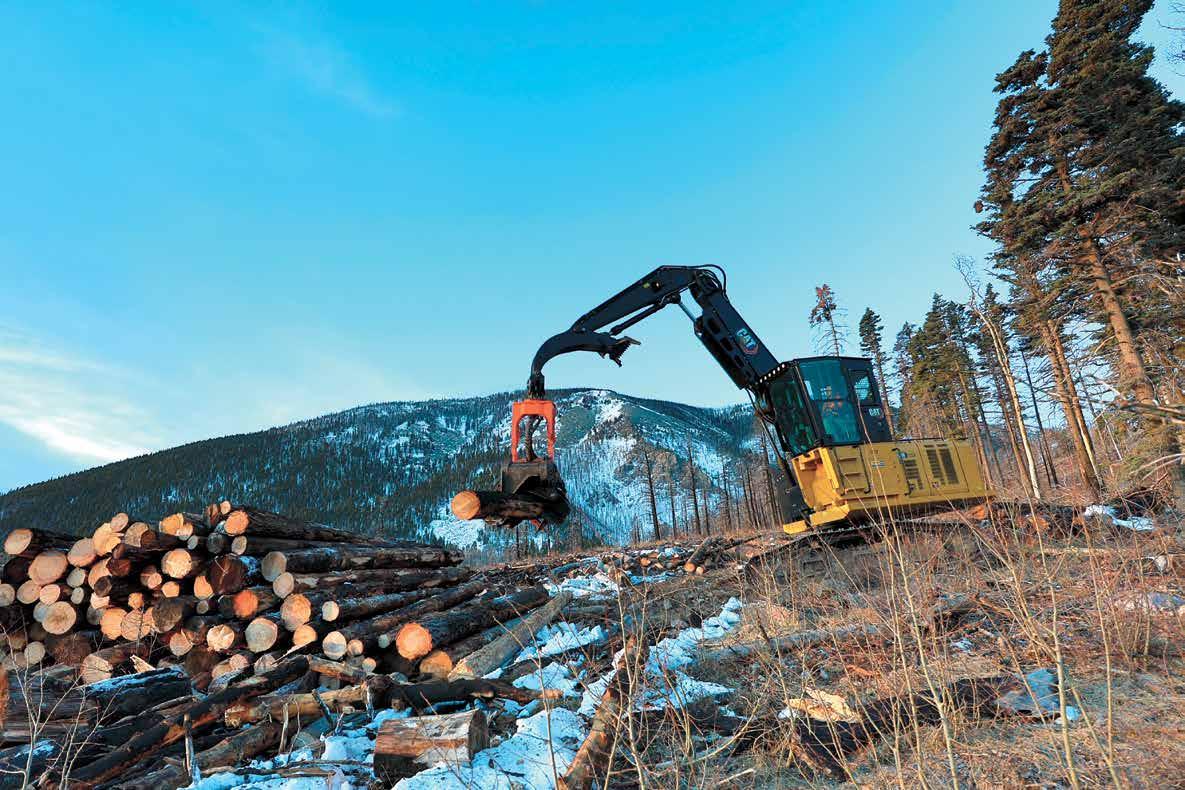
Newest machine is this Cat 538 forest machine, shown with a Southstar head and processing logs. It is also paired with a grapple to feed the chipper or grinder.
ensures we have the income to keep our doors open but secures work year-round for our employees. This is something that my mentors taught me, and it has stayed with me and with my children now.”
All three businesses rely almost exclusively on Caterpillar equipment. “I like Cat equipment,” said Lovato. “We get good service, and there are not a lot of repairs (needed),” he added.
He buys almost all of his Cat equipment from Peterson Tractor in Eugene, Oregon. “They offer very good support to us when we need parts, maintenance or repairs,” Lovato said. He also relies on Wagner Cat in Albuquerque for some service and repairs.
The trucking company operates a fleet of Kenworth semi-tractors, both W900B long nose, conventional cab, heavy-duty trucks and W900L, a limited-edition truck produced by Kenworth on its 100th anniversary.
Although Lovato did not start the logging company until last year, he is a fourthgeneration logger; his children represent the fifth generation. Lovato’s great-grandfather, grandfather, and an uncle all operated sawmills. His father was a logger, and he worked for him when he was younger.
Lovato started logging in 2000 when a forest fire created a business opportunity. He decided to set up a separate logging business after getting some advice from other loggers and insurance professionals while attending the Oregon Logging Conference.
“I guess I love the smell of sawdust,” he said. “I have always wanted to get into logging, and we were able to, and now have everything we need.”
Lovato buys standing timber and merchandises the logs to sawmills. His purchase prices are based on board feet, and the logs are scaled as they are loaded. The company mainly works in Doug fir, ponderosa pine, lodgepole pine, and some spruce.
Lovato has partnered with local and federal government agencies and built a reputation for doing quality work and having a high work ethic. There are two national forests east and northeast of Sapello, the Carson and the Santa Fe, and also two national monuments in the region. The company has done work for the U.S. Forest Service, CalFire, the Bureau of Land Management, Los Alamos National Laboratory, New Mexico Forestry Division, the Natural Resources Conservation Service, Western States Reclamation Inc., as well as
private landowners.
The company has been doing more work related to wildland firefighting in the last five years. “In the future we see a lot of work not only from post-fire (projects) but hopefully fire prevention,” said Lovato.
“I am hopeful the government will open up these forests and start treating them as a big garden that needs to be taken care of,” he added.
Logging and forestry operations are normally conducted by a crew of four, and three drivers from the trucking unit haul the wood. “These guys work hard,” said Lovato. “What sets us apart is we are not afraid to work long hours, and we have crews that are dedicated to that.” The logging and excavation crews both have a reputation for safely finishing jobs ahead of schedule, he said.
The newest piece of heavy equipment for the logging crew is a Cat 538 forest machine. The Cat 538 forest machine can be configured for general forestry operations, including processing logs, log handling and loading tasks, and building roads. It is powered
(continued on page
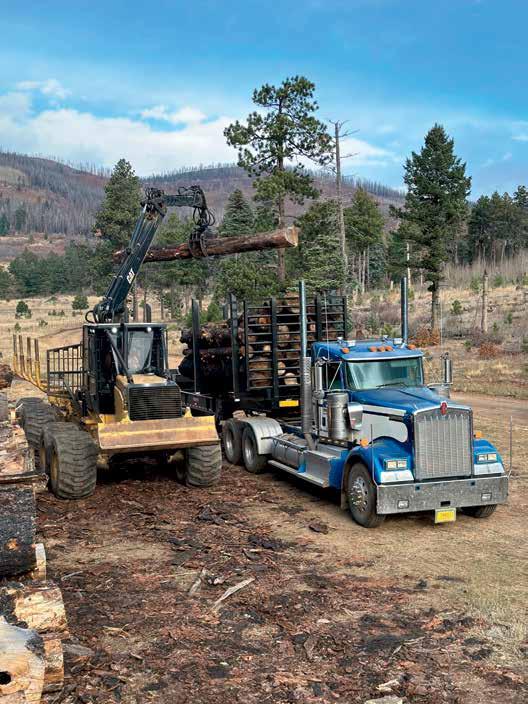
Cat 574 forwarder offloads logs onto waiting truck. Logging crew also has two Cat skidders to get the wood to the landing.
(continued from page 13)
by a Cat C7.1 engine with 174 hp that is fuel efficient and can run on biodiesel and other renewable fuels. Features include highvisibility forestry cab, smart mode to automatically match engine and hydraulic power to working conditions, heavy lift mode for more swing torque, and more.
“The Cat 538 forest machine is designed to be more productive, more comfortable, and cost less to maintain,” said Mike Dickenson, Caterpillar senior sales support consultant. “The electrohydraulic control system, increased travel speed, and high, wide undercarriage offer more power and precision. The efficient Cat 7.1 engine reduces fuel consumption while the Certified Forestry cab design improves operator comfort and safety. The machine also features advanced technology for fleet management and maintenance, making it a top choice for working with timber.”
(For more information, visit www.cat.com.)
Felling is done with a Cat 522B track feller buncher with a hot saw. Two Cat skidders (525 and 535 models) equipped with both grapples and winches and a Cat 574 forwarder transport timber to designated landing pads. The company also has a Cat
299 track skid steer with a Fecon mulching head to masticate brush and a larger, rubbertire Cat 563D masticator for big trees.
In addition, AGL Wood Products is equipped with a Terex track self-loading whole tree chipper and a Vermeer HG 6800TX horizontal grinder. Powered by a Cat 700 hp engine, the Terex can chip trees up to 30 inches in diameter.
The grinder is used mainly on-site at land-clearing projects. Chips and grindings are hauled back to the company’s yard; some are sold to mulch and ground covering. The rest is stockpiled and turned periodically to decompose into something that resembles peat moss, then mixed with soil and supplied to landscapers and nursery businesses. “‘We don’t waste anything,” said Lovato. “We utilize everything.”
The region immediately to the west of Sapello is rugged mountains. In some instances, the company has harvested timber on 50 percent slopes. The Cat feller buncher has worked well on the steep terrain, said Lovato.
Logging tracts at high altitude burned by forest fire usually produces good spruce saw logs. The company tends to do more chipping and mastication at lower elevations, where pine is more prevalent. Even the burned pine forests still produce some good salvage saw logs.
The Cat 538 swing machine can be paired with a Southstar attachment for processing wood or with a grapple for handling wood. When Lovato talked with TimberWest, it was being used on a clearcut project, processing trees or decking logs and feeding material to the chipper. The clear-cut was being performed on a tract that had been burned by wildfire. Some salvaged saw logs were being delivered to a local sawmill, but most were being hauled to a mill in Colorado, a half-day’s drive. “They really like the burnt wood up there because it has character,” said Lovato.
Low-grade logs go to the company’s wood yard to be processed into firewood with a Cord King 2760 firewood processor. Logs that are too small or not suitable for firewood are chipped and scattered on-site.
The company also does reforestation jobs. “On some projects,” said Lovato, “we throw out the (grass) seed first, then skid and log to work the seed in, and then chip lightly. It comes back really good.”
Depending on the fire, they may be contracted to provide water or to use bulldozers to build roads for fire trucks and other equipment. The company has two 18-wheel water tenders designed by Lovato and his sons. The tenders have 5,000-gallon aluminum tanks. They also have smaller 2,800and 1750-gallon water tenders.
AGL Wood Products is in the process of developing a sawmill at its wood yard to produce beams and rough lumber. Lovato has contracted with Illinois-based Sawmill Hydraulics Inc., makers of HELLE sawmill equipment, to design and build a custom scragg mill. He is hoping the sawmill will be operating by year’s end.
The excavation business does road building, site clearing and preparation for residential and commercial building projects, ranch development, including creating ponds, and seasonal snow removal. It is equipped with
three Cat excavators, three Cat bulldozers, a Cat motor grader, and an assortment of Cat loaders, backhoes, and skid steers, many of them paired with bucket plow attachments. Some of the machines are used in firefighting; the bulldozers, for example, have been used to create fire lines.
As noted earlier, Lovato Group is a family business. The forestry operations are supervised by son Seth, 24. Another son, Noe, 20,
(continued on page 16)
PIERCE
(continued from page 15)
Cat 522B track feller buncher with a hot saw working on steep ground. operates the feller buncher, and a daughter, Sarah, 21, operates a skidder. All Lovato children who work in the business have – or
a bonus every quarter that is based on safety. “People realize that everyone relies on each other,” Lovato said. “It’s a team, and every team member gets to play.”
The company’s reputation and success have been a blessing, said Lovato. “It was my goal and my dream, and we had our children, and I prayed that God would give me the
California Contractor Helping Plant Seeds for Future Loggers
Creekside Logging Adds Steep Slope Operations, Trucking Unit
By Dawn Killough
COTTONWOOD, CALIFORNIA
– When Delbert Gannon struggled to find good workers for his logging business in 2020, he did something about it.
“Trying to get people to come to work was almost impossible,” he said, “and we were training a lot of people who didn’t work out, which is very costly. I figured there had to be another way.” He got involved in educating and training future workers.
Gannon’s company, Creekside Logging, is
based in northern California in Cottonwood, which straddles Interstate 5, the highway traversing the state north-south. The company has a nine-acre site and 8,000-squarefoot shop staffed with three mechanics who service the fleet of equipment with the help of two service trucks.
Delbert Gannon
John Deere 2054 loader at work on a landing for Creekside Logging. The company has two more John Deere loaders.
Cottonwood is on the southern edge of the Shasta-Trinity National Forest, and there are two other national forests in close proximity, the Trinity and the Lassen. Creekside Logging harvests 25-30 million board feet a year with a crew of eight that works on flat or gently sloping ground and a crew of four that specializes in steep terrain and uses tethered equipment; the tethered crew averages 12-15 loads per day and the other crew, 25-30. The rest of the team of 25 are maintenance workers and truck drivers.
Gannon’s father and grandfather both worked in logging, so he joined the industry in 1990, starting by working for Blue Ridge Forest Management. He worked for the company until 2008, when he and Larry Strawn started Creekside Logging as a
partnership. Gannon became the sole owner in 2014.
Gannon hired Chris Chitwood to be general manager a few years ago, and the company has grown. They added tethering equipment to work on steep ground, and Gannon launched a separate trucking business, Battle Creek Timber in 2023, and added seven trucks. The trucking unit mainly hauls wood for Creekside Logging.
Usually all the men are working on a couple different job sites. The steep slope logging crew has been down for a year or so due to lack of work, but both crews will be working on a nearby burn site this summer.
The dominant species in the region include sugar pine, ponderosa pine, Douglas fir, white fir, and cedar. Creekside regularly
works for Sierra Pacific Industries (SPI), which has two mills in the region, in Anderson and Shasta Lake, one for large logs and the other for smaller wood. The company also supplies logs to the SPI mill in Quincy. Other markets are Trinity River Lumber Company in Weaverville and Mendocino Redwood Company in Ukiah. A typical job may be 1,500 acres. Creekside is usually paid by the ton or board feet. Hauls average 50-100 miles.
There are few markets for pulp or lowgrade logs, according to Gannon. Submerchantable wood and slash is left for erosion control.
Markets have been slower than recently,
(continued on page 20)
ContractorProfile
(continued from page 19)
with rising interest rates and a slowdown in homebuilding, but Gannon expects a gradual improvement.
Gannon invests in his company regularly, buying one or two pieces of equipment each year to make sure they stay up to date with technology. He recently bought a John Deere 959 shovel logger with a directional felling head to harvest big timber; the head will be able to harvest trees up to 39 inches in diameter. Papé Machinery in Redding was scheduled to deliver the machine in mid-May, and it will be used on the burn site over the summer.
“Our Papé dealer is the best in town,” said Gannon, “from buying machines to giving the best support for maintaining them.”
Last year he bought a new John Deere 2956G swing machine from Papé Machinery to use for processing, which is done with Waratah H424 attachments.
The John Deere 959ML shovel logger/ directional feller is powered by a John Deere 330 hp engine that generates 1,126 lb-ft. of torque. Maximum boom reach is 34-36 feet, and tractive effort is nearly 84,000 pounds-force. It can lift 9,610 pounds at maximum reach. The John Deere 959 tilts up to 26-degrees forward for steep slope operation; combined with a long, wide undercarriage, the leveling system maximizes performance in steep terrain. (For more information visit www.deere.com.)
The company’s other logging equipment
includes three feller bunchers, nine skidders, three John Deere loaders, and a TimberMax T20HD winch assist. It also is equipped with an assortment of excavators, bulldozers, and other excavation and road-building equipment.
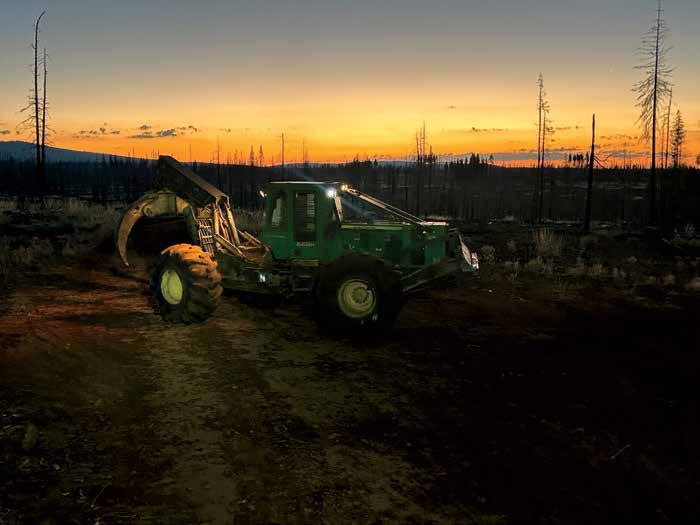
John Deere 2054 operating with lights. Creekside Logging does business with Papé Machinery in Redding, California.
When Gannon struggled to find and hire good workers, he became an advisor for two programs at Shasta College in Redding, just 15 miles north. HELO (Heavy Equipment Logging Operations) is a pre-apprenticeship program that teaches participants about
heavy equipment operation and maintenance, forestry, career planning, and leadership. Gannon was an advisor in setting up the program, which recently purchased two training simulators.
After completing the HELO program,
students can move on to CRAFT (California Registered Apprenticeship Forest Training), a state-registered apprenticeship program. A combination of on-the-job training and classroom-based supplemental instruction provides workers with knowledge about fire patrol, operation of power saws, wilderness first aid, scaling techniques, processor operation, and radio and map reading. Gannon is also on the advisory board for CRAFT.
Additionally, a summer program through CRAFT allows companies to cross-train workers on different equipment borrowed from HELO. Gannon will be teaching a couple of these cross-training classes there this summer.
Gannon is also a member of the advisory board for Anderson High School’s Career and Technical Education (CTE) program through the Shasta-Trinity Regional Occupational Program (STROP). The program provides CTE course work and handson training for students in six school districts in the Redding. Students are also able to simultaneously earn college credits through Shasta College.
His involvement has paid off. Gannon has hired several people from the college
(continued on page 22)
(continued from page 21)
programs, including two women who operate equipment.
Gannon is a member of Associated California Loggers. He is past president of the Sierra Cascade Logging Conference and continues to serve on the executive committee. The organization puts on an annual conference and equipment show and advocates for logging and forestry in dustries, supports training for young people,
and engages in outreach to the public. Creekside’s general manager, Chitwood, is currently serving as the organization’s first vice president.
Creekside provides an array of benefits for employees. Benefits include health insurance, dental insurance, and vision insurance. The company also offers a 401(k) retirement program with a matching contribution.
Those kinds of benefits apparently have helped with employee retention. Ten employees have been with the company for
more than seven years, and six workers have 15-20 years.
Gannon’s stepson, Justin Bradley, runs one of the processors. Gannon and his wife, Cynthia, also have a daughter who is a hair stylist. A stepdaughter is in Montana completing a nursing program.
Gannon started playing golf seriously three or four years ago. Other than that, in his free time he enjoys being with his family.
John Deere skidder delivering a hitch of logs to a landing. The company has nine skidders in all.
The company’s logging equipment includes three feller bunchers, nine skidders, three John Deere loaders, and a TimberMax T20HD winch assist.
NWH Makes Upgrade to Trim Saw at Eugene Lumber Mill
Second Optimizer Project by A&E Also Relies on JoeScan Technology
By Tim Cox, Editor
EUGENE, OREGON –
When NWH moved to optimize the trim saw at its mill in Eugene, Oregon, last year, the decision reflected several company values, and safety was one of them. The project, carried out by Automation & Electronics (A&E)
and relying on JoeScan scanning equipment, has reaped several important benefits.
NWH, formerly Northwest Hardwoods, which was established in 1967, is a leading hardwoods supplier to North America, Europe and Asia. Its corporate headquarters in Texas, NWH supplies manufacturers and distributors with over 14 domestic hardwood lumber species, a host of tropical hardwoods,
plywood and pallet stock.
In addition to the Eugene mill, the company also has two mills in Washington, in Longview and Centralia. It has a warehouse and reload facility in Longview and two more in Los Angeles and Oakland, California. NWH also has 12 more mills in Wisconsin, Michigan, Ohio, West Virginia, and Pennsylvania, a panel remanufacturing
Log on sharp chain infeed is headed into CM&E chipper-canter.
plant in Indiana, and additional warehouse and reload facilities.
The mill in Eugene, located in western Oregon a little over 60 miles south of Salem, was acquired by Northwest Hardwoods in 1996; it was shut down and revamped to produce lumber to the company’s standards and expectations. Today it is situated on 30 acres and consists of four major buildings. It runs one shift, and the operations employ 100 people. The mill produces over 30 million board feet of lumber products per year in red alder, Pacific Coast maple (also known as big leaf maple), and Oregon white oak. Most lumber is kiln-dried and surfaced S2S, finished lumber primarily for interior applications, destined to be used in the manufacture of furniture, millwork and moulding, cabinets, doors, and windows. A small percentage of pallet stock the company produces is sold green.
Logs are sourced from private landowners, including industrial forestry companies, and also state lands. They come from forests that meet Forest Stewardship Council certification for responsible management as well as other certifications. The company contracts loggers for harvesting operations and hauling logs.
The mill takes logs from 16-40 feet –40 feet is considered the ideal – and from 6 inches to 18 in diameter. In the yard they are bucked to 8-10-foot lengths by a single Kockums chop saw and then pass through a Nicholson ring debarker. Logs are sorted according to three sizes and then routed to one of the three primary breakdown machine centers: a CM&E chipper-canter and two Letson & Burpee double-cut band mills with Salem carriages. Secondary breakdown is handled by a pair of Schurman Machine Works gang saws with pallet material routed to a Newnes/McGehee gang. Material that requires edging goes to the USNR edger, and the final stage is the now-optimized USNR trimmer. The green lumber is sorted by length and stacked, then separated with stickers and moved to the green yard in preparation for drying.
The mill has an array of package kilns supplied by American Wood Dryers with a combined capacity of 800,000 board feet. The kiln-dried lumber is moved to the planer mill, where it is accumulated, surfaced on two sides by a Kimwood Machinery planer and sanded. The finished lumber is graded, sorted, packaged, and put in inventory.
All residuals – from bark to sawdust and scrap wood material – are sold. The only exception is the dust debris from sanding and finishing: it is accumulated in a silo and used to fuel the boiler system to heat the dry kilns.
(continued on page 26)
Red laser lines are visible on log being scanned prior to primary breakdown by a Letson & Burpee double-cut band mill.
(continued from page 25)
The trim saw optimizer project included redesigning the infeed system to make it faster and get more boards through quicker. NWH staff handled the design and fabrication of a new infeed, lug loader and fence modifications.
The new A&E geometric optimizer has aided both throughput and recovery. In addition, the automated process – the optimizer sets the trim decision instead of a person – reduced the number of employees at the machine center from two to one.
“The optimizer makes all the trim decisions,” noted Ed McGehee, manager of the mill. “It looks at the boards and makes the trim decision. It’s faster than an operator can make accurate decisions.”
A scanner examines the geometry (shape) of a board, and the optimizer makes trim decisions accordingly. Scanning the shape of the board reveals defects like wane and split. The system can be programmed for split and wane allowances, and the optimizer makes decisions based on the board shape and the parameters.
“We’re always trying for constant improvement in throughput and cost,” said Darren Gellerson, director of operations–west region.
The project not only saves labor, it makes the work station safer. “There’s less touching of lumber,” said Ryan Cosens, director of projects. “The lug loader is a lot safer. The person who is there is not putting their hands in a high-speed line.”
Although it did not result in a dramatic increase in production, it streamlined a little bit of a bottleneck. It also helped the company increase yield. “In the past there was a tendency to over-trim,” said Ed McGehee, mill manager. “Now we’re recovering more valuable grade. We’re throwing less in the chipper. It’s made a big difference.”
“When we spend money it’s to enhance efficiency and improve safety,” added Todd Walker, director of marketing. “That’s where we want to spend our money.”
McGehee characterized the company’s decisions related to capital improvement projects as “lots of singles and doubles adding up to home run numbers as opposed to big, sweeping projects.”
The company also replaced the carriage of the USNR green lumber stacker last year. USNR “implemented some impressive design upgrades to improve the consistency and speed and longevity of the equipment,” said McGehee.
A&E had handled a similar project at the
mill in 2022: optimizing the USNR edger, another project that also relied on JoeScan scanning equipment. The result helped the company to maximize yield and also increased throughput – probably by three boards per minute, McGehee estimated.
A&E is a global leader in industrial automation, software development, and control solutions. It specializes in designing, manufacturing, and integrating customized control systems for wood processing and other industries. It was acquired by Ontario-based TS Manufacturing in 2019. TS Manufacturing designs and manufactures equipment for the sawmill, mining and aggregate, and biomass and pelletization industries.
JoeScan, based in Vancouver, Washington, and named for its founder, Joey Nelson, manufactures scanning systems for sawmill optimizers. The company offers scanners for every mill machine center, from the log yard, primary breakdown, secondary breakdown, and transverse applications.
NWH launched a program to provide alder seedlings in 2024. In two years it has distributed 70,000 seedlings to be planted in the Pacific Northwest to help counter the decline in alder populations and boost species diversity. Working with PRT Growing
Services, the program supplies robust container stock seedlings, sourced from Weyerhaeuser to local foresters. The seedlings are specially adapted to thrive in various growing zones, enhancing their survival rates. Recipients also benefit from a best practices guide to ensure optimal planting and care.
In addition to its commitment to good natural resource management, NWH is keenly aware of and equally focused on human resources.
.“We’re a great employer in some of these smaller communities,” said McGehee. Employees earn a comfortable living plus enjoy generous benefits, such as group health insurance and a 401(k) retirement plan, among others. “We keep those small communities going, so we need the demand.” Most company facilities have employed several generations of the same family.
It’s one reason for the strong focus on safety. “We have a lower incident rate compared to other mills because of our emphasis on safety,” said Jed Miller, senior business director of the NWH western business unit.
“We want people to come to work and go home – safely,” said Walker. “It’s such an
(continued on page 28)
Infeed to USNR edger. It was optimized by Automation & Electronics in 2022.
(continued from page 27)
important part of our business. That’s who we are. It’s not just what we do. Our safety culture is huge.”
“It’s off the charts,” added Walker, “and it continues to get better and better.”
“Nobody is close in our industry,” said Gellerson. Safety is a core value of the company and has been for decades.
“The support is very, very real,” said McGehee, “from the regional level to senior leadership at the corporate level. We walk the walk. We’re able to do what we need to keep our employees safe.”
Another indication of how the company views the local community is a program –Hardwood Helpers – that provides time for employees to do volunteer service in their community. Through Hardwood Helpers, NWH employees help as volunteers with food and clothing drives, educational programs for children, and other charitable efforts. Over the past three years, NWH employees volunteered over 5,000 hours in their local communities.
“One thing we work on all the time is creating the demand for hardwoods,” said Walker. “There’s such a good story there. It’s good for the environment,” storing carbon in lumber. “We really feel if we manage and take care of the resource, it’ll take care of us. And it’s beautiful, and it lasts. It exudes quality.”
There is a strong collaboration between the company’s global sales force and manufacturing operations, noted Miller. “We take that feedback from the demand side and connect that to manufacturing. We’re constantly going over what we can do to meet that demand and provide the quality that is needed and the consistency. There’s a lot of work that goes on,” between the two aspects of the business. “It’s pretty unique in the lumber industry.”
There is competition for hardwoods from plastic and vinyl tile products. However, those products eventually can wind up in a landfill and are not biodegradable. In addition, some synthetic products give off toxic fumes when they burn while wood does not.
The company has stringent quality controls, noted Gellerson. “We go back and audit our lumber constantly and make sure it’s on grade. When you get our lumber, it’s going to be on grade. Our tallies are going to be right.”
“People don’t want surprises,” added Gellerson. “They can depend on our consistency.”
NWH has a significant export business, with sales offices in China and Japan. At this point it is hard to determine how much the tariffs imposed by President Donald Trump
– and retaliatory tariffs imposed by other countries, including China – are going to impact the company, and for how long. “It’s such a moving target,” noted Walker, with White House actions subject to change “by the hour, by the day.”
“It impacts our business because we do export products,” Walker acknowledged. However, the company has not made any adjustments yet. “We’re waiting to see what’s going to happen.” In fact, NWH CEO Eoin Lehane recently shared with other company
leadership that it is “probably in a better position than a lot of our competitors,” said Walker.
“The company has done a nice job of being appropriately diversified to handle shifting markets,” said Miller. “There’s some level of comfort that the business is strategized well. If this was 10 years ago, the tariffs would be very difficult for us.”
“We’ll continue to diversify our markets as well as look at domestic markets as a major focus as well,” added Miller.
Logs are bucked to 8-10-foot lengths by a single Kockums chop saw. Nicholson ring debarker is shown at left in green housing.
THE MILL YARD WORKHORSE
High stacking capability
Long-reaching boom
Fast, precise handling through 360° lift radius
Engineered
FORWARDER-CHIPPER READY For Service in California
BRUKS Chipper Mounted on Ponsse Machine Will Gather, Chip Forest Debris
WOODLAND, CALIFORNIA –
Bailey’s has delivered a customized Ponsse forwarder with a BRUKS chipper that will be used to help supply a pellet plant with raw material.
The Ponsse Buffalo King forwarder has an extended chassis with a BRUKS 806.3 mobile chipper mounted on it. The project to combine the two machines, involving two Ponsse dealerships, was completed for Tuolumne BioEnergy, which is developing a new pellet plant in Sonora, California, that will produce premium wood pellets for the domestic home heating market.
The machine will help utilize forest residual materials. It will be used to pick up and chip debris from logging operations and
similar material, helping to reduce fuels and mitigate fires.
Tuolumne BioEnergy, which is developing the pellet plant with the aid of a grant, ordered the Ponsse forwarder to be equipped with a chipper from BRUKS, a Swedish manufacturer. The chippers are custom made, according to Jim Haas, industrial sales manager for Bailey’s, and took about a year to arrive.
While unusual in North America, mounting a chipper on a forwarder is “fairly common” in Europe and Scandinavian countries, noted Haas. He knows of two such machines operating in the U.S., one in California and another in Colorado. “Not too many people design chippers for going on a forwarder like that,” added Haas.
The project involved two Ponsse dealerships, Bailey’s and PacWest Machinery.
Tuolumne BioEnergy ordered the equipment from Ponsse’s North American headquarters in Rhinelander, Wisconsin. At the time, Ponsse had service operations in Coburg, Oregon, but in 2023 it sold those operations to PacWest Machinery, naming the dealership its representative for sales and service of Ponsse equipment in Oregon Washington, and Idaho. Ponsse appointed Bailey’s as its dealer to represent it in California and Nevada last year.
The forwarder and chipper were shipped together. At PacWest Machinery, the bunks were removed from the forwarder, and the chipper was bolted on with special clamps. BRUKS factory technicians assisted. The forwarder was transported to Bailey’s for final installation, with assistance again from BRUKS personnel. Tuolumne BioEnergy is expected
to put the equipment into operation in midsummer. Bailey’s will service the machine.
The Ponsse-BRUKS combination will be used to go into the woods and process piles of logging slash, hazard tree debris, and other wood debris into chips. “It reduces fuel on the forest floor after logging,” said Haas.
The forwarder’s boom will be used to pick up material and feed it to the chipper. It has a bin to store the chips. When the bin is full, the forwarder can travel to a chip van, and the bin lifts to dump its load into the trailer.
machine in the Buffalo series of forwarders. It can carry nearly 20 tons. The BRUKS chipper is powered by a 500 hp Scania diesel engine and can process material up to 24 inches in diameter.
material, reducing hazardous fuels and improving forest health. The company’s products will be sold to retail, commercial and industrial markets in the U.S.
The plant is expected to employ about 25 people and to be operational in the summer.
Another benefit of the forwarder is that it can travel on a paved road, noted Haas. “The long-term strategy is it could be replicated elsewhere.”
The Ponsse Buffalo King is the largest
Bailey’s industrial machinery division is a representative for a number of other brands of commercial equipment for logging and forestry, tree care, and landscaping. Brands include ALBACH whole tree chippers, Fallbach tree cutting cranes, DYNA firewood processors, Neuson harvesters, Rotobec grapples, and more.
Tuolumne BioEnergy will produce premium wood fuel pellets produced from forest feedstock that would otherwise go to waste. The plant will process unmerchantable
Tuolumne BioEnergy is developing the plant with the aid of funding from the Biomass Utilization Fund. The fund was established by the Sierra Nevada Conservancy and the California Department of Housing and Community Development. It was allocated $17 million in federal funds to help finance new or expanding businesses in Tuolumne County that can use available forest biomass and provide an alternative to pile burning of forest waste.
Ponsse Buffalo King forwarder was customized with a BRUKS mobile chipper; it will be used to pick up and chip logging debris and similar material.
WINCH ASSIST SYSTEMS FOR STEEP SLOPE LOGGING: Enhancing Efficiency, Safety in Tough, Rugged Terrain
By David Grim
WITH THE 2025 Associated Oregon Loggers Convention concluding recently, and being the moderator for the seminar on ‘Rigging Gains and Innovation,’ I thought I would take a deeper dive into steep slope logging.
Steep slope logging — also referred to as ‘cable-assisted’ or ‘tethered’ logging — is an increasingly popular solution for harvesting timber on challenging terrain and reducing ground labor demands.
Traditional ground-based operations become less feasible, more costly, and considerably more dangerous as slopes exceed safe operating limits. Winch-assisted systems bridge this gap by providing equipment with extra traction and stability, helping operators navigate steep hillsides safely and efficiently.
Tethering can assist a variety of functions in the harvest system, including: felling, bunching, processing, shovel logging, skidding, forwarding, or concentrating decks.
Below, we explore the fundamentals of steep slope logging, from the underlying technology to best practices and leading equipment providers.
1. Mechanics of Steep Slope Logging
i. Cable-Tethering or Winch Assistance
The fundamental idea is to use a highstrength cable attached to a winch. One end of the cable is anchored to a secure machine (i.e., a purpose-built anchor machine) at the top of the slope while the other end is fixed to the harvester or forwarder working on the slope. The tension in the cable provides additional support, preventing machinery from sliding downhill.
ii. Purpose-Built vs. Modified Equipment
Some manufacturers design purpose-built
steep slope harvesters and forwarders while others offer aftermarket kits to modify existing logging machinery. Purpose-built units often have specialized frames, reinforced tracks, or hydraulic systems specifically designed for steep terrain.
iii. Advantages
• Safety: By preventing uncontrolled movement on steep slopes, winchassisted systems reduce worker injuries, accidents and equipment rollovers.
• Productivity: Operations can continue even on slopes that might otherwise be inaccessible, maximizing harvestable timber.
• Efficiency: Reduced reliance on manual felling and/or cable yarding can improve overall productivity and help to solve the task of finding and retaining a workforce.
2. Key Considerations for Safe Operations
i. Site Assessment
Thorough evaluations — such as measuring slope gradients, soil type, and potential weather impacts — are essential.
ii. Equipment Selection and Maintenance
Using a well-maintained, purpose-built or properly retrofitted machine with a reliable winch system is critical. Regular inspections of the cable and anchor points are vital for safety.
iii. Operator Training
Specialized training ensures that operators understand the capabilities and limitations of their equipment as well as the correct procedures for engaging and disengaging the winch system.
iv. Regulatory Compliance
• Tethered Variance: The OR-OSHA “2022 Revised Tethered Logging Research Variance Provisions” provides the rules that forest tethered operators must follow while working on steep slopes in Oregon.
• Line Inspection (OR-OSHA Guidance): Amongst other rules found within the variance, OR-OSHA specifies requirements for tether lines to ensure ongoing safety:
• Continuous Wire Rope: Tether lines must be one continuous piece of wire rope (not spliced) and have a rated breaking load in accordance with the system manufacturer’s recommendations.
• Repair or Replacement: Tether lines must be repaired (shortened) or replaced if there is evidence of chafing, sawing, crushing, kinking, crystallization, bird-caging, significant corrosion, heat damage, or any other weakening damage.
• Inspection Schedule: At a minimum, inspections by a competent person must occur on this schedule:
• Daily: Inspect the first 50 feet of each tether line prior to use (this can be done at day’s end for the following
• 2,000-hour: Inspect the entire length of each tether line and the drum connection after 2,000 hours of use. This inspection can substitute for a unit startup inspection if conducted between projects. Lines may be “upended” per the manufacturer’s specifications during annual inspections.
3. Equipment Providers
A variety of manufacturers and specialist companies offer solutions tailored to steep slope logging. Each brings its own innovations in safety, durability, and efficiency. Here are just a few that you can find working in Oregon:
• Summit Attachments and Machinery
• TimberMAX
• Harvestline
• DC Equipment
• Tractionline
• T-Mar Industries
• Ponsse
• Tigercat
• John Deere
When selecting a provider, it is essential to ensure their equipment meets the specific slope requirements and regulatory standards for your logging site. It is also important to consider after-sales support and parts availability, which are critical for maintaining uptime in demanding environments.
terrain while maintaining precise control over machinery.
ii. Data-Driven Harvest Planning
Integrating GIS data, drone surveys, and advanced analytics can help loggers optimize harvesting routes and reduce the environmental impact.
iii.
Improved Safety Features
Manufacturers are focusing on userfriendly control interfaces, fail-safes for winch systems, and real-time diagnostics to mitigate risks associated with steep slope operations.
Conclusion
Steep slope logging with winch assist has opened new opportunities for logging in Oregon, making it possible to safely reach and harvest trees on challenging slopes and locations. By combining specialized machinery, robust winch systems, and advanced operator training, logging operations can improve both safety and productivity.
As mechanized technology advances, the industry can expect even greater emphasis on automation, data analytics, and improved equipment design — further enhancing worker safety, production efficiency, and sustainability of steep slope logging.
(David Grim is safety and health manager for Associated Oregon Loggers. This article originally was published in the organization’s Maineline newsletter and is reprinted with its permission.)
Winch Assist
TimberWest solicited information from manufacturers that offer winch assist equipment for logging on steep terrain. Information about those companies follows.
Tigercat
The Tigercat 120 winch assist is fully integrated with all latest generation Tigercat steep slope capable carriers, providing seamless communications and optimal hydraulic efficiency. It is also designed to work without travel signal integration. The basic installation, requiring only the in-cab control unit and antennas, allows the Tigercat 120 winch assist to be mated to any carrier. The powerful, heavy duty boom system – with choice of a bucket or other attachments – firmly anchors the machine and can take on basic road building duties. With ample below grade capability, the boom can extend over the road bank to firmly anchor the machine. All machine functions are actuated with an ergonomic, intuitive remote control system. High capacity cooling combined with a secondary hydraulic braking circuit provides highly effective braking assistance and heat dissipation for higher-speed rubber tire machines such as skidders, forwarders and harvesters. www.tigercat.com
TimberMax
The TimberMAX T24HDX is a high-performance winch-assist attachment built for modern steep-slope forestry operations. With a pulling force of 24 tons, it allows machinery to safely and efficiently operate on challenging terrain. Designed to be mounted on a variety of base machines — like excavators — the TimberMax T24HDX offers unmatched versatility without requiring a dedicated winch machine. Powered by the carrier, it keeps maintenance simple while maximizing uptime. The fully automated control system, located in the machine working on the slope, ensures constant cable tension and smooth operation, allowing the operator to stay focused on production. Built in Canada for demanding environments, TimberMAX
winches are trusted by logging contractors worldwide to increase safety, productivity, and expand harvesting capabilities on steep slopes. www.timbermaxusa.com
T-WINCH
The T-WINCH remote controlled compact traction winch has proven to reduce consumption, lowering operating costs for contractors. Its construction and functional design ensure reliable handling in the field. If the operation position cannot be reached by conventional means, the T-WINCH can pull itself up the slope in the so-called extreme mode. For daily operation, the supported machine only requires a hitch point dimensioned for the pulling force. The pulling force is adjusted via remote control; the T-WINCH detects changes in direction on the rope automatically. The T-WINCH 30.2 is powered by a 441 hp engine and operates with 1-inch rope. It has a maximum rope speed of 5 mph and a nominal constant pulling force of 40,456 pounds-force. It can be used with machines in the range of 10-80 tons. www.ecoforst.at
After 10 years of service in North American forestry, the Tractionline winch assist system has been an industry leader. It provides live constant tension and a superior control system for separate tension levels for uphill and downhill travel. The Tractionline system uses a reverse bucket design along with a lower swiveling sheave that allows it to be used on tight roads with high banks and to work at right angles from the road without sidewashing and losing pulling power. This also enables the tether machine to leave the road assisted.
Tractionline
Installations can be on excavator or log loader bases. The Tractionline system was designed to work with multiple different tether machines with the simple addition of a wire harness; there is no need to purchase expensive control panels or additional radios systems. The new Tractionline MK4 model will be available in late 2025 with 65,000 pounds of pulling capacity. www.technicalforestsolutions.com
Ponsse
Ponsse Synchrowinch is optional equipment for cut-to-length (CTL) machines working on steep slopes. It is available on Ponsse Cobra, Ergo 8W and Bear harvesters and the Buffalo, Elephant and Elephant King forwarders. The winch is equipped during the installation stage. These machines, with balanced bogies, offer tractive force, stability and comfort for the operator. They feature engines, brakes and tanks developed for slope conditions. Ponsse Synchrowinch saves fuel, reduces stress on drive transmission components, and prevents rutting and soil erosion. Winch speed is automatically synchronized to the machine driving speed; the operator doesn’t need to operate or adjust it during normal work. The winch can be operated via remote control, making it easy to hook the cable to a tree or stump uphill. Tiltable crane base options make harvesting and forwarding more efficient on slopes. www.ponsse.com
Falcon Forestry Equipment
The Falcon winch assist has been designed and tested for thousands of operational hours in a wide range of conditions. It is engineered to be uncomplicated, simple to operate and easy to maintain. The tethered machine operator only has one rope to manage when working down the slope, reducing complexity and potential for snags. The design has less mechanical and electrical complexity, reducing faults and breakdowns. The winch unit is enclosed by rear guarding for protection with easy access for maintenance. The Falcon winch assist uses 1-⅛-inch swaged rope for 69 tons of breaking strength. The system has minimal impact on the original specifications and performance of the base excavator, and an optional quick hitch enables it to operate as a loader, excavator, or shovel. The Falcon winch assist also has a number of safety features to eliminate operator risk. www.falcon.dcforestryequipment.com
Summit Attachments
The Summit Attachments winch assist system provides a safe, stable anchor for forestry machines. It is available in high speed (44,000 pounds of pull force) and high pull (55,000 pounds pull force) models. The high speed model uses 2,600 feet of 1-inch swaged wire rope; the high pull version runs 2,250 feet of 1-⅛-inch swaged wire rope. Starting from an excavator or shovel base, the company engineers and builds winch assist packages. With a sheave mounted to the bucket tied back to the machine base, the Summit Attachments winch assist is stable even on soft ground. All functions are operated via foot pedal and MD4 controls. Select the tension with one click, then the winch is controlled automatically via the travel pedals. The company’s high speed winch assist is capable of line speeds up to 700 fpm. www.summitattachments.com
U. of Idaho Seeks Donors For Forest Operations Fund
The University of Idaho is seeking donations to its Forest Operations Excellence Fund.
The fund was created to support travel, maintenance, and supplies needed to sustain the various forest industry outreach, education, and engagement efforts in the university’s college of natural resources. This includes logging equipment simulator trailers that have been used to engage and educate over 1,500 students across nearly 30 events in the past year!
Keeping these resources free and widely accessible is critical and is made possible with financial support from grants and people who donate to the fund.
“As we look to the future, we need your help to continue offering these resources free of cost and to as many people as possible,” said Rye Becker, forest operations educator and advocate.”
To make a tax-deductible gift to the fund, use this link: https:// lnkd.in/gBNvu3Vc
Oregon Loggers Plan Log-A-Load Fundraiser
Associated Oregon Loggers will hold a golf tournament fundraiser to benefit Log-A-Load for Kids, the forestry industry charitable campaign that aids Children’s Miracle Network hospitals.
The event will be held at Bandon Crossings Golf Course in Bandon June 20.
Tournament format is 4-person scramble with shotgun start. Prizes will be awarded to the winning team, closest to the pin (men and women), long drive (men and women), and hole in one.
Registration fee of $600 is for a team of four. Registration includes greens fee and cart, continental breakfast, lunch, two drink tickets and a raffle ticket. All registration fees are donated to LogA-Load for Kids.
Online registration is available. For more information, contact Rachel Hultgren at the AOL office, (503) 364-1330 or rhultgren@ oregonloggers.org.
Sierra-Cascade Logging Conference Holds Expo
The Sierra-Cascade Logging Conference held its annual Forest Products & Construction Equipment Exposition at the Shasta District Fairgrounds in Anderson, California, Feb. 6-8.
The theme of the 76th annual event was: Growing Trees, Growing People – Mentor Someone.
“The conference board of directors and the individual committee chairs outdid themselves in producing quality and memorable events that received praise from all those who attended,” said Kirby D. Molen, SCLC president.
Shasta College provided a much-appreciated workforce of young adults who helped with the moving and logistics of equipment displays.
The annual Lumberjack Dinner and Education Auction was a success with the bidding for numerous quality items being robust. One of the great strengths of the conference is its goal to encourage young adults to further themselves by providing scholarships to colleges
In the Western U.S. Proceeds from the Education Auction go to provide scholarships and other education opportunities that occur throughout the year. This past year the conference funded 59 scholarships totaling $104,500.
Pacific Logging Congress Sets Summer Board Meeting
The Pacific Logging Congress will hold its summer board meeting at the Flamingo Resort in Santa Rosa, California, July 13-15. The theme of the event is ‘Adding Value Through Partnerships and Collaborations.’
The schedule will include meetings of the executive committees of the PLC and the Pacific Forest Foundation, PLC and regional conference representatives, strategic planning committee, the board and committees.
The event also will include a number of social activities, such as a reception and a tour of the Petrified Forest and wine tasting, meals, and time to take advantage of the resort amenities.
For more information or to register, visit the PLC website at www.pacificloggingcongress.org.
Intermountain Logging Conference Holds Show
The Intermountain Logging Conference and Equipment Show included equipment displays.
SThe two-day event included an educational program as well as indoor and outdoor exhibits by forest industry suppliers.
The keynote speaker for the event was Travis Joseph, president and CEO of the American Forest Resource Council.
Steve Henderson of Pine Creek Logging moderated a panel discussion of industry updates for equipment that
featured representatives of Caterpillar, Pape’ Machinery, and Whip Around.
Tyler Roady of PotlatchDeltic moderated a technology panel discussion of artificial intelligence applications for logging and mills. Participating companies included PotlatchDeltic, Kadoma Systems, and DC Equipment.
Tim McEntire of the Montana Logging
Association led a panel discussion on federal policy; participants included representatives of the Montana Dept. of Natural Resources and Conservation, the Washington Dept. of Natural Resources, and the Idaho Department of Lands.
A hands-on technical session with equipment dealers was moderated by Carl Duer of Papé Machinery and Chad Nelson of NBTM.
The event also included equipment simulators with the University of Idaho and Papé Machinery and a demo competition sponsored by Modern Machinery and Budco.
Erin Roos of Idaho Forest Group led a panel discussion on industry outlook featuring representatives of AgWest, Idaho Forest Group, and the University of Montana.
Jack Keck of Idaho Forest Group
moderated a presentation on remote technology for logging equipment featuring John Deere, Timbermatics, Timber Manager, and Tigercat.
Rob Keefe of the University of Idaho moderated a panel discussion of career training for timber industry jobs with representatives of the University of Idaho and Idaho Forest Group.
The Intermountain Logging Conference is an advocacy organization for the forest products industry, particularly the Intermountain West region. It is governed by a board of directors representative of the industry, from timberland owners to mills and equipment suppliers, and from the states of Washington, Oregon, Idaho, and Montana. The organization has more than 500 member companies.
NEW PRODUCTS
Tigercat Offers New Steep Slope Carriers
Tigercat has released two new track carrier models based on the new sloping tail platform for steep terrain harvesting operations.
Both the Tigercat L857 feller buncher and the Tigercat LH857 harvester are powered by the efficient Tigercat FPT N67 engine. Power is delivered to the track drives via a refined, efficient open loop hydraulic system, providing high tractive effort and excellent performance on steep slopes.
The sloping tail platform takes ground based steep terrain logging to the next level. Optimized weight distribution and low centre of mass, along with Tigercat’s patented super-duty leveling undercarriage, provide the operator with comfort, stability and confidence on steep terrain. The sloped tail profile provides increased leveling capability to 26 degrees and better cable clearance in winch-assisted applications. For roadside processing applications, the sloping tail –with its ability to clear obstacles – allows the LH857 to work more effectively on smaller, congested landings.
Other enhancements include further improvements to service access and in-tank hydraulic filtration for extended service intervals. The side opening engine enclosure completely exposes the engine and most hydraulic components. When open, the enclosure roof serves as a safe, spacious and convenient work platform.
The harvester can be equipped with several Tigercat boom and harvesting head options, including the 573 and 575. The feller buncher is well suited to the 5702 and 570226 felling saws and 5185 fixed felling saw.
For more information, visit www.tigercat.com.
CBI Launches 364T Whole Tree Chipper
Continental Biomass Industries (CBI) has introduced the ChipMax 364T whole tree chipper. It is an industrial wood chipper built from the ground-up with input from forestry and wood waste professionals.
The CBI ChipMax 364T is designed
for high-performance chipping with low maintenance costs. Applications include land clearing, biomass production, pulp and paper, forestry and wood processing, mulch production, and landscaping.
Powered by either a 550 or 755 hp engine, the ChipMax 364T features an improved chute geometry, enhancing chip throw for more efficient trailer loading. A standard chip accelerator optimizes performance by providing consistent output across varying chip sizes. The service platform next to the engine provides a convenient space for routine maintenance.
The ChipMax 364T also offers flexibility with two rotor options alongside the innovative CBI rotor design, which allows for quick and easy rotor swaps. This makes it simple to adjust chip sizes to produce a range of material, from consistent microchips to larger 30 mm chips.
“From design to execution, the ChipMax 364T embodies simplicity and reliability,” said Nate Fuller, general manager of CBI. “We’ve listened to the needs of our customers and created a machine that maximizes efficiency while keeping operations straightforward and cost-effective.”
For more information, visit www.terex. com/cbi.
DEVELON Introduces New Log Loaders and Road Builders
DEVELON announced the launch of the 7-Series of log loaders and road builders. It introduced the DX225LL-7 log loader and DX225RB-7 road builder with more models to be added in the coming months.
The DEVELON -7 Series log loaders and road builders feature built-in safety mechanisms, heavy-duty components and easy maintenance points to help operators take on timber processing and log loading tasks. They come standard with the MY DEVELON fleet management telematics system for maintenance reminders, remote diagnostics and usage recommendations.
“Equipped with reliable performance, and comfort and visibility enhancements, they are designed to help those working in challenging conditions,” said Morgan
Stallings, senior director, product management and marketing. “Feedback from a longtime log loader customer operating a DX225LL-7 prototype in the Pacific Northwest confirms that our design and enhancements are paying off.”
The new log loaders and road builders have increased horsepower, faster cycle times and more lifting capacity to work faster. When higher lifting capacity is needed, operators can use a convenient one-touch power boost button on the right-hand joystick to provide a momentary hydraulic boost. Operators can also choose from four selectable power modes to best match the application they’re working in to increase efficiency and minimize fuel consumption.
The new machines are built with heavyduty construction for harsh forestry conditions. They feature a large, all-weather steel cab that has superior comfort, excellent operator visibility, low noise levels and more room to work.
For more information on DEVELON products, visit na.develon-ce.com/en.
Postsaver Sleeves Proven In 25-year Independent Test
Postsaver, a leading manufacturer of total ground-line barrier sleeves, announced results following a 25-year field test conducted by the BRE (Building Research Establishment), Europe’s largest independent timber testing organization.
The company’s sleeves were tested according to a European standard for evaluating the effectiveness of wood preservatives in ground contact.
Researchers found that Postsaver’s duallayer ground-line barrier sleeves, when used with a mild dip preservative treatment, showed zero failures after nearly 25 years of continuous in-ground exposure — proving to be a highly effective solution for longterm timber protection.
The field test compared various treatment methods:
–Preservative dip treated stakes: These started to decay after 3 years of field testing
–Preservative dip treated stakes fitted with Postsaver sleeves: These samples had not failed after 25 years of field testing.
“This is a major milestone for us,” said Richard George, CEO of Postsaver. “To see our product perform so well under long-term, independent scrutiny validates everything we’ve worked toward. It proves that the combination of preservative protection and a total barrier sleeve significantly increases the life of timber products used in ground contact whilst reducing the environmental impact of fencing.”
For more information, visit www.postsaver.com.
FAE Introduces New Mulcher for Excavators Up to 40 Tons
FAE is expanding its range of top-ofthe-line forestry mulchers for excavators. The company introduced the new UMM/S/ EX model for excavators up to 40 tons –particularly for feller bunchers.
The new FAE UMM/S/EX can be used
Correction
TimberWest published incorrect information about Tigercat in the Tech Review of chippers and grinders in the March/April issue. We regret the error.
The correct information follows.
Tigercat
The Tigercat 6500 is a heavy-duty drum chipper designed for maximum throughput and high quality chip production. The versatility of the 6500 makes it an excellent solution for anything from forest management and fuel chips to demolition debris. Current applications are primarily in biofuel production using a variety of feed materials, such as forest debris, sawmill scrap, and logs and stumps. The Tigercat 6900 is a heavyduty, up-swing horizontal grinder designed for high production and extreme duty
for mulching trees and vegetation with a diameter of up to 16 inches and is compatible with excavators from 25 to 40 tons. Its hydraulic capacity ranges from 66 to 119 gpm, and it can handle pressure of up to 400 bar.
This mulcher is recommended for use anywhere a large mulching capacity is required, including in wooded areas or green spaces.
The UMM/S/EX has been designed with a number of features to provide top performance. Its VT automatic variable displacement motor allows for increased torque, and the Poly Chain belt transmission ensures optimum power transfer and reliability over time. Spike PRO bolted counter blades produce very fine mulch and make maintenance easy, while the mulching chamber features bolted protections made of an anti-wear material. The sturdy type-C rotor makes it possible to use different tooth models for different applications and comes with side teeth that help keep the crushing chamber clean. The sturdy steel frame is built to last.
This head is available in UMM/S/EX/ VT-150 size. With the introduction of the UMM/S/EX, FAE forestry mulchers can now be used with even more powerful vehicles, which have only been used in a limited capacity for this application up to now.
FAE is a leading designer and manufacturer of heads for tractors, excavators, skid steer loaders, special vehicles, and tracked carriers for forestry, agricultural, road and demining work.
For more information, visit www.faegroup.com/en_US.
Eastonmade Offers New Firewood Processor Model
Eastonmade Wood Splitters, which manufactures firewood processing equipment, has introduced its new Evo model, ushering in a whole new class of firewood processors.
At 7,000 pounds, the Evo is the heaviest machine in its class. It can process logs up to 22 inches in diameter and 20 feet long.
The Eastonmade Evo cycles a 20-ton cylinder in under 3 seconds and a 30-ton cylinder in under 5 seconds. The auto adjust chainsaw means the operator does not need to adjust pressure or flow settings regardless of the condition of the bar or chain. The saw applies the same load to the engine regardless of the bar and chain condition.
A 40 hp Vanguard gas engine is standard; a Deutz 74 hp diesel engine is optional. Other standard features include 25 gallon fuel tank, 80 gallon hydraulic oil capacity, 8 gallon bar oil capacity, hydraulic oil cooler, hydraulic wedge adjustment, 3-strand live deck with hydraulic log lift.
For more information, visit www.eastonmadewoodsplitters.com.
KDS Windsor, Affiliate Earn 100th CDK Contract
KDS Windsor and its sister company, Windsor Engineering, announced a major milestone: the award of its 100th Continuous Dry Kiln (CDK) contract.
This achievement underscores the position of KDS Windsor and Windsor Engineering as a world leader in drying technology, offering reliable, energy-efficient, and species-flexible kilns.
Of the 100 CDKs, 53 are in the Southeastern U.S., a region known for its production of Southern Yellow Pine. One has been installed in the Pacific Northwest, and the remaining 46 are distributed across Canada, New Zealand, Australia, and other global markets.
KDS Windsor and Windsor Engineering kilns have been custom engineered to dry a wide variety of timber species, including Southern Yellow Pine, Douglas Fir, SprucePine-Fir and others.
Their flexible kiln systems are compatible with a range of heating mediums tailored to the needs and resources of each client. Systems have been delivered with green sawdust gasifiers, dry shavings burners, high pressure hot water, thermal oil, steam, and direct gas firing.
Proprietary DrySpec® kiln control system and DryTrack® moisture measurement system provide precision drying.
KDS Windsor and Windsor Engineering are expanding and forging new partnerships in two key strategic regions: Europe and the Pacific Northwest. With growing interest in energy efficiency and timber quality, KDS Windsor and Windsor Engineering are poised to bring their proven technology and expertise to these markets.
“This milestone reflects not just quantity, but consistency, quality, and trust from our customers,” said Patrick Godfrey, vice president of sales and service at KDS Windsor. “We’re deeply proud of our global team, our engineering excellence, and the strong relationships we’ve built.”
For more information, visit www.kdskilns.com.
Italian Equity Firm Acquires MiCROTEC
Clessidra Private Equity SGR announced the acquisition of MiCROTEC, a leading player in wood and food scanning solutions, from the Austrian GSS GmbH.
Clessidra is one of the largest Italian private equity firms and part of Clessidra Group, a leading alternative investment operator in Italy.
Federico Giudiceandrea, founder and Chairman at MiCROTEC, will retain his stake in the company and continue his crucial
involvement in the company’s research and development strategy, shepherding the business through its next wave of innovation.
“We are very pleased to partner with Clessidra, whom we believe will accelerate MiCROTEC’s global expansion and segment diversification,” said Giudiceandrea.
MiCROTEC offers integrated scanning solutions for both the wood processing and the food quality control markets. The company’s flagship product, with integrated computerised tomography technology, is unique in the market. Its technology was recently in the spotlight to help identify the most suitable oak trees required to rebuild the spire of the Notre Dame cathedral in Paris.
MiCROTEC, headquartered in Italy, has long-standing relationships in the global sawmill industry.
Weyerhaeuser Buys Roseburg Land In Virginia, North Carolina
Weyerhaeuser Company announced an agreement to buy approximately 117,000 acres of high-quality timberlands in North Carolina and Virginia from Roanoke Timberlands, a subsidiary of Roseburg Forest Products, for $375 million.
Composed of mature, highly productive timberlands, the acreage will be well-integrated with existing Weyerhaeuser timberland and mill operations in North Carolina, will expand the company's footprint into attractive markets in southeastern Virginia, and will offer substantial alternative value opportunities. The acquisition is expected to deliver immediate and sustained portfolioleading cash flows within the company's southern timberlands business.
Key attributes of the acquisition:
–Located in strong and growing sawlog and fiber markets in the South
–Primarily fee ownership with 81 percent planted pine acreage, strong site productivity, and favorable all-weather logging operability
–Mature planted pine age class expected to produce an average annual harvest of 7.4 tons per acre (or 860,000 tons) over the first five years
–Expected to deliver an average annual timber free cash flow yield of 5.1 percent over the first five years
–Significant optionality to capture additional upside from real estate, natural climate solutions and natural resource opportunities
"These are exceptional timberlands, and we're excited and well-positioned to capitalize on this unique off-market opportunity," said Devin W. Stockfish, president and chief executive officer. "As we've demonstrated over the last several years, we are committed to active portfolio management across our unmatched timber holdings and have remained disciplined in our approach to growing the value of our timberlands. Upon closing of this acquisition, we will have acquired more than $1.1 billion of high-quality timberlands since the beginning of 2022.”
Gorman Group Acquires B.C. Lumber Mill from Weyerhaeuser
The Gorman Group announced the purchase of Weyerhaeuser’s lumber mill in Princeton, B.C.
The deal was for approximately $120 million in cash for the mill, which includes Weyerhaeuser’s manufacturing facility, all associated timber license assets in British Columbia, and the value of working capital, which will be subject to customary purchase price adjustments at closing.
“The Princeton mill has been a longstanding and valued supplier to our company, and we’ve built a strong working relationship with the Weyerhaeuser team over the years,” said Nick Arkle, CEO of the Gorman Group.
“This acquisition reinforces our supply chain, supports fibre security, and reflects our ongoing commitment to sustainable operations and community-based employment in British Columbia. It’s a natural fit for the Gorman Group’s long-term strategy and culture.”
“The community has always been incredibly welcoming and supportive of our mill and people, and it was important for us to sell to a local buyer with deep roots in the
region,” said Devin W. Stockfish, president and CEO of Weyerhaeuser. “Gorman has been a great customer and strategic partner, and we believe this will be a seamless transition that will position the mill for future success in a challenging operating environment — providing long-term certainty for the mill and the broader community.”
The transaction is subject to customary closing conditions, including regulatory review, with the sale of the mill expected to be completed in third-quarter 2025, and the forest tenures to follow over the ensuing months.
Weyerhaeuser expects to recognize a gain on the sale and incur a tax liability of approximately $15 million.
Weyerhaeuser’s other operations in Canada will not be affected by the transaction, and the company will continue to operate the Princeton mill independently of the Gorman Group until the transaction closes.
The Gorman Group is made up of Gorman Bros. Lumber Ltd., Canoe Forest Products, Oroville Reman and Reload, Downie Timber and Selkirk Cedar, and Gorman Bros. pole division.
Ponsse Plans Event
To Mark 2 Milestones
Ponsse will hold an event at its North American headquarters in Rhinelander, Wisconsin, June 14 to mark two milestones. The event will showcase 55 years since the founding of the company in Finland and 30 years since it began operating in the U.S.
“We cherish our team, our history, our growth, and most importantly, the relationships we’ve built with our customers,” the
CALENDAR
June 17-19
Pellet Fuels Institute Annual Conference, White Sulphur Springs, WV 703-522-6778, www.pelletheat.org
June 18-20
National Conference of Private Forest Landowners, Asheville, NC 404-325-2954, www.forestlandowners.com
June 21-24
Assoc. of Consulting Foresters of America National Conference, Lancaster, PA 703-548-0990, www.acf-foresters.org
June 28-29
Buckley Log Show, Buckley, WA 360-829-0474 www.cityofbuckley.com/logshow
MACHINERY ROW
company said in a statement.
The anniversary event will be held at the company’s service center in Rhinelander. It will highlight the company’s products and include demos. It will culminate in a party for employees, customers, and partners in the forest industry.
The anniversary event is being coupled with a fundraising campaign to benefit LogA-Load for Kids, the forest industry initiative that aids Children’s Miracle Network Hospitals. Ponsse is asking people to consider making a donation leading up to June 14. The campaign will benefit Marshfield Children's Hospital in Marshfield, Wisconsin, through Log-A-Load.
The goal is to raise $55,000. If the fundraiser reaches $30,000, Pekka Ruuskanen, manager of Ponsse’s U.S. operations, will shave his head. If the campaign raises $55,000, the largest owner from Finland, Juha Vidgren, will join him in shaving his head at the anniversary event.
To make a donation to the fundraising effort, use this link:
Ponsse was started by forest machine entrepreneur Einari Vidgren in his hometown of Vieremä, Finland. The Finnish family business has always been dedicated to the development, production, and service of cut-to-length forest machines. Today Ponsse equipment is used by loggers in nearly 40 countries.
The company established its U.S. affiliate in 1995 and two years later had its first U.S.based employee. The company still has several team members who joined in the 1990s,
For more information about the Ponsse anniversary event, call (715) 369-4833.
if your existing subscription is more than one year old RENEW ONLINE!
July 18-20
South Fork Loggers Day Festival, South Fork, CO 719-873-5512, www.southfork.org
July 31-August 2
Lumberjack World Championships, Hayward, WI 715-634-2484
www.lumberjackworldchampionships.com
August 5-7
Association of Equipment Distributors (AED), Leadership Conference, Austin, TX 630-574-0650, www.aednet.org
August 7-10
Morton Loggers Annual Jubilee, Morton WA 360-523-4049, www.loggersjubilee.com
is the key to true restoration. Without it, carbon loss, wildfire risk, and ecological decline are inevitable.
It is critical that fire-impacted forests return to thriving ecosystems as quickly as possible. The alternative is standing dead trees, invasive species, and a restoration timeline measured in decades and centuries instead of years.
On our own private lands that were destroyed by the Beachie Creek fire, we immediately harvested the dead timber and turned it into carbon-sequestering wood products for the lifetime of the structures that they are used in.
This process not only prevented the release of harmful greenhouse gases but also prepared the land for rapid reforestation. Within two years, we planted 3.5 million seedlings. Today, these young trees are growing into a new forest, providing habitat, clean water, and recreation opportunities for generations to come.
The Science of Forest Management
Latest scientific studies have shown that restoration “of large burn patches to conifer forests is unlikely over decades to centuries without management intervention.” (Coop et al. 2020).
We want to see forests remain as forests forever. Salvage and replanting are important tools for restoring our forests quickly after a devastating natural disaster.
The alternative, neglecting our burnt forests and hoping for the best, is no longer a viable alternative. Leaving dead wood provides fuel for future fires, encourages invasive plant and insect species, and leads to a massive increase in carbon dioxide emissions during the decomposition of the woody debris. Studies corroborate that the rapid growth of bushy hardwoods and hardy shrubs, along with residual debris in a post-fire scenario, “increase(es) the risk of subsequent high-severity, and occurrence of long-duration re-burns.”
Previous forest fires, such as the Eagle Creek Fire in the Columbia Gorge, provide examples of how native plant species are
overwhelmed when faced with hardy invasive plant species and require active management to maintain our native environments. After a major wildfire disturbance or drought, bark beetle and other invasive species populations can swell and attack healthy trees. The U.S. Forest Service predicts that 81 million acres of U.S. forests are at risk of losing at least 25 percent of their basal area in the next 15 years due to insects or disease without management intervention.
Carbon Benefits of Salvaging Wood
Above all, the carbon sequestering benefits of immediately salvaging postfire burned areas are quantifiable. Burnt or decomposing logs release methane, a greenhouse gas 25 times more potent than carbon dioxide. By converting burnt wood into durable building materials, we lock in carbon for decades, reducing greenhouse gas emissions and promoting a circular economy in forestry.
Every forest management decision affects our ecosystems, and doing nothing is a decision as well. Neglecting post-fire conditions can have the most damaging consequences. Proactive regeneration, such as replanting and natural reseeding, ensures long-term ecological recovery and reduces future fire risks.
Certifications and Compliance
Freres Engineered Wood is certified by the American Tree Farm System, an internationally recognized sustainability certification, and by the Pacific Lumber Inspection Bureau for chain of custody certification. Forest Stewardship Council certification is less relevant in the Pacific Northwest, covering only 200,000 acres in Oregon and Washington combined, while Oregon alone has 29.5 million acres of forest. The American Tree Farm System is specifically designed for North American forestry and is a better fit for our operations.
Oregon’s forest management is governed by a complex regulatory framework. The Oregon Forest Practices Act, the National Environmental Policy Act, and the Endangered Species Act set rigorous standards that all forest management must meet. Federal lands, which account for 60 percent of Oregon’s forests, do not qualify for Forest Stewardship Council certification, but all Oregon timber is harvested sustainably under strict guidelines.
Sustainable Building Material
Advanced engineered wood products, such as our Mass Ply Panels (MPP), offer the lowest environmental impact compared to materials like concrete and steel. Wood is renewable, recyclable, reusable, and sequesters carbon throughout its life cycle. When its use in buildings ends, it biodegrades naturally without significant environmental impact.
The Portland Airport’s terminal core is an outstanding example of sustainable construction. It stands as a symbol of innovation and environmental responsibility, built with local resources by Oregon residents. Freres Wood and the Santiam Canyon community are proud to have contributed to such a forward-thinking project that benefits both our community and the environment.
(Tyler Freres is vice president of sales of Freres Engineered Wood, a family-owned business based in Lyons, Oregon. Freres Engineered Wood and its affiliated business units manufacture lumber, veneer, plywood, and mass ply. This article originally was published on the Freres Engineered Wood website blog and is reprinted with the company’s permission.)