religion
“This is criticism as literature, literature as anthropology, anthropology as ethics. Ambitious and generous, it is a profoundly creative step in the renewal and integration of Jewish and critical discourses. It will, as Newton says he wishes, doubtless inspire much ‘countertext, original response.’” — J o n at ha n b oya rin , Mann professor of Modern Jewish studies, Cornell University
“To Make the Hands Impure brings together Newton’s impressive and successful academic/scholarly writing career. But it does not do so in a way that merely repeats and organizes what he has already done. The book is new and expansive and shows that Newton has not stopped rethinking the questions that have engaged him throughout his career.” —tsvi b la n Cha rD, national Jewish Center for learning and leadership
“Newton’s new book heuristically suggests that it is no longer the case that reading Bible is the same as reading any other piece of literature, as Spinoza suggested, but rather that reading any piece of literature is like reading the Bible, if one reads it the way rabbis do.” — sergey Do lgo p o lsk i, University at buffalo sUny
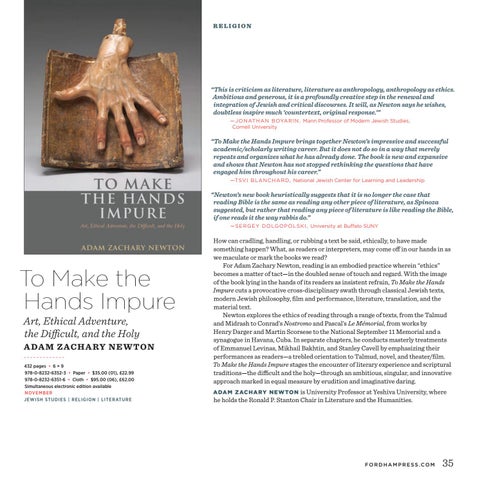
To Make the Hands Impure Art, Ethical Adventure, the Difficult, and the Holy
a da m zachary n ewton 432 pages • 6 × 9 978-0-8232-6352-3 • Paper • $35.00 (01), £22.99 978-0-8232-6351-6 • Cloth • $95.00 (06), £62.00 Simultaneous electronic edition available novEmbEr J EwiS H ST ud iE S | rE Ligion | LiTE rATurE
How can cradling, handling, or rubbing a text be said, ethically, to have made something happen? What, as readers or interpreters, may come off in our hands in as we maculate or mark the books we read? For Adam Zachary Newton, reading is an embodied practice wherein “ethics” becomes a matter of tact—in the doubled sense of touch and regard. With the image of the book lying in the hands of its readers as insistent refrain, To Make the Hands Impure cuts a provocative cross-disciplinary swath through classical Jewish texts, modern Jewish philosophy, film and performance, literature, translation, and the material text. Newton explores the ethics of reading through a range of texts, from the Talmud and Midrash to Conrad’s Nostromo and Pascal’s Le Mémorial, from works by Henry Darger and Martin Scorsese to the National September 11 Memorial and a synagogue in Havana, Cuba. In separate chapters, he conducts masterly treatments of Emmanuel Levinas, Mikhail Bakhtin, and Stanley Cavell by emphasizing their performances as readers—a trebled orientation to Talmud, novel, and theater/film. To Make the Hands Impure stages the encounter of literary experience and scriptural traditions—the difficult and the holy—through an ambitious, singular, and innovative approach marked in equal measure by erudition and imaginative daring. is University Professor at Yeshiva University, where he holds the Ronald P. Stanton Chair in Literature and the Humanities.
adam zachary ne wton
f o r d h a m p r e ss .co m
35