l i t e r at u r e
|
p o l i t i ca l t h e o ry
|
l aw
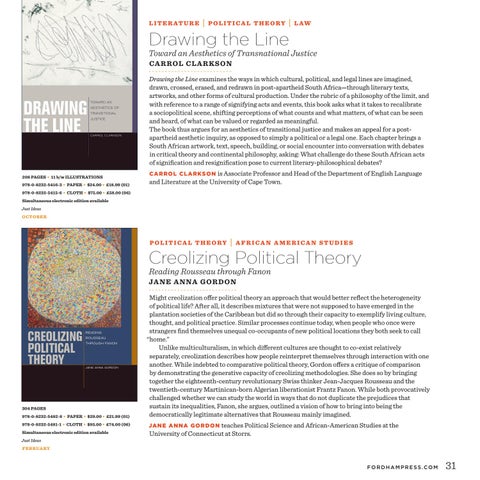
Drawing the Line
Toward an Aesthetics of Transnational Justice Ca r r o l C l a r ks o n
Drawing the Line examines the ways in which cultural, political, and legal lines are imagined, drawn, crossed, erased, and redrawn in post-apartheid South Africa—through literary texts, artworks, and other forms of cultural production. Under the rubric of a philosophy of the limit, and with reference to a range of signifying acts and events, this book asks what it takes to recalibrate a sociopolitical scene, shifting perceptions of what counts and what matters, of what can be seen and heard, of what can be valued or regarded as meaningful. The book thus argues for an aesthetics of transitional justice and makes an appeal for a postapartheid aesthetic inquiry, as opposed to simply a political or a legal one. Each chapter brings a South African artwork, text, speech, building, or social encounter into conversation with debates in critical theory and continental philosophy, asking: What challenge do these South African acts of signification and resignification pose to current literary-philosophical debates? 208 pages • 11 b/w illustrations 978-0-8232-5416-3 • Paper • $24.00 • £18.99 (01)
Ca r r ol Clar kson is Associate Professor and Head of the Department of English Language and Literature at the University of Cape Town.
978-0-8232-5415-6 • Cloth • $75.00 • £58.00 (06) Simultaneous electronic edition available Just Ideas Octo ber
p o l i t i ca l t h e o ry
|
african american studies
Creolizing Political Theory Reading Rousseau through Fanon Ja ne A nna Go rdon
304 pages 978-0-8232-5482-8 • Paper • $29.00 • £21.99 (01) 978-0-8232-5481-1 • Cloth • $95.00 • £74.00 (06) Simultaneous electronic edition available Just Ideas
Might creolization offer political theory an approach that would better reflect the heterogeneity of political life? After all, it describes mixtures that were not supposed to have emerged in the plantation societies of the Caribbean but did so through their capacity to exemplify living culture, thought, and political practice. Similar processes continue today, when people who once were strangers find themselves unequal co-occupants of new political locations they both seek to call “home.” Unlike multiculturalism, in which different cultures are thought to co-exist relatively separately, creolization describes how people reinterpret themselves through interaction with one another. While indebted to comparative political theory, Gordon offers a critique of comparison by demonstrating the generative capacity of creolizing methodologies. She does so by bringing together the eighteenth-century revolutionary Swiss thinker Jean-Jacques Rousseau and the twentieth-century Martinican-born Algerian liberationist Frantz Fanon. While both provocatively challenged whether we can study the world in ways that do not duplicate the prejudices that sustain its inequalities, Fanon, she argues, outlined a vision of how to bring into being the democratically legitimate alternatives that Rousseau mainly imagined. teaches Political Science and African-American Studies at the University of Connecticut at Storrs.
Ja ne Anna Gordon
F ebrua ry

f o r d h a m p r e ss .co m
31