photographers, 1840-1940; “Just Mud, Kershaw County, South Carolina Pottery to 1980” with Arthur Porter McLaurin, and in 1976 co-authored with Paul Jeter “Columbia’s Past in Glass.”
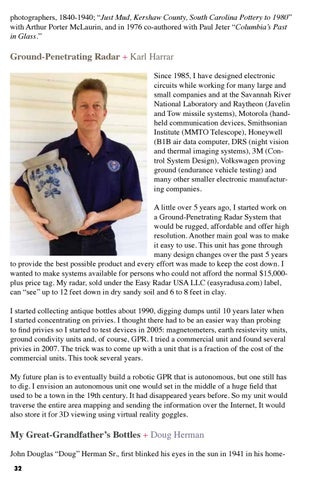
Ground-Penetrating Radar + Karl Harrar Since 1985, I have designed electronic circuits while working for many large and small companies and at the Savannah River National Laboratory and Raytheon (Javelin and Tow missile systems), Motorola (handheld communication devices, Smithsonian Institute (MMTO Telescope), Honeywell (B1B air data computer, DRS (night vision and thermal imaging systems), 3M (Control System Design), Volkswagen proving ground (endurance vehicle testing) and many other smaller electronic manufacturing companies. A little over 5 years ago, I started work on a Ground-Penetrating Radar System that would be rugged, affordable and offer high resolution. Another main goal was to make it easy to use. This unit has gone through many design changes over the past 5 years to provide the best possible product and every effort was made to keep the cost down. I wanted to make systems available for persons who could not afford the normal $15,000plus price tag. My radar, sold under the Easy Radar USA LLC (easyradusa.com) label, can “see” up to 12 feet down in dry sandy soil and 6 to 8 feet in clay. I started collecting antique bottles about 1990, digging dumps until 10 years later when I started concentrating on privies. I thought there had to be an easier way than probing to find privies so I started to test devices in 2005: magnetometers, earth resistevity units, ground condivity units and, of course, GPR. I tried a commercial unit and found several privies in 2007. The trick was to come up with a unit that is a fraction of the cost of the commercial units. This took several years. My future plan is to eventually build a robotic GPR that is autonomous, but one still has to dig. I envision an autonomous unit one would set in the middle of a huge field that used to be a town in the 19th century. It had disappeared years before. So my unit would traverse the entire area mapping and sending the information over the Internet, It would also store it for 3D viewing using virtual reality goggles.
My Great-Grandfather’s Bottles + Doug Herman John Douglas “Doug” Herman Sr., first blinked his eyes in the sun in 1941 in his home32