focusinterview. The Gottlieb House, Wood Marsh architects. Photo © Michael Wee.
The Marshall House, architect Bruce Rickard. Photograph © Michael Wee.
Karen McCartney. Photograph ©Hugh Stewart.
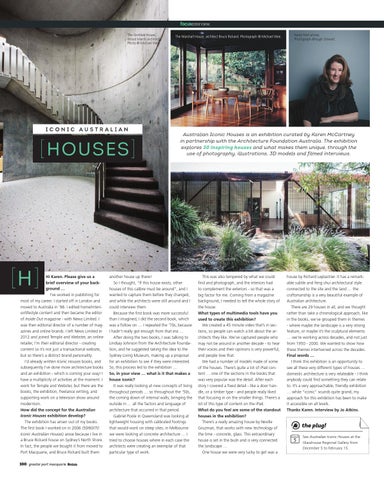
Australian Iconic Houses is an exhibition curated by Karen McCartney in partnership with the Architecture Foundation Australia. The exhibition explores 30 inspiring houses and what makes them unique, through the use of photography, illustrations, 3D models and filmed interviews.
The Kew House, architect Sean Godsell. Photograph © Michael Wee.
Hi Karen. Please give us a brief overview of your background … I’ve worked in publishing for most of my career. I started off in London and moved to Australia in ’98. I edited home/interior/lifestyle content and then became the editor of Inside Out magazine - with News Limited. I was then editorial director of a number of magazines and online brands. I left News Limited in 2012 and joined Temple and Webster, an online retailer, I’m their editorial director - creating content so it’s not just a transactional website, but so there’s a distinct brand personality. I’d already written Iconic Houses books, and subsequently I’ve done more architecture books and an exhibition - which is coming your way! I have a multiplicity of activities at the moment: I work for Temple and Webster, but there are the books, the exhibition, freelance writing, and supporting work on a television show around modernism. How did the concept for the Australian Iconic Houses exhibition develop? The exhibition has arisen out of my books. The first book I worked on in 2006 (50/60/70 Iconic Australian Houses) arose because I live in a Bruce Rickard house on Sydney’s North Shore. In fact, the people we bought it from moved to Port Macquarie, and Bruce Rickard built them 100 greater port macquarie focus.
another house up there! So I thought, “If this house exists, other houses of this calibre must be around”, and I wanted to capture them before they changed, and while the architects were still around and I could interview them. Because the first book was more successful than I imagined, I did the second book, which was a follow on … I repeated the ‘70s, because I hadn’t really got enough from that era … After doing the two books, I was talking to Lindsay Johnson from the Architecture Foundation, and he suggested taking the idea to the Sydney Living Museum, making up a proposal for an exhibition to see if they were interested. So, this process led to the exhibition … So, in your view … what is it that makes a house iconic? It was really looking at new concepts of living throughout periods … so throughout the ‘50s, the coming down of internal walls, bringing the outside in … all the factors and language of architecture that occurred in that period. Gabriel Poole in Queensland was looking at lightweight housing with calibrated footings that would work on steep sites; in Melbourne we were looking at concrete architecture … I tried to choose houses where in each case the architects were creating an exemplar of that particular type of work.
This was also tempered by what we could find and photograph, and the interiors had to complement the exteriors - so that was a big factor for me. Coming from a magazine background, I needed to tell the whole story of the house. What types of multimedia tools have you used to create this exhibition? We created a 45 minute video that’s in sections, so people can watch a bit about the architects they like. We’ve captured people who may not be around in another decade - to hear their voices and their opinions is very powerful, and people love that. We had a number of models made of some of the houses. There’s quite a lot of iPad content … one of the sections in the books that was very popular was the detail. After each story I covered a fixed detail - like a door handle, or a timber type - and people really liked that focusing in on the smaller things. There’s a lot of this type of content on the iPad. What do you feel are some of the standout houses in the exhibition? There’s a really amazing house by Neville Gruzman, that works with new technology of the time - concrete, glass. This extraordinary house is set in the bush and is very connected the landscape … One house we were very lucky to get was a
house by Richard Leplastrier. It has a remarkable subtle and feng shui architectural style connected to the site and the land … the craftsmanship is a very beautiful example of Australian architecture. There are 29 houses in all, and we thought rather than take a chronological approach, like in the books, we’ve grouped them in themes - where maybe the landscape is a very strong feature, or maybe it’s the sculptural elements … we’re working across decades, and not just from 1950 - 2000. We wanted to show how these themes intertwined across the decades. Final words … I think this exhibition is an opportunity to see all these very different types of houses … domestic architecture is very relateable - I think anybody could find something they can relate to. It’s a very approachable, friendly exhibition … while “iconic” sounds quite grand, my approach for this exhibition has been to make it accessible on all levels. Thanks Karen. Interview by Jo Atkins.
the plug! See Australian Iconic Houses at the Glasshouse Regional Gallery from December 5 to February 15.