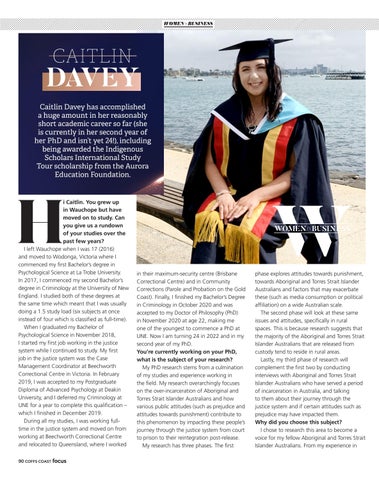
Caitlin Davey has accomplished a huge amount in her reasonably short academic career so far (she is currently in her second year of her PhD and isn’t yet 24!), including being awarded the Indigenous Scholars International Study Tour scholarship from the Aurora Education Foundation.
H
i Caitlin. You grew up in Wauchope but have moved on to study. Can you give us a rundown of your studies over the past few years? I left Wauchope when I was 17 (2016) and moved to Wodonga, Victoria where I commenced my first Bachelor’s degree in Psychological Science at La Trobe University. In 2017, I commenced my second Bachelor’s degree in Criminology at the University of New England. I studied both of these degrees at the same time which meant that I was usually doing a 1.5 study load (six subjects at once instead of four which is classified as full-time). When I graduated my Bachelor of Psychological Science in November 2018, I started my first job working in the justice system while I continued to study. My first job in the justice system was the Case Management Coordinator at Beechworth Correctional Centre in Victoria. In February 2019, I was accepted to my Postgraduate Diploma of Advanced Psychology at Deakin University, and I deferred my Criminology at UNE for a year to complete this qualification – which I finished in December 2019. During all my studies, I was working fulltime in the justice system and moved on from working at Beechworth Correctional Centre and relocated to Queensland, where I worked
90 COFFS COAST
focus
in their maximum-security centre (Brisbane Correctional Centre) and in Community Corrections (Parole and Probation on the Gold Coast). Finally, I finished my Bachelor’s Degree in Criminology in October 2020 and was accepted to my Doctor of Philosophy (PhD) in November 2020 at age 22, making me one of the youngest to commence a PhD at UNE. Now I am turning 24 in 2022 and in my second year of my PhD. You’re currently working on your PhD, what is the subject of your research? My PhD research stems from a culmination of my studies and experience working in the field. My research overarchingly focuses on the over-incarceration of Aboriginal and Torres Strait Islander Australians and how various public attitudes (such as prejudice and attitudes towards punishment) contribute to this phenomenon by impacting these people’s journey through the justice system from court to prison to their reintegration post-release. My research has three phases. The first
phase explores attitudes towards punishment, towards Aboriginal and Torres Strait Islander Australians and factors that may exacerbate these (such as media consumption or political affiliation) on a wide Australian scale. The second phase will look at these same issues and attitudes, specifically in rural spaces. This is because research suggests that the majority of the Aboriginal and Torres Strait Islander Australians that are released from custody tend to reside in rural areas. Lastly, my third phase of research will complement the first two by conducting interviews with Aboriginal and Torres Strait Islander Australians who have served a period of incarceration in Australia, and talking to them about their journey through the justice system and if certain attitudes such as prejudice may have impacted them. Why did you choose this subject? I chose to research this area to become a voice for my fellow Aboriginal and Torres Strait Islander Australians. From my experience in