David COOKE Dr.
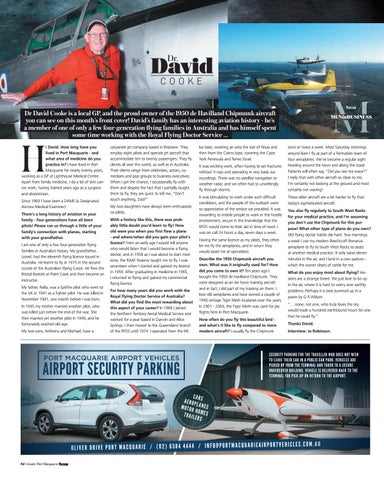
Dr David Cooke is a local GP, and the proud owner of the 1950 de Havilland Chipmunk aircraft you can see on this month’s front cover! David’s family has an interesting aviation history - he’s a member of one of only a few four-generation flying families in Australia and has himself spent some time working with the Royal Flying Doctor Service …
H
i David. How long have you lived in Port Macquarie - and what area of medicine do you practice in? I have lived in Port Macquarie for nearly twenty years, working as a GP at Lighthouse Medical Centre. Apart from family medicine, I do a lot of skin cancer work, having trained years ago as a surgeon and obstetrician. Since 1969 I have been a DAME (a Designated Aircrew Medical Examiner). There's a long history of aviation in your family - four generations have all been pilots! Please run us through a little of your family's connection with planes, starting with your grandfather. I am one of only a few four-generation flying families in Australia’s history. My grandfather, Lionel, had the eleventh flying licence issued in Australia. He learnt to fly in 1915 in the second course of the Australian Flying Corps. He flew the Bristol Boxkite at Point Cook and then became an instructor. My father, Rolla, was a Spitfire pilot who went to the UK in 1941 as a fighter pilot. He was killed in November 1941, one month before I was born. In 1945 my mother married another pilot, who was killed just before the end of the war. She then married yet another pilot in 1949, and he fortunately reached old age. My two sons, Anthony and Michael, have a
84 Greater Port Macquarie focus
corporate jet company based in Brisbane. They employ eight pilots and operate jet aircraft that accommodate ten to twenty passengers. They fly clients all over the world, as well as in Australia. Their clients range from celebrities, actors, comedians and pop groups to business executives. When I get the chance, I occasionally fly with them and despite the fact that I partially taught them to fly, they are quick to tell me, "Don’t touch anything, Dad!” My two daughters have always been enthusiastic co-pilots. With a history like this, there was probably little doubt you'd learn to fly! How old were you when you first flew a plane - and where/when did you gain your pilot's licence? From an early age I would tell anyone who would listen that I would become a flying doctor, and in 1958 as I was about to start medicine, the RAAF Reserve taught me to fly. I was seventeen when I started and gained my licence in 1959. After graduating in medicine in 1965, I returned to flying and gained my commercial flying licence. For how many years did you work with the Royal Flying Doctor Service of Australia? What did you find the most rewarding about this aspect of your career? In 1968 I joined the Northern Territory Aerial Medical Service and worked for a year based in Darwin and Alice Springs. I then moved to the Queensland branch of the RFDS until 1974. I operated from the Mt
Isa base, covering an area the size of Texas and then from the Cairns base, covering the Cape York Peninsula and Torres Strait. It was exciting work, often having to set fractures without X-rays and operating in very basic surroundings. There was no satellite navigation or weather radar, and we often had to unwittingly fly through storms. It was stimulating to work under such difficult conditions, and the people of the outback were so appreciative of the service we provided. It was rewarding to enable people to work in this hostile environment, secure in the knowledge that the RFDS would come to their aid in time of need. I was on call 24 hours a day, seven days a week. Having the same licence as my pilots, they often let me fly the aeroplanes, and in return they would assist me at operations. Describe the 1950 Chipmunk aircraft you own. What was it originally used for? How did you come to own it? Ten years ago I bought the 1950 de Havilland Chipmunk. They were designed as an Air Force training aircraft and in fact, I did part of my training on them. I love old aeroplanes and have owned a couple of 1940 vintage Tiger Moth bi-planes over the years. In 2001 - 2004, the Tiger Moth was used for joy flights here in Port Macquarie. How often do you fly this beautiful bird and what's it like to fly compared to more modern aircraft? I usually fly the Chipmunk
once or twice a week. Most Saturday mornings around 8am I fly as part of a formation team of four aeroplanes. We’ve become a regular sight heading around the town and along the coast. Patients will often say, “Did you see me wave?” I reply that with other aircraft so close to me, I’m certainly not looking at the ground and most certainly not waving! These older aircraft are a lot harder to fly than today’s sophisticated aircraft. You also fly regularly to South West Rocks for your medical practice, and I'm assuming you don't use the Chipmunk for this purpose! What other type of plane do you own? Old flying doctor habits die hard. Two mornings a week I use my modern Beechcraft Bonanza aeroplane to fly to South West Rocks to assist at another medical practice. It only takes eleven minutes in the air, and I land in a cow pasture which the owner clears of cattle for me. What do you enjoy most about flying? Aviators are a strange breed. We just love to be up in the air, where it is hard to worry over earthly problems. Perhaps it is best summed up in a poem by G R Wilson: “… none, not one, who truly loves the sky would trade a hundred earthbound hours for one that he could fly.” Thanks David. Interview: Jo Robinson.