focusinterview.
Warwick Barnes & Diane Kemp
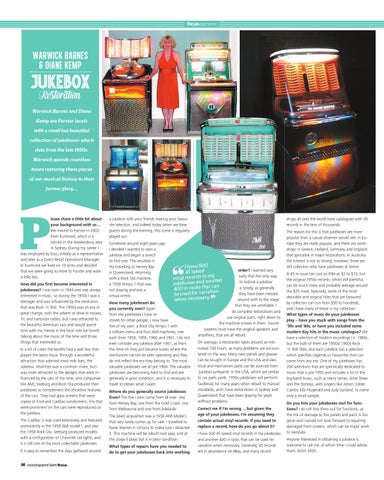
Jukebox Warwick Barnes and Diane Kemp are Forster locals with a small but beautiful collection of jukeboxes which date from the late 1950s. Warwick spends countless hours restoring these pieces of our musical history to their former glory ...
P
lease share a little bit about your background with us ... We moved to Forster in 2002 from Kurmond, which is a suburb in the Hawkesbury area in Sydney. During my career I was employed by Esso, initially as a representative and later as a Direct Retail Operations Manager. In Kurmond we lived on 10 acres and decided that we were going to retire to Forster and work a little less. How did you first become interested in jukeboxes? I was born in 1944 and was always interested in music, so during the 1950s I was a teenager and was influenced by the revolution that was Rock ‘n’ Roll. The 1950s was an era of great change, with the advent of drive in movies, TV, and transistor radios, but I was attracted to the beautiful American cars and would spend time with my friends in the local milk bar booth talking about the music of the time and those things that interested us. In a lot of cases the booths had a wall box that played the latest music through a wonderful attraction that adorned most milk bars, the Jukebox. Wurlitzer was a common make, but I was more attracted to the designs that were influenced by the cars of the time, and companies like AMI, Seeburg and Rock Ola produced their jukeboxes to complement the attractive features of the cars. They had glass screens that were copies of Ford and Cadillac windscreens; fins that were prominent on the cars were reproduced on the jukebox. The Cadillac V was used extensively and featured prominently in the 1958 AMI model I, and also the 1958 Rock Ola. Seeburg produced models with a configuration of Chevrolet tail lights, and it is still one of the most collectable jukeboxes. It is easy to remember the days gathered around
16 manning-great lakes focus.
shops all over the world have catalogues with 45 records in the tens of thousands.
a jukebox with your friends making your favourite selection, and indeed today when we have guests during the evening, this scene is regularly played out. Sometime around eight years ago I decided I wanted to own a jukebox and began a search to find one. This resulted in my travelling to Hervey Bay in Queensland, returning with a Rock Ola machine, a 1958 tempo 1 that was not playing and was a virtual wreck.
I have 500 45 speed my vinyl records in other an d an s xe jukebo at can 400 in rack s th ation ri be used for va ” y. ar ss when nece
“
How many jukeboxes do you currently own? Apart from the jukeboxes I have restored for other people, I now have five of my own: a Rock Ola tempo 1 with a rollover menu and four AMI machines, one each from 1958, 1959, 1960 and 1961. I do not even consider any jukebox after 1961, as from this time on they just became boxes where the mechanism cannot be seen operating and they do not reflect the era they belong to. The most valuable jukeboxes are all pre 1960. The valuable jukeboxes are becoming hard to find and are generally in poor condition, and it is necessary to travel to obtain what I want. Where do you generally source jukeboxes from? The five I own come from all over: one from Hervey Bay, one from the Gold Coast, one from Melbourne and one from Adelaide. The latest acquisition was a 1958 AMI Model I, that very rarely comes up for sale. I travelled to Narre Warren in Victoria to make sure I obtained it. This machine will be rebuilt next year, and at this stage it plays but is in poor condition. What types of repairs have you needed to do to get your jukeboxes back into working
order? I learned very early that the only way to restore a jukebox is totally, as generally they have been messed around with to the stage that they are unreliable. I do complete restorations and use original parts, right down to the machine screws in them. Sound systems must have the original speakers and amplifiers, that are all rebuilt. On average, a restoration takes around an estimated 700 hours, as many problems are encountered on the way. Many new panels and glasses can be bought in Europe and the USA and electrical and mechanism parts can be sourced from ‘jukebox junkyards’ in the USA, which are similar to car parts yards. 1950s jukeboxes will perform faultlessly for many years when rebuilt to manual standards, and I have restorations in Sydney and Queensland that have been playing for years without problems. Correct me if I’m wrong ... but given the age of your jukeboxes, I’m assuming they contain actual vinyl records. If you need to replace a record, how do you go about it? I have 500 45 speed vinyl records in my jukeboxes and another 400 in racks that can be used for variation when necessary. Generally, 45 records are in abundance on eBay, and many record
The reason for this is that jukeboxes are more popular than a casual observer would see; in Europe they are really popular, and there are workshops in Greece, Holland, Germany and England that specialise in major restorations. In Australia the interest is not as strong; however, there are still collectors who have jukeboxes at home. A 45 re issue can cost as little as $2 to $10, but the original 1950s records, whilst still plentiful, can be much more and probably average around the $25 mark. Naturally, some of the most desirable and original titles that are favoured by collectors can run from $50 to hundreds, and I have many of these in my collection. What types of music do your jukeboxes play – have you stuck with songs from the ‘50s and ‘60s, or have you included some modern day hits in the music catalogue? We have a selection of modern recordings i.e. 1980s, but the bulk of them are 1950s/ 1960s Rock ‘n’ Roll titles, but each jukebox has a selection which specifies Legends or Favourites that can come from any era. One of my jukeboxes has 200 selections that are specifically dedicated to music that is pre 1955 and includes a lot of the big band music, such as Harry James, Artie Shaw and the Dorseys, with singers like Jolson, Eddie Cantor, Ella Fitzgerald and Judy Garland, to name only a small sample. Do you hire your jukeboxes oiut for functions? I do not hire them out for functions, as the risk of damage to the panels and paint is too great and I would not look forward to repairing damaged front screens, which can be major work to reinstate. Anyone interested in obtaining a jukebox is welcome to call me, at which time I could advise them: 6555 3305.