foam magazine # 25 traces
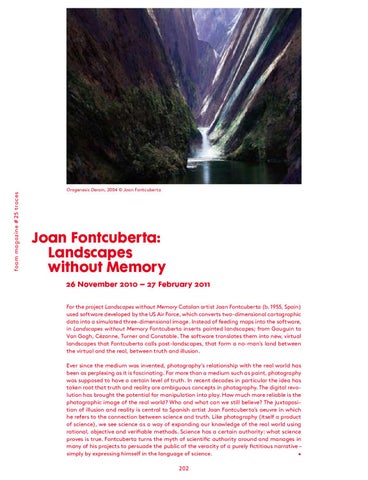
Orogenesis Derain, 2004 © Joan Fontcuberta
Joan Fontcuberta: Landscapes without Memory
�� November ���� – �� February ���� For the project Landscapes without Memory Catalan artist Joan Fontcuberta (b. 1955, Spain) used software developed by the US Air Force, which converts two-dimensional cartographic data into a simulated three-dimensional image. Instead of feeding maps into the software, in Landscapes without Memory Fontcuberta inserts painted landscapes; from Gauguin to Van Gogh, Cézanne, Turner and Constable. The software translates them into new, virtual landscapes that Fontcuberta calls post-landscapes, that form a no-man’s land between the virtual and the real, between truth and illusion. Ever since the medium was invented, photography’s relationship with the real world has been as perplexing as it is fascinating. Far more than a medium such as paint, photography was supposed to have a certain level of truth. In recent decades in particular the idea has taken root that truth and reality are ambiguous concepts in photography. The digital revolution has brought the potential for manipulation into play. How much more reliable is the photographic image of the real world? Who and what can we still believe? The juxtaposition of illusion and reality is central to Spanish artist Joan Fontcuberta’s oeuvre in which he refers to the connection between science and truth. Like photography (itself a product of science), we see science as a way of expanding our knowledge of the real world using rational, objective and verifiable methods. Science has a certain authority: what science proves is true. Fontcuberta turns the myth of scientific authority around and manages in many of his projects to persuade the public of the veracity of a purely fictitious narrative – simply by expressing himself in the language of science. • 202