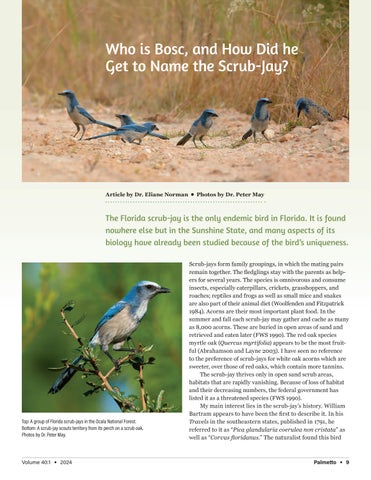
Who is Bosc, and How Did he Get to Name the Scrub-Jay?
Article by Dr. Eliane Norman l Photos by Dr. Peter May
The Florida scrub-jay is the only endemic bird in Florida. It is found nowhere else but in the Sunshine State, and many aspects of its biology have already been studied because of the bird’s uniqueness.
¥
●
Scrub-jays form family groupings, in which the mating pairs remain together. The fledglings stay with the parents as helpers for several years. The species is omnivorous and consume insects, especially caterpillars, crickets, grasshoppers, and roaches; reptiles and frogs as well as small mice and snakes are also part of their animal diet (Woolfenden and Fitzpatrick 1984). Acorns are their most important plant food. In the summer and fall each scrub-jay may gather and cache as many as 8,000 acorns. These are buried in open areas of sand and retrieved and eaten later (FWS 1990). The red oak species myrtle oak (Quercus myrtifolia) appears to be the most fruitful (Abrahamson and Layne 2003). I have seen no reference to the preference of scrub-jays for white oak acorns which are sweeter, over those of red oaks, which contain more tannins. The scrub-jay thrives only in open sand scrub areas, habitats that are rapidly vanishing. Because of loss of habitat and their decreasing numbers, the federal government has listed it as a threatened species (FWS 1990). My main interest lies in the scrub-jay’s history. William Bartram appears to have been the first to describe it. In his Travels in the southeastern states, published in 1791, he referred to it as “Pica glandularia coerulea non cristata” as well as “Corvus floridanus.” The naturalist found this bird
●