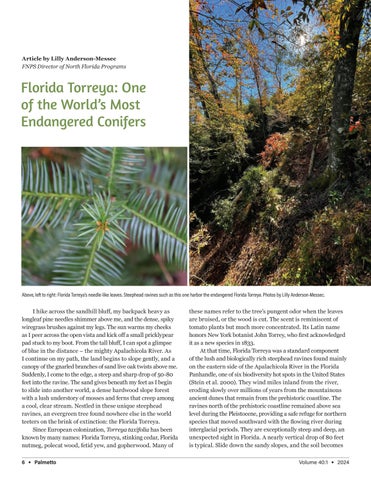
Article by Lilly Anderson-Messec FNPS Director of North Florida Programs
Florida Torreya: One of the World’s Most Endangered Conifers
I hike across the sandhill bluff, my backpack heavy as longleaf pine needles shimmer above me, and the dense, spiky wiregrass brushes against my legs. The sun warms my cheeks as I peer across the open vista and kick off a small pricklypear pad stuck to my boot. From the tall bluff, I can spot a glimpse of blue in the distance – the mighty Apalachicola River. As I continue on my path, the land begins to slope gently, and a canopy of the gnarled branches of sand live oak twists above me. Suddenly, I come to the edge, a steep and sharp drop of 50-80 feet into the ravine. The sand gives beneath my feet as I begin to slide into another world, a dense hardwood slope forest with a lush understory of mosses and ferns that creep among a cool, clear stream. Nestled in these unique steephead ravines, an evergreen tree found nowhere else in the world teeters on the brink of extinction: the Florida Torreya. Since European colonization, Torreya taxifolia has been known by many names: Florida Torreya, stinking cedar, Florida nutmeg, polecat wood, fetid yew, and gopherwood. Many of ●
these names refer to the tree’s pungent odor when the leaves are bruised, or the wood is cut. The scent is reminiscent of tomato plants but much more concentrated. Its Latin name honors New York botanist John Torrey, who first acknowledged it as a new species in 1833. At that time, Florida Torreya was a standard component of the lush and biologically rich steephead ravines found mainly on the eastern side of the Apalachicola River in the Florida Panhandle, one of six biodiversity hot spots in the United States (Stein et al. 2000). They wind miles inland from the river, eroding slowly over millions of years from the mountainous ancient dunes that remain from the prehistoric coastline. The ravines north of the prehistoric coastline remained above sea level during the Pleistocene, providing a safe refuge for northern species that moved southward with the flowing river during interglacial periods. They are exceptionally steep and deep, an unexpected sight in Florida. A nearly vertical drop of 80 feet is typical. Slide down the sandy slopes, and the soil becomes ●