Article by Dr. Jason Ferrell and Christine Krebs UF/IFAS Center for Aquatic and Invasive Plants
Changing Florida Forever: The Story of Two Invasive Aquatic Plants Article and photos by Roger L. Hammer
As members of the Florida Native Plant Society, you’ve probably heard the word “invasive” a lot. This is because there are a variety of invasive plants that have changed Florida forever. You are very aware of silktree or mimosa (Albizia julibrissin) with those eye-catching flowers and coral ardisia (Ardisia crenata) with bright red berries. But what about plants that float on our waterways and thrive below the surface? There are several aquatic plants that have had a tremendous impact on our precious waterways. We’d like to share two examples, water hyacinth and hydrilla. Neither of these plants are new and both will continue to plague our state for years to come. Water hyacinth (Eichhornia crassipes) In 1884, New Orleans hosted the World Cotton Centennial Exposition with exhibits highlighting the advancements in
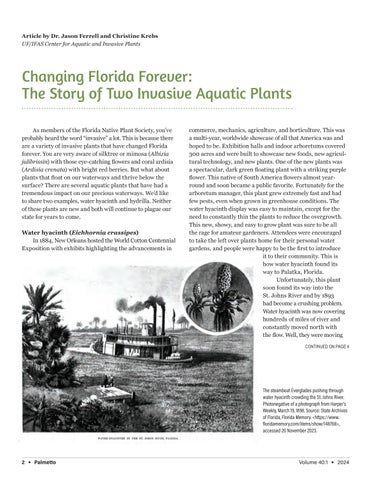
commerce, mechanics, agriculture, and horticulture. This was a multi-year, worldwide showcase of all that America was and hoped to be. Exhibition halls and indoor arboretums covered 300 acres and were built to showcase new foods, new agricultural technology, and new plants. One of the new plants was a spectacular, dark green floating plant with a striking purple flower. This native of South America flowers almost yearround and soon became a public favorite. Fortunately for the arboretum manager, this plant grew extremely fast and had few pests, even when grown in greenhouse conditions. The water hyacinth display was easy to maintain, except for the need to constantly thin the plants to reduce the overgrowth. This new, showy, and easy to grow plant was sure to be all the rage for amateur gardeners. Attendees were encouraged to take the left over plants home for their personal water gardens, and people were happy to be the first to introduce it to their community. This is how water hyacinth found its way to Palatka, Florida. Unfortunately, this plant soon found its way into the St. Johns River and by 1893 had become a crushing problem. Water hyacinth was now covering hundreds of miles of river and constantly moved north with the flow. Well, they were moving CONTINUED ON PAGE 4
●
●