Article by Jerald Pinson. Photos by Floyd Griffith.
Florida Mints Radiated as Peninsula Sank and Resurfaced During Ice Ages
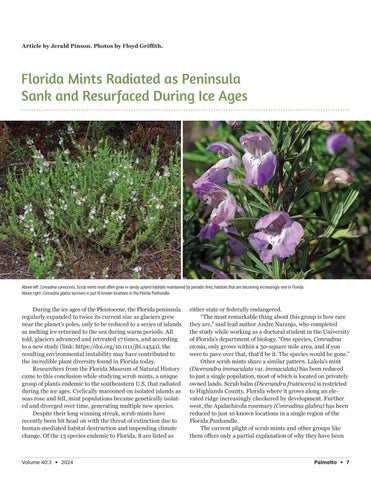
Above left: Conradina canescens. Scrub mints most often grow in sandy upland habitats maintained by periodic fires, habitats that are becoming increasingly rare in Florida. Above right: Conradina glabra survives in just 10 known locations in the Florida Panhandle.
During the ice ages of the Pleistocene, the Florida peninsula regularly expanded to twice its current size as glaciers grew near the planet’s poles, only to be reduced to a series of islands as melting ice returned to the sea during warm periods. All told, glaciers advanced and retreated 17 times, and according to a new study (link: https://doi.org/10.1111/jbi.14541), the resulting environmental instability may have contributed to the incredible plant diversity found in Florida today. Researchers from the Florida Museum of Natural History came to this conclusion while studying scrub mints, a unique group of plants endemic to the southeastern U.S. that radiated during the ice ages. Cyclically marooned on isolated islands as seas rose and fell, mint populations became genetically isolated and diverged over time, generating multiple new species. Despite their long winning streak, scrub mints have recently been hit head on with the threat of extinction due to human-mediated habitat destruction and impending climate change. Of the 13 species endemic to Florida, 8 are listed as
Volume 40:3 ● 2024
either state or federally endangered. “The most remarkable thing about this group is how rare they are,” said lead author Andre Naranjo, who completed the study while working as a doctoral student in the University of Florida’s department of biology. “One species, Conradina etonia, only grows within a 30-square mile area, and if you were to pave over that, that’d be it. The species would be gone.” Other scrub mints share a similar pattern. Lakela’s mint (Dicerandra immaculata var. immaculata) has been reduced to just a single population, most of which is located on privately owned lands. Scrub balm (Dicerandra frutescens) is restricted to Highlands County, Florida where it grows along an elevated ridge increasingly checkered by development. Further west, the Apalachicola rosemary (Conradina glabra) has been reduced to just 10 known locations in a single region of the Florida Panhandle. The current plight of scrub mints and other groups like them offers only a partial explanation of why they have been
Palmetto ● 7