Article by Ann Dang and Spencer Bennett Photos by Ann Dang
Rooted in Heritage: Restoring Spaces With Native Flora Home of the Tarflower Chapter, Mead Botanical Garden is a 48-acre urban oasis situated in Winter Park, Florida. The Garden was established in 1940 in honor of Theodore Luqueer Mead, a renowned American naturalist, entomologist and horticulturalist. Mead dedicated much of his work to the research of orchids and other plants and upon his passing, one of Mead’s inheritors worked with Rollins College to acquire property to safely house Mead’s prized collection, and dedicate a place in his memory.
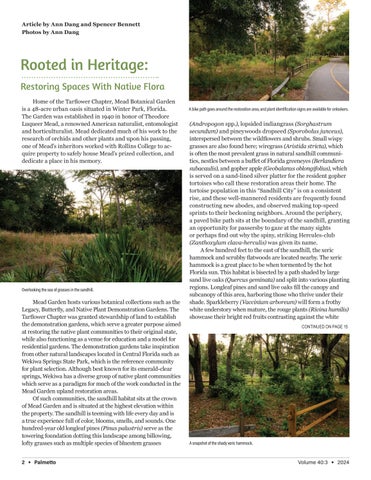
Overlooking the sea of grasses in the sandhill.
Mead Garden hosts various botanical collections such as the Legacy, Butterfly, and Native Plant Demonstration Gardens. The Tarflower Chapter was granted stewardship of land to establish the demonstration gardens, which serve a greater purpose aimed at restoring the native plant communities to their original state, while also functioning as a venue for education and a model for residential gardens. The demonstration gardens take inspiration from other natural landscapes located in Central Florida such as Wekiwa Springs State Park, which is the reference community for plant selection. Although best known for its emerald-clear springs, Wekiwa has a diverse group of native plant communities which serve as a paradigm for much of the work conducted in the Mead Garden upland restoration areas. Of such communities, the sandhill habitat sits at the crown of Mead Garden and is situated at the highest elevation within the property. The sandhill is teeming with life every day and is a true experience full of color, blooms, smells, and sounds. One hundred-year old longleaf pines (Pinus palustris) serve as the towering foundation dotting this landscape among billowing, lofty grasses such as multiple species of bluestem grasses 2 ● Palmetto
A bike path goes around the restoration area, and plant identification signs are available for onlookers.
(Andropogon spp.), lopsided indiangrass (Sorghastrum secundum) and pineywoods dropseed (Sporobolus junceus), interspersed between the wildflowers and shrubs. Small wispy grasses are also found here; wiregrass (Aristida stricta), which is often the most prevalent grass in natural sandhill communities, nestles between a buffet of Florida greeneyes (Berlandiera subacaulis), and gopher apple (Geobalanus oblongifolius), which is served on a sand-lined silver platter for the resident gopher tortoises who call these restoration areas their home. The tortoise population in this “Sandhill City” is on a consistent rise, and these well-mannered residents are frequently found constructing new abodes, and observed making top-speed sprints to their beckoning neighbors. Around the periphery, a paved bike path sits at the boundary of the sandhill, granting an opportunity for passersby to gaze at the many sights or perhaps find out why the spiny, striking Hercules-club (Zanthoxylum clava-herculis) was given its name. A few hundred feet to the east of the sandhill, the xeric hammock and scrubby flatwoods are located nearby. The xeric hammock is a great place to be when tormented by the hot Florida sun. This habitat is bisected by a path shaded by large sand live oaks (Quercus geminata) and split into various planting regions. Longleaf pines and sand live oaks fill the canopy and subcanopy of this area, harboring those who thrive under their shade. Sparkleberry (Vaccinium arboreum) will form a frothy white understory when mature, the rouge plants (Rivina humilis) showcase their bright red fruits contrasting against the white CONTINUED ON PAGE 15
A snapshot of the shady xeric hammock.
Volume 40:3 ● 2024