(Jacquinia keyensis), and Key thatch palm (Thrinax morrisii). Together, over fifty different species contribute layers of biodiversity, creating vital habitats for local wildlife. The ecological benefits have been remarkable. During a recent garden tour, a local resident commented on the abundance of birdlife, describing it as “unlike anything seen before in Coconut Grove.” This thriving wildlife habitat has become a model for other residents, inspiring them to consider similar restorations on their properties.
Advice for Aspiring Native Plant Gardeners For those new to native landscaping, the property owner emphasizes the importance of investing time, resources and selecting knowledgeable advisors. They advocate for moving beyond partial solutions: “A 100% native landscape is the most practical contribution a Floridian can make to support their community and the environment.” With future plans to add stone structures for visitors to enjoy the surrounding wildlife, the restoration continues. Once
neglected, the property has transformed into a peaceful space for contemplating the beauty of Florida’s native flora and fauna—a project that stands as a testament to the power of ecological landscaping. About the Author Natalia Manrique is Chair of the FNPS Landscape Committee and co-owner of NaMa Native Landscapes and Flora of Miami. Natalia has dedicated her career to promoting sustainable landscaping practices, with a special focus on Florida’s native plants. As an advocate for biodiversity and environmental stewardship, she celebrates the visionaries who lead the way in creating landscapes that honor Florida’s unique ecosystems.
Polyphemus Moth Host Plant Results By Marc Minno
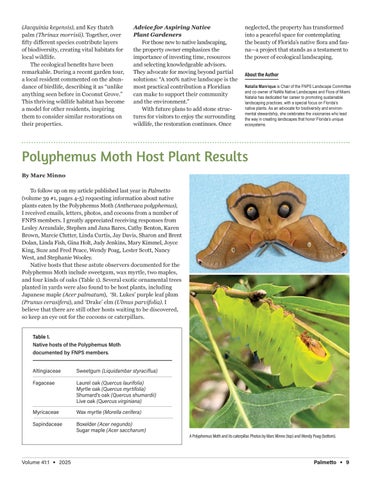
To follow up on my article published last year in Palmetto (volume 39 #1, pages 4-5) requesting information about native plants eaten by the Polyphemus Moth (Antheraea polyphemus), I received emails, letters, photos, and cocoons from a number of FNPS members. I greatly appreciated receiving responses from Lesley Arrandale, Stephen and Jana Bares, Cathy Benton, Karen Brown, Marcie Clutter, Linda Curtis, Jay Davis, Sharon and Brent Dolan, Linda Fish, Gina Holt, Judy Jenkins, Mary Kimmel, Joyce King, Suze and Fred Peace, Wendy Poag, Lester Scott, Nancy West, and Stephanie Wooley. Native hosts that these astute observers documented for the Polyphemus Moth include sweetgum, wax myrtle, two maples, and four kinds of oaks (Table 1). Several exotic ornamental trees planted in yards were also found to be host plants, including Japanese maple (Acer palmatum), ‘St. Lukes’ purple leaf plum (Prunus cerasifera), and ‘Drake’ elm (Ulmus parvifolia). I believe that there are still other hosts waiting to be discovered, so keep an eye out for the cocoons or caterpillars. Table 1. Native hosts of the Polyphemus Moth documented by FNPS members. Altingiaceae
Sweetgum (Liquidambar styraciflua)
Fagaceae
Laurel oak (Quercus laurifolia) Myrtle oak (Quercus myrtifolia) Shumard’s oak (Quercus shumardii) Live oak (Quercus virginiana)
Myricaceae
Wax myrtle (Morella cerifera)
Sapindaceae
Boxelder (Acer negundo) Sugar maple (Acer saccharum)
Volume 41:1 ● 2025
A Polyphemus Moth and its caterpillar. Photos by Marc Minno (top) and Wendy Poag (bottom).
Palmetto ● 9