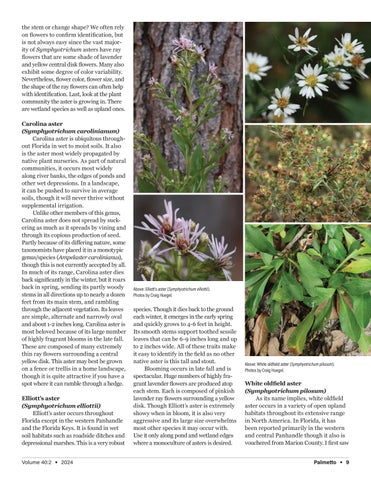
the stem or change shape? We often rely on flowers to confirm identification, but is not always easy since the vast majority of Symphyotrichum asters have ray flowers that are some shade of lavender and yellow central disk flowers. Many also exhibit some degree of color variability. Nevertheless, flower color, flower size, and the shape of the ray flowers can often help with identification. Last, look at the plant community the aster is growing in. There are wetland species as well as upland ones. Carolina aster (Symphyotrichum carolinianum) Carolina aster is ubiquitous throughout Florida in wet to moist soils. It also is the aster most widely propagated by native plant nurseries. As part of natural communities, it occurs most widely along river banks, the edges of ponds and other wet depressions. In a landscape, it can be pushed to survive in average soils, though it will never thrive without supplemental irrigation. Unlike other members of this genus, Carolina aster does not spread by suckering as much as it spreads by vining and through its copious production of seed. Partly because of its differing nature, some taxonomists have placed it in a monotypic genus/species (Ampelaster carolinianus), though this is not currently accepted by all. In much of its range, Carolina aster dies back significantly in the winter, but it roars back in spring, sending its partly woody stems in all directions up to nearly a dozen feet from its main stem, and rambling through the adjacent vegetation. Its leaves are simple, alternate and narrowly oval and about 1-2 inches long. Carolina aster is most beloved because of its large number of highly fragrant blooms in the late fall. These are composed of many extremely thin ray flowers surrounding a central yellow disk. This aster may best be grown on a fence or trellis in a home landscape, though it is quite attractive if you have a spot where it can ramble through a hedge. Elliott’s aster (Symphyotrichum elliottii) Elliott’s aster occurs throughout Florida except in the western Panhandle and the Florida Keys. It is found in wet soil habitats such as roadside ditches and depressional marshes. This is a very robust ●
PALM 40_2 FO Single.indd 9
species. Though it dies back to the ground each winter, it emerges in the early spring and quickly grows to 4-6 feet in height. Its smooth stems support toothed sessile leaves that can be 6-9 inches long and up to 2 inches wide. All of these traits make it easy to identify in the field as no other native aster is this tall and stout. Blooming occurs in late fall and is spectacular. Huge numbers of highly fragrant lavender flowers are produced atop each stem. Each is composed of pinkish lavender ray flowers surrounding a yellow disk. Though Elliott’s aster is extremely showy when in bloom, it is also very aggressive and its large size overwhelms most other species it may occur with. Use it only along pond and wetland edges where a monoculture of asters is desired.
White oldfield aster (Symphyotrichum pilosum) As its name implies, white oldfield aster occurs in a variety of open upland habitats throughout its extensive range in North America. In Florida, it has been reported primarily in the western and central Panhandle though it also is vouchered from Marion County. I first saw ●
7/15/24 9:20 AM