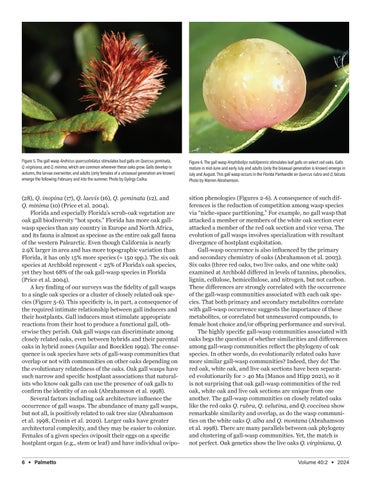
(28), Q. inopina (17), Q. laevis (16), Q. geminata (12), and Q. minima (10) (Price et al. 2004). Florida and especially Florida’s scrub-oak vegetation are oak gall biodiversity “hot spots.” Florida has more oak gallwasp species than any country in Europe and North Africa, and its fauna is almost as speciose as the entire oak gall fauna of the western Palearctic. Even though California is nearly 2.9X larger in area and has more topographic variation than Florida, it has only 15% more species (≈ 150 spp.). The six oak species at Archbold represent < 25% of Florida’s oak species, yet they host 68% of the oak gall-wasp species in Florida (Price et al. 2004). A key finding of our surveys was the fidelity of gall wasps to a single oak species or a cluster of closely related oak species (Figure 5-6). This specificity is, in part, a consequence of the required intimate relationship between gall inducers and their hostplants. Gall inducers must stimulate appropriate reactions from their host to produce a functional gall, otherwise they perish. Oak gall wasps can discriminate among closely related oaks, even between hybrids and their parental oaks in hybrid zones (Aquilar and Boecklen 1992). The consequence is oak species have sets of gall-wasp communities that overlap or not with communities on other oaks depending on the evolutionary relatedness of the oaks. Oak gall wasps have such narrow and specific hostplant associations that naturalists who know oak galls can use the presence of oak galls to confirm the identity of an oak (Abrahamson et al. 1998). Several factors including oak architecture influence the occurrence of gall wasps. The abundance of many gall wasps, but not all, is positively related to oak tree size (Abrahamson et al. 1998, Cronin et al. 2020). Larger oaks have greater architectural complexity, and they may be easier to colonize. Females of a given species oviposit their eggs on a specific hostplant organ (e.g., stem or leaf) and have individual ovipo-
sition phenologies (Figures 2-6). A consequence of such differences is the reduction of competition among wasp species via “niche-space partitioning.” For example, no gall wasp that attacked a member or members of the white oak section ever attacked a member of the red oak section and vice versa. The evolution of gall wasps involves specialization with resultant divergence of hostplant exploitation. Gall-wasp occurrence is also influenced by the primary and secondary chemistry of oaks (Abrahamson et al. 2003). Six oaks (three red oaks, two live oaks, and one white oak) examined at Archbold differed in levels of tannins, phenolics, lignin, cellulose, hemicellulose, and nitrogen, but not carbon. These differences are strongly correlated with the occurrence of the gall-wasp communities associated with each oak species. That both primary and secondary metabolites correlate with gall-wasp occurrence suggests the importance of these metabolites, or correlated but unmeasured compounds, to female host choice and/or offspring performance and survival. The highly specific gall-wasp communities associated with oaks begs the question of whether similarities and differences among gall-wasp communities reflect the phylogeny of oak species. In other words, do evolutionarily related oaks have more similar gall-wasp communities? Indeed, they do! The red oak, white oak, and live oak sections have been separated evolutionarily for > 40 Ma (Manos and Hipp 2021), so it is not surprising that oak gall-wasp communities of the red oak, white oak and live oak sections are unique from one another. The gall-wasp communities on closely related oaks like the red oaks Q. rubra, Q. velutina, and Q. coccinea show remarkable similarity and overlap, as do the wasp communities on the white oaks Q. alba and Q. montana (Abrahamson et al. 1998). There are many parallels between oak phylogeny and clustering of gall-wasp communities. Yet, the match is not perfect. Oak genetics show the live oaks Q. virginiana, Q.
●
PALM 40_2 FO Single.indd 6
●
7/15/24 9:20 AM