Article and photos by Roger L. Hammer
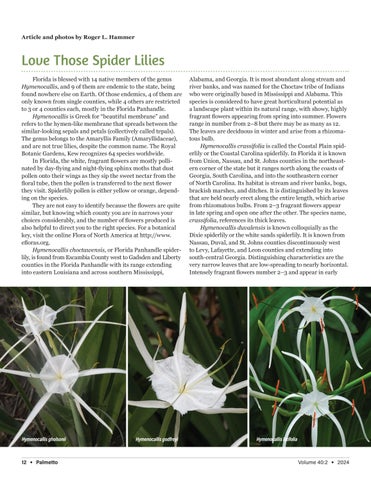
Love Those Spider Lilies Florida is blessed with 14 native members of the genus Hymenocallis, and 9 of them are endemic to the state, being found nowhere else on Earth. Of those endemics, 4 of them are only known from single counties, while 4 others are restricted to 3 or 4 counties each, mostly in the Florida Panhandle. Hymenocallis is Greek for “beautiful membrane” and refers to the hymen-like membrane that spreads between the similar-looking sepals and petals (collectively called tepals). The genus belongs to the Amaryllis Family (Amaryllidaceae), and are not true lilies, despite the common name. The Royal Botanic Gardens, Kew recognizes 64 species worldwide. In Florida, the white, fragrant flowers are mostly pollinated by day-flying and night-flying sphinx moths that dust pollen onto their wings as they sip the sweet nectar from the floral tube, then the pollen is transferred to the next flower they visit. Spiderlily pollen is either yellow or orange, depending on the species. They are not easy to identify because the flowers are quite similar, but knowing which county you are in narrows your choices considerably, and the number of flowers produced is also helpful to direct you to the right species. For a botanical key, visit the online Flora of North America at http://www. efloras.org. Hymenocallis choctawensis, or Florida Panhandle spiderlily, is found from Escambia County west to Gadsden and Liberty counties in the Florida Panhandle with its range extending into eastern Louisiana and across southern Mississippi,
●
PALM 40_2 FO Single.indd 12
Alabama, and Georgia. It is most abundant along stream and river banks, and was named for the Choctaw tribe of Indians who were originally based in Mississippi and Alabama. This species is considered to have great horticultural potential as a landscape plant within its natural range, with showy, highly fragrant flowers appearing from spring into summer. Flowers range in number from 2–8 but there may be as many as 12. The leaves are deciduous in winter and arise from a rhizomatous bulb. Hymenocallis crassifolia is called the Coastal Plain spiderlily or the Coastal Carolina spiderlily. In Florida it is known from Union, Nassau, and St. Johns counties in the northeastern corner of the state but it ranges north along the coasts of Georgia, South Carolina, and into the southeastern corner of North Carolina. Its habitat is stream and river banks, bogs, brackish marshes, and ditches. It is distinguished by its leaves that are held nearly erect along the entire length, which arise from rhizomatous bulbs. From 2–3 fragrant flowers appear in late spring and open one after the other. The species name, crassifolia, references its thick leaves. Hymenocallis duvalensis is known colloquially as the Dixie spiderlily or the white sands spiderlily. It is known from Nassau, Duval, and St. Johns counties discontinuously west to Levy, Lafayette, and Leon counties and extending into south-central Georgia. Distinguishing characteristics are the very narrow leaves that are low-spreading to nearly horizontal. Intensely fragrant flowers number 2–3 and appear in early
●
7/15/24 9:20 AM