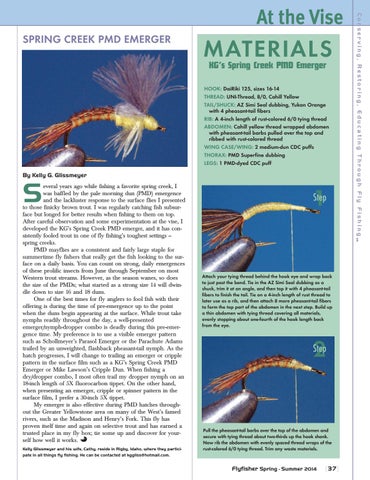
SPRING CREEK PMD EMERGER
MATERIALS KG’s Spring Creek PMD Emerger HOOK: DaiRiki 125, sizes 16-14 THREAD: UNI-Thread, 8/0, Cahill Yellow TAIL/SHUCK: AZ Simi Seal dubbing, Yukon Orange with 4 pheasant-tail fibers RIB: A 4-inch length of rust-colored 6/0 tying thread ABDOMEN: Cahill yellow thread wrapped abdomen with pheasant-tail barbs pulled over the top and ribbed with rust-colored thread WING CASE/WING: 2 medium-dun CDC puffs THORAX: PMD Superfine dubbing LEGS: 1 PMD-dyed CDC puff
By Kelly G. Glissmeyer
S
everal years ago while fishing a favorite spring creek, I was baffled by the pale morning dun (PMD) emergence and the lackluster response to the surface flies I presented to those finicky brown trout. I was regularly catching fish subsurface but longed for better results when fishing to them on top. After careful observation and some experimentation at the vise, I developed the KG’s Spring Creek PMD emerger, and it has consistently fooled trout in one of fly fishing’s toughest settings – spring creeks. PMD mayflies are a consistent and fairly large staple for summertime fly fishers that really get the fish looking to the surface on a daily basis. You can count on strong, daily emergences of these prolific insects from June through September on most Western trout streams. However, as the season wanes, so does the size of the PMDs; what started as a strong size 14 will dwindle down to size 16 and 18 duns. One of the best times for fly anglers to fool fish with their offering is during the time of pre-emergence up to the point when the duns begin appearing at the surface. While trout take nymphs readily throughout the day, a well-presented emerger/nymph-dropper combo is deadly during this pre-emergence time. My preference is to use a visible emerger pattern such as Schollmeyer’s Parasol Emerger or the Parachute Adams trailed by an unweighted, flashback pheasant-tail nymph. As the hatch progresses, I will change to trailing an emerger or cripple pattern in the surface film such as a KG’s Spring Creek PMD Emerger or Mike Lawson’s Cripple Dun. When fishing a dry/dropper combo, I most often trail my dropper nymph on an 18-inch length of 5X fluorocarbon tippet. On the other hand, when presenting an emerger, cripple or spinner pattern in the surface film, I prefer a 30-inch 5X tippet. My emerger is also effective during PMD hatches throughout the Greater Yellowstone area on many of the West’s famed rivers, such as the Madison and Henry’s Fork. This fly has proven itself time and again on selective trout and has earned a trusted place in my fly box; tie some up and discover for yourself how well it works. Kelly Glissmeyer and his wife, Cathy, reside in Rigby, Idaho, where they participate in all things fly fishing. He can be contacted at kggliss@hotmail.com.
1
Step
Attach your tying thread behind the hook eye and wrap back to just past the bend. Tie in the AZ Simi Seal dubbing as a shuck, trim it at an angle, and then top it with 4 pheasant-tail fibers to finish the tail. Tie on a 4-inch length of rust thread to later use as a rib, and then attach 8 more pheasant-tail fibers to form the top part of the abdomen in the next step. Build up a thin abdomen with tying thread covering all materials, evenly stopping about one-fourth of the hook length back from the eye.
2
Step
Pull the pheasant-tail barbs over the top of the abdomen and secure with tying thread about two-thirds up the hook shank. Now rib the abdomen with evenly spaced thread wraps of the rust-colored 6/0 tying thread. Trim any waste materials.
Flyfisher Spring - Summer 2014
[37]
C o n s e r v i n g , R e s t o r i n g , E d u c a t i n g T h r o u g h F l y F i s h i n g sm
At the Vise