COLORBEARER OF ATHENS LEAVING NOTHING TO CHANCE
LOCALLY OWNED SINCE 1987
Hope for Kids
Will Every Child in ACC Get a Post-Secondary Education? p. 8
JULY 21, 2010 · VOL. 24 · NO. 29 · FREE
Slopfest
Two Nights and a Whole Mess of Punk Rock p. 13
Despy Tribute p. 3 · The Spooks p. 14 · Darius Goes West Day p. 16 · Yo Soybean p. 19
They have the Amy just got her license and drove through the back of the garage so Dad decided to keep an eye on her policy. AUTO INSURANCE TEEN SAFE DRIVER SM PROGRAM GOLD STAR HOMEOWNERS AUTO & HOME DISCOUNTS MULTIPLE VEHICLE DISCOUNT GOOD STUDENT DISCOUNT
Every family’s unique. At American Family Insurance, we get this. That’s why our over 3,800 agents are ready to work with you to create your Custom Family Protection. For example, your family might need our Teen Safe Driver Program, which uses SM
an exclusive in-car camera to monitor your teen driver and can reduce risky driving behavior by 70%. Whatever your insurance *
needs are, we’ll help you choose from over 375 products and features to make sure you’re fully protected. Is your coverage as unique as your family? Find out at amfam.com/family or call 1-800-MY AMFAM (1-800-692-6326).
*Journal of Safety Research, 2007
American Family Mutual Insurance Company and its Subsidiaries American Family Insurance Company Home Office – Madison, WI 53783 ©2010 004087 - Rev. 5/10
2
FLAGPOLE.COM ∙ JULY 21, 2010
pub notes A Fond Farewell This week I’m turning Pub Notes over to local educator Dera Weaver’s remarks delivered at the memorial service for Despy Karlas Ljundahl (1919-2010) at the Unitarian-Universalist Fellowship on June 27, 2010—Pete McCommons. In May of 1966, Joe Shockley wrote in my yearbook, “Guess we’ll be lost in the crowd of 20,000 at the Big U next year!” Athens was only 30 miles from my home in Madison, but each of those short miles might as well have been a light year. My mother was terrified—she was right to be—and would have much preferred Georgia Southern or Women’s College of Georgia in Milledgeville, but I had my heart set on Athens. Like all wise mothers, she gritted her teeth and let me go. Almost immediately, my life became intertwined with Despy’s. Because I met her when I was only 18, and perhaps because the world in those years was re-creating itself around us, Despy became a constant in my life. Those weekly lessons and seminars shaped me as a musician, as a teacher, as a woman and, as I realized much later, as a soul alone in the world, always looking for the best path forward. Despy Karlas Ljundahl So, what was it like to be Despy’s student? Well, that first of all, you always knew where you stood. Despy never minced words, and she could get to the point with terrifying clarity. Once, when I was just beginning work on a particular Beethoven sonata, I said, “I have a stupid question.” Despy, always ready to explain and clarify, answered, “Oh, now, don’t be silly—you know there’s no such thing as a stupid question. Go ahead and ask.” So, I said, timidly, “I just don’t get all those trills in Variation 6 of this last movement—what’s going on with that?” And there was a long silence (during which the floor refused to open up for me), and then Despy said, “You know, that really is a stupid question.” Despy was a genius at teaching the mechanisms of practice. She insisted on dividing problems into their component parts. She would subdivide the musical score into numbered sections, then at the next lesson call out a number to make sure you could play each section on its own. And she never let us lose sight of the simple truth that no matter how hard you work a problem today, you have to keep coming back to it tomorrow and the next day—maybe not as hard, maybe not as often, but always respectful of its power to blossom once again into trouble. Despy had a thing about musical scores. She absolutely refused to see musical pages fluttering, and she insisted that we break the spine of our scores in several places so that the pages would always lie open perfectly flat. I can still see her, taking my brand-new (expensive!) Henle edition of the Beethoven sonatas and cracking it open in six places, slamming it up on the music rack and daring a page to flutter back or forward. And she’d write in those scores, too: she always kept colored pencils on the music rack—orange, green, blue, a particularly bright pink, a different color for each week. She pencilled copious notes in our music, and woe to the student who saw “less pedal” or “quieter thumbs” written in the same place in more than one color! In every way, that score had to belong to us, had to carry the imprint of all the work we’d done on it, had to carry us forward into the music itself. Long ago my relationship with Despy changed from teacher/ student into a friendship dear to us both. Yet she has never stopped being my teacher, and even today I base so many of my choices and responses to life’s events on the lessons I learned from her. Despy once said to me, “You know, Dera, change is the only constant in life. You may as well get used to it.” Her own life saw tremendous shifts and changes, and some of those changes nearly brought her to her knees. But every single time, I saw Despy seize change in both hands, break its back in at least six places, throw it open and make it her own. And the end result was always something beautiful. Dera Weaver
THIS WEEK’S ISSUE: News & Features City Dope . . . . . . . . . . . . . . . . . . . . . . . . . . 4 Athens News and Views
The financial crunch appears to have eaten into the sign maintenance budget at UGA.
Whatever It Takes . . . . . . . . . . . . . . . . . . . . 8 Education Partnership’s Name Is Its Ethos
A new initiative is designed to ensure that every child in Clarke County gets a post-secondary education.
Arts & Events Movie Pick . . . . . . . . . . . . . . . . . . . . . . . . 11 Holy Nolan
Director Christopher Nolan’s newest film, Inception, may be his best yet.
Film Notebook . . . . . . . . . . . . . . . . . . . . . 12 News of Athens’ Cinema Scene
Updates on the Summer Classic Film Series at Ciné
COVER DESIGN by Kelly Ruberto featuring artwork by Tex Crawford on display at Brick House Studio
4
Music Slopfest . . . . . . . . . . . . . . . . . . . . . . . . . . 13 Two-Day Punk Rock Smorgasbord
Our picks for a weekend filled with 40 kinds of rock and a plate full of BBQ.
The Spooks . . . . . . . . . . . . . . . . . . . . . . . 14 It’s Always Surfy in Philadelphia
Garage rockers hoping to haunt someone’s couch this Thursday.
CITY DOPE. . . . . . . . . . . . . . . . . . . . . . . 4 ATHENS RISING . . . . . . . . . . . . . . . . . . . 4 CITY PAGES . . . . . . . . . . . . . . . . . . . . . . 5 CAPITOL IMPACT. . . . . . . . . . . . . . . . . . . 6 COMMENT . . . . . . . . . . . . . . . . . . . . . . . . 7 WHATEVER IT TAKES. . . . . . . . . . . . . . . . 8 GRUB NOTES . . . . . . . . . . . . . . . . . . . . . 9 MOVIE DOPE. . . . . . . . . . . . . . . . . . . . . 10 MOVIE PICK. . . . . . . . . . . . . . . . . . . . . . 11 FILM NOTEBOOK. . . . . . . . . . . . . . . . . . . 12
THREATS & PROMISES. . . . . . . . . . . . . 13 SLOPFEST. . . . . . . . . . . . . . . . . . . . . . . 13 THE SPOOKS. . . . . . . . . . . . . . . . . . . . . 14 THE CALENDAR!. . . . . . . . . . . . . . . . . . 15 BULLETIN BOARD. . . . . . . . . . . . . . . . . 20 ART AROUND TOWN . . . . . . . . . . . . . . . . 21 COMICS. . . . . . . . . . . . . . . . . . . . . . . . . 22 REALITY CHECK. . . . . . . . . . . . . . . . . . 23 CLASSIFIEDS . . . . . . . . . . . . . . . . . . . . 24
12
This week at Flagpole.COM Read Patterson Hood’s Tour Diary as the Truckers
14
support Tom Petty on the road
Local music podcasts, live reviews and tweets at
twitter.com/FlagpoleMusic Talk back! We want to hear from you. Send a Letter to the Editor Place an ad! Our online Classifieds program is a snap Get your event listed! Our online Calendar form makes it easy Prof. Eugene Wilkes describes what the U.S. Supreme Court is doing to the basic rights of people detained by the police.
EDITOR & PUBLISHER Pete McCommons ADVERTISING DIRECTOR & PUBLISHER Alicia Nickles PRODUCTION DIRECTOR Larry Tenner MANAGING EDITOR Christina Cotter ADVERTISING SALES Anita Aubrey, Melinda Edwards, Jessica Pritchard MUSIC EDITOR Michelle Gilzenrat CITY EDITOR Dave Marr CLASSIFIEDS, DISTRIBUTION & OFFICE MANAGER Paul Karjian AD DESIGNERS Ian Rickert, Kelly Ruberto CARTOONISTS James Allen, Cameron Bogue, Aaron Fu, Missy Kulik, David Mack, Sarah Trigueros, Matthew Ziemer ADOPT ME Special Agent Cindy Jerrell CONTRIBUTORS Hillary Brown, Russell Cox, Tom Crawford, David Fitzgerald, John Huie, Carl Jordon, Gordon Lamb, Ryan Lewis, Jeff Tobias, Dera Weaver, Drew Wheeler, Kevan Williams CIRCULATION Charles Greenleaf, Harper Bridgers, Jimmy Courson, Swen Froemke, Matt Shirley WEB DESIGNER Ian Rickert ADVERTISING ASSISTANT Maggie Summers EDITORIAL ASSISTANT Erin Cork MUSIC INTERNS Nicole Edgeworth, Jessica Smith ADVERTISING INTERNS Laura Claire Whatley
VOLUME 24 ISSUE NUMBER 29
Flagpole, Inc. publishes Flagpole Magazine weekly and distributes 17,000 copies free at over 275 locations around Athens, Georgia. Subscriptions cost $55 a year, $35 for six months. © 2010 Flagpole, Inc. All rights reserved.
CONTACT US: STREET ADDRESS: 112 Foundry St., Athens, GA 30601 MAILING ADDRESS: P.O. Box 1027, Athens, GA 30603 EDITORIAL: (706) 549-9523 ADVERTISING: (706) 549-0301 FAX: (706) 548-8981 ADVERTISING: ads@flagpole.com CALENDAR: calendar@flagpole.com COMICS: comics@flagpole.com EDITORIAL: editor@flagpole.com LETTERS: letters@flagpole.com MUSIC: music@flagpole.com NEWS: news@flagpole.com WEB SITE: web@flagpole.com
Association of Alternative Newsweeklies
JULY 21, 2010 · FLAGPOLE.COM
3
city dope
athens rising
Athens News and Views
What’s Up in New Development
Another Election: We’ve got a Dopeful of announcements to make this week, so let’s get right to it: At 9:15 a.m. Saturday, July 24 at the ACC Library, the Clarke County Democratic Committee will hold a caucus election for three delegates and two alternates to the Democratic Party of Georgia State Convention. You must be a resident of Clarke County and a registered voter to be part of the delegation; each elected delegate is also asked to contribute a voluntary fee of $50. Contact CCDC Vice Chair for Communications Karen Solheim at (706) 202-7515 or ksolheim @hotmail.com for more information. Speaking of the above, said convention will be held in Athens at the Classic Center Aug. 14. Something tells the Dope the bars downtown will get a better bump from the Democrats than they did from the Methodists. Got Talent?: Also coming soon to the Classic Center is Athens’ Got Talent, a music and dance competition to benefit Women to the World (international) and PALS, two nonprofit
Do Something Good: Everyone in Athens should know about the amazing work Project Safe does fighting domestic abuse and advocating for its victims. If you’d like to be a part of the organization’s efforts, here’s a very easy way: volunteer at the Project Safe Thrift Store. Gwenn Carter, the thrift store’s volunteer coordinator, says the store can use help “in a million little ways”—and the hours you work can count towards court-sanctioned community service time, too. Download an application at www.project-safe.org, email Gwenn at gwenn@project-safe.org or drop in and talk to her between 9 a.m. and 3 p.m. at the store at 995 Hawthorne Ave. Musical Principals: The Clarke County School District announced leadership changes at several schools last week, and the biggest news was that Tad MacMillan, the enormously popular principal at Barrow Elementary School for the past eight years, will replace Kelley Castilin-Gacutan as principal of Clarke Middle School. Castilin-Gacutan was reassigned to the
Apart from the obvious, this long-running bit of campus commentary suggests that cuts at UGA may have taken their toll on the university’s sign-maintenance budget. organizations based in Athens whose missions are “to rescue women from poverty, dependency and abuse.” The talent show isn’t until October 2, but the first round of auditions is July 29 and 30 at Buffalo’s Southwest Café. That should give you plenty of time to get your act together, but if not, don’t worry: there’s another round of auditions Aug. 19 and 20. There’s a $10 entry fee for each act; go to www.athensgottalent.com for more information. Dunking for Darius: As mentioned elsewhere in this issue, Saturday, July 24 is the Sixth Annual Darius Goes West Day. But what the schlub who writes Film Notebook doesn’t tell you is that the DGW gang will be hosting a “Family Fun Night” from five to nine the evening before that at the old farmers’ market pavilion at 2152 W. Broad St. (just east of the Alps/Hawthorne intersection). The highlight of the carnival will unquestionably be a dunking booth containing (not all at once, presumably) all five candidates for Athens-Clarke County Mayor and the woman one of them will succeed, Mayor Heidi Davison. Will Gwen need galoshes? Will Spencer get soaked? You can make it happen—check out www.dariusgoes west.org to find out more.
4
FLAGPOLE.COM ∙ JULY 21, 2010
central office of the school district after a year of challenging relations with Clarke Middle faculty and parents; MacMillan will be replaced by Barrow Assistant Principal Ellen Sabatini. Also of note was the news that ACC District 9 Commissioner Kelly Girtz, a teacher at Classic City High School since it opened in 2003, was named that school’s acting director, replacing Dan Hunter, who is taking a teaching job in Savannah. The position of director at Classic City is akin to that of a principal; a permanent director will be named later, but Girtz will clearly have the inside track for the job. Congratulate him when you see him. Judged Worthy: After being passed over as a finalist for a seat on the federal bench in the Middle District of Georgia earlier this year, Athens Superior Court Judge Steve Jones was nominated by President Obama last week for a judgeship in the state’s Northern District. That’s good news for the Northern District, which includes Atlanta, Rome, Newnan and Gainesville but not, unfortunately for us, Athens. Jones has been a great judge and a great citizen in this community, and he deserves all of our thanks and best wishes. Dave Marr news@flagpole.com
The burgeoning little suburban edge city be reserved for a future and as yet undeout on GA 316 has always intrigued me. A signed residential phase. As Nichols puts it, phalanx of large office buildings lines the “Our problem is with what is not shown.” highway, recently joined by a large hotel, all While the plans for the lake parcel do just outside of the bypass. What would it look call for a 14-acre protected zone around the like if that square footage had been placed lake, most of that is in the unbuildable riparsomewhere more urban, perhaps on the edge ian buffer; it still leaves pockets of land in of downtown Athens, rather than out among Moss Siders’ backyards open for development. the pastures and parking lots of Oconee Nichols points out that the woods around the County? It might have made for an attractive lake are home to rare native vegetation, and and bustling little district. neighbors would hate to see that swapped out A recently proposed project on Jefferson in exchange for an unattractive subdivision. Road just outside the loop could presage a The Jefferson Road area already has several wave of growth coming to that part of Athens, unfinished developments as it is. stirred up partially by the forthcoming Medical College of Georgia campus, which will soon take up residence at the current site of the Navy Supply Corps School a mile or so closer into town. The new home of the Northeast Georgia Cancer Care Center would be a 180,000-squarefoot medical facility, three to four stories tall fronting the road. Other, older proposals on Prince Avenue come to mind in thinking about this one, such as a four-story building for the former Allen’s Hamburgers site, and a controversial proposal for a large medical office building on a vacant lot currently used as parking for Athens Regional Medical Center. Could this entire corridor one day be a large medical district anchored by the hospital and the new medical college? How much of a stretch is it to imagine a Prince Avenue lined with office buildings from the complex at The borders of this lake adjacent to the Moss Side neighborhood could be Chase Street west to the encroached upon if nearby development plans aren’t well managed. bypass in the next 10 to 15 years? While the economic potential of such a Nearby residents aren’t unreasonably asking future district is exciting to consider, what’s for the whole property to remain as it is; the more important for the moment is where this real concern is having a plan for the greenparticular project is proposed. With the site space that is legally binding. “The neighborlocated on a controversial piece of property hood is willing to sacrifice some of the land in backing up to the Moss Side neighborhood, return for the promise that all of the remainthe developers have their PR work cut out for ing property will be protected in perpetuity by them. The property is home to an attractive giving it to either the neighborhood or, better, pond and woodlands used by Moss Side resito one of the local land trusts,” says Nichols. dents as a neighborhood greenspace. The origThis is a good project that would coninal plans for the neighborhood (circa 1970s) tribute economically to the entire community called for a multi-family development on this and build on local ambitions of a homegrown parcel, but that phase was never built out. biotech/health care industry. It also would Most recently, a suburban shopping center attractively improve the Jefferson Road anchored by a Publix grocery store was prostreetscape. Likewise, the idea of a 14-plusposed for the site, with dense housing along acre woodland being permanently set aside for the lake. That plan was rejected unanimously the public (the owner acquiescing, of course) by the ACC Planning Commission. would be a great amenity for the Westside. The David Nichols, a Moss Side resident who only thing preventing this win-win scenario recently met with the developer and design is the compulsion to slam some more houses team, didn’t have any major objections to the onto a vacant piece of land—an impulse that medical complex. However, the current proought to have ended with the real estate posal calls for splitting the land for the medicrash. Hopefully, a reasonable compromise can cal complex and the lake into two separate emerge before people start digging in. parcels. The parcel that contains the lake, and most directly affects the neighborhood, would Kevan Williams athensrising@flagpole.com
city pages “It’s not a design guideline. It’s not a checklist. It’s a building code,” local architect Katrina Evans—who chairs the committee— told ACC commissioners last week. Efficiency features can add 2 to 5 percent to building costs, but those costs “are always going down as products become more mainstream,” she Designing a new building to be energysaid. efficient can cost a little more on the front Just adding a reflective, lighter-colored end but pays dividends in lower energy bills. “cool roof” can cut a building’s air condiThe Athens-Clarke County Government’s own tioning costs by 20 percent, she says; that’s buildings are already being constructed in one of the cheapest ways to save energy. accordance with LEED standards whenever Photovoltaics—electricity-generating solar a new building is built; the county’s new panels—are “still a little out of reach” costDanielsville Road fire station costs 10 to 20 wise, but other requirements that “walk the percent less to heat and line” between costs and cool than comparable fire benefits will be given The committee is stations, Central Services careful consideration. director David Fluck has Those might include addrecommending less told Flagpole. ing energy sensors; using stringent rules based But in most places, recycled materials; lowincluding Athens-Clarke paints and carpets on standards developed VOC County, new construction that don’t give off fumes; of privately owned buildventilation that brings in by ASHRAE, a heating ings is not required to outside air; “biodiverse” meet any energy-efficiency and air-conditioning landscaping; shade trees standards—it must only or light-colored, heatengineering society. comply with local building reflecting concrete pavcodes, which only require ing (rather than asphalt, basic insulation. That will change if county which absorbs heat); and designated recycling commissioners accept the recommendation of areas in buildings. a “green building committee” composed of ACC commissioners could vote in November local developers, designers, builders and propon formulating and eventually implementing erty owners. But rather than insisting that such a code. It could apply to apartments new buildings receive LEED certification—a over three stories high and to commercial process which, in and of itself, can add sigbuildings, either new or when renovations are nificant expense to a project—the commitplanned—but probably won’t apply to singletee is recommending the county adopt less family houses. That requirement is considered stringent rules based on standards developed too controversial. by ASHRAE, a heating and air-conditioning engineering society. John Huie
Mayor, Commish Get Staff Recommendations for Green Building Regs
Skate Shop O F AT H E N S
50 GAINES SCHOOL ROAD · 706.543.6368
JULY 21, 2010 · FLAGPOLE.COM
5
capitol impact Georgia’s Water Prospects Trickle Away One year ago, federal judge Paul Magnuson signed his name to a 97-page court order that was part of the ongoing water wars involving Georgia, Alabama and Florida. The ink that flowed from the judge’s pen to the final page of the ruling could have a profound effect on the water that flows through Georgia, and how it is used, for years to come. Magnuson declared that Metro Atlanta had no legal authority to withdraw drinking water from Lake Lanier. Unless Congress approved reauthorization, the judge said, access to the federal reservoir would be cut off in 2012. If the cutoff of Lanier water is actually implemented, the impact would be felt all over Georgia as Metro Atlanta legislators battle with their counterparts outside the region over the transfer of water from such sources as the Savannah, Coosa and Flint river basins. Gov. Sonny Perdue’s primary response to the ruling has been to fight it every step of the way through protracted litigation and court appeals. That’s an expensive approach, because Attorney General Thurbert Baker has farmed out the legal work involved to high-priced private attorneys rather than have it handled by in-house lawyers. The most recent available figure is that the state has spent at least $6.91 million on outside legal fees associated with the water litigation. “A year has passed since the Magnuson decision and Georgia, which is to say the Metro Atlanta growth industry, which controls the state, still cannot accept the fact that they are losing in court,” environmental lobbyist Neill Herring said. Perdue argues that there is “reason for optimism” about the state’s future supply of water, despite the lack of success in negotiations over the past 12 months. “Georgia has worked hard to develop and implement effective water planning efforts,”
6
FLAGPOLE.COM ∙ JULY 21, 2010
Perdue wrote in an op-ed column last week. “We have focused on encouraging a culture of conservation in Georgia, and our citizens have responded to that call.” There has been some progress in the area of more efficient use of our current resources. Perdue proposed and the General Assembly passed SB 370, which requires the installation of water-efficient plumbing fixtures in newly constructed buildings beginning in 2012 and puts restrictions on outdoor watering. There do not appear to have been any meetings of the three governors to discuss the water issue in recent months, although that’s difficult to know for sure because the negotiations have been conducted secretly. The governors involved are all lame ducks whose terms end in December. For all practical purposes, time is running out on the possibility that they might reach a workable agreement before they leave office. I once thought that the issue of water, which may be the most crucial question facing Georgia in the next five to 10 years, would be one of the dominant topics in the race for governor. I was wrong. In the closing days of the primary campaigns, all the fussing and fighting has been about the candidates’ reputed positions on gay adoption, benefits for gay couples and an organization of gay political activists known as Log Cabin Republicans. What does all this argument about gay issues have to do with ensuring that Georgians continue to have enough water to drink? Not a thing. “Unless we change course soon, we will be left high and dry in 2012,” said Sally Bethea, director of the Upper Chattahoochee Riverkeeper organization. “We do have the tools to end this war… if only the political resolve to end it will emerge.” Tom Crawford tcrawford@gareport.com
comment Hull Street Closure Will Form a New UGA Superblock AHA
LA
A E
E.
EE
AV E
NAN
O NEW EWAthens If this had been the headline of Flagpole’s excellent AV EVELAND Rising column onO JulyU 7, more people might have paid attenB L tion. But a new UGA superblock is about to E is exactlyB what RD V west ofE ALumpkin happen on the evolving UGA campus Street, A decision to initiate enabled by the Mayor and Commission’s BOS E abandonment of a portion A Eof Hull Street between Broad and Baxter streets. LENO R
V
SE
B
NOL
A
LAH
YNB
U
Kevan’s perspective cites the Hull Street dislocation as similar to numerous other streets lost to campus encroachment, and rightly speculates that the changes to Hull Street will “ripple out to surrounding neighborhoods.” But even worse, Hull Street is far more E than a part of Athens’ WAstreet grid. It is a Icritical component of Athens’ E T ST greater arterial grid, not simply a Broadto-Baxter “shortcut” as characterized by BARR OW ST A Pete McCommons (Pub Notes, June 23) and O TH O several ACC commissioners. Since Hull’s B B ST Last weekBI wrote about how SPLOST “capacity” is arterial, driver inconvenience H MADISO A approval of the Classic Center will surely push cars either onto an already M expansion L AVE would implicitly close the eastern-most chokedTR NGLumpkin or onto residential Newton ST STRONG ST. block of Hancock Avenue This week it’s Street. ME DOUGHER Y ST. about Hull Street. But this closure involves Face it: more cars on umpkin is not an AVEis not a boulevard designed for HANCOCK AVE. HAN CIt permanent “abandonment,” requiring the option. M&C to bring it in through the front door. high-traffic flow. Lumpkin’s current threeWASHINGTON ST. Nevertheless, open-door discussion has lane configuration, hills, curves and narrow CLAYTON ST. been scant, as Mayor-Commission sophism in-town portion are constraints. But its relied on a decade-old memo to fast-track new, “smart” design accommodates mulBROAD ST. ROAD S B ROA D ST it onto the July consent agenda without tiple users reasonably safely, both downS benefit of the usual agenda report or reqtown and on campus. And, importantly, ON S RIN uisite traffic study. Next comes an obligaLumpkin remains the route-of-choice when WANA SE ST WRAY tory hearing at the M&C agenda meeting, traveling north from Five-Points, flowing ST WADDELL ON July 22, and the final hearing and vote to conveniently into aRScongested but one-way WADDELL ST abandon a portion of Hull Street is scheddowntown. IR C uled for their Aug. 3 agenda. Similarly, the return route-of-choice southward begins with a one-way Hull BAL DWI N ST CT Street and continues down Hull to Baxter, and back to Lumpkin. It is that return BAXTER ST. HOOPE . BAXTER Back whenS UGA was planning its west route that would be disrupted by the procampus, all hell broke loose when UGA posed closure of an under-appreciated, O President Adams floated the idea of closing Lumpkin Street south-directed, linear Hull Street. Instead of closure, what Hull IVE TALMADGE S RS by shifting really needs is more study, and here are some possibilities: S R it into a realigned Hull Street. Recall Cardee GDA LE Kilpatrick’s outrage? At that HAtime, ST LL ST unknown to county commisCT EL sioners or the county attorney, private discussions evolved into D V ST U S AVE C D R ST E an alternative-concept memo to retain a reconfigured Lumpkin V A R U H Street, but also to move Hull Street westward in the vicinA long-range plan might be to forget about Hull and extend ER ity of Wray Street, connecting with Florida Avenue. Now, 10 Pulaski Street across Broad and into Florida Avenue. That U HER FORDlater, ACC commissioners have been given copies of that years would be ideal for UGA, providing even larger superblocks. But ST WG T R O September, 2000 memo, Pulaski, as a two-way perimeter street (similar to Thomas), WILC but asked to approve a new twist—do DLAWN not realign Hull Street; just close off part of it. works effectively as is, and its snub intersection with Broad AVE UGA’s objective is to create a “Northwest Precinct,” encomminimizes U A N V turning conflicts. E R S here is what I propose, which would work well passing the Hull Street parking garage, library-collections F Alternatively ITY G EUGA E G both O R and building (under construction) and a new multi-structure busi for G AAthens. ness As elsewhere on campus, 1. SInstead of superblocks, provide UGA with several miniT. E quad, among other buildings. P ample provision is envisioned pedestrians, bicycles, emerblocks by closing Florida Street on either side of Waddell. R E W for O NO MILLE DGE CIR T2. Reinvent Hull. Improve it. Do not close it off. Do not gency vehicles, stormwater, shade trees, grass and flowers. I segment it. And it does not need to be relocated westward to Florida. Instead, give Hull the same treatment as Lumpkin got, i.e., “smart” design features that would both enhance its funcYes, if streets are important toNIyou! tion and accommodate the increased demands of future downT AV E In his Athens Rising column, Kevan Williams asked the same town and campus development. N TER AM PTO question: “…whether this Hstreet closing is a negligible loss, 3. Increase the one-way value of Lumpkin and Hull by N or part of a ‘death by 1000 cuts’ for the Athens street grid?” restricting left turns onto Broad, thereby eliminating turn lanes LL
AA
V RG
N
M
IN
T H
CHIL DS ST.
STATE ST.
BARBER ST.
Y.
A
K .P
E.
AN
PULA SKI ST.
HU LL ST.
LYND
CH
K, ML
E
ER ST.
CO CH
BA
R
. ST
PRINCE
Moving Fast
T.
MART
E
E
E
R.
FOU DR
TH
M
AV E.
EE
I DA
CH
LL
NO
ST .
W
R.
R
V ER
FO
S
L
OK
VE
T C MPU
T I
RO
E
DR
T
DW
HO ON
OMF LD
H S
TO
IN
T.
ES
D
ST
IA A E
DRO W O
RFO
CR
U TH
R
ER
D
RD
SM
M LEDG
CAS
W
R
AM
WE
AV
ST
HU
ST. NEWTON
IL L
S
OC
SPR
OR
ARRIS T.
B
M L
W
HERTY DR.
FL
IR
T
LU M
WY.
IL
HICK Y ST
S .
ALL S
AS S
AVE.
FINLEY ST.
AR
SP
Hull Street Options
Is This a Big Deal?
N S
KI LUTH R
COLLEGE
ST.
ST.
NEWTON ST.
CH RC
S
LUMPKIN
H RRIS
E
HAS
L
RO
Here’s the Deal
and encouraging cross-through use. Begin Lumpkin’s one-way travel at Wray Street. 4. Both UGA staffers and ACC commissioners cite safety issues as justifying the segmentation of Hull Street. Without question, crazy driving, cell phones and jaywalking are endemic. But the best solution is the simplest and cheapest: reduce and strictly enforce a 25 mph speed limit on both Hull and Lumpkin. 5. At the south end, accommodate traffic headed on down Lumpkin by relocating Hull eastward to a roundabout intersection with Baxter and Lumpkin. This design would be tricky, but “slip-lanes” could accommodate much of the traffic without even having to enter the roundabout. 6. The roundabout would offer mid-street crossing refuge for pedestrians at Lumpkin and Baxter. But pedestrians and bikers would be better served by bridges (currently not proposed by UGA). 7. UGA plans to enlarge the Hull Street parking garage, adding even more cars and more congestion to the Baxter intersection. Therefore, create alternative access to the garage across Tanyard Creek onto Newton and its signalized intersection with Baxter. 8. Design Hull as a continuous and linear street, complete for cars, bikes and pedestrians—safe enough even for spaceyeyed academics, serving both town and gown. Enhance its arterial function. Include rain gardens, plant the trees and flowers, and do not forget about the 25 mph enforcement.
Confidential for County Commissioners
T
Streets are urban arteries, facilitating commerce and business and every other activity known to mankind. They surely have more value than any other urban space so should never be given away carelessly. Indeed, reflecting that higher public value, the Georgia Code specifies procedures to be followed for street abandonment (OCGA §32-7-2); also some tricky provisions for conveyance (OCGA §32-7-4), about which your agenda report says absolutely nothing. I assume you will follow those procedures. But don’t you think the public would be interested in knowing about both sides of this deal? In addition, you surely understand that your responsibility is far higher than following OCGA requisites; and that wellfunctioning streets expand travel options, not shrink them. We all luv ya, UGA. But please understand that Hull Street is way more than asphalt on red dirt, and any determination that y’all can make better use of that real estate than its current public users carries a heavy burden of proof. Unfortunately, that sort of proof was totally missing from the M&C’s July agenda report. And aside from vague “safety concerns” or “nobody uses that street anyway,” I haven’t heard it anywhere else. But there’s still time for you to tell us—to explain what is the compelling public purpose served by this abandonment, and what is the compensating public benefit. Also, we already know how Hull Street functions now. Before you part with it and as guardians of the public interest, please tell us: What is your plan to assure us that the remaining area-wide streets will continue to function at least as well 50 or 100 years into the future without a linear Hull Street? The public needs to know soon, so we can let you know if it equitably serves us.
E
HG
MIL
LL
R
MI
UL U RE
L
GE
S
Carl Jordan Carl Jordan is a former District 6 Athens-Clarke County commissioner.
JULY 21, 2010 · FLAGPOLE.COM
7
Whatever It Takes
Education Partnership’s Name Is Its Ethos
8
FLAGPOLE.COM ∙ JULY 21, 2010
Ryan Lewis
N
ow that the Whatever It Takes (WIT) post-secondary education initiative has applied for a Promise Neighborhoods grant from the federal government, the organization behind the application, Athens-Clarke County Family Connection Partnership/Communities in Schools, intends to ignore it. The organization, which combines the local chapters of two statewide organizations that coordinate services to improve the health, academic potential and family support of children, will forget about the $100 million it has asked for—at least for the time being—and continue to seek other sources of funds, according to Dr. Lewis Earnest, president of the partnership. “The grant will not be our focus… We’re forgetting about it until they make their decision,” Earnest says. With or without that federal money, WIT is committed to its “overarching goal,” which, according to its recently launched website (www. witathens.org), is to ensure that “At 1 p.m. on Wednesday, July 1, 2020”—just under 10 years from now—”every child in Athens will be on track to graduate from a post-secondary education.” Partners in the effort to achieving that goal include local schools, universities and health care programs as well as governmental and nonprofit programs that have resources to support at-risk children. Earnest says that outreach workers will recruit children in danger of future academic shortfalls into the program, where they may more easily receive the services of the agencies. The new partnership will focus extensively on providing the foundation for graduation from a four-year university or a vocational, military or technical school. “High school graduation is no longer enough… you need a quality education after high school,” says Earnest. The Promise Neighborhoods grant, the recipients of which will be announced in September, would provide WIT with initial planning funds of $500,000. This would allow for further research into community needs, as well as the hiring of a project manager and facilitators to begin a process of community engagement. With this preparation, WIT would then determine how best to spend the $10.5 million toward early learning programs it would receive annually for the following decade. “We feel like we’re in a good position for that grant, [but] we’re doing it with or without the grant,” says Earnest. Through interagency council meetings and direct appeals by Executive Director Tim Johnson, WIT has already collected partners around Athens. The name “Whatever It Takes” was taken from the title of a book by Paul Tough, an account of the Harlem Children’s Zone, a large-scale social service project that inundates children in New York City’s Harlem neighborhood with educational and health services aimed at turning them into college graduates. Following the Obama Administration’s announcement of the Promise Neighborhood grant in April, the U.S. Department of Education stated that the program would be based in part on the Harlem Children’s Zone model. Even so, Earnest and
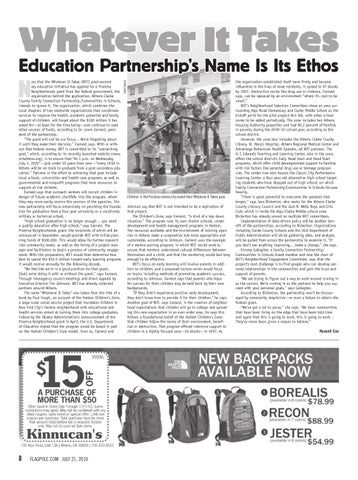
Children in the Pauldoe community model their Whatever It Takes gear. Johnson say that WIT is not intended to be a replication of that project. The Children’s Zone, says Earnest, “is kind of a top-down situation.” The program runs its own charter schools, career development and health management programs in Harlem. The resources available and the environment of existing agencies in Athens make a cooperative role more appropriate and sustainable, according to Johnson. Earnest uses the example of a mentor-pairing program, in which WIT would work to ensure that mentors understand cultural differences between themselves and a child, and that the mentoring would last long enough to be effective. WIT’s focus on early learning will involve parents in addition to children, and a proposed lecture series would focus on topics including methods of promoting academic success, according to Johnson. Earnest says that parents who hope for success for their children may be held back by their own backgrounds. “If they didn’t experience positive early development, they don’t know how to provide it for their children,” he says. Another goal of WIT, says Earnest, is the creation of neighborhood expectations that children will go to college and spreading this new expectation in an ever-wider area. He says this follows a foundational belief of the Harlem Children’s Zone: that children follow the norms of their environment, beneficial or destructive. That program offered intensive support to children in a tightly focused area—24 blocks—in 1997. As
the organization established itself more firmly and became influential in the lives of more residents, it spread to 97 blocks by 2007. Destructive norms like drug use or violence, Earnest says, can be replaced by an environment “where it’s cool to be smart.” WIT’s Neighborhood Selection Committee chose an area surrounding Alps Road Elementary and Clarke Middle School as the kickoff point for the pilot project this fall, with other school zones to be added periodically. The zone includes two Athens Housing Authority properties and had 90.2 percent of families in poverty during the 2009–10 school year, according to the school district. However, the zone also includes the Athens-Clarke County Library, St. Mary’s Hospital, Athens Regional Medical Center and Advantage Behavioral Health Systems, all WIT partners. The H.T. Edwards Teaching and Learning Center, also in the zone, offers the school district’s Early Head Start and Head Start programs, which offer child developmental support to families with risk factors like parental drug use or teenage pregnancies. The center now also houses the Classic City Performance Learning Center, a four-year-old alternative high school targeting students who have dropped out of high school, on which Family Connection Partnership/Communities in Schools focuses heavily. “There is great potential to overcome the greatest challenges,” says Sara Bickerton, who works for the Athens-Clarke County Literacy Council and the Jack R. Wells Boys and Girls Club, which is inside the Alps/Clarke Middle school zone. Bickerton has already served on multiple WIT committees. Implementation of data-driven policy will be another benefit of the partnerships, according to Bickerton. Organizations including Clarke County Schools and the UGA Department of Public Administration will all be gathering data, and analysts will be pulled from across the partnership to examine it. “If you don’t see anything improving… make a change,” she says. Kirrena Gallagher, a Family Connection Partnership/ Communities in Schools board member and now the chair of WIT’s Neighborhood Engagement Committee, says that the project’s next challenge is to find people who can develop personal relationships in the communities and gain the trust and support of parents. “We are trying to figure out a way to work around coming in as the saviors. We’re coming in as the partners to help you succeed with your personal goals,” says Gallagher. According to Bickerton, the partnership won’t be discouraged by community skepticism—or even a failure to obtain the federal grant. “We’ve got a lot to prove,” she says. “We have communities that have been living on the edge that have been told time and again that this is going to work, this is going to work… They’ve never been given a reason to believe.” Russell Cox
grub notes Taking Flight Summer Fare: When Flight Tapas and Wine Bar (225 N. Lumpkin St.) announced it was opening in the former Kaplan tutoring space next to the Georgia Theatre, it didn’t sound too impressive. Many a restaurant has tried to do tapas and wine, aiming for sophistication and ending up with bar snacks that weren’t even too glorified. Flight doesn’t succeed at everything it does, but for every failure on the menu, there’s a success, and the alcohol side of things appears to be far better than many another establishments’ in town. The concept, mirrored in a restaurant of the same name in Memphis, is there in the name: flights, or small tastings in groups of three, of both food and wine. You don’t have to order things this way, but it’s an option, with flights of soup, spring rolls, sea creatures and land critters as well as flights of wine. The sea flight will run you $14 for a plate of tuna tartare with wasabi vinaigrette, chili-powder-dusted fried calamari with an apricot-shallot sauce that sounds gross but is actually nice and black-tea-seared scallops served over shiitakes with a bit of truffle oil. There’s a lot that sounds potentially unsuccessful but works out decently, and while none of these items will blow your mind, all three have been well executed. The land flight, on the other hand, has one good thing (the grilled petite filet, well salted and crusted) and two not worth your time (too-thick beef carpaccio and bland chicken satay). A trio of soups has a strange attempt at gazpacho that is far closer to a pico de gallo, but it doesn’t taste bad; the silky porcini soup is better, and the carrot-ginger soup with basil oil is better yet, transcending all three of its named ingredients. Presentation is generally paid attention to. The mixed olive plate with marinated feta and pickled onions arrives with the olives in a ramekin that the staff then ceremonially pours onto the plate itself, creating a pretty and random arrangement. The warm spinach salad with blue cheese, pickled onions and …the briny, meaty bacon vinaigrette is a keeper, taste of the snails… and although the ingredients are kind of a no-brainer, they’ve still been pitched well, with the blue not too strong and the bacon diced just right. By contrast, the frisee salad, which has the same delicious bacon, fails in its undercooked fried egg and the lackluster texture of the greens. The kitchen isn’t great with potatoes. Both the ones that accompany the petite filet and those that make up the purple potato salad on the side of the bocadillo (a panini-style with sweet-tea-brined pulled pork and brie) aren’t great, but purple potatoes are almost always bound to fail, with their weird, dry consistency. The sandwich, incidentally, ain’t bad, but the description beats the reality. The two hearty, starch-based dishes—a porcini-gorgonzola risotto and gnocchi with spinach, prosciutto and pecorino—are hard to think of ordering in this kind of weather, and they’re flawed in execution. The risotto is soupy and the gnocchi too bogged down in their cream sauce, although the flavors of both have been well chosen. What’s the most exciting thing on the menu? The restaurant has escargot in a garlic butter flavored with Pernod that beautifully accents while never overpowering the briny, meaty taste of the snails themselves. Nowhere else in Athens is this even an option, and I would encourage you to pop over to the restaurant for this dish alone, which is satisfying, tasty and paired perfectly with a recommended white. The pairings seem smart, not obvious, and the wine list has plenty of French selections, which is rare these days. A light summer flight of a Jacqueline blanc de blancs (sparkling), a Hughes Beaulieu pic poul (white) and a Domaine Houchart rosé wasn’t 100 percent awesome, but it was intelligently put together and accessible. The cocktail list, likewise, has some silly dessert martinis but some choices for grown-ups, too, including drinks made with St. Germain elderflower liqueur and house-infused liquors. The atmosphere in the now unrecognizable space is comfortable and at least trying for something higher-end, but the customers in shorts and t-shirts (it’s Athens, after all) tend to bring it down. Flight has recently tacked up a banner on the fence around the Georgia Theatre announcing its existence, which may help it find its clientele. The restaurant does dinner Tuesday through Saturday from 4 p.m., and the bar is open until 2 a.m. There is a wine cellar downstairs that can be rented for events, and the restaurant accepts credit cards. Hillary Brown food@flagpole.com
Drink Specials: Entrée Specials:
2.00
$
16oz. Bottles of Coors Light
Rage O
O
HAIR
Sunday Beach Brunch Buffett on the “GNAT-io”
O
STUDIO
O
Welcomes Matthew Buzzetta!
Matthew comes to us from Van Michael and Bernard Daugoud Salons in Atlanta. He has worked fashion shoots with some of the top stylists in the world and has extensive training with Aveda, Karastas, Vidal Sassoon, Sebastian and Whella. Matthew specializes in the technique of French cutting, Keratin straightening and a variety of color services ranging from corrective color to foil placement.
O
O
O
For an Appointment Call
(706) 548-8178
$12 noon-3pm • Omelettes & Carving Station • $3 Mimosas & House Wine
Live Music
Thurs, July 22 - TJ MIMBS Fri, July 23 - NATHAN SHEPPARD Sat, July 24 - LEAVING COUNTRIES All Music starts at 6:30pm
O
College Ave. Downtown • Above Walker’s Coffee
NEW HOURS
7am-3:30pm Daily Contact Us
BREAKFAST LUNCH BRUNCH
for Rehearsal Dinners, Private Parties and Weddings! Call for a free quote!
JULY 21, 2010 · FLAGPOLE.COM
9
movie dope Some releases may not be showing locally this week. DAYS OF HEAVEN (PG) 1978. Cine’s Summer Classic Movie Series, sponsored by Balance Pilates, returns. This week’s classic, Days of Heaven, is Terence Malick at his finest. Hotheaded Bill (Richard Gere) convinces his lover, Abby (Brooke Adams), to marry their dying boss (Sam Shepard) in an attempt to share his wealth. Malick won a Best Director prize at Cannes, and Néstor Almendros won an Academy Award for Best Cinematography for his gorgeous agricultural panoramas. DEATH AT A FUNERAL (R) Not much about Death at a Funeral has changed since I reviewed the original film way back in aught seven, so why should my review? “Why should weddings have all the disastrous film fun? We can milk the sacred funereal cow for all its riotous laughs, too.” Even so, I failed to discover where they buried all the funny in Death at a Funeral, the latest grasp for mainstream success from Neil Labute. DEPARTURES (PG-13) 2008. This year’s Oscar winner for Best Foreign Language Film bested The Class and Waltz with Bashir. Now it’s time to put up or shut up. A recently unemployed cellist, Daigo Kobayashi (multiple award winner Masahiro Motoki) returns to his hometown and begins a new career as an “encoffineer,” the person who prepares the deceased for burial and the next life. Director Yôjirô Takita’s film snagged 28 other international awards to go along with its Oscar. Part of the ACC Library’s iFilms series. DESPICABLE ME (PG) The world’s premier supervillain, Gru (v. Steve Carell), is plotting his biggest heist yet—he’s going to steal the moon— when a trio of orphan girls brings the daddy out of Dr. Evil. I cannot get a read on Despicable Me from its trailers or its creators’ sparse feature filmographies. Featuring your usual all-star voice cast that includes Kristen Wiig, Jason Segel, Will Arnett, Ken Jeong, Julie Andrews, Danny McBride, Russell Brand, Mindy Kaling, Jack McBrayer, Jemaine Clement and more. GET HIM TO THE GREEK (R) Forgetting Sarah Marshall director Nicholas Stoller takes the writing reins from star Jason Segel, unleashing the “How I Met Your Mother” star’s rock god, Aldous Snow (Russell Brand), in
a story almost all his own. With 109 minutes of laughter and Apatowian affection, Get Him to the Greek is the summer’s best comedy to date. GROWN UPS (PG-13) Immune as I am to the charms of Adam Sandler, Kevin James, Chris Rock (the actor, as opposed to the stand-up comedian), David Spade and Rob Schneider (especially Rob Schneider), I am not the best person to tell you whether or not you’ll fall for their combined comic powers. I can tell you Grown Ups is not a very good movie, and it’s way below Sandler’s recent output. Five old pals—a Hollywood super-agent (Sandler), lovable loser (James), henpecked househusband (Rock), aging horndog (Spade) and granny-chasing New Ager (Schneider)—get together after their childhood basketball coach’s funeral. Inoffensive enough for easily amused families, the jokes in Grown Ups are primarily composed of friendly, heckling one-upmanship, better known as punchlines minus the work of a setup. Apparently, The Big Chill was too intellectual; what Lawrence Kasdan’s film lacked were fart/bunion/ hairpiece jokes and bunch of Kevin James pratfalls. HOW TO TRAIN YOUR DRAGON (PG) How to Train Your Dragon is a terrific computer-generated animated feature, and the first I recommend you should watch in 3D. As great as it is for families (if I had a kid, I would rush out to see it with him/her), Dragon left me breathless at the animation and kind of bored with the familiar story and tired pop culture jokes. Dragon is the latest from DreamWorks Animation, the home of Shrek, and the family resemblance is strong. Hiccup (v. Jay Baruchel) is a scrawny Viking screw-up who wants to hunt dragons like his gigantic, heroic dad (v. Gerard Butler). But after capturing his own flying firebreather, Hiccup learns there may be more to these creatures than hunting them. INCEPTION (PG-13) See Movie Pick. IRON MAN II (PG-13) Iron Man’s second mission picks up right after his last. Tony Stark, having outed himself as the armor-clad superhero, must do battle against a new foe: government bureaucracy. Facing down a congressional committee chaired by a particularly snide Senator played by
M OVIE L ISTI N GS Schedules often change after our deadline. Please call ahead.
ACC LIBRARY (706-613-3650)
Departures (NR) 6:30 (Th. 7/22)
CINÉ (706-353-3343)
Days of Heaven (PG) 5:45 (ends Th. 7/22) Mother and Child (R) 8:30 (ends Th. 7/22) The Secret in Their Eyes (R) 5:30, 8:15 (new times F. 7/23: 9:30) (add’l times Sa. 7/24–Su. 7/25: 2:00) (no 9:30 show Su. 7/25) To Kill a Mockingbird (NR) 4:30, 7:00 (no 7:00 show Sa. 7/24) (starts F. 7/23) Winter’s Bone (R) 5:15, 7:30, 9:45 (add’l times Sa. 7/24–Su. 7/25: 3:00) (no 9:45 show Su. 7/25) (starts F. 7/23)
UGA TATE CENTER THEATER (706-542-6396) Death at a Funeral (R) 7:00 (W. 7/21) Kick-Ass (R) 7:00 (Sa. 7/24 & W. 7/28)
Accurate movie times for the Carmike 12 (706-354-0016), Beechwood Stadium 11 (706-546-1011) and Georgia Square 5 (706-548-3426) cinemas are not available by press time. Visit www.flagpole.com for updated times.
10
FLAGPOLE.COM ∙ JULY 21, 2010
Garry Shandling with rapid-fire wit as opposed to his trademark repulsor beams, Stark manages to maintain control of his proprietary technology as fears of other iron men become campaign fodder. THE KARATE KID (PG) The remake of the 1984 classic is definitely not the best around; the somber-toned flick would place third in a tournament with the previous four Karate Kids. Was it really necessary to take two hours and 20 minutes to (re)tell a plot about a kid learning martial arts from a handyman in order to beat up some bullies? No. Xiao Dre (Jaden Smith, son of Karate Kid producer Will) learns kung fu from the dour Mr. Han (Jackie Chan) and enters a tournament against the really mean Fighting Dragons, led by a teacher who totally took lessons from Martin Kove’s Kreese. The final train-
centers on a lesbian couple, Nic and Jules (power acting duo Bening and Julianne Moore), both of whom conceived children through artificial insemination. Now their teenager, Laser (Josh Hutcherson, Journey to the Center of the Earth), has convinced his older sister, Joni (Mia Wasikowska, Alice in Wonderland), to investigate their donor dads. Filmmaker Lisa Cholodenko wrote and directed Laurel Canyon and High Art. With Mark Ruffalo. KNIGHT AND DAY (PG-13) Tom Cruise’s star does not shine like it used to. Twenty years ago on June 29, Cruise’s Days of Thunder roared onto screens. In the interim, summer blockbusters require less star power and fewer original concepts, while favoring bigger effects budgets and more recognizable intellectual proper-
It’s the new iPhone fix. ing montage and the tournament don’t make up for the two previous hours, though they are definitely the movie’s highlights. Where are the loads of fun references to the first film? How cool of a subtitle would “Put him in a body bag, Johnny!” or “Sweep the leg” be? No William Zabka/Ralph Macchio cameos? Alas, no dice. I’m sure this new flick will do wonders for local martial arts enrollment. KICK-ASS (R) Dave Lizewski (Aaron Johnson) is your average nobody teen, masturbating to images of his booby, middle-aged English teacher while dreaming of his school’s Mary Jane, Katie Deauxma (Lyndsy Fonseca). One day, Dave gets the stupid/bright idea of becoming a real-live superhero. His dangerous lifestyle leads him to an honest-to-god dynamic duo, Big Daddy (a bad-stached Nicolas Cage, whose ill-conceived interpretation of the character should have been nipped in the bud) and Hit-Girl (Chloë Grace Moretz). Naturally, a villain arises to challenge our band of everyday heroes. Much has and will continue to be made of this ultraviolent fantasy, especially the actions and language of the young, game Moretz. Most troubling to this comic fan were the misguided alterations made to Millar’s core idea of a zero-turned-hero who is really still a zero. Vaughn opts to turn this atypical hero story into the much more typical “hero gets powers, girl, and saves the day” tale. Loaded with fanboy Easter eggs and comics references galore, it is a blast to behold, but like with fan fave Wolverine, the less known about the origins of Kick-Ass, the better. THE KIDS ARE ALL RIGHT (R) Annette Bening’s other family-centric drama (following Mother and Child)
ties. Ten years ago, Knight and Day would have ruled the summer roost. But in 2010, Cruise jumped the couch a few years ago, Cameron Diaz’s box office clout never really materialized, and the under-funded special effects look abysmally dated. Hitchcockian in the Charade sense, Knight and Day pits super-spy Roy Miller (Cruise) and every-girl June Havens (Diaz) against the government, some European arms dealers and their growing affection for each other. After a meet-cute in the airport, Roy and June go on the lam, as Roy claims to have been framed as a rogue agent by his partner, Fitzgerald (Peter Sarsgaard). Roy allegedly stole a battery prototype created by wunderkind Simon Feck (Paul Dano). That Knight and Day does not work is no fault of Cruise or Diaz. Hollywood’s former golden boy sort of embraces his new crazy persona and fuels Miller’s cock-sure super-heroics with a touch of insanity that leads the viewer to question Roy’s wild conspiracy along with June. Unfortunately, screenwriter Patrick O’Neill cuts the crazy legs off Cruise’s performance with the most predictable of spy games. Diaz lessens June’s annoying density and her star charisma melds well with Cruise’s despite their lack of romantic chemistry. I did not buy their love affair, but Roy and June make a great new Scarecrow and Mrs. King. The unsurprising script and more competent but ultimately boring direction from James Mangold dull the engaging likability of Cruise and Diaz. It’s a shame, too, because a sharper Knight and Day could have been a fantastic ironic Bond substitute. If only Cruise had forged a directorial bond like Clooney has with Soderbergh…
THE LAST AIRBENDER (PG) M. Night Shyamalan, the arrogant writerdirector so maligned after a devastating trifecta that concluded with 2008’s The Happening, smartly streamlines the first 20 episodes of Nickelodeon’s Peabody Award-winning cartoon, “Avatar: The Last Airbender.” Airbender Aang (Noah Ringer) is the legendary Avatar, thawed out after a hundred-year deep freeze by Waterbender Katara (Nicola Peltz) and her doofy brother, Sokka (Eclipse’s Jackson Rathbone). Now he must learn how to bend the other three elements (water, earth and fire) in order to defeat the Fire Nation, which looks to rule the world. M. Night’s grandiose, almost operatic seriousness of purpose actually benefits the transition of the deceptively deep, often silly cartoon to the big screen. Nonetheless, I miss the childish fun of toon Aang. The Last Airbender lacks the fantastical awe that made the show’s universe like a brilliant little brother to Star Wars or Lord of the Rings, and no one will prefer it to the cartoon. Still, I’m ready for Book Two. LETTERS TO JULIET (PG) While in Verona, young American Sophie (Amanda Seyfried) finds a 50-year-old letter addressed to Juliet and decides to answer it. Soon she is seeking Claire’s (Vanessa Redgrave) Romeo, Lorenzo, and falling for the older woman’s grandson, Charlie (Christopher Egan). Anyone else but Seyfried (Mamma Mia!, “Big Love”), and I would probably hate this Sophie character. Letters to Juliet is another innocuous, romance fueled by chaste-teen-girl longing and Nicholas Sparks’ novels. Its targeted demo will be smitten; everyone else, not so much. LOVE RANCH (R) Ray Academy Award nominee Taylor Hackford directs his Oscar-winning wife, Helen Mirren, for the first time in this drama based on the first legal brothel in Reno, Nevada. Joe Pesci plays Mirren’s husband. Hackford had been around a long while before Ray (Have you ever been lifted up where you belong by An Officer and a Gentleman?), but none of his films are as memorable. Writer Mark Jacobson wrote the article upon which American Gangster was based. With Bryan Cranston, Scout Taylor-Compton, Gina Gershon (can you say typecasting?), Bai Ling and M.C. Gainey. MARMADUKE (PG) So the comic strip canine becomes a live-action movie, and Owen Wilson voices the teenaged Great Dane. I am sure the kiddies will eat this up just as greedily as they did both Alvin and the Chipmunks movies. Lee Pace (“Pushing Daisies”) and Judy Greer star as Marmaduke’s human owners, while a slew of familiar actors—Emma Stone, Ron Perlman, Christopher Mintz-Plasse, Jeremy Piven, Steve Coogan, Fergie, George Lopez—give voice to the animal kingdom. Directed by Tom Dey (Shanghai Noon, Failure to Launch). MOTHER AND CHILD (R) The stories of three women—a 50-yearold healthcare professional (Annette Bening), the daughter (Naomi Watts) she gave up for adoption over 30 years earlier and an African-American woman looking to adopt—unfold in writer-director Rodrigo García’s new film. García has made quite a career out of helming quality HBO series— “The Sopranos,” “Carnivale,” “Six Feet
Under,” “Big Love,” “In Treatment.” His features—Passengers—have not fared as well. With Jimmy Smits and Samuel L. Jackson. PREDATORS (R) A group of elite human warriors—including Adrien Brody, Alice Braga, Laurence Fishburne, Walton Goggins, Danny Trejo and Topher Grace (?!)—must elude more than one of the universe’s ultimate hunters. Robert Rodriguez’s name may sit above the title, but he is only exec-producing this reboot of the Predator franchise. Nimrod Antal is directing; his previous movies (Vacancy, Armored) were competent, if not stellar genre entries. I look for Predators to satisfy in similar fashion. RAMONA AND BEEZUS (G) Beverly Cleary’s classic kid, Ramona, comes to the big screen. Ramona Quimby (Joey King) is a grade-schooler that gets in a lot of trouble. Beezus (Selena Gomez) is her older sister, Beatrice. John Corbett and Bridget Moynahan play the Quimby parents, Bob and Dorothy, and Ginnifer Goodwin and Josh Duhamel as Aunt Bea and Uncle Hobart. Sandra Oh is Mrs. Meacham. These names will mean something to anyone that grew up reading these terrific books. I am more than a little bit excited about this movie. RESOLVED (PG-13) 2007. Filmmaker Greg Whiteley’s documentary starts by looking at high school debate and ends up addressing the racial and socioeconomic biases of the American education system. Former debaters Jane Pauley, actor Josh Lucas, Karl Rove, Supreme Court Justice Samuel Alito and journalist Juan Williams address how debate affected their lives. Winner of Best Documentary from the Los Angeles Film Festival and the Los Angeles Independent Film Festival and nominated for two Emmys. ROBIN HOOD (PG-13) On paper, a realistic, “historically accurate” version of the Robin Hood myth from the Gladiator team and super-producer Brian Grazer read like a dynamite summer blockbuster, but in reality, a dour, dark, incredibly anachronistic (everyone is a feminist, ecumenical, Enlightenment philosopher) Robin Hood is no Robin Hood at all. I would rather rewatch the 1938 Errol Flynn masterpiece, The Adventures of Robin Hood, than this version. In the medieval darkness, Russell Crowe’s Robin kind of misses the target. l SALT (PG-13) Accused of being a spy tasked with killing the U.S. president by a Russian defector, CIA operative Evelyn Salt (Angelina Jolie) must elude capture if she is going to uncover the truth about her identity. Naturally, she is very good at what she does. Salt looks like an X chromosome Bourne Identity, and I find the trailer to be a little silly. Director Phillip Noyce has a decent history for subtler spy games, having helmed Patriot Games, Clear and Present Danger and The Quiet American. THE SECRET IN THEIR EYES (R) 2009. The Academy Award winner for Best Foreign Language Film of the Year, The Secret in Their Eyes hails from Argentina, where it swept their Academy Awards, winning 13 Awards of the Argentinean Academy. An investigator, Benjamin Esposito (Ricardo Darin), begins a novel of an unsolved rape/murder that has haunted him for 25 years. Interestingly, writer-director Juan José Campanella is an American TV vet, directing such hits as “Law & Order: SVU” (17 episodes), “House” (four episodes) and “Strangers with Candy” (eight episodes). THE SORCERER’S APPRENTICE (PG) Disney hips up its seminal Fantasia sketch with Nic Cage as a curiously coiffed wizard backed up by his National Treasure director, Jon Turteltaub. A master sorcerer, Balthazar Blake (Cage), recruits a regular dude,
who’s a vampire, but she’s also in love with Jacob (Taylor Lautner), who turns into a giant wolf. And Jacob rarely wears a shirt. (OMG, he is so hot.) Well, a bitchy redheaded vampire named Victoria (Bryce Dallas Howard) wants to kill Bella so she creates an army of newborn vamps (they’re, like, totally stronger than older vamps). But the Cullens—that’s Edward’s vampire family—and Jacob’s wolf pack totally put aside their differences to protect Bella. The Twilight Saga is easily the most ill-prepared blockbuster franchise of all time, and Summit Entertainment’s no-list casting may have finally caught up with it. Neophyte production company/distributor Summit lucked out with the single-star entity that is Stewart/Pattinson/Lautner. However, their pittance of a budget for the original movie forced some bargainbasement shopping for Twilight’s supporting cast, and for every Billy Burke and Anna Kendrick, the franchise was saddled with an Ashley Greene, Peter “Mr. Jennie Garth” Facinelli, or… shudder… Jackson Rathbone. New director David Slade uses his previous experience with bloodsuckers (30 Days of Night) to construct some cool night scenes for author Stephenie Meyer’s fangless vampires. Unfortunately, nothing can amend for screenwriter Melissa Rosenberg’s atrocious dialogue and the movie’s sheer volume of mope. Everybody from Bella to Edward to Bella’s father, Charlie, frowns and whines. If only Bella had stayed longer on the Quileute Indian reservation where folks have better things to do than sulk like teens in a
‘50s melodrama. Everything in Eclipse builds to the showdown between a united Cullen-Quileute front and Victoria’s newborns, which lives up to its hype. VALHALLA RISING (R) A film from Danish filmmaker Nicolas Winding Refn, director of the acclaimed Pusher trilogy, Valhalla Rising follows the journey of mystery man One-Eye (Danish hulk Mads Mikkelsen) who transforms from a slave to a warrior in search of redemption. One-Eye, a Norse mute with (spoiler alert) one eye, discovers that his vision dramatically improves in his sleep; he can dream the future. Long imprisoned and routinely pitted against other captive criminals in Gladiator-esque death matches, One-Eye finds his escape in a dream and boards a Viking vessel into the unknown with the Christian Crusade, accompanied by a slave boy, Are (Maarten Stevenson). WINTER’S BONE (R) Independent film actress Jennifer Lawrence (Guillermo Arriaga’s The Burning Plain) stars in this adaptation of Daniel Woodrell’s 2006 eponymous novel. Seventeen-year-old Ree Dolly (Lawrence) searches for her degenerate father who fled criminal charges after putting the family home up for his bond. Gutsy Ree trudges through Ozark grit and tramples the family’s longstanding code of silence, determined to find her father and save her home for herself and her siblings. Winner of the Grand Jury Prize for Dramatic Film at the 2010 Sundance Film Festival. Drew Wheeler
Holy Nolan
Ellen Page and Leonardo DiCaprio the Bat) and financially (thanks to the Bat), Nolan’s newest film, Inception, may be his best yet. Mysterious thief Dom Cobb (Leonardo DiCaprio) is a mastermind at stealing from your mind. He and his team will forge your dreamscape, infiltrate it and extract whatever valuable secrets you are trying to hide. After a high-profile failure, Cobb receives the offer of a lifetime from former mark Saito (Ken Watanabe). Complete one especially tough job of inception (the nigh-impossible task of planting an idea in someone’s mind),
% OFF 10 Tattoo or
Body Piercing www.americanclassictattoo.net
1035A Baxter St. 706-543-7628
movie pick INCEPTION (PG-13) Blockbuster filmmakers do not come more reliably consistent than Christopher Nolan. Memento, his two Batman films and The Prestige (even his tiny first film, Following) all shared a whipcrack intelligence, unique visual aesthetic and the razor-sharp telling of an intricately woven story. With Nolan completely unconstrained creatively (by
ample parking available
and Cobb, a fugitive from justice, can finally return home. The master thief assembles the biggest, best team he can—stalwart cohort Arthur (Joseph Gordon-Levitt), rookie architect Ariadne (Ellen Page), forger Eames (Tom Hardy) and chemist Yusuf (Dileep Rao)—to pull a hi-tech, sci-fi heist in the mind of budding industrialist Robert Fischer (Nolan regular Cillian Murphy). But Cobb’s projection of his late wife, Mal (Marion Cotillard), has other ideas. With their shades of Escher, Nolan’s dreamlike images mesmerize, yet the story—its depth and clarity—is what grabs and holds you for two-and-a-half hours. A fourth straight two-plushour film suggests Nolan needs a stronger editor, but Inception wears the extra length well. Any non-genre folk frightened by anticipated confusion over the elaborate sci-fi setup need not fear. The film is complex but not confusing. The crisp action sequences suggest Nolan would direct a fine Bond film, if given the chance. A perfect summer blockbuster that is also an Oscar contender (for set design and cinematography), the thrillingly original Inception is the cinematic equivalent of an intelligent, bestselling beach-read, well written enough to aspire higher but entertaining enough for mass appeal.
ALIBI
THE G
Dave Stutler (Jay Baruchel, How to Train Your Dragon), to help him defeat his arch-nemesis, Maxim Horvath (Alfred Molina). Even with the gorgeous Monica Bellucci, I am skeptical about this flick, especially after Cage’s last sorcery movie, Season of the Witch. TO KILL A MOCKINGBIRD (NR) 1962. Ciné’s Summer Classic Movie Series, sponsored by Balance Pilates, returns with a wonderful slate of films including Mr. Smith Goes to Washington, Babette’s Feast, Days of Heaven, Seven Samurai, The Birds and A Clockwork Orange. This week’s classic, the Academy Award-winning adaptation of Harper Lee’s To Kill a Mockingbird, is one of the greatest Hollywood films of all time. Gregory Peck justly won Best Actor for his portrayal of the stalwart Atticus Finch. Look for Robert Duvall in his brief feature film debut. TOY STORY 3 (G) When toy owner Andy grows up and goes to college, he donates his favorite toys, including Woody (v. Tom Hanks) and Buzz Lightyear (v. Tim Allen), to a day care center. As excited as I am to meet the new toys, I am even more excited about the script by Little Miss Sunshine Oscar winner, Michael Arndt. Director Lee Unkrich codirected previous Pixar hits Toy Story 2, Monster’s Inc. and Finding Nemo. In 3D and IMAX 3D. THE TWILIGHT SAGA: ECLIPSE (PG-13) No matter how many times the director changes for the better, the cast, characters, and story remain the same. Bella (Kristen Stewart) is, like, so in love with Edward (Robert Pattinson),
AL
LERY
GOOD
DIRT
Drew Wheeler
JULY 21, 2010 · FLAGPOLE.COM
11
film notebook News of Athens’ Cinema Scene
2
Joyce Littel’s Home Girl Concert Series in conjunction with the Morton Theatre brings you these smooth jazz & soul artists to the Morton’s Centennial Celebration.
Smooth Jazz Saturday, July 24 & Soul at 7:30 p.m
featuring Trumpeteer
JOEY SOMMERVILLE with Songstress
PHILLIPPIA
as seen in “Tyler Perry’s Madea’s Family Reunion” $25 Orchestra • $20 Balcony • $15 Bleachers
www.mortontheatre.com
t for g tickets t or 706-613-3771
195 West Washingtonpr St. • Downtown Athens I
OUR SPONSORS
s
For more information please w h full o contact r manu s Littel Concepts at rainin 404-607-8772
The Morton Theatre is a unit of the Arts Division of Athens-Clarke County’s Leisure Services Department and is managed by the Morton Theatre Corporation, a 501(c)(3) non-profit organization.
MON
W
AT
Restaurant
100% Mexican Food & Seafood Buy 1 Burrito, 16oz. House Chimichanga or Margaritas Quesadilla, Get the 2nd & Mojitos 1/2 Price
2
$
MON-THU
MON-THU
400 Hawthorne Ave. Ste. 12 • 706-353-8557
12
FLAGPOLE.COM ∙ JULY 21, 2010
24
(like Sundance winner Winter’s Bone and the The Ramble: I recently spoiled a good mood Italian comedy Mid-August Lunch, both comby watching Born to Kill, Robert Wise’s sordid and savage 1947 film noir starring Lawrence ing soon to Ciné) will be squeezed out of the Tierney and Claire Trevor as two of the most exhibition marketplace altogether. As I’ve also noted before: the top prize winner at this unsavory “romantic” leads ever united on film (at least until Wise’s notorious coupling of year’s Cannes Film Festival still has no U.S. Christopher Plummer and Julie Andrews in The distributor. Sound of Music). It’s a film with a relentlessly negative outlook on love, but it remains comThe Monument: A great relic of the Golden pelling because its characters’ personalities Age of foreign film exhibition in the U.S.— and motivations grow more complex as their Ingmar Bergman’s The Seventh Seal—will be increasingly desperate entanglements evolve. screened for free in Room S151 of the Lamar That’s good directing and good writing: Dodd School of Art at 7 p.m. Wednesday, July for plot and character to move together even 21, concluding the Georgia Museum of Art’s through the improbable twists of an outré month-long Summer Film Series. Most of the pulp genre piece like Born to Kill in a way that series has focused on “avant-garde short films feels unforced and organic is a rare achieveof the 20th century.” More of that, please! ment. The 2009 Argentine thriller The Secret For more information, go to www.uga.edu/ in Their Eyes (playing at Ciné for at least a gamuseum. couple of days after this issue drops) pulls off a comparable feat: as it winds unhurriedly The Ciné Skinny: Don’t confuse the GMOA through its labyrinthine story involving the thing with Ciné’s Summer Classic Film Series, investigation of a gruesome and tragic murder which continues with Robert Mulligan’s To (and gracefully between its twin timelines), Kill a Mockingbird, opening July 23, and the gradual unspooling of the mystery is Akira Kurosawa’s The Seven Samurai, which exactly matched in emphasis by the patient opens July 30. The Friday evening screenings delineation of the characters and—espeof these films get special introductions: To cially—the nature and importance of their relationships. If that sounds like something any good investigative drama should do, let me note that The Secret in Their Eyes is remarkably good at it—better, for instance, than David Fincher’s Zodiac (which, to be fair, had many other virtues to its credit). Writerdirector Juan José Sundance-winner Winter’s Bone is slated to screen at Ciné on Friday, July 23. Campanella has been directing in American television for a decade, including Kill a Mockingbird is presented by Harper Lee a bunch of episodes of “Law and Order,” and expert Judy Long, while The Seven Samurai will be introduced by Michael Meindl, an MFA his facility with clean, economical storytelling shows—but he’s in much deeper territory here. student in dramatic media with a specialization in film… And mark your calendars for m The Future: The Secret in Their Eyes won Saturday, July 24, which is designated the the Academy Award for Best Foreign Film 6th Annual Darius Goes West Day. Be sure this year, which makes it, even without the to reserve tickets in advance for Ciné’s 7 p.m. benefit of established (in the U.S., that is) screening of the film, at which Darius Weems movie stars or a “name” director, a pretty and his “crew” will tell stories and answer high-profile import. The next non-U.S. release questions. If you’re one of the three or four on the docket for Ciné looks to be Micmacs by Athenians who don’t know what this is, or if Jean-Pierre Jeunet, the director of Amélie, you just want to get your tix, go to www.darione of the most successful imports of all usgoeswest.com. time (it looks terrific, incidentally). Among the American films currently showing or The Library: The Athens Jewish Film Festival scheduled at Ciné are ones starring Annette will present the latest entry in its Special Film Bening, Naomi Watts and Samuel L. Jackson Series at the ACC Library July 27 at 7 p.m.: (Mother and Child); Robert Duvall, Sissy it’s Delta Jews, a 1998 documentary about Spacek and Bill Murray (Get Low); and Michael the little known but deeply ingrained Jewish Douglas, Susan Sarandon, Danny DeVito and culture in the Mississippi Delta region… The Jenna Fischer (Solitary Man). Don’t get me library’s iFilms series continues July 22 with wrong: as I’ve said before, I’m all for drawDepartures, a sweetly comic Japanese drama ing crowds to our downtown art house with from 2008, and July 29 with the documen“major-indie”-type features, and I’m looking tary Imaginary Witness: Hollywood and the forward to seeing all of these. But as nonHolocaust. All iFilms screenings are Thursdays blockbuster, modestly budgeted films targeted at 7 p.m.… Finally, the library hosts a screenat adults—even ones with all-star casts—find ing of Athens, GA: Inside/Out Monday, July themselves less and less welcome in the mul26 at 6:30 p.m. Go to www.clarke.public.lib. tiplexes, I think we’re justified in worrying ga.us for more info on all this stuff. that (a) they’ll get made even less often and (b) “smaller,” independent and foreign fare Dave Marr film@flagpole.com
Music News And Gossip Out Loud, Out Strong: Vocalist Marty Winkler will celebrate her birthday on Friday, July 22 as part of Hotel Indigo’s “Live After Five” series. She’ll be joined by guitarist/bassist Michael C. Steele (Randall Bramblett, John Berry), and opening the show will be singer Lara Oshon, with whom Winkler plans to do some harmonizing and vice versa. The show runs from 6–8 p.m. and, actually, it’s a few days later than Winkler’s actual birthday, but wish her well, anyway. Winkler’s jazz and torch-song stylings are more tightly wound than Oshon’s breezy, 1970s-ish singer-songwriter vibe, but perhaps this match will work well. Visit the artists in question via www. myspace.com/laralive and www.myspace.com/ martywinkler. Psst!: The occasionally reuniting dance band Everybody Everybody will perform Thursday, July 29 at a “secret location,” but considering that the show is being run in conjunction with the new location of vintage shop Ohh, Boy!
Michael C. Steele and Marty Winkler (766 W. Broad Street), my suggestion to those scratching their heads is to go to Ohh, Boy! and follow their ears. Drummer Laura Swindall is in town visiting from San Francisco, so that’s why Everybody Everybody (whose other members are Nate Mitchell, David Specht and Melissa Colbert) can get together and play. The Eye Gate Light Show will handle visuals and so will Sabrina Cuadra (Whistling School for Boys), and DJs will begin spinning records at 8 p.m. Ohh, Boy! will stay open late this night for browsers and shoppers. Also, HHBTM Records is releasing a very limited (100 copies) cassette tape of Everybody Everybody that is to be available this night. Check out www. myspace.com/evrybdyevrybdy to hear what you’re in for. So, What’s Up?: When news broke a couple of weeks ago that UGA’s Music Business Program would lose its leaders (Bruce Burch, Keith Perissi and Heather McDonald) so they could go head up a similar program at Kennesaw State University, local reaction was a mixed bag, ranging from surprise and disappointment to “UGA has a music business program?” Students, in particular, are
obviously the most affected by this change, which leaves the future of the program at UGA in question, as the Terry College of Business has remained tight-lipped about such matters. Current program student Sam Williams told Threats and Promises, “I’m frustrated by [their] decision to leave and am concerned about the future of the program and the credits I’ve already earned. I’m especially frustrated considering this is just the latest in a long list of issues I’ve had with the program.” Williams refrained from elaborating further, but it’d be hard to believe other students don’t share his concerns. Flagpole will continue to follow this story, so check back for updates. A River Runs Through It: Augusta, GA is gearing up for its annual Westobou Festival, which is a 10-day, multi-disciplinary arts festival. Created in 2005, the festival’s goal is to bring attention to the ongoing cultural renovation of Augusta, and events are concentrated in the areas around downtown, Augusta State University and Paine College. The events scheduled are too numerous to mention, but musical artists of note include The Charlie Daniels Band (Sept. 17) and the legendary Al Green (Sept. 25). Tickets for each event are sold separately and available now. For more information, please see www.westoboufestival. com. But, seriously, go visit that site. There’s a wealth of interesting stuff concerning the festival’s founding, its name, etc. No Clue: Brand-new band Pilgrim, featuring Paul McHugh (Mother Jackson), T.J. Machado (Mother Jackson) and Matt Hudgins (Shit-Hot Country Band), will make its live debut on Friday, July 23 at Little Kings during Slopfest. I’m giving the heads-up on this one even though I’ve never heard ‘em and have no music to point you toward, because if you like any of these guys in their other projects, you’ll probably dig this one, too. McHugh says, “We’re a rock and roll band, obviously.” ‘Nuff said. The Softer Side of Hudge: The aforementioned Matt Hudgins has been on a real tear lately and playing a decent number of shows with his crack outfit the Shit-Hot Country Band. He’s gonna slow his roll on Sunday, July 25 at Farm 255, when he’ll be forced to perform for two whole hours beginning at 9 p.m. His plan is to play “a sensitive, depressing, Fever and Mirrors, singer-songwriter-y solo set” first, and then he’ll be joined by some of his bandmembers later on. Why he felt the need to reference Bright Eyes I’ll never know, but you can be sure I’ll ask him. He’ll be playing some new material this night, too. Gordon Lamb threatsandpromises@flagpole.com
Slopfest Two-Day Punk Rock Smorgasbord
D
erek Wiggs probably wouldn’t cop to the role of major league music promoter. But in 2009, when the economic downturn put the kibosh on the Athens Popfest, Wiggs and his friends at Little Kings stepped into the void to curate an affectionately named tribute: Slopfest. “Some of my friends who enjoyed it last year convinced us to do it again,” says Wiggs. “Probably shoulda learned my lessons a little better… we probably crammed in too many bands.” Wigg’s potential ulcer is our town’s gain: in Slopfest, Wiggs and company have orchestrated what may be the best gathering of locally grown, punk-fed music Athens will see this year. The two-day, 40-band line-up showcases an up-and-coming plethora of punk, offpop and indie rock, and has a feel that’s less Bumbershoot than it is backyard barbecue. As it was last year, those who show up ready to go at the show’s 4 p.m. start time will be treated to some grub: “Taylor and Connor Robertson, their mom makes these delicious fall-off-the-bone ribs that have become pretty famous among all their friends, so she’s gonna do something one of the days; I think Friday is the plan,” says Wiggs, who works with the Robertson boys at Transmetropolitan. “The next day we’re gonna do the same thing we did last year, a couple of pork butts. Last year Little Kings had a few burgers they chipped in, so people who get there early enough, they’ll get a plate of food.” And you say there’s music? Friday’s festivities, which include a more eclectic mix ranging from the Flagpole awardwinning shredded meat of Maximum Busy Muscle to the bluesy psych of Hot and Cold, will be emceed by the heroically funky DJ Mahogany. Saturday, which owes its allegiances to the more purely punk, will be hosted by Randy Smyre and Chris Lozo, who are known for spinning all the classics of our declining western civilization. Courtesy of Flagpole, here are five picks to watch for.
1. Ye Olde Sub Shoppe Somewhere between punky Americana and open-hearted twee, this is probably the only folk trio that performs huddled around a condenser mic onstage but also employs the use of a handheld drum machine with a belt-mounted cigarette-pack amp. Christopher Ingham has proved himself as a never-ending fountain of chronically sincere pop hooks via myriad projects, and here he’s joined by bandmates Jeff Morris and Jason Granfield in quiet solidarity. You can hear all the words, and you want to. Check out those Ken Freeman t-shirts!
2. Child Bite
One of a handful of bands traveling from afar to get in on the collective slop, Detroitbased spazz coalition Child Bite is in lean
form these days. Through the process of nighperpetual touring, they’ve trimmed their ranks down to the dreaded power-trio formation, following in the footsteps of kindred travelers such as the Minutemen, Shellac and Mountain. (Just kidding about Mountain). Child Bite is well worth your attention; after all, this is the sole band that ‘Powers deigned to tap as opening support for its debut performance way back in 2000-dickity-whatever.
3. Manray
Folks have been buzzing around about this new-ish addition to the local mathletic division. The brothers Olivera—Ryan, Jordan and Derek—are joined by guitarist/sound engineer deluxe Gene Woolfolk in composing algorithmic progged-out sounds, all spastic time-changes and atonal chord voicings. The group is in the process of submitting a recorded document to the masses, and it looks like Slopfest might be its sole appearance this summer, so take note.
4. Cop Dope
Taken for granted by the local scene, Cop Dope may be what Joni Mitchell was talking about all those years ago: you don’t know what you got ‘til it’s gone. This duly brutal and dutifully inventive thrash trio is set to implode like so many of its ilk; that is to say, within a year of its inception. It’s cool though; you can always relive the magic by listening to Cop Dope’s recently released cassette on all those cassette players we all still own. In the meantime, do yourself a favor and get up in the front to bask in all the unpleasant, unhinged glory—this is a band that will be missed.
5. Future Virgins
As a point of reference, the Future Virgins’ label, Plan-It-X South, suggests that they “[have] the feel of an unreleased Carrie Nations 7-inch,” and that’s not far off, not at all. If you need anything else to go on, basically, it’s catchy-as-shit punk rock that gives one the impression that an empty beer can might fly overhead at any moment. They’re from Chattanooga, but locals talk about them like they’re family. They’ve recorded at our own Chase Park Transduction with David Barbe, so go get acquainted with our Tennessean cousins, but heads up. Just sayin’. Jeff Tobias
WHAT: Slopfest WHERE: Little Kings Shuffle Club WHEN: Friday, July 23 & Saturday, July 24, 4 p.m. HOW MUCH: $6 (2-day pass), $5 (single)
JULY 21, 2010 · FLAGPOLE.COM
13
Child Bite photo by Mike White · deadlydesigns.com
threats & promises
The Spooks
y f r u S s y It ’s Alwa a i h p l e d a l in Phi M
Learn How To Better Conserve Our Trees:
www.acctreeprogram.com
AC
Tree Care • Tree Ordinance • Community Forestry
14
FLAGPOLE.COM ∙ JULY 21, 2010
aybe it’s just me, but Athens seems to be growing rapidly as a hotbed for the ‘60s garage revivalist scene. The number of bands playing here that fit that particularly grimy bill is growing exponentially, from Wild Harem’s memorably raucous visit to the Go Bar earlier this year to the epic Burger Records showcase at Little Kings. For whatever reason, the next generation of surf, psych and garage bands is flocking to the Classic City, and The Spooks, a bright young quartet out of Philadelphia, are next in line. Getting ready to kick off a lengthy tour, lead singer and guitarist Wil Hannan takes a few minutes to chat with Flagpole about the scene in Philadelphia, the band’s new 7-inch (available as a free download at www. thespooks.bandcamp.com) and his excitement about returning to the Southeast. “We start with a show on the 17th at a club called KFN with JEFF the Brotherhood,” Hannan begins, “and then we leave the 21st. The first night [of the tour] is in Greenville. We might also play in Atlanta, but we know some bands [in Athens] that we played with last year on tour. Mouser and Trashcans were good to us last time, and the audience was awesome,” he says. “We’re playing for that 7-inch; we just put it up on Bandcamp. So, we’re covering the 7-inch costs, Sleepy Monsters, and in the fall we’ve got a full album coming out. When we all get back in the fall, we’re recording it with Adam Granduciel from this band called The War on Drugs, here. He also plays with Kurt Vile. He started a label here called yvynyl; well, it’s called Crate Club, but the side we’re on is called yvynyl. It’s all based in Philadelphia.” While a lot of bands in this niche opt to cover obscure tunes they find digging through crates of dusty LPs, Hannan says all of The Spooks’ material is original. “We really don’t do any covers. We’ve done a few here and there, but they were just for the night, just for fun.” Surprisingly, while Athens has been inundated with garage rockers, Hannan says the garage scene back in Philadelphia is not exactly thriving. “People like the music here, but I wouldn’t say there’s an abundance of bands like that, no. We’ve got some friends
that are into kind of a similar lo-fi aesthetic, but just for much more purist, throwback rock—not that we’re like a purist thing—it’s not like they have in Athens or in Austin or San Francisco.” He goes on, however, to describe Philly’s larger music scene with great enthusiasm, saying, “I mentioned The War on Drugs earlier; they’re really awesome. This band called the Party Photographers is really cool. [There are] some really awesome bands. There’s a lot of good stuff going on up here. It’s a really distinct, really fresh music scene right now. Not much has been goin’ on here since, like, I dunno… the funk scene? The soul scene?” The aforementioned Wild Harem, whom The Spooks claim as a “brother band,” is joining them for several dates during the Texas leg of their country-circling tour. “We knew them before either of us was staging a band. Their singer Phil and I were friends for like four or five years. Phil and Jean-Paul, their bass player, came up to Philly when they were homeless and stayed with me and Alex, our drummer.” In addition to being excited to come back to Athens, Hannan is pumped to head out west, saying “I’ve never been west of Arizona before. I know some of the other guys have been, but just being anywhere outside of our hometown is exciting. I’m definitely looking forward to playing in Oakland and Long Beach. That should be a lot of fun. I’m really most excited about playing the littler, desert shows out in New Mexico and Arizona. Those shows turn out to be surprisingly fun.” Wrapping up our chat, Flagpole asks Hannan for a final word to the denizens of our fair town. “We’re excited to be back,” he offers, adding, “if anyone wants to give us a place to stay, that’d be awesome.” David Fitzgerald
WHO: The Spooks, Madeline WHERE: Farm 255 WHEN: Thursday, July 22 HOW MUCH: FREE!
the calendar! WHAT’S HAPPENING THIS WEEK
Deadline for getting listed in the calendar is every FRIDAY at 5 p.m. for the issue that comes out the following Wednesday. Email calendar@flagpole.com.
Tuesday 20 EVENTS: Argentine Dinner and a Movie (Various Locations) Catch Ciné’s screening of the Academy Award-winning film The Secret in Their Eyes along with a gourmet Argentinian 3-course meal at The National. Call to RSVP. $29/person (dinner and movie). 706-549-3450 EVENTS: Wine Tasting (Porterhouse Grill) Enjoy light appetizers paired with eight different wines provided by ABC Package. Call for reservations. 6–7:30 p.m. $15. 706-3690990 * KIDSTUFF: Splashdown (Bishop Park, Bishop Park Pool) Celebrate the 41st anniversary of the lunar landing with an evening of swimming, arts and crafts, astronomy and song. 7–9:30 p.m. FREE! 706613-3580 LECTURES & LIT.: Taste Your PLACE Book Club (Little Kings Shuffle Club) Discussion of Mark Winne’s Closing the Food Gap: Resetting the Table in the Land of Plenty. 7:30 p.m. FREE! www.localplace.org GAMES: Dart Tournament (The Pub at Gameday) Compete against other bar game extraordinaires. 706353-2831 GAMES: Locos Trivia (Locos Grill & Pub) All three Athens locations of Locos Grill and Pub (Westside, Eastside and Harris St.) feature trivia night every Tuesday. 8:30 p.m. FREE! www.locosgrill.com GAMES: Trivia (Doc Chey’s Noodle House) Every Tuesday. 7:30 p.m. 706-546-0015
Wednesday 21 EVENTS: The Seventh Seal (Lamar Dodd School of Art, Room S151) Dr. Janice Simon introduces Ingmar Bergman’s 1957 film, part of a summer series called “Avant-Garde Short Films of the 20th Century.” 7 p.m. FREE! www.uga.edu/gamuseum EVENTS: Canine Cocktail Hour (Hotel Indigo, Phi Bar & Bistro Courtyard) Drink and food specials for you and your dog! Every Wednesday. 5–7 p.m. www.athensdowntownhotel.com EVENTS: DJs, Donuts and Dance Class (Flicker Theatre & Bar) Join Ye Olde Sub Shoppe’s Christopher Ingham for this donut and beer pairing. Live DJs and dance instruction follow. Midnight, FREE! www.myspace.com/flickerbar KIDSTUFF: Children’s Storytime (ACC Library) For children ages 18 months to 5 years. Tuesdays, 9:30 a.m., Wednesdays, 10:30 a.m. FREE! 706-613-3650 KIDSTUFF: Homeschoolers Chapter Book Review (Madison County Library) Elementary schoolage homeschoolers gather at the
library to read a book together and talk about it. Every Wednesday. 2 p.m. FREE! 706-795-5597 KIDSTUFF: Storytelling (Madison County Library) Storyteller Jackie Elsner shares stories and songs for bookworms of all ages. 2 p.m. FREE! 706-769-3950 LECTURES & LIT.: Talking about Books (ACC Library, Small Conference Room) This month’s title is Sea Glass by Anita Shreve. Newcomers welcome. 10:30 a.m. FREE! 706-613-3650 MEETINGS: Library Sewing Group (Madison County Library) Currently crocheting with double-ended crochet needles. Newcomers welcome. 1–3 p.m. FREE! 706-795-5597 MEETINGS: Sitting Meditation Group (Mind Body Institute) Silent meditation every Wednesday. 1 p.m. FREE! 706-475-7329 GAMES: Bocce Ball (DePalma’s Italian Cafe, 2080 Timothy Rd.) Join the league on the lawn every Wednesday. 6:30 p.m. FREE! 706552-1237, timothy@depalmasitaliancafe.com GAMES: Dealing for Darius (Lucky Dawg Billiards) The winner of this two-night Texas Hold ‘Em tournament will win a trip to Vegas to compete with the pros. Proceeds benefit Muscular Dystrophy research. Ages 21 & up. July, 21–22, 6 p.m. $30 (adv.), $40 (door). 706-613-7237, www.dariusgoeswest.org/dealingfordarius GAMES: Game Night (Alibi) Develop coordination, tolerance and grace through beer pong. Every Wednesday and Saturday with Corey. FREE! 706-549-1010 GAMES: Poker Night (Buffalo’s Southwest Café) Texas Hold ‘Em every Wednesday. 18 and up. Sign in at 6:30 p.m. Dealing begins at 7:30 p.m. FREE! www.interstatepokerclub. com GAMES: Quiz Show (Flicker Theatre & Bar) Chris Creech hosts. Sign up to play at 8 p.m. Trivia starts at 8:30 p.m. FREE! www.myspace.com/ flickerbar GAMES: Sports Trivia (Beef ‘O’ Brady’s) Every Wednesday. Win house cash and prizes! 8:30 p.m. FREE! 706-850-1916 GAMES: Team Trivia (Lucky Dawg Billiards) Team Trivia every Wednesday night (2 rounds). First round at 9 p.m. Second round at 11 p.m. 9 p.m. FREE! 706-354-7829 GAMES: Trivia (Harry’s Pig Shop) Nerd wars at Classic City Trivia’s “most challenging trivia night in Athens.” Every Wednesday. 7:30 p.m. FREE! 706-612-9219 GAMES: Trivia (Your Pie, Five Points and Alps Rd.) Calling all know-italls! Every Wednesday. 7:30 p.m. FREE! www.yourpie.com GAMES: Trivia (Copper Creek Brewing Company) Test your trivia chops for prizes! Every Wednesday. 9 p.m. FREE! 706-546-1102
Thursday 22 EVENTS: Senior Skills Day (Columbus Avenue Senior Center) Stay sharp with a variety of fun activities. Every Thursday! 10 a.m. FREE! 706-613-3603 EVENTS: Taste Your PLACE Restaurant Contest & Silent Auction (Ciné Barcafé) Sample different tapas from local competing restaurants and place your bid in a silent auction. 6–8:30 p.m. $10. www.localplace.org KIDSTUFF: Shadow Puppet Show (ACC Library) “Tico and the Golden Wings,” a performance adapted from the book by Leo Lionni. 10:30 a.m. FREE! 706-613-3650 MEETINGS: Clarke County Democratic Committee (Clarke County Courthouse, Grand Jury Room) All interested persons are invited to attend this month’s meeting of the CCDC. 6 p.m. FREE! 706-202-7515 GAMES: Casino for a Cure (Lucky Dawg Billiards) Celebrate Darius Weems’ 21st birthday with a game of black jack, roulette, three-card poker or ring tables. Winners are entered in a raffle for prizes. Proceeds benefit Muscular Dystrophy research. Ages 18 & up. 6 p.m. $20. 706-6137237, www.dariusgoeswest.org/ dealingfordarius GAMES: Dealing for Darius (Lucky Dawg Billiards) Texas Hold ‘Em tournament. See Calendar Games July 21. GAMES: Trivia with a Twist (Johnny’s New York Style Pizza) For college students, by college students. Throw a lime in your Coors Light and compete! 7:30–9:30 p.m. 706-208-9400
Friday 23 EVENTS: Darius Goes West Day Carnival (Old Farmer’s Market, 2152 W. Broad St.) Celebrate Darius Weems’ 21st birthday and show your support for Muscular Dystrophy research at the sixth annual DGW Carnival with fun for all ages. See Calendar Pick on p. 16. 5–9 p.m. FREE! www.dariusgoeswest.org ART: “Uncertainty” Performance Night (ATHICA) An experimental live painting and sound performance accompany the current ATHICA Emerges IV exhibit, “Uncertainty.” 8–8:30 p.m. $3 (suggested donation). www.athica.org KIDSTUFF: Books & Bites (ACC Library) Comfy chairs, chips, chocolate and pizza provided. Ages 11–18. Registration requested. 5:30–10 p.m. FREE! 706-613-3650 KIDSTUFF: Luau (ACC Library) Join the library staff for Hawaiian folktales, music and more. Costumes and ukeleles welcome. 2:30 p.m. FREE! 706-613650
Gloria Wilson’s work “Color Me Pretty,” a comment on media and race, is on display at the ACC Library through July. KIDSTUFF: Preschool & Toddler Storytime (Madison County Library) Includes stories, fingerpuppet plays, songs and crafts for literacy-based fun. Ages 2–5. 10:30 a.m. FREE! 706-795-5597 GAMES: Poker (Lucky Dawg Billiards) Poker tournaments every Friday (2 rounds). First round at 7 p.m. Second round at 10 p.m. 7 p.m. FREE! 706-354-7829
Saturday 24 EVENTS: 2010 Athens Local Food Awards (Bishop Park, Farmers Market) Taste Your PLACE reveals the award winners at this year’s final Taste Your PLACE event. 10 a.m. FREE! www.localplace.org EVENTS: Darius Goes West: The Roll of His Life (Ciné Barcafé) Watch the award-winning documentary in its entirety, followed by a Q&A with the crew. Seating is limited. Reserve a spot. $5. 706-6137237, dariusgoeswest@gmail.com EVENTS: Adoption Day (Pet Supplies Plus) Local animal rescue organizations bring their pups out for a chance at finding a forever home. Saturday. 11 a.m.–3 p.m. 706-353-0650 EVENTS: Athens Canine Rescue Adoption Day (Pawtropolis) Meet your new best friend. 10:30–noon. 706-227-7887, www.athenscaninerescue.com EVENTS: Athens Farmers Market (Bishop Park) Fresh, locally grown organic produce, locally crafted goods, freshly baked breads and live music by Odd Trio and George Skaroulis. 8 a.m.–Noon. FREE! www.athensfarmersmarket.net EVENTS: Democratic Caucus Election (ACC Library) Help elect delegates to the Democratic Party of Georgia’s State Convention. 9:15 a.m. FREE! 706-202-7515, ksolheim@hotmail.com EVENTS: “Get to Know Your Parks” Tour (Various Locations) July is Parks and Recreation Month. Celebrate green spaces, public pools, playgrounds and more on a
guided tour! This week’s tour, “Get Fit with ACC Leisure Services,” departs from Lay Park. Space is limited; call to reserve your space. 9 & 11:30 a.m. $1. 706-613-3580 EVENTS: Gulf Benefit: Sacred Music Event (Healing Arts Centre) Help raise money for the Gulf Coast cleanup effort when you participate in a live music yoga class followed by chanting, then dancing, then chow. The world music collective Sky Island performs. 3–11 p.m. 706-248-3910, rahasya.org EVENTS: Oglethorpe Fresh (Downtown Lexington) Pick up some fresh produce and cut flowers at this new outdoor market across from Lexington Antiques. 8 a.m.–1 p.m. FREE! 706-338-2898 ART: Reception (Chase Street Warehouses, Be Here Now Gallery) For “Locals Only,” an exhibit featuring the work of over a dozen Athens artists in the pop-up gallery on Tracy Street. 8:30 p.m. FREE! Find Be Here Now Gallery on Facebook. ART: Reception (White Tiger Gourmet Food & Chocolates) For an exhibit featuring art quilts and fashions by Gretchen Elsner. Enjoy live music and play the board game “Costume” featured in Young, Foxy & Free magazine. 6 p.m. FREE! 706353-6847, www.egretion.com ART: Reception (Republic Salon) For an exhibit featuring large, vibrant acrylic paintings by Jaime Bull. 3–5 p.m. FREE! 706-208-5222, www. jaimebull.net PERFORMANCE: Ruminations (Ciné Barcafé) Let master illusionist Scott Medine lead you on a tour of the darkest recesses of your mind. 8 p.m. $10 (adults). $7 (kids 12 & under). www.athenscine.com OUTDOORS: Plant Walk (UGA Intramural Fields, Oconee Forest Park) Herbalist Holli Richey shares her tips for identifying edible and medicinal plants. Register online. 9:30–11:30 a.m. $10. www.hollirichey.com OUTDOORS: Saturday Strolls at Harris Shoals (Harris Shoals Park, Watkinsville) Explore nature next door with this series of walks
led by local naturalists and artists. 9–10 a.m. $5 (adults). FREE! (18 & under). 706-353-8310, ppriest@ charter.net OUTDOORS: Water Wonders Open House (Sandy Creek Nature Center) Explore all things aquatic, from the pond to the creek. Wear closed-toe water shoes and your best river clothes. 1–3 p.m. FREE! 706-613-3615 KIDSTUFF: Building Birdhouses (Freedom to Grow UNschool, 135 N. Peter St.) Freedom to Grow UNschool hosts a birdhouse building workshop. 1–3:30 p.m. Donations welcome. 478-718-1414, www.freedomtogrowunschool@ yahoo.com MEETINGS: Athens Fair Tax (Ryan’s Family Steakhouse) The Americans for Fair Tax group representing District 10 will meet for breakfast. 9:30 a.m. $4.99/person (breakfast buffet purchase mandatory!). 706-424-3751, sylvianovak@ yahoo.com, www.fairtax.org GAMES: Game Night (Alibi) Beer pong. Every Wednesday and Saturday with Corey. FREE! 706549-1010 GAMES: Poker (Lucky Dawg Billiards) Poker tournaments every Saturday (2 rounds). First round at 5 p.m. Second round at 8 p.m. 5 p.m. FREE! 706-354-7829
Sunday 25 ART: Closing Reception (ATHICA) For “Emerges IV: Uncertainty,” an exhibit showcasing four artists’ renderings of uncertain times. Featuring a panel discussion with the artists. 3:30 p.m. FREE! www.athica.org KIDSTUFF: Open Paper Arts (Madison County Library) Push the limits of paper craft! Every Sunday. 2–6 p.m. FREE! 706-795-5597 GAMES: Blind Draw Darts (Lucky Dawg Billiards) Elimination tournaments. 4 p.m. $5. 706-354-7829 GAMES: Poker (Lucky Dawg Billiards) Poker tournaments every Sunday (2 rounds). First round at 2
k continued on next page
JULY 21, 2010 · FLAGPOLE.COM
15
THE CALENDAR!
Sunday, July 25 continued from p. 15
p.m. Second round at 5 p.m. 2 p.m. FREE! 706-354-7829 GAMES: Trivia (Buffalo’s Southwest Café) Test your knowledge of ‘00s pop culture. 6:30 p.m. (sign in), 7 p.m. (start). 706-354-6655
GAMES: Trivia (Blind Pig Tavern) Think you know it all? 8 p.m. 706548-3442 GAMES: Trivia Tournament (Alibi) Every Monday! 9 p.m. FREE! 706549-1010
Monday 26
Tuesday 27
EVENTS: Athens, GA: Inside/ Out (ACC Library) Don’t miss a screening of the 1987 rockumentary playing as part of the Adult Summer Reading Program. 6:30 p.m. FREE! 706-613-3650 KIDSTUFF: Bedtime Stories (ACC Library) Every Monday. 7 p.m. FREE! 706-613-3650 KIDSTUFF: Infant Storytime (ACC Library) Nurture language skills. 10:30 a.m. & 2 p.m. FREE! 706613-3650 KIDSTUFF: Open Playtime (ACC Library) For children ages 1–3 with their caregivers. 10:30 a.m. FREE! 706-613-3650 LECTURES & LIT.: Last Monday Book Group (ACC Library, Small Conference Room) This month’s title is Raymond Chandler’s The Long Goodbye. Newcomers welcome. 6 p.m. FREE! 706-613-3650 GAMES: 20 Questions (Transmetropolitan) Join the “Transmet” Facebook group to receive the online question of the week. 9 p.m. FREE! 706-613-8773 GAMES: APA Pool Leagues (Lucky Dawg Billiards) Join anytime, any skill level! 7:30 p.m. 706-354-7829 GAMES: Game Night (The Pub at Gameday) New games including Wii bowling! 706-353-2831 GAMES: Keno Night (The Office Lounge) Every Monday! 7 p.m. FREE! 706-546-0840 GAMES: Ping Pong (Flicker Theatre & Bar) Get your paddle ready for a riveting round of table tennis. 4–8 p.m. FREE! www.myspace.com/ flickerbar GAMES: Rock and Roll Trivia (Little Kings Shuffle Club) Show off your knowledge every Monday! 8 p.m. FREE! www.myspace.com/ littlekingsshuffleclub GAMES: Team Trivia (Beef ‘O’ Brady’s) Every Monday night. Bring your friends! 8:30 p.m. FREE! 706850-1916
EVENTS: Athens Farmers Market (Little Kings Shuffle Club) Buy fresh, locally grown organic produce and freshly baked breads. Now accepting EBT cards. 4–7 p.m. FREE! www. athensfarmersmarket.net PERFORMANCE: Bawling Comedy Showcase (Last Call) Local comics will have you laughing and crying. Featuring Dan Weeks, Paul Gallois, Gilbert Lawand and more. 8:30–10:30 p.m. $3. www.lastcallathens.com KIDSTUFF: Back-to-School Storytime (Oconee County Library) Find new reasons to get excited about the school year at this storytime for children. 10:30 a.m. FREE! 706-769-3950 KIDSTUFF: Children’s Storytime (ACC Library) For children ages 18 months to 5 years. Tuesdays, 9:30 a.m., Wednesdays, 10:30 a.m. FREE! 706-613-3650 KIDSTUFF: Storytime (Oconee County Library) Enjoy a morning of stories, songs and crafts. For kids ages 2–5 and their caregivers. 10:30 a.m. FREE! 706-769-3950 LECTURES & LIT.: Brown Bag Lunch (ACC Library) Local veterinarian Dr. Jim Brousse discusses the various parasites which threaten your pets. Feel free to bring a lunch to this 45-minute program. 12:15 p.m. FREE! 706-613-3650 GAMES: Dart Tournament (The Pub at Gameday) You can’t spell dart without the art. Compete against other bar game extraordinaires. 706353-2831 GAMES: Locos Trivia (Locos Grill & Pub) All three Athens locations of Locos Grill and Pub (Westside, Eastside and Harris St.) feature trivia night every Tuesday. 8:30 p.m. FREE! www.locosgrill.com GAMES: Poker Night (Flicker Theatre & Bar) Last Tuesday of every month. 8:30 p.m. www.myspace. com/flickerbar
GAMES: Senior Bingo (Columbus Avenue Senior Center) Enjoy refreshments and play for prizes in this monthly game for players 55 and older. Every fourth Tuesday! 10 a.m.–noon, $4. 706-613-3603 GAMES: Trivia (Doc Chey’s Noodle House) Every Tuesday. 7:30 p.m. 706-546-0015 * Advance Tickets Available
Live Music Tuesday 20 Alibi 9 p.m. FREE! 706-549-1010 KARAOKE Every Monday, Tuesday, Wednesday and Saturday with the Singing Cowboy! Ciné Barcafé 9 p.m. $5. www.athenscine.com DREAM BOAT The ethereal vocals and acoustic guitar of Page Campbell backed by swirling video, care of Dan Donahue. OLA PODRIDA Singer/songwriter and Texas native David Wingo performs a blend of shoegaze and Americana. Doc McGee’s 8 p.m. $5 (musicians FREE!). www. docmcgees.com MUSICIAN ALL JAM Every Tuesday night Doc McGee’s presents Musician All Jam hosted by The Mike Delaney Project. Bring your instrument and sign up when you arrive to play. Farm 255 10 p.m. FREE! www.farm255.com BOMBS BOMBS BOMBS New local act playing quirky pop rock. EUREKA CALIFORNIA Local indie band influenced by American indie that sounds like British indie influenced by American indie. TATTLE TALES Catchy power-pop tunes with zippy synth riffs, dual male/female vocal harmonies and uptempo melodies. Flicker Theatre & Bar 8:30 p.m. $5. www.myspace.com/ flickerbar DANIEL AARON Frontman for local Americana band Timber performs a solo set.
2010
6.19 – 7.25.
IV:
Wednesday, July 21– Saturday, July 24
Sixth Annual Darius Goes West Day Various Venues It’s hard to believe it has been six years since the inspiring, multi-awardwinning film Darius Goes West documented the journey of Athenian Darius Weems, Darius Weems a wheelchair-bound young man suffering from Duchenne Muscular Dystrophy (DMD), as he embarked on the roadtrip of a lifetime across the country with friends. In the years since its release, Darius Goes West has grown from a movie into a movement, with “DGW” operating full-time as a non-profit organization committed to raising funds to support DMD research. In celebration of the film’s anniversary, the Sixth Annual Darius Goes West Day (which actually spans four days) will feature an array of entertainment. It all starts on Wednesday with the “Dealing for Darius/ Casino for Cure” Texas Hold ‘Em poker tournament at Lucky Dawg Billiards. The winner gets an all-expenses-paid trip to Las Vegas to play with the pros at the Hard Rock Café on Oct. 2 in a tournament that corresponds with Darius’ 21st birthday! On Friday it’s time for Family Fun Night with a carnival at the Old Farmers Market (2152 W. Broad St.). This event is totally free and features a mechanical bull, interactive games and a chance to dunk an Athens-Clarke County mayoral candidate! (That’s right, all five will be there, ready to get soaked!) DJ Kevin Cheek will supply the soundtrack. And finally, on Saturday you’ll have the opportunity to watch Darius Goes West on the big screen at Ciné. The screening starts at 7 p.m. and will be followed by a Q&A with Darius and the crew. Afterwards, follow Darius around the corner to New Earth Music Hall for a genre-hopping concert that includes pop band Modern Skirts (which has an adventurous new EP out now), rapper and recent Interscope signee Yelawolf, Southern rap group Nappy Roots plus Darius himself will take the mic as Big Daddy Weems to debut a couple new raps! For more information about Darius Goes West and to buy tickets to all the aforementioned festivities, visit www.dariusgoeswest.org. [Michelle Gilzenrat]
CLINT MAUL Local alt-country singer-songwriter with a set of accessible, engaging tunes. Go Bar 10 p.m. www.myspace.com/gobar CARS CAN BE BLUE Quirky and sometimes naughty local duo performing an all-covers mini set! FLETCHER C. JOHNSON Johnson plays reedy, overtwung drunk country singalongs with a discernible stink of boozer sweat and wet straw. POPPETS Super-fun pop-punk duo from Sweden!
SWEET SIXTEENS Idiosyncratic electro-pop with a garage-rock spirit. TRASHCANS Nate Mitchell of Cars Can Be Blue heads up this garagerock project that’s self-described as “lo-fi, blown-out scuzz punk.”
A SHARP TURN Three-piece combo playing jazz standards. (4 p.m.)
Little Kings Shuffle Club Athens Farmers Market. 4–5:15 p.m. FREE! www.myspace.com/littlekingsshuffleclub KATE MORRISSEY With a dark, velvet voice, Morrissey’s songwriting in literate and sincere. (5:30 p.m.)
The Melting Point 7 p.m. $3. www.meltingpointathens. com THE WELFARE LINERS Bluegrass band complete with upright bass, banjo, mandolin, guitar and fiddle, featuring the founder of Ghostmeat
The Loft 10 p.m. FREE! www.loftofathens.com DJ DECEPTICRON Mixing today’s hottest house, electro, and club hits.
Savannah’s
Curator: Katherine McQueen Asst. Curator: Katherine Holmes
CLOSING Weekend Events Uncertainty Performance Night
I
Steve Piazza Friday, July 23, 2010 • 8:00 – 8:30 p.m. with Poet Steve Piazza and Aperture: an experimental live painting & sound performance by Jimmy DeRoth $3.00 Suggested Donation but no one turned away.
Sunday, July 25, 2010
4:30 – 5:30 p.m. with reception to follow ATHICAEmerges IV: Uncertainty Artist & Curator Panel Discussion with Katherine McQueen, Curator, Katherine Holmes, Assistant Curator and Featured Artist: Casey McGuire and Participating Artists Melissa Dickenson, Jon Swindler & Patrick Triggs
160 Tracy Street, Unit 4 • www.athica.org • 706-208-1613
Gallery hours: Thursdays: 6:00 - 9:00 p.m., Fridays, Saturdays & Sundays: 1:00 - 6:00 p.m. and by appointment.
16
FLAGPOLE.COM ∙ JULY 21, 2010
Homewood Shopping Center • 706-546-4864 • M-Th 10a-11p • F-Sat 10a-12a • Sun 1-10p
Records and members of 6 String Drag and The F-Holes. New Earth Music Hall 9 p.m. FREE! www.newearthmusichall. com POETIC SOUL Mon2 and Buddah host this new open-mic for poets, singers and other soulful types. Every Tuesday. Sign up at 8 p.m. No Where Bar 10 p.m. $2. 706–546–4742 JUSTIN BROGDON Rock vet Justin Brogdon puts a lot of Southern soul into his epic songs, drawing from artists like The Black Crowes. Terrapin Beer Co. 6–9 p.m. $18 (adv.), $20 (door). 706–549–3377 TOMATOES AT TERRAPIN Benefit for the Athens Nurses Clinic featuring live music by AthFest headliners and local bluegrass stalwarts Packway Handle Band. See Calendar Pick on p. 23.
Wednesday 21 Alibi 9 p.m. FREE! 706-549-1010 KARAOKE Every Monday, Tuesday, Wednesday and Saturday with the Singing Cowboy! Boar’s Head FREE! 706-369-3040 KARAOKE Make new friends. Caledonia Lounge 10 p.m. $5 (21+), $7 (18+). www.caledonialounge.com CURIOUS ANIMALS Lo-fi indie occasionally breaking into pop-rock riffs. MR. FALCON High-energy, indie garage rock influenced equally by The Kinks and Pixies. YO SOYBEAN Local “party-folk” trio featuring upbeat, sing-a-long numbers with guests on guitar, banjo, mandolin, violin and more. See Calendar Pick on p. 19. Chelsea’s Gentlemen’s Club 11 p.m.–2 a.m. $5. 706–549–2904 THE BUDDAH VARIETY SHOW Buddah hosts this open mic for poets, singers, comedians, performance artists and dancers. Farm 255 “Primals Night.” 9–11 p.m. FREE! www.farm255.com AARON GENTRY Multiinstrumentalist from Quiet Hooves and Broken Bits. Go Bar 10 p.m. www.myspace.com/gobar DJS DREAMDOG Zack Hosey and Nate Nelson tag-team behind the decks. FLETCHER C. JOHNSON Reedy overtwung drunk country singalongs with a discernible stink of boozer sweat and wet straw. Day two of his two-night stand in Athens. SUMMER HYMNS Local indierockers swing between a power-pop sound and Flaming Lips-style fun. Johnny’s New York Style Pizza 7:30–10 p.m. FREE! 706-208-9400 KARAOKE Low-impact karaoke for rising stars. New Earth Music Hall 9 p.m. $5. www.newearthmusichall. com LOWDOWN COMEDY OPEN MIC Lowdown Comedy Open Mic runs every third Wednesday. Hosted by Chris Patton and featuring headliner Josh Harris.
The Office Lounge 9:30 p.m. FREE! 706-549-0840 KARAOKE Wednesdays with Lynn!
DBT Adolescent Treatment Study
Terrapin Beer Co. 5 p.m. www.terrapinbeer.com TRAVIS AVERY Country-tinged vocals and acoustic guitar.
Thursday 22 283 Bar 10 p.m. FREE! 706-208–1283 SWEET KNIEVEL Local experimental rock band incorporates elements of jazz, twang and soul.
reaL aCtion!
Alibi 9 p.m. FREE! 706-549-1010 OPEN MIC Hosted by Wes of Dixie Mafia every Thursday.
243 W. Washington st • athens, ga
Barnette’s 10 p.m. FREE! 706-546-0966 KARAOKE Every Thursday.
Happy Hour Specials 1600 hours - 2100 hours 50¢ off bottles and drafts • $3 Well Drinks
Caledonia Lounge 10 p.m. $5 (21+), $7 (18+). www.caledonialounge.com HENRY BARBE The son of Athens musician and acclaimed producer David Barbe, Henry takes center stage with a set of originals. ERIC BRENDO Indie rock with a psychedelic flair influenced by ‘90s alternative rock. NATIVE KID Soulful indie pop. DePalma’s Italian Cafe 6–8:30 p.m. FREE! 706-552-1237 (Timothy Road) THE JAKE MOWRER TRIO Guitarist Jake Mowrer plays jazz with influences from around the world.
Monday night: $ 1.50 HIGH LIFE $ 3.00 JAGER SHOTS $ 4.00 JAGER BOMBS
tuesday night: $ 1.25 PBR $ 2.75 JAMESON &
Wednesday night: $ 6.00 YUENGLING PITCHERS $ 5.00 MILLER LITE PITCHERS
thursday night: $ 2.75 TERRAPINS $ 3.50 BELL’S BEERS
JAGER SHOTS
El Paisano 8 p.m. 706-353-0346 KARAOKE Every Thursday with margarita specials. Farm 255 10 p.m. FREE! www.farm255.com MADELINE Bell-voiced local songwriter Adams plays endearing songs of smalltown loves, hopes and other assorted torments and joys. THE SPOOKS Experimental garage rock with hints of psychedelia. See story on p. 14. Flicker Theatre & Bar 8:30 p.m. $5. www.myspace.com/ flickerbar MAD WHISKEY GRIN Local duo featuring masterful guitarist Frank Williams, who slides and fingerpicks his way through bluesy and decidedly American sounds. JESS MARSTON Singer/guitarist from local rock band Romanenko. PATRICK MORALES Local singersongwriter with moody folk songs inspired by the Bering Sea. EDDY SHIN Bluesy rock numbers informed equally by pop and jazz. Think along the lines of John Mayer, Eric Clapton or Stevie Ray Vaughan
COLLEGE HUNKS move your
junk
cheap alternative to moving yourself owned and operated by current uga students FOR MORE INFO CALL CHRIS AT
67 8- 361- 2311
Gnat’s Landing 6:30 p.m. FREE! 706-850-5858 TJ MIMBS Everything from hiphop covers to alternative rock on acoustic guitar backed by loops and samples. Go Bar 10 p.m. www.myspace.com/gobar DR. FRED’S KARAOKE Hosted by karaoke fanatic John “Dr. Fred” Bowers, every Thursday. Hotel Indigo “Live After Five.” 6–8 p.m. FREE! www. athensdowntownhotel.com GWEN HUGHES Jazz pianist performs in the Phi Bar and Bistro of Hotel Indigo. Part of a weekly series k continued on next page
JULY 21, 2010 · FLAGPOLE.COM
17
THE CALENDAR! featuring wine tastings and live music. MARTY WINKLER Jazz-folk pop singer, joined tonight by collaborator Michael Steele on bass and guitar. Special guest: Lara Oshen. Last Call 10 p.m. FREE! www.lastcallathens.com BATTLE OF THE BANDS ROUND 1 Featuring Rolling Home, 3 Foot Swagger and Swank.
FRI.7.23
STEVIE MONCE BAND SAT.7.24
The Melting Point 9 p.m. $9 (adv.), $12 (door). www. meltingpointathens.com LIL MALCOM & THE HOUSE ROCKERS Five-man Zydeco band featuring guitarist Percy Walker and his two sons. The band’s steady focus on tradition sets them apart from modern “pop Zydeco” bands. New Earth Music Hall 9 p.m. FREE! www.newearthmusichall. com DJS LEWIS B AND BIZKAIA Experimental electronica. JUNK Keys, bass, and drums trio with an emphasis on jazz fusion and group improvisation. WOODFANGS Grungy, lo-fi psychedelic pop. The Office Lounge 8:30 p.m. FREE! 706-546-0840 OFFICE IDOL KARAOKE CONTEST Every Thursday with The Singing Cowboy. Terrapin Beer Co. 5 p.m. www.terrapinbeer.com THE FIRST STONE Indie folk-rock infused with funk.
Friday 23
EP3 NO COVER! $2 WINE
40 Watt Club 9 p.m. $6. www.40watt.com FOREST MAGIC This Chattanooga band plays unpredictable, conceptual music with an organic folk undertone. RAMBLE HORSE Indie pop rock. TRIBAL ZINE Local jam band with classic rock influences and laid back melodies. Alibi 9 p.m. FREE! 706-549-1010 DWIGHT WILSON & THE CLASSIC CITY SOUL Motown and R&B classics. The Bad Manor 11 p.m. FREE! www.thebadmanor.com STEVIE MONCE BAND Atlantabased singer/songwriter plays an acoustic set.
$2 PBR TALL BOYS
Bailey’s American Tavern 9 p.m.–midnight. FREE! 706-543-7591 KYSHONA ARMSTRONG Her music is soulful, passionate and honest. Every Friday at Bailey’s!
346 E. BROAD ST.
Caledonia Lounge 10 p.m. $5 (21+), $7 (18+). www.caledonialounge.com COLOSSUS Five-piece punk/metal band from Raleigh, NC. SAVAGIST Athens metal band featuring fine folks from punk/metal bands 300 Cobras, Hot Breath and The Dumps. SHARK HEART Adam Bugbee, Jason Askew and Matt Riley team up to bring brutal progressive metal in-
BETWEEN SIDEWAYS & MAGNOLIAS
THEBADMANOR.COM Available for Party Rental • 706-850-8500
18
FLAGPOLE.COM ∙ JULY 21, 2010
Buffalo’s Southwest Café 8 p.m. $7. 706-354-6655. TIME TRAVELERS Motown, rock and roll and country covers!
Tuesday, July 22 continued from p. 17
fluenced by Melvins, Pig Destroyer and Slayer. Farm 255 10:30 p.m. FREE! www.farm255.com HANS DARKBOLT Brand-new local band performing fiercely melodic pop tunes with swelling vocals and eerie harmonies. SOAPBAR Local group plays shaggy, diverse alt-rock informed by its lo-fi and folk peers. Flicker Theatre & Bar 8:30 p.m. $5. www.myspace.com/ flickerbar A TALE OF TWO CALEYS Dusty Lightswitch collaborators Caley Smith and Caley Ross sound “like a science-fiction folk musical.” THE BLUE EYED GOODBYES Captivating, Southern gothic narratives about heartbreak and loss delivered through well-crafted lyrics and airy, acoustic accompaniment. EFREN Local indie-folksters along the lines of Iron and Wine play selections from the upcoming release Always Been a Bleeder. Gnat’s Landing 6:30 p.m. FREE! 706-850-5858 NATHAN SHEPPARD The local acoustic guitarist-harmonicist is known for his emotive singing style and his modern reworkings of classic tunes. Go Bar 9 p.m. www.myspace.com/gobar A POSTWAR DRAMA Local act plays folk-rock with an occasional Eastern European bent. Dramatic tales of loss and hardship are mixed with driving, upbeat stomps. DJ GRAVEROBBERS Winston Parker spins high-energy electronic, dance and rock music. Dance party begins at midnight. SHE BEARS Energetic indie rock six-piece recommended for fans of Pavement and Modest Mouse. TRUNK DRUIDS “Somewhere between Witch Mountain and the Holy Mountain,” says the band. THE VISITATIONS Electronic folk featuring Davey Wrathgabar and a rotating cast of local musicians and a heavy touring schedule. Last Call 10 p.m. FREE! www.lastcallathens.com BATTLE OF THE BANDS ROUND 2 Featuring Scarlett Stitch, Tent City and Crooky Monsters. Little Kings Shuffle Club Slopfest. 4 p.m–2 a.m. $6 (two-day pass), $5 (door per day). www.myspace.com/littlekingsshuffleclub BASEMENT BANSHEES Punk rock. (9 p.m.) CHILD BITE High-energy garage soul from Detroit. (12:30 a.m.) EUREKA CALIFORNIA Local indie band influenced by American indie that sounds like British indie influenced by American indie. (8:30 p.m.) NANA GRIZOL Theo Hilton, formerly the mastermind of DIY punk band Zumm Zumm, performs handmade, enthusiastic and charming rock tunes. (1:30 a.m.) HOT AND COLD Local duo featuring Chase Prince and Joseph Campbell playing raw blues rock that sounds like a combination of The Cramps and Flat Duo Jets. (8 p.m.) JUNGOL Experimental electronic rock from Atlanta that ranges from ethereal to aggressive with operatic pop vocals. (11 p.m.) LAMINATED CAT Local psychedelic pop band fluent in the absurd and eccentric. (7 p.m.)
MANRAY Local foursome that plays high-energy, “off-timed” rock and roll with “threads of improvisation.” (12 a.m.) MAXIMUM BUSY MUSCLE Local tech-metal trio featuring Jay Roach on guitar, Mary Joyce on drums and Kris Deason on bass. (10 p.m.) NUCLEAR SPRING This local rock band plays sleazy, freaky psychedelic garage rock with glam swagger. (10:30 p.m.) PILGRIM Brand-new local rock and roll band featuring Paul McHugh (Mother Jackson), TJ Machado and Matt Hudgins. (6:30 p.m.) SEA OF DOGS Songwriter and banjopicker Emily Armond leads this endearing folk group with disarming honesty, candid lyrics and warm harmonies. (5:30 p.m.) SHITHEAD The tunes are laid back with a jam band sort of vibe. (6 p.m.) TENDABERRY Tendaberry brings its funky, soulful post-punk to Athens. (11:30 p.m.) THE AWESOMELIES Irreverent pop songs that are also awesome. (7:30 p.m.) UTAH Metal and hardcore duo. (9:30 p.m.) YAAL H’USH Local hard psych band making noise on guitar, keys and oscillator. (1 a.m.) YE OLDE SUB SHOPPE Big-hearted pop music played on tiny instruments. (5 p.m.) The Melting Point 8:30 p.m. $14 (adv.), $16 (door). www. meltingpointathens.com TIFT MERRITT Grammy-nominated singer/songwriter who captivates with new tunes from her latest album, Another Country. Memorial Park 8–9:30 p.m. $3. 706–613–3580 JULY JAZZ NIGHT Featuring Mary Sigalas and the Jake Mowrer Quartet. New Earth Music Hall 9 p.m. FREE! www.newearthmusichall. com DOC AND THE DELOREANS Progressive psychedelic rock with influences including Umphrey’s Mcgee, Perpetual Groove and Phish. LAISSEZ FUNK Local group plays funk-jam fusion plus a variety of covers. TREEDOM Funky, local four-piece with some psychedelic tendencies. The Office Lounge 9 p.m. FREE! 706-546-0840 RICK FOWLER BAND Local guitarist Rick Fowler specializes in a classic sort of British blues rock. Terrapin Beer Co. 5 p.m. www.terrapinbeer.com ALEXA WOODWARD Banjo-driven folk songs full of subtle textures and well-matched harmonies. WUGA 91.7 FM 4 p.m. FREE! www.wuga.org IT’S FRIDAY Nick Edelstein will perform on the local radio station’s weekly program. University Cable Channel 15 will also broadcast the show.
Saturday 24 40 Watt Club 9 p.m. FREE! www.40watt.com THE BURNING ANGELS Local act that plays Americana soul featuring guitar, dobro, fiddle and banjo. LEFTY HATHAWAY Local singersongwriter Lefty Hathaway plays rock and roll soul with turbulent piano jams reminiscent of the late, great Lowell George and fellow Tulsan JJ Cale.
THE WELFARE LINERS Bluegrass band complete with upright bass, banjo, mandolin, guitar and fiddle. Alibi 9 p.m. FREE! 706-549-1010 KARAOKE With the Singing Cowboy! The Bad Manor 11 p.m. FREE! www.thebadmanor.com EP3 This Ohio-based band plays a unique mix of space rock and oldschool improvisation. Bishop Park 8 a.m.–12 p.m. Athens Farmers Market. FREE! www.athensfarmersmarket.net ODD TRIO Jazz ensemble featuring Marc Gilley (One Ton Tomato). (8 a.m.) GEORGE SKAROULIS Contemporary pianist weaving compositions of classical, new-age, and Mediterranean influences. (10 a.m.) Boar’s Head 9 p.m. FREE! 706-369-3040 KIP JONES Many of Jones’ tunes split between the reflective acoustic territory of Harvest-era Neil Young and the country-infused rock of ‘80s-era Steve Earle. Caledonia Lounge 10 p.m. $5 (21+), $7 (18+). www.caledonialounge.com THE BASTARD SUNS Five-piece from Atlanta that mixes reggaeinfused punk rock with the spirit of Irish drinking songs. BURNS LIKE FIRE Local punk band featuring members of Karbomb, Wristbandits and Celerity. A quartet of musical disarray! SO IT GOES Socially conscious punk rock band that infuses elements of Spanish rock, folk and ska. Club Chrome 8 p.m. 706-543-9009 COREY CROWDER Performing Southern rock and alternative country songs, Crowder is influenced by roots rock and ‘60s soul. Farm 255 10:30 p.m. FREE! www.farm255.com EASTER ISLAND Self-described as Pedro the Lion meets Stars without the female vocalist. F STOP Local songster Eric Johnson brings alt-country and gothic folk together with a lineup that includes members of Timber. DODD FERRELLE Former Tinfoil Stars frontman and longtime Athenian Dodd Ferrelle pours heart and soul into his sweeping, anthemic ballads and alt-country rockers. Flicker Theatre & Bar 8:30 p.m. $5. www.myspace.com/ flickerbar TIMI CONLEY The Kite to the Moon frontman is opening the night with a set of solo tunes. KITE TO THE MOON A stimulating live show featuring jubilant, rowdy pop music. Front Porch Bookstore 6–7 p.m. FREE! 706–372–1236 MARNIE & DONNY RAY SIMONDS Multi-instrumentalists playing violin, keyboard, bass and guitar. Gnat’s Landing 6:30 p.m. FREE! 706-850-5858 LEAVING COUNTRIES Warm, inviting folk rock from here in Athens. Go Bar 9 p.m. www.myspace.com/gobar THE FUZZLERS Goofy punk with a highly interactive live show. NO BABIES Energetic, Bay Area punk band led by female vocalists and
CLOAK AND DAGGER DATING SERVICE Loud and loose straightahead rock with dueling vocals. OF LEGEND This local hardcore band has changed up its sound, heading in a more experimental direction. THRILL OF A GUNFIGHT Finely crafted hardcore and death metal.
Wednesday, July 21
Yo Soybean, Mr. Falcon, Curious Animals Caledonia Lounge Nicholas Mallis writes songs that will make you feel better about… well, everything. His upbeat, communal dance folk will compel you to Yo Soybean swing your partner ‘round and ‘round, even as his comforting, introspective lyrics make you consider your future with that very partner. His band could be described accurately as a brighter Bright Eyes, and he is every bit as friendly and enthusiastic as his music would suggest. Currently touring the Southeast, Mallis graciously agreed to answer a few questions about his band’s extensive lineup, recent relocation to Athens and the mysterious dream that started it all. “The whole thing is kind of fuzzy,” he begins, “but here’s what I remember. David [Bowie] and Johnny [Cash] were both pushing 40, David with a white suit on and Johnny in black, of course. We were all three playing underwater Ovation guitars on some beach with blue sand. Crazy, I know. I played them something that I wrote (I hadn’t actually written a song yet), and they loved it. That’s really all I remember about the dream, but not too long after that I actually did write a song and then started Yo Soybean.” The band came to Athens in March, with its second full-length, The Townie Sessions, hot off the presses, and a rotisserie baseball team’s worth of sidemen and women joining them for shows. “Our live show is ever changing,” Mallis continues. “In Athens, we usually have acoustic guitar, djembe/drums, banjo, violin and bass. We try to get as many people in on the live show as possible. ‘Community music’ is what people are calling it these days, I guess. Whatever it is, it just seems to make sense to us.” To be frank, it makes sense to Flagpole, too, and packing this community into the Caledonia is bound to make for a wonderfully intimate experience. [David Fitzgerald]
punctuated by reed instruments and screeching guitar. ROMAN GABRIEL TODD’S BEAST RISING UP OUT TO THE SEA Erratic, abrasive trio playing silly, growling punk. TWIN POWERS Local DJs spin late night glam rock, new wave, punk and Britpop. WOLFCHARGE Grown-folks’ thrash music. Healing Arts Centre 8–11 p.m. Donation. www.rahasya.org SKY ISLAND World music collective and guest DJ in concert to benefit the Gulf Coast Oil Spill Fund. Last Call 8 p.m.–12 a.m. FREE! www.lastcallathens.com DEUCES WILD BREAK DANCING CONTEST Hosted by Johnny Le AKA DJ Blaze. Little Kings Shuffle Club Slopfest. 4 p.m–2 a.m. $6 (two-day pass), $5 (door per day). www.myspace.com/littlekingsshuffleclub AMERICAN CHEESBURGER Rapidfire, loud and aggressive old-school thrash rock with Jeff Rapier (ex-The Dumps) on lead vocals. (12 a.m.) B.A.C. Punk rock. (4 p.m.) CARS CAN BE BLUE Quirky and sometimes naughty local punk/pop duo. (10 p.m.) CHARLIE GARRETT BAND Local guys Charlie Garrett (vocals, guitar), Jay Rodgers (bass), Andrew Hammer (drums) and Matt “Pistol” Stoessel (pedal steel) play countrytinged Southern rock. (8 p.m.) CIRCLE IN FLIGHT Local metal act inspired by Mastodon. (5:30 p.m.) COP DOPE Local band featuring former members of Dark Meat and Backtalk playing “power-violent ‘80s hardcore.” (6 p.m.) DAFFODIL Local trio plays hardhitting, noisy rock. (7:30 p.m.) DARK RIDE Featuring members of fellow Slopfest performers Hidden Spots and Future Virgins. (7 p.m.)
DEAD DOG This local act plays frenetic, spunky lo-fi punk delivered with a pop smile. (9:30 p.m.) FUTURE VIRGINS Catchy pop punk. (1 a.m.) GNARX The latest project from Christopher Ingham (Christopher’s Liver, Liverty) plays bluesy bar punk. (5 p.m.) HIDDEN SPOTS Punk rock from Chattanooga, TN. (11:30 p.m.) HOT NEW MEXICANS Catchy, boozy punk-influenced power pop group. Their new self-titled record is out now! (1:30 a.m.) LOS MEESFITS The music of The Misfits done in Spanish/Cuban salsa style. (8:30 p.m.) PS ELIOT Female-fronted, introspective folky punk rock from Birmingham, AL. (9 p.m.) THE F’N HEARTBREAKS All girl band backed by familiar faces from Atlanta’s garage scene and a saxophone. (11 p.m.) THE JACK BURTON Last Show Ever! Local “posi post-punk” group with melodic guitar lines and empathic vocals. (12:30 a.m.) THE SOPORS West Coast punk rock. (10:30 p.m.) ROMAN GABRIEL TODD Heavy rock with lots of distortion. (4:30 p.m.) WITCHES Local rock band featuring Cara Beth Satalino on lead vocals backed by a drummer and bassist. (6:30 p.m.) Morton Theatre 7:30 p.m. $25 (orchestra seats), $20 (balcony), $15 (bleachers). www. mortontheatre.com SMOOTH JAZZ & SOUL CONCERT Featuring trumpeter Joey Sommerville and soulful songstress Phillippia. New Earth Music Hall 9 p.m. “Darius Goes West Party.” $10 (adv.), $12. www.newearthmusichall. com BIG DADDY WEEMS Darius Weems, the star of Darius Goes West, takes the stage to perform his brand-new,
original rap songs. See Calendar Pick on p. 16. MODERN SKIRTS This piano-driven foursome has become one of Athens’ most treasured pop acts. NAPPY ROOTS The soul-influenced hip-hop group Nappy Roots draws members from California and Georgia, too. YELAWOLF Frantic near-punk hiphop from Alabama that samples everything it’s told not to, including bluegrass and Aerosmith. The Office Lounge 9 p.m. $5. 706-546-0840 90 ACRE FARM This acoustic trio from Watkinsville plays original Americana and covers. Terrapin Beer Co. 5 p.m. www.terrapinbeer.com CELL FEHRENBACH Soulful alt rock influenced by Tracy Chapman, India Arie and Lauryn Hill.
Sunday 25 Farm 255 9:30 p.m. FREE! www.farm255.com MATT HUDGINS & HIS SHIT-HOT COUNTRY BAND Classic country and honky tonk from a brand-new local ensemble. Square One Fish Co. Noon-3 p.m. FREE! www.squareonefishco.com SUNDAY JAZZ BRUNCH Rotating local jazz artists play on the patio.
Monday 26 Alibi 9 p.m. FREE! 706-549-1010 KARAOKE With the Singing Cowboy! Caledonia Lounge 10 p.m. $5 (21+), $7 (18+). www.caledonialounge.com A BREATH BEYOND BROKEN Experimental hardcore.
Ciné Barcafé 6 p.m. FREE! www.athenscine.com JAZZ JAM SESSION Joined by a rotating cast on various instruments. Flicker Theatre & Bar 10:30 p.m. FREE! www.myspace.com/ flickerbar RAW ASS TEMPLE New droney, experimental band featuring Derek Almstead, Heather McIntosh, John Fernandes and Kris Deason. New Earth Music Hall 9 p.m. FREE! www.newearthmusichall. com SUBSONIK New series bringing the freshest electronic music to Athens! Square One Fish Co. 8 p.m. www.squareonefishco.com FULL MOON PARTY Your staycation with an island-style buffet, mojitos and live music by Kinky Waikiki.
Tuesday 27 Alibi 9 p.m. FREE! 706-549-1010 KARAOKE With the Singing Cowboy! Caledonia Lounge 9:30 p.m. $5 (21+), $7 (18+). www. caledonialounge.com DUSTY LIGHTSWITCH Bluesinfluenced rock punctuated by dueling trumpets. Doc McGee’s 8 p.m. $5 (musicians FREE!). www. docmcgees.com MUSICIAN ALL JAM Bring your instrument and sign up. Go Bar 10 p.m. www.myspace.com/gobar GEISTERKATZEN This Athens-based ensemble creates experimental soundcapes. MCKENZIE Trance-inducing experimental psychedelic music. Little Kings Shuffle Club Athens Farmers Market. 4–7 p.m. FREE! www.athensfarmersmarket.net LEAVING COUNTRIES Warm, inviting folk rock from here in Athens. The Loft 10 p.m. FREE! www.loftofathens.com DJ DECEPTICRON Mixing today’s hottest house, electro, and club hits. The Melting Point 7 p.m. $3. www.meltingpointathens. com THE SILVERBIRD DUO Expect a mix of classic country, rock and folk.
285 W. Washington St. Athens, GA • Call 706-549-7871 for Show Updates
CHEAP DRINK SPECIALS EVERY NIGHT BEFORE 11PM • 18 + UP
FRIDAY, JULY 23
TRIBAL ZINE RAMBLE HORSE FOREST MAGIC doors open at 9pm • six dollars
SATURDAY, JULY 24
AMERICANA/BLUEGRASS NIGHT LEFTY HATHAWAY THE BURNING ANGELS THE WELFARE LINERS doors open at 9pm • FREE EARLY SHOW!
SATURDAY, JULY 31
GIRLS ROCK CAMP ATHENS SHOWCASE doors open at 5:30pm • five dollars
SATURDAY, AUGUST 7
CHRIS HURT
CD RELEASE PARTY
(FORMERLY COLT FORD SINGER)
RADIOLUCENT DANIEL LEE BAND
doors open at 9pm • ten dollars POPFEST!
THURSDAY, AUGUST 12
THE WEDDING PRESENT (PERFORMING BIZARRO)
GO SAILOR • CARS CAN BE BLUE AFTERNOON NAPS • SOURPATCH STANDARD FARE • GRAPE SODA
doors open at 7:30pm • twelve dollars POPFEST!
FRIDAY, AUGUST 13
THE APPLES IN STEREO CIRCULATORY SYSTEM • ELEKIBASS CASPER AND THE COOKIES • MARSHMALLOW COAST PIPES YOU SEE, PIPES YOU DON’T • SUPERCLUSTER
doors open at 7:30pm • twelve dollars POPFEST!
SATURDAY, AUGUST 14
MISSION OF BURMA
New Earth Music Hall 9 p.m. FREE! www.newearthmusichall. com POETIC SOUL Buddah hosts this open-mic. Sign up at 8 p.m.
OH OK • BUNNYGRUNT RAYMILLAND • TUNABUNNY SLEEPY VIKINGS doors open at 7:30pm • fifteen dollars
No Where Bar 10 p.m. $1. 706–546–4742 FREE LUNCH TRIO Jazzy, funky rock with grunge roots.
* 8/20 COMEDIAN PATTON OSWALT / MYQ KAPLAN (TIX ON SALE NOW) * 9/24 JENNY AND JOHNNY (TIX ON SALE NOW)
WUOG 90.5FM 8 p.m. FREE! www.wuog.org LIVE IN THE LOBBY 4 People the Band will perform on the college radio station’s twice weekly program. Listen over the air or drop by the station to watch!
All Shows 18 and up • + $2 for Under 21 * Advance Tix Available at Schoolkids Records ** Advance Tix Sold at http://www.40watt.com
EXCLUSIVE HOME OF THE
PBR 24oz CAN
* Advance Tickets Available
JULY 21, 2010 · FLAGPOLE.COM
19
bulletin board DO SOMETHING; GET INVOLVED! Deadline for getting listed in Bulletin Board and Art Around Town is every THURSDAY at 12 p.m. Email calendar@flagpole.com. Listings are printed based on available space; more listings are online.
ART Call for Artists (ATHICA) Seeking submissions from artists who request the participation of others as a key element of their work. Go online for submission guidelines. Deadline Oct. 6. www.athica.org Call for Artists (Georgia Piedmont Arts Center, Auburn) Seeking artists to participate in upcoming art festival, “Harvest of Art,” in September. Register or learn more online. 404-202-3044, www. georgiapiedmontartscenter.com Call for Artists Seeking submissions of digital video, film, performance and sound art of six minutes or less for “6X6,” a media arts event taking place at 7 p.m. on the first Wednesday of the month from March to August in the Ciné Lab. New theme and curator every month. August’s theme: Disaster. http://hexadic.blogspot.com Call for Artists (Fringe Collective Artistic Studios) Now seeking artisans to facilitate classes/ workshops. 706-540-2712, moon mama61@aol.com Call for Submissions The EcoFocus Film Festival is now accepting submissions of short films for the local fall festival celebrating environmentally concerned films. Go online for requirements. Deadline: Aug. 1. www.withoutabox.com, ecofocusfilmfest.org
AUDITIONS The Haunted Honeymoon (Memorial Park Quinn Hall) Athens Creative Theatre holds auditions for the next Reader’s Theatre show to premiere in September. Prepare to read from the script as a group.
Aug. 4, 6:30–9 p.m. FREE! 706-6133628, www.athenscreativetheatre. com Athens’ Got Talent (Buffalo’s Southwest Café) Don’t miss your chance to be a star! Audition for the first annual Athens area amateur talent competition. Proceeds from the October performance at the Classic Center benefit Women to the World. Register online. July 29 & 30 and Aug. 19 & 20, $10 (non-refundable entrance fee). www.athensgottalent. com
CLASSES ACC Leisure Services Fall Program Registration (Various Locations) Register yourself and your family for adult and youth art and dance classes, youth basketball and many other programs to keep busy this fall and winter. See full program online! Begins July 31, 9 a.m. www.accleisureservices.com Argentine Tango Essentials (Athens Elks Lodge, 3155 Atlanta Hwy.) Workshop taught by Clint Rauscher and Shelly Brooks of Atlanta’s Tango Evolution. No experience or partner necessary. July 27, 6–9 p.m. $5. 706-613-8178, cvunderwood@charter.net Art Classes (Blue Tin Art Studio) Now registering for an assortment of creative art classes for youth and adults. Learn to work in charcoal or acrylic; try painting with beeswax in encaustic painting; create 3-D sculpture from metal, wire or plaster; or learn various approaches to creating your own abstract art. 404-5566884, www.bluetinstudio.com Bachata (Athens Wellness Cooperative) Dance combinations and techniques for beginners and intermediate dancers. Music CD
Chester is a big handsome fella looking for his dreamgirl. Men make him a little nervous and his kennel makes him cranky. Not to get too weird here, but he really would love a nice lady (no kids) to cuddle with and dote upon.
20
FLAGPOLE.COM ∙ JULY 21, 2010
and refreshments included. July 25, 12:45–4:30 p.m. $47 (adv), $50 (door). 706-369-8855, www. bachatadanceworkshop.com Back Care Yoga (Mind Body Institute) Call to register. 706-4757329, www.armc.org/mbi Basic Computer Skills and Introduction to Computers (Oconee County Library) Learn the basic components of your computer or master Microsoft Windows XP. Registration required. Go online for list of upcoming classes. 706-769-3950, FREE! www.clarke.public.lib.ga.us/ oconee.html Bellydancing (Healing Arts Centre) “Beginners Egyptian Bellydancing” (Wednesdays, 7–8:15 p.m.). “Intermediate/Advanced Bellydancing” (Wednesdays, 8:30–9:45 p.m.). 706-613-1143, www.healingartscentre.net Chicken Butchering Class (Nature’s Harmony Farm) Learn to cut, bleed, scald, pluck and clean the interior cavity of a chicken! Chickens supplied; bring a cooler. Go online to register. Aug. 6, 1–4 p.m. $60 (includes two chickens). www.natures harmonyfarm.com Cooking in the Garden: Tomatoes! (State Botanical Garden of Georgia) Make delicious sauces with your garden’s bounty. Registration required. July 21, 6:30–8:30 p.m. $27. 706-542-6156, www.uga.edu/botgarden Dance Classes (Studio Dance Academy) Now registering for a wide range of youth and adult classes, from ballet and tap to swing and Nia. 706-354-6454, www.studiodance academy.com Dance Classes, Martial Arts and Yoga (Floorspace) Now registering for adult and children’s classes, featuring Open Dancing,
Lynn Marshall-Linnemeier’s photograph is part of the exhibition “Mapping the Present Just Went By” at the Madison-Morgan Cultural Center through Sept. 24. Fusion Bellydance, Creative Movement, Zumba, Nia, Martial Arts, Poi, Yoga and more! See full schedule online. www.floorspace athens.com Dancefx Fitness Classes (Dancefx) Stay in shape all summer with Pilates, zumba, body sculpting, floor barre, stretch and more. See full schedule online. $6/class. 706355-3078, www.dancefx.org Gardening Classes (Athens Technical College) Register for one or all of the seven classes taught by the Athens Area Master Gardeners. $15/class, $79/7 classes. 706-3695763, bmoody@athenstech.edu Latin Dance Bootcamp (Athens Wellness Cooperative) Learn salsa and bachata in just two days! Music CD and refreshments included. Partners encouraged, but not required. July 24, 12:30–4:30 p.m., July 25, 12–3:30 p.m. $55 (adv.), $60 (door). Discounts available. 706-369-8855 www.latindance classathensga.com Line Dancing for Seniors (Council on Aging, Harris Room) Keep your health in line and have fun at the same time! Tuesdays, 4–5 p.m. $5/class. 706-549-4850 Nia (Various Locations) Register for a session or drop in to try out this blend of dance arts, martial arts and healing arts. For all ages and fitness levels. Go online for class offerings. $12/drop-in, 706-424-9873, www. thebodyeclectic.net Outdoor Fitness Boot Camps (Various Locations) Now registering
men and women of all fitness levels for weekday morning and evening programs. Learn more and register online! www.wowbootcamp.net Pilates Booty Camp (Sangha Yoga Studio) A low-impact core fitness course led by Mary Imes. Tuesdays, 5:30–6:45 p.m. $75/session. 706-613-1143, www.healing artscentre.net Yangola (Floorspace) A blend of Capoeira Angola and Hatha Yoga. Wednesdays, 6:15–7:15 p.m. 727433-6449 Yoga Classes (Five Points Yoga) Classes in Mama-Baby Yoga, Prenatal Yoga and Forrest Yoga. Full schedule online. $10–$14/class. 706-355-3114, www.athensfive pointsyoga.com Yoga Classes (Sangha Yoga Studio) Choose from morning, afternoon or evening classes. For all skill levels. See full schedule online. $14/ drop-in, $60/6-class punch card. 706-613-1143, www.healingarts centre.net Yoga for Teens (Floorspace) Build strength and flexibility, improve your posture and coordination and reduce daily stess! Mondays, 5–6 p.m. $12/class, 706-424-9873, www.thebodyeclectic.net Yoga, Tai Chi and Mindfulness Classes (Mind Body Institute) Experienced and highly educated instructors offer a wide variety of basic and specialty classes throughout the day. Call for more info: 706-475-7329, www. armc.org/mbi
HELP OUT! Become a Mentor (Boys and Girls Clubs of Athens) Volunteer one hour per week to make a difference in the life of a child. Training provided. 706-546-4910, mentor@ athensbgca.com, www.fflife.net Bike Recycling Program (BikeAthens, Chase Street Warehouses) Join BikeAthens volunteers as they clean and repair donated bicycles for local service agencies. Bike repair skills a plus, but not necessary. Sunday, 2–4:30 p.m. Monday & Wednesday, 6–8:30 p.m. www.bikeathens.com Blood Drive (Red Cross Donor Center) Give the gift of life! Call to make an appointment today. 706546-0681, 1-800-GIVE-LIFE Book Donations (Oconee County Library) Collecting gently used books for the library’s annual fundraising book sale in September. Drop items at the library or call to arrange pick-up. 706-769-4077, 678-753-1471 I Art Athens Supply Drive Donate your art supplies to a local organization committed to enriching Athens teens with opportunities for artistic expression. Visit the wishlist online and contact Jillian to arrange pickup or drop-off. jillian@ iartathens.org, http://iartathens.org/ help-out Seeking Donations and Volunteers (Front Porch Bookstore, 102 Marigold Ln.,
Winterville) The bookstore operated by the Friends of the Winterville Library is seeking volunteers and book donations. No more textbooks, please! 706-372-1236, ronwetherbee @windstream.net
KIDSTUFF Babies & Beasties Series (Sandy Creek Nature Center) Help your toddler discover nature. Ages 18 months–2 years, with adult. Registration required. Thursdays in August, 10 a.m. $7. 706-613-3615 Back-to-School Bingo (Various Locations) Compete to win a backpack loaded with school supplies at a community center near you! Ages 6–12. July 27 (Parkview), July 28 (Broadacres), July 29 (Rocksprings), 4 p.m. $3. 706-613-3603 Beads and Hemp (ACC Library) Two-day workshop for teens to make jewelry with beads created from polymer clay and strung on hemp. July 21–22, 2–3 p.m. FREE! 706613-3650 EcoCamp (Georgia Nature Center, Watkinsville) Summer day camp for ages 4–16. The five-day sessions run through July. $49–$199. 706769-1000, www.ecocamp.org Gymnastics (Bishop Park) Don’t miss registration for the fall gymnastics program. Find classes for all ages, from “Diaper Gym” to “Adult Tumbling!” Begins July 31. Classes begin Aug. 4. 706-613-3589, www. accleisureservices.com/gymnastics. shtml Kids Summer Day Camp (Silverthorn Farm) Register your junior equestrian for week-long ses-
sions at this day camp just outside of Athens. 8 a.m.–1 p.m. $300/week. 706-548-8561, www.silverthorn farm.com Knee-High Naturalists (Sandy Creek Nature Center) A program of age-appropriate nature exploration, animal encounters, hikes and crafts. For parents and children. Alternating Wednesdays, 3:30–4:30 p.m. $13. 706-613-3515, www.sandycreek naturecenter.com New Moon Summer Adventure Camps (Various Locations) Now accepting registration for summer camp that travels to different state parks and natural areas daily. Activities include hiking, swimming, boating and more. Fee includes all activities and travel expenses. For ages 6–12. Through July 23, 8:30 a.m.–5:30 p.m. $150/ week. 706-338-2892, newmoon preschool@gmail.com Read to Rover (Oconee County Library) Beginning readers in grades 1–4 read aloud to an aid dog. Trainer always present. Registration required. 15-minute sessions, FREE! 706-769-3950 Summer Academy at UGA (UGA Campus) UGA Center for Continuing Education is now registering for its week-long summer programs for ages 11–17. This year’s offerings include Aviation, Dance, Bugs and Plants, CSI, Comic Book Art, Graphic Design, Film School, Mini Medical School and more. $199– $349. 706-542-3537, www.georgia center.uga.edu/summeracademy Swim School (Bishop Park) Now registering for lessons for levels I–V taught by an American Red Cross Certified Water Safety Instructor.
ART AROUND TOWN ACC Library (2025 Baxter St., Top of the Stairs Gallery) Paintings by Marshall Reddoch and Gloria Wilson. Through July. Amici Italian Café (223 E. Clayton St.) Photography by Evan Leavitt. Through July. ATHICA (160 Tracy St.) “Emerges IV: Uncertainty,” an exhibit showcasing four artists’ renderings of uncertain times, featuring a sculptural video installation by Casey McGuire and works by Melissa Dickenson, Jon Swindler and Patrick Triggs. Through July 25. Reception July 25. Big City Bread Cafe (393 N. Finley St.) A group show featuring the work of Erin McIntosh, Sarah Seabolt and their students next door at Blue Tin Studio. Through July 30. Chase Street Warehouses (Be Here Now Gallery) “Locals Only,” featuring the work of over a dozen Athens artists, including Michael Lachowski, Nash Hogan, Laurin Ramsey, Cindy Jerrell, Jeff Owens, Dana Jones and Steven Milsap. Saturdays through August 21. Reception July 24. Ciné Barcafé (234 W. Hancock Ave.) An exhibit featuring the explosive, colorful paintings of Carol John. Through August 15. Espresso Royale Caffe (297 E. Broad St.) Landscape photography by Tom Nix. Through August. Flicker Theatre & Bar (263 W. Washington St.) Work by Nina Barnes and Dave Barnes. Through July. Georgia Center (Hill Atrium, 1197 S. Lumpkin St.) “The 2010 Student Photography Exhibition,” featuring a collection of works by students completing the University of Georgia Center for Continuing Education Photography Certificate. Through July. The Globe (199 N. Lumpkin St.) Paintings by Greg Benson. Through July. Good Dirt (510 B North Thomas St.) Funtional pottery and sculpture by Allya Macdonald, Crisha Yantis and Al Pellenberg. Through July. The Grit (199 Prince Ave.) Paintings by Jeremy Hughes. Through July 25. Highwire Lounge (254 W. Clayton St.) “Big Cocks,” featuring fowl paintings by local outsider artist Cap Man. Through July. Jittery Joe’s Roasting Company (780 E. Broad St.) “Cool for Cats,” an exhibit featuring acrylic paintings of cats and kittens by Chloe Tewksbury and Brigette Herron. Through July.
Pre-school and parent/tot classes also offered. Through July 23, $33. 706-613-3589 Teen Night Live (Various Locations) Register your teen for a summer of field trips, music, dancing and fun in a safe environment! For ages 11–14. Through July 29, Tuesdays & Thursdays, 6–9 p.m. $10. 706-613-3871, www.acc leisureservices.com UNschool Open House (Freedom to Grow Unschool, 135 N. Peter Street) Learn about this new and innovative “unschool” for preschool to upper elementary students in Eastside Athens. Call to RSVP. July 22 & 27, 4–5:30 p.m. FREE! 478-718-1414, www.freedomtogrow unschool@yahoo.com Waseca School Biome Camp (Waseca Learning Environment) Campers explore the forest and learn about sustainability through art projects, community building and gardening. Discounts available. Through July, 8:30 a.m.–3 p.m. or 5:30 p.m. $140–$170/week. 706543-4473, wasecaschool.org Yoga Sprouts (Full Bloom Center) Now registering. Learn fun, playful yoga poses and breathing exercises while enhancing relaxation and confidence. For kids ages 2–6. Wednesdays, 3:30–4:30 p.m. $14/ drop-in, $60/6 classes. 706-3721757, www.yogasprouts.com Youth Soccer (Bishop Park) Now registering for kids ages 4–12. Season runs Aug. 31–Sept. 22. All games played at Southeast Clarke Park. July 31–Aug. 2. $42–$63 (scholarships available). Register: 706-613-3871, www.accleisure services.com
Just Pho…and More (1063 Baxter St.) Work by Sam Mach. Through July. Krimson Kafe (40 Greensboro Hwy., Watkinsville) “Old McDonald’s Farm,” a collection of paintings by Perry McCrackin. Through July. Lamar Dodd School of Art (270 River Rd., Gallery 307) “Found in Nature: Paintings and Drawings,” featuring the work of Philip Ayers and William Itter. Through July 25. Last Resort Grill (184 W. Clayton St.) “The Art of Collage,” an exhibit featuring the work of Susan T. Pelham. Through July. Lyndon House Arts Center (293 Hoyt St.) “Full House 2010” features over a hundred works in a variety of media by local artists and members of the organizations that meet regularly at the Lyndon House. Through Sept. 18. Madison County Library (1315 Hwy. 98 W., Danielsville) Oil and watercolor paintings by Caroline Carey. Through July. Madison-Morgan Cultural Center “Mapping the Present Just Went By,” a collaborative multimedia project presented by the MadisonMorgan Cultural Center and the Morgan County African-American Museum which combines stories, documents, sculpture and other historical relics with photography by Lynn Marshall-Linnemeier. Through Sept. 24. Mercury Art Works (Hotel Indigo, 500 College Ave.) New works by Art Rosenbaum and Margo Newmark Rosenbaum. Through August 27. Monroe Art Guild (205 S. Broad St., Monroe) “Summer Members’ Show.” Through Aug. 25. Republic Salon (312 E. Broad St.) Large, vibrant acrylic paintings by Jaime Bull. Through August. Reception July 24. State Botanical Garden of Georgia (2450 S. Milledge Ave.) “Dancing Naked Under Palm Trees,” an exhibit featuring watercolors of nature by Par Ramey. Through August. Transmetropolitan (145 E. Clayton St.) “The Rainbow of Carnage,” an exhibit featuring new paintings by Joe Havasy. Through July. UGA Aderhold (110 Carlton St., Room 232) “Home and Away,” an exhibit featuring photographs of Georgia and abroad by Sally Hudson Ross. Through September. White Tiger Gourmet Food & Chocolates (217 Hiawasee Ave.) Pop-up books, art quilts and other textile art by Gretchen Elsner. Through July.
SUPPORT Alzheimer’s Caregiver Luncheon Program (Bentley Center) The Athens Area Alzheimer’s Support Group meets the third Tuesday of every month. Noon–1 p.m. FREE! Eve Anthony, 706-5494850 Athens Mothers’ Center (St. Gregory’s Episcopal Church) Meet with other supportive moms and dads. Tuesdays & Fridays, 9:30–11:30 a.m. 706-552-8554, www.athensga.mothercenter.org Domestic Violence Support Group (Call for location) Dinner begins at 6 p.m. and group at 6:30 p.m. Childcare is provided during group. Call the hotline: 706-5433331. Second and fourth Thursday of the month in Clarke County. First and third Thursday of the month in Madison County. 6–8 p.m. Emotional Abuse Support Group (Call for location) Childcare is provided. Call the Project Safe hotline: 706-543-3331. Wednesdays, 6:30–8 p.m. Emotions Anonymous (Unitarian Universalist Fellowship of Athens) Informal and supportive 12step program open to anyone with a desire to become well emotionally. Sundays, 4–5 p.m. 706-202-7463, www.emotionsanonymous.org Mental Health Support Group (St. Mary’s Hospital) Meets in the lobby conference room. Thursdays, 6:30–8 p.m. 706-7835706, www.athensmentalhealth.org Parkinson’s Support Group (Council on Aging) Meet up every fourth Monday for an open support group for those living with Parkinson’s Disease. 2:30–4 p.m. FREE! 706-549-4850
st a La e i F n Come Joi r Ou
FIESTA! on Tuesday, July 27
Celebrating our 1 Year Re-Opening Anniversary!
1.50
$
16oz. Bud Light and
Drink Specials All Day and Giveaways!
Miller Light
2
12 oz. House Margaritas
2
Dos Equis Bottles
$ $
1395 College Station Rd. (706) 549-5933
ON THE STREET Immigrant Rights Rally (UGA Arch) Join Uni2, a newly formed local organization fighting for immigrant rights. Wednesdays through July. 5:30–7 p.m. 928-814-3377, proinm.10@gmail.com Powerspeak Languages (ACC Library) Now available through the Athens-Clarke County Library, Powerspeak Languages is a new online language-learning product. Call or go online to learn more. 706-6133650, www.clarke.public.lib.ga.us Summer Photo Contest Celebrate summer outdoors by entering your best digital photos of summertime fun in this contest sponsored by the ACC Department of Leisure Services. Email photos to mylaneal@co.clarke.ga.us. Entries accepted through July 30. 706-6133580, www.accleisureservices.com/ july.shtml Teen Advisory Board (Oconee County Library) Help plan and organize programs for the Oconee County Library’s Young Adult department that appeal to you! For ages 11–18. 706-769-3950 Teeth Whitening for Charity (Various Locations) All summer long, Mercy Health Centre is partnering with local dentists to raise money for low-income, uninsured citizens in need of medical treatment. Your donation will benefit this fund and your smile. Call or go online for a list of participating dentists. $250 donation, 706-254-9586, www.mercyhealthcenter.net “Tri to Beat Cancer” (Sandy Creek Park) The Cancer Foundation of Northeast Georgia hosts a sprint triathalon in Sandy Creek Park to raise money for local cancer patients. Aug. 29, 7–11 a.m. $50. 706353-4354, www.cfnega.org f
Independent and Distance Learning (IDL)
Suite 193 • 1197 South Lumpkin Street • Athens, GA The University of Georgia is committed to principles of equal opportunity and affirmative action.
TRANSMETROPOLITAN 145 E. clayton street • downtown athens • 706-613-8773 1550 oglethorpe avenue • westside • 706-549-5112
2
$
GUINNESS
All Summer! JULY 21, 2010 · FLAGPOLE.COM
21
comics
22
FLAGPOLE.COM ∙ JULY 21, 2010
reality check Matters Of The Heart And Loins I am dating a guy whom I have known for almost a year. Initially, we were just friends, and that was easy, and we got along well. Then he started dating somebody, and I barely saw him anymore. This was fine at the time because I started dating somebody else, too. But that relationship ended because, as I suspected, he was not as into me as I was into him, and I got frustrated, and he got sick of it, and we broke up. So, then I was back to hanging out with my friend as much as I could, and eventually he stopped seeing the other girl and everything was good. We stayed like that for a couple of months, and then things started to move in a more romantic direction. This was great, because I had actually had a crush on him since the beginning but I was afraid to do anything about it. So, when he finally confessed his feelings for me, I was really happy. We get along great and we have a lot of fun together. Plus, knowing him like that first kind of took the pressure off of the initial getting-to-knoweach-other phase. So, now we’re together, and he seems happy, but I am always worried about where this thing is going. I like him a lot and it’s fun and everything, but I don’t feel secure about what this thing is. I have only mentioned this to him once, and he almost laughed at me, which bothered me, but I pretended like nothing happened. I don’t think he realized that I was serious, and then I felt stupid, so I just pretended that I was kidding. So, now I don’t know what to do. I know I should be happy, and I guess I am for the most part, but I want to know where this is going and how serious it is. I don’t want to fall in love with him and then have him just walk away. But I also don’t want to scare him away. What should I do? How do I know that he’s not going to just leave? Anonymous The short answer is that you don’t know, Anonymous. But if you spend all of your time wondering where your relationship is going instead of getting to know him better as a person and enjoying the time you are having together, it is unlikely that he’s going to remain happy and it is very likely that he will leave. It seems like you’re telling me that this is the reason why your last relationship didn’t work out, right? But this one is different, and this guy has known you for a while and he still wanted to go out with you, so that’s saying something. Now you need to work on living in the moment and experiencing this relationship while it’s happening rather than worrying about what it means and where it’s going. Don’t be afraid to talk to a professional. Finding out where these feelings come from may help you learn to curb them.
I’ve been dating this girl for a year or so. When we started dating, she was talking a lot about her ex, and I knew that they had broken up very recently, so I tried to keep things casual and go slowly. The ex lived far away, and they still talked regularly on the phone, but we seemed to be getting along well and I wasn’t worried about it. I’m just not a jealous kind of guy and I had no problem with them being friends. So, things progressed, the relationship got better and better, and after several months her lease was coming up and we decided to move in together. We did, and things went really well. We make great roommates, we’re getting to know each other even better, and I couldn’t be happier. She has still been talking to her ex, but as I said, I don’t really mind because I have some exes with whom I am still friends. So, last week, he came into town, and I even went so far as to offer to let him stay with us. She didn’t want to do that, said it would be weird, and I never thought anything of it. I didn’t meet him, but they went out to lunch one day while he was in town. Whatever. So, the other day, I saw a friend of mine who I hadn’t seen in a really long time. It turns out that he is friends with my girlfriend’s ex, and that the ex stayed with my friend while he was in town. It also turns out that, according to this friend I haven’t seen in a long time, my girlfriend and her ex JUST BROKE UP when he was here last week. So, now I’m wondering what the hell has been going on this whole time. I know she hasn’t actually seen the guy, because there wouldn’t have been an opportunity, but I think it is entirely possible that she was lying to him the whole time—even though we’ve been living together. I was so stunned that I didn’t know what to say. I kind of brushed it off and changed the subject, but now I have no idea what to say to her. I guess I’m afraid of what will happen if she admits that it’s true. I love this girl, and this relationship is great, but can I stay with her if I find out she’s been lying to him the whole time? Even though she wasn’t technically cheating on me, can I stay with her? I need to know your thoughts before I confront her. First, you have to calm down. It is possible that this friend of yours got the story mixed up. But do ask her about it right away and respond accordingly. You say that she wasn’t technically cheating on you, but if they never actually broke up then she was cheating on him, and that doesn’t bode well for you. It isn’t a matter of whether or not you can stay with her at that point. It’s a matter of why you would. Confidential to Mmmm… Ow!: You’re familiar with the old saying “If it feels good, do it”? The second half of that goes “If it starts to burn, stop.” So, stop already! Sheesh.
There once was a time when magicians whispered into the ears of kings and queens....
BELIEVE Walk into the darkest recesses of your mind. Spend an evening with
Master Mentalist/Illusionist
Scott Medine Ciné Theater
Saturday, July 24 8pm •
Admission: $10 Adult, $7 Children 12 and under
Books? Clothes? Dinner? Music? Jewelry? Shoes? You really CAN have it all.
Jyl Inov Got a question for Jyl? Submit your anonymous inquiry via the Reality Check button at www.flagpole.com.
JULY 21, 2010 · FLAGPOLE.COM
23
classifieds
Buy It, Sell It, Rent It, Use It! Place an ad anytime at flagpole.com Indicates images available at flagpole.com
Real Estate
2BR/1BA renovated apts walking distance to Mama’s Boy & Dwntn! Avail. 8/1. Only$500$550/mo. incl. water/ trash. 225 China St. Small/quiet complex, perfect for grad students. No dogs. Laundry on premises. Call Chris (706) 202-5156 or chris@ petersonproperties.org.
Apartments for Rent 1BR/1BA. All electric. Nice apt. Water provided. On busline. Single pref’d. Available now! (706) 543-4271. 1,2, & 3BR apar tments. 2BRs starting at $516.67/mo! Receive a free move in pro– rate on all apartment types. On busline, pet friendly. Restrictions apply. Call us today! (706) 549-6254.
5BR/3BA. $750/mo. 117 Jolly Lane Athens, GA 30606. 1589 sq. ft., CHAC, DW, W/D. Near 5 Pts. & Memorial Park off of S. Lumpkin in Sleepy Creek (706) 850-6593.
2BR/2BA Harris Place Apts. Close to Dwntn & bus stop. Incl. DW & W/D! Avail. August. $650/mo. Call (706) 546-6900 or visit www. ValerioProperties.com.
Available Now. Spacious 2BR Dwntn apts. 3 blocks from N. campus. Out of bar scene. Close to everything. Call George (706) 340-0987.
2BR/1BA. $775/mo. Secure commercial bldg., utils incl. Just south of Foley Field. Just look for the lg. flagpole & American Flag in front of the bldg.! (800) 426-6235.
Downtown. Luxury apartments in Victorian Bldg. Great views. Townhouse. 1BR w/ office $975/mo, 2BR $1095–$1195/mo. Graham (706) 546-6616.
flagpole classifieds Reach Over 30,000 Readers Every Week! Business Services Real Estate Music For Sale BASIC
Employment Vehicles Messages Personals RATES*
Individual Real Estate Business (RTS) Run-‘Til-Sold** Online Only***
$10 per week $14 per week $16 per week $40 per 12 weeks $5 per week
* Ad enhancement prices are viewable at flagpole.com ** Run-‘Til-Sold rates are for MERCHANDISE ONLY *** Available for individual rate categories only
PLACE AN AD • At flagpole.com, pay with credit card or PayPal account • Call our Classifieds Dept. (706) 549-0301 • Email us at class@flagpole.com
• Deadline to place ads is 11:00 a.m. every Monday for the following Wednesday issue • All ads must be prepaid • Set up an account to review your placement history or replace old ads at flagpole.com
24
FLAGPOLE.COM ∙ JULY 21, 2010
Best deal in town! El Dorado 2BR/1BA & studio apts. in Normaltown. Free water, gas, basic cable & wireless Internet. W/D in 2BR units. Dog runs. $420–$675/mo. Joiner & Associates (706) 549-7371, www.gojoiner.com. Blvd Area Historic. 1BR/1BA apt. in rear half of victorian home. Private fenced yd. w/ deck. W/D. HWflrs. High ceilings. Available 8/1. Some pets OK. Lease, deposit, references req’d. $575/mo. (706) 227-6000. D o w n t o w n Apartment. 1BR/1BA. Clayton St. above Helix. $575/mo. Won't last so call Stacy today! (706) 4254048 or (706) 296-1863. Don't sign that lease until you see this place! Eastside. Preleasing for Fall. 5BR/3BA. Very lg. rms. Total electric. W/D, lawncare, trash p/u paid. Unbelievable $995/mo. (706) 621-0077. FTX Apartments. Campus & busline within half a block. Near Milledge Ave. 2BR units. Pre–lease for Fall 2010. These units are always 100% leased so act now for low rental rates. Call Stacy at (706) 425-4048 or (706) 296-1863.
Located off S. Lumpkin, on Sleepy Creek Dr., near 5 Pts. 1 yr. old carpet, tile & paint. 2BR/2BA w/ FP, storage & backyd. Sm. pets OK. $675/ mo. Call (404) 281-6273.
Special! 1st month free or $300 back at move–in. 1BR/1BA. Lg. rooms. Walk to UGA & Dwntn. Walk–in closet. Full kitchen. Cobb Hill Apts. $500/mo. (706) 546-0600.
West Athens, just off Prince. $600/mo. 2BR/2BA apt. Living room w/ FP, eat–in kitchen, deck. High speed Internet avail. Avail. now. (706) 433-2712. Westside condos. 2BR/2BA, $600/mo. Eastside quadraplex 2BR/2BA, $525/ mo. 2BR/1BA, $490/ mo. Eastside Duplex 2BR/1BA, 475/mo. Eastside basement apartment 2BR/1BA. W/D, nice yard. $550/mo. Call McWaters Realty, (706) 549-3222, (706) 353-2700 or cell (706) 540-1529. Watkinsville. Completely furnished. $675/mo. incl. utils. 1400 sq. ft. 1BR/1BA daylight basement apt. Overlooks lake, Dish TV, VCR, business size desk, carpet, new kitchen, private entrance, quiet n’hood. No pets, no smokers. See to appreciate! Evening (706) 769-6208, Day (706) 338-7727.
Commercial Property Athens Executive Suites. Offices available in historic Dwntn bldg. w/ on–site parking. All utils., Internet, & janitorial incl. Single or multiple offices avail. Call Stacy (706) 4254048 or (706) 296-1863. Eastside offices. 1060 Gaines School Rd. Rent: 1200 sq. ft.. $1200/mo. 450 sq. ft. $600/mo. 170 sq. ft. $375/ mo. (706) 546-1615 or www. athenstownproperties.com. Historic Downtown B u i l d i n g . 3200 sq. ft. Ample onsite parking. Office/ Commercial. Contact Stacy (706) 425-4048. Retail, Bar, or Restaurant for lease at Homewood Shopping Center. 3000 sq. ft. Call Bryan Austin at (706) 353-1039.
Paint Artist Studios. Historic Blvd area. Artist C o m m u n i t y. 1 6 0 Tr a c y St. Rent: 300 sq. ft. $150/ mo. 400 sq. ft. $200/mo. (706) 546-1615 or www. athenstownproperties.com. Retail Suites for lease at Homewood Village. 1K–12,500 sq. ft. available. For more info call Bryan Austin at (706) 353-1039 or visit www. sumnerproperties.net.
Condos for Rent $850/mo. 2BR/2.5BA. 1200 sq. ft. 385 Old Epps Bridge Rd. Near campus, bus, shopping. W/D included. Tile & HWflrs. Patio w/ river view. Available July. (706) 380-1288. 2BR/2.5BA. 1200 sq. ft. condos on Old Epps Bridge. 5 mins from Dwntn. $725–$850/mo. HWflrs., granite tiling, all appls incl. W/D hookups. Lg. outdoor green spaces w/ patios outside. Half Off 1st. month’s rent! Call (706) 202-9905. 2BR/2.5BA condo off Tallassee Rd. No pets. $550/ mo. (706) 202-0147. 2BR/2BA, Eastside. Available 8/2. 1300 sq. ft., CHAC, W/D, new DW. No pets. $575/mo. (706) 769-0757.
Condos For Sale 2BR Normaltown condo. Walk to ARMC, Navy School, shops, restaurants! Pool, busline, 1.5mi to Dwntn., HWflrs.! Buy for $88,000 or lease for $700/mo. Call Atlas (706) 534-0385 or email Matt@ AtlasRealEstateAdvisors.com. S e xy l i ke yo u . C o l o r f u l like you. Go to www.460barnettshoalsrd5c. com Donna Smith Fee, Keller Williams Realty Greater Athens, (706) 296-5717 cell (706) 319-2900 office.
Duplexes For Rent $750/mo. 4BR/3 Full BA. 10 min. to UGA, 233 Westchester Circle. Lg. living rm. All appls incl. W/D, sec. system. Avail. 8/1. Call Robin (770) 265-6509 or email robintdubois@gmail.com. $750/mo. 4BR/3 Full BA. 10 min. to UGA. 137 Westchester Circle. All appls incl. W/D, excellent condition. New carpet & paint. Lg. lv. rm., sec. system. Avail. 6/1. Owner/Agent, call Robin (770) 265-6509 or email at robintdubois@gmail.com.
3BR/2.5BA. 3 floors. 2 patios. New kitchen, completely updated unit. Pool. $1000/mo. Call Michelle (706) 433-2712.
1BR/BA. Near campus & busline. Close to shopping & eating.No pets, lg. rooms. Quiet area, lease & deposit. $400/mo. (706) 255-8277.
3BR/3BA condo. Available 8/1. Great amenities: pool, clubhouse, gated. Condo is partially furnished w/ security system. $425/BR. Call Kelli (706) 296-1780.
2BR Duplexes in 5 Pts on Hampton Ct. & Highland Ave. $675/mo. Avail. Aug. Call (706) 546-6900 or visit www.ValerioProperties. com/.
3 B R / 2 B A We s t s i d e condo. 10 min. to UGA. HWflrs, granite, tile. Pool use, gated, trash included in rent. $1100/mo. Geoff (706) 2063560 for more. Owner is lic. Ga. RE agent, #302489.
Next to Campus & Downtown. 4BR/2BA. W/D, D/W, HVAC. Balcony overlooks small creek. A minute walk to Dwntn/UGA. 4 parking spaces included! $1000/ mo. (706) 546-5659.
Studio 51. Luxury studios adjoining UGA campus. On UGA busline. Well apportioned. Stainless appls. Tile & bamboo floors. On–site laundry. Please visit w w w. studio51condos.com.
2BR/1.5BA duplex. $550/ mo. W/D & trash service incl. Private cul–de–sac. Pets welcome. $275 deposit. Park East. (706) 552-3500.
Charming & private. HWflrs., huge ceilings, fireplace, separate laundry room. 167 Oglethorpe Ave. $695/mo. Move in mid– August. Call Valerio Properties (706) 546-6900. Visit www. valerioproperties.com. E a s t A t h e n s . Great 2BR/1BA duplex. On city busline. Fresh paint, W/D, DW, range, fridge, trash & yd. service incl. Pets OK. Available now! $550/mo. Call Mike (877) 740-1514 toll free. Newly renovated 2BR/1BA duplex off Peter St. New everything! $550/mo, includes water. (706) 718-1159.
Navy School area. Duplexes for rent. Minutes from Dwntn & campus. 2BR/1BA w/ HWflrs & all appls. incl. W/D. Excellent condition. Great location. Available 8/1. $600/ mo. Herbert Bond Realty, owner/agent (706) 540-0472. O c o n e e C o . Ve r y n i c e townhouse duplex. 3BR/1.5BA. Fenced yd. Nice n’hood. Great schools. $795/ mo. (706) 338-8864. Pineview Dr. off S. Milledge. W / D , c e i l i n g f a n s , D W, microwave, total electric, fresh paint, up-to-date appls. 2BR/1BA $595/mo., 2BR/2BA $650/mo., 3BR/2BA $750/ mo., 4BR/2BA $850/mo. (706) 207-6361.
Houses for Rent $680/mo. 3BR/1BA. 121 E. Carver Dr. 1.5 mi. from UGA Arch. Fenced–in yd. HW & tile flrs., CHAC, W/D hookups, DW, micro. Pets welcome. Avail. now. Call (706) 614-8335. $680/mo. 2BR/2BA. 115 E. Carver Dr. 1.5 mi. from UGA Arch. Fenced–in yd. Tile & HWflrs. CHAC, W/D hookups, DW. Pets welcome. Avail. 8/1. (706) 614-8335. $1250/mo. Historic Blvd n’hood. Very nice updated 3BR. CHAC, W/D, DW, fridge. Huge screened front porch. Walk/bike to UGA campus. Busline. Incl. lawn & cleaning service. Avail. July 1st. (706) 255-0488 or email blvdchris@ yahoo.com. $550/mo. 3BR/1BA house. Single garage. Near Mall. Wo o d s i n b a c k . W a t kinsville. 3BR/2BA. All amenities, double garage, deck, woods w/ creek, Close to loop. $925/mo. (706) 549-4580. 1BR/1BA house located on Prince Ave. Available 8/1. Lg. bedroom w/ 2 closets. Living rm. w/ more storage space. HWflrs. throughout. Tiled kitchen w/ oven, fridge. Entrance has wooden patio. Call (706) 202-9905. 1BR apt. for $475/mo. 2BR apt. starting at $700/ mo. 3BR apt. starting at $1000/mo. All close to campus! Howard Properties (706) 546-0300. 1331 Dowdy Rd. 3-6BR/2BA. $1200–$1400/ mo. 100 yr. old farmhouse located ½ mile from civilization. High ceilings, HWflrs., & good dogs welcome. A spacious house w/ 2 lg. porches. Located close to great schools & all of your shopping needs in a serene setting, which is great for family friends & nature lovers, or anyone else who is looking for a great house to live for the upcoming year!Avail. 8/1. Pls. call (706) 548-9797,boulevard propertymanagement.com. 181 Holman Ave. Available immediately! 3BR/2BA in Normaltown. HWflrs, CHAC, quiet street. Grad students pref’d. (706) 372-1505.
1334 W. Hancock. 3BR/2BA for lease by o w n e r. Completely remodeled in–town home. New everything! Pets are welcome. $750/mo. Call Lance, (706) 714-4603. 2BR/1BA “A-Frame” house on Fowler Dr. 2 mi. from campus. Huge loft area, on bus route, total electric, CHAC. $525/mo. $525/dep. (706) 202-0147. 2BR/2BA townhouse. Very nice, clean, quiet, & safe. Beautifully landscaped. Great for family/grads. 15 mins from UGA. In Oconee School District. Available 8/1. $900/ mo. (404) 401-8369.
2BR/2BA + loft. Minutes to campus! Great room w/ vaulted ceiling, fireplace, designed flooring. Ceramic tile counter tops. Tile kitchen/bath. Stainless steel appls. New HVAC. Oversized deck w/ arbor. Privacy fenced backyard. For sale at $131,900 or $875/mo. Herbert Bond Realty, Carol Moon (706) 540-0472. 2BR/1BA cottage on Johnson Dr. 2 mi. from campus. CHAC, HWflrs, fenced pet area. $550/mo. No inside pets. $400/dep. (706) 202-0147. 2BR/1BA. $650/mo. 190 Grove St. house & an art studio for creative people w/ an open floor plan off Oconee St. Walking distance to UGA, Dwntn, 1000 sq. ft., porch, screened porch, garden area, yard art, claw foot tub, concrete floors. Pets are welcome. (706) 548-9797, www.boulevardproperty management.com. 260 North Rockspring. 3BR/2BA for lease by o w n e r. Completely remodeled in-town home. New everything! Pets are welcome. $840/mo. Call Lance, (706) 714-4603. 2BR/1BA. 349 Oak St. Less than a mi. to campus. Fenced backyd. Window A/C, gas heat. HWflrs. $700/ mo. + dep. Ralph Bryant (706) 207-6071. 2BR/1.5BA + office. 5 Pts. Lg. master w/ BA. Great for Grad Students. Close to campus. W/D, DW, CHAC, Pets OK. Avail. 8/1. $800/ mo. (706) 369-2908. 2, 3, 4BR houses. 5 Pts. close to campus & other areas. Check out our website at www.athenslease.com, or call (706) 410-6122. 2BR/2.5BA spacious townhouse. Avail. 8/1. The Summit of Athens. All appls. W/D, clubhouse, pool, workout rm. Gated, safe. Close to campus. $950/ mo. Call (770) 891-8255, gpreteroti@aol.com. 3BR/1.5BA. 460 Whitehead Rd. HWflrs, carpet, CHAC, attic fan, tiled kitchen, g a r b a g e d i s p o s a l , D W, fenced yd., pecan trees. $750/mo. & $500/dep. Call (706) 254-2936.
340 Barber Street. The only one like it. This is the best 3BR/2BA in town. This 2–story newly renovated house has beautiful skylights in the 25 ft. high living room ceiling w/ exposed brick give the house an urban feel. 340 Barber St. is in walking distance to campus & Dwntn. $1400/mo. (706) 548-9797, b o u l e v a r d p r o p e r t y management.com. 3BR/1BA house for rent. Sunset Terrace/Normaltown area. HWflrs. $750/mo. Call (706) 353-0708. 3BR/2BA houses for rent. Bonus room, basement, HVAC, fridge, W/D, 2 miles from Dwntn. 145 Conrad Dr. ($900/mo.), 320 Conrad Dr. ($1000/mo.). (706) 613-7242 or (678) 232-7228. 3BR/2BA. Cedar creek. Fenced backyd., gas grill, FP, wooded lot. Quiet family n’hood. Swimming community. 360 Sandstone Dr. $1025/mo. & dep. (706) 319-1846, (706) 548-4819. GA. R. E. lic. 300830. 3BR/2BA secluded country house. 12 miles from Dwntn. $1100/mo. Or, If the surrounding 76 acres are not needed, then only $900/ mo. New CHAC. Call (706) 340-7531. 3BR/1BA brick house in Normaltown! Available 8/2. HWflrs, CHAC, W/D, FP, lg. backyd. Quiet n’hood off King Ave. 1.5 miles to Dwntn/ UGA. $900/mo. Heather (706) 870-9019 or David (706) 757-8845. 340 Barber Street. The only one like it. This is the best 3BR/2BA in town. This 2–story newly renovated house has beautiful skylights in the 25 ft. high living room ceiling w/ exposed brick give the house an urban feel. 340 Barber St. is in walking distance to campus & Dwntn. $1400/mo. (706) 548-9797, b o u l e v a r d p r o p e r t y management.com. 3BR/2BA. Quiet cul–de–sac. Private fenced backyd. 2–car garage. DW, W/D hookups, HC accessible. Close to Navy School & bus line. Pets OK. $1250/mo. Call (706) 248-7692. 3BR/2BA old country house. 10 mi. from Dwntn. 16 acres. Suitable for 2 horses. Fenced pasture w/ shelter. CHAC, all appls. 1BR & 2BAs completely renovated. $950/ mo. (706) 340-7531.
3BR. W/D, DW, gas logs. Dwntn. Walk to class. Porch swing w/ rockers. CHAC. $325/BR, $975/mo. 185A S. Finley. (706) 714-1100. 4BR/ 2BA. B i g h o u s e , deck, fenced yard. 2 living areas, 2 kitchens, 2 offices. CHAC, DW, W/D, carport, lawn/pest incl. Pets welcome. Close to UGA/ Dwntn. Recently remodeled. Avail. Aug. Great deal. $1150/ mo. & dep. (706) 202-0858. 4BR/4BA house in The Retreat. Less than 1 mile from The Arch. Pool. Pets welcome. $200 discount per month. Only $1700/mo. Aaron (706) 207-1957. 4BR/3BA townhome. $850/mo. Huge floorplan! W/D, alarm system, pets welcome. $425/dep. Eastside, Deer Park. Visit www.hancockpropertiesinc. com(706) 552-3500. Awesome in–town Chalet. 3BR/2BA. 4 yrs old. HWflrs, fridge, W/D, private backyard, f ro n t p o rc h & b a l c o n y, deck. $950/mo. David (706) 202-8424. Adorable 3BR/2.5BA house in Winterville. Lots of storage, lg rooms, 1700 sq. ft., 1-car garage, fenced yd, 1/2 acre lot, W/D, DW, CHAC. Some pets OK. 6 mi. to UGA. $1000/mo. (706) 549-5006, www. AthensCondoSales.com. Attention students & small families. 3BR/2.5BA split lvl. in quiet cul–de–sac. Avail. 8/1! Close to campus! HWflrs., FP, sec. sys., all kitchen appls. $1275/mo. (770) 596-6234. Blvd area historic. 1BR/1BA house in Addieville. Screen porch, W/D. HWflrs, CHAC, high ceilings. Available 8/1. Pets OK. $850/mo. (706) 425-2040. D o n ’t m i s s o u t ! 3 – 5 B R cottages & townhouses star ting at only $325/ BR. Ask about our leasing specials! Call (706) 5431910 or Leasing@Landmark Athens.com. Eastside 4BR/2BA home. $800/mo. incl. trash & lawn care. All appls incl. Fenced in backyd, pets OK. Free rent 1st mo. w/ $800/dep. Call (706) 201-2121.
Eastside 3BR/2BA. Lg. yd., on dead–end street. $1000/mo. 4BR/2BA w/ lg. yd. $1200/mo. Five Points 3BR/1BA, single carport, $750/mo. Call McWaters Realty, (706) 549-3222, (706) 353-2700, (706) 540-1529. Free and reduced rent. Eastside Athens. Several nice clean 2BR/1BA houses in quiet n’hood. CHAC, deck, ceiling fans. Available Aug. 1st. $500/mo. $650/mo. Call (706) 340-4619. Huge house in N o r m a l t o w n ! 2–stor y, 4BR/2BA, HWflrs, CHAC, D/W, W/D hookups. On busline at Prince/Oglethorpe. $1350/mo. (706) 5466 9 0 0 o r g o t o w w w. ValerioProperties.com/. Move in now & pay no rent until Sept. 1st! 2 or 3BRs. W/D, DW, Secluded Patios. Easy Access to Loop & Dwntn. Best Deals in Town. ( 7 0 6 ) 5 4 8 - 2 5 2 2 , w w w. dovetailmanagement.com.
Navy School area. Close to Dwntn & campus. 3BR/2BA. 7 yrs. old. Split BR floorplan. Vaulted ceilings in living rm. 2–car garage, deck, lg. backyd. Great location! $1050/mo. Herbert Bond Realty, owner/agent (706) 540-0472. Normaltown area. 3BR/1.5BA. $800/mo. CHAC, W/D, HWflrs., fenced backyd, deck, gas heat/stove, FP. Pets OK. Available in Aug. (706) 247-1536. Only a few left for Fall! Brick homes starting at just $275/ BR. Close to Dwntn/UGA & pet friendly. Dekle Realty (706) 548-0580. Please visit www.deklerealty.com. Preleasing for fall. 1, 2 & 3BR houses. Close to campus & Dwntn. Call (706) 255-0066. Upper level (3BR/1BA) of split level home in Whitehead Rd. area. Available Aug. $600/ mo. + 2/3 bills + refundable deposit per 1 yr. lease agreement terms. Jason at (706) 254-2673 or jggrubbs@ mail.com.
Houses for Sale Charming & Fun in 5 Pts. www.465springdalestreet. com. Or be cool in the Country w/ garden space to grow your own! www.170ElderStreet.com. Donna Smith Fee, Keller Williams Realty Greater Athens, (706) 296-5717 cell (706) 319-2900 office. Duplex FSBO. $93K. Eastside 2BR/1BA. 205 & 207 Parkridge Dr. 30605. Completely remodeled inside & out. Current upstairs tenant. Monthly rent covers mortgage. Chris (706) 614-9716. FSBO. 520 Sunset Dr. Normaltown classic. $189K. HWflrs, completely renovated, lg. fenced yd., gas fireplace, finished attic space. Close to Navy School, Bishop Park, easy commute to Dwntn. Contact (706) 424-0167.
Roommates Needed 1 roommate to share 3BR/2BA house on Eastside w/ 1 male. No pets. $400/mo. + 1/2 utils. Storage available. Pool in backyard. (706) 202-7922. Room available in 2BR/2BA house near 5 Pts. $350/mo + 1/2 utils. All new appliances & bathroom fixtures. Dogs welcome. Ver y close to Memorial Park UGA. Call (912) 663-7108.
Rooms for Rent $315/mo! 4000 sq. ft. home. Full music studio. Pets OK. Eastside. 2 miles from shopping. 7 mi. from Dwntn/ UGA. (770) 561-1054. 5 Pts. area. M student/ Professional pref’d. Private BR/BA. Furnished living & lg. deck area. Must be OK w/ dog. W/D. $350/mo. + 1/2 utils. (404) 895-7129. ➤ continued on next page
JAMESTOWN
CONDOS
2BR / 2.5BA Townhomes $650
All Include Washer/Dryer & Fireplace Pool on-site!
Call Today for Move-In Specials Hamilton & Associates 706-613-9001
Hamilton & Associates
706-613-9001 www.athens-ga-rental.com
3BR/2BA. 5 yr. old house, 15 minute walk or 5 minute bike from campus, near Greenway, W/D, D/W, alarm, $1100/mo. Available 8/1. (706) 353-3893.
MANAGEMENT
JULY 21, 2010 · FLAGPOLE.COM
25
BR for rent in a 3BR/2BA house. $350/mo. + includes utils. 4 mi. from UGA campus, 1 mi. from Athens Tech! Internet & cable included. Call (706) 352-9318. Dashiell Cottages Inc. Move–in $75! (706) 8500491. All amenities, Wifi. Enjoy our river community, 5 blocks to UGA. Enjoy the wildlife observation. House w/ 2 extra rooms for rent. $350/mo. each + utils. 1st month free w/ only $100 deposit. 10 min. from UGA! Email bwh1220@gmail.com. Mature student for suite in 3BR home. BR/BA w/ study, kitchenette, private entrance/ deck. Furnished. Includes everything! Utils., DISH, Tivo, WiFi. Quiet, safe, near UGA. (706) 296-6956. Rooms for rent at 290 Barber St. Big house, close to Dwntn & campus w/ CHAC, HWflrs., W/D connections. Call (706) 202-0858. Roommates needed great house. Walk to campus & stadium. Lg. yd., lots of parking. W/D. Pets OK. Peter St. & Lexington. $400/mo. Call (770) 851-8730. Spacious, furnished BR. Quiet, close to campus, kitchen, laundry privileges. Shared BA, priv. entrance. No pets. M students only. $275/mo. incl. utils. (706) 353-0227. Avail. now!
For Sale Furniture DOWNTOWN . EASTSIDE . EPPS BRIDGE . FIVE POINTS . WATKINSVILLE
JERKED FISH TACO
FRIDAYS! served only on fridays!
grilled jerked cheese, guaca tilapia, mole, cilantr o and lime on y our choice of taco shell ! FIND US ON:
nd try it once aoked! o you’ll get h
To see our full menu visit WWW.BARBERITOS.COM
26
FLAGPOLE.COM ∙ JULY 21, 2010
Pillowtop Queen Mattress set. Never used. Still in factory plastic. $260. Full size mattress set. Never used. Still in factory plastic. $160. (706) 769-1959. Delivery available. Ta b l e s , c h a i r s , s o f a s , antiques, clothes, records & players, retro goods, & more! Cool, affordable furniture every day. Go to Agora! Your favorite everything store! 260 W. Clayton St., (706) 316-0130.
Yard Sales Multi-family yard sale on Sat. 7/24. Household items, wedding supplies, books, & much more. 365 Best Dr. ARMC area. 7am–1pm.
Music Equipment Fender American Standard Jazz Bass w/ molded case, color–blizzard, new condition, $950. Call Charles at (706) 613-6166.
Instruction Athens School of Music. Instruction in Guitar, Bass, Drums, Piano, Voice, Brass, Woodwinds, Strings, Banjo, Mandolin, Fiddle, & more. From beginner to expert. Instrument repairs avail. Visit www.AthensSchoolofMusic. com, (706) 543-5800.
Music Services D i s c J o c k e y ? K a ro a k e . Music Videos, DJ lighting, Fog machines & flat screens. Looking for house DJ/ karoake or 1 night gigs. Available for birthday parties & w e d d i n g re c e p t i o n s . JT (678) 889-2363 or discjockeyjt@att.net. Do you want to place a Classified but don’t see a suitable category? Suggest one to us! Email Flagpole Classifieds at class@flagpole.com. Fret Shop. Professional guitar repairs & modifications, setups, electronics, precision fretwork. Previous clients incl. R.E.M., Widespread Panic, Cracker, Bob Mould, John Berry, Abbey Road Live!, Squat. (706) 549-1567. Wedding Bands. Quality, professional bands. Weddings, parties. Rock, Ja zz, e tc . Ca l l Cl a s si c City Entertainment. ( 7 0 6 ) 5 4 9 - 1 5 6 7 . w w w. classiccityenter tainment. com. Featuring The Magictones—Athens’ premiere wedding & party band. www.themagictones. com.
Services Child Care Nanny & pet services available. 21 yr. old female graduating in May 2012 from UGA in Early Childhood E d u c a t i o n . R e f e re n c e s . Contact (404) 405-9464 or syj@uga.edu.
Cleaning Grungy Bathroom? I Only Clean Bathrooms. Summer special! 1st BA $25, 2nd BA $10. Call or Text Nick: (706) 206-0381. Professional service, 7 days a week!
Misc. Services Are you a professor, or business professional looking for a personal assistant, fundraising, or research help? Call me today! Motivated professional. (404) 496-6448.
Jobs Opportunities
Be Your Own Boss & work w/ former UGA Football All American David Pollack. Join our Georgia Nuriche team today!! Please call us at (888) 420-8283 or email at teamnuricheusa@ gmail.com...Go Dawgs!
Earn extra income assembling CD cases from home. No experience necessary. Call our live operators now. (800) 405-7619 ext. 2450. http:// www.easywork-greatpay.com (AAN CAN).
Part-time Experienced breakfast cook needed. Also experienced server needed for food running position. Please apply in person at Big City Bread Cafe. Weekend availability a must. Mystery shoppers earn up to $100/day. Undercover shoppers needed to judge retail & dining establishments. No exp. req’d. (800) 743-8535.
Vehicles Autos 2005 Camry LE. Beautiful powder blue. Great condition, extremely reliable, great gas mileage. 1 owner. Moving, must sell! Won’t last, call today. $6200 OBO. (404) 401-8369. Heyward Allen Toyota is having a great summer. Looking for new or pre– owned vehicles? Come see me. Chris Koopmans, Sales & Leasing Consultant, (706) 369-5020 ext.123. Email ckoopmans@ heywardallentoyota.com, or visit www.heywardallentoyota .com.
Notices Lost and Found Lost Female grey and white striped cat w/ white feet. Answers to Kitty Kat. Last seen in Hull area on Sat. July 10th. We miss her! Please call (706) 543-0052.
Messages L e a v i n g t o w n ? Don’t know how to get your weekly Flagpole fix? Subscribe! $35 for 6 months, $55 for a yr.! Call (706) 549-9523. Tramp Stamps are forever.
Personals Free to try! Hot talk (866) 601-7781. Naughty local girls! Try for free! (877) 4330927. Try for free! 100’s of local women. (866) 5176011. Live sexy talk (877) 602-7970. 18+ (AAN CAN). GayLive Network (877) 3591083. Call, Talk, Hookup. Gay, Str8, Curious & Bi men in hundreds of cities across America. (877) 3591083, Free trial promo code: NEWS9 (AAN CAN).
Pets Dog Foster Homes Needed! Athens Area Humane Society will provide everything you need (food, leash, toys, etc). You provide a loving home. If interested e-mail dogs@ athenshumanesociety.org.
Eat. Drink. Listen Closely. TUESDAY, JULY 20 Terrapin Bluegrass Series featuring
THE WELFARE LINERS
$3 Admission • $2 Terrapin Pints All Night!
THURSDAY, JULY 22 An Evening of Zydeco and Dancing featuring
LIL’ MALCOM
& THE HOUSE ROCKERS Tickets $9 adv. • $12 at the door
FRIDAY, JULY 23 Grammy Nominated Singer/Songwriter
TIFT MERRITT Tickets $14 adv. • $16 at the door
TUESDAY, JULY 27 Terrapin Bluegrass Series featuring
SILVERBIRD DUO $3 Admission • $2 Terrapin Pints All Night! THURSDAY, JULY 29
THE NEW FAMILIARS
Tickets $5 adv. • $7 at the door
FRIDAY, JULY 30
DIRK HOWELL BAND Tickets $10 adv. • $12 at the door
SATURDAY, JULY 31 American Cancer Society presents
“MEN OF THE CLASSIC CITY”
BACHELOR AUCTION featuring
THE HOLMAN AUTRY BAND Tickets $20 adv. • $25 at the door
THURSDAY, AUGUST 5
BRAD DOWNS
& THE POOR BASTARD SOULS WILLIAM TONKS, JOSH PERKINS Tickets $5 adv. • $7 at the door
FRIDAY, AUGUST 6
AMAZING RHYTHM ACES
Tickets $15 adv. • $20 at the door
FRIDAY, AUGUST 13
SWINGIN’ MEDALLIONS Tickets $18 adv. • $22 at the door
iPads • Macs • iPods • Software • Service Georgia’s Apple Specialist
JUST ANNOUNCED SATURDAY, AUGUST 14
KEVN KINNEY
Tickets $10 adv. • $12 at the door
1850 Epps Bridge Pkwy • 706-208-9990 • peachmac.com • Athens • Augusta • Now in Macon!
COMING SOON 8/12 - THE SUEX EFFECT 8/19 - THE INCREDIBLE SANDWICH, THE GOOD DOCTOR 8/20 - ABBEY ROAD LIVE!
8/25 - MATT JOINER and ALBATROSS 8/26 - SAM BUSH 8/27 - SONS OF SAILORS (Buffett Tribute) 9/1 - EMMITT-NERSHI BAND 9/3 - KINCHAFOONEE COWBOYS 9/4 - SANTANA TRIBUTE 9/10 - “DEJA VU” A Tribute to LOCATED ON THE GROUNDS OF Crosby, Stills, Nash and Young 295 E. DOUGHERTY ST., ATHENS, GA
706.254.6909
WWW.MELTINGPOINTATHENS.COM
FOR TICKETS & SHOWTIMES OR CALL THE BOX OFFICE 706.254.6909
JULY 21, 2010 · FLAGPOLE.COM
27
Huge Screen TVs
256 E. CLAYTON ST. (706) 549-0166
150+ Bottled Beers Expanded Wine List
Open Mon-Sat Noon-2am
Pool Tables Smoking Welcome on Our Outdoor Patio
WWW.ALLGOODLOUNGE.COM
IF BOOZE LEADS TO IMMORALITY, POOR JUDGEMENT & PROMISCUITY,
THEN GIVE ME A DRINK!
NEW
20 SELECT DRAFT BEERS
BUILD YOUR OWN BLOODY MARY BAR
W
Please Drink Responsibly.
Purveyors of Craft Beer and Fine Spirits
’ r s e k l a Coffee & Pub
30 Different Types of
Loose Organic Teas Local Roaster
Friday
Live Music on the Deck
Thanks Athens for Celebrating our 1 Year Anniversary & raising $900 for the Myeloma Bone Cancer Research Institute!
Delicious Tapas
delivered from Speakeasy!
Spacious Patio! Check us out on the web at
blueskyathens.com Located Above
Taco Stand Downtown
Saturday Kip Jones PLEASE Finish Your Drink... There are Sober Children in Africa. 260 EAST WASHINGTON STREET DOWNTOWN • 706-369-3040 TOP OF JACKSON ST. 12 STEPS FROM THE CORNER
1000 Faces Coffee Dancing Goats Coffee
Happy Hour Mon-Fri 4-9 Expanded
Draft Selection Front and Back
Patios
Large Selection of
Iced Coffee & Tea and Cold Spirited Drinks
128 College Ave. 706-543-1433