F LO R I DA I N T E R N AT I O N A L U N I V E R S I T Y
The
Paul L. and Trudy Cejas College of Communication, Architecture + The Arts
A vision for the nation's most innovative interdisciplinary college for creativity and innovation — uniting architecture, communication, journalism, art, music, and theatre in service of Miami's future
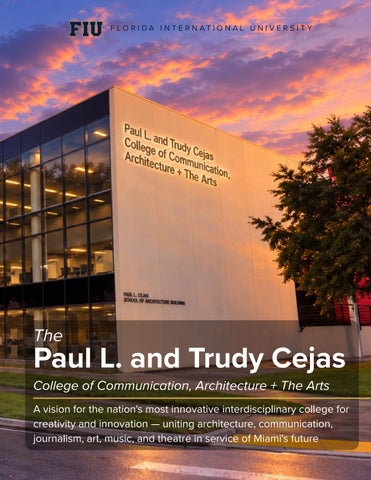
Ambassador and Mrs. Cejas, Few have shaped FIU and Miami as profoundly as the two of you. Ambassador Cejas, your service on the FIU Board of Trustees, your leadership in establishing the Wolfsonian at FIU and the School of Architecture — FIU's first professional school — and your service on the Miami-Dade County Public Schools Board reflect a shared lifelong belief that great communities are built through education, vision, and opportunity. Mrs. Cejas, the collection you and the Ambassador have built, and your support for the artists shaping contemporary art today, have helped make Miami a global city, a place where art is seen, discussed, created, and valued. The Paul L. Cejas School of Architecture Building already stands as a visible, permanent expression of that belief. Today, FIU has an opportunity to extend your legacy from a single building to an entire college — uniting architecture, communication, journalism, art, music, and theatre under a single name and a single, unifying vision for Miami's creative and civic future. A transformational naming gift would establish the Paul L. and Trudy Cejas College of Communication, Architecture + The Arts (Cejas College) — elevating FIU's most interdisciplinary college into a nationally distinguished home for the disciplines that design our buildings, tell our stories, inform our public, and shape our culture. The goal is bold and achievable: to build the nation's most innovative interdisciplinary college for creativity and innovation, one where architects, journalists, artists, musicians, performers, and communicators learn and create side by side. It would prepare students to succeed in each of these fields while attracting the world's leading practitioners, scholars, and creative leaders to FIU and South Florida.
Our Enduring Goal is to be counted among the nation's most innovative interdisciplinary colleges for creativity and innovation — a unified, nationally distinguished home for design, communication, journalism, and the arts, advancing FIU's Experience Impact 2030 goal of Top 30 public university standing while becoming Miami's most comprehensive creative and civic college.
1
Your Legacy Rooted in FIU and Miami Your relationship with FIU is inseparable from the university's emergence as a major public institution. And your influence is also deeply civic. Ambassador Cejas, your service on the MiamiDade County Public Schools Board reflects a commitment to education as the foundation of community progress. A named College of Communication, Architecture + The Arts would carry that commitment forward across every discipline it houses — opening pathways from K–12 arts and media education to undergraduate study, graduate training, professional practice, and civic and cultural leadership. Naming the entire college would complete a singular story that began with a single building: that Miami's future must be thoughtfully designed, clearly communicated, and imaginatively expressed — and that one name, the Cejas name, can stand for all three. Your legacy at FIU already lives in the people and lives shaped by the School of Architecture and the building that bears your name. The Paul L. and Trudy Cejas College of Communication, Architecture + The Arts would extend your tradition of uplifting the community to every discipline under its roof and would also honor your shared legacy and that of the entire Cejas family. It would affirm that architecture, communication, journalism, and the arts are essential to civic life: together they shape the spaces we inhabit, the stories that inform us, and how we understand ourselves and one another. They would stand as an enduring testament to your belief in education, creativity, public service, and Miami's limitless potential. No city needs this college more than Miami, and no university is better built to deliver it than FIU. Through this transformational investment, generations of FIU students would not merely participate in Miami's cultural and civic future. They would design it, report it, perform it, and lead it — at the nation's most innovative interdisciplinary college for creativity and innovation.
2
An Opportunity This is not simply the naming of an academic unit. It is an opportunity to unite every dimension of your legacy at FIU under one name: the design of the places where people live, the stories that inform and connect a community, and the art, music, and performance that give those places identity, meaning, and civic life. Communication, architecture, journalism, art, music, and theatre now sit at the center of design thinking, public life, technology, education, and economic development. FIU is positioned to lead at this intersection because our students reflect Miami, our programs are rooted in access and excellence, and the University brings architects, journalists, artists, musicians, performers, and technologists into daily collaboration. A named college would provide the stature and sustained investment needed to: Establish us as the nation's most innovative interdisciplinary college for creativity and innovation Unite six academically distinct, nationally recognized schools and departments under a single, permanently named college Elevate FIU's communication, architecture, journalism, and arts programs to national and international prominence Expand scholarships and graduate fellowships for talented students, including firstgeneration students Prepare graduates for sustainable careers as architects, designers, journalists, communicators, artists, and educators Recruit distinguished faculty and bring the world's leading practitioners, scholars, and creative leaders to Miami Strengthen advanced studios, newsrooms, performance venues, fabrication, and immersive creative technologies Grow exhibitions, public programming, and community partnerships across South Florida Embed the Ratcliffe Art + Design Incubator (RA+DI) as the College's platform for creative entrepreneurship, venture development, and social innovation
3
Driving Miami’s Information, Creative + Cultural Economies unity & Global Impac t Comm Museums & Cultural Institutions
Industry Partners
Strategic Themes
AI & Emerging Technologies
Climate Resilience
ters + Innovation P e Cen latfo r u t rm na g i s S Steven Cruz Institute for Media, Science + Technology
FIU by Design
emic Engines Acad
NBCUniversal Telemundo Univision
Community Engagement
Robotics & Digital Fabrication Lab
Herbert & Nicole Wertheim School of Music & Performing Arts
Department of Theatre
Kopenhaver Center
M-DCPS & K-12 Pipelines Arts & Culture
BOLD Agency School of Architecture
Experiential Learning
CARTA Students Student Success
Ratcliffe Art + Design Incubator (RA + DI) Alumni Leadership
Media Literacy Misinformation
Department of Art + Art History
Caplin News/Caplin News en Español
Creativity + Entrepreneurship
Miami Creative Economy
Applied Research
School of Communication
Global Perspectives
Lee Caplin School of Journalism & Media
DREAMS Location-Based Entertainment
Journalism & Democracy
Global Media Partners
Lee Caplin Immersive Studio for Altered Reality (iSTAR)
Urban Innovation
Public Programming
4
The Nation's Most Innovative Interdisciplinary College The goal is ambitious and achievable: establish the Paul L. and Trudy Cejas College of Communication, Architecture + The Arts as the nation's most innovative interdisciplinary college for creativity and innovation — the public model other universities look to when they ask how architecture, communication, journalism, and the arts should be taught together. Achieving that stature will require sustained investment in exceptional faculty, highly competitive graduate fellowships, student access, research and creative production, advanced facilities, exhibitions, visiting artists and practitioners, entrepreneurship, and national and international partnerships. The college's six-discipline model is already a competitive advantage few institutions can match. A Top-15 public school of architecture, a journalism school built with the largest naming gift in support of journalism in the history of the State University System of Florida, a music school built with the largest naming gift in support of music in that same system, and nationally accredited programs in communication, art, and theatre — all housed within one college, on one campus system, under one dean — position FIU to lead a category most universities have not even attempted to build.
Advancing FIU's Strategic Vision Your gift would directly advance FIU's Experience Impact 2030 priorities by expanding access, improving student and career outcomes, advancing innovation and creative discovery, strengthening community partnerships, and elevating FIU's national and global visibility. It would also provide the platform, resources, and momentum required to move FIU toward Top 30 public university standing and to build a college recognized nationally across every discipline it houses.
5
Architecture As the School of Architecture approaches the 30th anniversary of its founding, it stands at a defining moment. The school is located within the striking Paul L. Cejas School of Architecture building on the Modesto A. Maidique Campus. The building was named in recognition of the generosity of U.S. Ambassador Paul L. Cejas. The school has risen in three decades to become one of the nation’s Top 15 public schools of architecture, serving as South Florida’s most comprehensive public design institution and a globally engaged center for research and professional education. Limited to 800 uniquely talented students, the school offers professional and postprofessional graduate degrees in architecture, landscape architecture, interior architecture, and one of the nation’s first – and the state’s only – Doctor of Design (D.Des). The D.Des is a distinctive academic credential that elevates the school’s national profile and positions FIU at the forefront of advanced research design. The school is fully accredited by the National Architectural Accrediting Board (NAAB), the Landscape Architectural Accreditation Board (LAAB), and the Council for Interior Design Accreditation (CIDA). The school’s influence extends well beyond the studio. Signature annual design events such as Festival of the Trees and Walk on Water have become emblematic of its culture of experimentation, public engagement, and design distinction. A founding partner in the FIU Institute of the Environment and recipient of the National Science Foundation’s Convergence Accelerator grant, the school is advancing work through its Robotics and Digital Fabrication Lab to prepare architects, engineers, and the construction workforce to meet the evolving needs, challenges, and opportunities of the profession through AI, robotics, and immersive technologies.
Miami Beach Urban Studios The FIU School of Architecture Miami Beach Urban Studios (SOA MBUS) is a unique 7,500-square-foot facility in the 420 Lincoln Road Building that hosts an interdisciplinary array of innovative exhibitions, classes, research laboratories, and events for the following FIU School of Architecture departments: Architecture, Landscape Architecture, and Interior Architecture. MBUS houses the 3,500-squarefoot Knight-sponsored SOA Innovation Lab, which, with over 62 3D printers, is one of the largest 3D printing laboratories of its kind in the United States. The lab is proud to have been selected to be a participant in the HP/EDUCAUSE Building the Campus of the Future Project.
What Your Gift Would Make Possible As a named, elevated college, the Paul L. and Trudy Cejas College of Communication, Architecture + The Arts would take the foundation we have already built together and give it the stature, faculty, and resources to compete nationally — not as six separate programs measured against six separate sets of peers, but as a single, integrated model of interdisciplinary creativity and innovation that no other public research university in the country currently offers at this scale.
Five Strategic Priorities to Uplift the College 1. Create a School of Visual Arts with a Globally Elite Masters of Fine Arts Internationally recognized faculty recruitment and fully funded MFA fellowships Visiting artist and curator residencies Advanced studios and fabrication environments Strategic alliances with the Patricia & Phillip Frost Art Museum and Miami's leading museums and collectors 2. Student Support and Cejas Creative Futures Scholars Endowed scholarships and graduate fellowships across all six schools and departments Study abroad, professional travel, and conference support Paid internships, exhibitions, commissions, and teaching placements K–12 pipeline initiatives connecting Miami-Dade County Public Schools to FIU
3. Public-Facing Infrastructure and Creative Spaces Named studio and exhibition space at 420 Lincoln Road, identified as FIU Paul L. and Trudy Cejas College of Communication, Architecture + The Arts | Miami Beach On-campus immersive media, newsroom, and storytelling labs Community-based contemporary exhibition and performance spaces Advanced architecture and fabrication studios 4. Doctor of Design (D.Des.) Global Innovation Initiative Endowed doctoral fellowships and distinguished global scholars Research partnerships with municipalities, developers, and cultural institutions Applied research tied to resilience, affordable housing, mobility, and sustainable urbanism National and international convenings on the future of coastal and global cities 5. Dean's Strategic Investment Fund Strategic faculty recruitment and retention across the college Faculty research, creative practice, and scholarly innovation grants Marketing and branding for the newly named Paul L. and Trudy Cejas College Flexible capital to seize emerging opportunities that cannot wait for traditional funding cycles
8
CARTA’s Current Foundation of Excellence Eleven buildings and 167,551 square feet across the Modesto A. Maidique Campus and Biscayne Bay Campus including the Paul L. Cejas School of Architecture Building Wertheim Performing Arts Center Ratcliffe Art + Design Incubator Named studio and exhibition space at 420 Lincoln Road in Miami Beach Community-based sites throughout Miami-Dade County Six schools and departments spanning Architecture Communication Journalism Art Music Theatre 9
Spanish-Language Journalism CARTA is ahead of the competition in offering a bilingual Spanish-language journalism master’s program. Alumni include Emmy winners, Telemundo anchors and multimedia reporters, digital media directors, and winners of prestigious awards such as the Pulitzer, the Hearst National Championship, and the Sunshine State Awards.
The Ratcliffe Art + Design Incubator (RA+DI) was established at FIU's Biscayne Bay Campus and funded through the Philip E. and Carole R. Ratcliffe Foundation to bridge the gap between creative practitioners and entrepreneurial success. Rooted in the Arts and open to all college students, RA+DI has already helped its fellows launch nearly 100 ventures — early proof of a model the named college would scale across every discipline it houses.
CARTA hosts over 3,700 students from about 100 countries and 682 full- and part-time faculty and staff. More than 21,000 students – a third of the university’s student population – are registered for CARTA courses annually. 10
One College, Six Disciplines The School of Communication is nationally accredited by the Accrediting Council on Education of Journalism and Mass Communication (ACEJMC) and serves nearly 1,500 students, home to the Lillian Lodge Kopenhaver Center for the Advancement of Women in Communication and the FIU Bold Agency, a faculty-led, student-driven public relations agency. The Lee Caplin School of Journalism & Media is fully accredited by the Accrediting Council on Education in Journalism and Mass Communications (ACEJMC) and is home to the #1 college newscast in the Southeast (Caplin News and Caplin News en Español) and the nation's first and most accomplished master's program in Spanishlanguage journalism. The School of Architecture is housed in the Paul L. Cejas School of Architecture Building and has risen in three decades to become one of the nation's Top 15 public schools of architecture, serving 800 uniquely talented students. It offers the state's only Doctor of Design (D.Des.), and is fully accredited by the National Architectural Accrediting Board (NAAB), the Landscape Architectural Accreditation Board (LAAB), and the Council for Interior Design Accreditation (CIDA). Signature events such as Festival of the Trees and Walk on Water, and initiatives such as the Robotics and Digital Fabrication Lab, keep the School at the leading edge of design education. The Department of Art + Art History serves nearly 800 students in art education, art history, and the visual arts, including the Master of Fine Arts (MFA), and is fully accredited by the National Association of Schools of Art and Design (NASAD) and the Council for the Accreditation of Educator Preparation (CAEP). The department operates a student-run fine art gallery on Washington Avenue in Miami Beach and is deeply engaged with Art Basel, Design Miami, Art Miami, and Art Palm Beach. The Herbert and Nicole Wertheim School of Music & Performing Arts — known affectionately as The Wertheim, and established with the largest naming gift in support of music in the history of the State University System of Florida — is home to 230 uniquely talented students and produces and performs over 100 events annually at the Wertheim Performing Arts Center. The Department of Theatre serves 125 uniquely talented undergraduate students, is fully accredited by the National Association of Schools of Theatre (NAST), and partners with the Miami-Dade County Office of Cultural Affairs, the GableStage Theatre Company, and the refurbished Coconut Grove Playhouse. 11
CARTA | #CreativeForcesAtWork
Creativity shapes how we experience and understand the world around us. At CARTA, creativity is not simply personal expression; it is also a powerful economic and cultural force. In fiscal year 2022, the creative economy contributed upwards of $2.06 billion directly to Miami-Dade County’s economy, not including incidental spending, while statewide impact exceeded $5.8 billion in economic activity.
Recognizing Your Philanthropic Investment in FIU and South Florida FIU would be proud to recognize your generosity by permanently naming the college — encompassing the already-named Paul L. Cejas School of Architecture Building — as well as prominent identification across campus, publications, digital platforms, exhibitions, and signature initiatives; recognition of a named studio and exhibition space as the FIU Paul L. and Trudy Cejas College of Communication, Architecture + The Arts | Miami Beach at 420 Lincoln Road; and placement of your name on the Transformational Donors wall in the Management and Advanced Research Center (MARC) Building lobby. The Paul L. and Trudy Cejas College will enjoy an enduring association with student achievement, creativity, civic impact, and Miami's cultural leadership.
Experiential Learning | Community Impact At the core of CARTA’s identity is an experiential, interdisciplinary “learn by doing” philosophy that places students in real-world environments long before graduation. Through performances, exhibitions, studios, internships, media platforms, public engagement, and collaborative partnerships, students actively practice their disciplines while developing the technical fluency, creative vision, ethical grounding, and entrepreneurial mindset necessary to lead in an increasingly interconnected world. As a result of this applied teaching and research model, CARTA graduates are professionally prepared, ethically grounded, and equipped to contribute immediately within their fields. Their work helps fuel Miami’s emergence as a global cultural and creative hub through partnerships with world-class design firms, museums, performing arts organizations, prestigious galleries and collections, media and technology companies, startups, educational institutions, and national and international cultural convenings. CARTA’s impact extends well beyond the University. Our arts educators carry the transformative power of creativity into the region’s K–12 schools, where access to arts education is often limited by funding and resources. Through outreach initiatives and community partnerships, young people are introduced to visual arts, theatre, music, architecture, design, and creative expression in ways they may never have encountered, opening pathways to futures and careers that once seemed out of reach.
13
Experiential learning opportunities are a hallmark of the nation’s best colleges of communication, architecture, and arts. Some experiential learning opportunities we currently offer include: Caplin News at our Lee Caplin School of Journalism & Media and our Miami and DC news bureaus The FIU Wertheim Marching Band and the FIU Wertheim Courtside Players support FIU Athletics FIU Symphony Orchestra, FIU Choir, FIU Gospel Choir, FIU Opera, and FIU Latin Jazz all perform in the Herbert and Nicole Wertheim School of Music & Performing Arts FIU Theatre productions at the Wertheim Performing Arts Center, a professional venue with a 200-seat proscenium theatre and a 90- to 120-seat black box theatre FIU Architecture’s graduate internship class’s FIU By Design, a professional service and consultation unit within the college; Festival of the Trees; Walk on Water, a School of Architecture signature tradition since 1989 FIU Studio Learning + Culture: Studio-based education emphasizing learning-by-doing, bringing in visiting professionals to work with students Partnerships with the Coconut Grove Arts Festival, Miami Art Week, and Design Miami The FIU NBCU Fellowship, allowing Journalism + Media students to participate in and help shape a truth- and fact-based news process FIU Univision STEP Capstone Practicum Semester, an opportunity for students to train with Univision journalism and media professionals FIU Caplin News TV Studio, home to Newsbreak, the Caplin School of Journalism & Media’s live morning newscast in English and Spanish FIU Bold Agency, a faculty-led, student-driven public relations agency within the School of Communication
An Additional Benefit — a School of Visual Arts for the Cejas College With dedicated funded from your gift, the Department of Art + Art History would search for a Founding Director for a newly created School of Visual Arts at the Paul L. and Trudy Cejas College of Communication, Architecture + The Arts. This is a unique opportunity to unite two powerful dimensions of your legacy at FIU: the design of the places where people live and the art that gives those places identity, meaning, and civic life. Visual arts now sit at the center of design thinking, immersive technology, public space, education, entrepreneurship, and economic development. FIU is positioned to lead at this intersection because our students reflect Miami, our programs are rooted in access and excellence, and the university brings artists into daily collaboration with architects, journalists, musicians, performers, technologists, and entrepreneurs. The newly established school would provide the stature and sustained investment needed to: Build Florida's top-ranked visual arts school and position it among the nation's top 15 Elevate FIU's visual arts programs to national and international prominence Expand scholarships and graduate fellowships for talented students, including firstgeneration students Prepare graduates for sustainable careers as artists, creative professionals, entrepreneurs, and educators Recruit distinguished faculty and bring the world's leading artists, educators, historians, scholars, curators, and collectors to Miami Strengthen advanced studios, fabrication, digital arts, and immersive creative technologies Grow exhibitions, public art, and community partnerships across South Florida Embed the prominent CARTA Ratcliffe Art + Design Incubator as the school's platform for creative entrepreneurship, venture development, and social innovation
One School, Multiple Footprints A School of Visual Arts would give our distinctive public mission the visibility and resources to compete at the highest level while remaining unmistakably grounded in access, student success, and Miami. The School of Visual Arts would be conceived not as a single building, but as a connected network of academic, entrepreneurial, exhibition, and community spaces. Its reach across FIU and South Florida would distinguish it from traditional visual arts schools and provide students with direct access to the region's campuses, communities, cultural institutions, creative industries, and audiences. Modesto A. Maidique Campus. The school’s principal academic footprint would support undergraduate and graduate instruction, faculty studios and research, student exhibitions, interdisciplinary collaboration, and connections with the Patricia & Phillip Frost Art Museum, Casa Cuba, and FIU's broader creative and research enterprise. Biscayne Bay Campus. The CARTA Ratcliffe Art + Design Incubator would anchor the newly-uplifted school's creative-enterprise footprint — connecting art and design education with entrepreneurship, prototyping, technology, venture formation, and social innovation. 420 Lincoln Road | Miami Beach. Named studios and exhibition space — identified as Paul L. and Trudy Cejas College of Communication, Architecture + The Arts’ School of Visual Arts | Miami Beach—anchoring the school's public presence in the heart of Miami Beach. Throughout South Florida. Partnerships with Miami-Dade County Public Schools, colleges, universities, museums, collectors, municipalities, cultural organizations, neighborhoods, and creative industries would make the region itself an extended classroom, studio, exhibition venue, and laboratory for public impact.
16
An Integrated Creative Pipeline The elevated school would unite a comprehensive portfolio of programs that prepares students for three interconnected futures: as artists who create original work and shape culture; as creative professionals who apply visual thinking across museums, galleries, media, design, technology, public art, entrepreneurship, and the creative economy; and as educators who inspire the next generation in schools, museums, universities, and communities. Undergraduate Programs BA in Visual Arts. A broad, interdisciplinary foundation in studio practice, art history, visual literacy, and creative problem-solving. BFA in Visual Arts. A rigorous, studio-intensive professional degree focused on conceptual development, technical mastery, and portfolio readiness. BA in Art History. Preparation in research, writing, curatorial practice, and cultural interpretation for museums, galleries, education, and arts leadership. BS in Art Education. Preparation for future visual arts educators who will inspire the next generation throughout Miami-Dade County and Florida. Graduate Programs MFA in Visual Arts. The school's terminal degree and principal platform for national distinction, bringing ambitious artists, exhibitions, critical dialogue, and visiting creative leaders to Miami. MS in Art Education. Advanced research, pedagogy, and leadership for educators serving schools, museums, and community organizations. MAT in Art. A direct pathway for practicing artists and graduates to become certified, highly qualified art educators. Together, these programs create a continuum from classroom to studio, from emerging talent to professional practice, and from local opportunity to global recognition.
17
Artists, Creative Professionals, and Educators The School of Visual Arts would reject the false choice between artistic excellence and professional preparation. Students would develop a distinctive creative voice, rigorous studio and research practices, and the technical mastery required to become accomplished artists. At the same time, they would learn how to communicate ideas, collaborate across disciplines, manage projects, build audiences, understand markets, use emerging technologies, and sustain meaningful careers. Experiential learning would connect every student to the professional world through exhibitions, commissions, internships, residencies, community projects, museum and collector partnerships, teaching placements, visiting-artist engagement, and entrepreneurial development through RA+DI. Graduates would leave FIU with strong portfolios, professional networks, practical experience, and the confidence to create opportunities for themselves and others. For future educators, the school would combine artistic practice with pedagogy, research, cultural understanding, and classroom experience. Its graduates would strengthen visual arts education across Miami-Dade County and Florida — ensuring that young people encounter excellent arts instruction and see creative careers as attainable futures.
Ratcliffe Art + Design Incubator: From Creative Practice to Enterprise The CARTA Ratcliffe Art + Design Incubator (RA+DI) would become a defining component of the School of Visual Arts and its principal engine for creative entrepreneurship. Established at FIU's Biscayne Bay Campus and funded through the Philip E. and Carole R. Ratcliffe Foundation, RA+DI's mission is to bridge the gap between creative practitioners and entrepreneurial success while promoting innovation across the FIU community. Since launching, RA+DI has already helped its fellows bring nearly 100 ventures to life—early proof that this model works and a strong foundation for the expanded role RA+DI would play within the school. RA+DI expands traditional studio education by helping selected student fellows turn creative ideas into viable products, services, businesses, intellectual property, and community solutions. Through a one- to two-year fellowship experience, artists and designers receive mentorship, studio and prototyping resources, legal and accounting guidance, market research, branding and marketing support, financial training, stipends, seed capital, and opportunities to design, demonstrate, pitch, and sell their work.
As part of the proposed school, RA+DI would advance four interconnected goals: Prepare artists and designers to build sustainable careers and launch creative ventures Develop diverse entrepreneurial leaders who create jobs and expand economic opportunity in South Florida Connect visual arts with design, technology, sustainability, health, public space, and social impact Build a lifelong network of Fellows, alumni, mentors, visiting entrepreneurs, industry partners, and investors RA+DI would also connect the school's academic programs and Miami Beach exhibition presence to FIU's wider innovation ecosystem. Students could move from creative exploration to prototyping, venture formation, public presentation, and market engagement — making entrepreneurship an integral part of visual arts education rather than an activity pursued after graduation.
A Global Destination for Creative Leadership The School of Visual Arts would be more than a place where art is taught. It would become an international destination where the people shaping contemporary art, arts education, visual culture, scholarship, and collecting come together to create, teach, study, exhibit, exchange ideas, and mentor the next generation. The school would attract renowned artists through faculty appointments, residencies, commissions, exhibitions, and master classes; leading educators through visiting professorships, institutes, and curriculum innovation; and distinguished historians and scholars through research appointments, symposia, lectures, publications, archival initiatives, and interdisciplinary collaborations. Collectors from Miami and around the world would be invited into the intellectual and creative life of the school through collection-based teaching, exhibition loans, public conversations, studio visits, student mentorship, and partnerships with the Patricia & Phillip Frost Art Museum, Pérez Art Museum Miami (PAMM), the Institute of Contemporary Art, Miami (ICA Miami), The Bass, and the Cejas College’s School of Visual Arts | Miami Beach. These relationships would give students extraordinary access to the people, ideas, and collections defining global visual culture while positioning FIU as an influential convener within the international art world.
What Your Gift Would Make Possible Student Opportunity and Career Preparation Endowed scholarships, MFA fellowships, and support for RA+DI Fellows would remove financial barriers and expand professional travel, study abroad, internships, teaching experiences, exhibitions, commissions, and entrepreneurial opportunities—preparing graduates to thrive as artists, creative professionals, and educators. Global Faculty and Creative Leadership Endowed faculty support and a distinguished global program of visiting artists, arts educators, art historians, scholars, curators, and collectors would strengthen mentorship, research, exhibitions, scholarship, and international visibility. A Nationally Distinguished MFA Fully funded fellowships, advanced studios, visiting critics, professional development, and major public exhibitions would position the MFA as one of the nation's most compelling programs while preparing graduates for sustained artistic practice, teaching, and leadership in the creative sector. Studios, Technology, and Creative Enterprise Investment in fabrication, digital and immersive arts, RA+DI prototyping and venture development, and community-based studios—including a named studio and exhibition space at FIU's 420 Lincoln Road building, identified as Paul L. and Trudy Cejas College of Communication, Architecture + The Arts’ School of Visual Arts | Miami Beach—would place students at the leading edge of contemporary practice. Education, Museum, and Collector Partnerships The school would strengthen pathways with Miami-Dade County Public Schools and Miami Dade College while deepening strategic connections with Pérez Art Museum Miami (PAMM), Miami's contemporary art museums, and leading private collectors from South Florida and around the world. These relationships would expand recruitment, transfer opportunities, internships, exhibitions, collection-based learning, public programming, and global professional networks.
21
Why Miami — Why Now Miami has become one of the world's most dynamic cultural capitals, connecting North America, Latin America, the Caribbean, and the global creative economy. Its museums, collections, fairs, galleries, design districts, and creative enterprises command international attention: in fiscal year 2022 alone, the creative economy contributed upwards of $2.06 billion directly to Miami-Dade County's economy—with statewide impact exceeding $5.8 billion. Yet its long-term cultural strength depends on whether Miami can cultivate and retain its own talent. FIU is the region's largest and most inclusive pipeline for that talent. By building a nationally prominent School of Visual Arts at Miami's public research university, this investment would ensure that the city's cultural future is shaped from within—by artists, educators, and cultural leaders who understand its history, represent its communities, and imagine what comes next. Miami's cultural ecosystem gives this ambition an extraordinary foundation to build on. Few American cities offer this concentration of world-class museums within a few miles of one another: the Pérez Art Museum Miami (PAMM) on the downtown waterfront, the Institute of Contemporary Art, Miami (ICA Miami) in the Design District, The Bass in the heart of Miami Beach, and FIU's own Patricia & Phillip Frost Art Museum—all complemented by one of the most active private collector communities in the world. A visual arts school with the ambition to rank among the nation's top 15 needs exactly this kind of ecosystem: institutions that exhibit emerging and established artists side by side, collectors willing to loan, gift, and champion new work, and a public genuinely engaged with contemporary art. Miami already has the audience, the institutions, and the collectors. What it does not yet have is a public university visual arts program built to match them—and that is precisely the opportunity this gift would create.
The Cejas Legacy Ambassador Cejas, your legacy lives in the School of Architecture and the building that bears your name. Mrs. Cejas, yours lives in Miami's galleries and museums, beginning at the doors of The Bass. The Paul L and Trudy Cejas College of Communication, Architecture + The Arts would bring them under one roof. Your continued philanthropy by forming the Paul L. and Trudy Cejas College of Communication, Architecture + The Arts would transform the Department of Art + Art History into the School of Visual Arts and extend your shared legacy and that of your family in a powerful and complementary direction. It would affirm that architecture and art are essential to civic life: one shapes the spaces we inhabit; the other shapes how we understand ourselves and one another. Together, they would stand as an enduring testament to your shared belief in education, creativity, public service, and Miami's limitless potential.
23
24
Thank you Ambassador and Mrs. Cejas, for your enduring commitment to uplifting FIU and the entire South Florida community. Your transformational investment will further deepen your FIU legacy, demonstrating to generations of FIU students that, thanks to you, they do not have to merely participate in Miami's cultural future. They can create it.
#CejasCreativeForcesAtWork!