july 2017
9
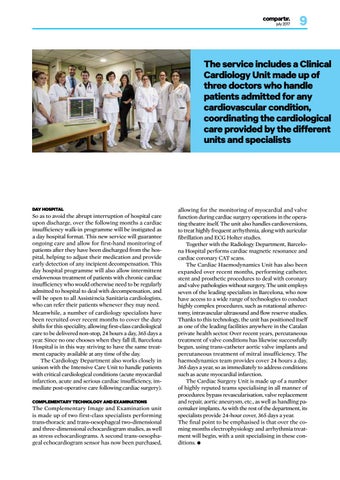
The service includes a Clinical Cardiology Unit made up of three doctors who handle patients admitted for any cardiovascular condition, coordinating the cardiological care provided by the different units and specialists
Day Hospital
So as to avoid the abrupt interruption of hospital care upon discharge, over the following months a cardiac insufficiency walk-in programme will be instigated as a day hospital format. This new service will guarantee ongoing care and allow for first-hand monitoring of patients after they have been discharged from the hospital, helping to adjust their medication and provide early detection of any incipient decompensation. This day hospital programme will also allow intermittent endovenous treatment of patients with chronic cardiac insufficiency who would otherwise need to be regularly admitted to hospital to deal with decompensation, and will be open to all Assistència Sanità ria cardiologists, who can refer their patients whenever they may need. Meanwhile, a number of cardiology specialists have been recruited over recent months to cover the duty shifts for this speciality, allowing first-class cardiological care to be delivered non-stop, 24 hours a day, 365 days a year. Since no one chooses when they fall ill, Barcelona Hospital is in this way striving to have the same treatment capacity available at any time of the day. The Cardiology Department also works closely in unison with the Intensive Care Unit to handle patients with critical cardiological conditions (acute myocardial infarction, acute and serious cardiac insufficiency, immediate post-operative care following cardiac surgery). Complementary technology and examinations
The Complementary Image and Examination unit is made up of two first-class specialists performing trans-thoracic and trans-oesophageal two-dimensional and three-dimensional echocardiogram studies, as well as stress echocardiograms. A second trans-oesophageal echocardiogram sensor has now been purchased,
allowing for the monitoring of myocardial and valve function during cardiac surgery operations in the operating theatre itself. The unit also handles cardioversions, to treat highly frequent arrhythmia, along with auricular fibrillation and ECG Holter studies. Together with the Radiology Department, Barcelona Hospital performs cardiac magnetic resonance and cardiac coronary CAT scans. The Cardiac Haemodynamics Unit has also been expanded over recent months, performing catheter, stent and prosthetic procedures to deal with coronary and valve pathologies without surgery. The unit employs seven of the leading specialists in Barcelona, who now have access to a wide range of technologies to conduct highly complex procedures, such as rotational atherectomy, intravascular ultrasound and flow reserve studies. Thanks to this technology, the unit has positioned itself as one of the leading facilities anywhere in the Catalan private health sector. Over recent years, percutaneous treatment of valve conditions has likewise successfully begun, using trans-catheter aortic valve implants and percutaneous treatment of mitral insufficiency. The haemodynamics team provides cover 24 hours a day, 365 days a year, so as immediately to address conditions such as acute myocardial infarction. The Cardiac Surgery Unit is made up of a number of highly reputed teams specialising in all manner of procedures: bypass revascularisation, valve replacement and repair, aortic aneurysm, etc., as well as handling pacemaker implants. As with the rest of the department, its specialists provide 24-hour cover, 365 days a year. The final point to be emphasised is that over the coming months electrophysiology and arrhythmia treatment will begin, with a unit specialising in these conditions.
.