In Commemoration of
MARY DALY
The Life of A Radical Feminist Theologian Kelsey Sharpe // ksharpe@media.ucla.edu On January 3, 2010 Mary Daly died from natural causes at the age of 81. Hers is not a name that is well known in most circles, but the feminist world has lost one of its most unabashed and courageous voices. Daly’s life and studies showed that it was possible to be both a radical feminist and a Christian theologian— two characteristics that many seem to believe are mutually exclusive. Born in Schenectady, NY in 1928, Daly was raised Irish Catholic. One of her earliest memories of the church was when a male classmate and altar boy at her parochial school told her that she would never be able to perform mass, as she was female. In an editorial for the New Yorker Daly wrote that this brought up an “unquenchable rage.” Despite this disheartening experience, Daly would go on to obtain a B.A. in English from The College of Saint Rose, an M.A. in English from The Catholic University of America, and a doctorate in religion from St. Mary’s College. She continued her education by getting two doctorates from a Swedish Catholic university—the University of Fribourg—one in sacred theology and one in philosophy. In 1967 Daly took a job teaching at Boston College, where she was often at the center of controversy. When she began teaching at BC it was still an all-male school, and she was nearly dismissed (in that she was denied tenure) for the radical views expressed in her first book “The Church and the Second Sex” (1968). However, administrators were convinced by the students to keep her on as faculty, and Daly would eventually become 04 FEM
a tenured professor. However, in 1999 Daly retired (under some duress) after a discrimination suit was brought against her by two male students; she had instituted a policy wherein male students were forbidden from taking her upper-division women’s studies classes—a breach of Title IX. Daly described herself as both a radical feminist and an eco-feminist, and her body of work reflects the diversity of her interests. While “The Church and the Second Sex” (1968) was her first book, “Beyond God the Father” (1973) is more famous for its content and characteristic writing style. In it, Daly attempts to lay the foundation for a feminism that embraces theology by breaking down the male-centered texts of the Bible and opening a space for women in the church. While the oppressive nature of church patriarchy contributed to her increasingly radical views, the argumentative discourse that she began in theological thought encouraged her writing in other fields. For example in “Gyn/ecology: The Metaethics of Radical Feminism” (1978), she actually asserts that patriarchy was in itself a kind of religion. As students at a secular institution, we may not have an appreciation for the difficulty of Daly’s everyday life, especially considering she was raised during a time when women were often excluded
from academia as a matter of course. The fact that her determination to overcome the patriarchy that she felt was so unacceptable should be an inspiration for those of us who have inherited her legacy. Similarly, Daly’s background and continued studies of theology are evidence that feminism and religion do not have to be at odds— if you consider the two as mutually beneficial, you may even find that a better, or different, understanding of one can lead to a clearer view of the other. For more information on Daly, comments from friends, students and loved ones, and links to other obituaries, see the website established by her estate—www.marydaly.org.
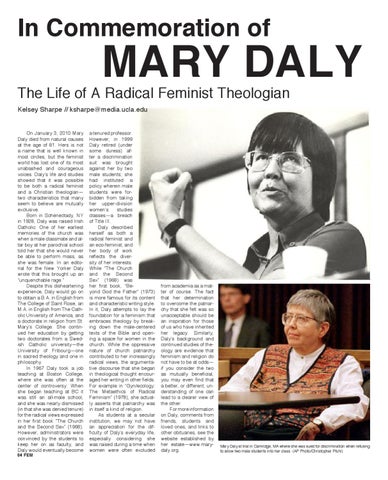
Mary Daly at trial in Camridge, MA where she was sued for discrimination when refusing to allow two male students into her class. (AP Photo/Christopher Pfuhl)