C U LT U R A L R E S O U R C E S
Fairfax County Marks 30 Years of Archaeology By Aimee Wells, Park Authority Archaeologist
Jackie Cuyler, a 25-year volunteer, says, “What better way to combine my love of history and the outdoors than to join the Fairfax County archaeology program? The best part of being a volunteer has been the lifelong friends made through our shared interest in excavating and interpreting the past.”
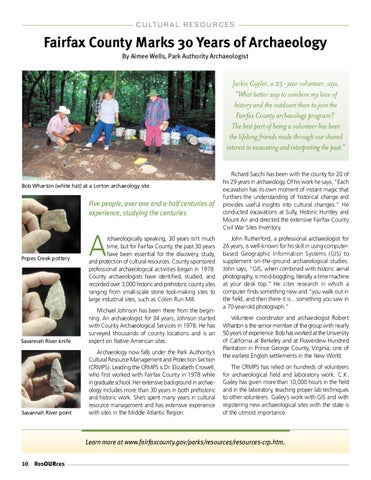
Bob Wharton (white hat) at a Lorton archaeology site
Five people, over one and a-half centuries of experience, studying the centuries
Popes Creek pottery
A
Savannah River knife
Michael Johnson has been there from the beginning. An archaeologist for 34 years, Johnson started with County Archaeological Services in 1978. He has surveyed thousands of county locations and is an expert on Native American sites.
Savannah River point
Archaeology now falls under the Park Authority’s Cultural Resource Management and Protection Section (CRMPS). Leading the CRMPS is Dr. Elizabeth Crowell, who first worked with Fairfax County in 1978 while in graduate school. Her extensive background in archaeology includes more than 30 years in both prehistoric and historic work. She’s spent many years in cultural resource management and has extensive experience with sites in the Middle Atlantic Region.
rchaeologically speaking, 30 years isn’t much time, but for Fairfax County, the past 30 years have been essential for the discovery, study, and protection of cultural resources. County-sponsored professional archaeological activities began in 1978. County archaeologists have identified, studied, and recorded over 3,000 historic and prehistoric county sites ranging from small-scale stone tool-making sites to large industrial sites, such as Colvin Run Mill.
Richard Sacchi has been with the county for 20 of his 29 years in archaeology. Of his work he says, “Each excavation has its own moment of instant magic that furthers the understanding of historical change and provides useful insights into cultural changes.” He conducted excavations at Sully, Historic Huntley and Mount Air and directed the extensive Fairfax County Civil War Sites Inventory. John Rutherford, a professional archaeologist for 26 years, is well-known for his skill in using computerbased Geographic Information Systems (GIS) to supplement on-the-ground archaeological studies. John says, “GIS, when combined with historic aerial photography, is mind-boggling, literally a time machine at your desk top.” He cites research in which a computer finds something new and “you walk out in the field, and then there it is…something you saw in a 70-year-old photograph.” Volunteer coordinator and archaeologist Robert Wharton is the senior member of the group with nearly 50 years of experience. Bob has worked at the University of California at Berkeley and at Flowerdew Hundred Plantation in Prince George County, Virginia, one of the earliest English settlements in the New World. The CRMPS has relied on hundreds of volunteers for archaeological field and laboratory work. C.K. Gailey has given more than 10,000 hours in the field and in the laboratory, teaching proper lab techniques to other volunteers. Gailey’s work with GIS and with registering new archaeological sites with the state is of the utmost importance.
Learn more at www.fairfaxcounty.gov/parks/resources/resources-crp.htm. 10
ResOURces