holders have relied on the monarchy as convenient arbiter for far too long. “As a result, a country that has historically prided itself on compromise and bending with the wind to fend off colonial powers has never developed the sort of institutional mechanisms to deal with its own internal problems,” he wrote. “Given the dramatic events of early 2010, the myth of a united people, so central to the ideology of the Thai state, has dissolved into the reality of serious social and ethnic divisions.” Among his most engaging stories was the crash of a Cathay Pacific flight over Vietnam in 1972, with 81 people on board. McBeth’s account is tremendously convincing, piecing together the evidence that persistently pointed to one man, Thai police lieutenant Somchai Chaiyasut. All the forensic evidence supported the theory that the blast came from a seat occupied by a pretty coffee shop hostess Somwang Prompin who was travelling with the seven-year-old daughter of the police officer, Sonthoya Chaiyasut. The pair were on their way to Hong Kong for a shopping trip. In court Somchai would deny he had loaded C4 into Somwang’s cosmetic case and argued: “How could I kill my own daughter?” He had taken out two insurance policies on both girls shortly before the flight took off. The court accepted a bomb was placed on board but stunned all by finding Somchai not guilty, probably because a Thai judge simply could not believe a Thai would do that to his own daughter. Somchai collected millions off the insurance company and moved to the US. Two years later he returned, with terminal cancer and died. For him this may have been a good thing. According to McBeth: “...bringing belated closure for airline staff and relatives, some of whom had seriously toyed with the idea of hiring a hitman to kill him.” In comparison to Thailand, McBeth says Indonesia has done well in its transition to a democracy over the past 10 years. But reservations persist particularly in regards to the impunity enjoyed by the country’s elite families and those linked to the military. “While the new legislators are generally younger and better educated they have shown by their behaviour that they are little different from their predecessors. To me that is the most disturbing trend of all,” he adds. He also singles out academics and journalists who were disbelieving of the carnage being committed by Pol Pot after his band of ultra-Maoists took control of Phnom Penh in 1975, despite the overwhelming evidence of atrocities committed. “Some journalists, particularly Der Spiegel correspondent Tiziano Terzani and the Far Eastern Economic Review’s Nayan Chanda, took the view that what we were hearing were gross exaggerations,
McBeth Collection
IN REVIEW
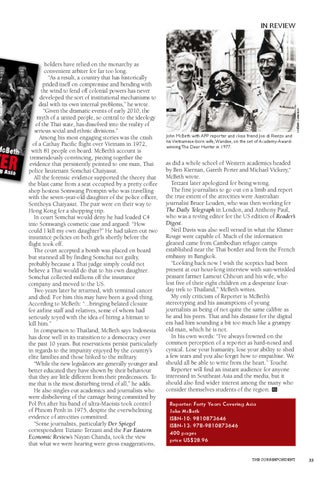
John McBeth with AFP reporter and close friend Joe di Rienzo and his Vietnamese-born wife, Wandee, on the set of Academy-Awardwinning The Deer Hunter in 1977.
as did a whole school of Western academics headed by Ben Kiernan, Gareth Porter and Michael Vickery,“ McBeth wrote. Terzani later apologized for being wrong. The first journalists to go out on a limb and report the true extent of the atrocities were Australian journalist Bruce Louden, who was then working for The Daily Telegraph in London, and Anthony Paul, who was a roving editor for the US edition of Reader’s Digest. Neil Davis was also well versed in what the Khmer Rouge were capable of. Much of the information gleaned came from Cambodian refugee camps established near the Thai border and from the French embassy in Bangkok. “Looking back now I wish the sceptics had been present at our hour-long interview with sun-wrinkled peasant farmer Lamout Chhoun and his wife, who lost five of their eight children on a desperate fourday trek to Thailand,” McBeth writes. My only criticism of Reporter is McBeth’s stereotyping and his assumptions of young journalists as being of not quite the same calibre as he and his peers. That and his distaste for the digital era had him sounding a bit too much like a grumpy old man, which he is not. In his own words: “I’ve always frowned on the common perception of a reporter as hard-nosed and cynical. Lose your humanity, lose your ability to shed a few tears and you also forget how to empathise. We should all be able to write from the heart.” Touché. Reporter will find an instant audience for anyone interested in Southeast Asia and the media, but it should also find wider interest among the many who consider themselves students of the region. Reporter: Forty Years Covering Asia John McBeth ISBN-10: 9810873646 ISBN-13: 978-9810873646 400 pages price US$28.96 THE CORRESPONDENT
33