Covnn Srony Ø
o
õ
o ñ
to rest, somehow more peacefull¡ would be if someone went to that very ridge, walked on it, tasted the thick
jungle heat. The families could not, or would not, go. But they could have a representative r'r,ho had known the fallen four. If such an opportunity arose, I wanted to be that witness.
t
of
1995, the opportunity seemed imminent in a stranger's phone call. Bill Forsyth, a retired air-force photoanalyst working as an MIA investigalast, in July
tor in Hawaii. had stumbled on Burrows incident." He was inquiring whether
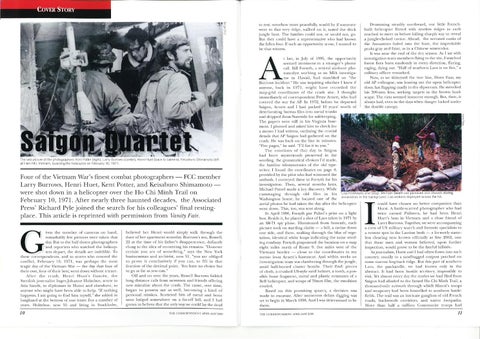
The last picture of the photographers Kent Potter (right), Larry Burrows (center), Henri Huet (back to camera), Keizaburo Shimamolo (left at Ham Nhi, Vietnam, boarding the helicopter on February 10, 1971
Four of the Vietnam War's finest combat photographers FCC member Larry Burrows, Flenri Huet, Kent Potter, and Keisaburo Shim¿¡¡sts were shot down in a helicopter over the Ho Chi Minh Trail on February I0,I97I. After nearly three haunted decades, the Associated Press' Richard Pyle joined the search for his colleagues' final restingplace. This article is reprinted with permission from Vanity Fair. iven the member of cameras on hand, remarkably few pictures were taken that day. But to the half dozen photographers and reporters rvho watched the helicopters depart, the details are indelible. To these correspondents, and to scores who covered the conflict, February 10, 1971, was perhaps the most tragic day of the Vietnam War the day that four of - down without a trace. their own, four of their best, went After the crash, Henri Huet's fiancée, the Swedish journalist Inger-Johanne Holmboe, wrote to Asia hands, to diplomats in Hanoi and elsewhere, to anyone who might have been able to help. "If nothing happens, I am going to find him myself," she added in longhand at the bottom of one letter. For a number of years, Holmboe, now 55 and living in Stockholm, 10
believed her Henri would simpl;' walk through the door of her apartment somedal'. Burrows's son, Russell, 22 at tlrre time of his father's disappearance, defiantly clung to the idea of recovering his remains. "Flowever certain you are of something," says the New York businessman and archivist, now 51, "1's¡ are obliged
to prove it conclusively if you can, to fill in that fraction of the decimal point. You have no choice but to go as far as you can." Off and on o\¡er the years, Russell Burrows fielded long distance calls from newsmen and friends offering ne¡r' minutiae about the crash. The cause, over time, began to possess me as well, becoming a kind of personal mission. Scattered bits of metal and bone were lodged somewhere on a far-off hill, and I had grown to believe that the only rvay rt'e could lay the dead THE CORRESPONDENT APRÌL-\,IAY
2OO0
I
"the knew if
anyone, back in 1971, might have recorded the map-grid coordinates of the crash site. I thought immediately of correspondent Peter Arnett, who had covered the war for AP. In 7972, before he departed Saigon, Arnett and I had packed 10 years' worth of deteriorating bureau fìles into metal trunks and shipped them Stateside for safekeeping. The papers were still in his Virginia basement. I phoned and asked him to check for a memo I had written, outlining the crucial details that AP Saigon had gathered on the crash. He was back on the line in minutes. "Five pages," he said. "I'll fax it to you." The emotions of that day in Saigon had been mysteriously preserved in the wording, the grammatical choices l'd made, the familiar idioslncrasies of the old typer.r,riter. I found the coordinates on page 4, provided by the pilot who had witnessed the ambush. I conveyed these to Forsyth for his investigation. Then, several months later, Michael Putzel made a key discovery. 'v\4rile
rummaging through old files in his Washington home, he located one of the
investigation team was clambering through the jungle, amid half-buried cluster bombs. Their find: pieces of cloth, a crushed US-style steel helmet, a tooth, a possible bone fragment, metal and plastic remnants of a Bell helicopter, and scraps of 35mm film, the emulsion eroded.
Based on this promising quarry, a decision was made to excavate. After numerous delays digging was set to begin in March 1998. And I was determined to be
THE CORRESPONDENT ¡\PRIL-r\IAY 2000
investigation team members flying to the site, I watched forest fires burn randomly in every direction, flaring, raging, dying out. "Half of southern Laos is on hre," a military offi cer remarked. Now, as we skimmed the tree line, Horst Faas, my old AP colleague, was leaning out the open helicopter door, hat flapping madly in the slipstream. He swivelled his 300-mm lens, seeking targets in the brown landscape. The vista seemed innocent enough. But, then, it always had, even in the days when danger lurked under
the double canopy. T o I
rLisa Hoshower and S/Sot Mrchael use prcKaxes and snovels excavation ln lhe background, Lao workers deployed across the hill
aerial photos he had taken the day after the helicopter went down. This, too, was sent along. In April 1996, Forsyth put Pulzel's print on a light box. Beside it, he placed a shot of Laos taken in 1971 by an SR-71 spy plane. Illuminated from beneath, each a hill, a ravine down picture took on startling clarity one side, and there, snaking through the blur of vegetation, identical white loops indicating the same winding roadway. Forsyth pinpointed the location on a map eight miles north of Route 9, f,ive miles west of the çle5s to the coordinates in my Vietnam border memo from Arnett's basement. And within weeks an
there.
Drumming steadily northn'ard, our little Frenchbuilt helicopter flirted rvith treeless ridges as each reached to meet us before falling sharply way to re't,eal a jungle-choked ravine. Ahead, the serrated ranks of the Annamites faded into the haze, the improbable peaks gray and faint, as in a Chinese watercolor. It was near the end of the dry season. As I sat with
could have chosen no better companion than Horst. A battle-scarred photographer who had twice earned Pulitzers, he had been Henri Huet's boss in Vietnam and a close friend of Larry Burrows. Togethe¡ we were accompanying a crew of US military search and foreusic specialists to a formerly namea remote spot in the Laotian bush less clearing now known officially as Site 2062, one that these men and \^romen believed, upon further inspection, would prove to be the fateful hillside. Asjournalists, Horst and I had often flown into such country, usually to a sandbagged outpost perched on some narrow hog-back ridge. But this part of southern Laos, the panhandle, we had known only in the abstract. It had been hostile territory, impossible to visit. Yet almost every day the stories we had filed from Saigon had alluded to the famed Ho Chi Minh Trail, a thor,rsand+nile network through which Hanoi's troops and weaponry had been funnelled to southern battlefields. The trail was an intricate ganglion of old French roads, backwoods corridors, and native footpaths. More than half a million Communist troops had 11