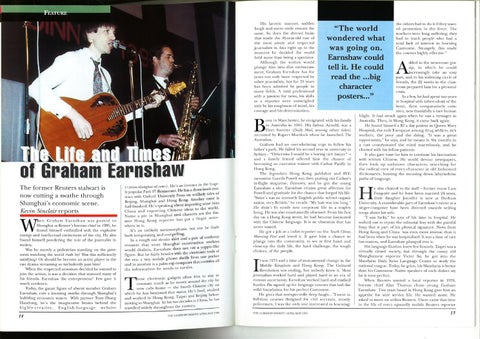
His laconic manner,
sudden
laugh and warm smile remain the same. So does the shrewd brain that made the 46-year-old one of
the most astute and
respected journalists in Asia right up to the
moment he decided the world held more than being a spectator. Although the notion would
plunge him into dire embarrassment, Graham Earnshaw has for years not only been respected by other journalists, but for 20 years has been admired by people in many helds. A total professional with a passion for ne'rvs, his skills as a reporter were outweighed only by his toughness of mind, his courage and his delerminaf ion.
'oThe world
wondered what was gorng on. Earnshaw could tell it. I{e could read the ...big character posters...!!
orn in Manchester, he emigrated with his family to Australia in 1965. His father, Arnold, was a Fleet Streeter (Daily Mail, atnong other titles) recruited by Rupert Murdoch when he launched The Australian.
Graham had no overwhelming urge to follow his father's path. He failed his second year in university in Sydney - "Otherwise I would be a boring rich lawyer" -
of Eraham Eann$haw The former Reuters stalwart is now cutting a swathe through Shanghai's economic scene. Knin Sinclair reports en Graham Earnshaw was posted to as Reuter's bureau chiefin 1995, he found himself enthralled with the explosive energy and intellectual excitement of the city. He also found himself pondering the role of the journalist in
Shanghai
socrety.
Was he merely a pedestrian standing on the pavement watching the world rush by? Was this suff,rciently satisfying? Or should be become an active player in the vast drama streaming so turbulently past him?
When the respected newsman decided he wanted to
join the action, it was a decision that stunned many of his friends. Earnshaw the entrepreneur? Few gave it much credence. Toda¡ the gaunt fìgure of absent member Graham Earnshaw, cuts a knowing swathe through Shanghai's bubbling economic waters. With partner Tony Zhang
Haodong, he's the imaginative brains behind the highly-creative, English-lansuase website
in the huge(<uuw.shanghai-er1'com>) ' He's an investor ly popular Park 97 tract with Oxford Beijing, Shanghai and H halÊfinished. He's sPeakin
China and exPorting C Name a pie in Shangha finger somemer Hong Kong rep"orter has got a where in it. one he finds It's an unlikely metamorphosis' but both invigorating and com In a rough old demin
never waned.
He got a job as a cadet reporter on the South China Morning Post and loved it. It gave him a chance to
J t was 1973 and a time of monumentàl change in rhe I Middle Kingdom and Hong Kong. The Cultural
to stay rn gadgets allow him around the city he
hese electronic constant touch as h" -outt ChÏtt't ¡.11,,':ti now calls home - the fourth studied He'slived' tt^tt' he hu, b.rto*.l
which 'n'i .nurr* ä;g, i"iPti 1q worked i,t Ho.,g and worKeu ano î:t:;: 'r in china' he has moving to Shanghai. I ;i;";;;:tades colrntry travetlãd wideþ throughout the
ryÏ
l
14
and a family friend offered him the chance of becoming an executive trainee with Cathay Pacific in Hong Kong. The legendary Hong Kong publisher and FCC raconteur Careth Powell was then putting out Cathay's in-flight magazine, Discouery, and he got the young Earnshaw a slot. Earnshaw retains great affection for Powell and gratitude for the chance that forged his life. "Swire's was an inter-rsely English public school organisation, very British," he recalls. "My hair was too long." He didn't fit neatly into corporate life in a miehry hong. He was also unashamedly obsessed. From his first day on a Hong Kong street, he had become fascinated with the Chinese language. It is an obsession that has
plunge into the communiry to see at first hand and close-up the daily life, the hard chalìenge, the tough choices, of the people.
trousers that most Shan would disdain, Earnshaw fìgure. But he fairlY bristle the era: a tinY mobile Ph and in another is a Palm-t the information he needs to survlve'
THE coRRIsPoNDENT/ÀPRIL-l\4AY
99e
IRevolution was ending, but nobody knew it. Most journalists worked hard and played hard in an era of riotous uncertainty. Earnshaw rvorked hard and studied harder. He signed up for language courses that laid the solid foundation for his perfect Cantonese. He gives that unexpectedly deep laugh... "I went to full-time courses designed for civil servants, mostly policemen. I was the only one interested in learning; THE CORRESPONDENT,/APRIL-r\{AY 1999
the others had to do it if they want-
ed promotion in the force. The teachers were long suffering; they had to teach people who had a total lack of interest in learning Cantonese. Strangely, this made the courses highly effective." dded to the newsroom gossip, in which he could ncreasrngly take an easy part, and to his widening circle of friends, ttre 22 weeks in the classroom prepared him for a personal crisis.
As a bo¡ he had spent two years in hospital with tuberculosis of the bone, then comparatively common, now thankfully a rare human blight. It had struck again when he was a teenager in Australia. Then, in Hong Kong, it came back again. He found himself a $2 a day patient in Queen Mary Hospital, the only European among drug addicts, sick workers, the poor . and the dying. "It was a great opportunit¡" he says, and he means it. Six months in a cast concenhated the mind marvelousl¡ and he chatted with his fellow patients. It also gave time for him to continue his fascination with written Chinese. He would devour newspapers, then look up unknown characters, searching for the radical core of every character in old fashioned dictionaries, hunting the meaning down labyrinthine paths oflanguage.
T T.
also chatted to the staff
- former nurse
Lam
.Fl H iäåî1,' :.H;J.' :T ïi' :? i-"ä1i
University. A considerable part of Earnshaw's talent as a singer-composer have been dirêcted towards writing songs about his wile. "I was lucky," he says of his time in hospital. He walked out to rejoin the editorial fray with the painful limp that is part of his physical signature. News from Hong Kong and China was even more intense than it had been when he was hospitalised. It was a time of rare fascination, and Earnshaw plunged into it. His language fixation knew few bounds. Taipei was a virtually closed society, but through the canny old Shanghainese reporter Victor Su, he got into the Mandarin Daily News Language Centre to study the national tongue. Toda¡ he grins, his Mandarin, is better than his Cantonese. Native speakers of each dialect say he is tone-perfect. \Arhen Reuters wanted a local reporter in 1976, bureau chief Alan Thomas chose young Graham Earnshaw. Two years based in Hong Kong gave him an appetite for wire service life. He wanted more. He asked to move on within Reuters. There came that time in the life of every upwardly mobile Reuters reporter
t5