was the culmination of a political
The role of the military in Indonesia has always been high profile. Schwarz
system "disengaged frorn r-eality". The president's choice of cabinet members
cliscolÌnts tl-re possibility of factions emerging that could splitthe colrntly or effect Suhafto's ren-ioval. "The military maintains a considelable degree of unity," he says, adcling that there is no
- inclucling his key fi'iends and family rnembers - reflected his belief that the International Monetary Fund
\ùØashington
-
-
and
are out to get him.
"The conventional wisdorn is that Habibie has no constituency, is disliked by tl'ie military and is likely to have a
very brief futr-rre." Pr-rndits forget, Schvr.arz says, that
the leadelship of tfie military
"The elite and the rniddle
tl'rat tl'ie generals
class are a truly shell-shocked
sector of society," Schwarz obselves, The astonishment is
him," he
rippling outward from Jakarta to the provinces in this highly centralisedsociety.ButSchwarz : does not see much of a future :. for the Iargely dormant
Schu.'arz is emphatic that thele are no parallels with the
widespread violence
Sirrrtrrering discontent in Indonesia ca1>tr-rrecl tkre attentiorr of rr.errrl>ers v,zl-ro sor-rg4l-rt incisirze anal¡zsis. Geofge FRrrssell listened to ts/o e><perts Schwarz firmly believes
the
'Tn" fjnancial crisis in Tndonesia I lemained the hot lunch topic at
sprawling archipelago has leached
the club in March. Several speakers
watershed
speculated on how far the Indonesian economic, political and social stlucture
existence. "Indonesia has ttndergone discreet, in'er.,ocable change," he says. "It can't go back to being run the way it was Lun."
would spiral out of control. Adam Schwarz, forr.rrer Jakarta
a
in its half-century of
.
The economy is not on the brink of collapse; it is collapsing. o Jakafia is in a state of denial. Tl're colporate sector is bankrupt,
the banking system is facing similar conditions, although govel'nment debt
"Thele a couple of factors
tendencies but a greater sense of autonomy," he says. Several instrr-rctions from Jakalta, such as the IMF-backed call to líft inter-plovincial tlade taxes, are
divided military and profound ideological tensions in lural areas at the encroachment of
Communist Party members
within rural Bali and
local
He also disputes the notion of a power struggle with the military after Suharto retires ol dies over the choice of Bacharuddin Jusuf Habibie as his
econofiry. "There will be a re-dependence on primary resoLlrces: oil, gas, mining ancl wood. This gives power to the
level.
designated successor.
oomsday scenarios have abounded since the regional financial turmoil began last year. However', one of the grimmest pictures of the future of Indonesia was painted by Er-rgene Galbraith,
the real economy, the political system
business sector.
"The whole framework is under
system." As the clisis hacl broadened and
Amid the crisis, the nation's rr,rbber stamp legislatule gathered to approve
government.
deepened, Schwarz notes, turo key issues have etnerged:
Plesident Suharto's re-selection for
forces
tùØe
question. need to revisit the great communal issues: lhe military, religion, ethnic, even the geoglaphical stability. "
says Schwarz, i.s that of a "deer caught
responsiveness
in headlights".
of the political
fr,rtr-rre
The economic clisis, he believes,
set the stage for further unrest, particularly in the nations' peliphery.
Nascent independence and alltonomy movements in
East
Titnor,
IrianJaya andparts of Sulawesi could be reignitedbyfracttues inthe central He says the ìnclonesian sectrlily - sulprisingly sn-rall at just
International Monetary Fund,
simultaneously. Galbraith says he is clisturbed by
destructive and alrogant.
Chinese rioting.
He told attendees at a club
watchers. Part of that, he says, is the country's sheer cornplexity. "Talking about Indonesia is very tlicky, to state the obvious," he said.
The official reaction to the crisis,
@
350,000 soldiers, paramilitary r-rnits and police - vu'ould be hard pressed to contain unrestin several provinces
theJakarta authorities' attitude to anti-
group head ofresearch folABNAmro Hoare Govett Asia.
He believes the crisis has been multiplied by the immobility of the luling elite. "\ühat stal'ted ollt as a financial clisis has become a crisis for is compounded, he adds, "by the non-
legions."
Ominous signs
remained ominous.
and sociai relations. " This
as
fundamentally changing Indonesia's
h-rncheon that the country's
in Wøiting, adopts a lowerkey tone than rnany Indonesia
owner c1asses."
Schwarz sees the crisis
dissension."
However', the cor-rntry is facing huge infl ationary and pricing pressures. The tightening of credit and corporate illiquidity continues to squeeze the
A Nøtion
"significant degree of second-tier
to
Java
threatening the Muslim land-
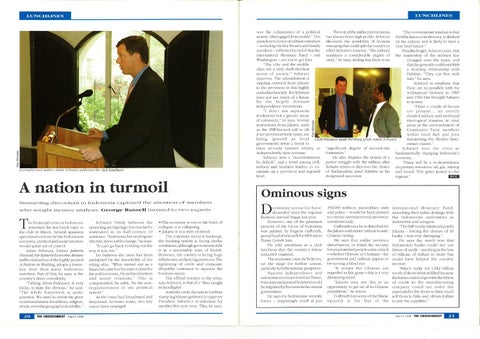
Richbr,ug greets Adatn Scbwørz
independently laise revenue. Schwarz sees a "clecentralisation b)'default", and a trend among civil, military and business leaders to cooperate on a provincial and regional
is in a reasonable state of health.
Postand Far Eastern Econom.ic Reuiew staffer and author-of the highly plaised
1965
to power.
governments sense a threat to
A lnration in turmoil
in
and 7966 that brought Suharto
not present... an oveltly
rheir already limited ability
Jotr.rnalíst ancl autbor A¿lam Schwat"z addresses tbe c
says.
"I don't see separatist
being ignored as
è
could establish
a wolking relationship with Habibie. "They can live with
independence movements.
J:
has
changed over the years, and
'
desclibing their initial dealings with
the Indonesian autholities
as
"Tl-re IMF's early relationship with Jakarta - forcing tl-re closure of 16 banks - was vely damaging."
He says that unlike previons He says the result was that disturbances, in wliich the security Inclonesian banks could not use forces protected people under attack letters of credit - lesulting in the loss - whether Chinese or Cl'iristian - the of billions of dollars in deals that govefnment and nilitary appeaf to could have helpecl the country be turning a blind eye. fecovef. "It seems the Chinese are "Nike's order fol US$2 billion legarded as fail game - this is a very worth of shoes went unfilled because dismaying tlend. the banks couldnot provide theletters "Jakarta may see this as an of credit so the manufacturing opportunity to get rid of its Chinese company coulcl not older the poprrlation," lle walns. materials for the shoes so they could Galblaith lays sollte of the blame
squalely ar the feet of
sell therl to Nike and obtain dollars
the to pay the suppliers."
another five-year term. This, he says, Nfarcl'r
1998 THE
C0RRf,SPOilllENT