Killed in Cambodia
Y
ooo
I
w.
*
I Dotninic Cbaþpeil:
ct
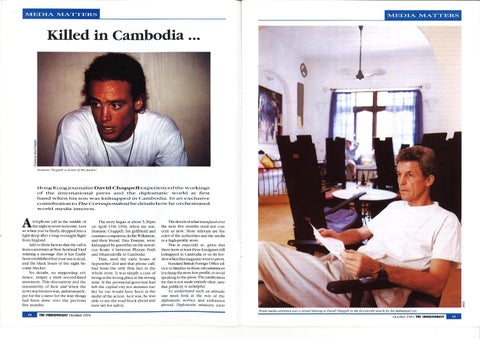
uictim of tbe media?
Hong l(ong j ourrralist fDarrid Ctrappell of the international press and ttre tranrd lr¡tren tris son.v\zas kidna-pped in corrtril>rrtion to TVte ()<>rreslQ<>nder¿tlte s.odd rnedia- interest. telephone call in the middle of the night is never welcome. Less so when you've finally dropped into a light sleep after a long overnight flight from England.
e><perienced ttre vzorkings diplornatic wrzodd at first Carnbodia. Irl. an e><clusirze details trovrztre orctrestrated
The story began at about 5.30pm
the next five months need not concern us now. More relevant afe the
constant companion, Kellie'Wilkinson,
roles of the authorities and the media in a high-profile story.
Add to these factors that the call is
and their friend, Tina Dominy, were kidnapped by guerrillas on the notori-
from a secretary at New ScotlandYard relaying a message that it has finally
ous Route 4 between Phnom Penh and Sihanoukville in Cambodia.
been established that your son is dead, and the black hours of the night be-
September 2nd and that phone call,
come blacker.
No details, no supporting
evi-
dence, simply a stark second-hand statement. This discourtesy and the insensitivity of how and when the news was broken was, unfortunately, par for the course for the way things had been done over the previous five months.
The details ofwhattranspired over
on April lltl:' 1994, when my son, Dominic Chappell, his gid-friend and
That, until the eady hours of had been the only firm fact in the whole story. It was simply a case of being inthewrongplace atthe wrong time. If the provincial governor had left the capital city ten minutes earlier he too would have been in the midst of the action. As it was, he was able to se e the road block ahead and
turn tail for safety.
This is especially so, given that there were at least three foreigners still kidnapped in Cambodia or on its borders when this magazine went to press. Standard British Foreign Offìce advice to families in these circumstances is to keep the storylow-profile, to avoid speaking to the press. The justification for this is not made entirely clear, save that publicity is unhelpful.
To understand such an attitude one must look at the role of the diplomatic service and embassies abroad. Diplomatic missions exist World meelia attention utas a tníxed blessin¿¡ to Dauíd Cbapþeil ìn tbe fiue-montb searcb for his kíd.n6tþþed son
October 1994
Tÿ, coRRxsPolfltElfT