Will the Left give peace a chance in the Philippines? Last month the Club hosted a lunch for Loreta Ann Rosales the president of leftist Partido ng Bayan. Manny Benitez, former editor-in-chief of the Manila Times went along to hear what she had to say. Here is his assessment of the Left as it now stands in the Philippines. peak of the leftist movement in Asia and what comes readily to
when she started talking about Philip- national reconciliation. pine politics and her own experiences Asked whether her party, which threw
mind is the last remaining active
as a former detainee and veteran street
its support behind the presidential bid of
communist-led insurgency in the re-
parliamentarian did she convince us of
gion, the 23-year-old costly guerilla war waged by the New People's Army (NPA) in the Philippines. Against this backgrou nd, we expected to hear one of those fiery, rabble-rousing Marxist ideologues as the guest
the authenticity of her leftist credentials.
Senator Jovito Salonga in last May's elections, recognised the legitimacy of
speaker from the "Philippine Left" to address the Club on August 1 3. To our pleasant surprise, however, the speaker turned out to be a soft-spoken yet gl¡b, mild-mannered but self-assured, pixielooking schoolmarm. lndeed, Loreta Ann "Eta" Rosales, a professor of social sciences at the staterun University of the Philippines, looked anything but the president of Partido ng Bayan, the only visible political organisation of the Left in the Philippines. Only
Her message soon became clear: that despite the election of a general as president, the Philippine Left was alive and well and was not about to give up its case of "dismantling foreign domination" and bringing about radical reforms in the nation's political, social and economic life, in the face of the new administration's blandishments. While her party was not "absolutely rejecting" the peace overlures initiated by newly-elected President Fidel Ramos, who she pointedly called "general" and condescendingly described as "centrist and Christian", Rosales expressed serious doubts about his sincerity and ability to bring about genuine
Ramos' presidency, Rosales bluntly said it did not, and repeated charges of elec-
toral fraud made by defeated presidential candidate Miriam Defensor-Santiago. Butthe Partido ng Bayan presidentwould not elaborate on how much fraud may have been committed, and to what extent if at all. Neither would - or, to be more precise, could Rosales explain away the
-
dismal peformance of the Partido ng Bayan in the 1987 election and, more significantly, in the 1992 election despite its alliance with the old and wellestablished Liberal Party of Salonga. Salonga had become the new hero of the Philippine Left for his key role as
then-Senate president in the rejection of the
Philippine-American military bases
treaty last year (the Liberal Party was the first ruling party after the Philippines gained its independence f rom the United States in 1946, and the first president of the republic, pro-American Liberal Manuel
Roxas, died ironically of a heart attack while delivering a speech at the US Air Force base in Clark Field). ln the 1987 senatorial and congressional elections, the Paftido ng Bayan managed to win only two seats in the House of Representatives and none in the Senate (Salonga, who was then not known as anti-American, garnered the most votes). This year, the leftist party's voice was hardly audible in the din created by the five major and more traditionally inclined parties, three of which
those of Ramos and runners-up -Santiago and Eduardo "Danding" Cojuangco
- were formed only a few months before the May ballot). The Partido ng Bayan was organised as a legitimate political party during the euphoric months following the February, 1986, People's Power Revolution that toppled the strongman rule of the late president Ferdinand Marcos, sending him and his wife, lmelda, into exile and ignominy. Among its "honoured" founders was the late Manila Irmespublisher Joaquin "Chino" Roces, a leading member of one of the Philippines' most influential families of Hispanic descent and the man behind the one million signatures that finally persuaded the widow of folk hero and formersenator Benigno "Ninoy" Aquino Jnr, to stand against Marcos in the 1986 snap presidential elections. Corazon Cojuangco-Aquino, who emerged from obscurity as a housewife, was perceived to have won the election, but was cheated of victory through the blatant rigging of the counting of votes. lt was Aquino's defiance of the Marcos' dictatorship and her controversial defeat at the polls that provided the spark to the People Power Revolution and the excuse to then de-
fence minister Juan Ponce Enrile and then deputy chief-of-staff of the armed
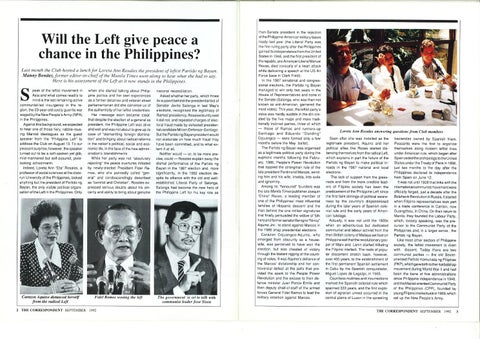
Fidel Ramos wooing the left
The government is set to talk with
forces General Fidel Ramos to lead the military rebellion against Marcos.
Loretø Ann Rosqles answering questions from Club members Soon after she was installed as the legitimate president, Aquino and her political allies like Roces started dis-
haciendas owned by Spanish friars. Peasants were the first to organise themselves along modern leftist lines
tancing themselvesf rom the radical Left, which explains in part the failure of the
under American rule, which began after Spain ceded the archipelago to the United States under the Treaty of Paris in 1898,
Partido ng Bayan to make political inroads in the 1987 national and local elections. The lack of support from the grassroots and from the more credible leaders of Filipino society has been the predicament of the Philippine Left since the first faint stirrings of political aware-
ness by the country's dispossessed during the later years of Spanish colonial rule and the early years of American tutelage. Actually, it was not until the 1920s when an adventurous but dedicated communist and labour activist from the then British colony of Malaya set foot on Philippine soil thatthe revolutionary gospel of Marx and Lenin starled titillating the Filipino intellect. The roots of popular discontent stretch back, however, over 400 years, to the establishment of the first permanent Spanish settlement in Cebu by the Spanish conquistador, Miguel Lopes de Legazpi, in 1565. Countless mutinies and insurrections marked the Spanish colonial rule which spanned 333 years, and the first explosion of agrarian unrest occurred in the central plains of Luzon in the sprawling
just two months to the day after the Philippines declared its independence from Spain on June 12. It was not until 1928 that links with the internatioDal communist movement were
officíally forged, just a decade after the Bolshevik Revolution in Russia. ltstarted when Filipino representatives took part in a trade conference in Canton, now Guangzhou, in China. On their return to Manila, they founded the Labour Party, which, loosely speaking, was the precursor to the Communist Party of the Philippines and, in a larger sense , the Paftido ng Bayan. Like most other sectors of Philippine
society, the leftist movement is riven
with
dissent. Today there are two the old Soviet-
communist parties
-
oriented Partido Komunista ng Pilipinas (PKP), which gave birth to the Hukbatahap
movement during World War ll and had
been the bane of five administrations since Philíppine independence in 1946, and the Maoisloriented Communist Party
of the Philippines (CPP), founded by young Filipino intellectuals in 1969, which set up the New People's Army.
communist lesder Jose Sison
2
T}IE CORRESPONDENT SEPTEMBER
1992
THE CORRESPONDENT SEPTEMBER
1992
3