CLASSIFIED
*l''^*t: ',á
PEOPLE
RESTAURANTS
ter another. He
has
many memories to
recall f¡om those hectic days. Not all his scoops, Parwani says, came from contacts and legwork. Some of the best were in con-
IìcstaLr
r'¿r¡r1
MAßUHAY SINGINC LOUNGE THE ONLY NATIVE FTLIPINO AND SPANISH RESTAURANT fN TOV/N DAll,Y BUSI\ESS HOURS 9.00â.m. - I l,30p.nì. AFTER EN.IOYIN(; YOUR MEAL COME AND VISI'T OUR SING-A-LONG f,OUNGE. OPEN 6.00 p.m. TO 2.00 a.m. (MâjorCrcdirC¡rds I
Accepted)
(l/F,Tsimshâlsui, Konloon.
I Minden ^venue,
A delightful bistro presents:
nection with the sea. He recalls one about three servicemen and a servicewoman who went boating in the NewTerritories and strayed into Chinese
waters. "These were sensitive times and the four were detained in China, while top-secretnegotiations went on for freeing them." Eventually they were returned to HMS Tamar, and Parwani leamt that they wele aboard the patrol boat HMS Hubberston. Undetened by guards at the gate and sentries on the gangplank, he sneaked on board, located the rescued quartet and got a worldbeating exclusive on what had happened over the border. But then somebody alerted the heavies, and the MPs charged into the cabin and "alrresled" the intrepid Parwani. explained to them that it was better to let the story come out as favourably as pos-
"I
sible, and convinced them that I would be emphasising how it was all a terrible mistake.
"
Parwani recalls. the end they took me to the captain,
"In
and I soft-soaped him so effectively that he not only let me go, but also lent me his films. "We gave the story a terrific play inThe Star. Then the Joint Services PR people called a press conference later in the day."
Live late night jazz, from after ten, till two am. Oldies but goodies, thirties to fifties, every day of the week. Open for happy hour, dinner, late night drinks or just coffee.
Another of his big breaks involved a freighter, heading for Hong Kong, that had sliced through a fishing boat in thick fog, causing heavy loss of life. Roused from his bed in the early houls,
Parwani grabbed a camera and headed towards Lyemun Pass in a rented motorised
sampan. His timing was
near-pelfect; through the gap came the freighte¡ its bows dented and badly scraped from the collision. Parwani forced the sampan woman to keep pace with the freighter while he clicked away
with his camera, photographing the damaged 89 Kimberley Road, Tsirnshatsui,
Kowloon. Tel.3-6E8554,
3-680073.
Beside St. Mary's Canossian College. Parking Sewice from 7pm onwards.
Make No Bones About lt
GoVegetarian G/F,
I
No lVinden Avenue, Off Mody Road, Kowloon Tel No:3-693718
12pm to3.30pm
630pm to11 pm
and daiìy
ship. Then he got her to drop back amidships where he shouted to surprised crewmen looking over the side, "Here, catch this,"
flinging up a rope. The startled sailors grabbed the lope and Parwani scuttled up the side and demanded:
"Take me to the captain ! " The result was an unbeatable exclusive. In the more than 20 years he spent in joumalism, Parwani's pride and excitement, of course, is the English-language moming tabloidwhichhelaunched in late 1979. Many seasoned newspaper owners held the view
that, with three English-language newspapers already in print, Hong Kong had two papers too many. But moving away fromThe
Star affer its founder Glaham Jenkins lost control of it and the new o\¡r'ner, Sing Tao's Sally nw Sian, appointed a young journal-
26 THE CORRESPONDENT OCTOBER 1988
.Çå
I
ism graduate, virtually fresh from university, to manage it, Parwani seemed to have felt that it was his calling to keep the true spirit of ?nfte
Star alive, albeit under another name,The Sun.
FCC member Roger Medcalf - a former hino Mail reporter and now a successful PR man - bet Parwani a bathtub full of champagne that The Sun wouldn't last a year. The Sun struggled on, and on the due date Medcalf kept his word - an old bathtub was C
takenuptothe l5th flool of the FCCpremises in Sutherland House, and lilled with ice and bottles of bubbly. But, then, The Sun didn't make it to another birthday and Parwani moved to Commercial Radio to become its news editor and later to fhe Hongkong Standard whereRobert Chow Yung, afor-
mer coìleague at T he Sta r,
to David Davies, who is retiring after 38 years with the agency.
There were more than a dozen faces fa-
had,
meanwhile, be-
come
miliar to Hong Kong among the 50 or so people who partied on into the night aboard
edi-
Mv Mulgi.
to r- in -ch ief and general
Though a Welshman through and through, Davies and his charming French wife, Marcelle, will spend their retirement in the French coun-
manager, s
ucceedi ng
Alan Castro, Parwani became the Standard's
managrng editor.
IT WAS a case of all old Hong Kong hands on deck when many members of the foreign press corps in Sydney joined an Agence France-Presse harbour cruise to bid farewell
tryside where they have a home in the Grand Pressigny not far from Tours.
Parwani (1el) with Sam Lam, a colleague from The Star
When Chow was later moved from the Hongkong Standard to become general manager of the Sing Tao Croup, Parwani moved with him. Now Chow is busy running the Chinese-language daily Fei Po and the management responsibility for the new venture, China Revieu,, has been given to Parwani.
NADARAJAH KANAGARATNAM,
WhO
held various senior positions at the Hor?gkottg Standard l2 years ago, is now back in Hong Kong -- this time to work with the Sottth Chinu Morttittg Post.
The Malaysian-born Kanagaratnam his career in journalism with the
started
Straits Times in Kuala Lumpur. But in 1973 he moved to Hong Kong -- joining the Hongkong Standard as sub-editor and later moving up to become, successively, its features editor, Sunday editor and leader writer. After three years of service with the Hongkong Standard, he retumed to Kuala Lumpul and joined rhe New Sn'aits Times where he became Sunday editor and leader wrrter. In the past six years, however, Kanagaratnam was managing editor of the S¡ar in Nevt,
the Malaysian capital. In 1985, he was awarded a Nieman fellowship at Harvard.
Davies, who owes much of his
fluent French to World War II much of which he spent underwater as a British liaison officer on a French submarine -- is a
former head of AFP's English services in Paris. He was a China-
watcher based in Hong Kong immediately after the Cultural
Revolution and
en-
joyed two tours of duty to the territory
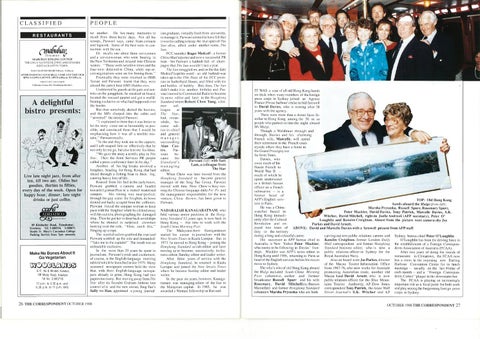
TOP: Old Hong Kong hands aboard fhe Mulgi (fi'on left):
Marsha Prysuska, Russell Spurr, Rosemary Spur¡
Peter Mackler, David Davies, Tony Patrick, Marcelle Davies, S,K. Witcher, David Mitchell, right-in Joelle Andreoli (AFP secretary), Peter O' Loughlin and Kenelm Creighton. Absentfrom the picture were camera-shy Joe Parkes and David Arnett. ABOVE: David and Marcelle Davies with a farewell present from AFP staff.
during a long and colourful career. His successor as AFP bureau chief in
carvingoutnewpublic relations careers and Kenelm Creighton, former London Daily
Australia, is New Yorker Peter Mackler, who seems to be following in Davies' footsteps. Mackle¡ was AFP's news editor in
Mail correspondent and former Hongkong Standard business editor, who is now a
Hong Kong until 1986, retuming to Paris as head of the English services before his ¡ecent move [o Sydney. The who's who of old Hong Kong aboard Ihe Mulgi included South China Morning
Royal Australian Navy. Also on board were Joe Parkes, director
P
ost
columnist, author
and
former
Russell Spurr and his wife Rosemary, David Mitchell(ex-Burson broadcaster
Marsteller) and former Hongkong Standard columnist Marsha Prysuska who are both
public relations officer
in
Sydney
for
the
of the Macau Tourist Information Office from 196'7-76,who now works for Austrade promoting Australian trade, anothe¡ old
Macau hand David Arnett, who is now public relations officer for the Blue Moun-
tains Tourist Authority, AP-Dow Jones corespondent Tony Patrick, the Asian Wall
SÍreet Journal's S.K. Witcher and AP
Sydney bureau chief Peter O'Loughlin. O'Loughlin has been the driving force in the establishment of a Foreign Correspondents Association of Australia (FCAA). After two years of doing the rounds of restaurants in Chinatown, the FCAA now has a room in the imposing new Darling Harbour Convention Centre for its lunch meetings -- usually on the last Friday of each month -- and a "Foreign Conespondents Comer" plaque in the downstairs bar. The FCAA is playing an increasingly important role as a focal point for both work and play among the burgeoning foreign press corps in Sydney.
OCTOBER 1988 THECORRESPONDENT 27
all