REMOVING OR RESTRICTING MICROPLASTIC INGREDIENTS OR “MICROBEADS” FROM CONSUMER AND INDUSTRIAL PRODUCTS
FFI GUIDANCE ON IMPROVING CORPORATE INGREDIENT POLICIES AND/OR REGULATORY MEASURES TO EFFECTIVELY PREVENT SOURCES OF MICROPLASTIC POLLUTION
VERSION 1, PUBLISHED 30 JANUARY 2017
1 Fauna & Flora International 30 January 2017
Microbeads guidance document Version 1
ABOUT FAUNA & FLORA INTERNATIONAL Fauna & Flora International (FFI), the world’s oldest international biodiversity conservation organisation, is a proven conservation innovator that continues to make a lasting impact on global biodiversity – the variety of life on Earth. FFI's work spans across the globe, with over 140 projects in over 40 countries, mostly in the developing world. We proudly stand up for biodiversity and aim to show just how relevant it is to all of those who share the planet. • • • •
LEADERSHIP: We’ve been working for more than a century in innovative, sustainable conservation, developing models that inspire others. DIVERSITY: Our focus is biodiversity: to secure a healthy future for our planet where people, wildlife and wild places coexist. VALUE: Our lean, entrepreneurial structure and style allow us to engage quickly and effectively on critical environmental issues. COLLABORATION: Lasting local partnerships have been at the heart of our conservation activities for more than one hundred years.
OUR VISION A sustainable future for the planet, where biodiversity is effectively conserved by the people who live closest to it, supported by the global community.
OUR MISSION To act to conserve threatened species and ecosystems worldwide, choosing solutions that are sustainable, based on sound science and take into account human needs.
2 Fauna & Flora International 30 January 2017
Microbeads guidance document Version 1
LIST OF ACRONYMS
ASTM BPF BtMB °C DEFRA EAC ECHA EIA EU FFI FTIR GHS HDPE INCI ISO KEBS < ≤ MCS MLAN mg/L µm mm MP MPIs MSFD NB nm NGOs NSF PBTs PCCPs
American Society for Testing and Materials Standards (International) British Plastic Federation Beat the Micro Bead Campaign Degrees Celcius Department for the Environment, Fisheries & Rural Affairs Environmental Audit Committee European Chemicals Agency Environmental Investigation Agency European Union Fauna & Flora International Fourier Transform Infrared Spectroscopy Globally Harmonized System of Classification and Labelling of Chemicals High-Density Polyethylene International Nomenclature of Cosmetic Ingredients International Organization for Standardization Kenyan Bureau of Standards Less than Less than or equal to Marine Conservation Society, UK Marine Litter Action Network Milligrams per litre Micrometer Millimeter Microplastic Microplastic Ingredients Marine Strategy Framework Directive Nota Bene (take special notice) Nanometer Non-Governmental Organisations Stichting de Nordzee (North Sea Foundation) Persistent, Bioaccumulating Toxins Personal Care and Cosmetic Products
3 Fauna & Flora International 30 January 2017
Microbeads guidance document Version 1
PE PET PMMA PS PSF PTFE PVC REACH T UK UNECE UNEP UPVC US USA
Polyethylene Polyethylene Terephthalate Polymethyl Methacrylate Polystyrene Plastic Soup Foundation Polytetrafluoroethylene Polyvinyl Chloride Registration, Evaluation, Authorisation and Restriction of Chemicals Temperature United Kingdom United Nations Economic Commission for Europe United Nations Environment Program Unplasticised Polyvinylchloride United States United States of America
4 Fauna & Flora International 30 January 2017
Microbeads guidance document Version 1
CONTENTS List of appendices ...............................................................................................................................................................................................5 1. Executive summary ......................................................................................................................................................................................6 2. Introduction ......................................................................................................................................................................................................8 3. The Good Scrub Guide initiative ..........................................................................................................................................................9 4. Key learnings & outcomes from the Good Scrub Guide initiative ............................................................................... 10 4.1 Voluntary corporate commitments relating to MPI use ............................................................................................... 10 4.2 Limitations with voluntary corporate commitments .................................................................................................... 12 5. Overview of national legislation relating to MPI use ............................................................................................................ 12 5.1 Overview ............................................................................................................................................................................................ 12 5.2 Enacted USA national legislation ........................................................................................................................................... 13 5.3 Proposed UK national legislation ............................................................................................................................................ 14 6. FFI’s principles of a robust corporate commitment or national legislation relating to MPI use ............... 16 6.1 Evolution of the FFI principles ................................................................................................................................................... 16 7. Summary .......................................................................................................................................................................................................... 17 7.1 Key learning outcomes of work to date ................................................................................................................................ 17 7.2 Purpose of FFIs principles and guidance .............................................................................................................................. 17 8. List of appendices ....................................................................................................................................................................................... 18 9. References ....................................................................................................................................................................................................... 19
LIST OF APPENDICES Appendix 1
Examples of demonstrated/potential impacts of marine microplastic pollution on biodiversity
Appendix 2
Summary of published definitions of microplastic ingredients (MPIs)
Appendix 3
Summary of microplastic ingredient (MPI) data from UK product database
Appendix 4
Recorded examples of unverified polymeric ingredients of concern found in personal care and cosmetic products (PCCPs) or cleaning products on the UK market
Appendix 5
Voluntary corporate commitments provided to Fauna & Flora International and the Marine Conservation Society by UK and/or international companies with regard to microplastic ingredient (MPI) use
Appendix 6
Detailed guidance on FFI’s principles, including evidence sources, designed to support delivering of effective legislation governing microplastic ingredient (MPI) use
5 Fauna & Flora International 30 January 2017
Microbeads guidance document Version 1
1. EXECUTIVE SUMMARY Microplastic ingredients (MPIs), commonly referred to as plastic microbeads1, are pieces of plastic up to 5mm in diameter (a microplastic (MP)) which are commonly used as ingredients in a variety of consumer and industrial products including, but not limited to, personal care and cosmetic products (PCCPs) and cleaning products. They are a proven direct source of marine microplastic pollution and are a problem because: •
All types of MPs, including MPIs, are known to pass through wastewater sewage treatment2,3,4,5 and enter waterways and oceans at rates of up to 550 million per day in the UK6,7.
•
In marine and freshwater environments, MPs can persist for hundreds of years8 and, due to their small size, they are often mistaken for food by a wide range of animals, including over 50 marine species9; MPIs specifically have also been found in the digestive tracts of fish in coastal environments10.
•
them where identified as an environmental risk. This process has not been standardised and significant differences of definition and scope exist among voluntary commitments globally. Policymakers have also made strides to respond to the problem of corporate use of MPIs; the US government introduced the first national ban on products containing specific types of MPIs through the Microbead-Free Waters Act of 201512. In September 2016, the UK Government also announced plans to introduce a national “ban on the sale and manufacture of cosmetics and personal care products containing tiny pieces of plastic, commonly known as ‘microbeads’”13, which could cover a much wider range of products than the US ban and has the potential to be the most progressive piece of legislation tackling a direct source of MP pollution in the world. The following briefing note has been prepared by Fauna & Flora International (FFI), a UK-based non-governmental conservation organisation that acts to conserve threatened species and ecosystems worldwide, choosing solutions that are sustainable, based on sound science and take into account human needs. We have been working on tackling preventable and unnecessary sources of marine microplastic pollution since 2011 in response to the growing scientific evidence of the potential biodiversity impacts around small pieces of plastic that can be directly taken up by organisms. The purpose of this guidance is to outline the principles and recommendations developed by FFI regarding effective measures to end MPI use that contributes to marine plastic pollution; these principles apply to companies designing voluntary commitments related to MPI use as well as policymakers seeking to ban the sale and manufacture of products containing MPIs.
Impacts of MPs on biodiversity have been demonstrated by peer-reviewed research and include mortality, internal injuries, starvation, reduced growth and suboptimal feeding/breeding behaviour in marine and freshwater species. MPs are known to persist in organisms’ digestive systems; release and adsorb persistent, bioaccumulating and toxic (PBTs) contaminants in the environment; act as a vector, transferring contaminants to those organisms that ingest them, as well as causing bioaccumulation in higher trophic levels (see Appendix 1).11
In order to solve this problem, the sectors responsible for PCCPs have made various voluntary commitments, in various global markets, to audit their use of MPIs and remove 6 Fauna & Flora International 30 January 2017
Microbeads guidance document Version 1
We ask that the following principles are considered by any company, brand, product formulator or ingredient manufacturer that wants to reduce the accumulation of marine plastic litter by phasing out microplastic ingredients from their products. These principles state that a corporate commitment to remove microplastic ingredient should include: 1. 2. 3. 4. 5. 6. 7.
Restriction of all microplastic ingredients Application to all ‘down the drain’ products No exemption for non-marine-tested synthetic solid ingredients No exemption for plastic ingredients below a certain size Implementation within an ambitious timeframe Application to all brands in a company’s portfolio Application to all future formulations of products
We also ask that these same principles are considered by any regional, national or international policymaker that wants to reduce the accumulation of marine plastic litter by banning the sale, manufacture or import of microplastic ingredients (and/or products containing them).
7 Fauna & Flora International 30 January 2017
Microbeads guidance document Version 1
2. INTRODUCTION Plastic pollution in the world’s oceans is ubiquitous. Globally, 300 million tonnes of plastic are produced annually, in a trillion dollar industry that employs over 180,000 people in the UK alone14. Virtually every aspect of life is now reliant upon plastic and consequentially, it is estimated that up to 12 million tonnes of plastic waste enters our oceans and waterways annually15.
document. In short, compelling evidence confirms both physical and toxicological effects that microplastic pollution has on marine biota. Many of the known toxins associated with microplastic pollution are passed along the food chain. Reports have even emerged confirming that water samples collected from across the globe are found to be contaminated with microplastic 20,21,22,23 particles . With regard to commercial fisheries, the proven impacts of microplastic pollution could have potentially grave economic repercussions and raise a number of questions highlighting implications for human health which are now being investigated more closely.24
Marine litter is defined as ‘items that have been deliberately discarded, unintentionally lost, or transported by wind and rivers, into the sea and on beaches16. Over 80% of marine litter is thought to originate from the land and up to 80% of this litter is composed of (macro) plastic waste (large, visible pieces of debris polluting waterways17). The socio-economic, ecological and environmental impact of visible macroplastic pollution has been manifest for many years and a large number of interventions have been launched accordingly, including but not limited to national & regional recycling schemes, clean-up operations, plastic bag levies and education campaigns. It is over the course of the last decade that the emergent topic of microplastic pollution has gained global notoriety.
Microplastic pollution is no longer a subject of scientific debate – the seriousness of the issue is very much at the forefront of the minds of the public25, the scientific community26, businesses (see Appendix 5), non27 governmental organisations , national policymakers24 and intergovernmental organisations28 alike. An internal FFI horizon scanning exercise in 2011 revealed that despite the seriousness of microplastic pollution - particularly in terms of biodiversity impact - there was limited activity underway in the UK tackling direct sources of microplastic pollution. FFI recognised the need for timely intervention in the UK and in 2012, launched its targeted marine plastics program. Drawing on core strengths held across the organisation, including a strong operational reputation with corporates and effective working relationships with other international NGOs working on similar issues, FFI set out to work collaboratively and constructively to improve corporate policies and practice to prevent avoidable, direct sources of microplastic pollution from entering the marine environment.
‘Microplastics’ were reputedly first described by Thompson et al. in 200418; this led to a definition by scientists in the USA, who used the term to refer to ‘plastic particles measuring less than 5mm in diameter’19. It is important to note that this definition does not include a l lower size limit for microplastic particles and particles as small as 1µm have been recorded in water samples. Today, the body of supporting scientific evidence highlighting the seriousness of the impact of microplastic pollution on biodiversity (see Appendix 1), habitat degradation, and associated socioeconomics has grown exponentially – a small sub-set of which is referenced throughout this
8 Fauna & Flora International 30 January 2017
Microbeads guidance document Version 1
3. THE GOOD SCRUB GUIDE INITIATIVE With the growing body of scientific literature covering the sources and impacts of microplastic pollution, an important distinction was made about types of microplastics26: -
To support this work, FFI created a product database which has evolved over time to assess the ingredients of some 1,500 Personal Care and Cosmetic Products (PCCPs). In 2012, FFI partnered with Dutch organisations Plastic Soup Foundation (PSF) and Stichting de Nordzee (North Sea Foundation, NSF) to launch the internationally focused Beat the Micro Bead (BtMB) website and smartphone App at the United Nations Environment Program (UNEP) second Global Land-Ocean Connections meeting in Jamaica in 2013. Together, the organisations behind the BtMB campaign started to approach some of the world’s most prominent multinational corporations about their use of microplastic ingredients (MPIs), encouraging a timely phase out in each instance. This work encouraged multinational corporations to make public commitments very early on that confirmed their intent to remove particular MPIs from at least part of their product range.
Primary microplastics – purposefully designed and manufactured to function at sizes ≤ 5mm Secondary microplastics – fragments ≤ 5mm formed by the breakdown of larger pieces of plastic
This distinction was important to FFI because it saw that in the case of primary microplastics, there was likely to be a solution to the problem: where microplastic use was purposeful, originating from a clear source and lost to the environment (accidentally or consequentially), a change in practice would likely eliminate this source of microplastic pollution. Microplastic particles (often used as abrasives) – or microbeads as they are now known – in cosmetic29 and personal care products such as facial exfoliators, body scrubs, and toothpastes were widely cited as an example of primary microplastic use17. For example, early patents promoting the use of ‘pulverised Polyethylene’ in facial powders or ‘plastic synthetic resin materials’ and ‘plastic scrubber particles’ made of polyethylene, polypropylene or polystyrene in exfoliating products date back to the 1960s30 and 1970s31 respectively. These microbeads, as they have come to be known, are (essentially) purpose-designed to wash down the drain and invariably enter the marine environment because the particles are too small (often ≤1mm) to be retained during wastewater treatment processes32.
These announcements being made on an international stage created an opportunity for brands and retailers operating or headquartered in the UK to follow a shifting market trend. Working closely with the Marine Conservation Society UK (MCS), FFI approached a range of companies to: -
An early market research exercise conducted by FFI highlighted the widespread commercial use of non-plastic, natural abrasive alternatives which reaffirmed the notion that this was an avoidable source of marine microplastic pollution. As such, FFI launched its Good Scrub Guide as a tool with which to influence change in corporate behaviour relating to the use (and associated reputational risks) of microplastics in personal care products.
Confirm the absence of MPIs in products marketed by identified ‘green’ brands Encourage the timely phase out of identified MPIs across all product ranges where relevant Seek further information and clarification about the use of suspected MPIs in certain products
In each case, FFI worked constructively with UK businesses to craft and publish public statements confirming action and corporate positions relating to MPI use (see Appendix 5). In addition to our work with corporate businesses, FFI & MCS launched a public outreach pledge page – Scrub it Out! –within the context of MCS’ Marine Litter Action Network (MLAN) in order to gauge the British public’s response to the MPI issue. 9
Fauna & Flora International 30 January 2017
Microbeads guidance document Version 1
Following the 2015 announcement of the United States (US) Federal government Microbead-free Waters Act12, Greenpeace UK launched a petition25 in the UK encouraging then Prime Minister David Cameron to follow the lead of then President Barack Obama. This campaign was phenomenally successful, securing over 350,000 signatures from the
British public in the first month alone and culminated in the formation of a UK microbead coalition – a collaborative partnership between FFI, Environmental Investigation Agency (EIA), Greenpeace UK and MCS – calling for the UK government to impose an effective legislative ban in the UK on the use of all MPIs in all PCCPs and cleaning products that go down the drain.
4. KEY LEARNINGS & OUTCOMES FROM THE GOOD SCRUB GUIDE INITIATIVE 4.1 Voluntary corporate commitments relating to MPI use Our work in this area has been informed and reinforced by careful and thorough review of published ingredient lists of a wide range of PCCPs and cleaning products33 (see Appendix 3 for summarised product data) and tracking/leveraging corporate phase-out commitments nationally and internationally34 (see Appendix 5 for list of leveraged corporate commitments). FFI has kept informed of all emerging scientific literature on the subject, tracked and reviewed proposed and enacted microbead legislation from around the world (see discussion in section 5 below) and maintained active participation in relevant multi-stakeholder working groups at home and abroad on this subject.
The key published definitions of MPIs that are relevant to microplastic litter arising from MPI use in PCCPs and cleaning products are summarised in Appendix 2. Furthermore, it is evident that the molecular make-up of any given plastic polymer has a significant bearing on the final physical state and properties of the ingredient. For example, a given polymer, with differing molecular weights can manifest in several different phases (i.e. liquid, wax, semi-solid and solid matter) but can retain the same technical/chemical name and/or International Nomenclature of Cosmetic Ingredients (INCI) number35,36,37. FFI has carefully applied this technical knowledge during its review of UK PCCPs and, where uncertainties have arisen, FFI has sought clarification and further information from some of the producers and formulators of PCCPs in question. FFI maintains an evolving document of unverified polymeric ingredients of concern (see Appendix 4 for full details), which could be MPIs in some product formulations, and continues to discuss these ingredients with product formulators and during conversations with corporates to ensure that in the preparation of voluntary commitments, the status (i.e. physical state) of these unverified polymeric ingredients of concern is reviewed and confirmed and to ensure that all voluntary commitments are as inclusive as possible, including all solid, particulate water-insoluble MPIs.
By reviewing published PCCP ingredient lists, the complexities of this subject became very clear. Plastics are generally defined as synthetic organic polymers17 but it is important to note that in the context of microplastic pollution and marine litter, not all synthetic ingredients can be considered MPIs. In a published review of MPI use in PCCPs, it was reported that the plastic ingredients of interest share the following properties with microplastic litter35: • • • • • •
Solid phase materials (i.e. solid particulates, not liquids) Insoluble in water Synthetic Non degradable (e.g. according to standardized tests) Made from plastic Small size (up to 5 mm, although they can be even smaller than 1 μm, i.e. nano-sized)
It should be noted that although the use of MPIs in PCCPs was the initial focus of the Good 10
Fauna & Flora International 30 January 2017
Microbeads guidance document Version 1
Scrub Guide initiative, it is known that MPIs are used in a wider range of consumer and industrial products including but not limited to domestic and commercial cleaning products37. Legislation governing the publication of ingredients on PCCPs is far more stringent than that of domestic & commercial cleaning products and as such, a review of MPIs in these products has been more challenging. That said, FFI has worked with its partner organisations in the UK microbead coalition to test a selection of such products in a laboratory using Fourier transform infrared spectroscopy (FTIR) to check for the presence of MPIs. Results of this testing have not been conclusive as of January 2017.
During the period 2015-2016, FFI’s work with MCS resulted in significant traction with UK businesses – helping generate progressive public commitments from bespoke companies, leading high street brands, major retailers and also multinational corporations (see Appendix 5)34. During the same time period, this process was amplified in an international context during FFI’s and MCS’ involvement in the global BtMB campaign, which also used to celebrate a large number of positive commitments made by national and international companies to voluntarily remove MPIs.
Summary of FFI’s key findings between 2012 and 2016 resulted in: •
• •
• • •
•
• • • •
Identification of six known MPIs commonly used in solid, water-insoluble form – polyethylene (PE)38,39,40,41, polypropylene (PP)42,43, polyethylene terephthalate (PET)44,45, polytetrafluoroethylene (PTFE)46, polymethyl methacrylate (PMMA)47 and nylon48,49 Identification of over 110 unverified polymeric ingredients of concern that could be solid, water-insoluble MPIs in some product formulations35,36,37 (see full list in Appendix 4) A systematic review of over 1,500 PCCPs in the UK, across more than 20 product categories, for the presence of known MPIs commonly used in solid, water insoluble form and of unverified polymeric ingredients of concern (see Appendices 3 and 4) Recording known, commonly used MPIs in a wide range of sampled PCCPs across over 10 product categories (see Appendix 3) Highlighting unverified polymeric ingredients of concern (see Appendix 4) in a wide range of sampled PCCPs across over 10 product types (see Appendices 3 and 4) Conducting an evaluation of 58 products in the last four months of 2016 to see whether or not there was any change in the ingredient lists of these products which were previously recorded during the period 2012-2015 as containing known MPIs (see Appendix 3 for more details). We found that: o 28 products (or 48.3%) across three product types (body scrubs, deodorants and face scrubs) still contained known MPIs in September-December 2016 o 16 products (or 27.6%) across four product types (body scrubs, deodorants, face scrubs and soaps) no longer contained known MPIs but contained unverified polymeric ingredients of concern in September-December 2016 o 14 products (or 24.1%) across four product types (body scrubs, deodorants and face scrubs) no longer contained any known MPIs or unverified polymeric ingredients of concern in SeptemberDecember 2016 Conducting a preliminary review, with the help of Greenpeace UK, of more than 50 cleaning products, across 10 product types, on the UK market for presence of common MPIs or unverified polymeric ingredients of concern Identification of known MPIs in 8 cleaning products and in 2 cleaning product types as of January 2017 Recording unverified polymeric ingredients of concern in 33 cleaning products and in 6 product types as of January 2017 Directly leveraging commitments from over 30 cosmetics brands, UK retailers and multinational cosmetics companies Tracking commitments from more than 50 brands, companies and retailers in total
11 Fauna & Flora International 30 January 2017
Microbeads guidance document Version 1
4.2 Limitations with voluntary corporate commitments In the process of evaluating corporate MPI policy and monitoring PCCP ingredient data, the following patterns have emerged:
made robust, public statements regarding MPI use11, our sample of microplastic-containing products demonstrates that the major UK market share of PCCPs is likely to contain marine environmental pollutants.
1. A number of companies have made unclear or inadequate public commitments that use ambiguous and narrow definitions of MPIs; 2. Commitments, in some cases, appear only to apply to a very limited range of products or to a specific function, e.g. exfoliation; 3. In some instances, MPIs have been replaced with ‘biodegradable’ plastics. This creates a risk of replacing ‘like-with-like’ because currently there are no standardised tests that ensure full marine biodegradability of such alternatives; 4. Some companies have shown disregard for the need for timely phase out of MPIs given the associated environmental impact of these ingredients50,51; 5. There remains an ongoing confusion as to which products can be considered ‘rinseoff’ or ‘leave-on’. This is exacerbated by the fact that many ‘leave-on’ products can be (and are) disposed of via normal drainage channels52.
Initially, FFI found that many of the companies that it approached to discuss MPI policies were unwilling to engage on the subject. Increasing media coverage over the past four years and a growing body of supporting scientific literature, coupled the international legislative developments, has made MPI use a very public subject and as such, FFI has experienced a noticeable tide change in the willingness and openness of businesses to engage on this issue. In October 2015, disparate corporate commitments were aligned across the European cosmetics industry when Cosmetics Europe – the pan-European association for Cosmetics and Personal Care companies – issued a public statement recommending the industry work to prepare voluntary “microbead” phase-out commitments in light of “the public concerns expressed over plastic debris in the marine environment”.54 This recommendation, whilst making some progress, replicated some of the observed limitations of pre-existing corporate commitments discussed herein (see more details in Table 2 below).
From the ingredient and commitment monitoring described in section 4.1 above, FFI found that products from 11 of the top 20 global beauty companies53 contained MPIs. Given that only 4 of these 11 companies have
5. OVERVIEW OF NATIONAL LEGISLATION RELATING TO MPI USE 5.1 Overview In the wake of early corporate commitments which denounced the use of MPIs, intense media coverage, scientific studies, political lobbying and international campaigning, draft legislation started to emerge which attempted to formalise key messages and prohibit
ongoing use of MPIs. For many, the use of MPIs was considered the ‘low-hanging fruit’ in an otherwise seemingly insurmountable problem of marine plastic pollution and announcements of legislative bans were initially widely celebrated (Table 1).
12 Fauna & Flora International 30 January 2017
Microbeads guidance document Version 1
Table 1: Summary of global legislative developments that aimed to prohibit use of MPIs in PCCPs Country
Recent developments
Australia
The New South Wales government called for a national ban on products containing plastic microbeads in August 2014 and in February 2016 the Environment Minister announced that the Federal Government will consider a national ban in 201755
Austria, Belgium, Luxembourg, the Netherlands and Sweden
Joint call to ban the use of microplastics in cosmetics and detergents in the European Union (EU) issued in December 201456
Canada
In November 2016 the Canadian Government announced that it will ban the sale of some products containing plastic microbeads in July 201857
Denmark
The Danish Minister for the Environment announced in May 2016 that will be putting pressure on the European Commission and Parliament to ban plastic microbeads
France
In October 2016 France had notified the European Commission that it will ban some cosmetic products containing microplastics by January 201858
Ireland
The Irish Government committed to banning plastic microbead use in November 2016 as part of a wider marine protection bill59
Italy
A national ban on the use of plastic microparticles in cosmetics in Italy was proposed in May 201660
Kenya
In January 2016, Kenya’s Bureau of Standards (KEBS) announced it would “discuss use of plastic microbeads in manufacture of cosmetics, soaps and toothpaste products”61
New Zealand
In January 2016 New Zealand’s Environment Minister commissioned research into the environmental impacts of plastic microbeads and the New Zealand Government began considering a national ban on products containing microbeads62,63
Singapore
In October 2016 Singapore’s National Parks Board claimed it was “looking into assessing the status and impact of marine debris and microplastics”64
South Korea
In September 2016 the South Korean Ministry of Food and Drug Safety announced plans to ban the use of microplastics in cosmetics65
Sweden
The Swedish Chemical Agency proposed a ban on cosmetic products containing plastic microbeads in Sweden through an EU-wide regulation66
Taiwan
In June 2016 the Environment Protection Administration of Taiwan announced plans to ban personal care products and toothpastes containing microbeads67
UK
The UK Government announced plans to ban the sale and manufacture of cosmetic and personal care products containing plastic microbeads in September 201613
USA
US Microbead-Free Waters Act signed into law in December 201512
5.2 Enacted USA national legislation In December 2015, the US Senate passed the US Microbead-Free Waters Act, which bans “rinse-off cosmetics that contain intentionallyadded plastic microbeads beginning on January 1, 2018” and which bans the “manufacturing of these cosmetics beginning on July 1, 2017”. The passing of the Act followed the designation of several similar acts in various US States.
The Act, which is the first piece of national legislation relating to MPI use, repeats some of the observed limitations of the Cosmetics Europe voluntary recommendation regarding definitions and scope of MPI use (see Table 2 below).
13 Fauna & Flora International 30 January 2017
Microbeads guidance document Version 1
5.3 Proposed UK national legislation In September 2016, the UK Government announced plans to ban the sale and manufacture of cosmetic and personal care products containing tiny pieces of plastic, commonly known as ‘microbeads’, and also pledged to gather evidence on environmental impacts of microbeads used in other products such as household and industrial cleaning products13. This announcement followed the publication of an Environmental Audit Committee (EAC, a cross-party group of Members of Parliament) report in August 2016 which urged the Government to introduce the ban and recommended that the “legislation should follow principles set out by Fauna & Flora International around universality and consistency”68.
standard of voluntary commitments made by different companies7. The opportunity for UK national legislation to overcome the inconsistencies of the industry voluntary commitments and the US Microbeads-Free Water Act of 2015 is made clear in Table 2, where “ideal” legislation is compared to both the Cosmetics Europe voluntary recommendation and the US Microbead-Free Waters Act. In December 2016, Defra launched a public consultation on its proposals to ban the manufacture and sale of cosmetics and personal care products containing microbeads which may cause harm to the marine environment70. The proposals published in this consultation have one major limitation in comparison to the “ideal” legislation as demonstrated by the assessment in Table 2. This proposed UK microbeads ban uses the ambiguous term ‘rinse-off’, which reflects how long a product might stay on the skin rather than the likelihood of the product to go down the drain and reach the marine environment71. This is a significant limitation because it means that the ban would not necessarily apply to products such as make-up which: • are often considered ‘leave-on’45 but • can often go down the drain in practice52 and • are known to contain known MPIs commonly used in solid, waterinsoluble form44,45 (see Appendix 3 for examples).
The EAC report summarised the findings and conclusions of the EAC inquiry69 conducted in May 2016 regarding the environmental impact of microplastics. As part of these proceedings, the Committee directly consulted a wide range of relevant stakeholders. These included prominent scientists in the field of marine plastic pollution; FFI and NGO partners MCS and EIA; Cosmetics Europe, the British Plastic Federation (BPF); major multinational PCCP manufacturers as well as Department for Environment, Food & Rural Affairs (Defra) representatives. At the NGO hearing organised by the Committee, FFI argued that the voluntary measures taken by the industry to date have not succeeded in ending the use of polluting MPIs effectively due to inconsistencies in the
14 Fauna & Flora International 30 January 2017
Microbeads guidance document Version 1
Table 2: Comparison of ideal microplastic ingredient legislation, the US Microbead-Free Waters Act 2015, the Cosmetics Europe voluntary phase-out recommendation and the Defra proposals to ban the use of plastic microbeads in the UK (as of January 2017)
Legislation/recommendation
Ideal microplastic ingredients legislation (i.e. “gold standard”)
US Microbead Free Waters Act 201512
Cosmetics Europe voluntary phase-out recommendation54 Defra proposals to ban the use of plastic microbeads in cosmetics and personal care products in the UK (published in December 2016)70
All solid plastic ingredients included?72
ü × × ü
All product types reaching domestic or industrial drainage?73
ü × × ×
"Biodegradable plastics" exemption absent?
Ingredient definition
Product type definition
ü
Two years from announcement
any solid, water insoluble, plastic particulate ingredient of 5 millimetres or less in size, performing any function in a product
any product that is, or can be, discharged to domestic or industrial drainage after its use
ü
2017 (two years from announcement)
“any solid plastic particle that is less than 5 millimeters in size and is intended to be used to exfoliate or cleanse the human body”
“rinse-off cosmetics…(the term `rinse-off cosmetic' includes toothpaste)”
×
2020 (five years from announcement)
“synthetic, solid plastic particles used for exfoliating and cleansing that are non-biodegradable in the marine environment”
“wash-off cosmetic products” (no further details given)
“solid microplastic ingredients < 5mm in size in every dimension”
“rinse-off cosmetics and personal care products including but not limited to exfoliating scrubs, shower gels and toothpastes”
2018 (two years from announcement)
ü
15 Fauna & Flora International 30 January 2017
Deadline for implementation
Microbeads guidance document Version 1
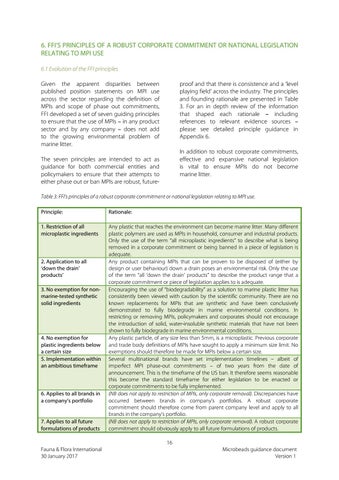
6. FFI’S PRINCIPLES OF A ROBUST CORPORATE COMMITMENT OR NATIONAL LEGISLATION RELATING TO MPI USE 6.1 Evolution of the FFI principles Given the apparent disparities between published position statements on MPI use across the sector regarding the definition of MPIs and scope of phase out commitments, FFI developed a set of seven guiding principles to ensure that the use of MPIs – in any product sector and by any company – does not add to the growing environmental problem of marine litter.
proof and that there is consistence and a ‘level playing field’ across the industry. The principles and founding rationale are presented in Table 3. For an in depth review of the information that shaped each rationale – including references to relevant evidence sources – please see detailed principle guidance in Appendix 6. In addition to robust corporate commitments, effective and expansive national legislation is vital to ensure MPIs do not become marine litter.
The seven principles are intended to act as guidance for both commercial entities and policymakers to ensure that their attempts to either phase out or ban MPIs are robust, future-
Table 3: FFI’s principles of a robust corporate commitment or national legislation relating to MPI use. Principle:
Rationale:
1. Restriction of all microplastic ingredients
Any plastic that reaches the environment can become marine litter. Many different plastic polymers are used as MPIs in household, consumer and industrial products. Only the use of the term “all microplastic ingredients” to describe what is being removed in a corporate commitment or being banned in a piece of legislation is adequate. Any product containing MPIs that can be proven to be disposed of (either by design or user behaviour) down a drain poses an environmental risk. Only the use of the term “all ‘down the drain’ products” to describe the product range that a corporate commitment or piece of legislation applies to is adequate. Encouraging the use of “biodegradability” as a solution to marine plastic litter has consistently been viewed with caution by the scientific community. There are no known replacements for MPIs that are synthetic and have been conclusively demonstrated to fully biodegrade in marine environmental conditions. In restricting or removing MPIs, policymakers and corporates should not encourage the introduction of solid, water-insoluble synthetic materials that have not been shown to fully biodegrade in marine environmental conditions. Any plastic particle, of any size less than 5mm, is a microplastic. Previous corporate and trade body definitions of MPIs have sought to apply a minimum size limit. No exemptions should therefore be made for MPIs below a certain size. Several multinational brands have set implementation timelines – albeit of imperfect MPI phase-out commitments – of two years from the date of announcement. This is the timeframe of the US ban. It therefore seems reasonable this become the standard timeframe for either legislation to be enacted or corporate commitments to be fully implemented. (NB does not apply to restriction of MPIs, only corporate removal). Discrepancies have occurred between brands in company’s portfolios. A robust corporate commitment should therefore come from parent company level and apply to all brands in the company’s portfolio. (NB does not apply to restriction of MPIs, only corporate removal). A robust corporate commitment should obviously apply to all future formulations of products.
2. Application to all ‘down the drain’ products’ 3. No exemption for nonmarine-tested synthetic solid ingredients
4. No exemption for plastic ingredients below a certain size 5. Implementation within an ambitious timeframe
6. Applies to all brands in a company’s portfolio
7. Applies to all future formulations of products
16 Fauna & Flora International 30 January 2017
Microbeads guidance document Version 1
7. SUMMARY 7.1 Key learning outcomes of work to date FFI’s work on microbeads and its work with corporate businesses have grown organically over the past five years. FFI has worked diligently to remain well-informed, constructive in its approach and participatory in all matters relating to this field of work. Despite establishing a clear link between the use of MPIs and marine microplastic pollution,
the nuances of this subject are varied and significant. For example, simply defining a ‘plastic’ ingredient proves challenging in a multi-stakeholder environment37. Similarly, defining product types to review (i.e. rinse-off or leave-on products71) is challenging depending on point of view.
7.2 Purpose of FFIs principles and guidance Overall, there has been a notable step-change in corporate position relating to MPI use with many sectors now openly working together to effectively solve this issue. Despite this promising progress, evidence gathered during FFI’s latest monitoring of product ingredient lists has revealed that in the UK, the issue is still far from being resolved (as of January 2017): •
•
in UK shops with new formulas no longer containing any known MPIs: o 16 (more than half) contained unverified polymeric ingredients of concern which could be MPIs and o only 14 (less than half) contained no known MPIs or unverified polymeric ingredients of concern (see Appendix 3 for a more detailed summary).
out of 58 down-the-drain PCCPs that contained known MPIs in 2012-2015, 28 or nearly half were still found in UK shops with the same known MPIs in SeptemberDecember 2016 and out of the other 30 products, which used to contain common MPIs in 2012-2015 but in September-December 2016 were found
FFI’s principles of a robust corporate commitment or national legislation relating to MPI use are intended to guide and inform companies and policymakers intending to reduce the potential for MPIs in consumer and industrial products to become marine plastic litter.
We ask that these principles are considered by any company, brand, product formulator or ingredient manufacturer that wants to reduce the accumulation of marine plastic litter by phasing out microplastic ingredients from their products. We also ask that the principles are considered by any regional, national or international policymaker that wants to reduce the accumulation of marine plastic litter by banning the sale, manufacture or import of microplastic ingredients (and/or products containing them).
17 Fauna & Flora International 30 January 2017
Microbeads guidance document Version 1
8. LIST OF APPENDICES
Appendix 1
Examples of demonstrated/potential impacts of marine microplastic pollution on biodiversity
Appendix 2
Summary of published definitions of microplastic ingredients (MPIs)
Appendix 3
Summary of microplastic ingredient (MPI) data from UK product database
Appendix 4
Recorded examples of unverified polymeric ingredients of concern found in personal care and cosmetic products (PCCPs) or cleaning products on the UK market
Appendix 5
Voluntary corporate commitments provided to Fauna & Flora International and the Marine Conservation Society by UK and/or international companies with regard to microplastic ingredient (MPI) use
Appendix 6
Detailed guidance on FFI’s principles, including evidence sources, designed to support delivering of effective legislation governing microplastic ingredient (MPI) use
18 Fauna & Flora International 30 January 2017
Microbeads guidance document Version 1
9. REFERENCES 1
In accordance with the definition widely accepted by the international marine litter scientific community, we define “microplastic” to be any piece of solid synthetic polymer of 5mm or less in size. We define “primary microplastics” as pieces of solid synthetic polymer of 5mm or less in size that are manufactured at that size, as opposed to “secondary microplastics”, which we define as pieces of solid synthetic polymer of 5mm or less in size resulting from the degradation of larger plastic items. In order to address all polluting plastic ingredients that are relevant to the marine litter debate, we define “solid, water-insoluble microplastic ingredients” as any solid, water-insoluble synthetic polymers of 5mm or less (with no lower size limit), used in any personal care and cosmetic product or domestic cleaning product, for any function. “Microbeads” have often been defined as any solid, water-insoluble synthetic polymers of 5mm or less (with no lower size limit), used in specific personal care and cosmetic products – including, but not limited to, face scrubs and body scrubs – for the specific purpose of skin cleansing and exfoliation. Given our focus on “reducing the marine environmental input” of polluting plastic ingredients, we focus on all product categories that can reach the marine environment i.e. those whose most common use involves their disposal via domestic drainage. 2 The Environmental Protection Bureau of the New York State Attorney General’s Office (2015). Discharging Microbeads to Our Waters: An Examination of Wastewater Treatment Plants in New York. http://www.ag.ny.gov/pdfs/2015_Microbeads_Report_FINAL.pdf 3 Magnusson, K., Wahlberg, C. (2014). Screening of Microplastic Particles in and down-Stream of a Wastewater Treatment Plant. Technical Report published for IVL Swedish Environmental Research Institute. Swedish Environmental Research Institute: Stockholm, Sweden. 4 Mason, S. A., Garneau, D., Sutton, R., Chu, Y., Ehmann, K., Barnes, J., Fink, P., Papazissimos, D. and Rogers, D. L. (2016). Microplastic pollution is widely detected in US municipal wastewater treatment plant effluent. Environmental Pollution, 218, 1045-1054. 5 Personal communications with Thomas Maes of the Centre for the Environment, Fisheries and Aquaculture Services (Lowestoft, UK) have revealed that preliminary data on microplastic sampling downstream of UK wastewater treatment facilities show that the maximum retention rate of microplastic in the UK is 80%. 6 Given the level of the wastewater treated and observed volumes of microplastic ingredients in wastewater effluent. 7 Environmental Audit Committee (2016). Oral Evidence: Environmental Impact of Microplastics, HC 179 Tuesday 24 May 2016. http://data.parliament.uk/writtenevidence/committeeevidence.svc/evidencedocument/environmental-auditcommittee/environmental-impact-of-microplastics/oral/33831.pdf Retrieved 12/12/16 8 Global Ocean Commission (2014). From decline to recovery: a rescue package for the global ocean (https://www.iucn.org/sites/dev/files/import/downloads/goc_full_report_1.pdf) 9 Secretariat of the Convention on Biological Diversity and the Scientific and Technical Advisory Panel – CEF (2012). Impacts of Marine Debris on Biodiversity: Current Status and Potential Solutions. Montreal, Technical Series No. 67. 10 Tanaka, K. and Takada, H. (2016). Microplastic fragments and microbeads in digestive tracts of planktivorous fish from urban coastal waters. Scientific Reports, 6, 34351. 11 Fauna & Flora International (2016). Written evidence for Environmental Audit Committee ‘Environmental impacts of microplastics inquiry’. http://data.parliament.uk/writtenevidence/committeeevidence.svc/evidencedocument/environmental-auditcommittee/environmental-impact-of-microplastics/written/31799.pdf 12 114th Congress (2015-2016). H.R.1321 - Microbead-Free Waters Act of 2015. https://www.congress.gov/bill/114th-congress/house-bill/1321 13 Department for Environment, Food & Rural Affairs and The Rt Hon Andrea Leadsom MP (2016). Microbead ban announced to protect sealife. https://www.gov.uk/government/news/microbead-ban-announced-to-protectsealife Retrieved 02/12/16 14 British Plastics Federation. About The British Plastics Industry. www.bpf.co.uk/industry/default.aspx. Retrieved 02/12/16 15 Jambeck, J. R., Geyer, R., Wilcox, C., Siegler, T. R., Perryman, M., Andrady, A., ... & Law, K. L. (2015). Plastic waste inputs from land into the ocean. Science, 347(6223), 768-771. 16 European Commission (2010). Marine Litter: Time To Clean Up Our Act. http://ec.europa.eu/environment/marine/pdf/flyer_marine_litter.pdf. Retrieved 02/12/16 17 Derraik, J. G. (2002). The pollution of the marine environment by plastic debris: a review. Marine pollution bulletin, 44(9), 842-852. 19 Fauna & Flora International 30 January 2017
Microbeads guidance document Version 1
18
Thompson, R. (2016). Written evidence submitted by Professor Prof. Richard C. Thompson (WQ17). London: Environmental Audit Committee. http://www.publications.parliament.uk/pa/cm201213/cmselect/cmsctech/writev/932/wq17.pdf. Retrieved 02/12/16. 19 Arthur, C., Baker, J., & Bamford, H. (2009). Proceedings of the International Research Workshop on the Occurrence, Effects, and Fate of Microplastic Marine Debris, September 9-11, 2008. 20 Gago, J., Galgani, F., Maes, T. and Thompson, R. (2016). Microplastics in Seawater: Recommendations from the Marine Strategy Framework Directive Implementation Process. Frontiersin MarineScience,3,219. doi: 10.3389/fmars.2016.00219 21 Barnes, D. K., Galgani, F., Thompson, R. C., & Barlaz, M. (2009). Accumulation and fragmentation of plastic debris in global environments. Philosophical Transactions of the Royal Society B: Biological Sciences, 364(1526), 1985-1998. 22 Law, K. L., Morét-Ferguson, S., Maximenko, N. A., Proskurowski, G., Peacock, E. E., Hafner, J., & Reddy, C. M. (2010). Plastic accumulation in the North Atlantic subtropical gyre. Science, 329(5996), 1185-1188. 23 Browne, M. A., Crump, P., Niven, S. J., Teuten, E., Tonkin, A., Galloway, T., & Thompson, R. (2011). Accumulation of microplastic on shorelines woldwide: sources and sinks. Environmental science & technology, 45(21), 9175-9179. 24 House of Commons Environmental Audit Committee (2016). Environmental impact of microplastics: Government Response to the Committee’s Fourth Report of Session 2016–17. http://www.publications.parliament.uk/pa/cm201617/cmselect/cmenvaud/802/802.pdf Retrieved 02/12/16 25 Greenpeace UK (2016). Please follow President Obama and other world leaders by banning the use of polluting plastic microbeads. Plastic microbeads are needlessly used in cosmetics. https://secure.greenpeace.org.uk/page/s/ban-microbeads Retrieved 02/12/16 26 Kershaw, P. J. (2015). Sources, Fate and Effects of Microplastics in the Marine Environment: A Global Assessment. Rep. Stud. GESAMP, 90, 96. 27 Beat The Microbead – International Campaign Against Microbeads In Cosmetics (2016). http://www.beatthemicrobead.org/ /. Retrieved 20/01/17 28 Secretariat of the Convention on Biological Diversity (2016). Marine Debris: Understanding, Preventing and Mitigating the Significant Adverse Impacts on Marine and Coastal Biodiversity. Montreal, Technical Series No. 83. 29 According to the 1976 EU Cosmetic Directive, cosmetics are defined as ‘any substance or preparation intended to be placed in contact with the various external parts of the human body(epidermis, hair system, nails, lips and external genital organs) or with the teeth and the mucous membranes of the oral cavity with a view exclusively or mainly to cleaning them, perfuming them, changing their appearance and/or correcting body odours and/or protecting them or keeping them in good condition’. 30 Blaustein, M. (1965). U.S. Patent No. 3,196,079. Washington, DC: U.S. Patent and Trademark Office. 31 Beach, W. J. (1972). U.S. Patent No. 3,645,904. Washington, DC: U.S. Patent and Trademark Office. 32 Rochman, C. M., Kross, S. M., Armstrong, J. B., Bogan, M. T., Darling, E. S., Green, S. J., ... & Veríssimo, D. (2015). Scientific evidence supports a ban on microbeads. Environmental science & technology, 49(18), 10759-10761. 33 FFI’s product monitoring has covered some of the most common personal care, cosmetic and cleaning products on the UK market but does not claim to offer comprehensive coverage of all consumer and industrial product sectors. Ingredient data can be collected in bulk or as a result of targeted research into one or more specific product types, brands or ingredients. Data has been collected and reviewed since 2012 and are presented and summarised in Appendix 3. 34 Fauna & Flora International and Marine Conservation Society (2015). Brands commitments – December 2015. http://www.fauna-flora.org/wp-content/uploads/GSG-Brand-Commitments.pdf Retrived 02/12/16 35 Leslie, H. A. (2014). Review of Microplastics in Cosmetics. Report to the Dutch Ministry of Infrastructure and the Environment. The Hague, Netherlands. 36 Leslie, H. A. (2015). Plastic in Cosmetics, Are we polluting the environment through our personal care?. United Nations Environment Programme (UNEP), 2015. Report for the Global Programme of Action for the Protection of the Marine Environment from Land-based Activities (GPA). 37 Ooms, J., Landman, H., Politiek, E. T., Van Bruggen, R. P. and Joosten, E. A. (2015) Test to assess and prevent the emission of primary synthetic microparticles (primary microplastics). Report for DG Environment, FPS Health, Food Chain Safety and Environment, Belgium. Tauw BV: Deventer, The Netherlands. 38 DuPont (2009). DuPont™ Gotalene® Exfoliating Micropowders FOR PERSONALCARE. http://www2.dupont.com/Cosmetics_Packaging_Resins/en_US/assets/downloads/Gotalene_Exfoliating_Powde rs_for_Personal_Care_Products042009.pdf Retrieved 02/12/16 39 Honeywell Specialty Additives (2013). Honeywell Asensa® Personal Care Products. http://www.incosmetics.com/__novadocuments/27072?v=635007670473800000 Retrieved 02/12/16 20 Fauna & Flora International 30 January 2017
Microbeads guidance document Version 1
40
Omya (2016). Product Offer – Consumer Goods UK http://www.omya.com/Documents/UK%20Product%20Offers/Product%20Offer%20UK_COG_EN.pdf Retrieved 02/12/16 41 Selden Research Ltd (2016). C051 Citrasel – Product Information Summary http://och.co.uk/download_resource.php?id=463 Retrieved 02/12/16 42 Prospector (2016). PropylTex 50PC. https://www.ulprospector.com/en/na/PersonalCare/Detail/752/65460/PropylTex-50PC Retrieved 02/12/16 43 PowerMaxed (2012). Citrus Lime Beaded Hand Cleaner – Technical Heath & Safety Information http://www.powermaxed.com/images/technical-data-sheets/PM9778-LIME-BEADED-HAND-CLEANER-MSDS.pdf Retrieved 02/12/16 44 Cosmetic Ingredient Review (2012). Safety Assessment of Modified Terephthalate Polymers as Used in Cosmetics http://www.cir-safety.org/sites/default/files/ModTer_122012_Tent_faa_final%20for%20posting.pdf Retrieved 02/12/16 45 Sherrington, C., Darrah, C., Hann, S., Cole, G. and Corbin, M. (2016). Study to support the development of measures to combat a range of marine litter sources. Report for European Commission DG Environment. Eunomia Research & Consulting Ltd, Bristol. http://www.eunomia.co.uk/reports-tools/study-to-support-the-developmentof-measures-to-combat-a-range-of-marine-litter-sources/ 46 MicroPowders Inc (2014). MicroSlip – Technical Data Sheet. http://www.mpipersonalcare.com/Files/TDS/MICROSLIP.pdf Retrieved 02/12/16 47 Prospector (2016). Covabead PMMA. https://www.ulprospector.com/en/eu/PersonalCare/Detail/818/235606/Covabead-PMMA Retrieved 02/12/16 48 MatWeb (2016). Arkema Group Rilsan® Powder T NAT BHV COS Nylon 11, Cosmetic Grade. http://www.matweb.com/search/datasheettext.aspx?matguid=bd37c516fd2e4c6a95b9ad5a1aed7b21 Retrieved 02/12/16 49 Cosmetic Ingredient Review (2012). Safety Assessment of Nylon as Used in Cosmetics. www.cirsafety.org/sites/default/files/nylon122012tent_faa_final%20for%20posting.pdf Retrieved 02/12/16 50 https://www.theguardian.com/environment/2016/jun/08/mps-attack-loopholes-in-cosmetic-industrysmicrobead-phase-out 51 Greenpeace (2016). Global Cosmetics and Personal Care Companies’ Microbead Commitment Ranking. http://www.greenpeace.org.uk/sites/files/gpuk/GPEA_Corporate%20Microbead%20Commitment%20Ranking.pd f 52 Clarion Brands (2015). Albolene Reveals That 81 Percent Of Makeup Wearers Are Frustrated With The Removal Process. http://www.prnewswire.com/news-releases/albolene-reveals-that-81-percent-of-makeup-wearers-arefrustrated-with-the-removal-process-300146509.html Retrieved 02/12/16 53 Top 20 companies as defined in Sherrington, C., Darrah, C., Hann, S., Cole, G. and Corbin, M. (2016). Study to support the development of measures to combat a range of marine litter sources. Report for European Commission DG Environment. Eunomia Research & Consulting Ltd, Bristol. http://www.eunomia.co.uk/reportstools/study-to-support-the-development-of-measures-to-combat-a-range-of-marine-litter-sources/ 54 Cosmetics Europe (2015). Cosmetics Europe Recommendation on Solid Plastic Particles (Plastic Micro Particles https://www.cosmeticseurope.eu/files/3714/7636/5652/Recommendation_on_Solid_Plastic_Particles.pdf Retrieved 02/12/16 55 ABC News (2016). Act on microbeads or I'll ban them, Environment Minister Greg Hunt warns cosmetic companies. http://www.abc.net.au/news/2016-02-29/microbeads-ban-voluntary-environment-greghunt/7207482?pfmredir=sm Retrieved 02/12/16 56 General Secretariat of the Council of the European Union (2014). Elimination of micro-plastics in products - an urgent need - Information from the Belgian, Dutch, Austrian and Swedish delegations, supported by the Luxembourg delegation. http://register.consilium.europa.eu/doc/srv?l=EN&f=ST%2016263%202014%20INIT Retrieved 02/12/16 57 CBC News (2016). Federal government set to ban sale of toiletries containing microbeads in 2018. http://www.cbc.ca/news/technology/plastic-microbeads-ban-federal-government-1.3837969 Retrieved 02/12/16 58 ChemicalWatch (2016). France to ban microplastics in some cosmetics products https://chemicalwatch.com/50368/france-to-ban-microplastics-in-some-cosmetics-products Retrieved 02/12/16 59 The Times (2016). Microbeads to be banned despite Green snub http://www.thetimes.co.uk/article/microbeads-to-be-banned-despite-green-snub-7jx80v0xl Retrieved 02/12/16 60 Atti Parliamenti (2016). Introduzione del divieto di utilizzo di microparticelle di plastica nei prodotti cosmetici. http://www.plasticsoupfoundation.org/wp-content/uploads/2015/03/LEGGEmicroplastics-DEF.pdf Retrieved 02/12/16 21 Fauna & Flora International Microbeads guidance document 30 January 2017 Version 1
61
Daily Nation (2016). Kenya: Kebs to Discuss U.S. Ban On Plastic Microbeads Use in Products. http://allafrica.com/stories/201601070307.html Retrieved 02/12/16 62 1News (2016). Government investigating use of microbeads in beauty products. https://www.tvnz.co.nz/onenews/new-zealand/government-investigating-use-of-microbeads-in-beauty-products Retrieved 02/12/16 63 RadionNZ (2016). Momentum grows for microbead ban http://www.radionz.co.nz/news/regional/293731/momentum-grows-for-microbead-ban Retrieved 02/12/16 64 The Straits Times (2016). Singapore takes aim at microbeads in products. http://www.straitstimes.com/singapore/environment/singapore-takes-aim-at-microbeads-in-products Retrieved 02/12/16 65 The Hankyoreh (2016). Rare occurrence as environmental groups applaud gov’t restriction on microplastic. http://english.hani.co.kr/arti/english_edition/e_national/763613.html Retrieved 02/12/16 66 Cosmetics Design Europe (2016). Swedish Chemicals Agency proposes national microbead ban for cosmetics. http://www.cosmeticsdesign-europe.com/Regulation-Safety/Swedish-Chemicals-Agency-proposes-nationalmicrobead-ban-for-cosmetics Retrieved 02/12/16 67 Taipei Times (2016). EPA announces plan to ban products that contain microbeads. http://www.taipeitimes.com/News/taiwan/archives/2016/06/09/2003648236 Retrieved 02/12/16 68 Environmental Audit Committee (2016). Environmental impact of microplastics. Fourth Report of Session 201617. http://www.publications.parliament.uk/pa/cm201617/cmselect/cmenvaud/179/179.pdf 69 https://www.parliament.uk/business/committees/committees-a-z/commons-select/environmental-auditcommittee/inquiries/parliament-2015/environmental-impact-of-microplastics-15-16/ 70 Defra (2016). Proposals to ban the use of plastic microbeads in cosmetics and personal care products in the UK and call for evidence on other sources of microplastics entering the marine environment. https://consult.defra.gov.uk/marine/microbead-banproposals/supporting_documents/Microbead%20ban_Consultation%20Document.pdf Retrieved 20/12/16 71 According to the EU Cosmetic Directive, a ‘Rinse-off’ product is defined as ‘a cosmetic product which is intended to be removed after application on the skin, the hair or the mucous membranes’. A ‘leave-on’ product is defined as a cosmetic product which is intended to stay in prolonged contact with the skin, the hair or the mucous membranes’. 72 Given that the term “microbeads” has no universally accepted definition, legislation on their use (mostly from examples across various levels of US administration) has tended to try to define them. Definitions have commonly been limited by the function of the particle in the product (i.e. “exfoliating” or “cleansing”) rather than solely the physical state of the plastic particle (i.e. any solid plastic particle). Solid plastic particles – performing any function – that are discharged to domestic drainage can become marine litter. “Gold standard” legislation would therefore not discriminate by the function of the ingredient, only that it is 5mm or less and in solid, waterinsoluble form. 73 The use of plastic particle functions to define “microbeads” in existing legislation has also necessarily limited the categories of product implicated in the legislation. “Exfoliating” and “cleansing” functions apply, for example, to plastic particles in face scrubs, body scrubs, foot scrubs, hand scrubs, soaps and toothpastes, but this definition is challenged by other product types that are also discharged to domestic drainage after use but whose plastic particulate ingredients could be interpreted as not performing these functions e.g. bath products (bubble bath etc.), deodorants, shaving gels/foams and product types whose plastic particulate ingredients may perform these functions, but not on the human body e.g. kitchen cleaners, detergents. The use of the terms “consumer” product and “domestic” drainage are also necessarily limiting, in that they do not implicate those products that use plastic particulate ingredients that perform exfoliating and cleansing functions on the human body but are discharged to industrial drainage e.g. industrial hand cleaners. The key terms limiting product type definitions are “rinse-off” and “wash-off”, both of which attempt to define implicated product types by the method by which they are used and then by which they reach domestic drainage after use. There may be some product types – e.g. make-up – where solid plastic ingredients are widely used but are not considered “rinse-off”; these product types may pose environmental risk in that consumers may still emit them to drainage – i.e. by washing with soap and water or by following product directions to rinse them off – even if product manufacturers do not intend this method of disposal for the product. “Gold standard” legislation would therefore define an implicated product type as any that is, or can be, discharged to domestic or industrial drainage after use.
22 Fauna & Flora International 30 January 2017
Microbeads guidance document Version 1
APPENDIX 1. EXAMPLES OF DEMONSTRATED/POTENTIAL IMPACTS OF MARINE MICROPLASTIC POLLUTION ON BIODIVERSITY (KEY PUBLISHED STUDIES AS OF APRIL 2016) Primary impact mechanism
Direct ingestion or uptake via water column of plastic particles by organisms (demonstrated in over 50 marine species1)
Secondary impact mechanism
Demonstrated/potential impacts(s)
Release of adsorbed hydrophobic marine chemicals into organism tissues
• Mortality of marine worms as well as reduced burrowing ability and internal injuries when exposed to adsorbed hydrophobic chemicals on polyvinyl chloride (PVC)2 • Hormone disruption and tumour formation in adult freshwater fish when exposed to adsorbed hydrophobic chemicals on Polyethylene (PE) pellets3 • Transfer to and accumulation in tissues of adult freshwater fish when exposed to absorbed hydrophobic chemicals on PE microbeads4 • Inhibition of neurotransmitters and oxidative stress in common gobies (prey species of cod) when exposed to mixture of PE microspheres and hydrophobic pyrene (environmental contaminant)5 • Reduced immune system response and genetic mutation in blue mussel exposed to PE and PS microplastics and hydrophobic pyrene (environmental contaminant)6
Release of inherent chemical additives into organism tissues
• Mortality (at high concentrations) and decrease in fecundity (at all concentrations) in planktonic crustaceans when exposed to various sizes of polystyrene (PS) microparticles (NB impact mechanism was not examined)7 • Mortality of marine worms as well as reduced burrowing ability and internal injuries when exposed to additives leaching from PVC8
Persistence/elevated presence in digestive organs of organisms
• Potential starvation/reduced body condition in 15 species of surfacefeeding European seabirds9 (NB cited study only records increasing frequency of presence, not observed impact) • Deterioration/inflammation of tissues in blue mussels when exposed to high-density polyethylene (HDPE) pellets10 • Reduced feeding activity and reduced energy reserves in marine worms when exposed to sediment containing microscopic unplasticised polyvinylchloride (UPVC)11
Trophic food web transfer from low to high level organisms
• Potential reduced health of commercial organism when blue mussels transfer PS microspheres to brown crabs (NB cited study only records transfer of PS, not observed impact)12 • Potential multi-generational mortality and reduced health when PS microspheres transferred between low trophic level worms and copepods to higher trophic level shrimp (NB cited study only records transfer of PS, not observed impact)13
Intergenerational transfer
• Potential multi-generational reduced health and size and potential perforation of digestive organs when various polymers transferred between adult and fledgling Cory’s shearwater (NB cited study only records transfer, not observed impact)14
Concentration in high trophic level organisms
• Potential population level threat (given observed declines) in fin whales ingesting variety of microplastics and adsorbed/leached contaminants (NB cited study only records presence of microplastics and contaminants, not impact)15 • Potential mortality in True’s beaked whale with microplastics in digestive tract (NB cited study only records presence of microplastics and contaminants, not impact)16
Provision of altered and/or supplementary habitat
• Increase of marine bacterial density and resulting potential for invasive species transport observed in North and South Pacific, North Atlantic and in various microbial species i.e. microplastics acting as vector for high concentrations of potentially invasive organisms17,18,19 • Increased egg density and resulting alteration of ecosystem structure observed in a marine insect in habitats with high microplastic loads20
Release of inherent chemical additives into organism tissues (without ingestion)
• Increase of anomalous larvae development of sea urchins when exposed to additives leaching from PE pellets21
Presence in intertidal or subtidal habitats
1 Fauna & Flora International 30 January 2017
Microbeads guidance document Appendix 1, Version 1
REFERENCES 1
Secretariat of the Convention on Biological Diversity and the Scientific and Technical Advisory Panel – CEF. (2012). Impacts of Marine Debris on Biodiversity: Current Status and Potential Solutions. Montreal, Technical Series No. 67. 2 Browne, M. A., Niven, S. J., Galloway, T. S., Rowland, S. J., & Thompson, R. C. (2013). Microplastic moves pollutants and additives to worms, reducing functions linked to health and biodiversity. Current Biology, 23, 2388-2392. 3 Rochman, C. M., Korube, T., Flores, I., & Teh, S. J. (2014). Early warning signs of endocrine disruption in adult fish from the ingestion of polyethylene with and without sorbed chemical pollutants from the marine environment. Science of the Total Environment, 493, 656-661. 4 Wardrop, P., Shimeta, J., Nugegoda, D., Morrison, P. D., Miranda, A., Tang, M., & Clarke, B. O. (2016). Chemical pollutants sorbed to ingested microbeads from personal care products accumulate in fish. Environmental Science & Technology, 50(7): 4037-44. 5 Oliveira, M., Ribeiro, A., Hylland, K., Guilhermino, L. (2013). Single and combined effects of microplastics and pyrene on juveniles (0+ group) of the common goby Pomatoschistus microps (Teleostei, Gobiidae). Ecological Indicators, 34, 641-647. 6 Avio, C. G., Gorbi, S., Milan, M., Benedetti, M., Fattorini, D., d'Errico, G., ... & Regoli, F. (2015). Pollutants bioavailability and toxicological risk from microplastics to marine mussels. Environmental Pollution, 198, 211-222. 7 Lee, K. W., Shim, W. J., Kwon, O. Y., Kang, J. H. (2013). Size-dependent effects of micro polystyrene particles in the marine copepod Tigriopus japonicus. Environmental Science & Technology, 47, 11278-11283. 8 Browne, M. A., Niven, S. J., Galloway, T. S., Rowland, S. J., & Thompson, R. C. (2013). Microplastic moves pollutants and additives to worms, reducing functions linked to health and biodiversity. Current Biology, 23, 2388-2392. 9 Robards, M. D., Piatt, J. F., & Wohl, K. D. (1995). Increasing frequency of plastic particles ingested by seabirds in the subarctic North Pacific. Marine Pollution Bulletin, 30(2), 151-157. 10 von Moos, N., Burkhardt-Holm, P., Köhler, A. (2012). Uptake and effects of microplastics on cells and tissue of the blue mussel Mytilus edulis L. after an experimental exposure. Environmental Science & Technology, 46, 1132711335. 11 Wright, S. L., Rowe, D., Thompson, R. C., Galloway, T. S. (2013). Microplastic ingestion decreases energy reserves in marine worms. Current Biology, 23, R1031-R1033. 12 Farrell, P., & Nelson, K. (2013). Trophic level transfer of microplastic: Mytilus edulis (L.) to Carcinus maenas (L.). Environmental Pollution, 177, 1-3. 13 Setälä, O., Fleming-Lehtinen, V., & Lehtiniemi, M. (2014). Ingestion and transfer of microplastics in the planktonic food web. Environmental Pollution, 185, 77-83. 14 Rodriguez, A., Rodriguez, B., & Nazaret Carrasco M. (2012). High prevalence of parental delivery of plastic debris in Cory’s shearwaters (Calonectris diomedea). Marine Pollution Bulletin, 64(10), 2219-2223. 15 Fossi, M. C., Marsili, L., Baini, M., Giannetti, M., Coppola, D., Guerranti, C., & Rubegni, F. (2016). Fin whales and microplastics: The Mediterranean Sea & the Sea of Cortez scenarios. Environmental Pollution, 209, 68-78. 16 Lusher, A. L., Hernandez-Milian, G., O’Brien, J., Berrow, S., O’Connor, I., & Officer, R. (2015). Microplastic and macroplastic ingestion by a deep diving, oceanic cetacean: The True’s beaked whale Mesoplodon mirus. Environmental Pollution, 199, 185-191. 17 Carson, H. S., Nerheim, M. S., Carroll, K. A., & Eriksen, M. (2013). The plastic-associated microorganisms of the North Pacific Gyre. Marine Pollution Bulletin, 75, 126-132. 18 Zettler, E. R., Mincer, T. J., & Amaral-Zettler, L. A. (2013). Life in the “Plastisphere”: Microbial communities on plastic marine debris. Environmental Science & Technology, 47, 7137-7146. 19 Reisser, J., Shaw, J., Hallegraeff, G., Proietti, M., Barnes, D. K. A., Thums, M., Wilcox, C., Hardesty, B. D., & Pattiaratchi, C. (2014). Millimeter-sized marine plastics: A new pelagic habitat for microorganisms and invertebrates. PLoS ONE, 9(6): e100289. 20 Goldstein, M. C., Rosenberg, M., & Cheng, L. (2012). Increased oceanic microplastic debris enhances oviposition in an endemic pelagic insect. Biology Letters, 8(5), 817-820. 21 Nobre, C. R., Santana, M. F. M., Maluf, A., Cortez, F. S., Cesar, A., Pereira, C. D. S., & Turra, A. (2015). Assessment of microplastic toxicity to embryonic development of the sea urchin Lytechinus variegatus (Echinodermata: Echinoidea). Marine Pollution Bulletin, 15, 99-104.
2 Fauna & Flora International 30 January 2017
Microbeads guidance document Appendix 1, Version 1
APPENDIX 2: SUMMARY OF PUBLISHED DEFINITIONS OF MICROPLASTIC INGREDIENTS (MPIS)
Criteria Source
Leslie (2014)1
Context
Scope
Marine litter science
It should be noted that many synthetic polymers in cosmetic formulations do not fulfil the criteria for microplastic (e.g. polymers that are liquids at normal environmental temperature ranges; water soluble polymeric substances) and that we limit the discussion here to the solid particles that would be considered to be marine litter if they were to reach the marine environment.
Composition
Physical state
Size
Solubility
Degradability
• Synthetic • Made from plastic
Solid phase materials (i.e. solid particulates, not liquids)
Small size (up to 5 mm, although they can be even smaller than 1 µm, i.e. nano-sized)
Insoluble in water
Nondegradable (e.g. according to standardized tests)
Nondegradable* Leslie (2015)2
Marine litter science
Synthetic polymeric ingredients in PCCPs that can be regarded as a ‘microplastic’, as defined by the international marine litter scientific community3,4
Included are: Ooms et al. (2015)5
Verschoor et al. (2016)6
Business practice and policy
Regulation
Recommended for inclusion:
Synthetic polymers and/or copolymers (plastics)
Synthetic materials conventional plastic materials (also biobased) Expansion to elastomers and silicone rubbers
Solid phase materials (particulates, not liquids)
Small size (maximum 5 mm, no lower size limit is defined)
Insoluble in water
Solids and semi-solids: melting T > 20°C
< 5mm
Insoluble in water
100 nm – 5mm
< 1 mg/L
-
Research the 1 mg/L threshold
Reservations for future considerations:
Expansion to other anorganic polymers
-
A review of existing proposals and working definitions indicates that there are five major elements that should be specified in order to determine whether a compound is a microplastic:
Synthetic polymerbased materials
A substance that is not a liquid or a gas
< 5mm
<1 mg/L
Selected threshold values were adopted or derived from widely used and accepted legal frameworks:
ISO7, REACH8
UN-GHS9
MSFD10
REACH11
-
*Nondegradable refers to the lack of ability of the material to decompose or mineralize at measurable rates. The consequence of being nondegradable is that the material is persistent. No material is expected to last indefinitely. Both non-biodegradable and biodegradable
Development of criterions for biodegradability within representative conditions Compartment Half-life Marine water < 60 days Fresh or estuarine water < 40 days Marine sediment < 180 days Fresh or estuarine sediment <120 days Soil <120 days REACH12
1 Fauna & Flora International 30 January 2017
Microbeads guidance document Appendix 2, Version 1
REFERENCES: 1
Leslie, H. A. (2014). Review of Microplastics in Cosmetics. Report to the Dutch Ministry of Infrastructure and the Environment. The Hague, Netherlands. Leslie, H. A. (2015). Plastic in Cosmetics, Are we polluting the environment through our personal care? United Nations Environment Programme (UNEP). Report for the Global Programme of Action for the Protection of the Marine Environment from Land-based Activities (GPA). 3 Thompson, R.C., Olsen, Y., Mitchell, R.P., Davis, A., Rowland, S.J., John, A.W.G., McGonigle, D., Russel, A.E. (2004). Lost at sea: where is all the plastic? Science 304, 838. 4 Arthur, C., Baker, J., & Bamford, H. (2009). Proceedings of the International Research Workshop on the Occurrence, Effects, and Fate of Microplastic Marine Debris, September 9-11, 2008. 5 Ooms, J., Landman, H., Politiek, E. T., Van Bruggen, R. P. and Joosten, E. A. (2015) Test to assess and prevent the emission of primary synthetic microparticles (primary microplastics). Report for DG Environment, FPS Health, Food Chain Safety and Environment, Belgium. Tauw BV: Deventer, Netherlands. 6 Verschoor A, de Poorter L, R DrÜge, Kuenen J Falcon E (2016). Emission of microplastics and potential mitigation measures - Abrasive cleaning agents, paints and tyre wear. RIVM Report 20160026. National Institute for Public Health and the Environment: Bilthoven, Netherlands. 7 International Organization for Standardization (2013). ISO 472:2013 Plastics – Vocabulary. 8 ECHA (2012). Guidance for monomers and polymers. Guidance for the implementation of REACH. Version 2.0, report no. ECHA-12-G-02-EN, Helsinki, Finland. 9 UNECE (2013). Globally Harmonised System of Classification and Labelling of Chemicals. Fifth revised edition http://www.unece.org/trans/danger/publi/ghs/ghs_rev05/05files_e.html Retrieved 15/12/2016 10 European Commission (2008). Directive 2008/56/EC of the European Parliament and of the Council of 17 June 2008 establishing a framework for community action in the field of marine environmental policy (Marine Strategy Framework Directive). Official Journal of the European Union, L164, 19-40. 11 ECHA (2014). Guidance on Information Requirements and Chemical Safety Assessment. Chapter R.7a Endpoint specific guidance. Report no. ECHA-14-G-03-EN. 12 European Commission (2007). REACH Annex XIII. Criteria for the identification of persistent, bioaccumulative and toxic substances, and very persistent and very bioaccumulative substances. 2
2 Fauna & Flora International 30 January 2017
Microbeads guidance document Appendix 2, Version 1
APPENDIX 3: SUMMARY OF MICROPLASTIC INGREDIENT (MPI) DATA FROM UK PRODUCT DATABASE Data collection, through online and in-shop monitoring of full product ingredient lists, commenced in 2012 and now includes records of ca. 1500 products across over 10 product categories. We have found ingredient names commonly associated with microplastic ingredients (MPIs), such as polyethylene (PE), polypropylene (PP), polyethylene terephthalate (PET), polymethyl methacrylate (PMMA), polytetrafluoroethylene (PTFE) or nylon, in more than half of the product categories reviewed. We have also found over 90 unverified polymeric ingredients of concern (see Appendix 4), which could be MPIs in some product formulations, in
products across more than half of the product categories reviewed. Over the course of 2016, FFI has been systematically reviewing the data it holds, updating records where appropriate. These updates could reflect changes to ingredient lists in line with voluntary corporate commitments to phase out MPI use or they might reflect corporate change due to increased public awareness on the issue or due to the introduction or proposal of relevant legislation in other countries. All information below was correct to the best of our knowledge in January 2017.
Table A1. Summary of data collected online and/or in shops in the period from 2012 to 2015. The aim during this period was to grow our product and ingredient list with information about known or common MPIs and also about names of unverified polymeric ingredients of concern (see Appendix 4) which could be MPIs in some product formulations. Product counts Intended application of product
Applied to human body
Route to drainage
Intended removal from skin involves drainage emission and product directs users to emit to drainage
PE
PP
PET
PMMA
PTFE
Nylon
0 0 44 4 0 131 0 3 2
0 0 0 0 0 2 0 0 0
3 0 0 0 0 0 0 0 0
0 0 0 0 0 2 0 0 0
0 0 0 0 0 0 0 0 0
0 0 0 0 0 6 1 0 0
Containing both known MPIs and unverified polymeric ingredients of concern 3 0 21 0 0 40 1 1 1
1
0
0
0
0
0
0
0
0
0
0
0
0
0
0
0
32
224
Containing known MPIs commonly used in solid, water insoluble form
Product category
Bath product Body glitter Body scrub Deodorant Face mask Face scrub Fake tan Foot scrub Hand scrub Industrial hand cleaner Shampoo
Containing unverified polymeric ingredients of concern (see Appendix 4) 61 3 44 0 0 87 1 3 2
Without any known MPIs or unverified polymeric ingredients of concern 166 17 132 3 3 135 0 11 11
1 Fauna & Flora International 30 January 2017
Microbeads guidance document Appendix 3, Version 1
Some users remove to drainage in practice and removal products direct users to emit to drainage
Shaving product Shower gel Soap Toothpaste BB cream Foundation Lipstick Mascara Powder
0 0 1 8 0 1 6 1 0
0 0 0 0 0 0 0 0 0
0 0 0 0 0 0 0 0 0
0 0 0 0 0 1 0 0 0
2 0 0 0 0 0 0 0 0
1 0 0 0 2 2 0 0 1
2 0 0 2 1 2 4 1 1
23 1 0 13 3 4 4 6 1
26 5 40 109 0 2 2 1 0
Table A2. Summary of data collected online and/or in shops in 2016. The aim during this period was to learn about the range of products in which MPIs can be found and also to monitor for changes in ingredient lists that were already in our database (see Tables A3 and A4 below for summaries of observed changes). Product counts Intended application of product
Applied to human body
Route to drainage
Some users remove to drainage in practice and removal products direct users to emit to drainage
Product category
Body scrub Deodorant Face mask Face scrub Fake tan Hairspray Industrial hand cleaner Shaving product Shower gel Toothpaste BB cream Blusher
PE
PP
PET
PMMA
PTFE
Nylon
3 1 1 9 0 0
0 0 0 0 0 0
0 0 0 0 0 0
0 0 0 0 0 0
0 0 0 0 0 0
0 0 0 0 0 0
Containing both known MPIs and unverified polymeric ingredients of concern 2 1 0 2 0 0
6
1
0
0
0
0
0
0
0
0 0 0 2 0
0 0 0 0 0
0 0 0 0 0
0 0 0 0 0
4 0 0 0 2
0 0 0 2 0
4 0 0 4 2
15 2 4 8 2
1 2 0 0 0
Containing known MPIs commonly used in solid, water insoluble form
Containing unverified polymeric ingredients of concern (see Appendix 4) 2 1 6 6 1 1
Without any known MPIs or unverified polymeric ingredients of concern 0 0 8 14 0 0
2 Fauna & Flora International 30 January 2017
Microbeads guidance document Appendix 3, Version 1
Inserted into domestic or industrial washing machines or dishwashers
Applied to domestic or industrial surface
Emitted to drainage directly via washing machine or dishwasher
Intended removal involves drainage emission
CC cream Concealer Eyeshadow Foundation Highlighter Lip balm Lipstick Mascara Moisturiser Powder Dishwasher cleaner Dishwasher detergent Fabric stain remover Laundry detergent Washing machine cleaner Floor cleaner Multipurpose cleaner
1 0 0 0 1 1 3 0 0 0
0 0 0 0 0 0 0 0 0 0
0 0 0 0 0 0 1 1 0 0
0 0 0 0 1 0 0 0 1 1
0 0 0 0 0 0 0 1 1 0
0 1 2 0 1 0 0 2 2 1
1 1 0 0 1 0 3 2 3 0
2 1 0 2 1 0 3 2 11 0
1 0 0 0 0 1 0 0 5 0
0
0
0
0
0
0
0
1
1
0
0
0
0
0
0
0
3
0
0
0
0
0
0
0
0
13
8
0
0
0
0
0
0
0
12
4
0
0
0
0
0
0
0
3
0
1
0
0
0
0
0
0
0
1
0
0
0
0
0
0
0
1
0
3 Fauna & Flora International 30 January 2017
Microbeads guidance document Appendix 3, Version 1
Table A3. Summary and assessment of potential change or lack of change observed in 2016 in product ingredient lists that contained known MPIs, commonly used in solid, water insoluble form, in the period 2012-2015. The 2016 statuses of products were verified both through online ingredient list searches and through checking the ingredient lists on the products’ packaging in UK shops. Observed potential change or lack of change Intended application of product
Route to drainage
Product category
2012-2015 status: contains known MPIs → 2016 status: still contains known MPIs
2012-2015 status: contains known MPIs → 2016 status: no longer contains known MPIs but contains unverified polymeric ingredients of concern
2012-2015 status: contains known MPIs → 2016 status: without any known MPIs or unverified polymeric ingredients of concern
Applied to human body
Intended removal from skin involves drainage emission and product directs users to emit to drainage
Body scrub Deodorant Face scrub Soap Toothpaste All product types (total change)
3 3 28 0 1
3 1 15 1 0
3 1 17 0 2
35 (44.9%)
20 (25.6%)
23 (29.5%)
Table A4. Latest evaluation of potential change or lack of change observed in the last four months of 2016 in product ingredient lists that contained common known MPIs in the period 2012-2015. The statuses of products in the period September – December 2016 were verified both through online ingredient list searches and through checking the ingredient lists on the products’ packaging in UK shops. Observed potential change or lack of change Intended application of product
Route to drainage
Product category
2012-2015 status: contains known MPIs → Sep-Dec 2016 status: still contains known MPIs
2012-2015 status: contains known MPIs → 2016 status: no longer contains known MPIs but contains unverified polymeric ingredients of concern
2012-2015 status: contains known MPIs → 2016 status: without any known MPIs or unverified polymeric ingredients of concern
Applied to human body
Intended removal from skin involves drainage emission and product directs users to emit to drainage
Body scrub Deodorant Face scrub Soap All product types (total change)
1 3 24 0
3 1 11 1
2 1 11 0
28 (48.3%)
16 (27.6%)
14 (24.1%)
4 Fauna & Flora International 30 January 2017
Microbeads guidance document Appendix 3, Version 1
APPENDIX 4. RECORDED EXAMPLES OF UNVERIFIED POLYMERIC INGREDIENTS OF CONCERN, WHICH COULD BE MICROPLASTIC INGREDIENTS (MPIS) IN SOME PRODUCT FORMULATIONS, FOUND IN PERSONAL CARE AND COSMETIC PRODUCTS (PCCPS) OR CLEANING PRODUCTS ON THE UK MARKET IN THE PERIOD FROM 2012 TO 2016 In Section 4.1 of FFI’s guidance document entitled ‘Removing or Restricting Microplastic Ingredients or “Microbeads” from Consumer and Industrial Products’ FFI introduced the concept of unverified polymeric ingredients of concern. Unverified polymeric ingredients of concern are ingredients that could manifest as solid, water insoluble plastic particles (therefore falling under the definition of marine litter) in some products and liquids or water soluble substances (that are beyond the scope of what can be considered marine litter) in other products. Several cited references also contain examples and explanations regarding such unverified polymeric ingredients of concern1,2,3.
The names of unverified polymeric ingredients of concern as determined by the International Nomenclature of Cosmetic Ingredients (INCI) do not reveal whether the substances are used in solid, liquid, water-soluble or water-insoluble form – this can only be determined on a case by case basis by product manufacturers or formulators (NB INCI naming conventions do not apply to cleaning products). A list of over 110 examples of unverified polymeric ingredients of concern that we have found in the ingredient lists of consumer and industrial products on the UK market in the period from 2012 to 2016 is included in the table below. It is important to note, however, that there can be no exhaustive list of such ingredients.
Recorded Ingredient:
Recorded use in PCCPs/cleaning products:
Acetates Copolymer
Bath Product
Acid/MA Copolymer
Laundry Detergent
Acrylamide/Sodium Acryloyldimethyltaurate Copolymer
Body Scrub, Face Scrub, BB Cream, Moisturiser
Acrylate Copolymer
Fabric Stain Remover
Acrylated/C10-30 Alkyl Acrylate Crosspolymer
Bath Product, Body Glitter, Body Scrub, Deodorant, Face Scrub, Foot Scrub, Moisturiser, Mousse, Shaving Product, Toothpaste
Acrylates/Beheneth-25 methacrylate copolymer
Shampoo
Acrylates Copolymer
Bath Product, Body Glitter, Body Scrub, Deodorant, Face Mask, Face Scrub, Foot Scrub, Foundation, Hand Scrub, Lipstick, Mascara, Moisturiser, Mousse, Shampoo, Shaving Product, Shower Gel
Acrylates/Aminoacrylates/C10 30 Alkyl PEG-20 Itaconate Copolymer
Face Scrub
Acrylates/ammonium methacrylate copolymer
Face Scrub, Face Wash
Acrylates/Dimethicone Copolymer
BB Cream, Foundation
Acrylates/Palmeth-25 Acrylate Copolymer
Body Scrub, Face Scrub
Acrylate / PEG-10 Maleate / Styrene Copolymer
Bath Product
Acrylates Crosspolymer-4
Bath Product
Acrylates/Steareth-20 Methacrylate Copolymer
Bath Product, Face Scrub
Acrylates/Stearyl Acrylate/Dimethicone Methacrylate Copolymer
Foundation
Acrylic Acid/Isobutyl Acrylate/Isobornyl Acrylate Copolymer
Lipstick
1 Fauna & Flora International 30 January 2017
Microbeads guidance document Appendix 4, Version 1
Acrylic Copolimer
Washing Machine Cleaner
Acrylic Copolimer Emulsion
Fabric Stain Remover
Acrylic Polymer
Fabric Stain Remover
Acrylic/Sulphonic Copolymer
Dishwasher Detergent
Alkyl methacrylates crosspolymer
Face Scrub
Ammonium Acryloyldimethyltaurate / Carboxyethyl Acrylate Crosspolymer
Face Scrub
Ammonium Acryloyldimethyltaurate/VP Copolymer
Face Mask, Face Scrub, Shaving Product
Ammonium polyacrylate
BB cream, Body Scrub, CC cream, Moisturiser
Anionic Polyurethane
Fabric Stain Remover
Bis-isobutyl peg/ppg-20/35/amodimethicone copolymer
Shampoo
Butylene/ethylene/styrene copolymer
Body Scrub, Lip Balm
Calcium Divinylbenzene Styrene Copolymer Sulfonate
Laundry Detergent
Capryloyl glycerin/sebacic acid copolymer
Moisturiser
Carboxylated Copolymer
Washing Machine Cleaner
Cera Microcristallina
Body Scrub, Face Mask, Face Scrub, Foundation, Lipstick, Shaving Product
Copolymer Acryelate
Industrial Hand Cleaner
Copolymer of Acrylic and Sulphonic Acids
Dishwasher Detergent
Co-polymer of PEG / Vinyl Acetate
Laundry Detergent
C30-45 Alkyl Cetearyl Dimethicone Crosspolymer
Shower Gel
Dimethicone Crosspolymer
Face Mask, Deodorant
Dimethicone/Divinyldimethicone/Silsexquioxane Crosspolymer
Foundation
Dimethicone/Methicone Copolymer
BB Cream, Foundation
Dimethicone/Peg-10/15 Crosspolymer
BB Cream, Mascara, Shower Gel
Dimethicone/Phenyl Vinyl Dimethicone Crosspolymer
BB Cream, Face Scrub
Dimethicone/Polyglycerin-3 Crosspolymer
BB Cream, Foundation
Dimethicone/vinyl dimethicone crosspolymer
Body Glitter, Deodorant, Face Scrub, Fake Tan, Foundation, Moisturiser
Dimethylacrylamide/Sodium Acryloyldimethyltaurate Crosspolymer
Face Scrub
Diphenyl Dimethicone/Vinyl Diphenyl Dimethicone/Silsesquioxane Crosspolymer
Foundation, Pressed Powder
Ethylene/propylene/styrene copolymer
Body Scrub, Lip Balm
Ethyltrimonium chloride methacrylate/hydrolyzed wheat protein copolymer
Shampoo
Gelatin Crosspolymer
Deodorant
Gylcereth-7 hydroxystearate/IPDI copolymer
Body Scrub
Glyceryl Acrylate/Acrylic Acid Copolymer
Bath Product, Body Glitter, Face Mask, Face Scrub, Mascara, Moisturiser, Shaving Product, Shower Gel
2 Fauna & Flora International 30 January 2017
Microbeads guidance document Appendix 4, Version 1
Hdi/Trimethylol Hexyllactone Crosspolymer
Blusher, Face Scrub, Lipstick
Hydrogenated Polyisobutene
BB Cream, Body Scrub, Face Scrub, Lipstick, Shaving Product
Hydrogenated Styrene/Methyl Styrene/Indene Copolymer
Lipstick
Hydrogenated Styrene/Isoprene Copolymer
Lipstick
Hydroxyethyl Acrylate/Sodium Acryloyldimethyltaurate Copolymer
Body Scrub
Hydroxyethyl Acrylate/Sodium Acryloyldimethyl Taurate Copolymer
BB Cream, Body Scrub, Face Scrub, Fake Tan, Lip Balm, Moisturiser, Shaving Product
Lauryl Methacrylate/Glycol Dimethacrylate Cross polymer
Face Scrub
Methyl Methacrylate Crosspolymer
Face Scrub, Moisturiser
Modified Styrene/Acrylic Copolymer
Fabric Stain Remover
Octylacrylamide/Acrylates/Butylaminoethyl Methacrylate Copolymer
Hairspray
Palmitoyl Hydroxypropyl Trimonium Amylopectin/ Glycerin Crosspolymer
Face Scrub
PEG-2M
Shaving Product
PEG-7M
Foaming Cleanser, Shaving Product
PEG-14M
Face Scrub, Shampoo, Shaving Product
PEG-20M
Toothpaste
PEG-23M
Shampoo, Shaving Product
PEG-45M
Shampoo
PEG-90M
Shaving Product
PEG-8/SMDI Copolymer
Shampoo
PEG/PPG-116/66 Copolymer
Toothpaste
Peg-12 Dimethicone Crosspolymer
Mascara, Shower Gel
PEI-2500
Laundry Detergent
Poloxamer 184
Body Scrub
Poloxamer 407
Face Scrub, Shampoo, Toothpaste
Polyacrylamide
BB Cream, Body Scrub, Face Scrub, Moisturiser
Polyamide-2
Shampoo
Polyacrylate
Laundry Detergent, Fabric Stain Remover
Polyacrylate-13
Face Scrub
Polyacrylate-1 Crosspolymer
Face Scrub
Polyacrylate-33
Industrial Hand Cleaner
Polyacrylate Crosspolymer-6
Face Mask
Polyester
Fabric Stain Remover
Polyethylenimine
Dishwasher Detergent, Dishwasher Cleaner
Polyglyceryl-2 Isostearate/Dimer Dilinoleate Copolymer
Lipstick
3 Fauna & Flora International 30 January 2017
Microbeads guidance document Appendix 4, Version 1
Poly(Glycol Adipate)/Bis-Hydroxyethoxypropyl Dimethicone Copolymer
Foundation
Polyisobutene
Face Scrub
Polylactic Acid
Body Scrub, Face Scrub
Polymer/Solids
Body Scrub
Polypropylene Terephthalate
Face Scrub
Polysilicone-1 Crosspolymer
Foundation
Polyurethane-40
Foundation
Polyvinyl Alcohol
Dishwasher Detergent, Dishwasher Cleaner, Fabric Stain Remover, Laundry Detergent
Polyvinylalcohol Crosspolymer
Foundation
Polyvinylpyrrolidone (PVP)
Bath Product, Fabric Stain Remover
PPG-17/IPDI/DMPA Copolymer
Mascara
PPG-51/SMDI Copolymer
Face Scrub
PVM/MA copolymer
Body Glitter, Shampoo, Shaving Product, Toothpaste
Styrene/Acrylamide Copolymer
Bath Product
Sodium Acrylate/Acryloyldimethyl Taurate Copolymer
Face Scrub, Shaving Product
Sodium acrylates copolymer
Fabric Stain Remover, Face Mask, Face Scrub, Moisturiser
Sodium Acrylic Acid/MA Copolymer
Laundry Detergent
Sodium Gluconate Acrylates Copolymer
Shaving Product
Styrene/Acrylates Copolymer
Bath Product, BB Cream, Body Scrub, Deodorant, Fabric Stain Remover, Face Scrub, Mascara, Shampoo
Sodium polyacrylate
Body Scrub, Dishwasher cleaner, Face Mask, Face Scrub, Foot Scrub, Mascara, Laundry detergent, Moisturiser, Multipurpose cleaner, Serum, Shampoo, Shaving Product, Sunscreen Washing machine cleaner
Sulfonated Polyethylene/Polyethylene Terephthalate
Laundry Detergent
Sulfonated Polymer
Dishwasher Cleaner, Washing Machine Cleaner
Synthetic beeswax
Face Scrub, Mascara
Synthetic wax
Body Scrub, Face Scrub, Hand Scrub, Sunscreen
Taurate/Vp Copolymer
CC Cream, Face Mask, Face Scrub, Shaving Product
VA/Crotonates/ Vinyl Neodecanoate Copolymer
Hairspray
Vinyl Dimethicone/Methicone Silsesquioxane Crosspolymer
BB Cream
VP/DMAPA acrylates copolymer
Shampoo
VP/Eicosene Copolymer
Lipstick, Mascara
VP/Hexadecene Copolymer
Lipstick, Mascara
VP/Methacrylamide/Vinyl imidazole copolymer
Shampoo
VP/VA copoylmer
Shampoo
4 Fauna & Flora International 30 January 2017
Microbeads guidance document Appendix 4, Version 1
REFERENCES 1
Leslie, H. A. (2014). Review of Microplastics in Cosmetics. Report to the Dutch Ministry of Infrastructure and the Environment. The Hague, Netherlands. http://www.ivm.vu.nl/en/Images/Plastic_ingredients_in_Cosmetics_072014_FINAL_tcm234-409859.pdf 2 UNEP (2015). Plastic in Cosmetics. http://apps.unep.org/publications/index.php?option=com_pub&task=download&file=011718_en 3 Ooms, J., Landman, H., Politiek, E. T., Van Bruggen, R. P. and Joosten, E. A. (2015) Test to assess and prevent the emission of primary synthetic microparticles (primary microplastics). Report for DG Environment, FPS Health, Food Chain Safety and Environment, Belgium. Tauw BV: Deventer, The Netherlands. http://www.health.belgium.be/sites/default/files/uploads/fields/fpshealth_theme_file/microplastics_manual_vo or_de_website_env2.pdf
5 Fauna & Flora International 30 January 2017
Microbeads guidance document Appendix 4, Version 1
APPENDIX 5:
VOLUNTARY CORPORATE COMMITMENTS PROVIDED TO FAUNA & FLORA INTERNATIONAL AND THE MARINE CONSERVATION SOCIETY BY UK AND INTERNATIONAL COMPANIES WITH REGARD TO MPI USE
1 Fauna & Flora International 30 January 2017
Microbeads guidance document Appendix 5, Version 1
Brand Commitments December 2016 Parent Company
Africology
Ali Mac Skincare Ltd
ALL NATURAL SOAP Co.
Brand Name
Africology
Ali Mac Skincare
ALL NATURAL SOAP Co.
Website
www.africology-uk.com
www.alimacskincare.com
www.allnaturalsoap.co.uk
Public position statement
Date Received
“At Africology, we are acutely aware of environmental issues impacting our planet today. We are always conscious of the natural world when formulating our products. We are mindful of the footprint microplastics have on our environment. They are cheap, easily available but once washed down the drain cause plastic particle water pollution. Most wastewater treatments do not filter out microbeads and they get discharged into waterways ultimately damaging gulfs, inland waterways and seas worldwide. As part of our environmental commitment we choose to use jojoba beads as opposed to plastic microbeads. Jojoba beads are a natural, biodegradable exfoliant. Their smooth, spherical shape ensures that they gently exfoliate without creating microscopic tears on the surface of the skin. Africology believes that great products can only go so far towards creating radiance but by respecting the individual, the planet and animals, we can create something truly special. Africology products have always and will always be free from all solid microplastic ingredients.”
2-Sep-2016
“Ali Mac Skincare Ltd. Evolved from truth and awareness in the power of Nature; Our Company’s position with regard to microplastic ingredient use is that such ingredients are cruel and unnecessary; If nature didn’t design it then you won’t find it in our products; we are against cruelty to animals and conduct our business using the highest possible ethical standards. We live in this world and aim to protect it into the future for generations to come.... It’s not for money that we exist we are in the business of true natural beauty, health and sustainability. Ali Mac Skincare Ltd produce a beautiful range of Natural and Organic Skincare whose product range ingredients are entirely free from all solid microplastic ingredients (including but not limited to polyethylene, polypropylene, polyethylene terephthalate, polymethyl methacrylate, polytetrafluoroethylene and nylon) I can Confirm that Ali Mac Skincare’s entire product range was developed with an awareness, not always evident in the beauty and skincare arena and have Always been free from microplastic ingredients and will always be free from microplastics. We consider our environment and truly believe that maintaining the range as closely as possible to How Nature intended is better for us and our environment.”
1-Jun-2015
“ALL NATURAL SOAP Co. always has been and always will be entirely opposed to the use of plastics and microplastics in its soap products. Our entire soap range is not only 100% plastic free; all our soaps and the exfoliating agents we use are also totally biodegradable. Examples of the scrubbing particles we use are poppy seeds, carrot powder, various seaweeds and flower petals. These are all entirely natural and not even ‘nature-identical’ like, for example, micas. We draw our ingrdients only from nature, and handmake soaps with varying degrees of texture (including smooth) to suit every skin type and exfoliating preference.”
1-Jun-2015
2
Brand Commitments December 2016 Parent Company
Brand Name
ARK Skincare
ARK Skincare
Asda
All own brands, including Asda, Skin System and exclusive tertiary products
B-Line Health and Beauty
Boots
B-Line
All own brands, including Boots exclusive Beauty and Personal Care products
Website
Public position statement
Date Received
www.arkskincare.com
“ARK Skincare is proud that our facial exfoliators are free-from microplastic ingredients. We have made a commitment to always exclude microplastics from all new products. This includes our new Triple Effect Exfoliator, launching Summer 2015. We can confirm that the new product range launching in 2015 will be entirely free from microplastics.”
29-May-2015
www.asda.com
“We take our responsibility to the environment seriously, so much so we produced our own Climate Change report last year which looked at what businesses, including ourselves, should be focussing on when tackling environmental issues. As such we understand the importance of removing Microplastics from all of our own brand products and have been working hard to do so. Our commitment by the end of 2015 is that all new & existing products will be free from Microplastics.”
28-Apr-2015
www.b-linebeauty.com
“As a small independent British company B-Line is proud to be among the first to respond to the growing environmental concerns about the use of solid microplastic ingredients in the beauty industry. Having researched alternatives B-Line Body and Sole Exfoliant has therefore been re-formulated using natural bamboo powder to create an effective ‘scrub’ effect. Bamboo powder is our preferred alternative to microbeads, enabling us to maintain our high quality standards while helping support the Beat the Microbead campaign. It replaces our previous formulation from November 2015. We can confirm no other B-Line products have ever contained, or do contain, solid microplastic ingredients, nor will they be used in any future product development.”
19-Oct-2016
www.boots.com
“At Boots UK we are committed to bringing our customers great health and beauty brands that they can trust. All our products are subject to strict European safety regulations and our team of formulation experts carefully assess sustainability issues and test all Boots own brands and Boots exclusive products before they go on sale. While plastic microbeads are only used in a tiny proportion of our products we have been working with Cosmetic Europe to understand and address this industry wide issue. As a responsible company, and ahead of any regulatory changes, we stopped using plastic microbeads in the development of all new Boots own brands and Boots exclusive Beauty and Personal Care products in February 2014. In addition we are already reformulating our Boots own brands and Boots exclusive Beauty and Personal Care products by replacing all plastic microbeads, as defined below, with ingredients that do not have an adverse sustainability impact. Reformulation will be complete and manufacture ceased by the end of December 2015 at the latest, with the majority completed well in advance of this deadline. We are also carefully managing our stock to ensure that the vast majority of old-formulation products will be out of stores well before the end of December 2015. Notes: Plastic microbeads are designated as synthetic non-biodegradable solid plastic* particles >50μm and <5mm in size used to exfoliate or cleanse in rinse-off cosmetic products. *Plastic in this context is defined as synthetic material made from linking monomers through a chemical reaction to create an organic polymer chain that can be processed into various solid forms retaining their defined shapes during life cycle and after disposal.”
28-May-2015
3
Brand Commitments December 2016 Parent Company
Brand Name
Botanical Brands
All own brands, including Blend Collective, Botanicals, Lippy Girl, Living Nature, Natural Being, Pulpe de Vie and Songbird
Bulldog Skincare For Men
Clarins
Bulldog
Clarins
Website
Public position statement
Date Received
www.botanicalbrands.com
“As a distributor of organic and natural skincare, Botanical Brands are committed to sourcing brands with the highest ethical standards and as such all our brands have always been free from microplastic ingredients and always will be free of microplastics. In particular, Living Nature and Botanicals who produce exfoliating scrubs and masks always opt for safe, natural ingredients which will not harm the skin or the environment. This is a no-compromise issue for us and we are proud to support this initiative.”
28-May-2015
www.meetthebulldog.com
“Bulldog Skincare For Men have never used microplastic ingredients in any of our products and we can confirm that the quality of our products do not suffer due to the absence of microplastics. Furthermore, many of our customers are reassured that they are not contributing to the growing problem of microplastic pollution by using our products.”
24-Apr-2015
www.clarins.com
“As a leading cosmetic house, Clarins greatly values its image as being a leader in social responsibility and will continue to work tirelessly to offer the best products in terms of safety and efficacy for our customers, together with the sustainability for our planet and our environment. Last year, concerns were raised about the usage of plastic micro-beads in cosmetic products for their exfoliating properties. While they are completely inert, very effective and extremely well tolerated by the skin, in view of the known impact that plastic micro particles have on the environment, we ceased manufacturing any products within the Clarins range containing this ingredient in December 2014.
24-Jun-2015
We can confirm that Clarins research has found an alternative to substitute micro-beads with more respectful components. The new component is Cellulose, which is 100% natural, as well as being equally efficient, perfectly tolerated and maintaining our stringent quality and safety requirements” Clarins Laboratories
Collinsworth
Elements Natural Skincare For Men
www.collinsworthltd.co.uk
“Elements Natural Skin Care for Men by Collinsworth fully supports the Good Scrub Guide initiative. I can confirm that all products produced by Collinsworth Ltd are free from solid microplastic ingredients. Collinsworth have never used microplastics in any products and I can guarentee that we will never use microplastics in any future formulations. Keep up the good work!” Gillian Whitworth - Co-Founder
4
21-May-2015
Brand Commitments December 2016 Parent Company
The Co-operative
Derma e
Brand Name
All own brands
Derma e
Website
Public position statement
Date Received
www.co-operative.coop
2015 statement: “The Co-op do not have any own-brand products that contain microbeads. The Co-op’s policy is not to use solid microplastics and only use natural or biodegradable alternatives.” 2016 update: “We don’t use microbeads in any of our products. We took this decision before 1998 making us the first retailer to do so. The detail is that we don’t use solid microplastics in any products, and would only use naturally biodegradable materials, or alternatives that are demonstrably biodegradable in the marine environment. We also stopped sourcing branded products containing microbeads from September 2016. There may still be some branded stock on shelf in some stores for a while.”
27-Apr-2015 & 23-Nov-2016
www.dermae.com
“One of derma e’s primary concerns when choosing ingredients to formulate is how our choices affect the environment. We have never even considered using the controversial plastic microbeads in our formulas. We have always chosen to use natural exfoliants such as apricot seed powder, corn meal, walnut shell powder and; minerals, magnesium oxide and aluminum oxide. derma e whole heartedly supports the ban of these environmentally toxic beads. Our products do not contain and have never contained any type of plastic microbeads. Microbeads per the Micro Beads Water Act 2015 is defined as, “any solid plastic particle that is less than five millimeters in size and is intended to be used to exfoliate or cleanse the human body or any part thereof.” Our products have never contained plastic microbeads ingredients or any kind of solid micro plastic including polyethylene (PE), Polypropylene (PP), polyethylene terephthalate (PET), poly methyl methacrylate (PMMA) and nylon. Therefore, our brand is 100% free of environmentally toxic micro plastics and beads.” Dr. Linda Miles L. Ac., D.O.M., Owner and Chief Formulator, derma e® Natural skin care
10-Feb-2016
14-Jun-2016
16-Apr-2015
Faith in Nature
Faith in Nature
www.faithinnature.co.uk
“At Faith in Nature, we are committed to looking after the environment and therefore we do not use microplastic ingredients in any of our products, and have never done so. Based on our principles of using the best quality ingredients that nature has to offer, we use blackcurrant seeds as the exfoliant in our beautiful Faith in Nature Exfoliating Face & Body Polish.”
The Green People Company
Green People
www.greenpeople.co.uk
“Green People are happy to confirm that all of their products are free from solid plastic, and any new formulations will also be free from solid plastic.”
5
Brand Commitments December 2016 Parent Company
Juniper Australia Pty Ltd
Marks & Spencer
Morrisons
Brand Name
Juniper
Website
Public position statement
“Juniper Australia Pty Ltd, has never used and will never use microplastic ingredients such as microbeads in any of our products. We are ethical and strong environmentalists about everything we do in business and have always felt that ingredients such as microplastic ingredients (including but not limited to polyethylene, polypropylene, polyethylene terephthalate, polymethyl methacrylate, www.juniperaustralia.com.au polytetrafluoroethylene, nylon and solid co- and cross-polymers) have never been necessary in either skincare of cosmetics, but have been a cheap alternative to corporations more concerned about their profit than the planet. We stand by our strong commitment to the planet and publically make the statement that our products will always remain plastic free!” Signed on the 6 day of April 2016, Jayne Shepherd – Juniper Australia Pty Ltd
All own brands, “M&S has committed to removing plastic microbeads from M&S own brand personal care products. All including www.marksandspencer.com existing and new products and formulations manufactured from 2016 onwards will be free from plastic Formula and Pure microbeads.”
All own brands
www.morrisons.com
“We are aware of the growing concerns over the environmental impact of plastic micro-beads. None of our Own Brand health and beauty products contain these microplastics and our Chemicals Policy prohibits their use. During our Own Brand development process we will always look to use alternative naturally sourced exfoliants that are available and approved for use within the cosmetic and toiletry industry.”
Date Received
6-Apr-2016
13-Mar-2015
6-May-2015
Paul Broadhead - Technical Manager
Neal's Yard Remedies
Neal's Yard Remedies
Pai Skincare
Pai
E. T. Browne Drug Company
Palmer's
"Neal’s Yard Remedies is a proud supporter of the Good Scrub Guide and the Beat the MicroBead campaign. As a leading ethical and organic retailer, Neal’s Yard Remedies pride ourselves on using ingredients with honesty, integrity and transparency. We firmly believe that microplastic ingredients www.nealsyardremedies.com do not belong on our faces and do not belong in our oceans. For this reason, Neal’s Yard Remedies has never - and will never - use plastic ingredients in any of its products and would strongly encourage all companies to end this unsustainable practice. "
1-Jul-2014
www.paiskincare.com
“At Pai, we’re committed to making the most ethical and sustainable choices wherever possible. None of our products ever have, or will, contain solid microplastic ingredients.”
21-Sep-2015
www.uk.palmers.com
“We are proud of our plastic free scrubs for face and body and I confirm that the entire product range of Palmer’s is free from all solid microplastic ingredients. Palmer’s have never used and will never use microplastics in any of our products. I think that the Good Scrub Guide is a great initiative. It is important to let our customers know that our scrubs are not only kind to skin but also kind to our environment.” Zahira Beddou
2-Jun-2015
6
Brand Commitments December 2016 Parent Company
Brand Name
Website
Public position statement
Date Received
“PHB Ethical Beauty has never and will never use microplastic ingredients in any of its products.
PHB Ethical Beauty
PHB Ethical Beauty
www.phbethicalbeauty.co.uk
We confirm that our entire product range is free from all solid microplastic ingredients (including but not limited to polyethylene, polypropylene, polyethylene terephthalate, polymethyl methacrylate, polytetrafluoroethylene and nylon).
27-May-2015
We confirm that all our products have always been free from microplastic ingredients and will always be free from microplastics.” Rose Brown - CEO PHB Ethical Beauty “In recent years, PZ Cussons has shared the growing concern around the use of plastic microplastic beads in personal care and cosmetic products because of their potential to pollute our oceans and harm precious marine life.
PZ Cussons
All own Beauty and Personal Care brands, including: • Charles Worthington • Fudge • Fudge Urban • Sanctuary Spa • St. Tropez • Carex • Cussons Baby • Imperial Leather • Luksja • Mum & Me • Original Source • Premier • Robb
As a business, we strive to conduct our operations with integrity and in a way that does not impact negatively on the environment. We believed that other companies’ target of 2017 was too long to wait and instead, prompt action was needed to remove or replace this ingredient with natural alternatives in all PZ Cussons products globally.
www.pzcussons.com
We worked quickly and with determination to reformulate those products which did contain microplastic beads and, despite it often being a lengthy process to properly validate safe alternatives, we are proud to have managed this ahead of our target deadline of mid-2015. This achievement extends to all plastic ingredients (including but not limited to polyethylene, polypropylene, polyethyl terephthalate, polytetrafluorethylene, polymethyl methacrylate and nylon) across all PZ Cussons brands and product lines. Natural alternatives to microplastic beads include nut kernels such as those obtained from almonds and walnuts, as well as a special grade of silica which is very fine sand with a mild polishing action. For most of our products with exfoliating properties, for example the Original Source body scrubs, we have already been using natural alternatives such as almond shell. All of the brands in the PZ Cussons portfolio including Sanctuary Spa and St.Tropez have been part of this replacement work and have had natural alternatives approved for some time and new reformulated variants are already available. It is important to note that there will still be some older products containing microplastic beads in the supply chain and these are identifiable by checking the labelling back of pack. But to confirm we no longer use microplastic beads in any PZ Cussons products globally.”
7
29-May-2015
Brand Commitments December 2016 Parent Company
Repcillin
Sainsbury's
Brand Name
Repcillin
All own brands
Website
Public position statement
Date Received
“Here at Repcillin, we are obliged to produce products that are not only attractive and functional, but sustainable products with the smallest possible ecological footprint which, as a result, will make the world just that little bit healthier. Repcillin brand is proud of the fact of not using microplastic ingredients in any of our skincare products and can guarantee that we will never use microplastics in any future formulations. We aren’t perfect, but we do love the earth, and try to make our environmental footprint as small as we can.”
16-Dec-2015
www.sainsburys.co.uk
“We take our responsibilities to protect the environment very seriously which is why we led the way by stopping the production of Sainsbury’s personal care products containing micro-plastics in 2013. Following this, we expect any of our products containing micro-plastics to be sold through within the next year.”
15-Apr-2015
www.sodashi.com
"Sodashi maintains a focus on sustainable, environmentally-minded practice in every aspect of our business. We believe wholeheartedly in the damage done to the environment and natural ecosystems by the manufacture and use of microplastic ingredients. Sodashi does not condone the use of microplastics in personal care products of any sort: we never have, and never will, use microplastic ingredients in any of our products."
14-Apr-2015
www.repcillinpure.co.uk
Sodashi
Sodashi
Sukin Organics Pty. Ltd.
Sukin - Australian Natural Skincare
Superdrug
All own brands, including Superdrug, Superdrug Extracts and B.
www.superdrug.com
Tesco
All own brands, including Tesco, Tesco Kids, Along Came Betty, My Skin and Pro Formula
www.tesco.com
www.sukinorganics.com
"There's no grey area in regards to a commitment to sustainable skincare, and certainly no blurred lines when it comes to our ingredients. Our face and body scrubs are free from damaging plastic beads and instead are replaced with natural, bio degradable resources such as nut shells, bamboo and jojoba ester beads to form gentle exfoliation for our skin and for the earth."
2-Jun-2015
"Superdrug takes its position as a responsible retailer seriously and in 2014 launched a new policy that no new Own Brand products should include microplastics. In addition we have committed to reformulate all Own Brand exfoliators, the only products to include microplastics, to remove them. This work is in progress and will be complete by the end of 2016."
21-Apr-2015
“Tesco is committed to removing all plastic microbeads from across our own-brand project range by 2017. Any new formulations or new products we launch from 2016 onwards will be free from plastic microbeads.”
10-Mar-2015
8
Brand Commitments December 2016 Parent Company
Brand Name
Website
Public position statement
Date Received
“For Trilogy, sustainability is a journey that began when we began and continues on into the future. Our brand is built on foundations of ethical, environmental and social responsibility and holds NATRUE Natural Cosmetics Certification.
Trilogy
Trilogy
www.trilogyproducts.com
Our entire range of natural skincare products has always been and will always continue to be free of plastic microbeads. There are effective natural and biodegradable alternatives available, which are so much kinder to our skin and our world. Wouldn’t you prefer using jojoba wax spheres instead of petrochemicals to exfoliate your skin?
4-Jun-2015
We’ve been a supporter and proud participant of The Good Scrub Guide from the outset and we’re delighted to see such an important initiative gaining profile and momentum for change. Here in New Zealand, our beaches, coastlines and oceans are ingrained in our culture and we’re passionate about keeping them clean and healthy.”
Waitrose
Westlab
Wilko Retail Ltd
All own brands
Westlab
All Own Label Health & Beauty brands
www.waitrose.com
"Waitrose is happy to confirm that all its own brand products in all its range are free from solid plastic, and any new formulations will also be free from solid plastic."
10-Apr-2015
www.westlabsalts.co.uk
“As a natural product Westlab uses high-grade premium mineral salt as a highly effective cleansing and exfoliating ingredient. Westlab products contain no synthetic additives nor micro plastic particles so its consumers can be reassured they will not be contributing to the worldwide issue of microplastic pollution when using their products. Westlab have always been microplastic-free and will remain to be so in the future.”
8-Jun-2016
www.wilko.com
"Here at Wilko, we take our pledge to be a Responsible Business seriously. As part of this responsibility, we do our very best to source ingredients for our Own Label products that don’t harm people or the environment. And it’s why we’ve made the decision to remove all solid microplastic ingredients from our Own Label Health & Beauty products. We’re working hard to re-formulate all of our current range. By the end of 2015, we’re pleased to tell you that we’ll have removed the plastic ingredients from most of these products and replaced them with lovely, natural alternatives. But our work doesn’t stop there, and by 2017, all of the Health & Beauty products you’ll find in our stores and online won’t contain any plastic ingredients at all. We’re a business that’s passionate about our products and we’ll continue to make sure that any new Health & Beauty products we share with you are also free from microplastic ingredients."
2-Jun-2015
9
APPENDIX 6: DETAILED GUIDANCE ON FFI’S PRINCIPLES, INCLUDING EVIDENCE SOURCES, DESIGNED TO SHAPE EFFECTIVE LEGISLATION GOVERNING MPI USE
Principle
Applicable to legislation as well as corporate commitments?
1. Restriction of all microplastic ingredients
ü
Detailed rationale:
Reference(s) for rationale details:
MPIs are manufactured for use as exfoliants in cleansing and scrubbing products
• • • • • • • •
Leslie 2014 Review of Microplasitcs in Cosmetics report1 UNEP 2015 Plastic in Cosmetics report2 Evidence from laboratory tests of cleansing or scrubbing products3,4,5 DuPont’s polyethylene particles6 Honeywell’s polyethylene particles7 Omya’s polyethylene particles8 Prospector ingredient database listing for polypropylene9 MatWeb ingredient database listing for nylon10
MPIs are manufactured for other uses in non-cleansing and scrubbing products
• • • • • • • •
Leslie 2014 Review of Microplasitcs in Cosmetics report1 UNEP 2015 Plastic in Cosmetics report2 Ooms et al. 2015 test11 CIR safety data sheet for polyethylene terephthalate (PET)12 Lush USA blog13 MicroPowders data sheet for polytetrafluoroethylene (PTFE)14 Prospector ingredient database listing for polymethyl methacrylate (PMMA)15 CIR safety data sheet for nylon16
When used to exfoliate, MPIs are often (but not always) made from the polymer polyethylene (in solid form) and referred to as “microbeads”
• DuPont’s polyethylene particles6 • Honeywell’s polyethylene particles7 • Omya’s polyethylene particles8
Polypropylene is manufactured as an exfoliant (in solid form)
• Prospector ingredient database listing for polypropylene9
Polyethylene and polypropylene are used in solid form in industrial hand cleaning products
• Selden industrial hand cleaner with polyethylene beads17 • Power maxed industrial hand cleaner with polypropylene beads18
Polyethylene terephthalate (PET) is manufactured (in solid form) as an exfoliant, a bulking agent, a hair fixative, a viscosity increasing agent and a glitter
• CIR safety data sheet for PET12 • Lush USA blog13
Polymethyl methyl acrylate (PMMA) is manufactured (in solid form) to increase smoothness, fluidity and lubricity
• Prospector ingredient database listing for PMMA15
Nylon is manufactured (in solid form) as a bulking and opacifying agent
• CIR safety data sheet for nylon16
Polytetrafluoroethylene (PTFE) is manufactured (in solid form) to aid in dispersibility, lubricity and feel
• MicroPowders data sheet for PTFE14
Many other synthetic polymers, cross-polymers and co-polymers can be manufactured to be solid in form (i.e. a plastic) and used in products
• Leslie 2014 Review of Microplastics in Cosmetics report1 • UNEP 2015 Plastic in Cosmetics report2 • Ooms et al. 2015 test3
Many existing corporate “microbead phase-out“ commitments specify that they will only remove one or more named polymer, rather than all MPIs
• Greenpeace East Asia 2016 report19
Many existing corporate “microbead phase-out“ commitments specify that they will only remove MPIs with a specific function, rather than all MPIs
• Greenpeace East Asia 2016 report19
The European “voluntary phase-out” recommendation by trade body Cosmetics Europe only encourages removal of MPIs with a specific function
• Cosmetics Europe 2015 voluntary phase-out recommendation20
The US Microbeads ban only restricts the use of MPIs with a specific function
• US Microbead-Free Waters Act21 1
Fauna & Flora International 30 January 2017
Microbeads guidance document Appendix 6, Version 1
2. Application to all ‘down the drain’ products’
3. No exemption for non-marinetested synthetic solid ingredients
4. No exemption for plastic ingredients below a certain size
5. Implementation within an ambitious timeframe 6. Applies to all brands in a company’s portfolio 7. Applies to all future formulations of products
ü
ü
ü
ü
MPIs are included in products that are used on users’ skin and direct users to dispose of the product in whole or in part to drains after use
• Appendix 2 of this report
MPIs are included in products that are used on users’ skin and are intended by manufacturers to be removed to non-drain waste (bins)
• Appendix 2 of this report
Products that manufacturers intend to be removed to non-drain waste are emitted in whole or in part to drains after use, through user behaviour/choice
• US survey of consumer behaviour22
MPIs are used in products that are used on surfaces that are then emitted in whole or in part to drains after use
• Appendix 2 of this report
MPIs are used in products that are used in washing machines that are then emitted in whole or in part to drains after use
• Appendix 2 of this report
Many existing corporate “microbead phase-out” commitments specify that they will only remove MPIs from specific categories of product (“rinse-off”)
• Greenpeace East Asia 2016 report19
The US Microbeads ban only restricts the use of MPIs in a specific category of product (“rinse-off”)
• US Microbead-Free Waters Act21
MPIs have been replaced by some companies with alternatives that are non-organic (synthetic)
• Greenpeace East Asia 2016 report19
Synthetic alternatives to plastic ingredients can be labelled as “biodegradable”, but it is not known whether they are biodegradable in conditions relevant to the marine environment
• UNEP 2015 Biodegradable Plastic and Marine Litter report23
The only known standard assessing marine environmental biodegradability of plastics (ASTM D7081-05) has been deprecated
• ASTM Website24
One company has publically acknowledged using a plastic ingredient with supposed “biodegradable” properties in its reformulation process; this replacement is known to not be fully marine biodegradable
• Company phase-out report25
MPIs ranging from 0.0003mm up to 0.5mm in size have been found in products
• Dow Chemical sunspheres data sheet26 • Napper et al. 2015 study27 • Tanaka & Takada 2016 study28
Some corporate commitments have specified a lower size limit for the MPIs they will remove
• Greenpeace East Asia 2016 report19
The European cosmetic trade body Cosmetics Europe had previously considered only MPIs above 0.001mm to be “microbeads”
• Eunomia 2016 report29
Many corporate “microbead phase out” commitments do not set an implementation date
• Greenpeace East Asia 2016 report19
The European “voluntary phase-out” recommendation by trade body Cosmetics Europe only requires compliance within five years of being issued
• Cosmetics Europe 2015 voluntary phase-out recommendation20 • US Microbead-Free Waters Act21
The US Microbeads ban requires compliance within two years
• FFI correspondence30 X
X
Some corporate commitments are different between and within their brand portfolio
Some completed corporate commitments have resulted in reformulating products with synthetic ingredients that perform in the marine environment comparably to plastic
• Company phase-out report25
2 Fauna & Flora International 30 January 2017
Microbeads guidance document Appendix 6, Version 1
REFERENCES 1
Leslie, H. A. (2014). Review of Microplastics in Cosmetics. Report to the Dutch Ministry of Infrastructure and the Environment. The Hague, Netherlands. http://www.ivm.vu.nl/en/Images/ Plastic_ingredients_in_Cosmetics_07-2014_FINAL_tcm234-409859.pdf 2
UNEP (2015). Plastic in Cosmetics. http://apps.unep.org/publications/index.php?option=com_pub&task=download&file=011718_en 2
UNEP (2015). Plastic in Cosmetics. http://apps.unep.org/publications/index.php?option=com_pub&task=download&file=011718_en 3
Tanaka, K. and Takada, H. (2016). Microplastic fragments and microbeads in digestive tracts of planktivorous fish from urban coastal waters. Scientific Reports, 6, 34351. 4
Napper, I. E., Bakir, A., Rowland, S. J. and Thompson, R. C. (2015). Characterisation, quantity and sorptive properties of microplastics extracted from cosmetics. Marine Pollution Bulletin, 99 (1-2), 178-185. 5
Wardrop, P., Shimeta, J., Nugegoda, D., Morrison, P. D., Miranda, A., Tang, M., and Clarke, B. O. (2016). Chemical pollutants sorbed to ingested microbeads from personal care products accumulate in fish. Environmental Science & Technology, 50(7), 4037-4044. 6
DuPont (2009). DuPont™ Gotalene® Exfoliating Micropowders FOR PERSONALCARE. http://www2.dupont.com/Cosmetics_Packaging_Resins/en_US/assets/downloads/Gotalene_Exfoliating_Powde rs_for_Personal_Care_Products042009.pdf Retrieved 02/12/16 7
Honeywell Specialty Additives (2013). Honeywell Asensa® Personal Care Products. http://www.incosmetics.com/__novadocuments/27072?v=635007670473800000 Retrieved 02/12/16 8
Omya (2016). Product Offer – Consumer Goods UK http://www.omya.com/Documents/UK%20Product%20Offers/Product%20Offer%20UK_COG_EN.pdf Retrieved 02/12/16 9
Prospector (2016). PropylTex 50PC. https://www.ulprospector.com/en/na/PersonalCare/Detail/752/65460/PropylTex-50PC Retrieved 02/12/16 10
MatWeb (2016). Arkema Group Rilsan® Powder T NAT BHV COS Nylon 11, Cosmetic Grade. http://www.matweb.com/search/datasheettext.aspx?matguid=bd37c516fd2e4c6a95b9ad5a1aed7b21 11
Ooms, J., Landman, H., Politiek, E. T., Van Bruggen, R. P. and Joosten, E. A. (2015) Test to assess and prevent the emission of primary synthetic microparticles (primary microplastics). Report for DG Environment, FPS Health, Food Chain Safety and Environment, Belgium. Tauw BV: Deventer, The Netherlands. http://www.health.belgium.be/sites/default/files/uploads/fields/fpshealth_theme_file/microplastics_manual_vo or_de_website_env2.pdf 12
Cosmetic Ingredient Review (2012). Safety Assessment of Modified Terephthalate Polymers as Used in Cosmetics http://www.cir-safety.org/sites/default/files/ModTer_122012_Tent_faa_final%20for%20posting.pdf Retrieved 02/12/16 13
http://www.lushusa.com/on/demandware.store/Sites-Lush-Site/en_US/Stories-Article?cid=article_all-thatglitters 14
MicroPowders Inc (2014). MicroSlip – Technical Data Sheet. http://www.mpipersonalcare.com/Files/TDS/MICROSLIP.pdf Retrieved 02/12/16 15
Prospector (2016). Covabead PMMA. https://www.ulprospector.com/en/eu/PersonalCare/Detail/818/235606/Covabead-PMMA Retrieved 02/12/16 16
Cosmetic Ingredient Review (2012). Safety Assessment of Nylon as Used in Cosmetics. www.cirsafety.org/sites/default/files/nylon122012tent_faa_final%20for%20posting.pdf Retrieved 02/12/16 17
Selden Research Ltd (2016). C051 Citrasel – Product Information Summary http://och.co.uk/download_resource.php?id=463 Retrieved 02/12/16 18
PowerMaxed (2012). Citrus Lime Beaded Hand Cleaner – Technical Heath & Safety Information http://www.powermaxed.com/images/technical-data-sheets/PM9778-LIME-BEADED-HAND-CLEANER-MSDS.pdf Retrieved 02/12/16 19 Greenpeace (2016). Global Cosmetics and Personal Care Companies’ Microbead Commitment Ranking. http:// www.greenpeace.org.uk/sites/files/gpuk/GPEA_Corporate%20Microbead%20Commitment%20Ranking.pd f 20
Cosmetics Europe (2015). Cosmetics Europe Recommendation on Solid Plastic Particles (Plastic Micro Particles https://www.cosmeticseurope.eu/files/3714/7636/5652/Recommendation_on_Solid_Plastic_Particles.pdf Retrieved 02/12/16
3 Fauna & Flora International 30 January 2017
.JDSPCFBET HVJEBODF EPDVNFOU "QQFOEJY 7FSTJPO
21
114th Congress (2015-2016). H.R.1321 - Microbead-Free Waters Act of 2015. https://www.congress.gov/bill/114th-congress/house-bill/1321 22 Clarion Brands (2015). Albolene Reveals That 81 Percent Of Makeup Wearers Are Frustrated With The Removal Process. http://www.prnewswire.com/news-releases/albolene-reveals-that-81-percent-of-makeup-wearers-arefrustrated-with-the-removal-process-300146509.html Retrieved 02/12/16 23 UNEP (2015) Biodegradable Plastics and Marine Litter. Misconceptions, concerns and impacts on marine environments. United Nations Environment Programme (UNEP), Nairobi. 24 ASTM International (2014). Standard Specification for Non-Floating Biodegradable Plastics in the Marine Environment (Withdrawn 2014) https://www.astm.org/Standards/D7081.htm Retrieved 02/12/16 25 Marks & Spencer (2016). World Oceans Day - What is M&S doing to protect our Oceans?. Blog post on 08/06/16. https://corporate.marksandspencer.com/blog/stories/world_oceans_day_what_is_mands_doing_to_protect_o ur_oceans Retrieved 02/12/16 26 Dow Personal Care (2006). SUNSPHERES™ Hollow Sphere Technology. http://www.dow.com/assets/attachments/business/pcare/sunspheres/sunspheres_powder/tds/sunspheres_po wder.pdf Retrieved 02/12/16 27 Napper, I. E., Bakir, A., Rowland, S. J. and Thompson, R. C. (2015). Characterisation, quantity and sorptive properties of microplastics extracted from cosmetics. Marine Pollution Bulletin, 99 (1-2), 178-185. 28 Tanaka, K. and Takada, H. (2016). Microplastic fragments and microbeads in digestive tracts of planktivorous fish from urban coastal waters. Scientific Reports, 6, 34351. 29 Sherrington, C., Darrah, C., Hann, S., Cole, G. and Corbin, M. (2016). Study to support the development of measures to combat a range of marine litter sources. Report for European Commission DG Environment. Eunomia Research & Consulting Ltd, Bristol. http://www.eunomia.co.uk/reports-tools/study-to-support-thedevelopment-of-measures-to-combat-a-range-of-marine-litter-sources/ 30 Private correspondence between FFI and several multinational brands has demonstrated confusion as to whether a parent company’s microplastic ingredient policy applies to its entire portfolio and whether a subsidiary company’s microplastic ingredient policy also applies to the parent company. Additional confusion has arisen where the policies issued by a parent company and one or more of its subsidiaries appear to be misaligned or inconsistent with one another.
4 'BVOB 'MPSB *OUFSOBUJPOBM +BOVBSZ
.JDSPCFBET HVJEBODF EPDVNFOU "QQFOEJY 7FSTJPO