Issue 3 2021/22
When the UN Secretary-General declares “code red for humanity” it is surely time for even the most complacent among us to take the climate crisis seriously. The latest report from the Intergovernmental Panel on Climate Change was a wake-up call for governments and businesses alike and a timely reminder – in the run-up to COP26 in Glasgow – that we are confronting the biggest challenges humanity has ever faced. Some of the richest habitats and most important carbon sinks on Earth are being systematically destroyed. Over a quarter of the Amazon is already emitting more carbon than it absorbs. The remaining Amazon rainforest is perilously close to an irreversible tipping point beyond which its ability to recycle water would be severely compromised, with disastrous implications for the world’s climate. The intertwined climate and biodiversity crises may seem intractable, but as Sir David Attenborough has pointed out, we have the skills to address them. Human ingenuity knows no bounds, a fact uppermost in the mind of our new patron, Prince William, when he launched The Earthshot Prize. Designed to unearth creative solutions to our planetary crises, this initiative has FFI’s full support. Its ambitious goals – protect and restore nature; clean our air; revive our oceans; build a waste-free world; fix our climate – resonate strongly with our own work. This kind of positivity and can-do attitude will be crucial at the climate and biodiversity conferences in Glasgow and Kunming. Warm words are not enough, but anyone doubting that these forums can have a real impact need look no further than the recent IUCN World Conservation Congress where delegates voted overwhelmingly in support of a global moratorium on deep-sea mining. Within days, a Canadian start-up poised to profit from plundering the seabed saw its share price drop sharply when investors withdrew their support. There is a growing awareness of the urgent need to divest 4
Juan Pablo Moreiras/FFI
From the Chief Executive
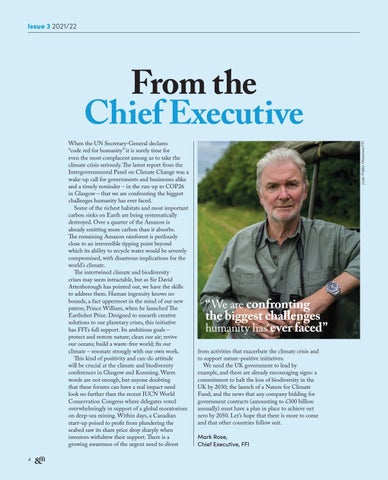
“ We are confronting the biggest challenges humanity has ever faced” from activities that exacerbate the climate crisis and to support nature-positive initiatives. We need the UK government to lead by example, and there are already encouraging signs: a commitment to halt the loss of biodiversity in the UK by 2030; the launch of a Nature for Climate Fund; and the news that any company bidding for government contracts (amounting to £300 billion annually) must have a plan in place to achieve net zero by 2050. Let’s hope that there is more to come and that other countries follow suit. Mark Rose, Chief Executive, FFI