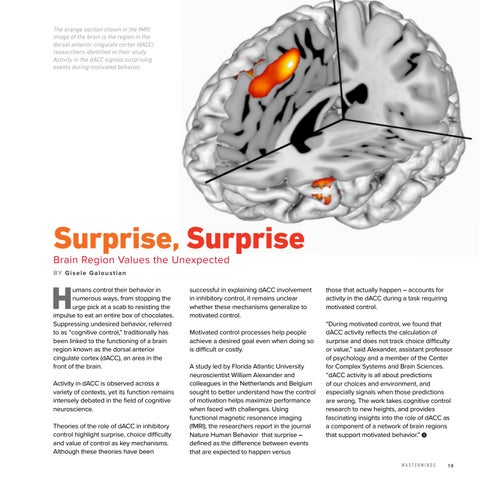
The orange section shown in the fMRI image of the brain is the region in the dorsal anterior cingulate cortex (dACC) researchers identified in their study. Activity in the dACC signals surprising events during motivated behavior.
Surprise, Surprise Brain Region Values the Unexpected BY G i s e l e G a l o u s t i a n
H
umans control their behavior in numerous ways, from stopping the urge pick at a scab to resisting the impulse to eat an entire box of chocolates. Suppressing undesired behavior, referred to as “cognitive control,” traditionally has been linked to the functioning of a brain region known as the dorsal anterior cingulate cortex (dACC), an area in the front of the brain. Activity in dACC is observed across a variety of contexts, yet its function remains intensely debated in the field of cognitive neuroscience. Theories of the role of dACC in inhibitory control highlight surprise, choice difficulty and value of control as key mechanisms. Although these theories have been
successful in explaining dACC involvement in inhibitory control, it remains unclear whether these mechanisms generalize to motivated control. Motivated control processes help people achieve a desired goal even when doing so is difficult or costly. A study led by Florida Atlantic University neuroscientist William Alexander and colleagues in the Netherlands and Belgium sought to better understand how the control of motivation helps maximize performance when faced with challenges. Using functional magnetic resonance imaging (fMRI), the researchers report in the journal Nature Human Behavior that surprise – defined as the difference between events that are expected to happen versus
those that actually happen – accounts for activity in the dACC during a task requiring motivated control. “During motivated control, we found that dACC activity reflects the calculation of surprise and does not track choice difficulty or value,” said Alexander, assistant professor of psychology and a member of the Center for Complex Systems and Brain Sciences. “dACC activity is all about predictions of our choices and environment, and especially signals when those predictions are wrong. The work takes cognitive control research to new heights, and provides fascinating insights into the role of dACC as a component of a network of brain regions that support motivated behavior.”
MASTERMINDS
19