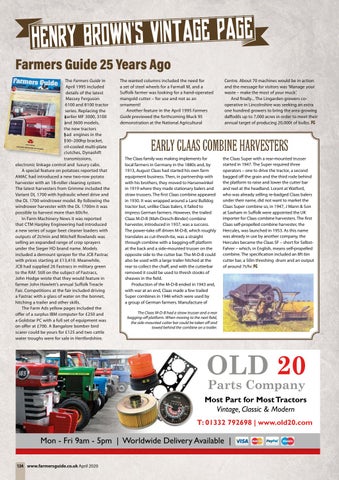
Farmers Guide 25 Years Ago The Farmers Guide in April 1995 included details of the latest Massey Ferguson 6100 and 8100 tractor series. Replacing the earlier MF 3000, 3100 and 3600 models, the new tractors had engines in the 100–200hp bracket, oil-cooled multi-plate clutches, Dynashift transmissions, electronic linkage control and luxury cabs. A special feature on potatoes reported that AMAC had introduced a new two-row potato harvester with an 18-roller cleaning system. The latest harvesters from Grimme included the Variant DL 1700 with hydraulic wheel drive and the DL 1700 windrower model. By following the windrower harvester with the DL 1700m it was possible to harvest more than 60t/hr. In Farm Machinery News it was reported that CTM Harpley Engineering had introduced a new series of sugar beet cleaner loaders with outputs of 2t/min and Mitchell Rowlands was selling an expanded range of crop sprayers under the Sieger HD brand name. Models included a demount sprayer for the JCB Fastrac with prices starting at £13,410. Meanwhile, JCB had supplied 26 Fastracs in military green to the RAF. Still on the subject of Fastracs, John Hodge wrote that they would feature in farmer John Howlett’s annual Suffolk Treacle Fair. Competitions at the fair included driving a Fastrac with a glass of water on the bonnet, hitching a trailer and other skills. The Farm Ads yellow pages included the offer of a surplus IBM computer for £250 and a Goldstar PC with a full set of equipment was on offer at £700. A Bangalore bomber bird scarer could be yours for £125 and two cattle water troughs were for sale in Hertfordshire.
The wanted columns included the need for a set of steel wheels for a Farmall M, and a Suffolk farmer was looking for a hand-operated mangold cutter – for use and not as an ornament! Another feature in the April 1995 Farmers Guide previewed the forthcoming Muck 95 demonstration at the National Agricultural
Centre. About 70 machines would be in action and the message for visitors was ’Manage your waste – make the most of your muck’. And finally... The Lingarden growers cooperative in Lincolnshire was seeking an extra one hundred growers to bring the area growing daffodils up to 7,000 acres in order to meet their annual target of producing 20,000t of bulbs. FG
EARLY CLAAS COMBINE HARVESTERS The Claas family was making implements for local farmers in Germany in the 1880s and, by 1913, August Claas had started his own farm equipment business. Then, in partnership with with his brothers, they moved to Harsenwinkel in 1919 where they made stationary balers and straw trussers. The first Claas combine appeared in 1930. It was wrapped around a Lanz Bulldog tractor but, unlike Claas balers, it failed to impress German farmers. However, the trailed Claas M-D-B (Mah-Dresch-Binder) combine harvester, introduced in 1937, was a success. The power-take off driven M-D-B, which roughly translates as cut-thresh-tie, was a straight through combine with a bagging-off platform at the back and a side-mounted trusser on the opposite side to the cutter bar. The M-D-B could also be used with a large trailer hitched at the rear to collect the chaff, and with the cutterbar removed it could be used to thresh stooks of sheaves in the field. Production of the M-D-B ended in 1943 and, with war at an end, Claas made a few trailed Super combines in 1946 which were used by a group of German farmers. Manufacture of
the Claas Super with a rear-mounted trusser started in 1947. The Super required three operators – one to drive the tractor, a second bagged off the grain and the third rode behind the platform to raise and lower the cutter bar and reel at the headland. Lorant at Watford, who was already selling re-badged Claas balers under their name, did not want to market the Claas Super combine so, in 1947, J Mann & Son at Saxham in Suffolk were appointed the UK importer for Claas combine harvesters. The first Claas self-propelled combine harvester, the Hercules, was launched in 1953. As this name was already in use by another company, the Hercules became the Claas SF – short for SelbstFahrer – which, in English, means self-propelled combine. The specification included an 8ft 6in cutter bar, a 50in threshing drum and an output of around 7t/hr. FG
The Claas M-D-B had a straw trusser and a rear bagging-off platform. When moving to the next field, the side-mounted cutter bar could be taken off and towed behind the combine on a trailer.
OLD 20 Parts Company
Most Part for Most Tractors Vintage, Classic & Modern T: 01332 792698 | www.old20.com
Mon - Fri 9am - 5pm | Worldwide Delivery Available | 124 www.farmersguide.co.uk April 2020
Henry Brown.indd 124
25/03/2020 10:33