on the ground. It’s not always about a sniper taking the shot but providing that situation awareness for teams who might have restricted fields of view,” it was explained, with reference to snipers operating on land, from the air, and aboard maritime vessels. The importance of sniper teams is currently being highlighted during ongoing operations in the Middle East, where coalition forces continue to encounter the self-proclaimed Islamic State (IS) in Iraq and Syria, also known as Daesh. Defense sources explained to The Year in Special Operations how sniper teams were employed during military operations in urban terrain (MOUT), including combat operations to clear enemy combatants from the city of Mosul. Sources also made reference to integral roles played by SOF snipers during CT operations, as part of both internal security and expeditionary operations, where teams can often be employed in a special reconnaissance (SR) role to trigger reactive operations. Meanwhile, semi-automatic and bolt-action sniper solutions continue to be operated side by side across U.S. Special Operations Command (SOCOM) and the wider international community, sources explained. “Semi-automatic systems are ideal in CT missions, allowing operators to rapidly engage multiple targets in quick succession, although bolt-action rifles will always be more accurate because of less moving parts,” one industry source explained to The Year in Special Operations. SOCOM Options
In 2009, SOCOM launched its Precision Sniper Rifle (PSR) program, designed to analyze and test sniper weapon systems to replace the command’s fielded bolt-action SOF sniper systems, including the MK13, M40, and M24. The initial solicitation described a requirement for a manual or gas-operated action weapon available in left- and right-hand configurations with daylight optical gunsight and ammunition providing operators with 1.0 MOA (minute of angle) accuracy from 300 to 1,500 meters when fired from the shoulder.
Other requirements stipulated a Mean Rounds Between Failure rate of 1,000 rounds; total length of weapon system less than 52 inches; and all-up weight of 18 pounds when fitted with a five-round magazine. However, after selecting a winner based on Remington Defense’s Modular Sniper Rifle (MSR), capable of firing .338 Lapua Magnum (LM), .338 Norma Magnum (NM), .300 Winchester Magnum (WM), .308 Winchester, and NATO Standard 7.62 mm x 51 mm ammunition, the program failed to materialize. Hence why SOCOM is now pursuing its next strategy to equip next-generation snipers with suitable technology – the Advanced Sniper Rifle (ASR) program, which, according to industry sources, will also comprise a multi-caliber and bolt-action solution. Sources explained to The Year in Special Operations how the ASR program is expected to come to fruition over the “next few years.” The news follows SOCOM’s Broad Agency Announcement, published on the Federal Business Opportunities website on March 30, 2017, calling for “advanced sniper barrels” available in .300 WM and .300 NM calibers, providing lighter-weight options with “extreme accuracy less than 1 MOA and at least double current barrel life.” According to Barrett’s international sales manager, Jordan Progar, the benefits of multi-caliber technology provide SOF teams with not only cheaper training costs with options to fire smaller and less-expensive ammunition (.50 BMG versus .308 Winchester as an example) but also more theater-relevant calibers for various environments, including MOUT, where snipers are engaging at shorter ranges and do not require larger-caliber, longer-range cartridges. Progar described current requirements emerging from the COE opposed to operations in Afghanistan over the past decade, which sometimes called for a sniper capability out to 1,800 meters. “In the urban environment, including those [Daesh] controlled areas, you don’t need a .338 LM because you’re engaging at ranges of 800 meters or less. “Lesser calibers can provide more discreet capabilities for snipers, especially if fitted with suppressor technology, while the ability to switch between caliber types [as outlined by the PSR and expected ASR solicitation] also allows levels of interoperability with coalition partners deployed on operations,” Progar said. Looking ahead to the ASR requirement, Barrett confirmed it is lining up its Multi-Role Adaptive Design (MRAD) solution to participate in the program against likely competition from Accuracy International’s AX-series, Remington Defense’s MSR, and Sako’s TRG-42. According to Progar, the MRAD comprises a user-changeable barrel system that can be removed by loosening two bolts using a wrench. Calibers can be changed in the field within just 30 seconds, he said.
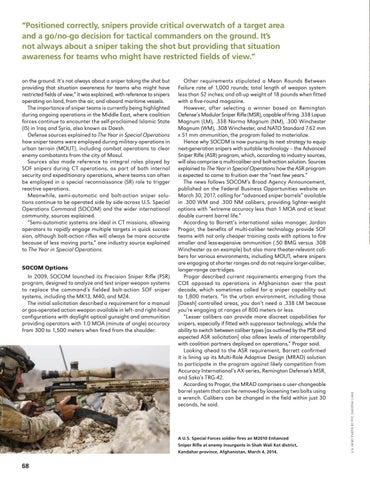
A U.S. Special Forces soldier fires an M2010 Enhanced Sniper Rifle at enemy insurgents in Shah Wali Kot district, Kandahar province, Afghanistan, March 4, 2014.
68
U.S. ARMY PHOTO BY PFC. DACOTAH LANE
“Positioned correctly, snipers provide critical overwatch of a target area and a go/no-go decision for tactical commanders on the ground. It’s not always about a sniper taking the shot but providing that situation awareness for teams who might have restricted fields of view.”