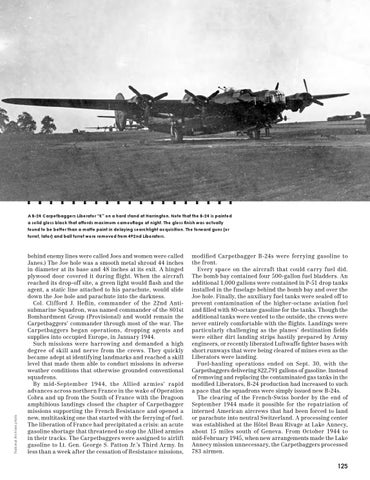
A B-24 Carpetbaggers Liberator “K” on a hard stand at Harrington. Note that the B-24 is painted a solid gloss black that affords maximum camouflage at night. The gloss finish was actually found to be better than a matte paint in delaying searchlight acquisition. The forward guns (or
National Archives photo
turret, later) and ball turret were removed from 492nd Liberators.
behind enemy lines were called Joes and women were called Janes.) The Joe hole was a smooth metal shroud 44 inches in diameter at its base and 48 inches at its exit. A hinged plywood door covered it during flight. When the aircraft reached its drop-off site, a green light would flash and the agent, a static line attached to his parachute, would slide down the Joe hole and parachute into the darkness. Col. Clifford J. Heflin, commander of the 22nd Antisubmarine Squadron, was named commander of the 801st Bombardment Group (Provisional) and would remain the Carpetbaggers’ commander through most of the war. The Carpetbaggers began operations, dropping agents and supplies into occupied Europe, in January 1944. Such missions were harrowing and demanded a high degree of skill and nerve from the crews. They quickly became adept at identifying landmarks and reached a skill level that made them able to conduct missions in adverse weather conditions that otherwise grounded conventional squadrons. By mid-September 1944, the A llied armies’ rapid advances across northern France in the wake of Operation Cobra and up from the South of France with the Dragoon amphibious landings closed the chapter of Carpetbagger missions supporting the French Resistance and opened a new, multitasking one that started with the ferrying of fuel. The liberation of France had precipitated a crisis: an acute gasoline shortage that threatened to stop the Allied armies in their tracks. The Carpetbaggers were assigned to airlift gasoline to Lt. Gen. George S. Patton Jr.’s Third Army. In less than a week after the cessation of Resistance missions,
modified Carpetbagger B-24s were ferrying gasoline to the front. Every space on the aircraft that could carry fuel did. The bomb bay contained four 500-gallon fuel bladders. An additional 1,000 gallons were contained in P-51 drop tanks installed in the fuselage behind the bomb bay and over the Joe hole. Finally, the auxiliary fuel tanks were sealed off to prevent contamination of the higher-octane aviation fuel and filled with 80-octane gasoline for the tanks. Though the additional tanks were vented to the outside, the crews were never entirely comfortable with the flights. Landings were particularly challenging as the planes’ destination fields were either dirt landing strips hastily prepared by Army engineers, or recently liberated Luftwaffe fighter bases with short runways that were being cleared of mines even as the Liberators were landing. Fuel-hauling operations ended on Sept. 30, with the Carpetbaggers delivering 822,791 gallons of gasoline. Instead of removing and replacing the contaminated gas tanks in the modified Liberators, B-24 production had increased to such a pace that the squadrons were simply issued new B-24s. The clearing of the French-Swiss border by the end of September 1944 made it possible for the repatriation of interned American aircrews that had been forced to land or parachute into neutral Switzerland. A processing center was established at the Hôtel Beau Rivage at Lake Annecy, about 15 miles south of Geneva. From October 1944 to mid-February 1945, when new arrangements made the Lake Annecy mission unnecessary, the Carpetbaggers processed 783 airmen.
125