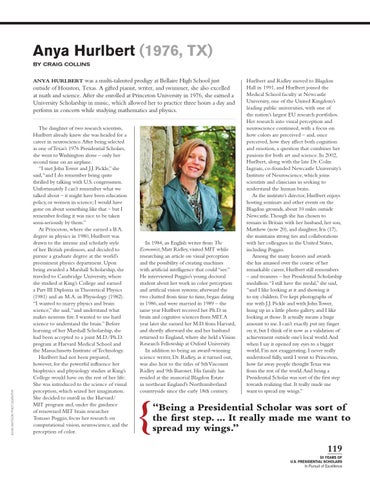
Anya Hurlbert (1976, TX) BY CRAIG COLLINS
ANYA HURLBERT was a multi-talented prodigy at Bellaire High School just
JOHN WATSON PHOTOGRAPHY
outside of Houston, Texas. A gifted pianist, writer, and swimmer, she also excelled at math and science. After she enrolled at Princeton University in 1976, she earned a University Scholarship in music, which allowed her to practice three hours a day and perform in concerts while studying mathematics and physics. The daughter of two research scientists, Hurlbert already knew she was headed for a career in neuroscience. After being selected as one of Texas’s 1976 Presidential Scholars, she went to Washington alone – only her second time on an airplane. “I met John Tower and J.J. Pickle,” she said, “and I do remember being quite thrilled by talking with U.S. congressmen. Unfortunately I can’t remember what we talked about – it might have been education policy, or women in science; I would have gone on about something like that – but I remember feeling it was nice to be taken semi-seriously by them.” At Princeton, where she earned a B.A. degree in physics in 1980, Hurlbert was drawn to the intense and scholarly style of her British professors, and decided to pursue a graduate degree at the world’s preeminent physics department. Upon being awarded a Marshall Scholarship, she traveled to Cambridge University, where she studied at King’s College and earned a Part III Diploma in Theoretical Physics (1981) and an M.A. in Physiology (1982). “I wanted to marry physics and brain science,” she said, “and understand what makes neurons fire. I wanted to use hard science to understand the brain.” Before learning of her Marshall Scholarship, she had been accepted to a joint M.D./Ph.D. program at Harvard Medical School and the Massachusetts Institute of Technology. Hurlbert had not been prepared, however, for the powerful influence her biophysics and physiology studies at King’s College would have on the rest of her life: She was introduced to the science of visual perception, which seized her imagination. She decided to enroll in the Harvard/ MIT program and, under the guidance of renowned MIT brain researcher Tomaso Poggio, focus her research on computational vision, neuroscience, and the perception of color.
In 1984, an English writer from The Economist, Matt Ridley, visited MIT while researching an article on visual perception and the possibility of creating machines with artificial intelligence that could “see.” He interviewed Poggio’s young doctoral student about her work in color perception and artificial vision systems; afterward the two chatted from time to time, began dating in 1986, and were married in 1989 – the same year Hurlbert received her Ph.D. in brain and cognitive sciences from MIT. A year later she earned her M.D. from Harvard, and shortly afterward she and her husband returned to England, where she held a Vision Research Fellowship at Oxford University. In addition to being an award-winning science writer, Dr. Ridley, as it turned out, was also heir to the titles of 5th Viscount Ridley and 9th Baronet. His family has resided at the manorial Blagdon Estate in northeast England’s Northumberland countryside since the early 18th century.
{
Hurlbert and Ridley moved to Blagdon Hall in 1991, and Hurlbert joined the Medical School faculty at Newcastle University, one of the United Kingdom’s leading public universities, with one of the nation’s largest EU research portfolios. Her research into visual perception and neuroscience continued, with a focus on how colors are perceived – and, once perceived, how they affect both cognition and emotion, a question that combines her passions for both art and science. In 2002, Hurlbert, along with the late Dr. Colin Ingram, co-founded Newcastle University’s Institute of Neuroscience, which joins scientists and clinicians in seeking to understand the human brain. As the institute’s director, Hurlbert enjoys hosting seminars and other events on the Blagdon grounds, about 10 miles outside Newcastle. Though she has chosen to remain in Britain with her husband, her son, Matthew (now 20), and daughter, Iris (17), she maintains strong ties and collaborations with her colleagues in the United States, including Poggio. Among the many honors and awards she has amassed over the course of her remarkable career, Hurlbert still remembers – and treasures – her Presidential Scholarship medallion. “I still have the medal,” she said, “and I like looking at it and showing it to my children. I’ve kept photographs of me with J.J. Pickle and with John Tower, hung up in a little photo gallery, and I like looking at those. It actually means a huge amount to me. I can’t exactly put my finger on it, but I think of it now as a validation of achievement outside one’s local world. And when I say it opened my eyes to a bigger world, I’m not exaggerating. I never really understood fully, until I went to Princeton, how far away people thought Texas was from the rest of the world. And being a Presidential Scholar was sort of the first step towards realizing that. It really made me want to spread my wings.”
“Being a Presidential Scholar was sort of the first step. … It really made me want to spread my wings.” 119 50 YEARS OF U.S. PRESIDENTIAL SCHOLARS
In Pursuit of Excellence