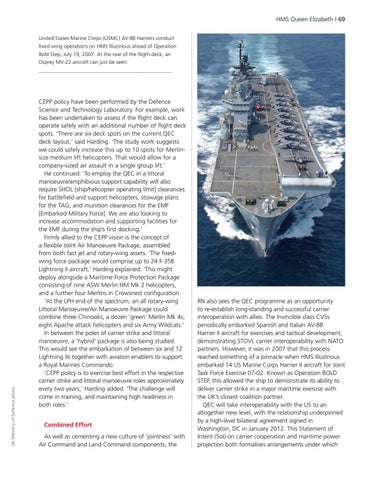
HMS Queen Elizabeth I 69 United States Marine Corps (USMC) AV-8B Harriers conduct fixed wing operations on HMS Illustrious ahead of Operation Bold Step, July 19, 2007. At the rear of the flight deck, an Osprey MV-22 aircraft can just be seen.
UK Ministry of Defence photo
CEPP policy have been performed by the Defence Science and Technology Laboratory. For example, work has been undertaken to assess if the flight deck can operate safely with an additional number of flight deck spots. ‘There are six deck spots on the current QEC deck layout,’ said Harding. ‘The study work suggests we could safely increase this up to 10 spots for Merlinsize medium lift helicopters. That would allow for a company-sized air assault in a single group lift.’ He continued: ‘To employ the QEC in a littoral manoeuvre/amphibious support capability will also require SHOL [ship/helicopter operating limit] clearances for battlefield and support helicopters, stowage plans for the TAG, and munition clearances for the EMF [Embarked Military Force]. We are also looking to increase accommodation and supporting facilities for the EMF during the ship’s first docking.’ Firmly allied to the CEPP vision is the concept of a flexible Joint Air Manoeuvre Package, assembled from both fast jet and rotary-wing assets. ‘The fixedwing force package would comprise up to 24 F-35B Lightning II aircraft,’ Harding explained. ‘This might deploy alongside a Maritime Force Protection Package consisting of nine ASW Merlin HM Mk 2 helicopters, and a further four Merlins in Crowsnest configuration. ‘At the LPH end of the spectrum, an all rotary-wing Littoral Manoeuvre/Air Manoeuvre Package could combine three Chinooks, a dozen ‘green’ Merlin Mk 4s, eight Apache attack helicopters and six Army Wildcats.’ In between the poles of carrier strike and littoral manoeuvre, a ‘hybrid’ package is also being studied. This would see the embarkation of between six and 12 Lightning IIs together with aviation enablers to support a Royal Marines Commando. ‘CEPP policy is to exercise best effort in the respective carrier strike and littoral manoeuvre roles approximately every two years,’ Harding added. ‘The challenge will come in training, and maintaining high readiness in both roles.’ Combined Effort As well as cementing a new culture of ‘jointness’ with Air Command and Land Command components, the
RN also sees the QEC programme as an opportunity to re-establish long-standing and successful carrier interoperation with allies. The Invincible class CVSs periodically embarked Spanish and Italian AV-8B Harrier II aircraft for exercises and tactical development, demonstrating STOVL carrier interoperability with NATO partners. However, it was in 2007 that this process reached something of a pinnacle when HMS Illustrious embarked 14 US Marine Corps Harrier II aircraft for Joint Task Force Exercise 07-02. Known as Operation BOLD STEP, this allowed the ship to demonstrate its ability to deliver carrier strike in a major maritime exercise with the UK’s closest coalition partner. QEC will take interoperability with the US to an altogether new level, with the relationship underpinned by a high-level bilateral agreement signed in Washington, DC in January 2012. This Statement of Intent (SoI) on carrier cooperation and maritime power projection both formalises arrangements under which