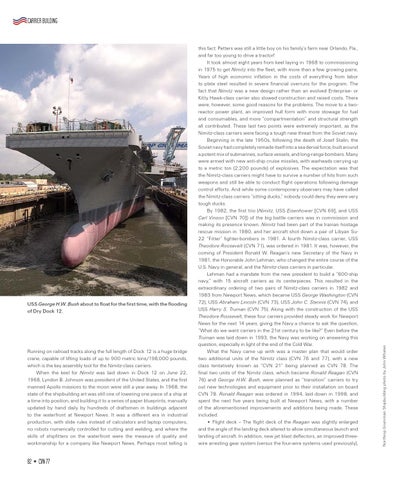
USS George H.W. Bush about to float for the first time, with the flooding of Dry Dock 12.
Running on railroad tracks along the full length of Dock 12 is a huge bridge crane, capable of lifting loads of up to 900 metric tons/198,000 pounds, which is the key assembly tool for the Nimitz-class carriers. When the keel for Nimitz was laid down in Dock 12 on June 22, 1968, Lyndon B. Johnson was president of the United States, and the first manned Apollo missions to the moon were still a year away. In 1968, the state of the shipbuilding art was still one of lowering one piece of a ship at a time into position, and building it to a series of paper blueprints, manually updated by hand daily by hundreds of draftsmen in buildings adjacent to the waterfront at Newport News. It was a different era in industrial production, with slide rules instead of calculators and laptop computers, no robots numerically controlled for cutting and welding, and where the skills of shipfitters on the waterfront were the measure of quality and workmanship for a company like Newport News. Perhaps most telling is
this fact: Petters was still a little boy on his family’s farm near Orlando, Fla., and far too young to drive a tractor! It took almost eight years from keel laying in 1968 to commissioning in 1975 to get Nimitz into the fleet, with more than a few growing pains. Years of high economic inflation in the costs of everything from labor to plate steel resulted in severe financial overruns for the program. The fact that Nimitz was a new design rather than an evolved Enterprise- or Kitty Hawk-class carrier also slowed construction and raised costs. There were, however, some good reasons for the problems. The move to a tworeactor power plant, an improved hull form with more stowage for fuel and consumables, and more “compartmentation” and structural strength all contributed. These last two points were extremely important, as the Nimitz-class carriers were facing a tough new threat from the Soviet navy. Beginning in the late 1950s, following the death of Josef Stalin, the Soviet navy had completely remade itself into a sea denial force, built around a potent mix of submarines, surface vessels, and long-range bombers. Many were armed with new anti-ship cruise missiles, with warheads carrying up to a metric ton (2,200 pounds) of explosives. The expectation was that the Nimitz-class carriers might have to survive a number of hits from such weapons and still be able to conduct flight operations following damage control efforts. And while some contemporary observers may have called the Nimitz-class carriers “sitting ducks,” nobody could deny they were very tough ducks. By 1982, the first trio (Nimitz, USS Eisenhower [CVN 69], and USS Carl Vinson [CVN 70]) of the big battle carriers was in commission and making its presence known. Nimitz had been part of the Iranian hostage rescue mission in 1980, and her aircraft shot down a pair of Libyan Su22 “Fitter” fighter-bombers in 1981. A fourth Nimitz-class carrier, USS Theodore Roosevelt (CVN 71), was ordered in 1981. It was, however, the coming of President Ronald W. Reagan’s new Secretary of the Navy in 1981, the Honorable John Lehman, who changed the entire course of the U.S. Navy in general, and the Nimitz-class carriers in particular. Lehman had a mandate from the new president to build a “600-ship navy,” with 15 aircraft carriers as its centerpieces. This resulted in the extraordinary ordering of two pairs of Nimitz-class carriers in 1982 and 1983 from Newport News, which became USS George Washington (CVN 72), USS Abraham Lincoln (CVN 73), USS John C. Stennis (CVN 74), and USS Harry S. Truman (CVN 75). Along with the construction of the USS Theodore Roosevelt, these four carriers provided steady work for Newport News for the next 14 years, giving the Navy a chance to ask the question, “What do we want carriers in the 21st century to be like?” Even before the Truman was laid down in 1993, the Navy was working on answering this question, especially in light of the end of the Cold War. What the Navy came up with was a master plan that would order two additional units of the Nimitz class (CVN 76 and 77), with a new class tentatively known as “CVN 21” being planned as CVN 78. The final two units of the Nimitz class, which became Ronald Reagan (CVN 76) and George H.W. Bush, were planned as “transition” carriers to try out new technologies and equipment prior to their installation on board CVN 78. Ronald Reagan was ordered in 1994, laid down in 1998, and spent the next five years being built at Newport News, with a number of the aforementioned improvements and additions being made. These included: • Flight deck – The flight deck of the Reagan was slightly enlarged and the angle of the landing deck altered to allow simultaneous launch and landing of aircraft. In addition, new jet blast deflectors, an improved threewire arresting gear system (versus the four-wire systems used previously),
Northrop Grumman Shipbuilding photo by John Whalen
carrier building
82 H CVN 77
building bush.indd 82
12/9/08 5:08:16 PM