postwar aircraft carriers
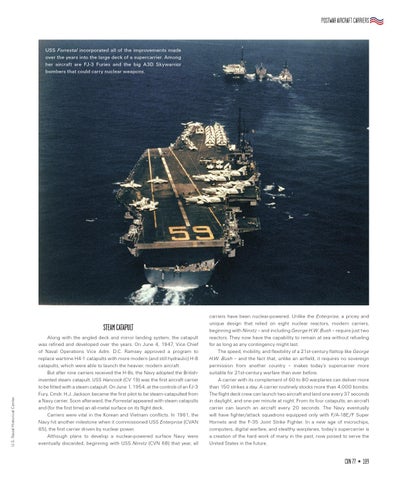
USS Forrestal incorporated all of the improvements made over the years into the large deck of a supercarrier. Among her aircraft are FJ-3 Furies and the big A3D Skywarrior bombers that could carry nuclear weapons.
U.S. Naval Historical Center
STEAM CATAPULT Along with the angled deck and mirror landing system, the catapult was refined and developed over the years. On June 4, 1947, Vice Chief of Naval Operations Vice Adm. D.C. Ramsey approved a program to replace wartime H4-1 catapults with more modern (and still hydraulic) H-8 catapults, which were able to launch the heavier, modern aircraft. But after nine carriers received the H-8s, the Navy adopted the Britishinvented steam catapult. USS Hancock (CV 19) was the first aircraft carrier to be fitted with a steam catapult. On June 1, 1954, at the controls of an FJ-3 Fury, Cmdr. H.J. Jackson became the first pilot to be steam-catapulted from a Navy carrier. Soon afterward, the Forrestal appeared with steam catapults and (for the first time) an all-metal surface on its flight deck. Carriers were vital in the Korean and Vietnam conflicts. In 1961, the Navy hit another milestone when it commissioned USS Enterprise (CVAN 65), the first carrier driven by nuclear power. Although plans to develop a nuclear-powered surface Navy were eventually discarded, beginning with USS Nimitz (CVN 68) that year, all
carriers have been nuclear-powered. Unlike the Enterprise, a pricey and unique design that relied on eight nuclear reactors, modern carriers, beginning with Nimitz – and including George H.W. Bush – require just two reactors. They now have the capability to remain at sea without refueling for as long as any contingency might last. The speed, mobility, and flexibility of a 21st-century flattop like George H.W. Bush – and the fact that, unlike an airfield, it requires no sovereign permission from another country – makes today’s supercarrier more suitable for 21st-century warfare than ever before. A carrier with its complement of 60 to 80 warplanes can deliver more than 150 strikes a day. A carrier routinely stocks more than 4,000 bombs. The flight deck crew can launch two aircraft and land one every 37 seconds in daylight, and one per minute at night. From its four catapults, an aircraft carrier can launch an aircraft every 20 seconds. The Navy eventually will have fighter/attack squadrons equipped only with F/A-18E/F Super Hornets and the F-35 Joint Strike Fighter. In a new age of microchips, computers, digital warfare, and stealthy warplanes, today’s supercarrier is a creation of the hard work of many in the past, now poised to serve the United States in the future.
CVN 77 H 189
modern aircraft carrier.indd 189
12/9/08 2:24:38 PM