ANNISTON MUNITIONS CENTER Anniston, Alabama Mission Anniston Munitions Center provides timely and accurate receipt, storage, issue, maintenance, inspection, demilitarization, and recycling of ammunition and missiles.
Photo by Mark Cleghorn, Anniston Army Depot Photographer
Capabilities • Ammunition renovation • Ship, receive, and outload • Preservation, packaging, and maintenance • Quality assurance • Explosive demilitarization • Missile recycling History Anniston Ordnance Depot was established in February 1941. In 1952, the depot was assigned a maintenance mission for the overhaul and repair of combat vehicles. In 1962, the installation was renamed Anniston Army Depot and became part of the Army Materiel Command. In 1976, Anniston Army Depot became a part of the U.S. Army Depot System Command. In 1995, it became part of the Industrial Operations Command. In 1998, the 722nd Ordnance Company relocated from Fort McClellan, Ala., to Anniston Army Depot under Base Realignment and Closure 1995. Also in 1998, the conventional ammunition mission became a tenant organization. On Oct. 1, 1999, Anniston Munitions Center officially came under the full command and control of Blue Grass Army Depot in Richmond, Ky. Anniston Munitions Center received its first on-site commander in June 2004. Statistics For fiscal year 2014, Anniston Munitions Center has an operating budget of $17.4 million and a payroll of $9.5million.
Sustaining the Strength of the Nation
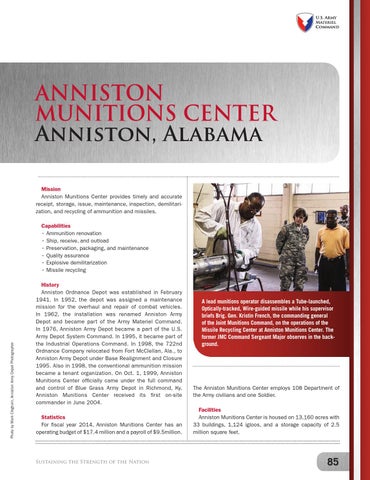
A lead munitions operator disassembles a Tube-launched, Optically-tracked, Wire-guided missile while his supervisor briefs Brig. Gen. Kristin French, the commanding general of the Joint Munitions Command, on the operations of the Missile Recycling Center at Anniston Munitions Center. The former JMC Command Sergeant Major observes in the background.
The Anniston Munitions Center employs 108 Department of the Army civilians and one Soldier. Facilities Anniston Munitions Center is housed on 13,160 acres with 33 buildings, 1,124 igloos, and a storage capacity of 2.5 million square feet.
85