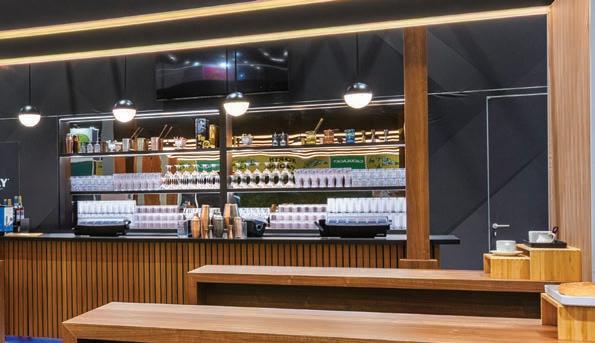
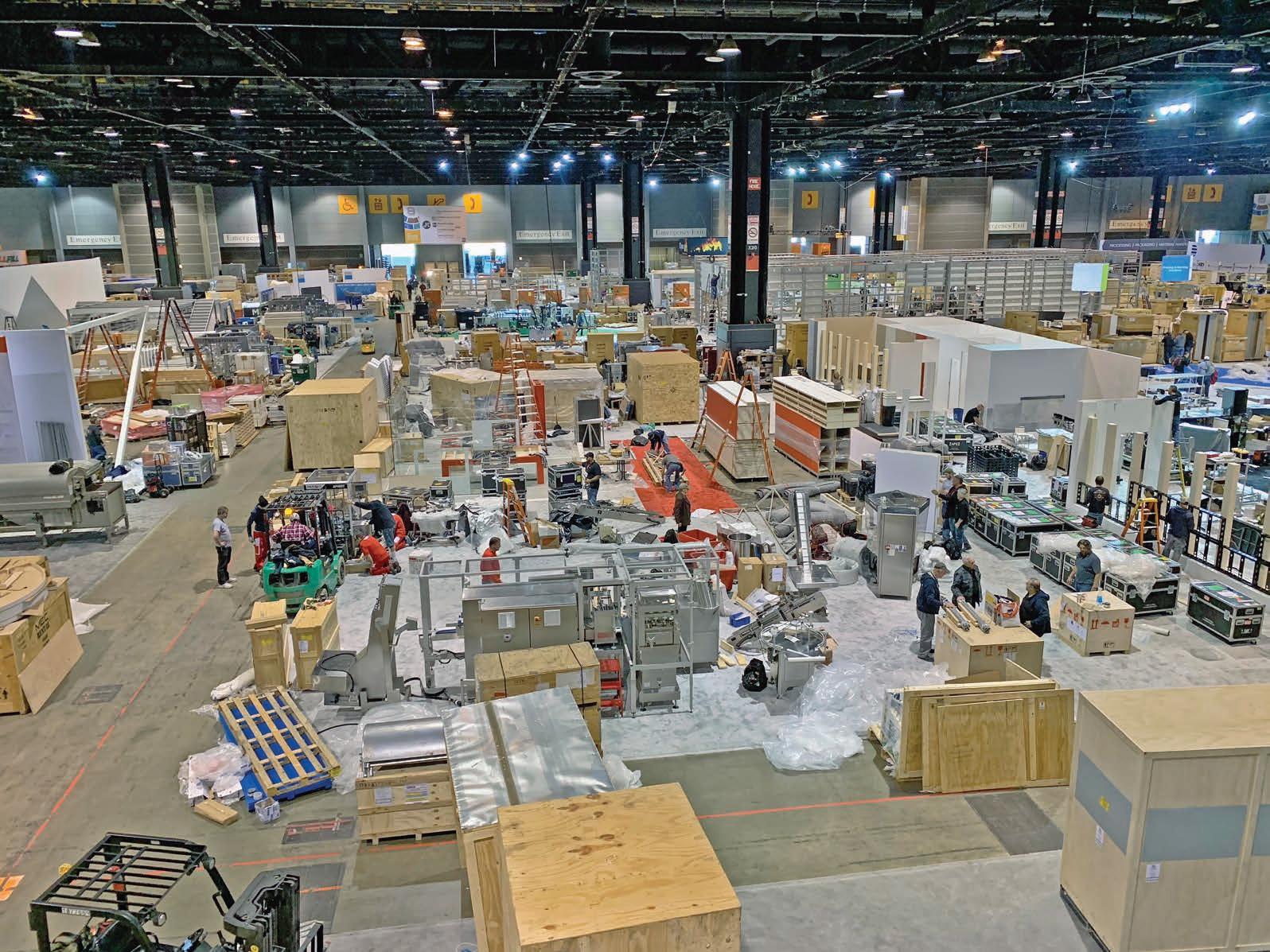
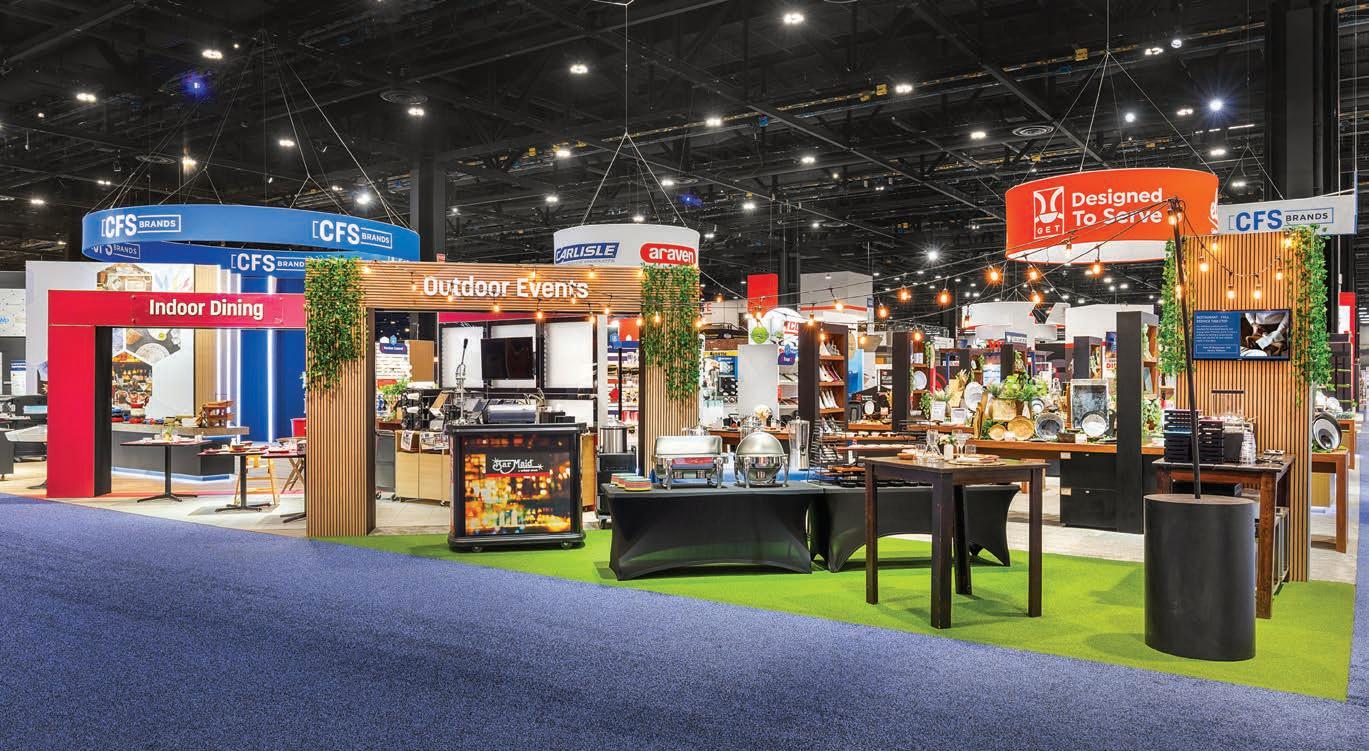
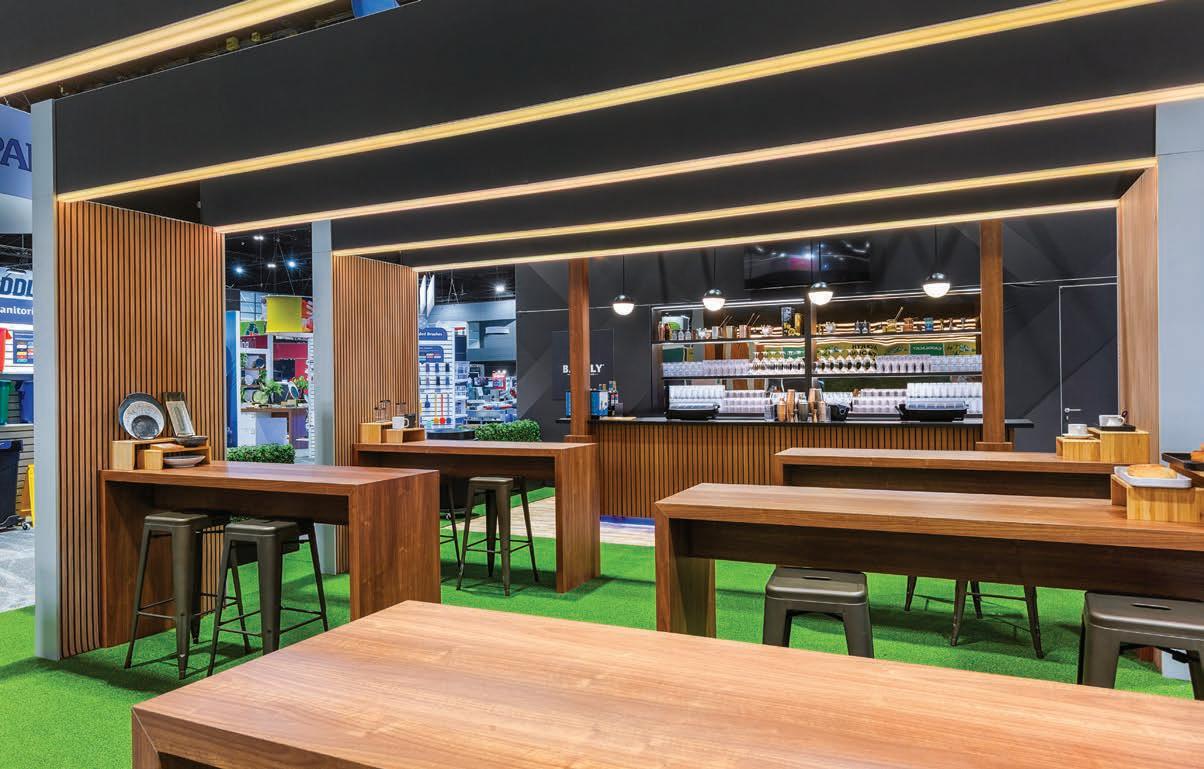
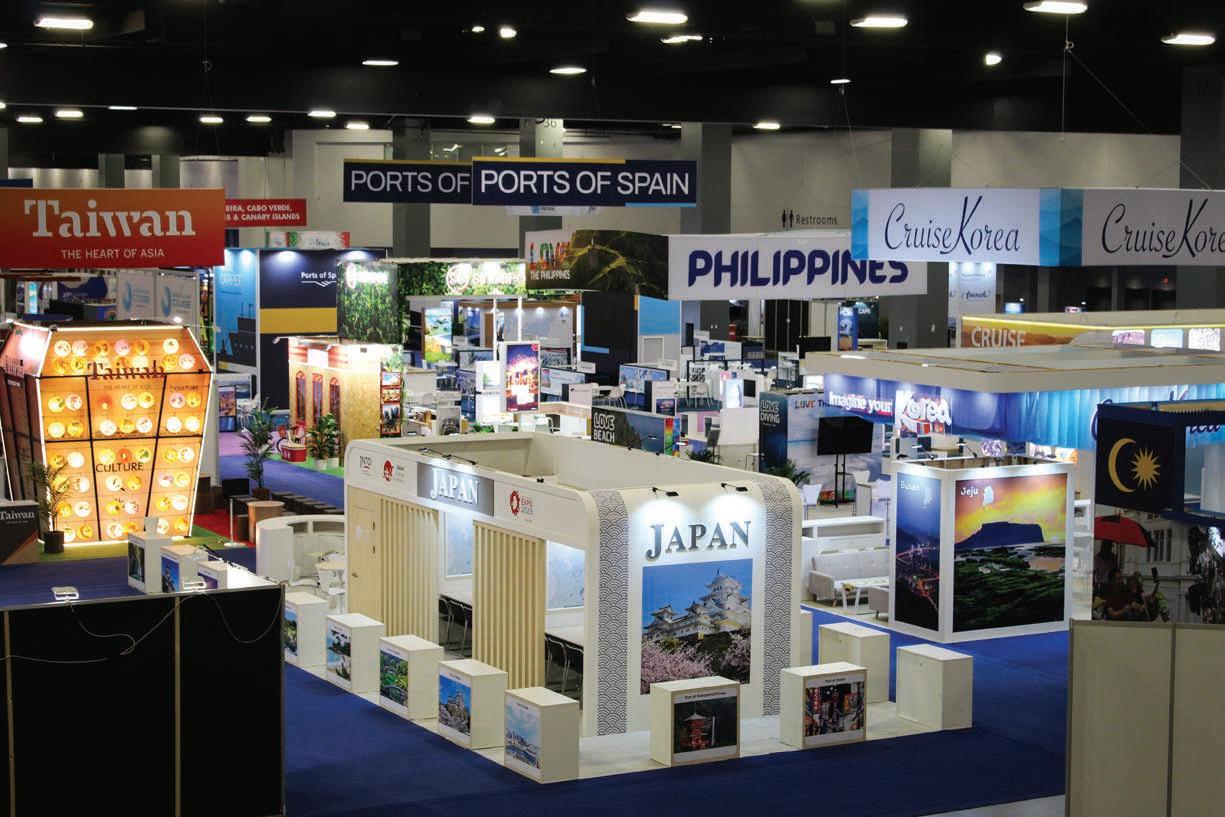
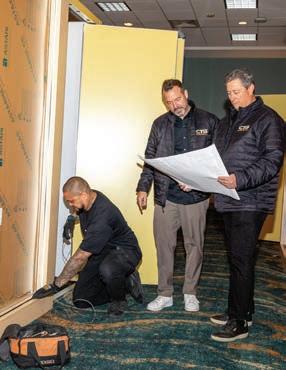
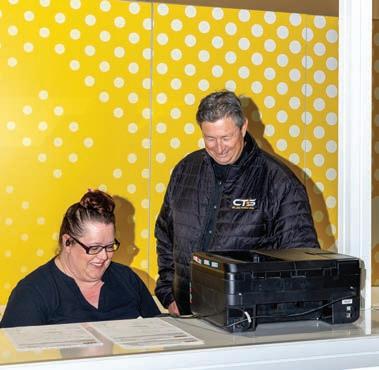
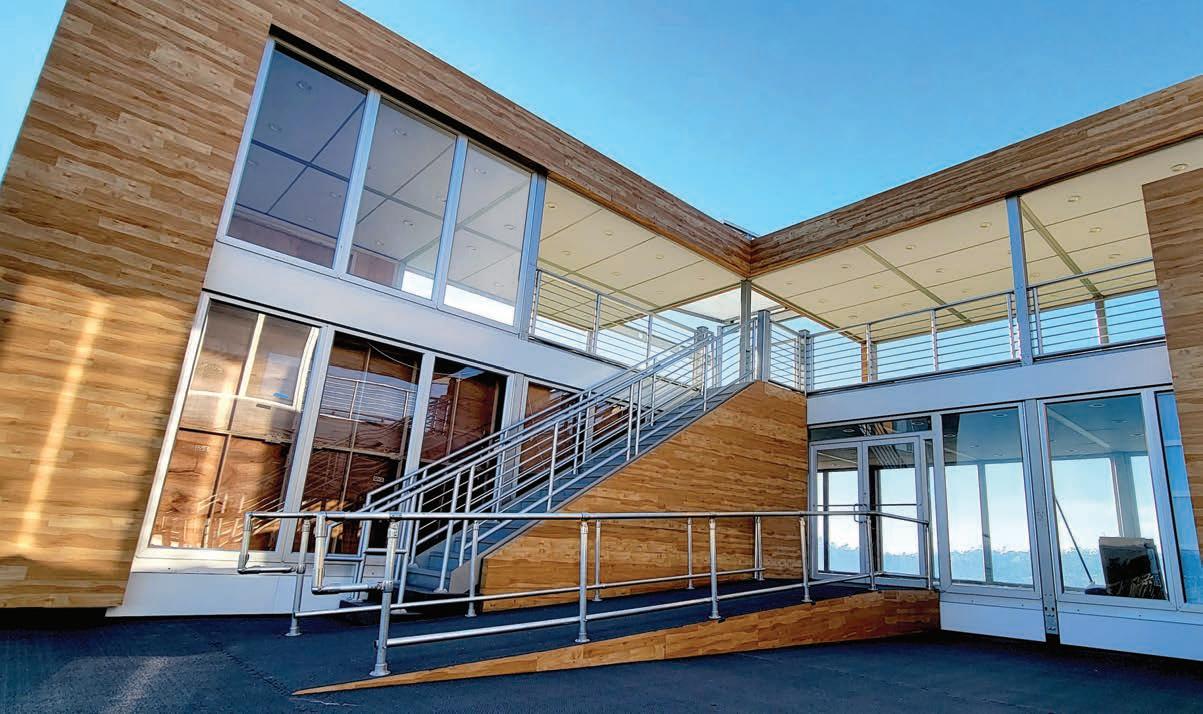
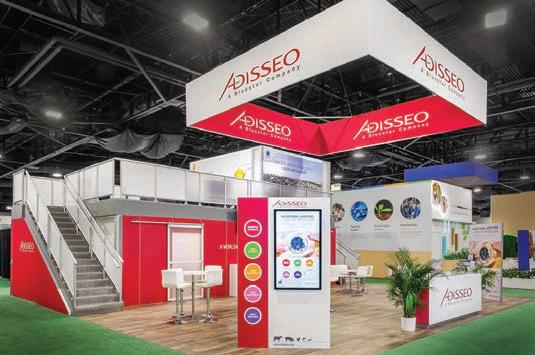
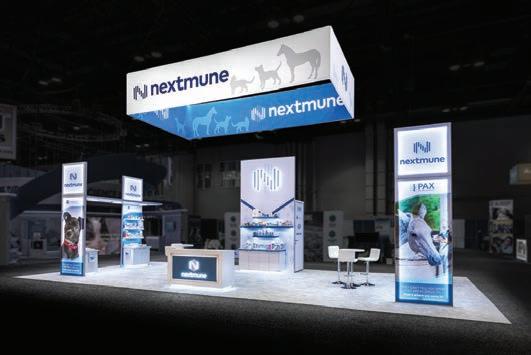
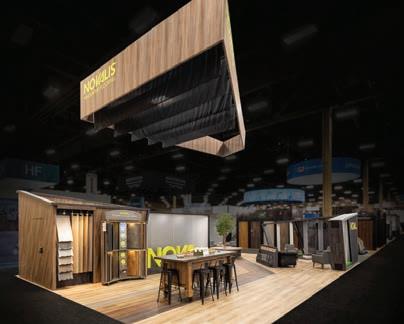
Metro Exhibits designed a booth for CFS Brands with restaurant-style vignettes showcasing products in real-world applications and marked by archways for an intended route of travel through the exhibit.
Aluvision’s award-winning Omni frame series and LED line were strategically used in the 70x170 reconfigurable exhibit:
Flexible modularity & easy assembly
Engineered for SEG & panels on both sides
Durable & strong for product shelving, TV monitor & custom element support
Provides cost & labor efciency
Read the full story and find out how using Aluvision systems helped Metro Exhibits to design freely and build better. Article inside this issue!
We want to set you up for success! Let's produce something great together.
Contact Us: Service@willwork.com
Family owned and operated
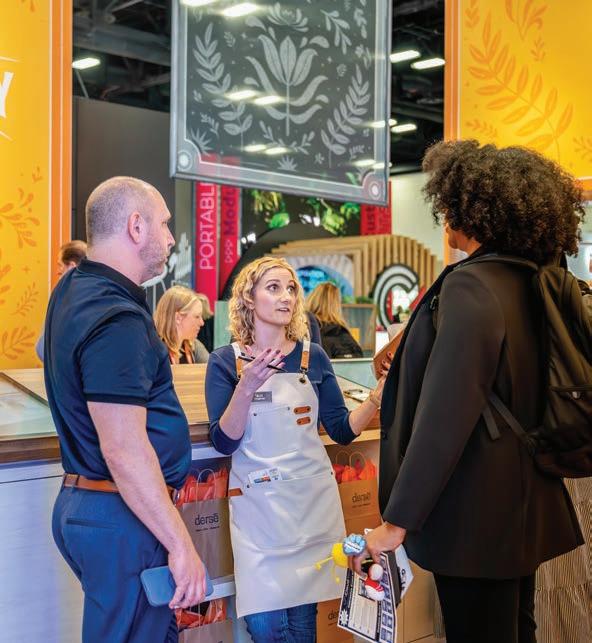
Bottom photo by Donovan Hogan, Derse
A Good Time to Reset
Summer may not bring the same crush of events as spring or fall, but it’s far from slow. July still includes major shows, steady regional activity, and the fnal stretch of a busy frst half. It may not be peak season, but for many, it’s still full throttle. That said, there’s a shift in the air. As August approaches and things begin to taper, July ofers a rare window to regroup. With the big spring shows behind us and planning for fall already underway, this is a good time to take stock of where we are and what still needs attention.
This quarter, a few themes keep coming up in conversations across the industry. One is the challenge of keeping sustainability practical. We’ve seen great ideas and strong commitments, but the lack of alignment is real. It’s not unusual for venue rules, exhibitor goals, and contractor policies to confict, leaving labor stuck in the middle. When the people doing the work aren’t part of the planning, even well-meant policies can create friction or get ignored.
Another is the international headwind. Visa delays, shifting travel policies, and global instability are shrinking overseas participation at U.S.-based shows. That is not just a badge count issue; it afects the value proposition for exhibitors who rely on international leads.
We’re also still talking about the workforce. Good people are stepping up, and training programs are expanding, but the industry pipeline remains thin. Most young professionals don’t know this feld exists, and fewer still under-
stand the real career potential it ofers. That needs to change.
But there’s progress, too. The sustainability conversation is shifting toward integration instead of overload. Tools like the Sustainability Sourcing Compass are helping exhibitors put their values into action. Labor leaders and show organizers are having more direct conversations about improving workfow and reducing burnout. We’re seeing it on the foor, not just in theory. That’s real movement.
And if you need a reminder of the industry’s community spirit, look at the energy around the growing investment in union-led training programs. These touchpoints matter. They create space for real conversation, mentorship, and progress that carries beyond the show floor.
So, if this season gives you a little more space to think, use it. Catch your breath. Look ahead. Have the conversations now that make fall easier to navigate.
The foor isn’t going anywhere—but we can keep getting better at how we build on it.
See you out there.
Don Svehla,
Publisher/Founder
Questions? Suggestions? Comments about our content? We love feedback and hearing from you! Send me an email at dons@exhibitcitynews.com
PUBLISHER & FOUNDER
Donald V. Svehla Jr. (702) 272-0182 ext. 102 DonS@exhibitcitynews.com
Debbie Hall, Mark Hebert, Ray Smith, Kerstan Szczepanski
PROOFREADERS
Lisa Abrams, Mark Hebert, Kerstan Szczepanski
Welcome to the Community
Picture this: fowing convention centers, bright smiling faces, a whole host of people that you know like the back of your hand. Jim Obermeyer calls the tradeshow community a “small town” (pg. 88), and I cannot help but believe that is the best term for it.
Our industry is flled to the brim with people who can and want to help you succeed. They see each other as collaborators rather than competitors and are constantly working together. Regardless of the obstacles that may come our way, we as an industry are a community: consistently pushing forward.
Nonetheless, we are constantly faced with new challenges. Whether that is in developments for technology or rules and regulations, there is never a dull moment. For that reason our Quarter 3 issue for the magazine focuses on these challenges.
We at Exhibit City News (ECN) recognize that in the ever-changing world it is hard to get a pulse on what policies are in place and what was true three weeks ago. We understand that the content that we have within these pages may be obsolete in a year. We were told to keep the content evergreen, which is what we did to the best of our ability, and to report on the news as well. Sometimes, however, you have to be topical in order to push the industry forward.
In these pages you will fnd stories about how companies are here to help you, how some are assisting brands for a refresh (Rebrand Redesign pg. 46) and how others are utilizing their expertise to create a
better community (Everything Falls Into Place pg. 76). We discuss the technology of today (Bright Ideas pg. 38) and yester year (Thomas Alva Edison—Tradeshow Marketer pg. 84).
Mostly, however, we focus on the law, on regulations, workforce development, and changes in taxes and visas. Paco Collazo warns us about wait times for visas (pg. 88) and Jon Ellms reminds us why regulations are so important (pg. 24). When it comes to these considerations, and the path towards the future, the only way forward is together.
When it comes to tradeshows, collaboration is key. We are often told that nothing can happen without the help and dedication of a team. Everyone has a role to play from laborers to convention management. Continue striving for communication and collaboration and when in doubt never forget:
We at ECN are standing by to help you.
Marlena Sullivan, Editor Questions? Suggestions? Comments about our content? We love feedback and hearing from you! Send me an email at digitaleditor@exhibitcitynews.com
A MUST-READ FOR EVENT PROFESSIONALS
by Mark Hebert
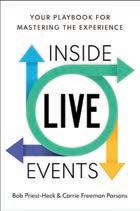
Inside Live Events
Your Playbook for Mastering the Experience by
Bob Priest-Heck & Carrie Freeman Parsons
Inside Live Events is a practical, strategic guide to planning and executing live experiences— whether you’re a seasoned professional or new to the industry. The authors stress that successful events don’t just happen— they are designed, refined, and continuously improved. They emphasize that the industry’s focus must shift toward creating meaningful moments rather than just managing logistics. Attendees no longer want to passively observe; they seek interactive, immersive environments where they can connect, learn, and engage. With an up-to-date glossary of exhibitor terminology and a strategic, experience-driven approach, Inside Live Events is an essential read for anyone in the exhibition and events space. Whether you’re refining your skills or just starting out, this book provides a roadmap for creating unforgettable experiences. The authors leave readers with a simple but powerful challenge: “We have started this book in the hope that you will finish it.”
For the full book review please visit: https://exhibitcitynews.com/bookreview-inside-live-events-your-playbookfor-mastering-the-experience/
ACQUISITIONS AND MERGERS FOR Q2 2025
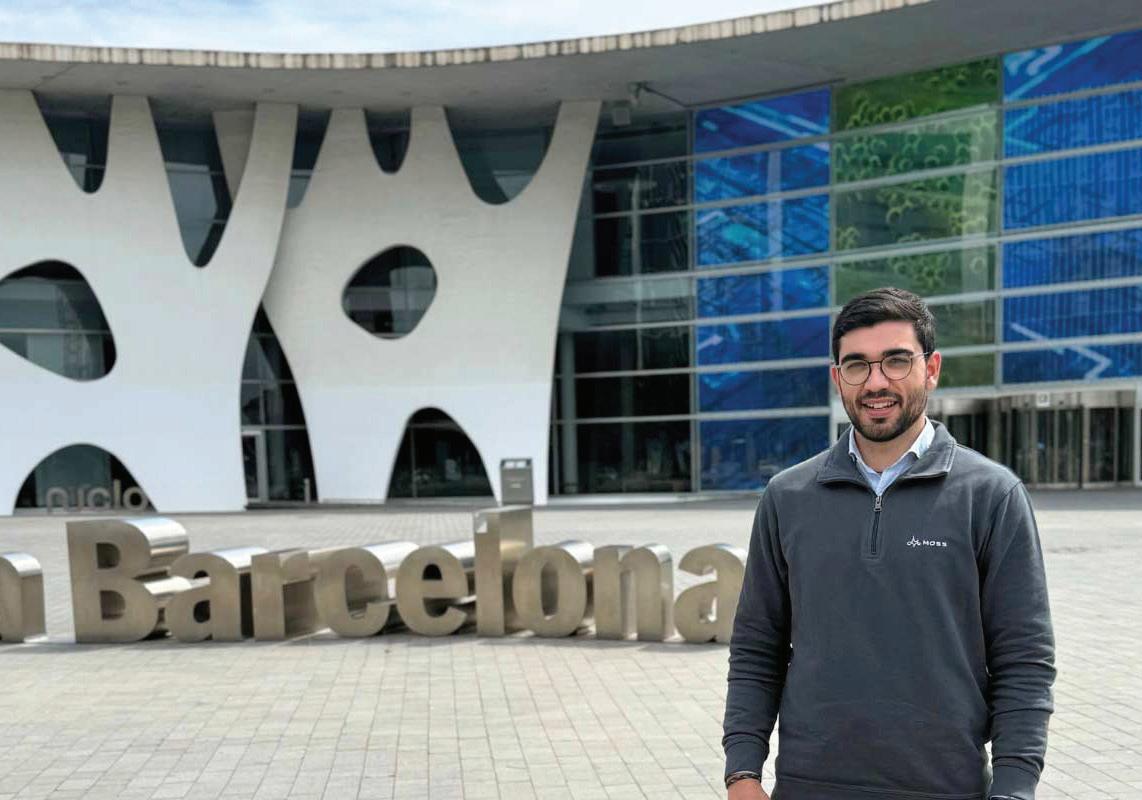
Impact XM acquired UK-based Touch Associates to boost global event strategy, while Moss Inc. opened a new ofce in Barcelona to serve Spain’s exhibit market. Freeman acquired Tag Digital, which joins Marketing Design Group (MDG) to expand marketing services across EMEA, APAC, and North America. The moves strengthen capabilities across experiential, structural, and digital disciplines.
NEW WEBSITES
Ion Exhibits launched a redesigned site focused on speed, mobile usability, and immersive storytelling to refect its evolution in custom exhibits. Orbus Visual Communications Group introduced a new platform unifying six brands, highlighting capabilities across exhibits, interiors, and retail environments. The updates make it easier for clients to explore solutions across sectors.
WORKFORCE DEVELOPMENT
The Exhibitions Industry Collective (EIC) launched a national workforce initiative to introduce students to careers in events. Backed by the Exhibitions & Conferences Alliance (ECA) and other groups, the program includes school presentations, speaker toolkits, and impact tracking to help close the talent gap and raise awareness of multiple diferent industry roles.
BRAND ACTIVATIONS
Smash Booth debuted HoloGlam at the Experiential Marketing Summit (EMS) in Las Vegas, featuring a hologram-style video guests can view on their phones without an app or headset. The takehome illusion blends video capture with compact display technology and ofers brands a simple, high-tech way to drive post-event engagement.
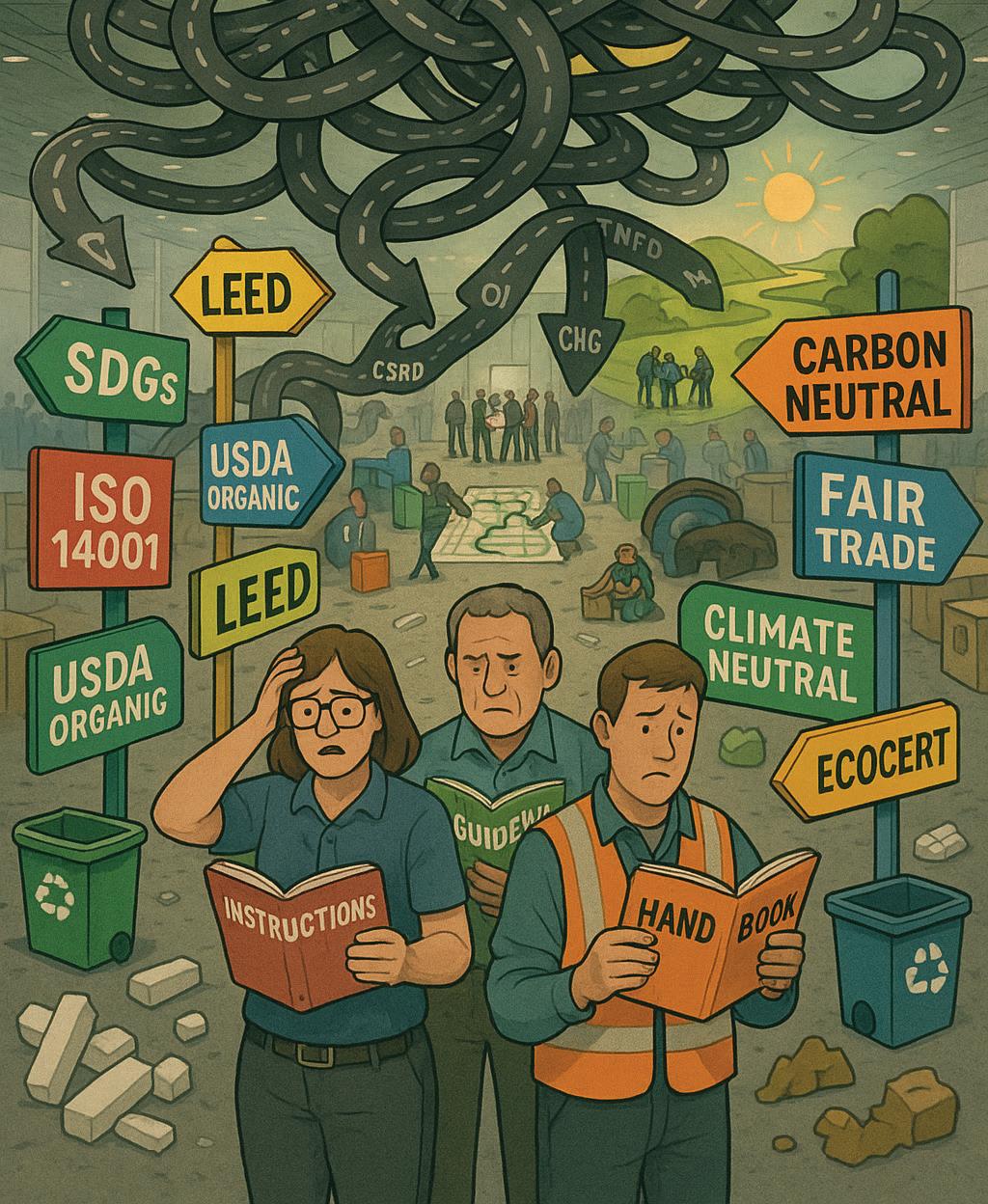
ADDRESSING THE GUIDELINE OVERLOAD
Sustainability eforts are gaining momentum, but fragmented rules are frustrating labor crews and contractors.
“Too many rulebooks for the same game,” one insider says. With multiple standards, shifting timelines, and unclear mandates, execution often falls apart on the show foor. Industry leaders are calling for unifed guidance that is practical, consistent, and built for real-world conditions. Read More: pg 18
THE HEART OF THE CONVENTION
Citywide events rely on hundreds of skilled staf to guide, greet, and ground the attendee experience. Agencies like HADCO Stafng Solutions and Manpower of Southern Nevada say strategic placement and personality ft are key. “You can’t deny the power of face-to-face meeting,” says HADCO CEO Aubrie Jones. “The value of people is priceless.” Read More: pg 74
GLOBAL HEADWINDS HIT U.S. EXHIBITIONS
International attendance at U.S. shows is slipping, driven by visa delays, global unrest, and shifting policy. Organizers are adjusting with longer timelines and hybrid options, but recovery remains fragile. Industry voices warn that unless accessibility improves, major events risk shrinking global reach, thinning exhibitor ROI, and missing the mark on long-term participation. Read More: pg 36
CONVENTION CENTER SNAPSHOT
by Kerstan Szczepanski
courtesy
Photo
of Visit Anaheim
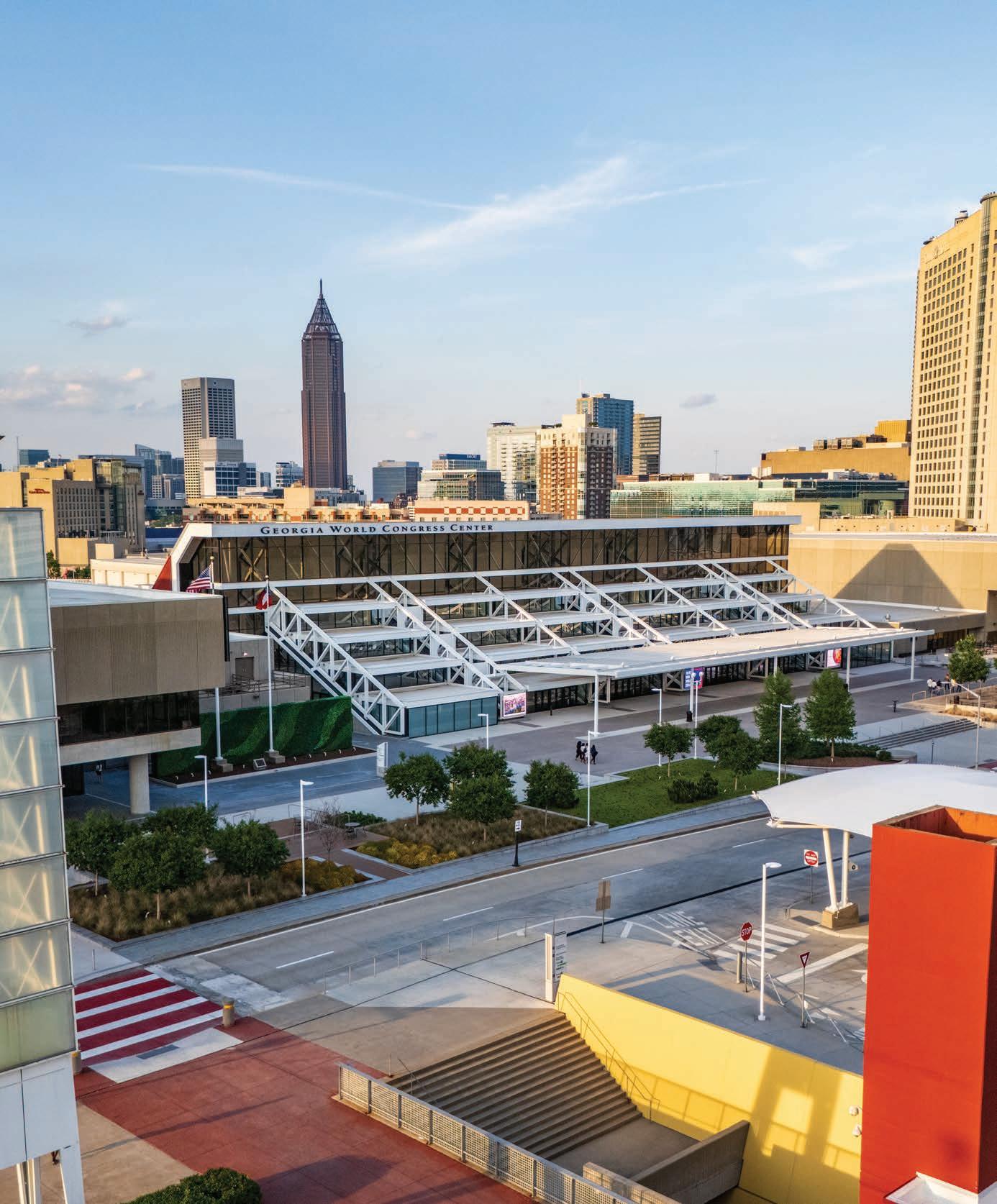
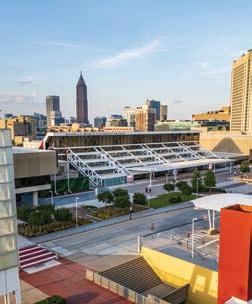
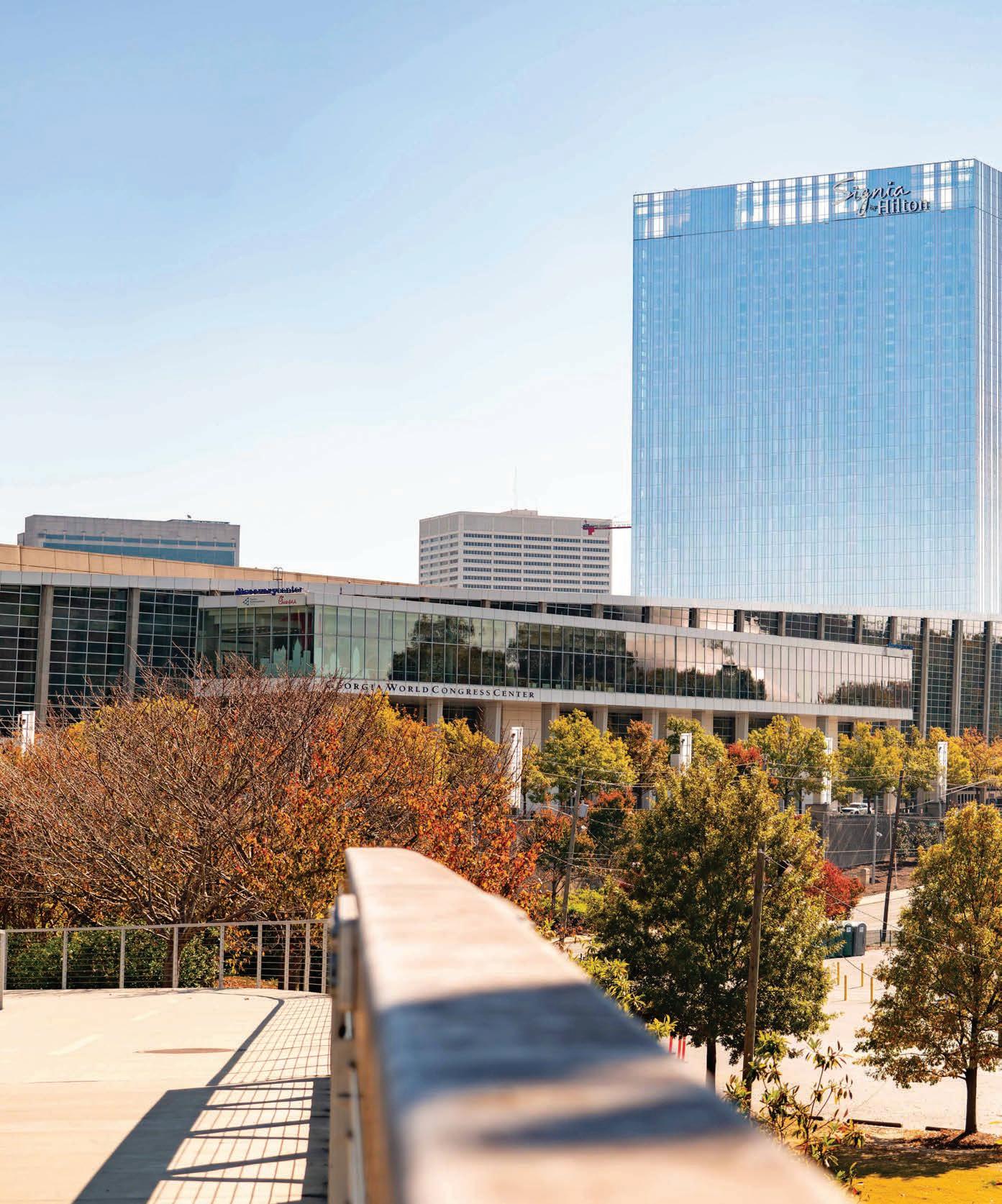
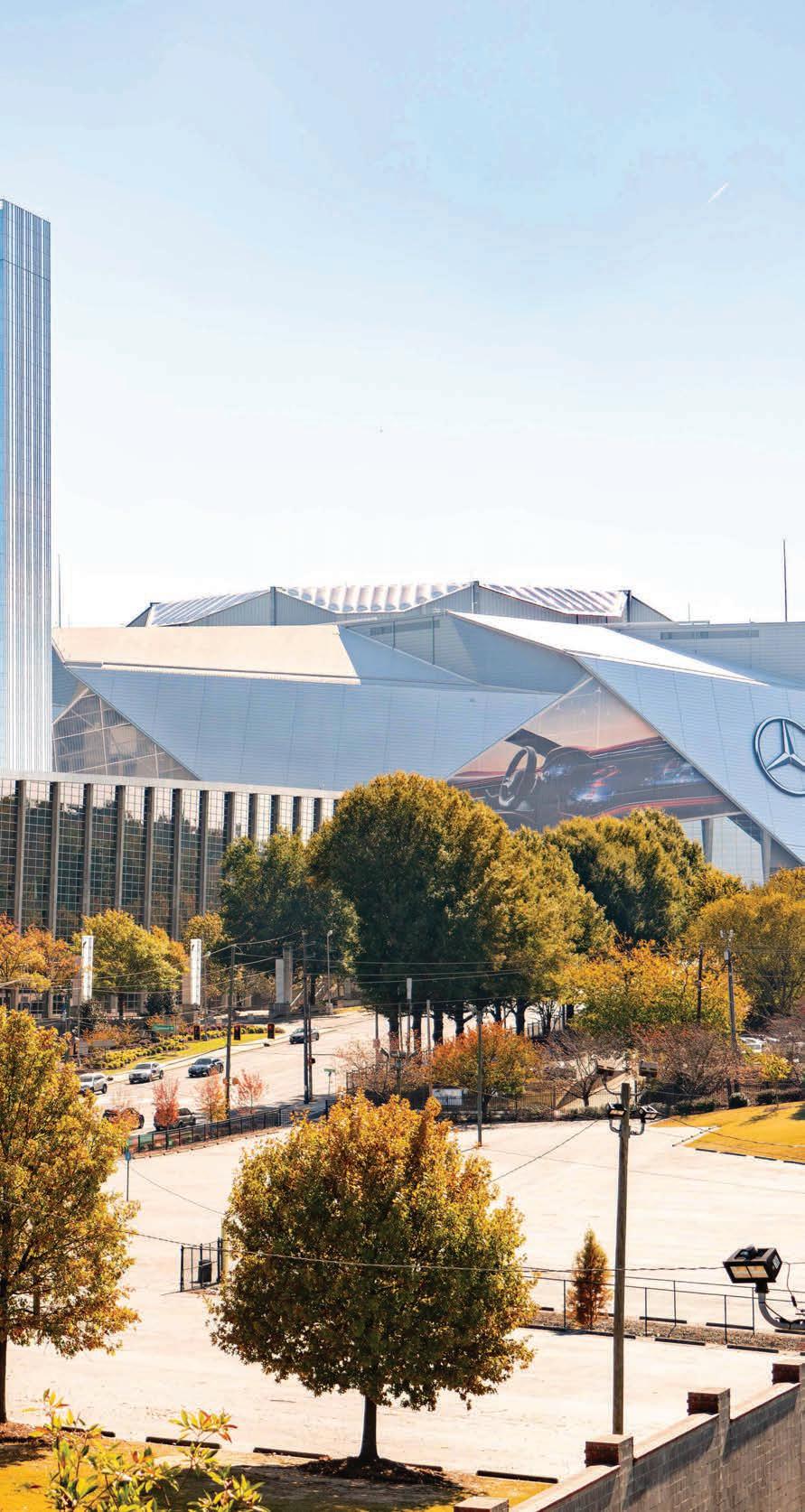
Georgia World Congress Center
Location: 285 Andrew Young International Blvd NW, Atlanta, GA 30313
Date Opened: 1976
Square Footage: The Georgia World Congress Center (GWCC) totals 4 million square feet, including: 1.5 million square feet of exhibit space, 105 meeting rooms, the Thomas Murphy Ballroom (33,000 sq. ft.), the Georgia Ballroom (25,700 sq. ft.), and the 21 acre Centennial Olympic Park.
Parking: Onsite parking includes several decks and surface lots with over 5,600 spaces, including the Red Deck (connected to Building C). Parking can be reserved online through gwccparking.com.
Hotels: More than 13,000 hotel rooms are within walking distance, including Signia by Hilton Atlanta (attached to GWCC and connected to Mercedes-Benz Stadium), Omni Atlanta Hotel at CNN Center, the Glenn Hotel, Embassy Suites, and AC Hotel nearby.
Airport:
International Airport (ATL) is approximately 11 miles away, about 15–20 minutes by car.
Transportation: The Metropolitan Atlanta Rapid Transit Authority (MARTA) rail system Red or Gold lines stop at CNN Center/GWCC Station. Taxis, rideshares, and shuttles are available curbside, and direct freeway access via I-20, I-75, and I-85.
WiFi: Free and premium options.
Website: www.gwcca.org
Now More Than Ever
by Tommy Goodwin, Exhibitions & Conferences Alliance
The
By Exhibit City News
TPodcast Returns
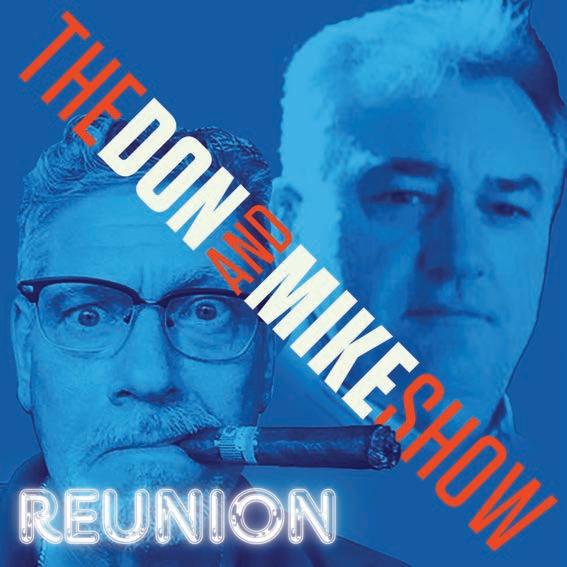
Don & Mike Show Reunion
ADDRESSING THE GUIDELINE OVERLOAD
BY MARK HEBERT
As sustainability rules multiply across the tradeshow industry, labor crews are caught in the middle. Can the sector align on one practical, unified standard before confusion turns into burnout?
“Too Many Rules, Not Enough Road”
The lights were still warming up on the show foor when a union crew member turned to a contractor and shook his head. “Wait, are we following the client’s guidelines, the venue’s policy, or the decorator’s checklist on this one?” he asked, looking down at the pallet of recyclable graphics and stack of packing foam. “Because I’ve seen three diferent instructions on what to do with this stuf.”
That kind of confusion has become common in the tradeshow industry. The momentum toward sustainability is real, but the roadmap is getting harder to follow.
Over the last fve years, companies, large and small, have made ambitious pledges. Many signed onto Net Zero Carbon Events commitments. Others are aligning with Environmental, Social, and Governance (ESG) standards, International Organization for Standardization (ISO) certifcations, or custom sustainability programs built in-house. Venues have drafted their own rules. So have general contractors. So have the brands exhibiting. So have the builders.
But instead of alignment, the result is often gridlock. As one industry insider puts it, everyone may be headed in the same direction. But they’re following dif-
ferent maps, speaking diferent languages, and rarely coordinate the route.
That complexity creates real burdens for the crews tasked with executing it. From show foor labor to freight logistics to exhibit installation, operational teams are being asked to implement sustainability mandates, often without warning or preparation.
Julie Kagy, executive director of the Exhibition Services & Contractors Association (ESCA), says that in many cases, those decisions are being made without input from the people doing the work. “Venues are establishing processes that contractors are expected to follow, but without being part of the discussion,” she says. “That creates friction and confusion. If a sustainability goal can’t be met with the labor or time that’s scheduled, it ends up getting missed or just costing more.”
Jim Obermeyer, chair of the Experiential Designers and Producers Association’s (EDPA) sustainability committee, says the real world on the show foor rarely looks like the guidelines. “You walk the foor during setup and see cardboard, foam, plastic wrap, everything headed straight for the trash,” he says. “Companies are trying, but right now, everyone’s approaching it diferently—with varying results.”
The tradeshow industry isn’t short on sustainability ambition. But as one insider put it, the growing number of frameworks, certifcations, and guidelines can feel like “12 rulebooks for the same game.”
What would it take to build a shared, practical playbook: one that’s ambitious,
implementable, and not just another set of boxes to check?
That’s the question this story sets out to explore.
The Overload –“A Tangle of Good Intentions”
Nobody’s arguing that sustainability isn’t important. Sustainability has become a baseline expectation across much of the tradeshow world. But the industry’s passion for progress has also led to an unintended side efect: a food of guidelines—often overlapping, inconsistent, or incompatible.
“We’re seeing a real surge in demand for sustainable practices,” says Marsha Flanagan, president and CEO of the International Association of Exhibitions and Events (IAEE). “But what’s also rising is confusion—especially when labor and ops teams are handed guidance that conficts from one show to the next. Waste diversion rules, sourcing policies, carbon tracking—it all varies, depending on which venue, organizer, or contractor is calling the shots.”
That inconsistency adds cost and slows down execution. Even when everyone is trying to do the right thing, the lack of a shared framework can make collaboration harder.
Kagy sees the same pattern playing out. “The labor teams are under pressure to turn a hall quickly, and then a new guideline shows up telling them to sort materials at the dock. “But there’s no added time, no added crew, no added
equipment,” she says. “That’s where these policies break down. They weren’t built with operations in mind.”
That’s not to say the current eforts lack value. In fact, many of the guidelines circulating in the industry today—like the Net Zero Carbon Events roadmap, ISO 20121, and the Events Industry Council (EIC) Sustainable Event Standards—have been developed with input from hundreds of subject matter experts. They ofer real tools. But they don’t always speak the same language. And they certainly aren’t designed for interchangeable use on show foors.
Glenn Hansen, who helped author the Guidance for Sustainable Exhibition Stand Construction (GSESC) for EDPA, puts it this way: the problem isn’t just having too many cooks. It’s that the cooks are using diferent recipes, in diferent kitchens, for the same meal. “The events industry has the same issue that fnancial reporting had a few years ago: an alphabet soup of standards,” he says. “Each one might be thoughtful on its own, but together they create noise.”
And when there’s noise, companies often fall back on the easiest path.
In practice, some companies gravitate toward the simplest standard they can reasonably meet. That’s not out of indifference, but because of tight budgets, fast timelines, and the complexity of juggling multiple frameworks. As one insider observed, when eforts default to the most basic requirements, it becomes much harder to drive meaningful progress.
So where do we go from here?
Where It’s Breaking Down –“On the Floor, It Falls Apart”
If the tradeshow foor is where the magic happens, it’s also where sustainability guidelines are most likely to break down. Kagy says the problem often starts with who’s at the table. “When policies are developed without input from the crews who actually carry them out, they’re more likely to break down onsite,” she says. “The result isn’t just confusion—it’s extra cost and extra stress for the people on the ground.”
One example: labor teams are expected to separate waste at the dock. It sounds simple on paper, but the reality is much more complicated.
“You can’t just bolt sustainability onto a load-in schedule that’s already tight,” Kagy says. “If the team is not stafed for it, or there’s no space or equipment set up for sorting, then what happens? Corners get cut—or nothing happens at all.”
The data side isn’t much better. Hansen, also of Reduce 2, sees it all the time: organizers and suppliers are being asked to measure carbon emissions and sustainability impacts, but no one agrees on how or what to measure. “The real vulnerability is in the data,” he says. “Everyone wants to track progress, but people don’t know what to collect. So, you get garbage in, garbage out.”
Even when companies do collect good data, the methodologies are changing so fast that comparisons can become meaningless. “One year, a business-class fight might count as two economy seats. The next year, it’s four,” Hansen says. “So now your carbon footprint from 2023 can’t even be compared to 2024. What are you supposed to do with that?”
There’s also the issue of digital friction. Hansen says event registration platforms—valuable tools for gathering sustainability data—often won’t touch the topic. “Those platforms treat the reg form like prime real estate. They don’t want to add one more question, even if it’s something critical like attendee travel or hotel data. But that data is essential for understanding an event’s footprint.”
Obermeyer, who recently spent six weeks at fve diferent shows, says the contrast is easy to spot. Some areas are still generating large volumes of waste— unused materials, discarded signage— while others are making visible shifts. “You’re starting to see more reusable structures, and more teams asking the right questions at the dock,” he says. “There’s real momentum in pockets, but the industry still has a long way to go.”
James Zacharias, division president at Brumark, says much of the confusion stems not from conficting mandates, but from the assumption that sustainable practices are inherently costly or complex. “The biggest disconnect is the perception that sustainability is expensive and complicated,” he says. “In reality, our
WHAT SHOULD A UNIFIED STANDARD INCLUDE?
If the industry were to align around a shared sustainability framework, here’s what stakeholders say it must address:
Labor Execution: Realistic timelines, staffing support, and procedures for onsite waste sorting and material handling
Material Guidelines: Transparency of sourcing, reusability standards, and clear recycling mandates
Logistics & Transportation: Carbon-conscious freight, eco-friendly packaging, and incentives for consolidation
Carbon Accounting: Consistent Scope 3 measurement, verifiable baselines, and apples-to-apples tracking over time
RFP Language: Standardized sustainability clauses for venues, suppliers, and contractors
Onsite Waste Strategy: Joint planning between venues and contractors, with clear sorting and disposal protocols
Data Collection & Sharing: Tools that enable consistent, comparable data across shows and stakeholders
Scalability: Guidance that works for both single booth exhibits and citywide conventions
program is designed to do the opposite— it simplifes the process and integrates recovery and recycling directly into the show foor experience.”
His company has focused on making those solutions work for all stakeholders.
“We’ve developed adaptable programs that meet partners where they are,” Zacharias explains. “EACs get a streamlined recovery model that’s easy to plug into operations. For general contractors and organizers, we’ve built a scalable fooring recovery program that can also drive potential revenue.” By reducing friction, you make it easier to build buy-in,” he adds. “When sustainability is efortless, participation goes up— without adding complexity for our clients.”
The bottom line? These breakdowns aren’t caused by a lack of will. “It’s not
that people don’t care,” Kagy says. “It’s that the current system doesn’t make it easy to care.”
And without alignment on what matters, what’s feasible, and how it’s tracked, everyone ends up making it up as they go. That’s not a strategy. That’s burnout.
A Call for Cohesion – “Everyone Wants Alignment, But…”
For all the confusion on the ground, there’s a surprising amount of agreement at the top: most major industry groups want to see sustainability guidance brought into better alignment.
“There’s a real appetite for collaboration,” says Dasher Lowe, executive director of EDPA. “We’re not saying everything has to be standardized down to the bolt. Still, there’s clearly value in a framework that allows for segment-specific guidance within an overall industry direction.”
Lowe points to the GSESC, developed jointly by EDPA, ESCA, and EIC, as a step in that direction.
“It was built to be practical,” he says. “And the fact that our members and clients are already using it to shape RFPs tells us we’re on the right track. But the bigger question is: what comes next? Who brings all these frameworks together?”
IAEE President and CEO Marsha Flanagan echoes that sentiment. “Our industry is incredibly diverse,” she says. “Diferent geographies, business models, and stakeholders. It’s complicated. But that’s exactly why we need to start coordinating.”
Flanagan says IAEE isn’t trying to reinvent the wheel with a new standard. Instead, the organization is encouraging the adoption of proven guidance, including tools from EIC and the Joint Meetings Industry Council. “The risk if we don’t align is that regulation will step in and make the choice for us,” she says. “That’s why we’re working now, voluntarily and proactively, to build toward something unifed.”
The common thread running through all these responses? Nobody’s arguing for more checklists or more acronyms. If anything, the goal is fewer. And while no one claims that a perfect, one-size-ftsall solution is possible or even desirable,
there is growing consensus that the time to start aligning is now.
“This isn’t just a strategic priority,” says Kagy. “It’s a window of opportunity. We need to stop monetizing sustainability and start embedding it. That’s only going to happen if we start rowing in the same direction.”
Models That Work – Building Blocks, Not Silver Bullets
The good news? There’s no shortage of smart, functional sustainability frameworks already in circulation. The challenge, stakeholders say, isn’t inventing new models. It’s recognizing what’s already working and fguring out how to scale it.
One of the most prominent examples is the GSESC, a collaborative efort between EDPA, ESCA, and EIC. Released in late 2023, the document ofers clear, actionable steps for design and production frms looking to reduce waste, source materials responsibly, and track sustainability performance across their exhibit builds. It was created with input from dozens of companies and is currently being updated to include a new scoring system for deeper accountability.
Obermeyer says the impact has been tangible. “Our members were looking for something they could actually use. Not just a white paper, but a tool that could live inside an RFP,” he says. “And that’s exactly what this has become. Clients are referencing it. Designers are using it. It’s created a common language, and we’re already seeing results.”
Hannah Deters, IAEE’s director of events and sustainability, says the association’s newly launched Sustainability Toolkit is designed to meet organizers where they are, whether they’re beginners or already deep into decarbonization eforts. “The goal is to ofer fexibility without confusion,” Deters says. “Actionable steps, clear accountability, and room for customization. We’re not here to dictate; we’re here to support.”
The Toolkit ofers a fve-step, 16-module structure that’s intentionally fexible—allowing event teams to adopt and scale based on their own maturity level and event size. “We didn’t want to create
TOOLS FOR TAMING THE TANGLE
Here are the major sustainability frameworks, toolkits, and certifications referenced by stakeholders in this story—each offering a different piece of the puzzle:
Net Zero Carbon Events Roadmap:
A global initiative guiding the events industry toward net zero emissions by 2050, with a focus on collaboration and carbon tracking.
ISO 20121: Event Sustainability Management Systems: An international standard offering a framework to design and deliver sustainable events, used across global venues and suppliers.
EIC Sustainable Event Standards: A suite of standards developed by the EIC to assess environmental and social performance across suppliers and events.
Guidance for Sustainable Exhibivtion Stand Construction (GSESC): Created by EDPA, ESCA, and EIC, this document outlines actionable steps for exhibit producers and contractors to reduce environmental impact.
IAEE Sustainability Toolkit: A fivestep, 16-module guide designed for exhibition organizers at any stage of their sustainability journey.
Sustainable Event Professional Certificate (SEPC): An educational program by EIC that provides comprehensive training on sustainable event planning and reporting.
something aspirational that no one could act on,” says Deters. “This is built to work in the real world—with timelines, budgets, and staf constraints.”
EIC has taken a broader approach, establishing a full suite of sustainability standards along with the Sustainable Event Professional Certifcate (SEPC) program. Amy Calvert, EIC’s CEO, says her team’s sustainability standards were developed with input from more than 300 subject matter experts from all corners of the industry. “It gives the standards credibility, but it also gives them depth. They weren’t built in a vacuum. We see these as the foundation of a shared playbook,” she says.
HOW WE GOT HERE
Milestones in the industry’s push for sustainability
ISO 20121 launched as the first formal event sustainability framework
Net Zero Carbon Events movement begins gaining traction
“Adoption is growing, especially when organizers and contractors use the standards together, as a collaborative framework.”
Zacharias agrees these frameworks have real value—especially when they support gradual adoption. “Sustainability isn’t a sprint—it’s a marathon,” he says. “Every step forward is progress, and these frameworks empower businesses to integrate sustainable practices in ways that make sense for their current operations and future goals.”
Yet even the best tools face barriers to universal adoption.
“There’s no central referee,” says Kagy. “You’ve got fve diferent playbooks out there, and nobody’s coordinating the plays. That leads to duplication and confusion.”
Hansen agrees. As a technical advisor on the GSESC document, he’s worked across several standards groups. “They’re all trying to solve the same problem,” he says. “But unless we consolidate or at least align these tools, we’re just overwhelming the people on the show foor.”
In other words, the frameworks exist. The roadmaps are drawn. What’s missing is the glue that holds them together.
The Road Ahead – Can the Industry Get in the Same Car?
If there’s one thing nearly every stakeholder agrees on, it’s this: the industry can’t aford to stay fragmented forever.
“We know you can’t snap your fngers and make one all-encompassing framework overnight,” says Lowe. “It has to be collaborative—and it has to respect the diferences between industry verticals.”
That’s why multiple organizations are beginning to explore how their tools can live under a shared umbrella. Some point to the Industry Collective, a growing co-
alition of groups including EDPA, ESCA, IAEE, and others, as the natural convener for a cross-sector efort. Others say it’s less about a single document and more about agreement on the core areas that any responsible guidance should cover.
Kagy suggests it may be time to hit pause on new sustainability guidelines and focus instead on integrating what’s already in circulation. “Let’s stop reinventing the wheel and focus on integrating what we’ve already got,” she says. “Pick a central home. Create a central repository. Build from there.”
Hansen says any future framework also needs to be informed by real-world data—and a shared understanding of what’s measurable. “We’ve got better tools now than we did fve years ago,” he says, “but there’s still a long way to go. If the industry wants consistent reporting, we need consistent baselines.”
There’s also the looming threat that inaction could invite outside regulation. “If we don’t fgure this out soon,” says Kagy, “someone else will. And they probably won’t understand the nuance of what happens on a show foor.”
That’s the window the industry is staring at now: align on its own terms, or risk having the rules written by people who’ve never worked on a tradeshow.
One Guideline, or a Missed Opportunity?
The idea of a single, unifed sustainability standard might feel ambitious or even improbable. But stakeholders warn the alternative is far worse.
“Right now, the train is moving whether we’re ready or not,” says Hansen. “And if we let the guidelines continue to multiply unchecked, we’re going to end
up with confusion, burnout, and missed goals. If we want to stay in control of our industry’s future, the time to act is now.”
The real risk isn’t just confusion, it’s irrelevance. Several interviewees noted that if the industry can’t come together, regulators might do it for them. That’s not a theoretical concern. Around the world, governments are taking a harder look at event emissions, supply chain waste, and labor sustainability. If the tradeshow sector can’t speak with a unifed voice, it may lose the opportunity to help shape the policies that are coming.
But there is hope. Many of the pieces already exist—robust toolkits, credible frameworks, engaged stakeholders. What’s missing is the bridge between them.
As Kagy emphasized, sustainability can’t be a marketing checkbox or an afterthought. It needs to be part of how the industry operates—built into every show, every hall, every load-in and teardown. That kind of shift, she suggests, requires trust and shared commitment. It’s not about credit—it’s about doing the right thing in a consistent, practical way.
And that includes giving labor a seat at the table, not just a checklist. As Obermeyer puts it, “If your policy falls apart on the dock, it wasn’t a very good policy to begin with.”
So, what happens next?
Ideally, a coordinated move toward consolidation won’t be driven by regulation, but by a shared desire to reduce the noise, align on what matters, and build something practical that lasts. Maybe it won’t be one rule to rule them but one guideline that doesn’t require a decoder ring might be a good place to start.
Until then, the message from the show foor is clear: the more we unify, the more we all stand to gain.
EDPA, ESCA, and EIC publish the GSESC guidelines
IAEE releases its Sustainability Toolkit
Growing call for consolidation and shared frameworks
Visualy Br ads
An Appetite for Flexible Modularity
by Aluvision & Metro Exhibits
True event partners provide smart strategies for design and fabrication. They ensure maximum impact on the event foor without exceeding their client’s budget.
As a leading supplier of sustainable, modular systems for exhibits and events, our partners take advantage of Aluvision’s reusable solutions to meet their clients’ objectives and ensure their success across show foor and bottom line.
Recently, Aluvision partner Metro Exhibits demonstrated the power of utilizing our versatile systems for one of their clients with two major shows in the frst half of 2025.
SERVING UP STRATEGY
When CFS Brands approached Metro Exhibits with their program needs, they
welcomed the opportunity to showcase their skills, creativity, and exhibit design savvy for this super supplier of kitchen and cooking equipment.
Metro Exhibits knew the undertaking for the 11,900 sq. ft. booth that would frst appear at NAFEM in February and then next at NRA in May would require a strategic approach.
The ask from CFS Brands was simple: create an experience where attendees could see all product lines, including newly launched brands and special product demonstrations, and where they could meet with sales reps in a semiprivate setting. The execution of such a task was anything but.
CFS Brands, which provides essential supplies and equipment for the most trusted brands in food service, sanitary maintenance, healthcare, and hospitality, serves a variety of industries. Metro Exhibits was challenged to design a space comprising many diferent brands that would appeal to a wide-ranging audience while maintaining an overarching lookand-feel.
On the logistical side, they had to ensure CFS Brands stood out from their competitors with a cost-efective
design solution that allowed for easy reconfguration to ft both show footprints as well as manageable costs for shipping, drayage, and labor.
ALUVISION: CLEAR CUT ADVANTAGES
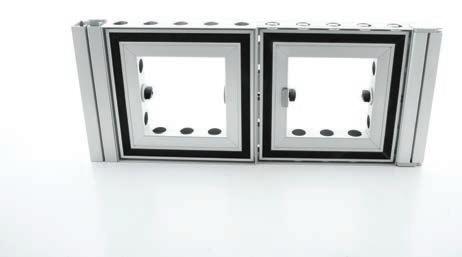
Aluvision’s award-winning Omni pro series was selected by Metro Exhibits for the foundation of the 70x170 booth. These ultra-lightweight frames accommodate SEG and panels on both sides, and easily and seamlessly connect to any size frame system and other materials such as wood. Made of aluminum with precision quality engineering standards, Aluvision’s Omni pro series are also advantageous for their durability, strength, and stability; something Metro Exhibits relied on to support the shelving, TV monitors, and slat wall elements incorporated throughout.
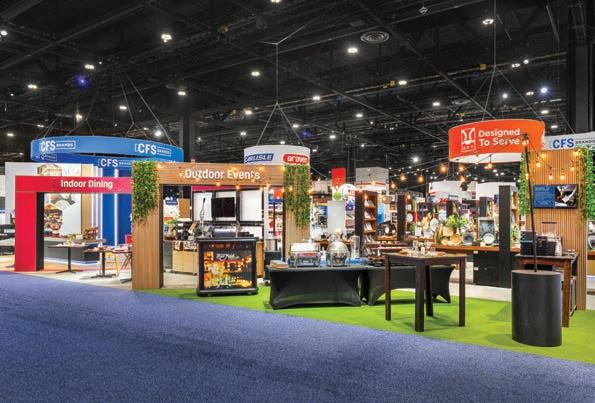
Metro Exhibits strategically organized CFS Brands’ product lines into a series of restaurant-inspired vignettes to showcase the products in real-world applications. They added archways to designate the intended route of travel from one scenario to the next.
The Aluvision Omni pro series was used for all the divider walls, product display shelves, and scene backdrops because of
Metro Exhibits strategically organized CFS Brands’ product lines into restaurant-inspired vignettes with archways to create an intentional footpath and experience.
Photo by Exposures, Ltd.
the fexibility it afords in supporting any type of graphic treatment. It was also used to create the archways, which needed to be reconfgured for orientation between the two shows. With an eye for detail, Metro Exhibits incorporated Aluvision’s Omni LED line in certain areas for added aesthetic and pronunciation of certain product lines and atmospheres.
The intended path began with an outdoor dining and kitchen setup to an indoor dining scene with bar and bufet, to an industrial kitchen and then to a janitorial scenario.
With meeting space centrally located and the various vignettes placed around the
edges of the booth, Metro Exhibits met their client’s goal for both intimate conversation and public demonstration areas.
RECIPE FOR SUCCESS
Working with Aluvision systems allowed Metro Exhibits to freely create for their client, knowing they had a versatile building solution that could provide structural support as well as design fexibility.
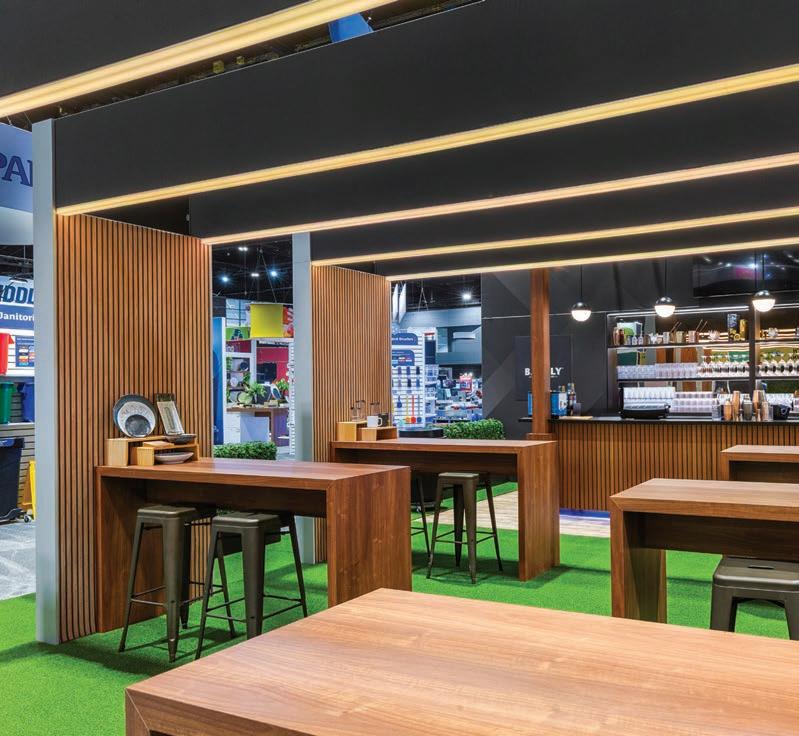
The designers created custom elements, such as functional (swinging) industrial kitchen doors and an industrial grill hood, that were incorporated into the Aluvision frame structure in the kitchen vignette to add authenticity to the atmosphere. Where these and other elements intertwined with the modular system, such as the bar’s inset mirror shelf and the wooden parsons tables and pergola of the interior dining vignette, Metro Exhibits demonstrated Aluvision’s seamless connection capacity. What’s more, Metro Exhibits relied on Aluvision’s durable, strong frame system to support the weight of the suspended pergola.
Thanks to Aluvision’s toolless assembly and plug and play model, Metro Exhibits capitalized on a streamlined connection system that simplifed installation and dismantling while enhancing setup control and structural integrity.
For such a large booth, being cognizant of the ease of I&D and managing the client’s budget is paramount. Utilizing Aluvision’s ultra lightweight frames was a quarter of the weight for shipping and drayage, and less costly overall than a full wooden fabrication. A true partner, Metro Exhibits delivered on cost savings as well as successful outcomes for both shows.
“The response from our clients was overwhelmingly positive. They praised Metro Exhibits for our dedication and how well we helped them show up on the event foor and draw trafc to their booth. They reported it to be a ‘fantastic’ showing for CFS Brands.”
Learn more about Metro Exhibits: metroexhibits.com
Learn more about Aluvision: aluvision.com
Aluvision’s durable, strong Omni pro series system supported custom elements like the pergola for the common area and central bar, with Aluvision’s Omni LED line adding an elevated aesthetic. Photo by Exposures, Ltd.
Aluvision Omni pro range: durable, versatile, iF Design Award 2025 winner
The Rules and Regulations You Need to Know for Healthcare Exhibits
BY JON ELLMS, VICE PRESIDENT, HEALTHCARE CONVENTION & EXHIBITORS ASSOCIATION (HCEA)
Healthcare conferences and exhibits ofer a powerful way for companies to engage and build advocacy with healthcare professionals (HCPs), introduce new products, and build credibility. Promotion of drugs and devices is governed by federal law, state laws, European Union (EU) regulations, and voluntary codes of conduct. Collectively, they shape almost everything from how exhibits are designed, to what messages are communicated, what activities are permitted, and how data is collected.
While the laws are concise, there’s far less agreement on how to interpret those laws at exhibits. Legal teams review every word, every image, and every exhibit activity. It ultimately falls on the convention manager to identify the risk points, negotiate between stakeholders, keep creative and account teams on the right path, and to make sure what’s agreed on
in advance is what happens on the show foor.
FDA Regulations
One simple Food and Drug Administration (FDA) rule shapes every exhibit at every event: companies can only promote a drug or device for its approved use, with limited exceptions for some devices that have reached a certain stage of testing. Long before the exhibit hits the foor, every single message has gone through multiple rounds of review. Running afoul of the FDA can be catastrophic.
For companies with an approved product, this simple rule also splits most exhibits into two: one for selling (commercial) and one for felding scientifc inquiries (medical). The FDA doesn’t lay out exactly how this works, so each company decides how to comply. Most companies agree on a visible separation of the areas with diferent carpet colors or signage, no crossover of mes-
sages, and absolutely no content from one side being visible from the other, other than a unifying corporate logo overhead. The company’s insistence on strict segregation usually runs afoul of the association’s sightline rules. And usually, it falls on the convention manager to negotiate a solution.
State Gift Laws & Voluntary Codes of Conduct
Many states restrict or prohibit gifts, meals, and other items of value for healthcare professionals. Minnesota caps gifts to HCPs at $50 per year. Vermont bans most gifts and requires disclosure of anything of value, even brochures, in some cases. Massachusetts restricts meals and entertainment, even if they’re educational.
Even more conservative are the Pharmaceutical Research and Manufacturers of America (PhRMA) and Advanced Medical Technology Association (AdvaMed) codes which set high standards for ethical interactions with healthcare professionals.
This forces companies to build engagement strategies around education versus a giveaway. Branded pens and stress balls? Out. Anatomical models? Probably not—unless they are for the patient, not the physician. Cofee and a chocolate chip cookie? Probably okay, though some companies won’t allow the cookie.
There are a lot of gray areas, and getting everyone on the
same page can be difcult, and it usually falls on the convention planner to negotiate and push the process forward.
Data Privacy Laws
In the early 2010s, the EU drafted legislation that affirmed privacy as a human right and a few years later, the General Data Protection Regulation (GDPR) went into effect, restricting companies’ ability to collect personally identifiable information. Exhibitors responded by rewriting their interactive media to collect less information and require more explicit consent to collect that information. The net effect is that there is less useful information at more
cost. Once again, the convention manager is the final check in the system.
Federal Reporting Requirements
Not only do the rules dictate what can be done in an exhibit, they also compel exhibitors to track almost every transaction with every booth visitor.
Open Payments legislation requires drug and device manufacturers to track and report payments and transfers of value made to physicians, including meals, travel, lodging, honoraria, educational materials, and product samples. Consequently, most exhibitors require attendees to swipe their badge in exchange for that free cup of cofee—un-
less of course the physician is from one of several states where it’s not allowed at all. With all of these obstacles, it’s easy for an expensive hospitality program to become downright inhospitable.
State and Local Licensing for Booth Staf
Nevada, like many states, licenses pharmaceutical company representatives who speak to prescribers. Washington, DC has similar requirements for medical booth staf. But now, presumably to generate more fees, many municipalities require exhibit staf to be licensed to work just 3-4 days in an exhibit in their jurisdiction.
This isn’t insurmountable, but it adds yet another task for event professionals and incurs additional cost.
With Complexity and Chaos Comes Opportunity
Planning healthcare exhibits is hard, sometimes frustrating work. Drugs and devices are not sexy, like cars or consumer electronics. On the fip side, once you’ve proven your mettle in healthcare, and able to navigate all the rules, you become more valuable—and in demand. Over time, there’s real opportunity to build a name for yourself and grow your career, all while helping to get life-saving therapies to the patients who need them.
Jon Ellms, a veteran of medical conventions since 1996, is the president of Friday Morning, an healthcare-focused experiential marketing consultancy, and president-elect of the Healthcare Convention and Exhibitors Association, the only trade organization dedicated to healthcare convention marketing.
Strategic Solutions to Evolving Behaviors
by Maritz
In today’s fast-moving digital world, attention is a scarce commodity. People expect interactions to be quick, intuitive and rewarding —and when those expectations aren’t met, they move on. This shift in behavior is reshaping how event organizers think about engagement, especially when it comes to registration and housing. Gone are the days when attendees would tolerate clunky, multistep booking processes. Now, even a few extra clicks can mean the diference between a completed registration and a lost opportunity. For organizations that rely on events to connect with their audiences, this presents both a challenge and an opportunity.
That’s where a unifed approach can make all the diference.
A Seamless Journey for Attendees
Imagine this: an attendee clicks a single link, registers for an event, books their hotel, enters their payment information once, and receives one confrmation email. No juggling multiple platforms, no confusion, no wasted time. Just a smooth, intuitive pro-
cess from start to fnish.This kind of streamlined experience doesn’t just make attendees happy, it keeps them engaged. When the process is easy, they’re more likely to complete it. That means higher registration numbers, more hotel bookings and a better return on investment for organizers.
One Platform, Many Advantages
For event organizers, the benefts of a unifed system go beyond convenience. With registration and housing under one roof, you gain a single source of truth for your data. That means better insights, more targeted marketing and a clearer picture of your event’s performance. You also get consistency across branding, data security and customization. And with one team managing everything, communication is streamlined. One point of contact. One weekly call. One accounting system. It’s not just easier, it’s smarter.
Beth O’Brien, Senior Director of Meetings and Conventions at Academy of Managed Care Pharmacy, highlights the
real-time advantages of this approach:
“Unifying registration and housing allow for real-time pivots based on registration trends. Because the systems are integrated, the Maritz team can request additions on shoulder nights or for additional rooms on peak nights in real time. For associations who are concerned about meeting contractual obligations around attrition, linking the two gives that extra push to encourage attendees to stay in the room block.”
More Than a Service: A Strategic Partner
We’re not just a vendor. We’re your consultant and
partner in creating meaningful, memorable events. From experience design to data strategy, we work alongside you to align every detail with your goals. Our full-service approach means we’re with you every step of the way to ease your workload, enhance your attendees’ experience and help you achieve measurable success. When registration and housing work together, the impact is clear: increased revenue, improved show quality, reduced risk and a better experience for everyone involved.
Because when everything works as one, everything works better.
Navigating Sustainability in Exhibitions
by Glenn Hansen and Glenda Brungardt
Sustainability is no longer optional in the exhibition industry—it’s a critical pillar of responsible participation. Whether motivated by internal Environmental, Social, and Governance (ESG) goals, stakeholder expectations, or brand integrity, exhibit professionals are under increasing pressure to integrate sustainable practices into every phase of their planning.
Adopting sustainable practices doesn’t rest solely on good intentions. Exhibit professionals can’t go at it alone. Their ability to succeed depends on aligning with supply chain partners who not only understand their goals but are also equipped to act with transparency, consistency, and measurable accountability.
That insight became clear when Reduce 2 and The Exhibitor Advocate teamed up to support an exhibitor eager to make sustainability a priority in their sourcing practices. The exhibitor sought not just to source more sustainably, but to embed sustainability into every conversation with suppliers. They wanted practical ways to compare vendors, integrate sustainability into contracts, and make informed, impactful decisions. While the parties were familiar with the valuable sustainability guidelines from Experiential Designers and Producers Association (EDPA), Exhibition Services and Contractors Association (ESCA), and Events Industry Council (EIC), their ask raised an opportunity to build on these resources to better address the specifc needs of brand-side exhibit and event marketers.
Through collaboration, this challenge was transformed into an opportunity.
By leveraging industry’s best practices and adapting them into actionable, supplier-facing language, a solution was co-developed that evolved into the Sustainability Sourcing Compass. This innovative tool allows exhibit professionals to align their procurement processes with sustainability goals while fostering meaningful progress across the event supply chain.
Designed with a “push/pull” model in mind, the Compass recognizes that while associations and suppliers may push for progress, sustainable transformation also depends on exhibit professionals pulling that progress forward through their purchasing decisions. Exhibitors drive demand. This tool gives them the means to articulate it.
To make the Compass more comprehensive and future-focused, additional insights were incorporated from the Professional Convention Management Association (PCMA) Foundation and the Net Zero Carbon Events initiative. The result is a practical, scalable resource that includes both request for proposal (RFP) language and contract clauses across key exhibit supplier categories. The contract section is intended to supplement—not replace—existing agreements.
As the nonprofit association wholly dedicated to exhibitor success, The Exhibitor Advocate offers a natural home for the Sustainability Sourcing Compass. The organization will steward the tool, ensuring it remains a dynamic resource by updating it regularly to align with future regulations, emerging guidance, and the continually evolving landscape of sustainability within the industry.
What’s Inside the Sustainable Sourcing Compass?
The core of the tool is the Verbiage tab, which features RFP and contract verbiage mapped across major supplier categories. Each entry is navigated to relevant suppliers with checkmarks for ease of reference, allowing planners to plug in only what applies to their specifc needs.
Why the Compass Matters for Exhibitors
1. Drive Innovation from Suppliers RFPs that include sustainability prompts vendors to bring forward smarter, eco-conscious solutions tailored to your program.
2. Build Competitive Intelligence
Suppliers are evaluated not just on price or design, but also on environmental performance, pushing sustainable innovation throughout the supply chain.
3. Support Corporate ESG Reporting Aligning procurement with sustainability goals helps demonstrate accountability to executives, boards, and other stakeholders.
4. Improve Stakeholder Satisfaction
From reduced onsite waste to smoother setups, sustainable practices enhance the experience for attendees, internal teams, and show organizers.
5. Lower Exhibit Costs, Efcient design, material reuse, and optimized logistics help cut costs in drayage, storage, and labor.
6. Reduce Waste and Emissions
By embedding sustainable practices into sourcing, planners shrink their exhibit’s environmental footprint and meet CSR expectations.
7. Expand Exhibit Options
Access a broader range of innovative inventory, including modular systems and rental solutions aligned with sustainability.
8. Deliver Durable,
High-Quality Builds
Sustainable materials ofer enhanced durability and performance, while reinforcing long-term ESG commitments.
Ready to Lead?
The Sustainability Sourcing Compass is here to help exhibitors take a proactive role in transforming the sourcing process. By embedding sustainability expectations into RFPs and contracts, exhibit professionals help set new standards for accountability and innovation across the event supply chain.
It’s time for sustainability to be more than an aspiration. With the Compass, exhibitors can make it a shared commitment—one sourcing decision at a time.
Is Tax Reform Important to the Tradeshow Industry?
BY KERSTAN SZCZEPANSKI
Exhibit City News (ECN) understands that this topic is fuid and ever changing, the following article was written in May 2025.
As major tax cuts from 2017 are set to expire in the U.S., the exhibitions and events industry is worried about what comes next.
Tommy Goodwin, executive vice president of the Exhibitions and Conferences Alliance (ECA), says the fallout could hit hard.
ECA’s 2025 Tax Reform Agenda webpage states: “In 2025, the U.S. business and professional events industry will employ 2.63 million Americans and drive $426.1 billion in spending nationwide. Our industry currently pays $51 billion in federal taxes and $79 billion in state and local taxes in communities across the U.S. Business and professional events—including tradeshows, conferences, meetings, and expositions—drive demand for restaurants, hotels, travel services, and Main Street commerce, which further contributes to federal, state, and local tax revenue. They also support small businesses: 99 percent of all business events organizations are small businesses themselves, and more than 80 percent of all exhibitors at U.S. business events are entrepreneurs and small businesses.”
Exhibit City News (ECN) sat down to speak with Tommy Goodwin about taxes, his predictions, and how we, as an industry, can help.
ECN: Mr Goodwin, thank you for joining us today. You’ve stated that the tradeshow industry contributes approximately $130 billion in annual tax revenue, so the issue of tax reform is very important to the industry. Can you outline ECA’s position regarding tax reform?
Goodwin: ECA is the advocacy arm of the industry, and one of the issues we’re working on this year is tax reform. As this conversation has gone on, it’s like anything: ‘We could just extend that. Why don’t we throw this onto it? Why don’t we do this? We should do this too.’ The discussion is like a Christmas tree, we’re hanging diferent ornaments on it.
ECN: Does the current political climate concerning debt complicate the discussion?
Goodwin: Yes. During the campaign President Trump talked about changes like no taxes on tips and no taxes on social security. You add those things in, it starts to raise the price tag a little bit, and that price tag is already going to be about four and a half trillion dollars over 10 years. That’s a lot of money, even by D.C. standards. So, the question
that’s been percolating in Washington D.C. for a year or so now is how do we pay for that? Do we pay for all of it? Do we pay for none of it? Do we pay for some of it? What do we do with that?
ECN: What specifc concerns does ECA have on tax reforms’ efect on the industry?
Goodwin: There are three main concerns: potential corporate tax rate increases could reduce companies’ marketing and events spending; changes to nonproft tax status could afect associations’ tradeshow revenues; and modifcations to private equity tax treatment could limit industry investment.
First is raising the corporate tax rate. If you raise the corporate tax rate, small businesses have less to spend on their employees, on growing their business, that kind of thing. But, if you think about where else companies would cut back, it’s going to be marketing, advertising, travel, entertainment. That’s basically the entire fuel of the tradeshow industry. That could have a catalytic impact.
ECN: Nonprofts? How does their tax status impact the industry?
Goodwin: We’ve seen in the news various nonproft organizations, colleges and universities have run afoul of the current administration. That kind of generated a con-
versation. Should we change the tax status of all nonprofts or only certain nonprofts?
A change in status would afect nonprofts like raising the corporate tax rate would afect businesses, and many of those nonprofts are heavily involved with the tradeshow industry.
ECN: You mentioned private equity. The popular view of private equity involves giant corporations devouring other corporations, how can this matter to the tradeshow industry?
Goodwin: I think that’s probably business by business specifc. I know that at least among one of the acquisitions of the general service contractors recently, their acquiring frm has pumped quite a bit of money into the business. I think there’s just a broader perception that private equity is extractive by its nature. But in the industry, it’s not just billion dollar companies being bought by even bigger billion dollar companies to be spun of and sold as billion dollar companies one day. I don’t think that’s necessarily where the paradigm is in this particular space.
The pandemic, or more specifcally, the pandemic recovery, had a hand in bringing private equity deeper into the industry. Private equity took a particularly keen interest
in this industry as they saw people coming back to faceto-face events. They realized this may be the last vestige of where buyers and sellers get together somewhere as opposed to Zoom.
A lot of companies took on some private equity funds during the pandemic when they couldn’t get Paycheck Protection Program assistance or PPP ran out. That was their bridge from the dark days of the pandemic to the light at the end of the tunnel. Many of these companies were small businesses. Go through an archive of Exhibit City News over the last two or three years, look at where a lot of private equity acquisitions were. On the service contractor side, GES was just purchased, Fern Expo, those were all private equity deals.
The ECA board of directors and the associations that we represent believe cutting of access to a source of investment is not a good idea. Our thought is to keep things the way they are. I would imagine any change to the tax treatment of private equity would either freeze or drastically reduce the amount of investment coming out of private equity frms.
ECN: Are there any further concerns ECA has beyond the main three?
Goodwin: We’ve got a workforce development provision that would allow tax advantages to college savings plans to pay for certifcations and licenses and that kind of thing. Workforce development is vital to the industry and ECA sees education and training as important. We have a fairly well known
skilled workforce shortage in our industry. Are there things you can do in the tax code to help with that? For example, do 529 plans have to pay for just college? Can they pay for a license? Can they pay for certifcation? Can people put money away with a tax advantage and get a career jump? There is the certifed exhibition manager program. Salary studies have shown, get a CEM certifcation and your salary can jump, $12,000, $13,000.
ECN: What are the next steps?
Goodwin: What we’re really fghting back against are tax increases against the industry. ECA thinks about it from a growth perspective. If you raise corporate rates, that’s less money than companies are investing in their tradeshows and coming to face
to face events. If you change the treatment of private equity, that’s less investment coming into the industry. If you change the tax status of the associations, that’s not only likely fewer associations, but less actual good nonproft work that the associations themselves do. It’s how do we think about the tax code in a way that is pro-growth, pro-investment, pro-impact, and pro-workforce development.
As ECA says on our website: We are America’s small businesses supporting America’s small businesses.
For more information on ECA’s tax reform agenda visit www.exhibitionsconferencesalliance.org/policy-priorities/eca-2025-tax-reform-agenda
For more information about the Exhibitor’s Conferences Alliance see www. exhibitionsconferencesalliance.org
Captivate Exhibits: Where Values Lead the Build Custom environments
shaped by faith, flexibility, and brand storytelling
by Mark Hebert
Captivate Exhibits isn’t just building structures. They’re creating spaces with meaning. From tradeshow exhibits to interior environments, their work helps clients express their identity and connect with their audience.
Whether it’s a custom exhibit or a permanent lobby installation, Captivate starts by listening. They want to understand what the client needs, why it matters, and how to build it in a way that refects their values.
That kind of approach doesn’t come from a rigid process. It comes from a nimble, experienced team that can turn on a dime and still deliver top-tier quality.
Expanding Beyond the Show Floor
While Captivate is widely known for its exhibit work at major tradeshows across the country, the company has been expanding its capabilities to support a broader range of client needs. That includes branded interior environments, custom lobbies, trophy case installations, and history walls, all designed and fabricated with the same attention to detail as their portable and modular builds.
The team is currently managing several active projects across multiple industries, including six to eight custom environments underway right now. Each one is tailored to the client’s brand story, audience, and goals—with nothing pulled
from a template or done on autopilot.
This expansion refects Captivate’s evolution into a true experiential partner, ofering strategic support whether clients are engaging prospects on the tradeshow foor or welcoming visitors into their corporate space.
Proven Performance, Real Results
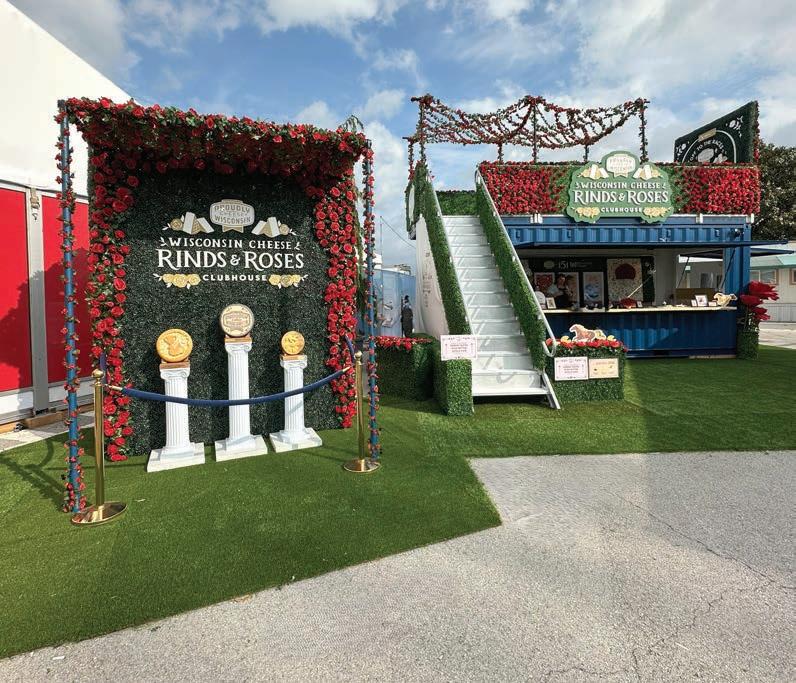
Captivate’s dedication to craftsmanship and client experience was on full display during a mobile brand activation for Dairy Farmers of Wisconsin at the Kentucky Derby. The client’s response captured the impact of their work:
“Thanks for all your help and support this past week. Everyone said our space was the best, prettiest and most fun activation on the whole grounds. We could not have done it without your support and workmanship. Here’s to the next big idea!” — Miranda, Dairy Farmers of Wisconsin
Projects like these are a testament to Captivate’s ability to deliver under pressure, adapt quickly to changing needs, and still create something unforgettable.
Led by Values
Captivate’s team doesn’t just talk about values. They live them. As a mission- and faith-centered business, their work is rooted in integrity, service, and accountability. It shows in how they treat clients,
support each other, and lead every job. Their goal is not just to build beautiful environments, but to build trust, deliver what’s promised, and serve as a reliable partner in every sense of the word.
“We’re not here to sell stuf—we’re here to solve something for the client,” says John Schlosser, vice president of sales and marketing. “That might be a design problem, a space challenge, or a story that needs telling. But it’s always about more than just building a thing.”
That’s what sets Captivate apart in a fast-paced industry that often favors speed over meaning. Captivate proves that you can have both.
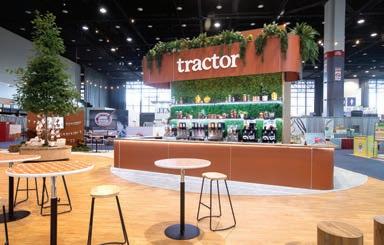
Captivate’s work with Tractor Beverage is another example of this evolution. The team is transforming a 50-foot Airstream trailer into a mobile brand experience that will travel across the country through the end of the year. The entire project— from design and build to execution—is being handled in-house by Captivate.
Looking Ahead
With new interiors in progress and a full tradeshow calendar ahead, Captivate remains focused on helping clients stand out. Whether it’s on the show foor, in the front ofce, or at a brand activation across the country, they’re ready to build the space that tells the story.
Global Headwinds Hit U.S. Exhibitions
FEWER BADGES, TOUGHER BORDERS
BY EXHIBIT CITY NEWS STAFF
Tradeshows are no longer just about foor plans and lead counts. Global unrest, shifting visa policies, and growing concerns at the border are changing how international participants engage with U.S. events, and in some cases, whether they attend at all. For organizers, exhibitors, and host cities, the impact is becoming harder to ignore.
According to the 2025 International Association of Professional Congress Organisers (IAPCO) Global Socio-Political Impact Survey, nearly 60 percent of non-U.S. event organizers say political confict or policy changes in their regions have already afected their ability to plan or host events. For one in four, the impact has meant canceling, relocating, or postponing key gatherings.
Now, new federal data shows that similar disruptions are emerging within the United States, as international travel to U.S.-based events continues to decline.
U.S. sees continued decline in international arrivals
Preliminary figures from the Department of Commerce and U.S. Customs and Border Protection show a 14 percent drop in international visits to the U.S. in March 2025 compared to the same time last year. The U.S. Travel Association warns that the decline could cost the country over $21 billion in
travel-related export revenue this year if the trend holds.
Canada saw a 26 percent drop in overnight land visits and a 14 percent decline in air travel. Western Europe saw air travel fall by 17 percent, marking its frst year-over-year decrease since 2021. Asia remains 25 percent below pre-pandemic levels. These regions have long been considered among the highest-value inbound markets for U.S.-based tradeshows, especially in globally connected sectors like technology, healthcare, and aerospace.
“International travelers are vital for the destination,” Fletch Brunelle, Vice President of Marketing at the Las Vegas Convention and Visitors Authority, told Exhibit City News (ECN) in 2023. “They traditionally make up 14 percent of overall visitation.” That same year, the Las Vegas Convention and Visitors Authority (LVCVA) reported recovery momentum from key markets like Canada and the UK— progress now threatened by rising visa delays, policy shifts, and global instability.
Event organizers face a new normal
For those planning international shows—or even U.S. events that rely on global attendees—operational risk is becoming a growing factor. According to IAPCO, over 49 percent of event organizers reported shifting preferred destinations due to safety or political concerns. That shift is already forcing changes in freight logistics, stafng, speaker sourcing, and even insurance coverage.
For international organizers, permits and approvals have also become a new bottleneck. When asked, 27 percent of IAPCO’s respondents say they’ve encountered unexpected delays or denials due to regulatory hurdles or political shifts in their regions.
A policy divide: protection versus participation
President Donald Trump, who returned to ofce in January 2025, and some of his supporters say recent disruptions to international participation are a necessary consequence of restoring control over immigration and border policy. In May,
the U.S. House of Representatives passed a fve-year, $150 billion immigration enforcement package that includes expanded visa vetting, increased stafng at the border, and broader deportation authority.
Trump has repeatedly defended this enforcement-frst approach, stating in past remarks that “we want workers… but they have to come in legally.”
Stephen Miller, the former White House advisor and key architect of Trump-era immigration policies, continues to infuence their 2025 direction. In a February appearance on The Steve Deace Show, Miller said:
“The distinction between legal and illegal immigration is meaningless if both are used as tools to displace American workers or burden our public systems.” He has long argued for reducing even legal immigration if it risks straining resources or lowering wages.
This policy view holds that immigration, whether legal or illegal, should be strictly controlled to prioritize national security and economic self-interest. While such measures may limit international participation at events, supporters argue that sovereignty and safety take precedence.
Pro-business
conservatives push back
Not all conservatives agree. Several pro-business organizations, including the U.S. Chamber of Commerce and New York City Tourism + Conventions, have raised concerns that current immigration and visa policies are slowing the recovery of international tourism and business engagement.
New York City Tourism + Conventions recently revised its forecast, projecting 12.1 million international travelers to the city in 2025—down from 14.6 million in an earlier estimate. “The environment has become more challenging for international visitors,” said CEO Fred Dixon in a May 8 Bloomberg interview, citing visa wait times, shifting federal policy, and perception issues at the border.
While the U.S. Chamber of Commerce has not issued a recent statement specifc to the exhibition industry, it has consis-
What U.S. Organizers Can
Do Now
1. Start early for international participation: Build in longer lead times for international attendees, speakers, and exhibitors. Visa delays remain common. Providing support letters and documentation early can help avoid last-minute disruptions.
2. Monitor key travel markets: Stay informed on travel patterns from highimpact regions like Canada, Europe, and Asia. Use updates from the U.S. Travel Association (U.S. Travel), the Transportation Security Administration (TSA), and the U.S. Department of State to anticipate changes in attendance or accessibility.
3. Prioritize regional partnerships: When long-haul travel becomes unpredictable, regional collaboration can help maintain exhibitor diversity and buyer access. Consider partnerships within North and Latin America to keep programs strong and participation steady.
4. Build hybrid options as backup: Hybrid and on-demand content can help preserve programming when international speakers or attendees cannot travel. Simple livestreams or recorded sessions can keep engagement intact without adding complexity.
5. Set clear expectations: Use preshow communications to provide visa guidance, travel requirements, and entry information. Help international participants prepare in advance to reduce confusion and delays.
6. Stay engaged with advocacy and industry groups: Organizations like the International Association of Exhibitions and Events (IAEE), the Society of Independent Show Organizers (SISO), U.S. Travel, and the Exhibitions & Conferences Alliance (ECA) are active in policy issues affecting international access. Stay connected with the Experiential Designers and Producers Association (EDPA) and the Exhibitor Advocacy Group (EAG), who represent the exhibitor and design community in conversations about real-world challenges on the show floor.
tently called for immigration reforms that would streamline visa processing and expand legal pathways for foreign talent. In a 2023 letter to Congress, the Chamber wrote that outdated systems and an insufcient supply of work visas “signifcantly hinder the ability of companies to meet their workforce needs.”
Chamber President Suzanne P. Clark summed up the problem in a January 2023 address: “When a border crisis allows millions to cross illegally into this country, but we can’t get visas processed for engineers and nurses that businesses are desperate to hire and communities need—government isn’t working.”
The Chamber’s position underscores a growing divide within conservative circles—between those emphasizing border enforcement and those advocating for greater legal access to support business growth, international travel, and global partnerships.
Freeman data reinforces shifting attendee behavior
While the Freeman 2025 Commercial Trends Report does not address immigration or geopolitical policy, it does highlight shifting attendee expectations and participation patterns that add relevant context. The report shows that attendees are becoming more selective, with more than half saying they plan to attend only two to three events this year. Travel ease and reliability are among the top factors infuencing attendance.
Although Freeman’s research focuses on domestic behavior, some exhibitors surveyed noted declines in international trafc and expressed concerns about factors—such as visa issues or global travel instability—that are largely out of their control. Many say these conditions are already afecting return on investment and long-term planning.
What does this mean for U.S. shows?
As multiple reports and industry sources suggest, these trends are reshaping how U.S.-based events approach international participation. Whether it’s
visa delays, political rhetoric, or missed connections, the cumulative efect is a narrowing funnel of attendance. Shows with traditionally global reach may see smaller international pavilions, fewer high-profle speakers, and tighter ROI for multinational exhibitors.
Some organizers are already adapting by building in longer lead times, exploring hybrid content delivery, and forming regional partnerships to reduce reliance on long-haul travel and at-risk markets.
Where both sides agree: this isn’t going away
Even conservative policymakers acknowledge that these shifts are not short-term adjustments. The Trump administration has made clear that enforcement-frst immigration policy will continue. Global instability, including war zones and refugee movements, will likely continue to challenge cross-border travel and participation in international events.
Meanwhile, the event industry faces a question of balance: How can U.S.based tradeshows maintain their international relevance and reach without compromising national policy priorities or attendee confdence?
While the Freeman 2025 Commercial Trends Report does not address immigration or foreign policy directly, it reinforces a key point: event organizers are expected to do more than rent space. As Freeman puts it:
“You’re not just real estate agents selling space. You’re the community developers designing the environments where business happens.”
That community increasingly depends on reliability, accessibility, and planning confdence, regardless of what’s happening at the border.
SOURCES AND REFERENCES
For the full list of sources and references used for this article, please visit our website: ExhibitCityNews.com.
Join the conversation online at our LinkedIn or tag us in your post with your comments and thoughts.
Let’s Talk Visa Delays (But Keep It Positive!)
Hey folks, let’s have a real talk, yeah?
As your friendly neighborhood international producer and designer, I gotta say—these visa wait times? They’re throwing of our tradeshow plans.
You’re staring at a visa wait time that’s longer than a Netfix binge. It’s frustrating, to say the least.
Now, I’m not here to throw a pity party.
We’re a resilient bunch, us international exhibitors.
By Paco Collazo
Look, we all know the drill. We’re pumped to showcase our stuf, meet you all, and maybe grab a beer after the show. But getting there? That’s a whole other story. Imagine this: you’ve got this killer product or service, right? You’re buzzing to show it of in the U.S., make some connections, maybe even land a sweet deal. Then—bam!
We’ve got passion.
We’ve got drive. We’re not giving up. But let’s be honest—this visa thing? It’s a real pain.
And it’s not just about us. It’s about the whole vibe of the tradeshow, it is just not the same without the international attendees and exhibitors, it just isn’t. The local community misses out on the buzz, the fresh ideas,
and the chance to connect with people from all over. Let’s face it, that’s what makes these events so awesome, right? Diversity.
We’re talking about real money here, too—hotels, fights, booths—it all adds up. When you’re stuck waiting for a visa, that’s money sitting idle. Money that could be creating jobs, driving innovation, you name it.
But hey, it’s not all doom and gloom. We’re seeing some good folks step up and push for change. Organizations and associations like EDPA, The Exhibitions and Conferences Alliance, and Exhibit City News are talking, pushing, connecting us with
each other and our government leaders, and they’re trying to make things better. That gives me hope.
So, here’s the deal: plan ahead, people. Like, way ahead. Let’s keep the conversation going. We’re all in this together, and we’re gonna make these tradeshows the global party they’re meant to be.
Because at the end of the day, we’re all just trying to connect, share our passions, and have a good time. And we’re not gonna let a little paperwork stop us.
We’re coming—maybe a little late—but we’re coming, and we’re coming with the best attitude possible.
AIRPORT SNAPSHOT by Kerstan Szczepanski
HartsfieldJackson Atlanta International Airport
Airport Code: ATL
Location: 6000 N Terminal Pkwy, Atlanta, Georgia
Date Opened: September 15, 1926 (originally Candler Field, renamed in 2003 to honor former mayors William B. Hartsfeld and Maynard Jackson).
Size: Over 4,700 acres, two terminals, seven concourses, fve parallel runways (three 9,000 foot runways, one 10,000 foot runway, and the longest runway at 12,390 feet), and over 190 gates.
Transportation: The Metropolitan Atlanta Rapid Transit Authority (MARTA) Rail Service with direct service via the Airport Station. By car, ATL has easy access via Interstates 75, 85, and 285, with on-site car rentals, taxis, rideshares, and hotel shuttles, and regional buses.
On-Site Facilities: Over 300 retail and food outlets, duty free shops, sky lounges, bookstores, tech stores, and Atlanta-themed boutiques. Free Wi-Fi and mobile charging stations, nursing pods, pet relief areas, and family restrooms.
Fun Fact 1: ATL has held the title of the world’s busiest airport by passenger volume for over two decades. In 2023, it served over 104 million passengers.
Fun Fact 2: ATL features one of the largest public art programs of any airport, including permanent exhibits and rotating installations from local artists.
Website: www.atl.com
Are World’s Fairs Dead?
Before social media, computers, and the internet, before television and even commercial aviation, one way people learned about the world around them was to attend large international events. Depending on the region of the world, they’ve been called expos, exhibitions, and fairs. But by whatever name, over a billion people visited these events: 1.2 billion, to be more exact.
people attended World Fairs in the United States (U.S.). In the frst 90 years, from 1851 to 1940, there were 25 Fairs in the U.S. In the past 84 years, only six Fairs have happened in the states—and of those six, fve lost money. In fact, the last World’s Fair in the U.S., New Orleans 1984, was the only World’s Fair to declare bankruptcy during the run of the show. Not surprisingly, there have been no World’s Fairs in the U.S. since that time, 41 years ago.
will run through October 13, 2025. Prior to show opening, the Japan Association projected attendance at 28.2 million. That number is optimistic: a more likely number is 22 million people, and even that number will be reduced if it is an exceedingly hot summer, or if any unexpected problems occur. Still, it is a lot of people.
Like host countries for World’s Fairs in the past, Japan hopes to promote its economy, its technology, and its culture. The theme of Expo 2025 is: “Designing Future Society for Our Lives.” One attraction displayed and demonstrated on opening day was a fying car.
The future.
By Bob McGlincy
So, why did individuals from all over the globe pay to travel to and attend these events? What was the attraction?
Fun, Excitement, & Money. These fairs were cultural phenomena and entertainment meccas. They created jobs, attracted tourists and generat-
ed revenue. Host cities gained recognition. Attendees had fun. Businesses sold products. Countries showcased their culture. Entrepreneurs displayed inventions. Many of the innovations showcased at World’s Fairs changed the way we live today. Examples include: the elevator, the telegraph, the telephone, the phonograph, the television, the computer, as well as movies, munitions, medicines, medical devices, pharmaceuticals, farm devices, and electric lights. In the 19th and 20th centuries, World’s Fairs were the place to see, to be seen, and to experience.
Are they still happening?
In the past 175 years approximately 300 million
So, are World’s Fairs dead? No, but it may be a question of semantics. “World’s Fair” is a term mostly used in the U.S. Since the New Orleans World’s Fair, there have been 16 “International Recognized Exhibitions” worldwide. Shanghai in 2010 attracted 73 million visitors. Before this year, the most recent World Expo was in Dubai. It was scheduled for 2020, but due to Covid, it did not start until October 2021. It hosted 192 participating countries and attracted 25 million visitors.
Bidding on the 2025 Expo started in the beginning of 2017. Paris initially bid on the event but withdrew that September after being awarded the 2024 Olympics. Osaka was awarded the event in November 2018.
Expo 2025 opened on April 13th with 158 participating countries. A total of 40 countries, including the U.S., erected architecturally stunning national pavilions. Mitsubishi, Nintendo, Panasonic, and Sumitomo are four of the 14 private sector pavilions on site. The Expo
Today, these expos are more about countries and themes than they are about inventions, brands, or corporations. They look to promote progress and foster cooperation.
The ofcial governing body for World’s Fairs is Paris’ Bureau International des Expositions (BIE). According to the BIE, there are three primary categories of Expos: Universal, Specialized, and Horticultural. After this year, the next Universal Expo, the largest type, will be 2030 in Riyadh, Saudi Arabia. Belgrade, Serbia will host a Specialized Expo in 2027. Yokohama, Japan will host the Horticultural Expo in 2027, with Minneapolis, U.S. is tentatively scheduled for one in 2031.
Bob McGlincy is the co-author of “The Invisible Industry—The Evolution of Trade Shows” and can be reached at bobm@exhibitcitynews.com
Transforming Spaces.
WHERE INNOVATION MEETS ACTIVATION.
We are the architects of unforgettable moments that power meaningful connections between brands and their audiences using AV and LED technology. With a focus on innovation, we seamlessly blend cutting-edge equipment, heartfelt storytelling, and a touch of production magic to elevate your vision and leave a lasting impression. Let's craft extraordinary experiences together!
“This year’s exhibit drove a 100-percent increase in booth traffic and lead generation.”
Rebrand Redesign: Advantage Solutions at NPEW 2025
by Lynn Larson
Amajor brand update
can prove an invaluable opportunity to reposition your organization in the marketplace and reeducate your target audience on the evolution and expansion of your oferings. But it can also come with unforeseen charges, from the upfront creative investment to the costs associated
with restocking promotional products and reskinning corporate assets. When done correctly and efciently, however, the value far outpaces the expense.
Such was the case for Advantage Solutions, which enlisted Storylink Creative to completely redesign its exhibit and debut its new brand identity to the world at Natural Prod-
ucts Expo West (NPEW) 2025 in Anaheim. The resulting exhibit needed to convey the company’s new branding and represent the full breadth of Advantage Solutions’ services, all with a little multimedia magic and a pinch of personality to help it stand out on the frenetic NPEW show foor.
To keep costs contained
(and free up funds to reinvest in up-leveling the redesign), Storylink looked to the company’s most recent NPEW booth. Reusing the existing Moss framing system would render the new booth more afordable and inherently sustainable. The associated savings, then, were redistributed into the exhibit in the form of
GET MORE BANG FROM YOUR NEW-BUILD BUDGET
Take Inventory: Do a deep dive into existing assets to see what can be reskinned and reused. If framing systems or other elements are not reusable, build that reusability into your new booth by thinking about the long-term lifecycle of your investment.
Invest in Digital Signage:
Yes, it’s a bigger upfront investment than printed fabric graphics, but it will allow you to more easily and inexpensively swap out messaging when needed. Plus, dynamic video will outperform static graphics every day of the week.
Design for Reuse: Consider how the elements you’re creating for the exhibit can be repurposed. For example, content on the interactive touchscreens was designed to enable reuse at tradeshows and events beyond NPEW 2025.
Spend Wisely: Ask your exhibit agency about valueengineered options. The goal here is not to get the cheapest booth that can do the job, but rather to pick and choose where to save, allowing you to spend strategically on the items most likely to provide the desired impact.
Seek Lightweight Solutions: Lightweight materials and structural simplicity will decrease costs associated with material handling and I&D labor, allowing you to invest in retainable assets versus intangible show services.
44 low-profle screens comprising nine arrays—as well as an LED header to convey messaging and capture NPEW attendees’ attention.
“I had the pleasure of working with the Storylink team, who helped bring our creative vision to life,” said Kurt Perenchio, enterprise creative director at Advantage Solutions. “They delivered a series of well-branded videos which helped tell our story and drive lead generation for our company.”
The 30 x 30-foot foor plan was divided into three primary zones, spotlighting Advantage Solutions’ portfolio in the categories of branded services, retail services, and experiential services. Meanwhile, an interactive touchscreen at the center of the space looped branded content and enabled guests to deep dive into Advantage Solutions’ comprehensive capabilities.
Echoing the undulating lines of Advantage Solutions’ new brand identity, colorful
graphics were woven into the exhibit’s tensioned-fabric walls and fooring, as well as custom-produced video content synched across the omnipresent digital signage, kinetically reinforcing the tagline “We Keep Commerce and Life Moving.” In fact, the multimedia installations and related video content created by Storylink were recently honored with a Hermes Creative Award in the category of Best Multiscreen Video Production.
“Our evolved booth design and inclusion of digital storytelling cohesively shared our evolved brand narrative,” said
Nicole Simonds, vice president marketing communications at Advantage Solutions. “From our overhead signage to the display graphics—and even the foor—it communicated our purpose of connecting people with products and experiences that enrich their lives, while showing brands and retailers how we can do that for them in store and on the shelf.” Simonds added that this year’s exhibit drove a 100-percent increase in booth trafc and lead generation, garnering positive feedback from clients, customers, and internal stakeholders on the Advantage Solutions team.
EXHIBITORLIVE 2025 Roundup
BY MARLENA SULLIVAN
It would not be the start of a new year without the annual EXHIBITOR LIVE . Hosted in San Antonio for 2025, EXHIBITOR LIVE is known as the tradeshow for tradeshow professionals. In many ways, it is more of a community event where the family is getting back together again than a tradeshow. Everyone knows each other, the newest products are show cased, and the community comes together to say hello despite their extremely busy season.
Super San Antonio EXHIBITORLIVE embraced San Antonio and all the city had to ofer. The opening reception party was held on Paseo del Rio, the riverwalk, outside of the convention center. It allowed the industry to have their frst experience of the beautiful city. The river glistened green and blue for St. Patrick’s day, and the weather was pleasant without a hint of rain.
The next day, when the doors opened for the exhibit hall, industry professional were greeted by live music and a short welcome ceremony to the grand door opening. Ofering tours and decorating the entrance hall in spirit of San Antonio, Exhibitor brought the city inside the convention center.
Booths Beaming Bright
This year the booths were bigger and better. Everyone who exhibited brought their best and were ready to showcase why clients should work with them. There was large scale monopoly ofered at the AppleRock booth where an attendee could roll large dice, hurry across foor squares, and tap at a screen to collect falling cash for physical prizes. The Derse booth ofered a full apothecary with oils and scents given to clients who walked through their activation, where they found the solution to the ailment a client is experiencing. BlueHive had attendees determine their strengths through a fascinating 360 interactive environment, where one stood in a circular display with videos and questions that was both small in size and fully enrapturing. Steelhead showcased their elegance with their wall of locks, emphasizing their dedication to connections between themselves and their business partners. Exhibitus showcased their intentionality through their kitchen and glowing mirrors, attendees could interact with household appliances and displays that changed based on how activations were used. Hamilton drew from key Texan colors of deserts and sunsets while asking the audience to look beyond what traditional conventions can ofer with
booth that reexamined what it means to be remembered. From the LEDs to the booth staf, everything was glowing, smiling and beautiful. EXHIBITORLIVE showcased what could be and what will be in the world of shaping dreams.
Panel Highlight
On the second to last day of the event, EXHIBITORLIVE hosted a workforce development panel with industry leaders and members of the unions speaking about development and training. Workforce development is a major concern for many in the industry, and the panel ofered solutions and clarity regarding questions on training and mentorship.
Students Excited For the Future
As always, EXHIBITORLIVE’s student booth showcased the work of students ready to enter the events and exhibitions industry. The students were lively and bright ready to network with the
professionals who were more than excited to meet them as well. All of the projects and students were a great look into the minds entering the industry: creative, innovative, and flled with possibility.
Associations and More EXHIBITORLIVE is the biggest week for tradeshow professionals, and with that responsibility comes a variety of events hosted by the associations in tandem with the event itself. The Experiential Designers and Producers Association (EDPA) hosted two big events on Sunday and Tuesday night, while Women in Exhibitions (WIE) hosted their annual breakfast and networking even on Wednesday morning. All three events were flled with not only great networking opportunities but catching up with family. New faces and old faces came together to expand the already large family and embrace change and progress fully.
See you next year in Tampa, Florida.
Bright Ideas
THE LATEST TRENDS IN LIGHTING AND LED
BY DANELLE DODDS
When you live in a city reputed to be the brightest spot on Earth, the subject of lighting is a hot topic. Folklore claims Las Vegas burns as the most brilliant city when viewed from a portal of a spaceship. The same lore suggests we glow with 15,000 miles of neon tubing. Regardless of what you believe, the latest trends in lighting and LED are anything but tall tales.
LED by Example
If you’ve ever stood below the 49.3 million LED lamps hovering over Fremont Street, you understand the power of looking into the light. While LED is not a new technology, it continues to dominate the feld as the key to creativity. The latest design trends include a little twist.
Bend the Rules: Faux Neon
If you’ve strolled through a tradeshow in the last year
or two, you’ve likely caught the gleam of glowing curves and dramatic enhancements reminiscent of vintage neon. That eye-catching glow isn’t your grandfather’s gas-flled neon signage; it’s the latest evolution in event lighting: faux neon.
Also known as faux LED neon or rope light, this modern lighting incarnation is more than a pretty face.
The chip-based LED technology is encased in a fexible silicone coating, difusing the LED dots into a continuous LED light band and allowing maximum fexibility. These products are available in many diferent profles and various bending directions— up, down, serpentine, and more. Thanks to advancements in technology, designers can create booth lighting elements and features visible from virtually any angle.
“Neon LED has really taken of. I think we’re going to see 2025 and beyond as The Year of LED Neon,” shared Steve Hess, president at Trussworks. It’s easy to see why. Unlike traditional neon, which relies on fragile gas-flled glass tubes, LED faux neon is more durable, energy-efcient, with endless creative possibilities. But it’s not just about making a booth “pop.” Lighting has evolved into a strategic narrative tool. “LED lighting is a powerful tool for creating captivating scenes. With thoughtful design, it can tell a compelling story, engage your audience, and evoke deep emotions,” says West Coast Sales Manager with Display Supply & Lighting, Inc. (DS&L), Mike Sunseri. Whether drawing attendees into a product demo or creating a mood that matches a brand ethos, faux neon provides a fexible, vibrant medium for immersive booth design.
While it shines in playful photo ops (think glowing hashtags on Instagram photo ops), its true power lies in its ability to enhance architectural features, spotlight focal points, and add motion to static elements. With its fexibility and full-spectrum glow, faux neon is bending the rules of booth design.
Picture This: LED Video
Tiles
In the evolving world of exhibit LED technology, beMatrix LED video tiles are stepping into the spotlight. These high-defnition displays are becoming a go-to solution for designers who want to efortlessly blend a high-impact experience with an efortless installation. What makes these LED video tiles a breakout star? For starters, they’re engineered to integrate perfectly within the beMatrix frame system. That means faster installs, sleeker vi-
photo courtesy of Trussworks; DV photo courtesy of Total Show Technology
suals, and fewer headaches for exhibitors and builders alike. The visual payof is just as impressive. With a tighter pixel pitch, the LED video tiles deliver brilliant color accuracy and smooth playback, which is especially important in theater-style presentations where every detail counts. “One of the trends that we’re seeing now are exhibits wanting to have theater presentations in closer, tighter spaces,” explains Total Show Technology’s director of sales, Rich Cornish. Whether you’re streaming immersive content, looping product videos, or layering motion graphics, the result is cinematic quality that holds the attention of even the closest show-goer. And it’s not just about beauty; it’s smart, too. These energy-efcient LED tiles make them an ideal choice for sustainability-minded events. Fewer watts, more wow. Add the seamless integration of beMatrix’s signature
“Perfect Corners,” and you get a polished, edge-to-edge display with limited visual gaps. The result? A sleek, modern, high-tech LED display that tells your story in high defnition from every angle.
Mind the Gap:
LED End Cap Lighting
For years, exhibit builders and designers have been searching for a solution to efectively illuminate the exposed edges of their frame systems. Enter LED end cap lighting. The extrusion LED end cap trend is an innovative way to fnish the design of aluminum booth frames with attractive accent lighting. LED end cap lighting is a fast-growing standard, with multiple versions hitting the market to meet demand. As visual storytelling becomes more immersive and detail-focused, these products ofer an eye-catching way to fnish a booth with polish and purpose.
“There has been a growing trend where designers want to splash colors on the edges of their booth and backwalls,” says Sunseri. DS&L introduced an RGB-programmable end cap lighting system that is fully programmable. The product allows for color changes, dynamic efects, and seamless fnishing. There’s no more settling for dull borders or distracting frame lines. Instead, exhibitors can amplify mood, brand identity, and movement at the margins.
But DS&L isn’t the only innovator lighting up the edges.
Trussworks/Prism LED ofers the popular LovoEdge, a high-impact lighting solution that has become a staple in modern booth builds. “It’s our number one selling product and has been a game changer in the industry for the last two years,” says Hess. Trusswork’s Director of Business Development, Roman Moszkowicz, agrees, “For designers, it’s a beautiful way to highlight the exhibit, like framing artwork.”
Control Freak: The Future of Interface
In the future, the most transformative shift may not come down to diodes or tubing. The next horizon may be how customers interact with technology itself. As smart systems evolve, lighting controls are moving beyond handheld remotes and toward an intuitive, app-based platform that hands easier control to the users. “I don’t think LED lighting is going to change dramatically, but how we are going to interface with it…will,” muses Hess. With that comes its own set of challenges. As designers continue to push boundaries and demand more immersive and responsive environments, lighting manufacturers will be challenged to deliver richly customizable and user-friendly systems.
In an industry powered by innovation, the path forward is brilliant. Follow the Exhibit City News LinkedIn profile to stay current with the latest trends and bright ideas.
Print at Full Scale
BY MARK HEBERT
Tradeshows demand big visuals and fast turnarounds. In 2025, many printers say the pressure is higher than ever. Two U.S.-based frms, US-SEG and Horizon Print Solutions, are tackling that challenge in diferent ways. One delivers large-scale customization through automation and consistency, the other focuses on speed and personalized service. Both are redefning what print partners can ofer the exhibit industry.
US-SEG: Seamless Scale and Built-in Reliability
For decades, seams were a necessary compromise in large-format fabric graphics. US-SEG is removing that barrier with 16-foot-wide, seamless dye-sublimation printing. The change expands what designers can do with space and layout.
“Until recently, seamless fabric graphics were limited to a maximum width of 10 feet,” says Cory Shidlofsky, director of sales at US-SEG. “This forced designers to adapt their creative concepts to ft within technical constraints, resulting in tiled visuals, visible seams, or compromises in scale and layout.”
US-SEG is based in Orlando, with multiple facilities across the U.S. (including Las Vegas) as well as overseas. The company specializes in high-volume, fabric-based printing for exhibits and environments. Its production facility is designed for automation, global scalability, and color precision. The team operates 13 dye-sublimation printers, including three that print at 16 feet wide. Graphics are produced on lightweight fabrics that pack small, ship efciently, and install quickly. Unlike UV prints, dye-sub graphics are odorless and fnished with a soft matte surface, making them well-suited for
enclosed tradeshow environments.
“Designers are now free to explore more ambitious spatial designs,” Shidlofsky says, “with larger uninterrupted surfaces, panoramic visuals, and cleaner aesthetics.”
Beyond scale, US-SEG’s production line is built for consistency. Every step, from prepress checks to fnishing, is engineered for speed and accuracy. Cutters use camera systems to verify dimensions. Files are prepped for stretching, shrinkage, and complex contours. Color profles across all devices are FOGRA-certifed, ensuring consistent, brand-accurate color output.
Finishing is automated. Quality checks are photo-documented, with precise measurements on fle for every job.
“This integrated and automated approach results in fawless graphics, shorter setup times, and total peace of mind for our clients,” Shidlofsky says.
That reliability extends to capacity. With double production capability across materials, US-SEG can absorb last-minute jobs or spikes in demand. Its fnishing department alone can process up to 8,000 square meters per day.
“Since the post-COVID recovery, exhibit builders and event organizers have been facing tighter setup schedules, higher cus-
16’ Cutting machine
Cutting machine camera
tomer demands, and rising transportation costs,” Shidlofsky explains. “We address these challenges by continuously innovating in both software and hardware.”
As modular systems become the industry standard, US-SEG has aligned its production to support widely used formats, including systems like beMatrix and Aluvision. The goal is faster setup and visual consistency. For brands with international activations, consistent output matters.
“Thanks to our international focus,” Shidlofsky notes, “US-SEG enables clients to deliver a consistent and high-impact brand experience anywhere in the world. Our global reach ensures uniform quality and execution across all markets.”
One misconception, he says, is that high-quality printing can’t be replicated at scale or across multiple facilities.
“At US-SEG, we challenge that assumption,” he says. “Our fully optimized and automated workfows ensure absolute precision in both dimensions and color, eliminating the need for prebuilds. We don’t just deliver prints. We deliver predictability, reliability, and peace of mind.”
Horizon Print Solutions: Nimble, Personal, and Print-Smart
Horizon Print Solutions takes a diferent path. While others scale up, Horizon moves fast and stays close to the client. For founder Will Houghton, that’s not just strategy—it’s how the business runs.
Efciency, he says, is the key to standing
out in a crowded market. “Efciency is a major diferentiator in today’s rushed business world,” Houghton explains. “Businesses that are doing well are growing rapidly and need a partner who is nimble, who understands the industry and who can make things happen fast, with ease.”
At Horizon’s Las Vegas headquarters, that speed is baked into the operation. Today, typical projects are turned around in 48 hours and shipped nationwide—the result of years spent adapting to shifting customer demands.
“Item demand over my long career has evolved forward three times in forty years,” Houghton says. “Smaller and smaller project sizes, all the way down to ‘consumer needs items for a birthday party’ sized print orders being asked of us.”
Even as job sizes shrank and timelines shortened, Horizon stayed focused on business-to-business work. “We are selective in maintaining a strict Business to Business model,” he says.
That doesn’t limit the product mix. Houghton points to the rise of shortrun, creative requests—everything from selfe frames to gift kits to multi-channel marketing campaigns. “Consumers are fnding new ways to display and use print,” he says, “and those ideas come to work with them.”
One fast-growing product category is branded kits flled with promotional items tailored to a specifc theme or event. “Think a gift box with eight or nine
small, branded merchandise items, all themed around the same party, event, seminar, or holiday,” he says. “The box becomes an experience for the receiver.”
He believes in the format enough to use it himself. “This branded box is such a major play in my industry that I send these to clients,” Houghton says. “Two were sent last week.”
Creativity, he says, is only half the equation. Execution matters just as much—and often trips people up. “Doing it yourself doesn’t really get you very far,” he explains. “Print, branded merch, apparel campaigns, mailing—there are more nuances than ever, more choices, and unfortunately more disappointed customers as a result.”
His advice: don’t bring in a printer after the fact. “Call a printer when you think of a mailing project,” he says, “not while driving to the post ofce.”
That early planning paid of on a recent job that required Horizon to produce more than 22,500 food and gift vouchers—each one fraud-resistant and fully traceable.
“We generated an artifcial watermark, used special paper, added assigned numbering, and reversed out Prismatic Rainbow Foil, which also matched the theme of the event,” Houghton says. “And we did it in four business days.”
For Horizon, every job is a balance of speed, accuracy, and trust. “Fast, efcient, knowledge, directions, and solutions,” Houghton says. “That’s what our clients are seeking today.”
Two Models, One Goal: Print That Performs
US-SEG delivers scale and automation. Horizon Print Solutions delivers speed and service. Each serves a diferent kind of customer, but both refect how print partnerships are evolving in 2025.
Today, quality and speed are table stakes. What earns trust is consistency—whether it’s a seamless wall of graphics or thousands of branded kits delivered on time.
These frms aren’t just reacting to client needs. They’re helping shape what’s next.
10’ HP Stitch dye sub printers
Choosing the right path for ERP implementation
Evaluating the pros and cons of inhouse versus partner-led rollouts
By Rick Kostopoulos, CEO, NewGen Business Solutions
Every growing business reaches a point where spreadsheets, disconnected tools, and manual workarounds no longer cut it. The hours spent on administrative tasks and redundant data entry in fnances, procurement, operations, and client services cut into the bottom line and sacrifce efciency.
Businesses reclaim time and efciency by implementing one centralized system, known as Enterprise Resource Planning (ERP), which connects core business functions in a seamless platform to improve visibility, reduce errors, and support scalability.
The most critical aspect of implementing an ERP system is choosing a partner who knows all the business process requirements for your industry, who can optimize the functionality of your selected ERP to your organization, and who has developed industry-specifc customizations to further enhance operational efciency.
The case for implementing ERP in-house
Some businesses implement ERP systems in-house, aiming for complete control over functionality, architecture, and costs. However, there are signifcant challenges that can outweigh the benefts:
» 1. LACK OF EXPERIENCE AND UNDERSTANDING
Many ERPs are highly specialized, yet most businesses lack a deep understanding of how they work and what they can do. This leads to confusion during selection and underused features and missed opportunities for efficiency after implementation. It’s like finally choosing a multitool but only ever using the screwdriver – inefficient.
»
2. HIGH UPFRONT COSTS AND TIME INVESTMENT
ERP implementation requires a deep understanding and mapping of internal processes, which often pull internal teams away from revenue-generating work. Despite the intent to save money, in-house ERP implementation frequently runs over budget, past deadlines, and experiences costly mistakes.
» 3. HIRING AND SUPPORT DIFFICULTIES
In-house implementations are sometimes so specialized that it’s hard to find engineers who understand them. Onboarding and retaining talent become a challenge, especially as the system ages or needs to scale.
The case for partnering with ERP consultants
Most growing businesses choose to work with consultants who specialize in verticalized ERP platform implementations. These partners bring feld-tested
experience, specialized addons, and often deliver faster, more stable rollouts.
» 1. FASTER DEPLOYMENT AND LOWER LONG-TERM COSTS
Experienced ERP consultants have proven implementation frameworks and tools that shorten the path to go-live. This minimizes downtime, reduces internal disruptions, and accelerates the return on investment.
» 2. ACCESS TO WELL-SUPPORTED PLATFORMS WITH TAILORED SOLUTIONS
Established platforms like Oracle NetSuite come with large user communities, documentation, and available talent. Even better, some consultants build on top of these systems with industry-specific enhancements. For example, our product ConventionSuite, built on NetSuite, is tailored for the trade shows and events industry with tools for Venue Management, Exhibit House Management, and General Service Contractor operations.
» 3. ONGOING EXPERTISE AND STRATEGIC GUIDANCE
Consultants bring more than technical implementation, they offer business process insights, best practices, and post-launch support. Whether for a one-
time deployment or ongoing optimization, their guidance helps businesses continuously improve and scale. Plus, for NetSuite at least, every technical enhancement is rolled out to the entire user base, regardless of whether they’re startups or enterprise juggernauts, which hugely benefits smaller businesses.
Make the right move for your business
If your current systems are limiting growth, it’s time to consider ERP. For businesses managing venues, running trade shows, or fabricating exhibits, the right ERP solution can streamline operations and boost efciency, catapulting productivity and revenue to new levels.
Explore ConventionSuite, the all-in-one ERP solution built on NetSuite. Visit conventionsuite.com or email sales@newgennow. com to schedule a free demo and consultation.
Rick Kostopoulos is an ERP expert with over 28 years in the industry. He is the founder, President, and CEO of NewGen Business Solutions, and the creator of ConventionSuite, the only NetSuite-powered ERP built for the events, venue, and trade shows industries.
Georgia World Congress Center
Where Scale Meets Southern Hospitality
By Kerstan Szczepanski and the Georgia World Congress Center
Located in the heart of downtown Atlanta, the Georgia World Congress Center (GWCC) stands as one of the premier convention destinations in the country. Spanning more than 4 million square feet, including 1.5 million square feet of fexible exhibit space, GWCC is among the largest and most versatile convention centers in North America. Its seamless design is perfect for accommodating some of the world’s largest expos. But GWCC is more than sheer size. With 13 exhibit halls, 98 meeting rooms, three fxed-seat auditoriums, two grand ballrooms, and versatile outdoor plazas, it’s a chameleon that can adapt to events of every scale and sector. From global industry tradeshows like IPPE, IWF, and MODEX to pop culture staples like MomoCon and youth sporting events including Big South, GWCC provides the infrastructure and Southern hospitality to support it all. A true game-changer for the campus is the Signia by Hilton Atlanta, GWCC’s connected headquarter hotel. Attached directly to Building C and accessible via a pedestrian walkway, the hotel ofers over 950 guest rooms and 100,000 square feet of its own meeting space, including Georgia’s largest hotel ballroom, as well as an outdoor event deck and lawn. This seamless integration enhanc-
es the experience for attendees, ensuring comfort, convenience, and continuity. Accessibility is one of GWCC’s most valuable assets. Its 200-plus acre walkable campus also features Mercedes-Benz Stadium and Centennial Olympic Park and is adjacent to State Farm Arena and just steps from a MARTA rail station, allowing visitors to travel from Hartsfeld-Jackson Atlanta International Airport to the campus with ease. Over 13,000 hotel rooms and a variety of cultural attractions—such as the Georgia Aquarium, World of Coca-Cola, and the Center for Civil and Human Rights—are all within walking distance. Foodies will be happy to learn that Atlanta is now a Michelin city, with nine restaurants holding a Michelin star.
GWCC leads the industry in sustainability. It is the frst convention center in the world to earn LEED Gold certifcation for Existing Building: Operations & Maintenance, setting the standard for green building practices in large-scale event spaces.
With unmatched fexibility, location, and service, the Georgia World Congress Center is more than a venue—it’s a destination. Whether you’re hosting a corporate summit or exploring your favorite fandom, GWCC ofers an extraordinary experience on a grand scale.
EAT
Ruth’s Chris Steak House – Downtown (267 Marietta St NW, in the lobby of Embassy Suites) is a classic, with an elegant, business-friendly atmosphere. Just steps away from the convention center, it is a great way to put that expense account to work.
Sweet Auburn Curb Market (209 Edgewood Ave SE) is the budget friendly option close by. Also known as the Municipal Market, it’s part farmer’s market and is a cultural landmark. Grindhouse Killer Burgers, Bell Street Burritos, and Afrodisiac’s West African and Caribbean soul food are just the beginning of the menu.
SLEEP
The Westin Peachtree Plaza (210 Peachtree St) connects to the convention center by Skybridge. This sleek high-rise features the Sun Dial, a rotating rooftop restaurant with 360° views. There’s valet parking, gym, indoor pool, two bars/lounges, two restaurants, and breakfast from 7–10:30 am.
Hotel Indigo Atlanta Downtown (230 Peachtree St NE) is a boutique style hotel five minutes from GWCC. This modern hotel in a historic building designed by John Portman features chic design, cozy rooms, and easy access to Peachtree Center MARTA.”
PLAY
On top of the Glenn Hotel, SkyLounge (110 Marietta St NW) offers a panoramic downtown view with cocktails, wines, and light bites—perfect after a long convention day.
The Georgia Aquarium (225 Baker St NW) is both family-friendly and educational. One of the world’s largest aquariums when it opened—and still the most diverse—it’s home to the only whale shark exhibit outside Asia. Don’t miss the dolphins, penguins, sea otters, and sharks.
Photo courtesy of the Georgia World Congress Center
SHOP TO SHOWFLOOR
An In-Depth Look into Today’s World of I&D and Event Labor
Derse at EXHIBITORLIVE 2025 Pg. 58
Deckel & Moneypenny with VonHagan at EXHIBITORLIVE 2025 Pg. 60
Hanwha Vision America by Visual Communications, Inc. at ISC West Pg. 62
Photo by Donovan Hogan, Derse
Derse at EXHIBITORLIVE 2025
By Kerstan Szczepanski
Derse prides itself on the thought that goes into design and implementation of clients’ exhibits. This was demonstrated in a number of ways for their own booth at EXHIBITORLIVE.
“Like we do for our clients,” Alli Hughes, marketing manager for Derse, says, “we approached our solution thinking about how and where we can make thoughtful budget deci-
sions that will make the most impact. One way we designed and built our booth was to be fully ground supported and eliminate the need for rigging.”
But Derse’s thoughts on the booth theme were the real hallmark for this exhibit.
“What made our booth unique was not just the attention to detail within the exhibit and connected experience itself, but the extension of the
By The Numbers
Booth Footprint: 20’ x 40’
Booth Height: 18’
LED Tile: (2x) 10’ x 5’ LED tile walls
theme through our 360-degree marketing eforts before, during, and after the show,” Hughes says.
Ashlyn St. Ours, senior customer experience designer for Derse, says, “Our initial exploration centered on the idea of chemistry: both in the interpersonal sense—the ‘handshake chemistry’ that represents Derse’s strong relationships—and in the way we blend unique, client-specifc solutions. We began imagining an immersive setting where this kind of alchemy could take place, and the Apothecary emerged as a natural ft. It sits at the intersection of the practical and the magical, just like the inventive, efcient, and deeply tailored work Derse delivers for its clients.”
The idea and its execution were stunning, including two tile walls that depicted storefront windows and pedestrians. The tile walls were just the beginning, as Peter Kreutziger, creative director for Derse, points out. “The Derse Apothecary architecture and graphics were inspired by old-style, traditional storefronts with intricate woodwork, tin ceilings, and innate features. This aesthetic formed the foundation of our exhibit and merged with a more modern and brighter take on a boutique store environment. The interior evoked a feeling of human connection, like a traditional apothecary, serving as a gathering place where you seek the help and guidance from expert alchemists, or in our case experien-
PROJECT CREDITS
Exhibit Designer: Peter Kreutziger, Derse
Experiential Designer: Ashlyn St. Ours, Derse
Graphic Design: Tess
Brzycki, Derse
Video Design: Michelle Renaud, Derse
Fabrication: Derse
Graphic Production: Tectonics
Audiovisual: Stamm Media
Flooring: Brumark
Exhibit I&D: Sho-Link
Photography: Donovan Hogan, Derse
tial marketing consultants.”
“What made the Derse Apothecary truly remarkable was its holistic storytelling,” sums up St. Ours. “Every touchpoint—before, during, and after EXHIBITORLIVE was intentionally connected. From the intake experience to the storytelling journey to the branded ‘remedy’ takeaway, each element played a deliberate role in reinforcing our message and bringing the narrative to life. That narrative extended even after the show foor closed, with personalized post-show outreach. More than just an exhibit, it was a fully choreographed, 360-degree experience designed to spark curiosity, drive meaningful conversation, and leave a lasting impression.”
By the Numbers
Booth size: 20’ x 20’
Height: 6’ 6”
PROJECT CREDITS
Client: Deckel & Moneypenny
Exhibit Design: Deckel & Moneypenny
System provider: VonHagan Design, AgencyLED Exhibit System: OneLED MOVIEBOX
Deckel & Moneypenny with VonHagan at EXHIBITORLIVE 2025
By Kerstan Szczepanski
This booth was a quiet rebellion against convention. In a sea of overstimulation, Deckel & Moneypenny (D&M) chose simplicity—and in doing so, created something unforgettable. It’s not just a space to look at, it’s a space that sparks curiosity, memorization, and clarity,” says Steve Deckel, CEO of Deckel & Moneypenny.
This booth was unlike anything else on the show foor, making it an EXHIBITORLIVE Best of Show Finalist. Where most exhibits compete for attention with towering structures and high-density graphics, D&M deliberately chose restraint. The booth was a minimalist white cube with a mirror LED centerpiece in a
20 x 20-foot space, facing the central hub of the hall to maximize fow and visibility. Surrounded by pure white fooring, the bursts of color from the LED visuals were even more striking.
But its true uniqueness was in the interactive experience—visitors were given red-flter lenses to reveal hidden messages embedded in layered graphics. This fltering efect was both a visual spectacle and a metaphor for the agency’s mission: helping brands cut through the noise to reveal powerful, focused messaging.
From a production standpoint, this was a departure from the builder’s usual projects—smaller in scale but conceptually ambitious. They had to consider how to
turn a compact footprint into a full sensory experience, and how to integrate layered visuals seamlessly with the glasses.
The concept was inspired by a quote from Jean-Michel Basquiat: “I cross out words so you will see them more.” Basquiat often emphasized meaning through subtraction.
“We translated that idea visually. By layering colors and graphics and then using red lenses to strip away the noise, we allowed visitors to uncover what truly matters—whether a message, a feeling, or a brand’s essence. It was an experience that mirrors our process as a creative agency: revealing clarity through complexity,” says Deckel.
Hanwha Vision America by Visual Communications, Inc. at ISC West
By Kerstan Szczepanski
Gary Prochorchik / Exposures, LTD
When Hanwha Vision America (Hanwha Vision) set out to reinvent their presence on the tradeshow foor and align with their updated brand identity, Visual Communications, Inc. (Visual) focused on more than just aesthetics. The team took a strategic approach, considering how the entire experience could drive the best return on investment for Hanwha Vision and the best return on experience for attendees. In design, Visual aimed for an environment that brings the brand to life by excit-
Photography by
By the Numbers
Booth Footprint: 55’ x 100’
Booth Height: 25’
Modular Usage: 55’ x 100’, 40’ x 60’, 20’ x 30’, 10’ x 20’
ing attendees, and clearly communicating product messaging, all while equipping exhibit staf with functional tools for engagement. The Hanwha Vision Tri-circle was represented in various ways throughout the space both as literal representations and nuanced design details. The elevated Hanwha Vision logo was prominently visible from across the show hall, drawing attendees in. Once inside, a hierarchy of messaging and swooping display elements guided the eye down to the products, emphasizing the strength and innovation
PROJECT CREDITS
Client Team
(Hanwha Vision America)
Sr. Event Marketing Manager:
Alicia Sabach
Tradeshow and Events Manager: Patrick Tracey
Exhibit House
(Visual Communications, Inc)
Account Executive: Matt Iacone –Principal/Chief Operating Officer Design: Visual Communications, Inc.
Build: Visual Communications, Inc.
Account Mgr: Stephen Marroletti –Sr. Account Manager
Erin Robinson – Account Manager
Lead designer:
Todd Dailey – VP Creative
Production/Engineering: Visual Communications Inc.
Graphics Production: Visual Communications Inc.
Photography: Gary Prochorchik –Exposures, LTD
Exhibit I&D: Eagle Management
of Hanwha Vision’s technology.
The exhibit, which debuted at ISC West 2025, conveys a controlled whirlwind of innovation, refecting Hanwha Vision’s ever-evolving suite of solutions. To support Hanwha Vision’s growth and adaptability, the booth components were engineered for efciency and easy updates between shows, allowing for quick changes to product displays and messaging. In a move that streamlined both pre-show prep and on-site setup, Hanwha Vision’s tech and marketing teams worked
in-house with Visual’s carpenters and project managers to pre-mount products. This seamless collaboration signifcantly reduced installation time and overall costs. As one Hanwha Vision employee said, “You guys are this far along already? We’re in good shape!”
As Janet Fenner, president of Defned Marketing, summed it up best, when she commented on how the innovative design complimented the well-organized infrastructure. “The technology mounting was a true work of art. Intricate and beautiful.”
Upstate, NY
Portland, ME
Burlington, VT
Montpelier, VT
Concord, NH
Springfield, MA
Hartford, CT
Worcester, MA
Boston, MA
Providence, RI
The ExSys Awards recognize excellence in systembased exhibits, showcasing projects that exemplify creativity, innovation, and superior design. These awards celebrate the ingenuity and creativity of designers and marketers who push the boundaries of modular and system-based solutions.
Winners Announced 07/29/25
The Awards Ceremony is on July 29th in Chicago, Illinois. 10501 Seymour Ave., #200. Franklin Park, IL. Register with the QR code below.
For more information on the event please visit Exhibit City News. For more information on the ExSys Awards and future awards programs please visit the Experiential Design Authority’s website.
ExperientialDesignAuthority.com Scan to register for the event /exsys-awards
General Contractors Consider Economy and Prices
by Debbie Hall
The economy is in fux with fuel, goods, services, food and beverage costs, all of which create challenging times for general contractors. There are contracts with set prices that might cause losses and negotiate future projects with rising costs and tighter margins. According to automotive-feet.com, gas prices continued to dip as of May, with prices falling in most United States (U.S.) states. The national average cost of gas currently in May stood at $3.14, according to U.S. Energy Information Administration (EIA) data. However, some states have seen increases due to localized price cycling. According to GasBuddy’s Head of Petroleum Analysis, Patrick De Haan, oil prices have been rallying over the month, but that can change.
that the all-items Consumer Price Index (CPI), a measure of economy-wide infation, increased by 0.2 percent from February 2025 to March 2025. In 2025, overall food prices are anticipated to rise slightly faster than the historical average rate of growth. Prices for all food are predicted to increase by 3.5 percent, with a prediction interval of 1.9 to 5.1 percent. Food-awayfrom-home prices are predicted to increase by 3.8 percent, with a prediction interval of 2.8 to 4.7 percent.
Fuel prices impact the transportation of goods, and food prices impact more than meals. General contractors are now attempting to forecast the economic future, prices, availability and ROI.
ly exploring diferent options,” explained Cesar Jaramillo, chief revenue ofcer, at Expo Convention Contractors, Inc. General contractors are exploring other regions, including Central and South America. H&Co. forecasts, “Latin America continues to be a dynamic region for international trade, ofering diverse opportunities for investors and multinational companies. As of 2025, the region has demonstrated resilience and adaptability, with signifcant growth in various sectors. Agricultural exports play a key role in food security, supply chain stability and sustainable trade development.”
out the U.S. are relying on those ofces to bring goods and vendors to a location at a reduced cost. Companies such as Expo Convention Contractors, Inc. ofer multi-city contracts to their clients and provide their company trucking services to keep costs down.
The USDA Economic Research Service (ERS) reports
“We know that the market is shifting rapidly, so we’ve had to get creative to keep our prices stable. We have been active-
South America primarily exports valuable commodities, including food products, fuels and raw materials. Key exports include sugar, bananas, cocoa, cofee, tobacco, beef, corn and wheat.
As for transportation, general contractors with multiple locations and/or partners through-
When negotiating prices for 2025, “We encourage our organizers or exhibitors to use the inventory we normally use show-to-show. We can ofer things already in place and use in multiple shows,” said Jaramillo. “If it’s a small increase, 3 percent or 6 percent, we transfer that into the fnal price to the customer. But we try to negotiate hard to ensure it doesn’t afect the fnal line.”
General contractors are now in the mindset, especially in decor and furniture, to purchase inventory that can be reused when designing. This keeps costs at the same price while general contractors work with their clients and vendors.
Cesar Jaramillo
Photo of crowd by Product School
THE TRADESHOW GRAPHIC COMPANY THAT CARES THE TRADESHOW GRAPHIC COMPANY THAT CARES
Ranked #7 Among Midwest's Fastest Growing Companies of 2025
Built to Deliver How Union Partnerships Keep Projects on Track
by Mark Hebert
In the Eastern Atlantic region, contractors partnering with the Carpenters Union are discovering more than a skilled workforce. They’re gaining a strategic partner. With a focus on jobsite readiness, safety, and collaboration, the Eastern Atlantic States Regional Council of Carpenters (EASRCC) helps companies meet tight deadlines, control costs, and build smarter.
“Our prime focus is ensuring positive returns with the goal of creating temporary and permanent well-paying jobs, creating ratables, stimulating local economies and businesses and governments they serve,” states EASRCC.
That mission plays out not just in training centers and union halls, but on tradeshow foors, convention sites, and event venues where precision, speed, and professionalism are essential.
Skilled, Safe, and Ready to Work
Guy Langlais, Vice President of Labor Relations at GES, has worked with union carpenters for over two decades. “I’ve worked with about 25 diferent Carpenters Union locals across the U.S. and Canada,” he says. “Skilled labor is number one. That’s why we partner with the union, because they know what they’re doing.”
In the fast-paced world of live events, there’s no room for delay. “We often have short periods of time to get shows set up, sometimes only a couple of days. We need people who can get it done safely and efciently. Union carpenters meet that challenge,” Langlais says.
The safety factor is just as critical. “Their apprenticeship program prepares them for the job site. When we hire from the union, we know they’re trained and professional. That’s invaluable.”
Dennis Sullivan, Executive Vice President of Operations at Freeman, agrees.
“As a company specializing in live events, from building large-scale exhibits to intricate stage sets, we rely on having access to a skilled union workforce,” he says. “The top benefts are the reliability and consistency they bring to every project.”
Training That Pays Of
Union partnerships bring more than bodies to the jobsite. They bring results. Through structured apprenticeship programs, the union ensures that workers show up ready to work, with OSHA certifcations and trade-specifc training already in place.
“The union’s apprenticeship and training programs ensure that every worker meets a minimum standard of performance,” Sullivan says. “Which is essential in our fast-paced industry where timelines are non-negotiable.”
That preparation is key to project success and contractor peace of mind. A trained workforce lowers the risk of injury, reduces turnover, and increases productivity. These are critical metrics when labor costs are tight, and deadlines are even tighter.
In addition to classroom instruction, many union apprentices participate in real-world simulations and jobsite shadowing before they take on major roles. The result is a workforce that not only knows the trade but understands the pressures and expectations of high-profle event production.
A Real Relationship
Contractors who partner with the Carpenters Union aren’t just stafng up. They’re entering a collaborative relationship.
“When I reach out to Carpenters leadership, they’re responsive, they listen, and we solve problems together,” Langlais says. “It’s a real partnership, not adversarial.”
That responsiveness helps contractors stay agile. Whether it’s adapting to last-minute changes or navigating complex logistics, union representatives work alongside contractors. “You get immediate access to qualifed labor and a union you can negotiate with. If they’re not in business, we’re not in business.”
Sullivan echoes that point. “Our relationship with union leadership is fantastic. It’s built on open communication and mutual respect,” he says. “Even when we face challenges, we work through them together. A strong partnership is key to our shared success and the continued growth of our business.”
An Economic Engine
Union labor isn’t just good for business. It’s good for communities. The Carpenters Union investments in workforce development, training facilities, and outreach help create a steady pipeline of skilled workers. Carpenter Contractor Trust (CCT), a partner of the Carpenters Union, provides a Small Business Center which helps develop minority-, women-, and veteran-owned contractors, ofering one-on-one guidance, access to fnancial planners, and networking support.
This dual investment—in workers and contractors—helps ensure fair competition on prevailing wage projects and builds long-term capacity in local markets. It also creates opportunities for new entrepreneurs who might not otherwise have access to industry knowledge, capital, or mentoring. By supporting local employment, expanding contractor opportunities, and working closely with employers to meet demand, the Carpenters Union contributes to regional economic stability and resilience.
For contractors, that kind of reliability is worth its weight in gold. “It’s a skilled workforce, and that makes a huge diference,” Langlais says. “They get the job done.”
Trade Show Carpenters Local 491
Recruiting and Training the Next Generation
BY RAY SMITH
Even as executive vice president of the Exhibitions and Conferences Alliance (ECA), Tommy Goodwin rarely meets anyone who says they always dreamed of working in the tradeshow construction industry.
Let’s face it, driving a forklift, laying carpet and building exhibit booths falls galaxies shy of becoming a TikTok sensation.
Filling entry-level tradeshow construction jobs has been a perpetual challenge, selling someone on a physical occupation that can require frequent travel and a crazy schedule, and it’s getting tougher as aging workers hang up their toolbelts.
The industry lost an estimated 2.8 million workers during the COVID pandemic, either through layofs, furloughs, or retirement, according to Goodwin. So, what’s it going to take for Millennials and Gen Z workers, estimated at 42 percent of the U.S. population, to fll that void?
“We’re going to have to get out and tell them why this industry matters,” Goodwin says from his lobbyist ofce in Washington, D.C. “We’ve got to go to them. They’re not coming to us. Nobody knows about us. These jobs, whether it’s electrical, construction, or rigging, these are pretty darn
good-paying jobs, and very exciting careers because they go all across the country, all around the world.”
A key element of an ECA initiative to recruit the next generation is to have industry professionals visit schools and talk about working in exhibitions and events. By directly engaging with students, they can lay out diverse career paths and provide a roadmap for entering the industry, Goodwin explains.
“We’ve got to tell them about these opportunities, one by one, school by school,” he says.
Training Centers
Nationwide, labor unions are developing training programs geared toward the tradeshow industry.
The Eastern Atlantic States Regional Council of Carpenters (EAS Carpenters Union) opened 17 training centers with instruction in a variety of specialties, including tradeshow carpentry.
Hands-on training is integrated with practical learning, producing well-rounded and job-ready journeymen. After four years, apprentices leave with valuable trade skills, free from debt, ready to earn a decent wage.
The training centers are like a college campus for car-
penters, serving as a bridge between education and a lifelong career. They signifcantly contribute to the local economy by creating skilled labor, reducing unemployment, and enhancing local industry.
Members who show strong leadership characteristics can apply to the United Brotherhood of Carpenters’ (UBC) international training center in Las Vegas. They learn how professionalism, productivity, skill, and attitude contribute to their personal success, as well as that of their employers.
Goodwin credits the unions for creating tradeshow curricula, training a workforce with a defned set of skills. “If you’re on the foor, building a booth, driving cargo, you need hard skills to do that. At the end of the day, there’s a lot going on on the show foor, moving in and out. You need a safe work environment for everybody.”
Early Exposure
Amy Barnes, senior manager of experiential learning programs at Tallo, an online career-building platform, agrees with the early exposure
“Current young adults have spent many more hours with a computer in their hands than power tools,” she points out. “Young people cannot choose or prepare for a career they don’t understand. They’re
drawn to what they know. Conversely, students who have experienced hands-on learning activities in felds such as construction or manufacturing are much more likely to declare an interest in these felds.”
Encouragingly, Barnes notes that rising costs of college and a decrease in the perceived value of higher education have made trade jobs more appealing to some younger people.
Also, while she’s seen an explosion of young people exploring digital careers, new research suggests that the majority of people who entered the workforce between 2019 and 2024 actually prefer in-person work.
Working remotely from home, interacting through video conferences and emails, leaves people feeling lonely and disconnected. In fact, 77 percent of employees worldwide do not feel engaged at work, according to a recent Gallup poll.
“Younger workers understand the value of human connection and experienced the frst-hand impact of isolation during the recent pandemic,” Barnes says.
Service With A Smile
The Pennsylvania Convention Center opened a 1,000-square-foot training center in 2024 to present programs for its staf and labor contractors focused on safety,
development of technical skills and customer service. It includes a conference room for hosting instructor-led training programs and two computer labs for online training.
The convention center made a long-term commitment that its labor force is not only skilled and focused on safety, but also strives for a high level of hospitality, says John McNichol, president and CEO of the Pennsylvania Convention Center Authority.
Training is coordinated with convention industry companies such as installation and dismantle (I&D) and decorators so workers can build the most efcient and economical exhibits.
“Builds are becoming more intensive and more elaborate and one of the major focuses of our skills training is ensuring our staf has the experience and know-how to construct the more complex builds, which reduces labor costs for our customers and exhibitors,” McNichol states in an email to Exhibit City News. “Beyond skills training, our program also focuses on hospitality and safety training for our labor personnel.”
It also provides the more experienced labor partners with tools and best practices to guide the younger generation of workers, he adds.
With the slogan “Safety, Skills, and Smiles,” the program is an outgrowth of the Hospitality Industry Advancement Trust (HIAT), a partnership between convention center management and unions responsible for providing show foor labor. Those unions include Laborers’ International Local
332, International Alliance of Theatrical Stage Employees
Local 8 (IATSE), International Brotherhood of Electrical Workers (IBEW) Local 98, and Iron Workers Local 405.
The Pennsylvania Convention Center and its tradeshow unions match donations based on manhours worked to ensure funding of the trust, about $250,000 to $400,000 a year, to meet the evolving training needs of its workforce.
Labor Shortage
The labor shortage is being felt by nearly all industries across the nation, a result of several factors, including low participation in the labor force, fallout from job losses during the COVID pandemic, early retirement, and less immigration.
The latest data from the U.S. Chamber of Commerce shows roughly 8 million job openings and 6.8 million unemployed workers. Unable to be fully stafed, businesses struggle to grow, compete, and thrive.
“The longer this challenge exists, the more dedicated the industry needs to be to solve it,” Goodwin says. “How do you fll the top of the funnel? The industry’s future depends on how well we attract, train and retain our employees.”
The number of workers aged 65 and older has more than doubled over the past 20 years to roughly 11 million, according to the Bureau of Labor Statistics. Prior to the pandemic, the average age of a worker on the tradeshow foor was 56. “Once they’ve got you here three or four years, they’ve got you for life. It’s about getting more people into that queue. The work’s always going to be
there, Goodwin says.
Labor shortage is a complex issue infuenced by a variety of factors, Tallo’s Barnes explains. A signifcant number of workers were sucked into the “silver tsunami,” having reached retirement age.
About one-fourth of adults aged 18-24 fall into the NEET category, which means they’re “Neither Employed nor pursuing Education or Training,” the career manager notes. They represent a potential workforce that’s underutilized, further contributing to the labor shortage.
“Addressing this issue requires a multifaceted approach, including better alignment of education with job market needs, support for vocational training, and policies that encourage workforce participation across all demographics,” Barnes says.
Union Benefts
Tradeshow carpentry is not only a good-paying job, but also an essential part of the always-growing live events business that is “roaring back to life after the pandemic,” according to Carpenters Local 491, based in Maryland.
Union members start earning $30 an hour on the frst day of their apprenticeship, and the benefts package outweighs that of most jobs in the gig economy and service workers.
The best part of the job for union carpenter Aaron Lewis is the sense of “giving back to the community,” he says in a website testimonial. It’s also a job that he loves to do, having helped his father with carpentry projects as a kid, and it comes with great benefts.
“I worked a lot of jobs but haven’t quite had these types of benefts, you know. I have my annuity, I collect my pension once I retire and I can take care of my family,” Lewis says.
The carpenters’ union ofers job fexibility and access to unlimited free training for life, programs that lead to certifcations and new skills, all of which can increase pay and promote a career.
Pell Grant
The ECA is lobbying the government for assistance in solving the skilled workforce challenge, not just in the tradeshow business, but across many industries, Goodwin says.
Sen. Tim Kaine, D-Va., introduced the Jobs Act of 2025 in February, a bill that would expand eligibility for a portion of the $24 billion in Pell Grants to be used for job training.
Specifcally, the bill requires the Department of Education to award a job training Pell Grant to a student who does not have a degree; attends an institution of higher education; is enrolled in a career and technical education program that provides 150 to 600 hours of instructional time over eight to 15 weeks and provides training aligned with high-skill, high-wage, or in-demand industry sectors; and meets all other eligibility requirements for a Pell Grant.
Clearly, the recruitment of new workers remains a challenge for the tradeshow industry. However, by ofering a comprehendible path to professional success and personal satisfaction, the sector will thrive upon the ingenuity and resourcefulness of younger generations.
Hands-On Service, Elevated Experiences
by Lisa Abrams
When Exhibit City News (ECN) spoke with Kevin Dana, executive director of marketing and merchandising for CORT Events in our 30th Anniversary issue (“Immersive Spaces”), we were given a history of the company and its growth in the tradeshow and events industry. In this second part, ECN sat down with Stephanie Byrd, marketing manager for CORT Events, to discuss what is in store for the company this year.
Style and Service Delivered Byrd mentioned the company’s new ‘CORT Events ‘Hands-On Service, Elevated Experiences’ campaign launch, which visually represents the teams behind CORT Events. She emphasized not just products, but people are key to CORT Event’s success.
“We really wanted to visually combine all of the contributing factors behind what makes our entire operation thrive,” Byrd noted. “CORT Events has more than just robust products, locations around the country and high quantities of on-trend furniture. There’s so many of our team members behind the scenes, whether that be drivers, delivery teams, sales teams, and customer support. This is what our new campaign encapsulates and gives credit to.”
Personalization
With all of the robust products CORT Events ofers, it’s
the personalization program that garners the most enthusiasm from Byrd. “With over 100 products that can be customized, we ofer exhibit and event clients share-worthy experiences to maximize every inch of their space,” she said. “The program allows customers to curate a space that speaks to their clients’ end goals, whether that’s with custom printed backdrops, whiteboards on cocktail tables for collaboration, or custom bar setups to perfectly tie in a theme or motif.”
“With personalization, on show foors, events and large corporate lounges, it’s a very popular way attendees get to be immersed in that experience. Tying that personalization in is really benefcial to consider early in the planning process, as it has the sensory power to take a good event experience to a highly memorable event experience.”
A signifcant example was CORT’s booth at IMEX America. “At IMEX America last year, we immersed attendees in a forested, lush environment. There were high resolution fabric backdrops that placed you in a leafy, wooded spot. You could practically feel the gentle breeze, hear the rustle of the leaves, and see the sunlight streaming through the canopy,” Byrd said enthusiastically. To complete the scene, CORT Events amplifed that forested feel by bringing the image out onto the front of a
green juice bar, furthering the dimensional experience. She continued, “We personalized all of these pieces. You really got that immersive, experiential experience from even down the aisle from where our booth was; when you stepped inside, you couldn’t help but feel the immersion.” CORT Events completed the feel with neutral toned, textural soft seating and faux greenery around the edges of the space.
New Arrivals
When asked about CORT Events’ latest oferings, Byrd revealed that the company annually introduces new products. Currently, they are launching new items for their collections, including expanding upon the popular Allegro collection, with the new Allegro loveseat. With a mid-century design, and a bold corporate blue hue, the Allegro loveseat is the perfect addition to the collection as it ofers a comfortable, mid-sized option for exhibit spaces and show management foorplans.
Byrd elaborated that another popular addition to the collection is the Timber cocktail table, which compliments the wooden Timber end table. The natural, biophilic feel of the larger table is a go-to creating
show foor spaces where exhibit planners are wanting to bring the outdoors inside.
Another in-demand collection at the core of the CORT Event’s catalog is their Posh Collection, which makes a striking impression in today’s trend of brightly lit trade show exhibits.
Byrd also discussed their drape program expansion, introducing Poly Premier fabric alongside their Super Velour oferings.
“Our Poly Premier collection is launching this summer, and we are excited to ofer it to our clients! We’re expanding our collection of exhibit drape to feature Poly Premier fabric. We carry a lot of Super Velour, and we will continue to, but the beneft of Poly Premier is that it’s a lighter weight; perfect for versatility in draping a variety of exhibit spaces, and it ofers a better value as well, especially when planners think about draping of large booths or creating delineation or a dramatic design with large drape installs.” Byrd added that this expansion will be up and running by early fall.
As Byrd says, “Our highest goal is helping clients achieve their customers’ end results. We want them to shine.”
Tradeshow
Association
- Mike Morrison
The Heart of the Convention
THE POWERFUL SWAY OF PROFESSIONAL STAFF
BY DANELLE DODDS
It’s 8:12 a.m. on a Tuesday in Las Vegas. You’re in one of the thousands currently converging on the Las Vegas Convention Center. Even in the best circumstances, you’re narrowly edging the show foor opening. But the ever-present city trafc cones are clogging your trip’s arteries; it will take a miracle to make it on time.
Once you arrive, you bob and weave through the tens of thousands of fellow attendees while furiously scrolling the convention app to locate your meeting spot in the madness. The techno womb of the show throbs against your eardrums. Your eyes dart wildly from screen to signage, unsure of which direction to go.
In the whirlpool of chaos, a pair of helping hands breaks the surface of your tension. A fgure comes toward you, cutting through the salmon run of attendees. This show foor siren is armed with a calm, confdent smile. They lean in and look at you like you’re the most important person in the world, and a wave of calm washes over you as they say fve little words.
“How can I help you?”
The buoy in the middle of the chaos? The calm, friendly, and knowledgeable face of a professional staf is parting the sea of confusion.
Anchors to the City
The unsung heroes of the citywide convention are those logo-shirted professionals who frame the aisles, arm the desks, and stroll the show foor. Professional gig workers are more than a fnishing touch to
conventions. Their role is deceptively innocuous but critical to the show’s success and the experience attendees have with the destination. A more ftting moniker is to call them ‘city ambassadors,’ as they are the frst, last, and most memorable impression attendees have of the convention and the host city itself.
Conventions come and go, but a citywide event can anchor a city’s projected pipeline. When the throngs of tens of thousands of people stream into a destination for a citywide conference, the tsunami of attendance is unlike any other wave. Economic impacts from titan shows like SEMA, ConExpo-Con/Agg, AWS re:Invent, Las Vegas Market, and CES generate a meteoric tidal wave of non-gaming revenue extending into the jaw-dropping millions. The fnancial ripple generated by SEMA 2023 alone was reportedly more than $250 million. Along with that infux of revenue came over 160,000 attendees from more than 140 countries. We’re talking about hundreds of thousands of jobs resulting in income directly lining local’s pockets. While it may seem like simply a headline, the direct umbilical to the local community makes each citywide signifcantly more personal. Thousands of temporary staf fll critical roles when large conventions come to town. When it’s this level of spotlight, the locals need to be show-ready.
Aubrie Jones, CEO of HADCO Stafng Solutions, doesn’t skip a beat when she states: “Staf can make or break the city-
wide experience from the minute attendees step of the airplane.”
She would know. Prior to founding the seven-year-old stafng agency with her sister and HADCO President Sara Miller, she was a former meeting planner and professional entertainer who sold, produced, or starred in almost every role within the hospitality ecosystem. “I have even held a sign at the airport,” she grins. Having crafted hundreds of events from 30,000 feet, she has a personal understanding of what it takes to be successful from the ground level. “We hold some of the largest meetings in the world, and these buildings are huge. They can be very overwhelming and intimidating to people. Staf can truly set the tone of the event for an attendee. We train our team to approach people and ofer help.”
Manpower Inc. of Southern Nevada’s Business Development Manager and Convention and Events Director, Doug Jones (no relation), agrees. he has crewed the stafng ship since 2000 and joined Manpower in 2015. He has helped connect tens of thousands of city ambassadors with incoming conventions and has a keen eye for talent. The Las Vegas ofce is the founding franchise of the well-known international organization and has been stafng conventions and citywides in Silver City for 54 years. He completely understands how one proactive person can change the tide for an attendee’s convention experience. “Not knowing where to go is a half-an-hour mistake. There are always new attendees,
Photo courtesy of HADCO
new exhibitors, and a new show foor. Their customers may or may not know this city. They’re stressed. Our staf walking up to someone and saying, ‘Let me show you where that is’ changes everything.”
That level of one-on-one is heart-warming, but when you consider the sheer number of physical staf needed to assist a deluge of hundreds of thousands of attendees, it’s mind-blowing to recognize how large the pod of professional staf must be to support a citywide. Stafng a show on the magnitude of a citywide takes months of preparation and weeks of training. Ambassadors need to be familiar with the show, the app, the venues, the schedules, and everything in between. The numbers for CES 2024 showed a blanketing of over 2.5 million net square feet of exhibit space, including 4,300 exhibitors. Hundreds of thousands of attendees poured through both terminals at Harry Ried International Airport, eddied across 17 hotels, and anchored in each hall of the leviathan LVCC. Peripheral hospitality events bubbled at all hours of the day and night. Every touchpoint of a citywide needs a welcoming heartbeat; this requires hundreds of skilled city ambassadors to school through the ocean of hospitality.
Professional stafng is a big gig business in places like Las Vegas. According
to data from the U.S. Census Bureau, Vegas ranks an impressive eighth-best for gig economy in the nation. “People make a professional living as gig workers. We have a database of thousands of people, and we employ hundreds of people every single week,” A. Jones shares.
D. Jones concurs: “Our weekly payroll can range from $500,000 to over a million.”
Professional stafng agencies are constantly recruiting to have a pool of that many staf. In most cases, those contact lists have taken years to populate, with eagle-eyed recruiters and word-of-mouth drawing new talent every month. But a citywide’s stafng schedule demands more than warm bodies. City ambassadors carry a special set of hard and soft skills that staf recruiters recognize immediately. Staf are hand-selected by the event’s team to ensure success across the board. “To this day, I still personally interview new hires,” confdes A. Jones. “They are the core of our business.”
These recruiters aren’t just slotting names into shifts; they’re aligning personalities to environments, selecting stafers who refect the tone and tempo of each show. And that takes more than a spreadsheet; it takes institutional knowledge and emotional intelligence.
“There’s a big diference between someone holding a sign and someone actively engaged with the convention,” states D. Jones knowingly.
Personalities and technical skills are stitched to the various positions with the precision of an expert matchmaker. “One of the most critical things to success is to not only fnd the right people, but to also put them in the right spots. If you don’t put them in the right spots, they won’t be successful and the attendees won’t feel the same impact,” A. Jones explains. “It’s the meeting planners in us. We strategically think about who we place where. Who are most vocal, engaging, friendliest people? They are going to those people right at the ramp because they’re going to be seen by the most people.”
Ultimately, the staf aren’t just running the event; they are the event. From badge pick-up to fnal departures, the staf represents the glue keeping it all together. They are the local personalities who bring the spirit of the city to the show foor, and they’re the face the city shows the world. “We want to convey the same energy our city exudes,” expresses A. Jones. “The people that are out here working and representing our city are proud to be here and do what they do.
That pride is contagious. It elevates the mood of an entire event. D. Jones underlines that infuential signifcance: “When you’re talking about an event like a citywide, it’s a dramatic impact. Stafng touches everything from registration, directional, scanners, session monitors, and more. If you know your people, have attention to detail, and are selective in who you assign to what time, you represent the look and feel of the event.”
When you cut to the chase, the magic of conventions lives in the power of face-toface meetings. At its core, conventions are fueled by the synergy of personal contact. “You can’t deny the power of face-to-face meeting. The value of people is priceless.” A. Jones says with conviction. When asked where the power of professional staf is felt the most during a citywide, she simply states, “Everywhere.”
Everything Falls Into Place
by Kerstan Szczepanski
It’s a domino efect.” That’s how Mike Hust describes the way Convention Technical Services Electrical (CTS Electrical) has grown over the past 29 years. One satisfed client talks to another, then another. One successful show leads to the next. Every connection, every event, every handshake are the dominos: setting up the next.
But before those dominos could fall, they had to be carefully placed.
In 1996, Hust was handling electrical for the Summer Olympics in Atlanta when friend and mentor Norm Yahraus asked him to partner in a new tradeshow company. For Hust, who had started in the industry with Greyhound Electric and later GES at Tradeshow Electric, working with Yahraus was a no-brainer. “The smartest man in this business I’ve ever met in my life,” Hust says of Yahraus, with afectionate reverence. “Norm Yahraus was a father fgure to me, he was my mentor, and one of my closest, closest friends.”
Together with David Paulsen, another friend and trusted colleague, they founded CTS Electrical.
That foundation was built not just on experience, but on something deeper: trust, relationships, and an absolute commitment to the client’s
success. “If the company that hires us doesn’t succeed, then we don’t succeed,” Hust says. “What do you need, let’s make this thing work. That’s been our philosophy from day one.”
CTS Electrical started small and focused on Las Vegas and Southern California. But the dominos started to fall, clients came, stayed, and spread the word. Today, CTS Electrical powers everything from the Carwash Show and Dreamhack to EVO USA, Neuroscience, and Distributech, working events across the West Coast with ofces in Las Vegas and Anaheim, and active connections reaching into Sacramento, Salt Lake City, and San Diego.
Who Is CTS?
CTS Electrical is a regional powerhouse in tradeshow electrical; a service based company that provides electrical services for tradeshows, corporate events and live productions. Quietly built on reputation, repeat business, and a deeply personal touch, Hust says, “We’re not a big marketing company, so it’s always been word of mouth for us. General Service Contractors have used us and then told other service contractors about us, and they subcontract business back and forth all the time.”
His pitch is simple: “Give us one show, and we’ll prove it.”
CTS Electrical sees clients not just as customers, but as partners, and often as friends.
“We’re the ultimate team player,” says Hust. “We’re here for you to succeed, and we’ll do whatever it takes.”
And it’s a mindset that’s helped the company not only survive, but grow, even through turbulent times.
“Covid kind of turned things around for us. The big companies had to downsize and that opened up things for other service contractoring companies, the smaller companies that we work with.” Since then, they’ve seen consistent growth, about 20 percent per year.
More Than Electrical: CTS Production
That momentum also led to expansion. With the launch of CTS Production, a new division headed by general manager Sean Jackson, CTS Electrical has stepped into live event production. The newest arm of CTS Electrical helps clients who need lighting design, video and sound reinforcement for booths, and for meetings or client events. As a full service one-of audio frm, CTS Electrical will craft and design custom events. They help produce corporate concerts for over 10,000 fans or as small as 50 attendees.
“It goes hand-in-hand when you’re doing power for a stage,” Hust says. “It just made sense.”
Still, electrical remains the heart of the business. And the real strength of CTS Electrical? Their team.
“Our success—it’s not me or Dave,” Hust says. “It’s our frontline. It’s our foremen, our electricians—the people the clients actually see and work with. They’re the ones getting it done, meeting the deadlines, solving problems.”
And that kind of dedication doesn’t shut of when the workday ends. As Hust likes to say, holding up his phone: “This doesn’t turn of at 5.”
A Company That Feels Like Family
You could say CTS Electrical isn’t just in the business of power, they’re in the business of people. And for Hust, Paulsen, and the entire CTS Electrical crew, that’s not a tagline, it’s personal.
“We feel like we’re more of a team player. We’re very fexible with our pricing. But more than that, our clients become family to us,” Hust says.
That sense of care and commitment, paired with nearly three decades of industry expertise, is why CTS Electrical remains one of the most respected electrical partners in the Western tradeshow scene.
“We want that long-term relationship,” Hust says. “Your business grows, we grow too. It’s a domino efect.”
Need electrical? Just call Mike. www.ctselectrical.com
WE ENSURE YOUR TRADE SHOW SUCCESS! IT’S THAT SIMPLE.
As a unique Las Vegas based carrier, we are dedicated to one thing - trade shows . With over 30 years of experience we are highly trained, skilled and focused on providing you with flawless service handling your exhibit materials in and out of Las Vegas convention venues.
What makes us so great?
› 24/7 nationwide service - year round
› Warehousing & exhibit crate repair
› Customized account management
› Show-to-show coordination
› On site show floor representation
› Over 100,000 sq. ft. of booth storage
› Certified weight tickets/on-site truck scale
› Pad wrapping & color-coded show labels
› More than 100 vans, tractors & trailers solely serving the Las Vegas market
Proud member of
FIVE IN FIFTEEN MYRTLE BEACH, SC
5 places to go within a 15-minute walk of Myrtle Beach Convention Center
Welcome to the Golf Capital of the World
BY KERSTAN SZCZEPANSKI
What do you do when there’s no breakout meeting or the panels are done for the day? Where do you go when you need a little time away from the hubbub of convention chaos? Exhibit City News’ 5 in 15 ofers fve places to go to eat, relax, or simply stay that are a 15 minute or less walk
from the convention center. In Myrtle Beach, South Carolina that means the Myrtle Beach Convention Center (MBCC), the convention center of the Golf Capital of the World.
EAT
Myrtle Beach has three Soho Steak and Seafood Sushi Bars (407 21st Ave
N), but the one you’ll want is just seven minutes from the convention center. Asian-fusion with rooftop seating, Soho is great for small groups or solo diners. Open from 11:30 a.m. to 1:00 a.m., Soho ofers lunch, dinner, or late night relaxation. Start with Bang Bang Solo Shrimp or Philly Cheesesteak Egg Rolls
for appetizers, and move on to Pad Thai, Yaki Soba, Spicy Orange Chicken, Ribeye, Surf n Turf, Baby Back Ribs, or New Zealand Lamb Chops for your entree. There is a sushi menu which is available day and night; sushi and sashimi, platters, and rolls including the hot Dynamite Roll, the Myrtle Beach Special Roll,
the Alaska Roll, or Crunchy Roll. There’s over 110 items on the sushi menu; even vegetarian options!
SLEEP
The Strand (2700 North Ocean Blvd) is stylish and intimate, with a more personal feel than larger resorts. A boutique vibe on a beachfront location, the Strand is a 14 minute walk from MBCC, and a great place to mix work and play. Take a day after the tradeshow to relax in the private cabanas at the oceanfront pool, after a free deluxe hot breakfast. There’s free wif, free parking, a ftness center, a bar and lounge with happy hour, and of course, the gorgeous beach.
If the 14 minute walk to the beach is too much, you can stay at the Sheraton Myrtle Beach (2101 N Oak St), which is actually connected to the convention center. Upscale, professional, as well as convenient, the Sheraton Myrtle Beach is a full service hotel with on-site dining, ftness center, and modern, spacious rooms with city or partial ocean views. The Sheraton is 10
minutes away from the Myrtle Beach airport, ofers free wif, a business center, conference facilities, indoor pool, breakfast bufet and restaurant, cofee shop, and convenience store.
PLAY
Right at the edge of our 15 minute limit is the Myrtle Beach SkyWheel (1110 N Ocean Blvd). Climate controlled gondolas take you 20 stories over the Atlantic for a breathtaking view. And we’re kind of cheating here, because the Skywheel is on the Myrtle Beach boardwalk, where there’s plenty else to do, day or night, including ice cream, arcades, the Myrtle Beach Slingshot, Ripley’s Haunted Adventure and much more.
Crocodile Rocks Dueling Piano Bar (1320 Celebrity Cir Unit CS5) is open from 7:00 p.m. to 2:00 a.m. for those that want to add some nightlife to their tradeshow visit. An interactive dueling piano bar, the energy is high as two pianists take requests, play favorites, bring comedy, and get everybody to singalong just 12 minutes away from the convention center.
Crocodile Rocks Dueling Piano Bar
Soho Steak and Seafood Sushi Bars
The Strand
Thomas Alva Edison — Tradeshow Marketer
BY BOB MCGLINCY
What do you think of when you hear the name, Thomas Edison? Does a light bulb go of in your head?
A visionary, a businessman, a self-promoter, Edison averaged one invention every 11 days for 40 years. He fled more than 1,000 patents. His products ranged from the automatic telegraph and the telephone transmitter to the phonograph, light bulbs, electric distribution systems, motion picture cameras, and alkaline storage batteries. Edison is the reason the United States uses its standard voltage system in homes today. What many people don’t realize is that he was a marketing maven. More so than any other individual or business in the 19th century, Edison exhibited at expositions. He did so to fund his passion for inventing.
Edison believed in applying science to make the world a better place. He sought to improve ideas (both his and others) to create practical products that benefted the public. He coined the words phonograph, flament, talkies, flms, and popularized the word, light bulb. Edison created an
invention factory in Menlo Park, laying the foundation for future R&D labs at AT&T, DuPont and Xerox. Edison was a self-made success story, but his success didn’t happen overnight.
There was a time when Edison was unknown. He realized he needed to make people aware of his inventions and their value. He frst sold a few patents. Then he began exhibiting at industrial expositions and World’s Fairs. He won awards and medals. As his reputation increased, so did the demand for his products.
Exhibiting at Expositions and Fairs
Brilliant ideas and remarkable products are meaningless if no one knows about them.
The American Institute Fair. Founded in 1829, this New York City event ofered manufacturers and inventors a chance for recognition and fnancial prizes. In 1870, Edison garnered a frst-place award for his glass-domed, universal stock printer. It was his frst-time exhibiting; it would not be his last.
The Centennial Exposition. Philadelphia welcomed
the World’s Fair to America in 1876. Edison initially planned on exhibiting in a 400 square foot booth space, but he wanted better exposure, so he moved into the Western Union exhibit. Edison showcased his automatic telegraph (capable of recording 1,000 words a minute), his quadruplex telegraph system (which transmitted four separate messages simultaneously over one wire). He displayed his electric pen (a duplicating system similar to a mimeograph) and a range of printers.
Walking the show foor inspired Edison. The Wallace-Farmer dynamo powered a system of arc lights and triggered his work on incandescent illumination. After viewing Bell’s new telephone, Edison thought he could make it more functional. His invention of the phonograph grew out of his work developing a telephone transmitter.
The 1878 Paris Exposition. Intended to aid the hard-of-hearing, Edison’s megaphone magnifed sound up to 50 times. Another display demonstrated his phonograph. It was the frst device that could record and
play back sound; it was so original that many in the audience suspected a ventriloquist to be hiding somewhere nearby. Perhaps even more important, and life-altering, were Edison’s inventions of the carbon microphone and the chalk receiver, which dramatically improved the performance and functionality of Bell’s telephone.
After Paris, Edison entered one of the most prolifc phases of his illustrious career. In one 4-year period, Edison averaged fling one patent every 4.5 days. In 1879 he demonstrated a bulb that glowed continuously for a 14.5 hours. However, before electricity could light up the night, its existence had to be demonstrated to the public. Electrical shows became the frst industry-specifc tradeshows.
For Edison to exhibit in Europe required a signifcant commitment. Today a trip from New York to Paris is a seven to eight hour fight. In the 1880’s it took ten to fourteen days—frst by steam ship and then by rail.
The International Exposition of Electricity. In 1881, Paris hosted the frst
Thomas Edison in his laboratory – 1890
event devoted to the science and technology of electricity. Edison displayed multiple products: a vote recorder; a two, four, and eight way telegraph; the electric pen; the phonograph; transmitters; dynamos; and electric lights. Against stif competition, Edison’s high resistance lamp design was declared “most efcient” and awarded “Best of Show.” An additional fve other Edison products won gold medals.
The 1882 Crystal Palace Electrical Exhibition. Edison again demoed multiple products, this time in London. After his successes in Paris, he was hailed as a conquering hero, and had his name spelled overhead in lights. That same year, he developed an electrical distribution system in New York City.
The International Electrical Exhibition of 1884. Philadelphia’s Franklin Institute hosted 196 companies and 280,000 visitors over fve weeks. Several of Edison’s companies displayed lights, dynamos, and power distribution systems for lighting houses, hotels, and hospitals. Edison’s attention-attracting exhibits included a lit foor, a pyramid with 2,600 fickering lights, and a 30-foot fountain ablaze with color.
Other shows occurring this decade included electrical expositions in Munich, Vienna, plus two more in London. Edison’s companies exhibited in these shows, as well as ones in Louisville and New Orleans.
The 1889 Paris Exposition. Edison leased an acre of exhibit space to showcase his inventions. The booth space
was slightly larger than 100 x 400-feet. The booth displayed 493 separate inventions. The centerpiece of the exhibit was a 40-foot-high bulb-like structure, consisting of 20,000 individual incandescent light bulbs. He demonstrated his phonograph in a separate listening room and attracted thousands of people daily. Edison was there for fve weeks and was awarded France’s coveted Legion of Honor.
The 1893 Chicago World’s Fair. Edison and JP Morgan founded a new company called General Electric (GE) a year before the show. They spent the equivalent of $16.4 million to exhibit there. GE won an astonishing 32 gold medals. Edison’s Tower of Lights dazzled with 18,000 light bulbs attracted eyeballs, but his kinetoscope, a prototype motion picture camera, went on to revolutionize the entertainment industry.
After Chicago, Edison’s companies exhibited in expositions in San Francisco, Atlanta, Nashville, and Omaha, as well as in the 1896 National Electrical Exhibition in New York City. At that show, Edison displayed household appliances, a fuoroscope, and lighting fxtures.
The National Electric Light Association was a trade association for electrical enthusiasts. Their frst show was in Chicago in 1885. It then rotated to New York, Philadelphia, Baltimore, and St. Louis. Edison, Tesla, and Westinghouse were honorary members and frequent exhibitors. At the 1899 NELA show in New York City, Edison featured his alkaline storage
battery. The talk of that show was an Edison movie titled, “The Kiss.” It was an eighteen second reenactment of the fnal scene from a popular stage musical. Only the kiss was on flm, and displayed in public to a large crowd. Scandalous!
The 1900 Paris World’s Fair. GE exhibited multiple products and was said to be the second most popular attraction at the Fair. The Eifel Tower was the frst. Edison displayed his x-ray machine and a rubber conveyor belt which won a grand prize. He showcased his movie projector, the Kinetoscope, and flmed short movies of the Fair, the crowds, and the Champs-Elysee.
The 1901 Pan American Exposition. Bufalo wanted to outshine Paris. Cheap electricity from the Niagara Falls power plant, coupled with Edison’s 2 million light bulbs, created an electrical marvel. Edison flmed a series of both nighttime and daytime scenes.
The St. Louis World’s Fair. Edison built the power plant for the 1904 Fair and was asked to oversee all presentations in the Palace of Electricity. One of his crowd-fascinating displays was a working factory demonstrating the production of incandescent light bulbs. The Fair itself was an electrical marvel. At night, the buildings blazed with light and created a spectacular panorama that outshined the previous fairs in Bufalo and Chicago.
Throughout the remainder of the decade, Edison and his companies exhibited in cities across America, including Charleston, Portland, Jamestown, and Seattle.
Brilliant ideas... are meaningless if no one knows about them."
The National Association of Talking Machine Jobbers. At this 1911 show, Edison introduced a prototype disc player which replaced cartridges on his phonograph. The sound quality was not as good, but it enabled longer recordings. Edison also showcased an apparatus to add color and sound to movies.
1915 Pan-Pacifc Expo. In addition to existing products, including his new record player, Edison displayed a submarine alkaline storage battery. To honor his lifetime of achievements, San Francisco declared October 21 “Edison Day.”
A fnal observation. Edison’s passion was inventing. To fnance his passion, he had to sell products. At times he teetered on bankruptcy. He occasionally delayed paying vendors and even missed some mortgage payments, but he never missed a payroll, even though he employed thousands of workers. At the time of his death, Edison was worth approximately 252 million in today’s dollars. Tradeshows work.
Acer Exhibits Builds Trust Through Custom Design and Real Results
by Mark Hebert
For brands that want exhibits to do more than look good, Acer Exhibits & Events (Acer) has spent 22 years turning complex ideas into real results on the show foor.
The veteran-owned agency blends creative precision with long-term client strategy, operating out of a 170,000-squarefoot full-service facility in Havre de Grace, Maryland. Founded in 2003 by Mark Crane and Michael Dunne, Acer has grown into a trusted partner for exhibit design, fabrication, rentals, logistics, and storage across nearly every industry.
Acer’s work is widely recognized in the feld. The company has been named to Event Marketer’s Fab 50 list for over a decade and has earned multiple placements on EXHIBITOR Magazine’s Find It – Top 40. In 2023, Exhibit City News named one of Acer’s designs a “WOW!” booth in its year-end issue. Most recently, the frm was honored as a fnalist in two categories of the inaugural ExSYS Awards,
which spotlight modular and system-based exhibit design. Their work for Hultec and Fabletics, both using beMatrix systems, was recognized for its execution and versatility.
But what keeps Acer relevant isn’t just awards—it’s the company’s client-frst mindset. “Our goal is to truly partner with our clients, constantly looking for ways to improve,” says Wendi Jacobs, marketing and account development manager. “We look at the whole picture—not just a single project. That includes their show program, their budget, their timeline. We try to anticipate what our clients need before they know they need it.”
That practical, fexible approach applies to projects of every size. Acer is just as comfortable building a highend centerpiece as it is fnding smart design solutions that stretch limited budgets.
The frm’s recent debut project for the L’Oréal umbrella of brands at AAD 2025 brought that mindset into focus. The 80 x 140-foot space
involvement with the Exhibitor Appointed Contractors Association (EDPA) and other professional groups. “Like our approach to clients, we really believe in forming partnerships in our industry,” Jacobs says. “We’ve helped other agencies in a pinch, and we’ve also leaned on competitors when we needed local support. That kind of mutual trust is rare.”
unifed seven distinct brand identities within a single environment. “There wasn’t a single standout moment—this was a full team efort from start to fnish,” says Ashley Crane, business development manager. “We had fve or more exhibits staged in our build area at once, including various sections of the L’Oréal space. It felt like navigating a highly intricate tradeshow maze, each exhibit representing a diferent industry vertical. It worked because our teams stayed aligned.”
That ability to manage complexity while maintaining design integrity is part of what distinguishes Acer in the exhibit space. Whether it’s a modular rental, a large-scale custom build, or a program requiring phased implementation, the team applies the same focus: collaborative planning, realistic solutions, and efective execution.
Acer’s partnerships extend beyond clients. The company maintains strong industry ties through long-standing
That sense of community was deeply felt when a longtime Acer team member, Tim Almony, passed away unexpectedly. The EDPA Northeast Chapter quickly organized a fundraiser for his family. “There are not many industries which would rally together to make a diference in one family’s lives,” Jacobs says. “We are so grateful for that generosity.”
Looking forward, Acer continues to invest in sustainability, experiential technology, and creative hiring. The company has added staf in nearly every department and is also a founding supporter of Exhibitor Advocate, a nonproft focused on tackling exhibitor challenges like rising costs and fairness in the industry.
“We’ll build you a diamond-crusted reception counter if that’s what you want,” Jacobs says. “But if you don’t have the budget for it, it’s our job to get you the same impact within the resources you do have.”
It’s this combination of realism, reliability, and creative range that keeps Acer trusted by clients and respected by peers.
As Crane put it during the company’s anniversary celebration: “We will continue working as a team to raise the bar in satisfying our clients—hopefully for another 20 years and more.”
Small Town Vibes
Recently, I have been contemplating tradeshows, community, and the ways in which this industry resembles a small town.
I grew up in a small rural community in Missouri. My dad was the country dentist for our community. Every time we went out to the grocery, local hardware store, or farmers market, he would run into someone he knew: a current or past patient or just someone he met along the way. When we went to church on Sunday, he knew half the people in the audience.
condo in Chicago, and we moved to a lake house at Lake of the Ozarks in Central Missouri.
By Jim Obermeyer
It is a huge vacation and tourist destination in the summer, with literally thousands of people descending on the area to spend their vacations, holidays, and long weekends. But then the weather changes and the boating season ends. Everyone goes back to their real homes in other cities. The lake area becomes a small town with just the locals that live here full-time.
How diferent is this from walking into the hotel I always stay in and knowing the lady behind the front desk, or the bartender at the place I go to for dinner every time I’m in town?
I grew up and went to school with farmers’ kids and spent lots of time with them outside. Whether it was playing baseball in the felds, picking blackberries in the woods, or canoeing and swimming in the pond behind our property, my brother and I were always outside hanging out with friends.
After high school, I went of to a large state university where I knew absolutely no one. It was a whole new experience. When I married my wife, we moved to a suburb of St. Louis, and both worked in the city where we knew no one. My career took me to Indianapolis, back to St. Louis (living in a totally diferent area than the frst time) then to Chicago. They were all big cites with big city culture. Then Covid hit, we sold our
If you live here in the of season, especially in January and February when many locals take their vacations and head south for a break, it takes on a really small-town feel. I walk into Jack’s Hardware store and know the guys working there. We are friends with the owners of the local cofee shop, Brewed Awakenings. I know the guy at my local Signal gas station. And we can walk into the bar at Baxter’s Lakeside Grill and catch up with what’s going on with the bartenders. I feel like I’m back in my small town, and I’ve grown to really enjoy it.
When I think about it more I wonder: how diferent is this to walking into the convention center and knowing the guys behind the labor desk or knowing the labor lead on my large installation?
Or for that matter, how diferent is it from the opening night reception at the annual EDPA Access conference or the banquet at the annual Randy Smith Memorial Golf Classic? You can walk around the room and talk with all of your old friends, those you’ve known and worked with for literally decades. You tell stories and remember great events you worked on together and those you used to work with who are no longer with us.
Maybe what’s kept me going in this industry for so long is that ‘small town vibe’ I grew up with, became entrenched in, and missed when I lost it. Maybe it’s all the good people you work with, the relationships you build, and the memories you create that keep us all coming back to this wild and crazy industry. Whatever it is, I know I will miss this when my career comes to an end. I guess I better get to know a few more people around town…
See you on the show foor.
Jim Obermeyer has been in the exhibits and events industry for over 40 years, both as a corporate trade show manager and exhibit house owner. He can be reached at jobermeyer903@gmail.com
Photo courtesy of EDPA
Gayle Wright’s Story of Grit, Grace, and Containers
BY DEBBIE HALL
Editor Note: Since the time of this article being written, Gayle Wright has transitioned into being a Account Executive at Fern Exposition Services. She remains based in Las Vegas.
Gayle Wright and IPME ft the trade and expo industry perfectly. International Port Management Enterprise (IPME) is a shipping container supplier and in-house production studio providing turn-
key solutions for innovative container systems. Gayle, as the sales manager, brings her unique background and love of people to create teamwork with clients, vendors, and attendees.
Gayle sat with Exhibit City News (ECN) to discuss her day-to-day adventures.
Day to Day
“I keep East Coast hours even though I am based on
“When I meet with a prospective client, I begin by learning about them and their company to understand how IPME can deliver the best solution for their activation. My goal is to gain insight into both the individual I’m working with and the organization they represent. It’s through this understanding that I begin building a strong, collaborative relationship.”
Gayle attends many tradeshows and expos and will review the exhibitor and attendee list. She strategizes on what she needs to focus on, their brand, their goals, and what they have done. Gayle looks forward to these conversations.
“I view myself as a solo entrepreneur, and my bosses support that. I might ‘work’ seven days a week, but I love it. I feel connected, and I feel that people are so supportive of me.”
A Special Relationship
She develops partnerships with exhibit houses to help clients with referrals.
the West Coast,” said Gayle. “I wake up at 3:30 a.m. I run at least 10K, then I go to the gym, lift weights, and do yoga for about 30 minutes in a sauna. After fnishing my workout at the gym, I head home to my ofce to begin responding to emails and returning phone calls.”
While taking care of current clients, she is developing new relationships.
IPME is always happy to manage the full scope of an activation. However, when budget constraints come into play, it often makes sense to collaborate with trusted partner vendors to ensure they stay within the client’s budget without compromising quality.
“I have partnered with Cameo Coleman with Word Up Productions. She was my frst boss at Freeman, and she’s an expert when it comes to stage rigging—an area where I consider myself more of a novice. When I bring her into a project, I know the client is going to receive an exceptional expe-
Kevin Clyde (left), Gayle Wright (right) and Jeff Sorensen (far right)
rience through the combined strengths of IPME and Word Up Productions.”
A Unique Background
She was born and raised in Concord, California, east of the San Francisco Bay Area. Some counties were named after her family, residents for generations.
“I was fascinated with law enforcement, and I had a dream of becoming an FBI agent or lawyer. At one point, I wanted to join the military, but my mom talked me out. I love everything about law enforcement. I don’t think people really understand that it is about communication and working within the culture, the community, and people,” explains Gayle.
She would be hired by the Pittsburg (California) Police Department in the East Bay of the San Francisco Bay area, given a beat in one of the highest crime areas, which included diverse cultures.
“It really changed me as a person. I learned how police offcers and the community work together. I really got to know the humanization of people.”
She met her future husband through a friend. He asked her to move to Las Vegas in
2004. At 30, she desired to get married, start a family, and continue her career in law enforcement.
Gayle applied to the Las Vegas Metropolitan Police Department but was looking for temporary employment. Her mother-in-law had a friend who worked at Freeman Expositions Transportation Department, and they ofered her a job in the Exhibitor Service Department.
“I loved the job as an exhibitor service rep., making and fostering relationships, solving problems, and helping people. We wanted to start a family, and it made more sense for me to stay at Freeman and have better hours.”
She worked her way into a management position and was assigned to the biggest shows including CES and World of Concrete.
Gayle was divorced in 2014, and in 2017, she needed a mental break from constant travel, 14-hour days, and no time of.
“I left Freeman, became certifed to teach yoga, traveled, and went sailing. I learned how to meditate. Before I knew it, almost a whole year had passed, and it was time for me to get a job, so I reached out to
Brumark and was ofered a job as a sales account manager. My dream was to be in sales. Working with Rick [Pierson] at Brumark, I learned how to build relationships.”
IPME:
Past, Present, and Future
The pandemic would change everything in 2020. Nobody knew if tradeshows were going to come back, and if they did, what to expect. Gayle was furloughed.
IPME, her client at Brumark, would contact her. Gayle would resonate with IPME co-founders Bill Hinchlif and Craig Rapoza.
“They were so innovative. I told Bill [Hinchlif] you’re my big brother, and he calls me his little sister. We can have a conversation and create together.”
Gayle wants to own the outdoor space. While their product can be used indoors, containers aren’t for everybody.
“I always tell prospective clients that I’m not the cheapest solution, but I’m going be the fastest. When a client is onsite building a booth, charges can increase with onsite labor charges over. I want to help clients save the most money and get the most value
for their investment.
“We have 10 full-time employees, including a designer, an estimator, two salespeople, a co-founder, a general manager, a project manager, and people that work in our warehouse.”
Gayle does not view the other exhibit houses as competitors and sees the future as a hybrid. “It’ll be part of it, especially the double-deck booths. We can set up a two-story structure in four to six hours. We did a three-story structure for T-Mobile at the Sphere for Formula 1 and were done in a day and a half.”
Personally
Gayle serves on the board of directors for Women in Experiential, is the Las Vegas chapter president of the EDPA, and spends her leisure time enjoying the outdoors, primarily trail running and hiking. “I do competitions, marathons, Hyrox fitness competitions, and Spartan races. I’m going to Morzine, France, to do one in the French Alps. I have a really large network of friends who also do these kinds of competitions all over the world, so we all congregate together.
Gayle Wright (left), Angie Johnson (right) and Cameo Coleman (far right)
Gayle Wright (left) and Peggy Renner (right)
We Specialize In:
• Traditional Forms
• Promotional Products
• Tags & Labels
• Large Format Printing
• Commercial Printing
• Specialty/Unique Items
• Stationery
• Logoed Apparel
Services We Offer:
• Graphic Design
• Mailing Solutions
• Ez-Net Online Ordering
• Warehousing/ Product Management
• Kitting Fulfillment Services
• EZ-Net: Online Ordering & Proofing
• Collateral Management & Distribution: Move projects & Packages... with your mouse.
• Direct Mail Solutions: Ongoing effort or one time campaign
“My staffing experience using Christy was unsurpassed, she was able to find me quality, competent administrative assistants on an ongoing basis and a warehouse manager with 24 hrs. notice. As an owner of a tradeshow supply business relying on Christy allowed me to focus on my clients during the frenetic tradeshow season!”
Alison Wainwright Las Vegas Mannequins
VPeople on the Move
by Kerstan Szczpanski
isit Orlando Appoints Charles Harris (right) to chief operating ofcer. Harris is an award-winning global operations management executive with exten sive experience in spearheading operational transformation, fostering business growth, and orchestrating impactful sales and marketing strategies within the tourism and hospitality, technology and sports management industries.
Before joining Visit Orlando, Charles served as president and chief executive ofcer at RSCVA / Reno Tahoe.
Fiona Bruder has beenappointed global chief executive ofcer of George P Johnson Experience Marketing. Bruder has been with George P Johnson Experience Marketing for over 22 years, lately as president – Americas. She joined as executive director, client services in December of 2002. A member of Chief, the private network of executive women, since October of 2023, Bruder has also been a member of the International Board of Directors for Meeting Professionals International since January of 2025. She graduated from Fordham University in 1990 with a BA, Economics, and recieved an MBA in Marketing in 1993.
Denise DiGiacinto has been promoted to vice president human resources at Metro Exhibits. Having started at Metro nearly 11 years ago, DiGiacinto moved up from ofce manager to human resources manager and vice president new business development before landing her new position. Prior to Metro Exhibits, DiGiacinto was retail merchandiser at the Echo Design Group.
The Trade Group announced that Michael DeBord has joined the company as its new executive vice president of operations. DeBord spent 27 years at Freeman, serving in multiple leadership roles, including director of operations, assistant to the general manager, and general manager. Throughout his tenure, he played a pivotal role in optimizing operational efciencies, improving client experiences, and scaling production capabilities.
Brad Nuccio has joined NewGen Business Solutions as vice president of sales, ConventionSuite. Nuccio brings a unique blend of sales leadership and live event expertise to his role at ConventionSuite by NewGen Business Solutions. With more than 20 years of experience Brad has built his career helping businesses modernize operations and scale revenue. Prior to joining ConventionSuite, he held leadership roles at technology companies, event service providers, and managed operations for several venues. He was previously a strategic advisor GTM at Iventis, and spent seven years with Momentus Technologies.
Pinnacle Live has appointed Richard Maranville (left) as chief technology ofcer. Maranville’s career spans over two decades, during which he has demonstrated exceptional leadership and a commitment to driving technological advancements. At Freeman, he was instrumental in developing and managing digital products that revolutionized the event journey.
The New Orleans Ernest N. Morial Convention Center’s governing body, the Ernest N. Morial New Orleans Exhibition Hall Authority recently announced the appointment of Elizabeth Ellison-Frost to its board of commissioners. She previously held roles at ExxonMobil Refning & Supply where she was a key member of the company’s Latin American and North American regional response teams and led public information eforts during several high-profle incidents.
Choose Chicago announced that Kristen Reynolds (below left) will serve as the organization’s new president and chief executive ofcer. Reynolds joins Choose Chicago after an impactful tenure as president and CEO of Discover Long Island. A Certifed Destination Management Executive (CDME), she also serves on the board of directors for Destinations International and the New York State Hospitality & Tourism Association, and previously was President of the New York State Destination Marketing Organizations.
Fern Expo, an Nth Degree company, announced the expansion of its creative organization with the appointment of Angela Strahan and Jorge Mijares. Strahan joins as vice president of creative services and strategy, while Mijares takes on the role of vice president of creative services and design. Most recently, Strahan and Mijares ran PB&J Design, a creative agency they co-founded in 2019. At PB&J, they worked with some of the world’s most recognized brands including Anheuser-Busch, Cisco, Dell Technologies, Intel, GE HealthCare, Marriott, and many others. Prior to PB&J, Mijares served as director of creative services at Hargrove and held leadership roles at Exhibitwrx, Línea Asesores and Exhibitor SA. Strahan’s background includes serving as creative director at Hargrove and design director at Spiro along with senior design roles at Best Buy and GES.
Pinnacle Live announced the appointment of Peter Strebel (left) as their new chief sales ofcer. Strebel has previously served as president of Omni Hotels & Resorts and president of Wyndham Hotels. Strebel’s journey in the hospitality world spans over three decades, during which he has been a driving force behind growth, guest satisfaction, and innova-
tive strategies. His leadership at Omni Hotels & Resorts, where he navigated the company through signifcant expansions, has been particularly noteworthy.
ASAE has announced the appointment of Christopher Moore as its new chief learning and meetings ofcer. Most recently, as senior vice president, head of learning content, coaching, and product marketing at ExecOnline, Moore played a key role in expanding the company’s learning products and revenue streams through research-driven innovation. Prior to ExecOnline, he held leadership roles at several leading information services and strategy consulting frms. Moore holds a degree in Economics and Psychology from the University of Virginia.
Helen Scroggs (left) as sales manager. Hyatt Regency San Antonio Riverwalk welcomed Chryssaldo Thomas as general manager.
The New Orleans Ernest N. Morial Convention Center (NOENMCC) announced the promotion of Mary Jones to senior director of financial services. NOENMCC has also promoted Jade Simmons to director of financial operations. The Miami Beach Convention Center (MBCC), owned by the City of Miami Beach and privately managed by Oak View Group, has appointed Bethael Gabriel as its new director of public safety and transportation.
Sanjay Ahuja has joined Expo Convention Contractors as national sales manager. Expo also welcomed Sarah Murphy as their new sales manager –West Coast. Fern Exposition Serviceshas announced Gayle Wright as a new Account Executive. Graphic Image Flooring announced Heather Wirtz (left) as director of customer success. Trish Bauer has joined Slate360 as director, strategic accounts. Sparks has appointed Caroline Sparkes as director of international marketing. Ruben Gonzalez Pelayo is now production and engineering manager at The Taylor Group.
Momentum management has multiple new hires, appointments, and promotions. Jeremiah Pick has joined Momentum as their new account coordinator. Olivia Conley has returned to Momentum as controller. Joe Chavez is Momentum’s new Northern California city manager. Reed Moskal has been promoted to Denver city manager. Charles McGrail is Nashville city manager. Daniel Laukhart is Momentum’s new Las Vegas foor manager.
ASM Global Named Mike Campo general manager of Huntington Convention Center of Cleveland. The Raleigh Convention Center announced the promotion of Ashely Auman, CEM-AP to director of sales. Tony Hodgins has been promoted to regional general manager at the Pennsylvania Convention Center. Visit Austin announced the appointment of Walden Agustin as its new director of Midwest sales.
The Atlanta Convention & Visitors Bureau announced the hiring of Rockwell Smith as manager, human resources. The ATL Airport District Convention & Visitors Bureau (CVB) has announced
Visit Indy has announced several staff promotions including four team members that have been promoted to Area Sales Leader. Minerva Garcia (left) leads corporate groups and associations in the Northeast and Southeast markets. Kevin Harmon oversees the Western region and select Midwest states. Kenneth M. Hemsley, Jr. oversees associations based in Washington, D.C., Maryland and Virginia. Nicole Perry also serves the Western region. In addition to the new Area Sales Leader roles, Visit Indy has promoted Joyce Russell to vice president of sales, and Diane Whitsitt to associate vice president of sales administration.
Stephanie Werenka has joined Access TCA as senior manager, client services. Aluvision Inc. welcomed Kimberly Cramer as account manager, Hannah Roy as an account coordinator, and Caleb Skelton as an account manager. ColorCraft welcomed Maggie Kremkow as director of new business development. Condit has announced Drew Robbins as their new account executive.
Sho-Link Incorporated announced several appointments and promotions. Scott Sokol has been promoted as the new head of client relations for their general services contracting division. Jim Genzano has been promoted to director of general services contracting. Heather Roy has been hired as operations manager, general services contracting. Casey Burchak has been promoted to Regional Manager. Joe Terzi was promoted to regional manager. Ken Hoskin was promoted to Las Vegas City Manager. Charles Laverty has been promoted to Atlanta Assistant City Manager. Duston Frank was promoted to Las Vegas show foreman.
GalaxyCon has announced a string of new hires. Jann Jones joins as senior director of creator talent and publishing. Ansley Newland joins as programming manager. Danielle Garbett joins as Live Event Manager. Chris Carruthers joins as business development & sponsorship manager. Danielle Vandeluyster (left) joins as marketing manager. Zane Riley joins as merchandise manager. Shawn Pierre joins as junior graphic designer. Alexandra Stellrecht joins as executive assistant.
By Mark Hebert
Lee Knight
Founder of Exhibitor Media Group
Sept. 30, 1949 – May 21, 2025
Lee Knight, the pioneering founder of Exhibitor Media Group and a transformative fgure in the tradeshow and event marketing industry, passed away on May 21, 2025, in Rochester, Minnesota. He was 76.
Knight’s infuence spanned more than four decades. Through his leadership, he elevated the tradeshow world with a relentless focus on education, innovation, and professional development. His work reshaped the landscape of face-to-face marketing and inspired generations of exhibit and event professionals.
Knight earned a Master of Fine Arts degree from the University of Iowa in 1964, where he studied under acclaimed painter Byron Burford and worked as a personal studio assistant to British artist David Hockney. This early creative foundation fueled a career rooted in storytelling, design, and strategic thinking.
In 1982, Knight launched Exhibitor Media Group with a mission to bring structure and professional standards to the tradeshow industry. Over the next 40 years, he built a portfolio of programs that helped defne the modern exhibit and event marketing profession. He launched EXHIBITOR Magazine, which quickly became the leading publication for tradeshow and corporate event marketers and established the Certifed Trade Show Marketer (CTSM) program, the industry’s only university-afliated credential. He created EXHIBITORLIVE, the fagship conference for face-to-face marketing education, and expanded professional development through EXHIBITORFastTrak, and EXHIBITOR eTrak. He also founded Gravity Free, a design conference known for bringing together creative leaders from across disciplines to explore innovation from fresh angles.
Knight sold Exhibitor Media Group in 2022 but remained active through LK
Publications, where he continued to write, mentor, and advise as “Observer-at-Large.”
He often said CTSM’s success came from collaboration. He credited early conversations with Jim Anderson, Walt Skowron, and Dee Silfes for shaping its foundation—and praised Silfes for building it into a respected credential. “I could not have entrusted it to a better person,” he wrote. That belief in shared leadership and mentorship defned how Knight approached every initiative.
In a statement following Knight’s passing, EXHIBITOR described him as someone who “inspired generations of marketing professionals” and was respected for his “visionary leadership and deep commitment to the professional growth of others.”
The Lee Knight Exhibit Design Scholarship
Knight’s commitment to fostering new talent continues through the Lee Knight Exhibit Design Scholarship at Bemidji State University. Established with his wife, Sharon Van De North, the scholarship supports students in the School of Technology, Art, and Design who focus on exhibit and experience design.
The award is given to students described as “fearless designers”—those who take creative risks and demonstrate leadership potential through innovation.
“The establishment of this scholarship not only refects the importance of designers practicing creativity and innovation in the world but also Lee Knight and Sharon Van De North’s dedication to
fostering budding talent,” said Dr. Sachel Josefson, professor at Bemidji State. Dr. Bonnie Higgins added, “We are immensely grateful for their generosity and are excited to see the positive impact this will have on our students’ futures.”
Tributes from Across the Industry
Peers, colleagues, and friends from across the exhibit and event marketing world shared tributes honoring Knight’s legacy.
“Lee didn’t just raise the bar, he built the ladder for others to climb. He understood that growing the industry meant growing the people in it. He gave so many of us the tools, the knowledge, and the encouragement to believe we belonged here. His impact is woven into the very fabric of this industry, and his absence will be felt on every show foor, in every classroom, and in every conversation where we push this work forward,” said Don Svehla, Founder and Publisher of Exhibit City News.
“Lee Knight was an icon. He called himself ‘The Tradeshow Conjurer’ and attracted crowds by performing card tricks. But his biggest trick was creating a magazine that shared exhibitors’ success stories and changed the industry,” said Bob McGlincy, author and longtime tradeshow strategist.
“I frst met Lee at TS2 in New Orleans, sitting at a table with him doing card tricks. Over the decades—at Gravity Free and Exhibitor Shows—he was always the gentleman and took time to encourage me,” said Melinda Stewart, a veteran recruiter in the exhibit and design world.
“Lee changed the exhibit industry into the trade show and event marketing industry. A true innovator,” said Gary Stewart, founder of StewartMDM.
“He was one of the most important contributors to the professionalism and success of the events industry,” said Skip Cox, former CEO of Exhibit Surveys and Senior Vice President of Research at Freeman.
“Not many people have had this kind of impact. A consistent inspiration. Fly fshing with angels now,” wrote Drew
Powers, Vice President of International Business Development at Willwork.
“Didn’t matter who you were or how long you had been in this industry—you left with a new idea, and a new friend,” said Jason Thomas, CTSM, a longtime government event manager.
A Lasting Legacy
Knight’s legacy is built not just on the companies he founded, but on the professionals he empowered. He believed that learning, mentoring, and challenging norms would drive the industry forward. He showed others how to think creatively, act strategically, and invest in people.
He is survived by his wife, Sharon Van De North, and a global community of peers, students, and colleagues who continue to beneft from the ideas, programs, and values he championed.
Memorial information will be shared as it becomes available. In lieu of fowers,
contributions may be made to the Lee Knight Exhibit Design Scholarship at Bemidji State University.
Knight once described his mission as “turning strategy into performance and learning into leadership.” That mission continues, in every professional he inspired and every program that bears his name.
David H. Dodson
Coastal International Oct. 13, 1952 – Apr. 29, 2025
David H. Dodson, a longtime industry professional and U.S. Army veteran, passed away peacefully at home in Ripon, Wisconsin, on April 29, 2025. He was 72.
David began his career in the U.S. Army’s tank division and later worked with the Department of Defense before retiring from government service. In the early 1990s, he joined Derse’s Milwaukee ofce in feld services, later moving into audio-visual work at United Audio Visuals, where he drew on earlier experience as a DJ.
After UAV closed, David briefy stepped away from the industry but stayed in touch with colleagues. He later returned as an account manager at Coastal International, where he worked until retirement. He stepped back to care for his wife, Ruth, and the couple eventually moved to Ripon to be near their grandchild.
He is survived by his wife, Ruth; his mother; and a sister. His passing marks the loss of the last of her three sons. A small local service with a casket was held prior to cremation.
A military funeral with a 21-gun salute will be held June 14, 2025, at Terry Baptist Church in Terry, Mississippi. Donations may be made to Tunnel to Towers Foundation at www.t2t.org.
Tim Almony
Acer Exhibits
Sept. 25, 1981 – Dec. 15, 2024
The tradeshow industry lost a quiet force behind the scenes with the sudden passing of Tim Almony on December 15, 2024. He was 43.
A warehouse employee at Acer Exhibits, Tim was known for his steady work ethic, kind nature, and willingness to help anyone who needed it. He wasn’t one to seek recognition, but his absence has been deeply felt by coworkers and friends who relied on his support both professionally and personally.
Tim is survived by his wife, Dawn Brodt, and their two daughters, Alexis and Cheyenne. Family and friends remember him as a loving father and husband, always present and dependable.
“He was a great father, a good husband and just a good guy all around,” said family friend Kayla Buta.
To honor his memory and support his daughters, the EDPA Northeast Chapter dedicated its annual Rally at the Alley fundraiser to Tim in May 2025. Held in Foxborough, Massachusetts, the event drew strong support from across the industry.
Tim’s legacy lives on in the community he helped hold together — not with fanfare, but with quiet, unwavering commitment.
Paul Person
Graphics by Paul Person
Jan. 6, 1958 – May 14, 2025
Paul Person, a respected fgure in the exhibit graphics world, passed away peacefully on May 14, 2025. He was 67.
A Chicago native, Paul began his career in the sign industry alongside his father before moving into tradeshow graphics. Over the years, he worked with frms like Nimlok, Nomadic Display, and Display Graphic Systems before founding Graphics by Paul Person in 2016. Known for his technical skill, calm demeanor, and commitment to quality, he earned the trust of clients across the industry.
Paul earned degrees in physical sciences, biology, and geomorphology, and maintained a lifelong interest in weather, science, and design. His thoughtful nature and quiet generosity left a lasting impression on everyone he worked with.
He is survived by his wife, Ellen Person; his children, Jonathan and Caitlin Person; his granddaughter, Addison; his mother, Beverly Person; and his siblings Bruce, Mark, Judith, and Matthew. He is also survived by his frst wife, Mary Bailey Person, the mother of his children, and many nieces, nephews, and extended family members. He was preceded in death by his father, Roy Person; his sisters, Kathleen and Elizabeth; and his nephew Timothy Herzog.
Memorial donations may be made to the American Diabetes Association Research Foundation.
George Kish
Palm Beach
County Convention Center
Nov. 23, 1957 – Mar. 11, 2025
George Kish, a respected fgure in the exhibit and event industry, passed away on March 11, 2025. He was 67.
George began his career in 1988 as an exhibit recruiter and later moved into sales roles with Skyline-NYC, Nomadic NY, Skyline Hungary, DisplayEZ, and 3L Corporation. He also held leadership roles at Exhibit DEAL and Think 360, and most recently served as Exhibitor Services Manager at the Palm Beach County Convention Center.
Known for his sharp style, sense of humor, and musical talent as a drummer, George was proud of his Hungarian heritage. In a fun twist of history, he appeared as a child extra in The Godfather (1972), featured in Connie’s wedding scene.
His decades in the industry earned him the respect of colleagues and clients alike, and his presence will be missed.
TRADESHOW
By Kerstan Szczepanski
South GSX 2025
NEW ORLEANS, LA
SEPTEMBER 29–OCTOBER 1, 2025
GSX, produced by ASIS International, will convene security professionals from around the world at the Ernest N. Morial Convention Center in New Orleans. Focused on physical and cyber security, this event includes expert-led education sessions, real-world training, and an expansive expo hall featuring the latest in surveillance, access control, and threat detection technologies. 2024’s event exceeded expectations, with nearly 500 exhibitors and 16,000 registrants from over 85 countries. Website: www.gsx.org
Midwest NSC Safety Congress & Expo
DENVER, CO
SEPTEMBER 12–18, 2025
The National Safety Council (NSC)’s annual event will be at the Colorado Convention Center in Denver for a week of education, training, and solutions focused
on workplace safety. More than a century old, the NSC Safety Congress & Expo will host 15,000 safety professionals with hundreds of exhibitors ofering the latest in safety products, Personal Protection Equipment (PPE), and risk management tools. Educational sessions and keynote speakers will address key topics from construction safety to mental health in the workplace. Website: www.nsc.org
Color Printing
• Rack cards
• Brochures
• Booklets
• Everything else
By Kerstan Szczepanski
Midwest
IFT FIRST
CHICAGO, IL
JULY 13–16, 2025
McCormick Place will host IFT FIRST (Food Improved by Research, Science, and Technology), the Institute of Food Technologists’ fagship event focused on food science and innovation. Attended by more than 16,000 food industry professionals, IFT FIRST has the latest in food technology, safety, sustainability, and product development. Attendees can expect cutting-edge research presentations, interactive exhibits, and networking opportunities with experts shaping the future of food. Website: www.iftevent.org
• Delivery in Las Vegas, FedEx/UPS to all cities
• Be a HERO use Horizon Print Solutions and make it EZ
• Everything for your show or event from a top quality 25 year supplier!
Meeting & Event Supplies
• Lanyards & Credentials
• Binders, Tabs and inserts
• Tote Bags & Inserts
• Tickets & Programs
Promotional Products
• Giveaways
• Table Drapes & Signage
• Branded Apparel
• Gifts & Awards
By Kerstan Szczepanski
SEATTLE, WA
AUGUST 29–SEPTEMBER 1, 2025
PAX West, one of the largest gaming festivals in North America, returns to the Seattle Convention Center. This fan-focused event celebrates video games, tabletop games, indie developers, and cosplay. With immersive panels,
gaming tournaments, demos of unreleased titles, and a vibrant expo foor, it’s a cornerstone of the gaming calendar for both fans and industry insiders. Website: www.west.paxsite.com
Comic-Con International: San Diego
SAN DIEGO, CA
JULY 24–27, 2025
One of the largest conventions in North America, the world-famous Comic-Con returns to the San Diego Convention Center, drawing more than 130,000 fans of comics, movies, TV, games, cosplay, and pop culture. Major entertainment studios will showcase upcoming projects, while panels, autograph sessions, and exclusive merch unveilings will energize the show foor. It’s the defnitive branding and entertainment event of the year. Website: www.comic-con.org/cc
By Kerstan Szczepanski
Southwest IBIE 2025
LAS VEGAS, NV
SEPTEMBER 13–17, 2025
Known as the “Baking Expo™,” IBIE will be held at the Las Vegas Convention Center, spotlighting the latest in baking manufacturing, equipment, and ingredients. This is the grainbased foods industry’s largest event in the Western Hemisphere, whose roots go back some 100 years, just after sliced bread became a thing. Held every three years, IBIE attracts thousands of professionals from retail, wholesale, and commercial baking. Educational tracks cover automation, clean label trends, and sustainability, while exhibitors showcase solutions from dough to distribution. Website: www.bakingexpo.com
2025 EDITORIAL CALENDAR*
QUARTER 1 (JANUARY-MARCH)
Print & Digital
• Passing of the Torch
• Women in Business
• Changing Age Dynamics of the Industry
• Labor and Hiring Concerns
• ExhibitorLIVE Preview
• Day in the Life
• Wow Booth Features
• Tradeshow Calendar & Service Guide
• Associations & Advocacy Features
Digital only
• Maximizing ROI
• Recruiting Talent
• New Faces in the Industry
• Recruiting for the Industry
• Budgeting Tips for Exhibitors
• Advocacy Updates
Focus City: Northeast
QUARTER 3 (JULY - SEPTEMBER)
Print & Digital
• Tradeshow Technology
• Tradeshow Suppliers
• Furniture
• AV / Lighting / Graphics / Photography/Internet
• ExSys Awards
• Event Management Software
• General Contractors
• Day in the Life
• Wow Booth Features
• Tradeshow Calendar & Service Guide
• Associations & Advocacy Features
Digital only
• AI Considerations
• Randy Coverage
• Insurance/Legal/Contracts/Regulations
• Fall Show Updates
• Show Services
Focus City: Southeast
*Content is subject to change
QUARTER
2 (APRIL - JUNE)
Print & Digital
• Design and Innovation
• Sustainability
• Flooring
• Importance of a Brand
• Experiential Marketing
• Day in the Life
• Wow Booth Features
• Tradeshow Calendar & Service Guide
• Associations & Advocacy Features
Digital only
• Sustainability
• Social Media and New Age Marketing
• Measuring Marketing Success
• Tradeshow Marketing/Traffic
• Innovative Design
Focus City: Southwest
QUARTER 4 (OCTOBER - DECEMBER)
Print & Digital
• Transportation Trends
• Warehousing/Material Handling
• Shipping and Logistics
• Healthcare
• Security/Safety
• Labor Update
• Day in the Life
• Wow Booth Features
• Tradeshow Calendar & Service Guide
• Associations & Advocacy Features
Digital only
• Industry Predictions
• Show Management
• Awards Coverage
• Randy Coverage
• Post-Show Analysis
• Industry and Tradeshow Predictions 2026
Focus City: Midwest
Deadline / Space reservation: 8th day, or closest business day, of month prior to print issue. We would love to hear from you! Share the coverage you would like to see in future issues at newsdesk@exhibitcitynews.com
For 40 years, Access has been a trusted name in the face-to-face industry, known for building award winning experiences that ignite emotions, stimulate thought, and drive engagement. Our environments are designed to educate audiences and inspire innovation. Above all, we are committed to ensuring your brand approaches events with a planned budget, a go-to-market strategy, and a well-designed and built experience.
Our Superpower? beMatrix Rental Service Centers!
It doesn’t take super intelligence to see how renting frames from beMatrix is the smart choice, and we don’t need super speed to make sure you get your frames in time for your next show! Countless other shows are right around the corner, but do you have the inventory you need? Our Rental Service Centers have the beMatrix frames and hardware you need when needed.
By renting with beMatrix, you get a ton of perks. Save space by not having to worry about long-term inventory storage, reduce transportation costs by getting access to hardware closer to your event, and gain access to tons of beMatrix products for way less than the cost to purchase them outright.
You can also take advantage of:
y 1-week minimum rental time frames.
y No maximum rental time frames.
y Minimal investment required.
y Variable expenses: Expand your inventory during peak season without capital investment.
You can learn more about our Rental Program by scanning the QR code, or by reaching out to our staff at CustomerService@beMatrix.com.