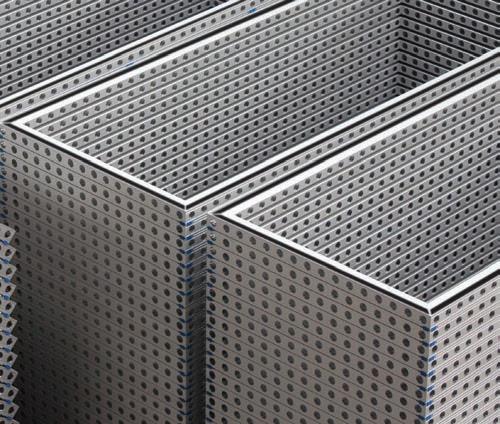
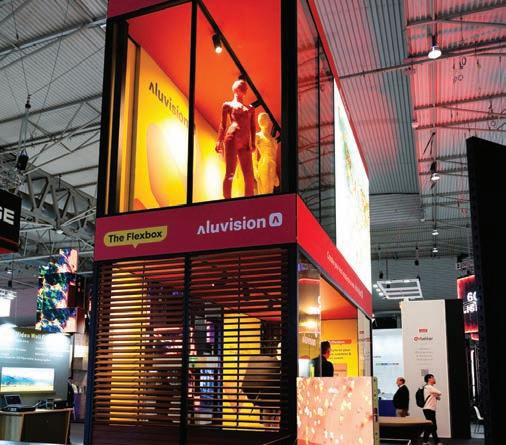
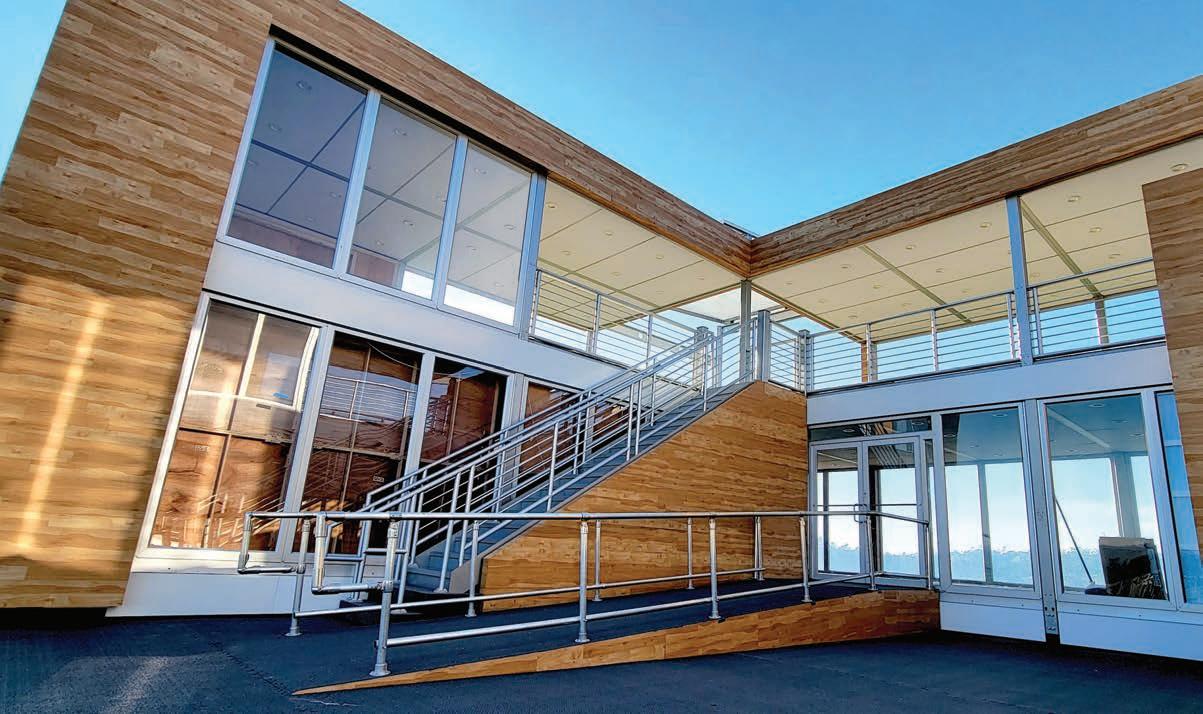
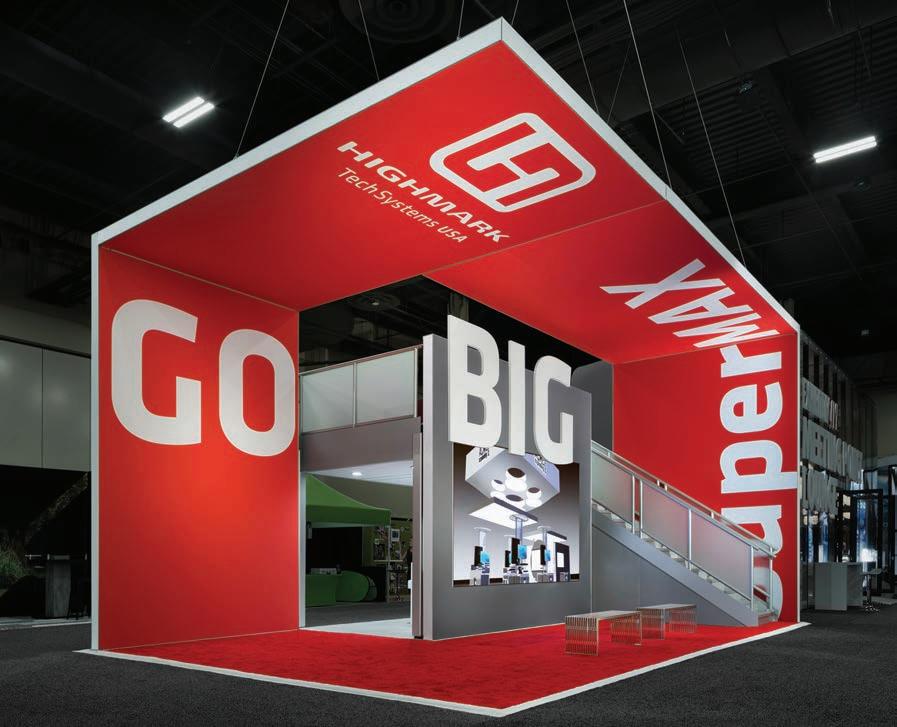
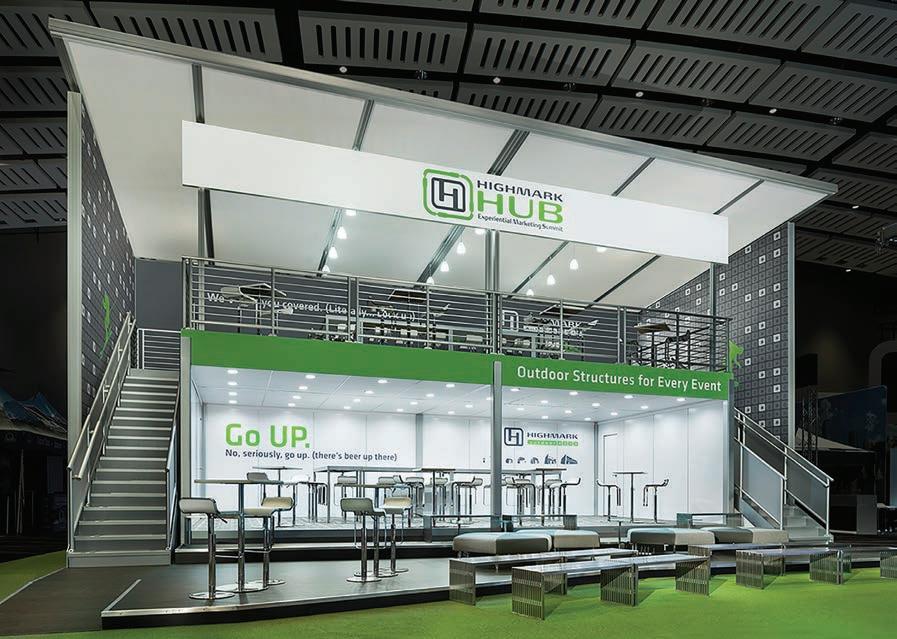
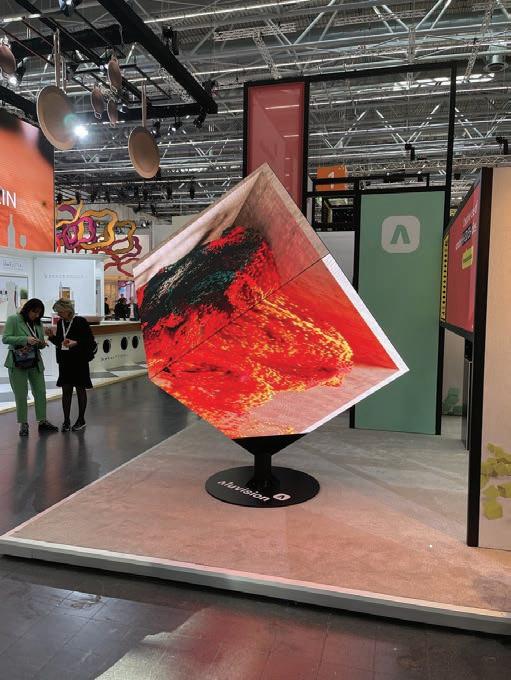
At Aluvision, we empower creativity without limits. Our mission is to turn ambitious visions into reality for exhibitors and event planners alike, ensuring every brand story shines brilliantly.
For you, this means high returns on your investment and access to the cutting-edge system of the future. Our modular designs blend artistic flair with engineering excellence to deliver unparalleled flexibility and impact.
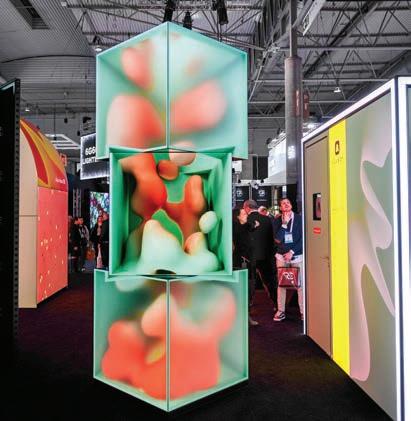
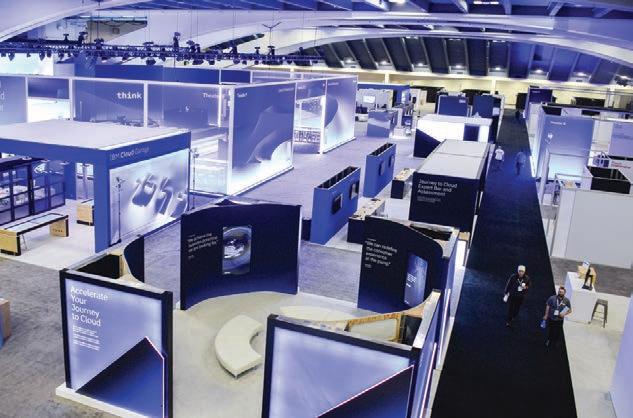
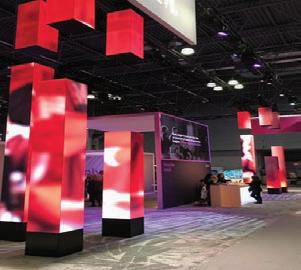
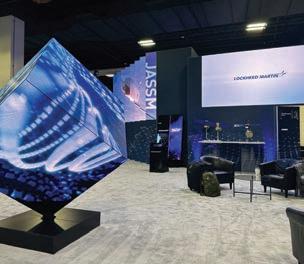
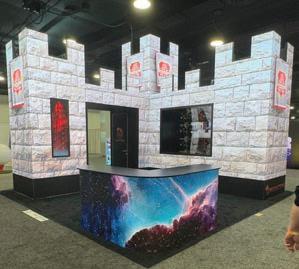
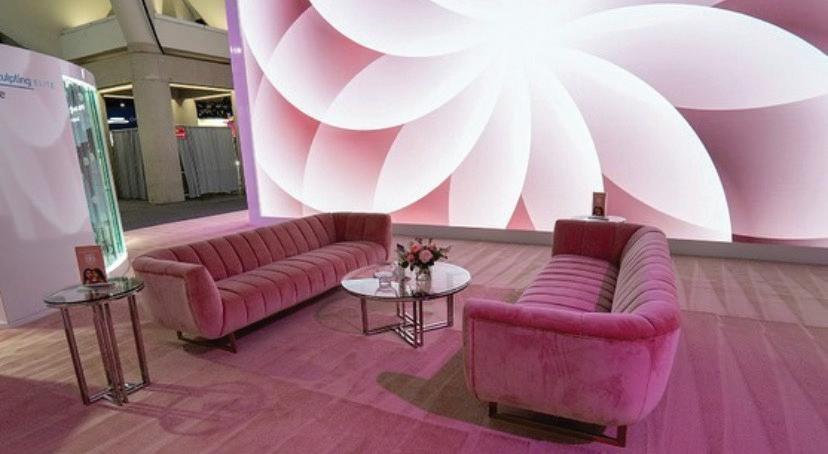
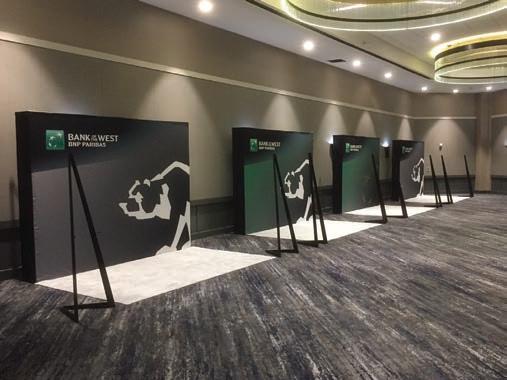
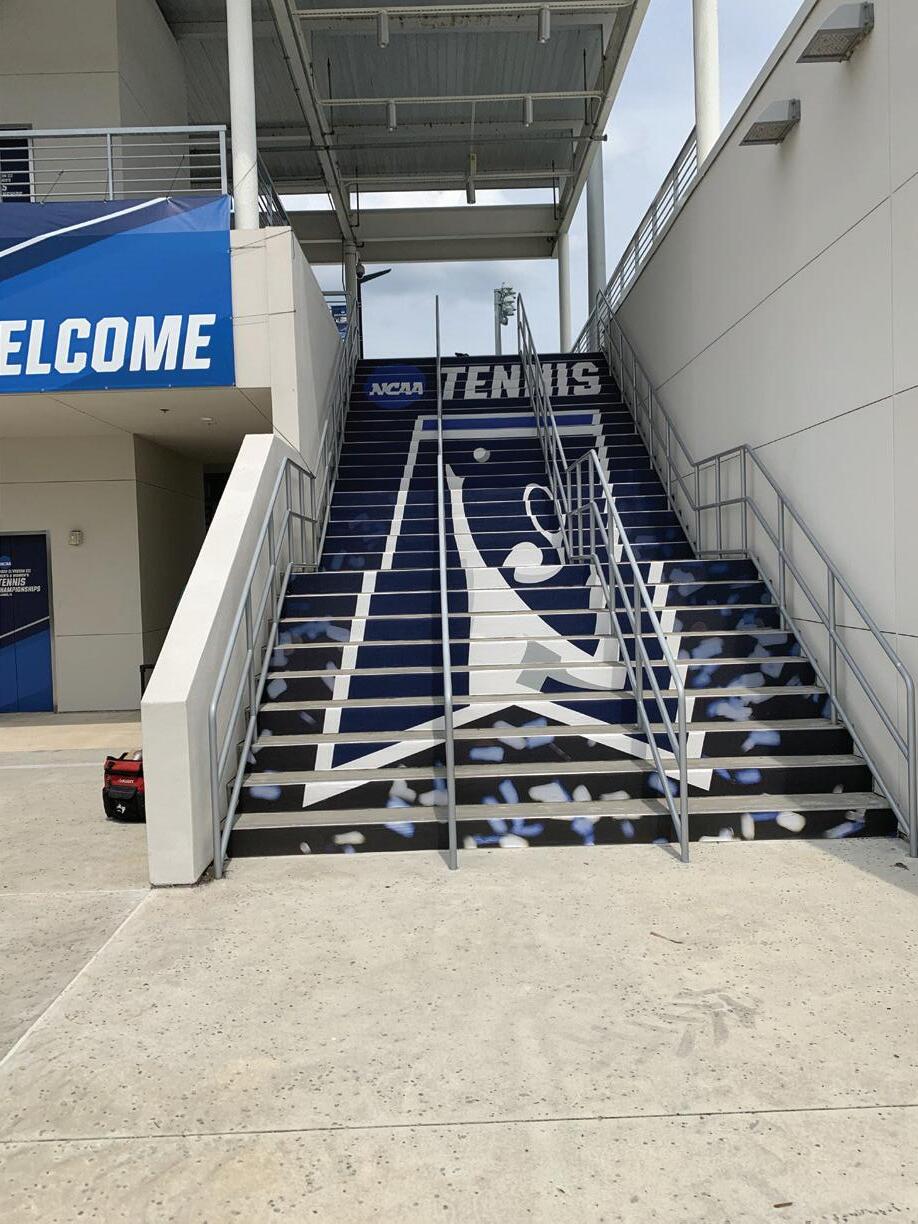
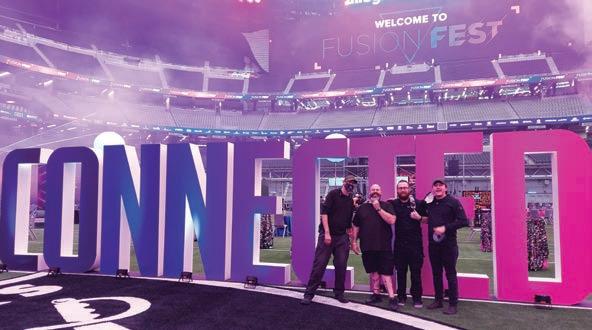
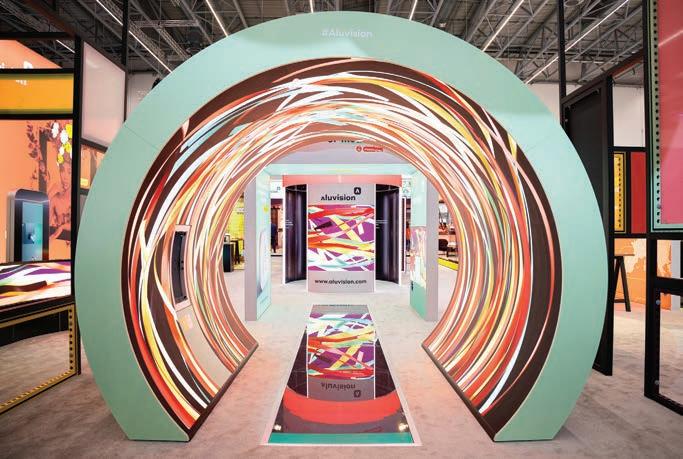
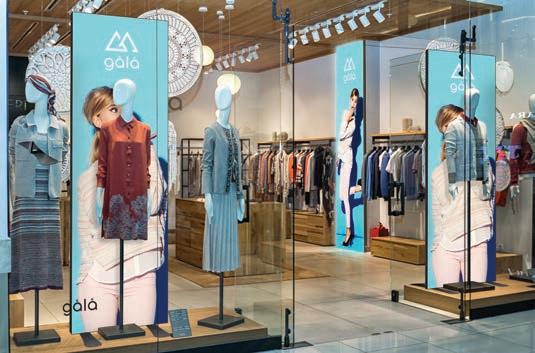
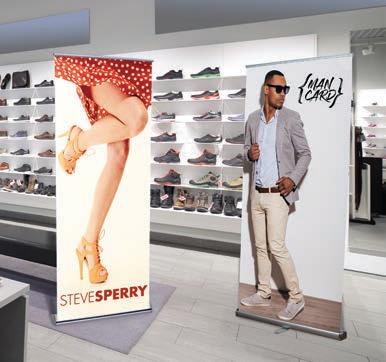
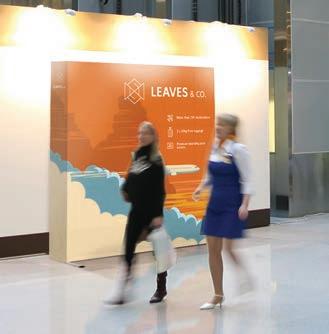
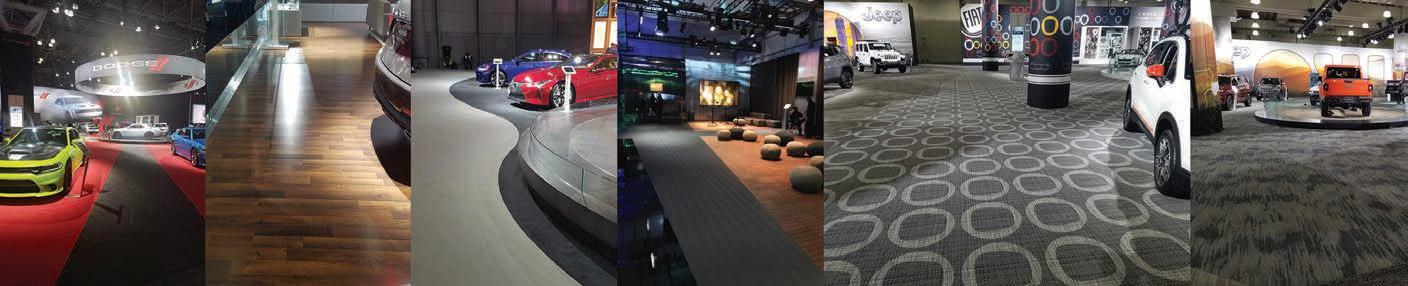
Whether it’s creating walls, towers, tunnels, hanging structures, lightboxes, or floors, we provide the perfect canvas for your immersive event space.
Create your next masterpiece with Aluvision.
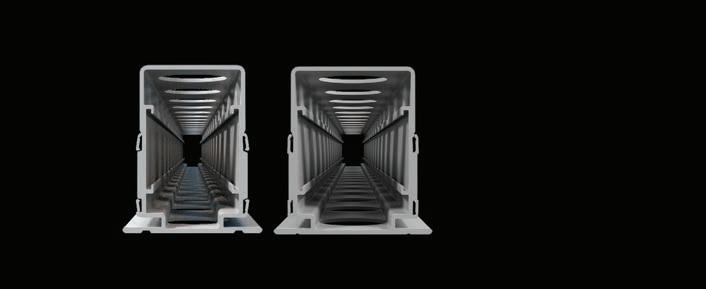
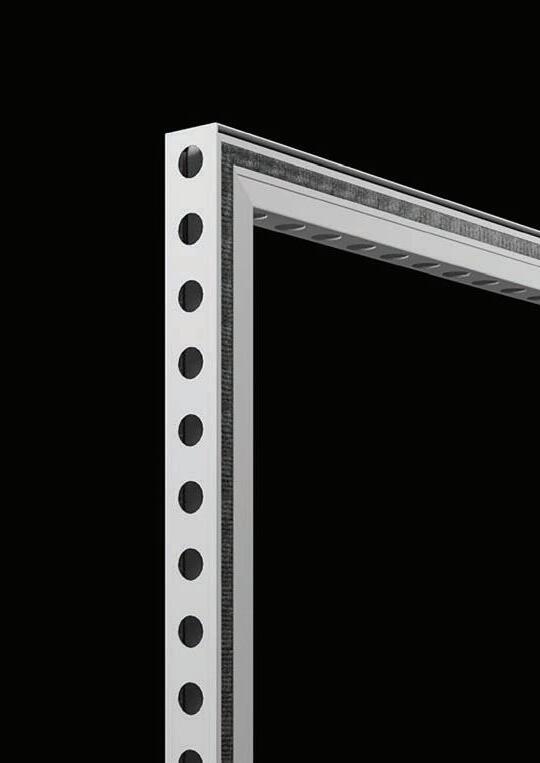
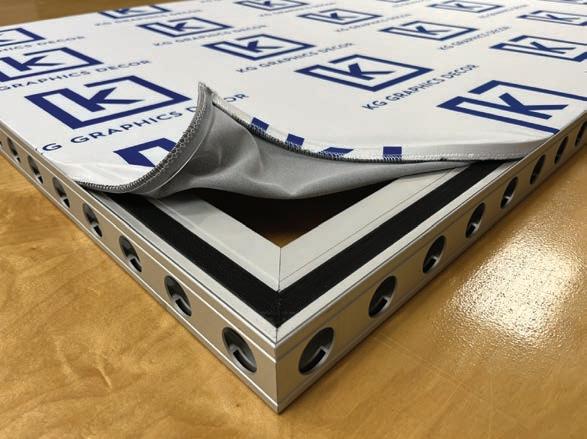
Equal high quality & precision compared to our ‘55’ range
Integrated Velcro® and SEG slot
Clean, anodized finish
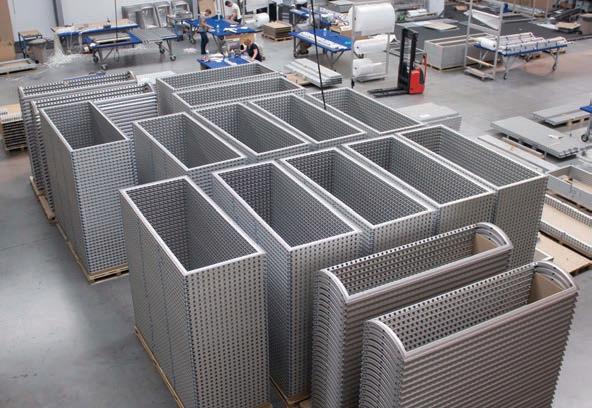
Curved and straight frames
Extended range of components
We want to set you up for success! Let's produce something great together.
Contact Us: Service@willwork.com
Family owned and operated
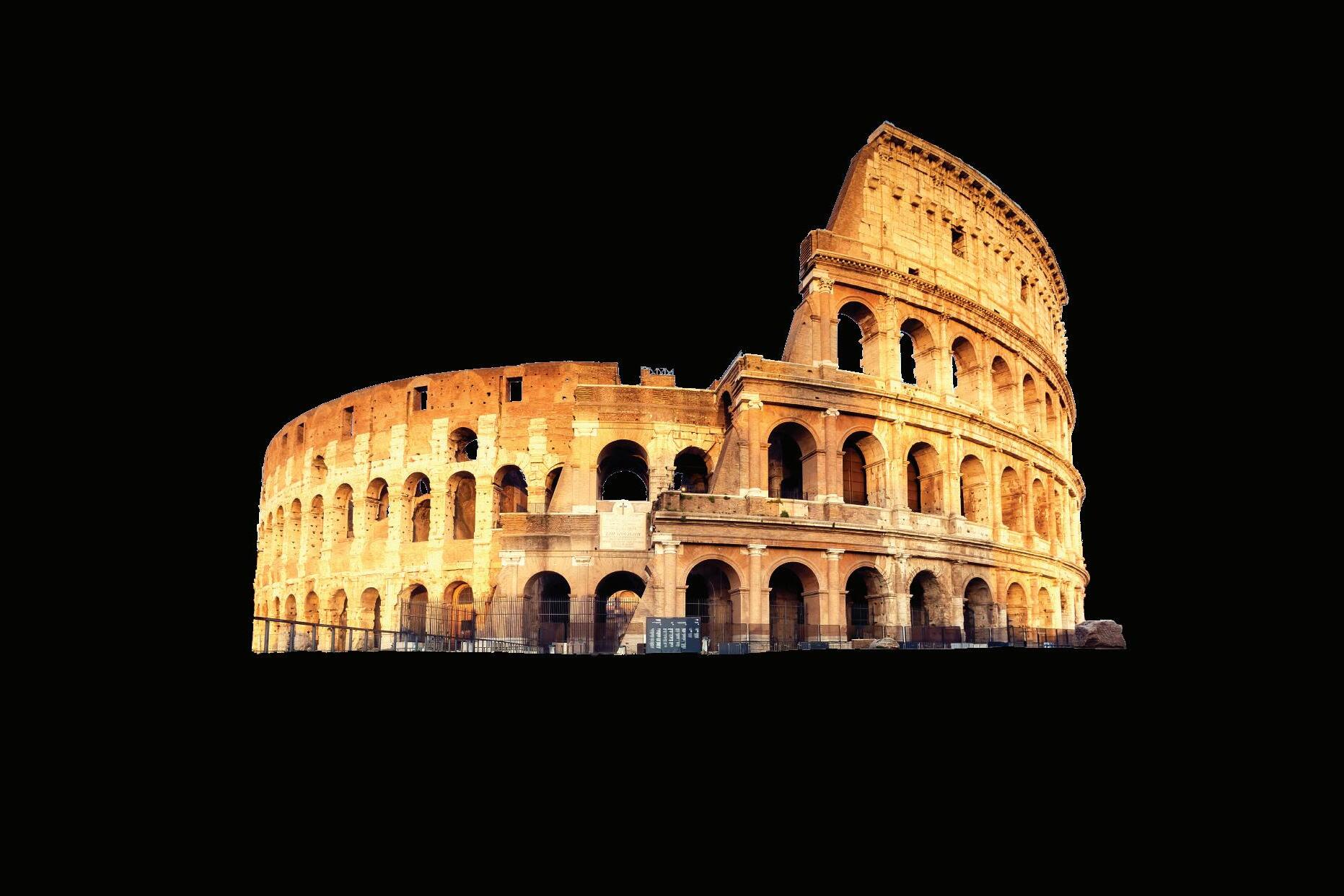
The Amount of Trade Show Carpet Waste Sent to Landfills, Could Fill the Roman Colosseum 1,148 Times Each Year.
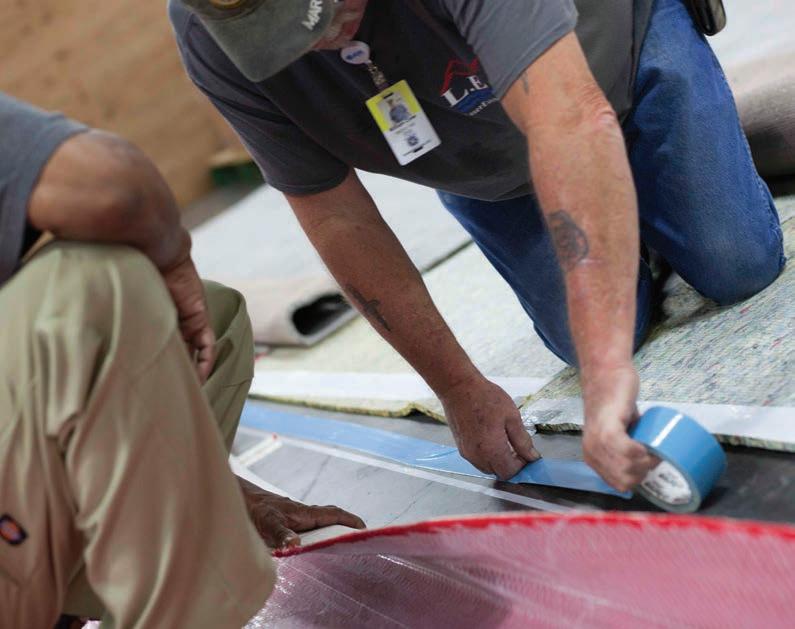
We Help Your Team Reduce Flooring Waste
Brumark's innovative recovery and recycling program diverts flooring material from landfills and contributes to the creation of recycled content, products, and alternative fuels. Use the code below to learn more about the processes and how much waste is reclaimed.
Let’s tackle this together.
Change is Inevitable. Responding to Change is Not
Talk to any person in the live events world, and the chatter around managing change is deafening. Infationary pressures, technological advancements, compressed project timelines, private equity infuences, worker shortages, vendor consolidation, reduced marketing budgets, and shifts in the marketing mix—are you dizzy yet? I am. This tidal wave of change is sweeping across the industry, reshaping business models in real-time. In this issue, we focus on how the world of warehousing and transportation is adapting to these new realities.
We tackle these obstacles throughout this issue. Our cover story, written by Chris Kappes, addresses Catalyst Exhibits and how they are maneuvering through the industry with new transportation considerations. Our writer Ray Smith addresses these considerations and many of the concerns of the freight and logistic companies across the nation.
ECN writer Mark Hebert ofers two insightful stories that are must-reads: AI, Real-Time Tracking, and Automation are Revolutionizing Tradeshow Logistics and Truck Driver Shortage Challenges Tradeshow Logistics. These pieces examine how innovations and ongoing challenges are transforming the backbone of live events.
And if you’re in the market for warehouse space, don’t miss Melissa Skipworth’s informative article, Looking for Optimal Warehouse Space? Two Turns Of the Freeway, Max.
We are also thrilled to introduce Tommy Goodwin, Vice President of the Exhibitions & Conferences Alliance, as a reg-
ular columnist. Tommy, a key fgure in our industry’s government and advocacy eforts, is dedicated to raising awareness about the economic and job-creating impacts of live business events among policymakers. His piece Decision 2025: What It Means for the Business Events Industry is essential reading as we head into an election year like no other.
For thirty years, Exhibit City News has been the go-to resource for industry news and insights. This issue is no different. We’re delighted to feature articles by industry leaders Pat Alacqua and Jane Gentry, who ofer valuable perspectives on navigating business growth—a diferent but equally important kind of change. Their insights are vital for anyone looking to thrive amid the shifting landscape. Our goal at ECN is to curate the most thoughtful and relevant content that you won’t fnd anywhere else. We are the voice of the industry, constantly listening, studying, and collaborating to bring you the information you need to succeed. Change is inevitable, but how we respond to it defnes our future. As the landscape of our industry shifts faster than ever before, staying ahead requires not just resilience but vision. Embrace the challenges, seize the opportunities, and let’s navigate this journey together.
Don Svehla, Publisher/Founder Questions? Suggestions? Comments about our content? We love feedback and hearing from you! Send me an email at dons@exhibitcitynews.com
PUBLISHER & FOUNDER
Donald V. Svehla Jr. (702) 272-0182 ext. 102 DonS@exhibitcitynews.com
Christopher "Chris" Kappes chrisk@exhibitcitynews.com
SR. BUSINESS DEVELOPMENT
Christy Giambattista ChristyD@exhibitcitynews.com
BUSINESS DEVELOPMENT
Taunya Mitchell TaunyaM@exhibitcitynews.com
SOCIAL MEDIA EXECUTIVE
Ashley Sou AshleyS@exhibitcitynews.com
COLUMNISTS
Pat Alacqua, Paco Collazo, Jane Gentry, Liz Lathan, Bob McGlincy, Jim Obermeyer
CONTRIBUTING WRITERS
Sven Bossu, Danelle Dodds, Thea Engst, Tommy Goodwin, Pat Friedlander, Bob McGlincy, Taubie Motlhabane, Jessica Sibila, Melissa Skipworth, Ray Hubble Smith
STAFF WRITERS
Chris Kappes, Mark Hebert, Kerstan Szczepanski
PROOFREADERS
Lisa Abrams, Thea Engst, Mark Hebert, Kerstan Szczepanski
CIRCULATION
Manny Chico Circulation@exhibitcitynews.com
Make Memories Worth Remembering
Hello readers. Fall is in the air. The leaves are changing their shades. For many, approaching the end of the year is about slowing down, bundling up and bracing for winter. However, for many of us, the Q4 season is the beginning of the sprint to the end of the year. Whether attending a variety of the large events in November and December, end of the year parties, new acquisitions or announcements of new partnerships, we are all racing towards 2025 at full speed.
Here at Exhibit City News, we are completing our Q4 edition, preparing to publish our 30-Year Anniversary Book, and crafting a whole host of additional (super-secret) projects for 2025. While I can’t reveal too much, I can hint at things like trophies, calendars, and digital innovations. But, of course, the future is always full of surprises!
As Lewis Carroll wrote in Through the Looking Glass, I have but a “poor sort of memory that only works backwards.” Let’s recap, shall we?
2024 has been a whirlwind. I started at Exhibit City News in November of 2023, and four magazines (plus our 30-Year Anniversary Book) later, I may not feel like a pro, but this industry feels like a home. A year ago, I started without a clue of the names, jargon, or companies. As ECN continues to expand and grow, I fnd myself training people and assuring them that while it all seems so overwhelming at
frst, it gets easier. The people who make tradeshows happen are always ready to support newcomers through the initial confusion, as I’ve discovered. The support network in this industry is strong and reliable.
I have seen a host of acquisitions across the industry, as well as new businesses being introduced or even renamed. Hundreds of people have moved to new jobs (congrats) and new events have sprung up. We have heard our voice, as an industry, represented in larger numbers on Capitol Hill. We have created a whole host of new podcasts and content series. And potentially, most importantly, a whole host of new trades people are being welcomed in, supported, and guided by the old guard who have stuck with this industry through thick and thin.
It is with much pride and excitement; I present our Quarter 4 issue of 2024.
Exhibit City News’ Quarter 4 issue is one of the familiar issues for our long-time readers and a staple of what makes ECN, well… ECN. As this is our Transportation and Warehousing issue, we have decided to dive deep into the topics that are affecting the people who get these exhibits to and from the convention centers.
Inside you will fnd stories about design, transportation considerations, and insights into labor. Our writers address topics concerning the industry: labor shortages, rising prices, competition in a
market that does not have much room for growth, technology, sustainability, and so much more.
We complete our Show Floor Etiquette series (pg. 36). We spotlight the city of San Francisco, its rich history and what it has to ofer the modern tradeshow. As always, we focus on those who make tradeshows happen: the people.
Whether you’re already ready for a vacation or just gearing up to an excellent fall and winter season, we at Exhibit City News support you. We will see you in the new year, with fresh ideas, new considerations for your design and tradeshows, and as always, a focus to remain true to the trade.
Whatever your plans may be, we wish you the best. Remember to stay warm as the chill of winter begins to form. And as always, we are in the business of cultivating experiences that are remembered, so don’t forget to enjoy yourself. Make memories worth remembering.
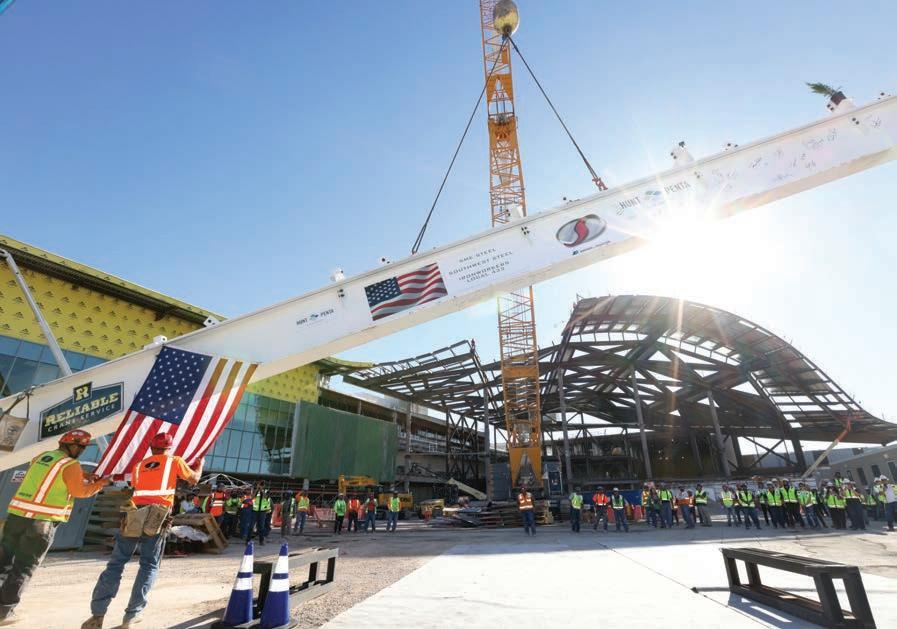
LVCVA TOPPING-OFF CEREMONY AND RENOVATIONS UPDATES
The Las Vegas Convention Center’s $600 million Phase III renovation hit a major milestone with a topping-of ceremony, marking the completion of the structural framework. The project, which began in 2023, aims to enhance architectural uniformity and improve facilities. Renovations include new lobbies, upgraded exhibit halls, and improved infrastructure, with work continuing through 2025 to keep pace with tradeshow schedules.
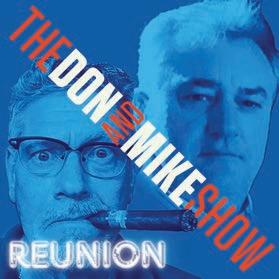
THE DON AND MIKE SHOW RETURNS
After a year-long hiatus, The Don and Mike Show is back, reigniting excitement in the tradeshow industry. Co-hosts Don Svehla and Mike Morrison revive the podcast to deliver fresh insights, vital updates, and engaging content twice a month. As a staple in the industry, the show promises to keep listeners informed and connected in a rapidly evolving landscape.
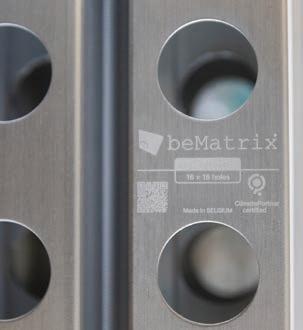
BEMATRIX® WINS TWO GREEN GOOD DESIGN™ AWARDS VAND CLIMATEPARTNER CERTIFICATION
beMatrix® has earned two Green
GOOD
DESIGN™ awards for its sustainable innovations: the ECO Frames and the Carbon Footprint Calculator. These awards coincide with the company achieving ClimatePartner Certifcation, highlighting its commitment to reducing carbon emissions. The ECO Frames, made from 78 percent recycled aluminum, eliminate harmful chemicals, while the Carbon Footprint Calculator helps clients minimize environmental impact, reinforcing beMatrix®’s leadership in eco-friendly exhibit solutions.
MARITZ ACQUIRES CONVENTION DATA SERVICES FROM FREEMAN
Maritz has expanded its presence in the events industry by acquiring Convention Data Services (CDS) from Freeman. This strategic move brings 200 CDS employees into Maritz over the next three years, strengthening Maritz’s capabilities in registration and lead management services. CEO David Peckinpaugh emphasizes that the acquisition will enhance client oferings and drive innovation, positioning Maritz for continued growth in the events sector.
ROOKIE ON THE EXHIBIT SHOW FLOOR, PART 4
The Blueprint for Excellence
New tradeshow workers face pressure, but success begins with solid communication, industry knowledge, and attention to safety. Robert Smith of the United Brotherhood of Carpenters ofers advice on building a strong foundation: ask questions, manage details, and stay fexible. Mastering these skills will help rookies excel on the tradeshow foor. For the full story see page 36
TWO TURNS OFF THE FREEWAY, MAX!
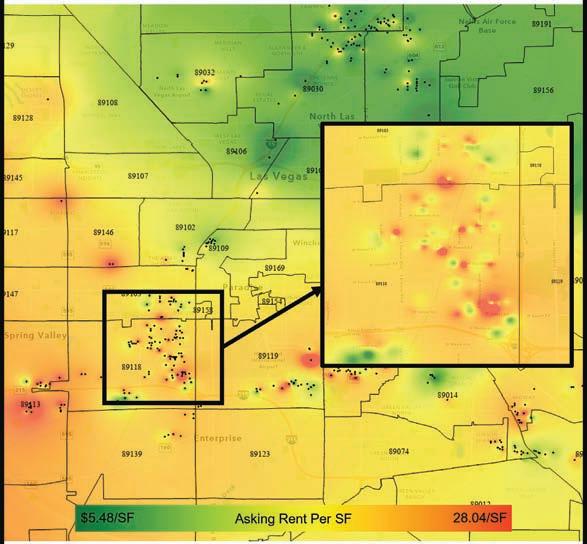
Finding the right warehouse space for tradeshow logistics can be challenging. Key factors include proximity to major transportation routes, parking, and modern infrastructure. Flexibility for growth and appropriate dock sizes are crucial. In Las Vegas, industrial spaces are modern, but prices are higher compared to Chicago and Orlando. Careful planning ensures efciency and cost savings. For the full story see page 42.
RISING COSTS FOR SHIPPING AND LOGISTICS
Freight costs are skyrocketing, while shipping rates have dropped, leaving small operators like Hank Duran struggling. Factors such as rising fuel costs, insurance, and a shortage of drivers make the industry tough to navigate. Larger frms dominate, but creative strategies and personal connections are key for survival in today’s challenging market. For the full story see page 70.
Kerstan Szczepanski
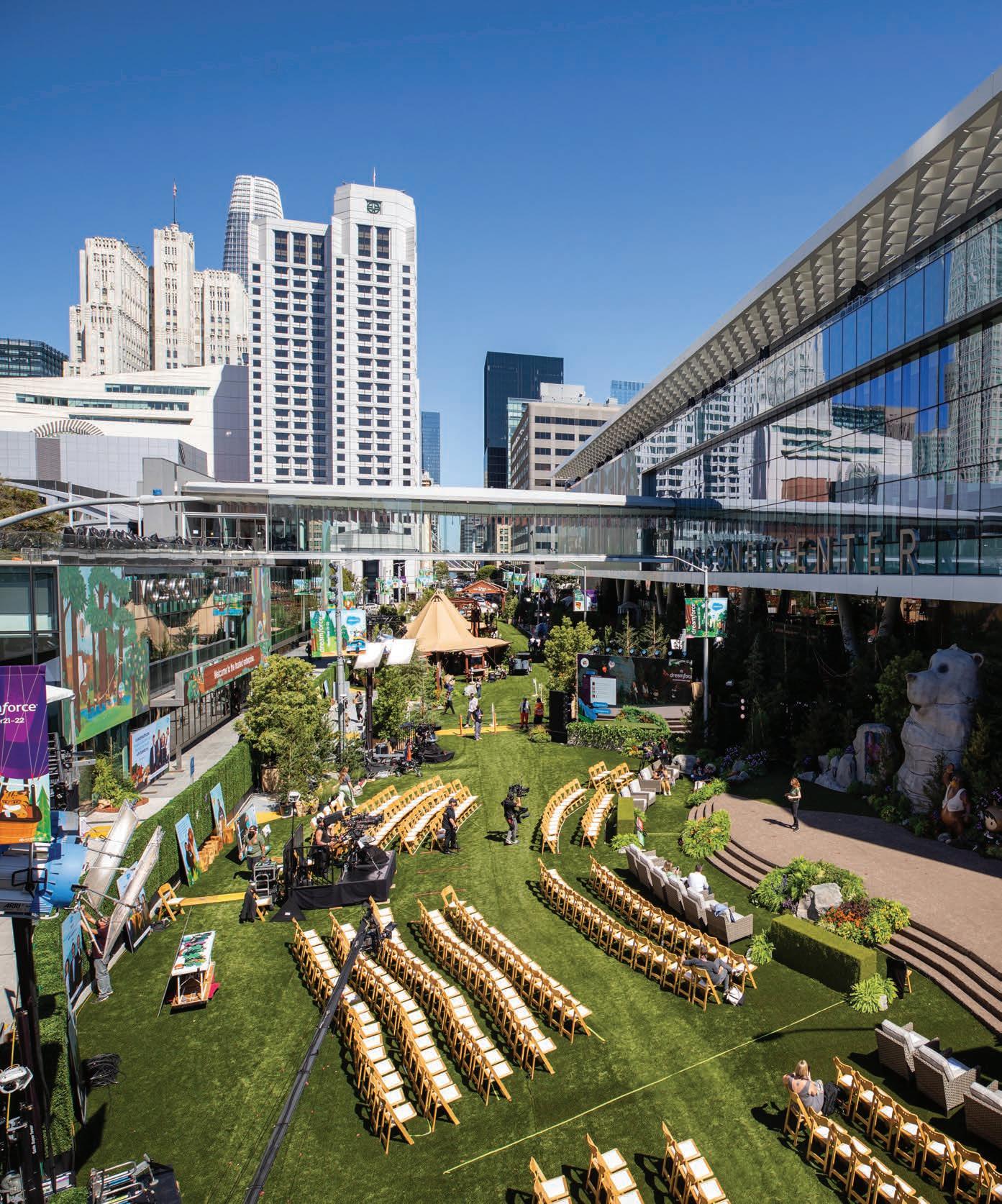
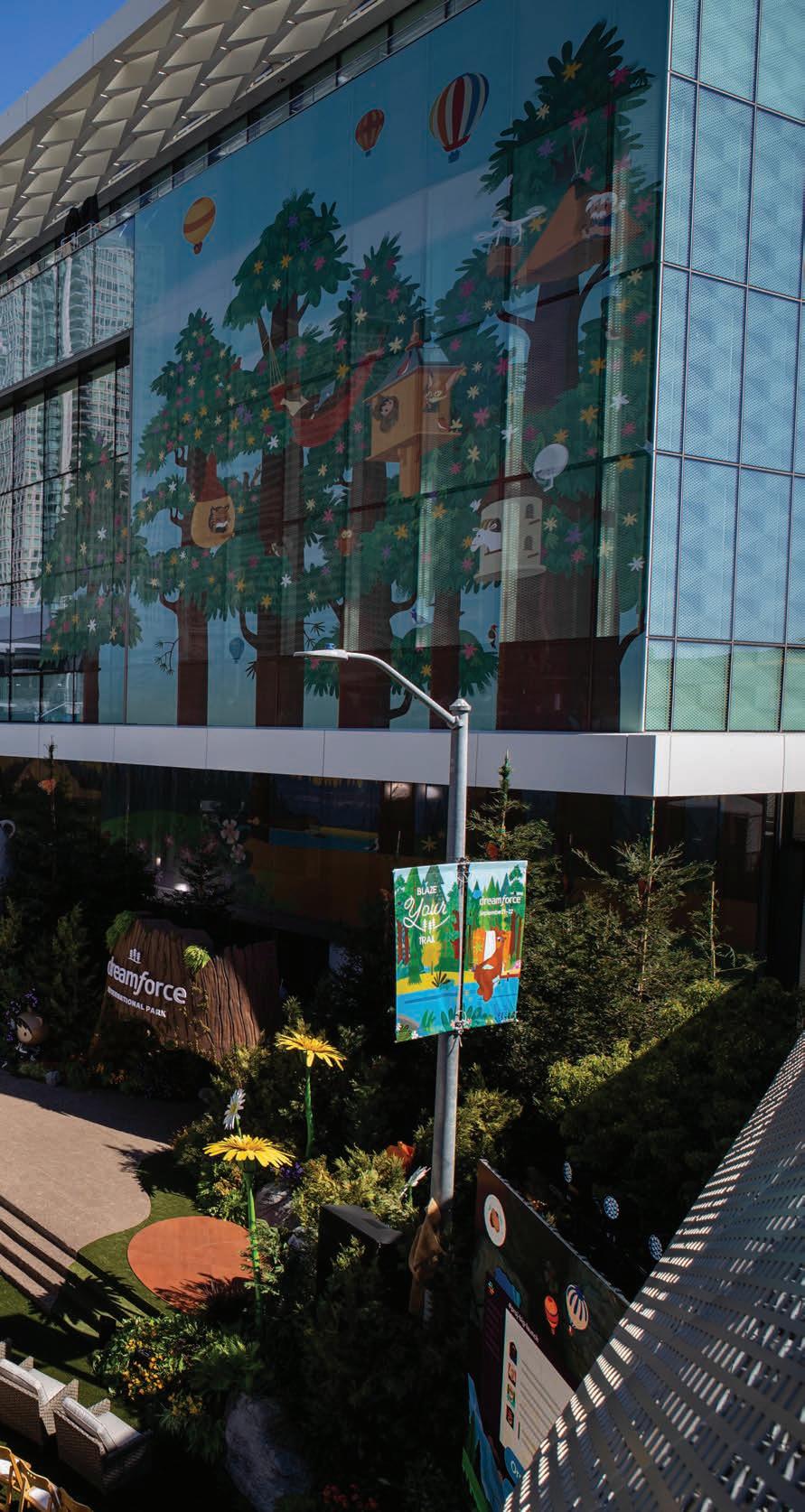
Photo courtesy of Salesforce, Inc.
Moscone Convention Center
Location: 747 Howard St, San Francisco, CA 94103
Date Opened: December 1981
Square Footage: The Moscone Convention Center ofers over 2 million square feet of total event space, including more than 500,000 square feet of exhibit space and over 100 meeting rooms. The venue includes three main halls: Moscone North, South, and West. Moscone West ofering an additional 181,000 square feet of meeting space across three levels.
Parking: Nearby public parking garages such as the Fifth & Mission Parking Garage. There is no dedicated parking at the center.
Hotels: The InterContinental San Francisco, Marriott Marquis, and Four Seasons San Francisco are within walking distance.
Airport Info: San Francisco International Airport (SFO) is about 13 miles south of the convention center, approximately a 20–30-minute drive.
Transport: Moscone Center is easily accessible via the Bay Area Rapid Transit (BART) system, with Powell and Montgomery stations nearby. Muni buses and light rail also serve the area. The center is located near Highway 101 and Interstate 80 for those driving into the city.
WiFi: Free basic WiFi throughout the convention center with the option for premium, paid upgrades.
Website: www.moscone.com
Where to eat, sleep & play in San Francisco p. 72
Three Spinning Plates
I’m writing this in mid-August, and we are already diving into the crazy-busy fall tradeshow and event season. I thought summer in the exhibit industry was supposed to be slow. Isn’t this supposed to be the time to go on vacation with the family, or hang out at the lake and relax in between the insanity of spring and fall show schedules? Isn’t this when we work to achieve the balance in life?
By Jim Obermeyer
take a break at all?
It’s not hard to get so caught up in the deadlines and pressures that you simply don’t take a break. While I really enjoy what I do, I also really enjoy my family, my friends, and my recreational time. The problem is in the balancing act.
Here are a few questions that may help put this whole balancing thing in perspective for you:
I have often likened balance to trying to keep three plates spinning in the air at the same time. On one plate is your career. On another are your family and friends. The third holds your hobbies, interests, and other extracurricular activities. If you neglect one for very long, it starts to fall, and you have to focus some attention on it to get it back in balance. Vacation is supposed to be the time when you put all three plates down to rest for a while and recharge your batteries.
When I was a kid, our parents did the big two-week driving vacation every year, like so many of that generation. It was their time to get away for two weeks and relax. In my career, I don’t think I have ever gone away for two full weeks and been completely disconnected from work. It just doesn’t work that way anymore, especially in this industry. We have to fgure out how to do it in shorter bursts. How do you take a break from plate spinning? Do you
1. What is it that you treasure?
Someone once said that “wherever your treasure is, there will your heart be also.” Basically, you are shaped by what you do, what you focus on. In some cases, this is pretty easy to see. If you are entirely focused on money, you may eventually be seen and remembered as being greedy. If you are solely focused on appearances, you may ultimately be seen as shallow. Ask yourself, what do you focus on? How do you think that refects on you?
2. How do you take the time you need?
I think it’s fair to say that there aren’t too many of us that can aford (either the time or the money) to take a full two-week vacation every year. Even if we could, I’m not sure it would be what we need anyway. I think shorter, more frequent escapes probably work better. The trick is scheduling them.
Let’s take this to an even deeper level. Do you fnd time each day to recharge? Both mentally and physically? What is it that helps you to recharge? Spending time with family, exercising, walking, sitting in a park at lunch? We each need to fnd a way to take that quick escape to recharge.
I’m a car guy. I walk car shows, cruise car lots, and enjoy driving. To me, a perfect escape is either taking of on a winding country road with the windows down and the radio up or spending the evening in my driveway detailing my vehicles.
My wife is diferent. She takes of and cruises through the malls. She rarely buys anything; she just window shops. It’s her escape.
It’s not as much about a specifc event as it is about a way of life. Developing a method by which to intermittently recharge to achieve balance is essential to balance. It’s the “trickle charge” method.
3. Why is this whole “balance in life” thing so important?
Simply put, it reminds us of what’s important in life. It helps to clear our perspective. I think it keeps us healthy — mentally and physically. You know the saying: “No one ever lays on their deathbed wishing they had spent more time at work.”
Stop with the overworked, overstressed, overtime lifestyle! By all means, do your work, enjoy your work, but mix in a few minutes of balance each day. I’ll bet you’ll still get everything done, and you’ll enjoy life even more. The plates will all stay spinning.
See you on the show foor.
Jim Obermeyer has been in the exhibits and events industry for over 40 years, both as a corporate trade show manager and exhibit house owner. He can be reached at jobermeyer903@gmail.com
The Largest Annual Tradeshow in the United States
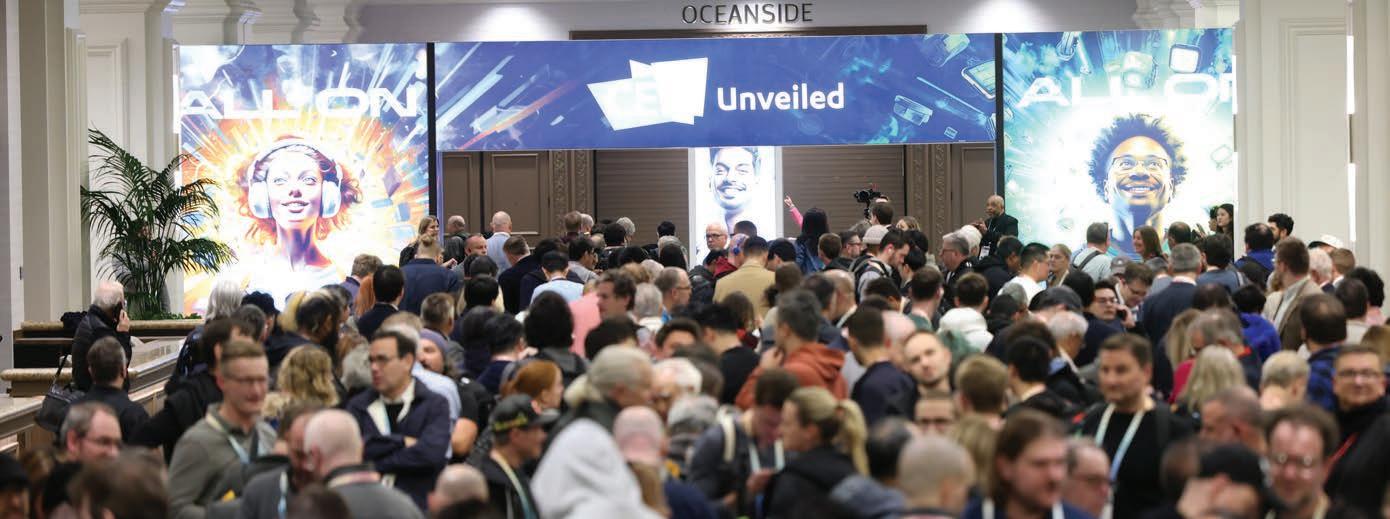
The Consumer Electronics Show (CES) is a cutting-edge technology event that brings next-generation ideas and products to the exhibit foor. It allows industry professionals to see, touch, compare—and sometimes even use—the newest and coolest gadgets. It allows retailers and vendors to make deals and order items six-to-nine months in advance of the holiday buying season.
By Bob McGlincy
number of international exhibitors and their “booth babes.” Some of the early exhibitors included LG, Motorola, and Phillips. Sony joined the show foor in 1971 when the show relocated to Chicago. It expanded to three hotels in New York, before moving to Chicago in 1971. The show attracted 40,000 attendees in 1972 and by 1977, the show attracted 50,000 attendees and had 700 exhibitors.
radio, computer tablets, and notebooks. A few automobile brands were present of the show foor as early as the late 1990s, but car technology did not take of at CES until the 21st century. Self-driving cars were present in 2014, with electric vehicles appearing in 2016.
Some of the attractions on the show foor in 2024 were:
» A 4K-wireless, transparent TV from LG.
CES 2024 was one of the largest tech shows in the world, as well as the largest tradeshow in the States. In January of 2024, it displayed products in over 2.5 million square feet of exhibit space, hosted more than 4,300 exhibiting companies, and attracted over 135,000 attendees—including the most international attendees at this show in its 57year history. With a record 1,400 new start-ups, and over 300 of the Fortune 500 companies represented, it was the place to see, be seen, and to do business.
CES attracts massive crowds, showcases cutting-edge technology, and displays breathtaking, museum-quality, brand architecture. But that wasn’t always the case.
The show started in 1967 as a spinof from the Chicago Music Show. Located in two separate New York City hotels, the frst show hosted approximately 100 exhibitors and attracted 17,500 attendees. For the frst decade, the show was dominated by the music industry and was unique for the
A second event, called The Winter Show, opened in Las Vegas in 1978 with a half million net square feet of exhibit space. In 1984, CES attracted over 100,000 attendees at each of their shows, both the summer and winter events. Between 1994 and 1997, CES experimented with shows in six diferent cities—Chicago, Las Vegas, Mexico City, Philadelphia, Atlanta, and Dallas — before settling on one show a year. That show was in Las Vegas. In 1997, the show broke the million square foot barrier, and has never looked back.
Some products debuting at those shows in the early years were: VCRs in 1970, Pong in 1975, Atari in 1979, CDs in 1981, Commodore 64 in 1982, Amiga (the frst “home computer”) in 1984, and Nintendo in 1985. The John Madden video game appeared in the early ’90s. DVDs premiered in 1996, HDTV in 1998, Xbox in 2001, and Blu-ray discs in 2004. Other items showcased on the exhibit foor over the years included satellite
» A prototype flying car from Xpeng Aeroht.
» A 22-ton autonomous tractor from John Deere.
» Robots, hydrogen cars, electric vehicles, healthcare tech wearables.
» A super dehumidifier producing 120 gallons of water a day.
» Compact solar-powered emergency generators.
» A pedal desk capable of charging cell phone and other devices.
» Designer glasses that aid the hearing impaired.
» Exquisite designs and interactive exhibits from myriad display houses.
Each January, CES showcases present day technology demonstrating future possibilities. This show is one more example of how and why tradeshows work—they work very well.
Willwork creates labor and technology solutions for experiential marketing applications, including tradeshow exhibits, corporate events, brand activations, and themed retail environments. Bob McGlincy is director, business management. He can be reached at Bob.McGlincy@willwork.com
Transforming Spaces.
WHERE INNOVATION MEETS ACTIVATION.
We are the architects of unforgettable moments that power meaningful connections between brands and their audiences using AV and LED technology. With a focus on innovation, we seamlessly blend cutting-edge equipment, heartfelt storytelling, and a touch of production magic to elevate your vision and leave a lasting impression. Let's craft extraordinary experiences together!
Global Price Disparities in the Stand Building Industry A Guide for the American Market
The design and production industry, a vital part of the global events sector, is marked by signifcant price variations across diferent regions of the world.
For American companies looking to expand their reach, attract new markets, and fnd new customers, one easy solution is to exhibit in other parts of the world. It is important that they know:
» 1. There are top quality suppliers in all parts of the world.
» 2. It is cheaper to exhibit in other countries than in the U.S. This can make exhibiting and promoting in other countries worth the investment.
Why is the US more expensive? Labor & Venue Obliged Services
Below is a chart created to give an idea of what it would cost to design this booth around the globe.
Asking friends from nine countries, the chart was made by obtaining quotes for the same booth using local materials (wood, frames, fabric, vinyl, etc.). These numbers were provided with the assistance of SISTEXPO, Stevens Exhibits, Elevation 3D, Grupo de Eventos, Creative Ideas Global, Diper, Cialona and AEM Production.
The following costs do not take into consideration tax or general services attached to them (such as electricity, rig-
ging, etc.) because it depends on the country, event, venue, and event organizer.
PLACE
Toronto
Las Vegas
Sao Paulo
Hong Kong
Shanghai
Argentina
Amsterdam
Milan
Mexico
By Paco Collazo
USD
$58,361
$100,000
$10,800
$26,935
$12,826
$11,253
$29,894
$19,861
$21,600
Factors Infuencing Global Price Diferences
Labor Costs
Labor is one of the most signifcant contributors to the price diferences. In regions like Asia and Eastern Europe, labor costs are relatively low, which allows companies to ofer booth building services at more competitive prices. In contrast, Western Europe and North America, where labor is more expensive, tend to have higher overall costs. This diference can make a substantial impact on the total project budget, particularly for large-scale booths.
Material Costs and Availability
The availability and cost of materials also play a crucial role in determining prices. In regions where materials such as wood, metal, and specialized fabrics are abundant, costs are generally lower. However, in areas where
these materials are scarce or need to be imported, prices can increase signifcantly. Furthermore, the growing demand for sustainable materials in some markets, especially in Europe, can add to the cost, as eco-friendly options are often more expensive.
Local Regulations and Compliance
Local regulations, including safety standards and environmental laws, vary widely from one country to another. In regions with strict regulations, such as Germany, the cost of compliance can add signifcantly to the price of stand construction. These regulations often require more detailed planning, higher-quality materials, and rigorous testing, all of which contribute to the overall cost. Conversely, regions with more lenient regulations may ofer lower prices but may require additional oversight to ensure they meet international standards.
Market Demand and Economic Environment
The economic climate and market demand in a given region also infuence prices. In highly developed markets with a strong demand for exhibitions, such as major cities in the U.S. and Europe, stand builders can command
higher prices. In emerging markets, where the industry is still growing, prices tend to be lower as companies compete for business. This can provide opportunities for cost savings but may also come with tradeofs in terms of experience and available resources.
Acknowledgments
We would like to extend our sincere thanks to all the companies who helped provide the data and insights necessary to accurately refect costs in each region. Their contributions have been invaluable in ensuring the accuracy of the information presented in this article.
Kyle Palm Senior Network Specialist
WE ENSURE YOUR TRADE SHOW SUCCESS! IT’S THAT SIMPLE.
As a unique Las Vegas based carrier, we are dedicated to one thing - trade shows . With over 30 years of experience we are highly trained, skilled and focused on providing you with flawless service handling your exhibit materials in and out of Las Vegas convention venues.
What makes us so great?
› 24/7 nationwide service - year round
› Warehousing & exhibit crate repair
› Customized account management
› Show-to-show coordination
› On site show floor representation
› Over 100,000 sq. ft. of booth storage
› Certified weight tickets/on-site truck scale
› Pad wrapping & color-coded show labels
› More than 100 vans, tractors & trailers solely serving the Las Vegas market
Proud member of
What Happened to the Noise of Live Events?
In the live event business, we love noise. But have you noticed it’s getting quieter?
by Chris Kappes
The familiar buzz of saws, CNC machines, and pneumatic hammers crafting exhibits has become increasingly rare in tradeshow design and build agencies today. That production noise used to be a telltale sign that money was being made in “the shop,” sparking high-fves and smiles all around.
As I walk through various agencies, the once-bustling production facilities have grown eerily quiet. The exhibit design and build business has shifted from the bespoke creation of custom exhibit solutions to the assembly of aluminum systems covered with SEG tension fabric and packaged rental exhibits. Owners suggest that business is generally good—maybe not quite as good as 2019—but still better than it was. The money being made is green, but it’s a different shade, reflecting a dynamic reallocation of marketing budgets, unprecedented inflation, shorter lead times, and growing environmental concerns.
Today’s Reality
Over the past decade, the percentage of revenue allocated to B2B marketing budgets has shifted from traditional channels like print
and direct mail to digital marketing and technologies. While COVID-19 was a curse, it also served as a stark reminder that nothing compares to meeting face-to-face. You may purchase commodity items online, but when it comes to non-commodity products or services, selling at live events is where the real action is.
Even though B2B companies allocate 10 to 11 percent of revenue to marketing, these dollars are spread across more competing channels than ever before. The funds set aside for live events simply can’t support the heyday of exhibiting. Infation’s impact has been dramatic, as shown by the comparison of costs from 2013 to 2023:
» Booth space rental: up 42%
» Exhibit design and build: up 66%
» Shipping and drayage: up 50%
» On-site services: up 31%
» Travel and accommodations: up 46%
» Marketing and promotion: up 50%
Working In A McDonald’s World
We’re all addicted to speed—not the drug, but the expectation that when you place an order, it’s delivered post-haste. Decisions on what and how to exhibit are notoriously last-minute, driven by new product introductions, competitive pressure, and other factors. Four weeks is now considered a luxury. As a result, the designer and
producer community has had to adapt its business model to respond with “just-in-time” systems and kit solutions that can be pulled from inventory, cleaned, assembled and deployed. When you add the necessity of speed to infationary cost pressures, something’s got to give—and that something is the exhibit design aesthetic. Walk any live event today, and homogeneous exhibits are the norm, not the exception. It’s not a criticism, it’s a solution driven by the business’ evolution.
Environmental Pressures
Exhibitors and organizers are increasingly focusing on sustainable practices to reduce their environmental footprint. This includes adopting eco-friendly exhibit materials, reducing single-use plastics, and implementing recycling programs.
The Exhibit Designers and Producers Association (EDPA) has launched the Net Zero Carbon Events Initiative to bring together organizations across the industry— from venues to organizers to exhibitors and more—to drive the events sector toward net zero carbon emissions. As referenced on the EDPA website, the goals of this collaboration, hosted by The Joint Meetings Industry Council (JMIC), are: » Jointly communicate our industry’s commitment to tackling climate change and driving toward net zero by 2050.
» Develop common methodologies for measuring the industry’s direct, indirect, and supply chain greenhouse gas emissions.
» Construct an industry-wide roadmap toward net zero by 2050, and emissions reductions by 2030 in line with the Paris Agreement, with support and guidance on key issues.
» Foster collaboration with suppliers and customers to ensure alignment and common approaches.
» Establish common mechanisms for reporting progress and sharing best practices.
For more information and to learn about EDPA’s recycling program with return polymers, visit their sustainability tab on its website.
A Quiet Revolution
The noise of live events may have softened, but beneath the quiet, a revolution is taking place. The evolution from custom craftsmanship to streamlined assembly, from opulent designs to sustainable solutions, refects the broader changes in our world. In the silence of the workshop, we fnd innovation. In the hum of uniformity, we discover efciency. As the industry continues to adapt, one thing remains clear: the spirit of live events—connecting people, brands, and ideas—is very much alive.
The noise may have changed, but the impact resonates louder than ever.
Late Merch? No Problem What to do Instead of Panic
By Liz Lathan
Picture this: You’ve completed the setup of your booth on time. Early, in fact, and feeling good. You’re just waiting on the boxes that contain all of your merch to show up. Your booth is actually a merch store, making the jerseys, hats, and T-shirts vital to the experience.
An hour to show time. No merch. You check with the show team. “It’s on the truck. We just can’t get a hold of the driver.”
Thirty minutes to show time. No merch. “We know it’s on the truck. They said the driver left the warehouse an hour ago.”
Ten minutes to show time. No merch. “We’re not sure.” Doors. No merch.
The crowd streams in. You have a beautiful, empty booth. What do you do?
This happened to me at a show last fall representing a professional women’s fastpitch softball team. We didn’t have a plan for it. But we did have a portable speaker and four professional players in the booth.
Rather than wallow in despair, we turned on some tunes, put the players in the empty area of the booth, and invited passersby to come meet the team. We turned on
our crowd-gathering charm and created an atmosphere that felt inviting, fun, and crowded enough for no one to notice that the booth was empty of merch.
About two hours into the show, our merch showed up. We could have sold a lot more had it arrived on time, but we still made an impression, and our fans had a great experience.
The takeaway of this experience is: Things happen. It’s okay. Don’t panic.
When it comes to getting your things, put the general contracting team on highalert. Have someone reminding them every five minutes that you still don’t have your stuff. While this seems like overkill, they are busy and if they don’t hear from you, they will assume everything is fine. Be personable, not angry. They are much less likely to help you if you’re yelling at them.
Now for that empty booth. Standing around, looking stressed, and ignoring the crowd is not a good look for you or your company. Gather up your staf and stand tall! Look around to see what resources you can pull together to still have a presence while you wait for your materials to arrive.
Here are 10 ideas on what to do in an empty booth:
» 1. Got a trashcan in your booth? Run to the business center and grab some printer paper and some markers. Put the trash can at one end of the booth and the stack of paper on the other. Ask attendees to write their greatest challenge on one and try to throw it into the trash can! (Keep those challenges and use them as insights later!)
» 2. Got digital content? Print up a QR code at the business center and have it ready for people to access!
» 3. Got a portable speaker? Crank up the tunes and host a lip-syncing competition amongst your staff! Invite others to join!
» 4. Run to the back and grab some cardboard and markers. Write a pithy saying on the cardboard and hold it up! (“Booths are overrated! Our company is not!” “Will work for SQLs” “Free hugs!” )
» 5. Got a cocktail table and two stools but nothing else? Put it in the center of your empty space, grab a piece of cardboard and make a sign like Lucy from Peanuts that says “The [insert industry] doctor is in! Advice 5 cents!”
» 6. Make a quick trip to a local store and buy a pile of children’s books and some markers. Invite attendees to write words of encouragement in the front of the books and donate them to a local
children’s hospital at the end of the event.
» 7. Got a curtain and a draped 6-foot table and nothing else? Run to the office supply store and buy paper, markers, and binder clips and invite attendees to write one thing that would make their job easier and hang them up on the curtain in the booth (keep these for insights!)
» 8. Make a sign that welcomes people to the booth, asks a thought provoking question, or is a statement that draws the eye.
» 9. Get out your smartphone, turn on the stopwatch, and invite 10 people into your booth for 90-second networking. In 90 seconds, they all have to meet each other and tell someone one thing that they hope to learn or find at the event.
» 10. Run to the nearest store and buy a bunch of rugs and throw pillows. Make a cozy floor living room and post a schedule of “Cushion Conversations” or “Rug Roundtables” or “Throw Pillow Think Tanks”!
See? All is not lost—even if your merch is. In fact, you might just fnd that your booth is even more successful than it ever would have been with all your stuf there!
Liz Lathan, CMP, runs a community for corporate event professionals.
AIRPORT
SNAPSHOT by Kerstan Szczepanski
San Francisco International Airport
Airport Code: SFO
Location: San Francisco, CA 94128
Date Opened: May 7, 1927
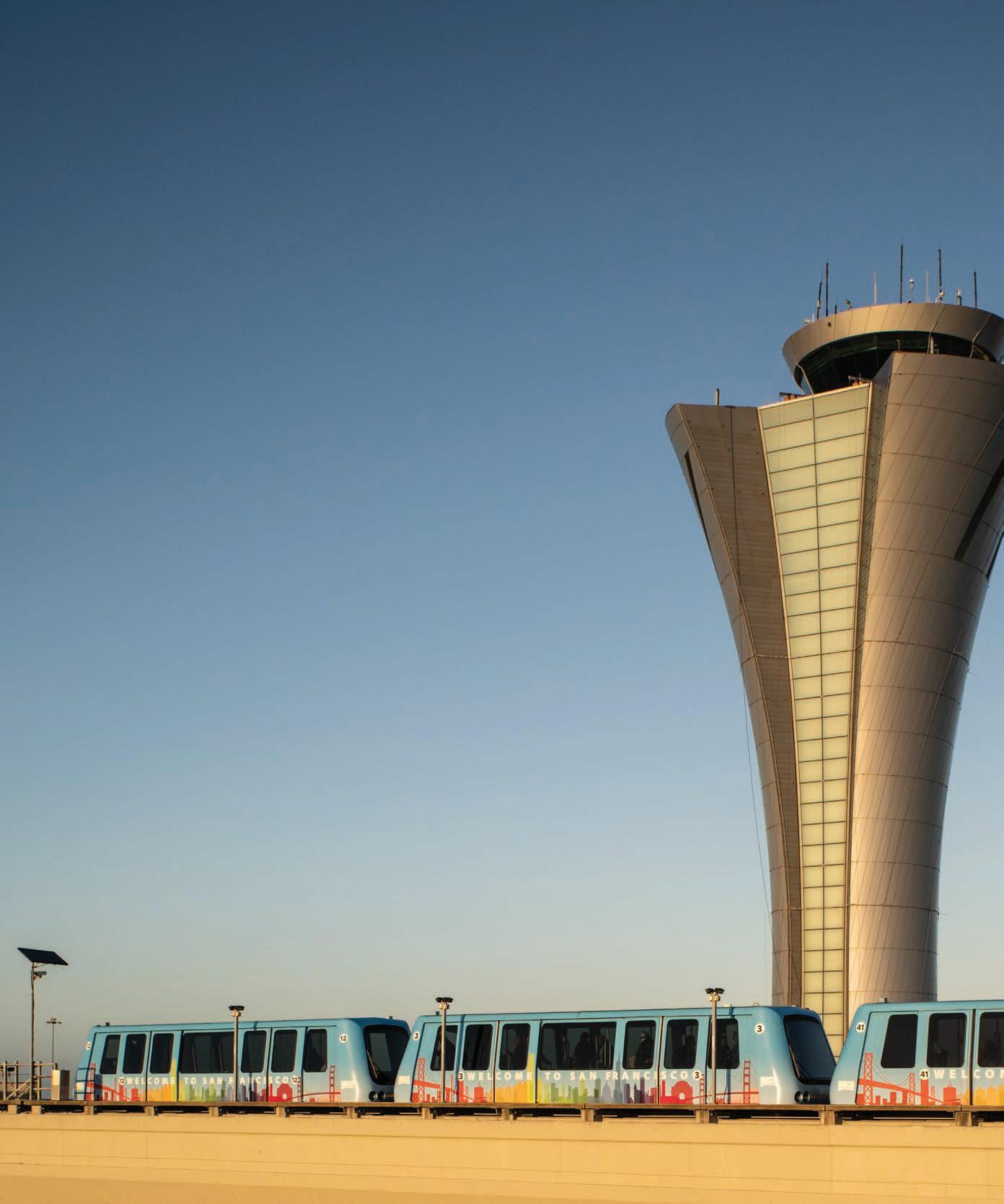
Size: Covering 5,207 acres, San Francisco International Airport (SFO) features four terminals and seven concourses with 120 gates. The four runways range from 7,500 to 11,870 feet in length. It serves as a major hub for international travel on the West Coast.
Transportation: SFO is accessible via U.S. Highway 101. The Bay Area Rapid Transit (BART) system has a station at the International Terminal, providing direct access to downtown San Francisco, the East Bay, and beyond. Shuttle services, busses, taxis, and rideshare options like Uber and Lyft are readily available.
On-site Facilities: SFO ofers free WiFi throughout the terminals, numerous charging stations, yoga rooms, and pet relief areas. There are over 100 restaurants and retail shops, as well as art exhibitions throughout the airport. SFO also features an aviation museum and library, a Berman Refection Room for quiet meditation, and a medical clinic.
Fun Fact 1: SFO’s International Terminal is the largest international terminal in North America, featuring an expansive, light-flled design.
Fun Fact 2: The airport’s SFO Museum was the frst of its kind to be located in an international airport and features rotating exhibits year-round.
Website: www.fysfo.com
Photo by Karl Nielsen
Presidential Debate Logistics in Philadelphia
CorpEvents NE Partners with Aces Convention Services
by Mark Hebert
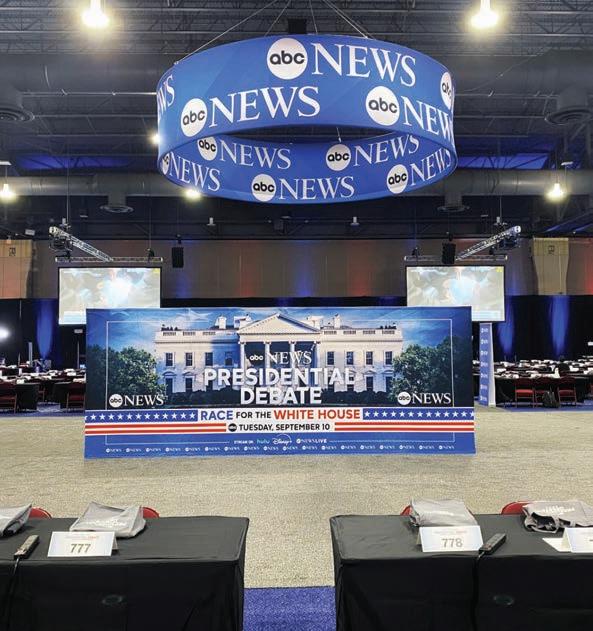
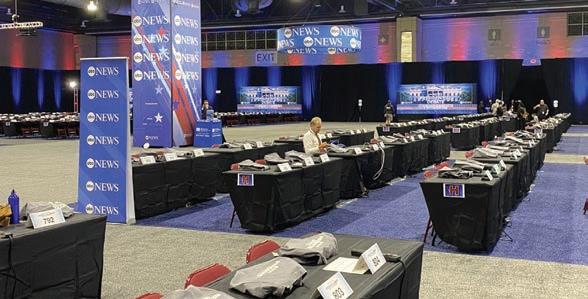
CorpEvents New England (NE), a Massachusetts-based event management company, played a crucial role in September’s highly anticipated presidential debate in Philadelphia. Led by President Bob Dobinski, the company was contracted to manage key elements of the event’s logistical setup, partnering with American Convention Exhibitor Service (ACES) to tackle the vast 80,000 square feet in Hall B of the Philadelphia Convention Center, where press and pundits gathered for the spin room.
Michael McGuckin, President of ACES, highlighted the strength of the partnership:
“Over the last 20 years, American Convention Exhibitor Service (ACES) has cultivated a unique strategic partnership with CorpEvents NE, delivering unparalleled customer service. Our collaboration stands as a testament to how mutual respect and dedication can create exceptional experiences for our clients. Our relationship showcases the power of synergy in consistently exceeding client expectations and setting new standards in the industry.”
The debate featured Vice President Kamala Harris and former President Donald Trump for the frst time head-to-head of the 2024 election cycle. Dobinski’s team was tasked with han-
dling essential assignments such as carpeting, drapery, branding graphics, and the full labor setup in collaboration with local unions. This project showcased the company’s ability to deliver large-scale solutions while leveraging key partnerships.
A Niche Player with National Impact
While CorpEvents NE operates primarily within the New England region, their ability to pivot and meet national demands is a defning strength.
“We’re unique in that we focus solely on New England, but we rely on service partners across the country,” said Dobinski.
“That allows us to conwtribute to major national events like this without overextending our reach.”
Dobinski said the opportunity emerged from a longstanding relationship with ABC News, who reached out for assistance after working with the company on several previous debates. “It’s a great example of how partnerships
can create opportunities,” Dobinski explained. “We don’t have a labor agreement in Philadelphia, but through our partnership with Aces Convention Services, we’re able to make it happen.”
The Spin Room and Press Area
At the center of CorpEvents NE’s work was the creation of the spin room, where press and pundits dissected the debate after the event. The space featured extensive carpeting, sound drapes to reduce echo, and branding graphics designed to serve as backdrops for media coverage. Dobinski’s team, working under ABC News’s creative direction, was tasked with transforming the convention space into a polished, functional area for both reporters and TV crews.
“ABC News wanted an economical implementation of their vision, and we’re working closely with their creative director, Megan Dohmlo, to bring it all together,” Dobinski said. “We had our frst walk-
through last week and started moving in after Labor Day to ensure everything is ready for the press on Monday.”
Dohmlo, ABC News’s Creative Director, expressed her confdence in the team before the debate:
“When facing such a large project in such a short turnaround time, the best game plan is to surround yourself with people and vendors you trust. I knew that when I picked up the phone to pitch this enormous project to Bob, both the process and the end result would be a success.”
Meeting Challenges with Flexibility
A major challenge of the project was the tight timeline. With only three weeks to plan and execute the setup, Dobinski emphasized the importance of his team’s fexibility. “Short planning cycles like this can lead to unanticipated circumstances, but our ability to pivot and fnd solutions quickly is what sets us apart,” he explained before the event. “The trade unions in Philadelphia have been incredibly cooperative, which has made our job much smoother.”
Beyond New England
In addition to their work at the presidential debate, the company is active with the USTA and has been involved in venues like Madison Square Garden and the US Open tennis championship.
Navigating Growth
TACKLING GROWING PAINS CHALLENGES
BY PAT ALACQUA AND JANE GENTRY
Imagine this: Your business is thriving—sales are up, you’re adding employees, serving more customers, and expanding into new markets. It’s the kind of growth every business leader dreams of.
As the weeks go by though, unsettling issues start to surface. New hires are confused about their roles, leading to inefciencies. Managers who once had everything under control are now stretched thin, struggling to provide the direction and support your team needs.
Processes that were once efcient are slowing down, causing delays and frustrations. Fires are popping up left and right, distracting you from strategic priorities, and your employees are starting to feel insecure about their place in the company.
WHAT’S GOING ON?
You’ve done everything right—invested in growth, hired great people, and expanded your reach. Yet, instead of celebrating your success, you’re now dealing with problems that weren’t there before.
THE GROWING PAINS OF SUCCESS
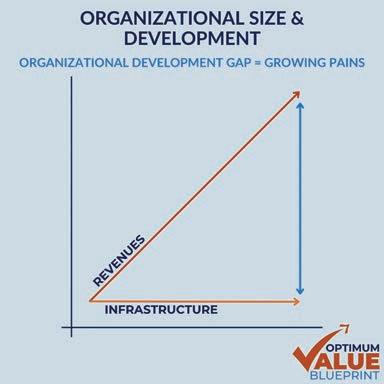
As your business grows, internal processes and organizational infrastructure often don’t keep pace with the expansion. This creates a gap—a mismatch between what your organization needs and what it can currently handle.
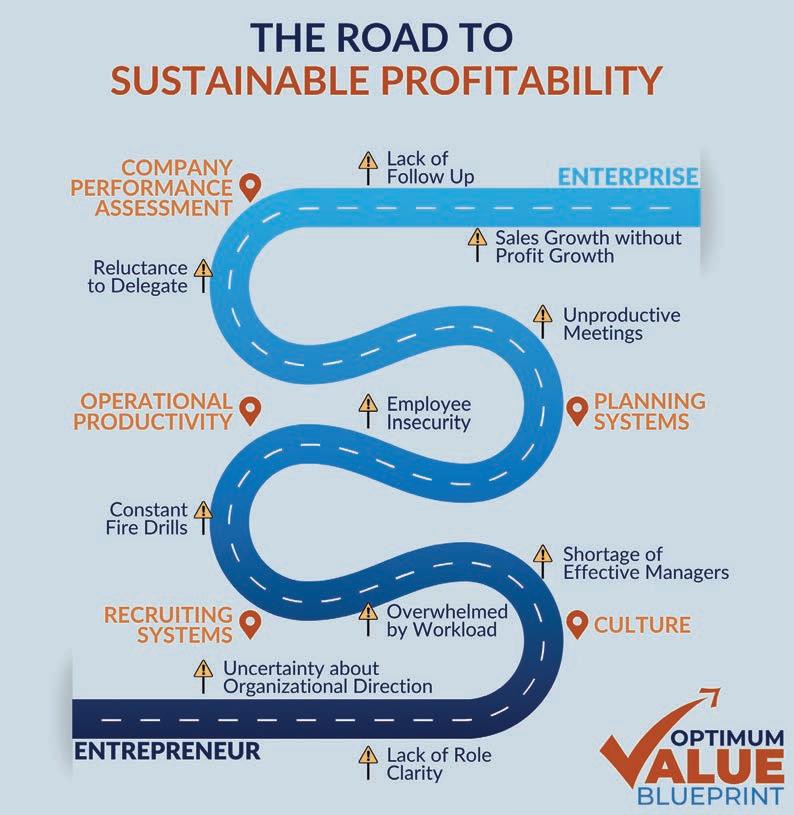
And that gap is where growing pains live. Invisible signposts like role confusion, overwhelmed managers, constant frefghting, and employee insecurity
signal deeper issues needing attention. Growing pains are the difculties businesses face as they expand. They happen when the systems, structures, and processes that once supported the organization can no longer keep up with its size and complexity. These organizational development gaps—whether in leadership, communication, infrastructure, or resource management—can hinder your company’s ability to sustain growth. Recognizing and addressing these gaps is critical for smooth, sustainable growth.
MILESTONES ON THE ROAD TO SUCCESS
Let’s explore a customizable roadmap designed to guide you from startup to a sustainable enterprise. This journey
highlights key milestones and identifies the invisible signposts that, if not addressed, could steer your company off course.
While we’ll outline a typical sequence, remember that every company is unique. The order of these steps and milestones may vary depending on your specifc circumstances and growth stages. This roadmap is adaptable to your company’s individual needs and challenges, ensuring you can efectively navigate the path to long-term success.
» Milestone #1: Culture
Your company’s culture is the bedrock of sustainable growth. As your business grows, maintaining a strong, adaptive culture is essential. Address conflicts head-on and eliminate activities that don’t contribute to profitability.
» Milestone #2: Recruiting Systems
As your company scales, so must your talent. Set clear recruiting goals for managers and tie them to performance appraisals. This ensures your team grows in line with your business strategies.
» Milestone #3: Operational Productivity
Operational productivity is the backbone of a growing company. Empower employees, streamline processes, and ensure alignment with your goals. Decentralize decision-making, clearly define roles and responsibilities, and align rewards with profit generation.
» Milestone #4: Planning Systems
Create a consistent planning process. Establish ongoing goals, design budgets, and ensure timely and accurate information is available throughout the organization.
» Milestone #5: Company Performance Assessment
Implement feedback systems to ensure alignment and make necessary adjustments. Set up effective meeting management and communication channels, so everyone knows what’s happening and what their roles are.
THE QUICK WIN: SELF-ASSESSMENT FOR GROWING PAINS
Before we dive deeper, take a moment to evaluate where your company stands. Access our Quick Win Self-Assessment at Growth.OptimumValueBlueprint.com to pinpoint the growing pains in your organization. This tool will help you identify the areas needing immediate attention, so you can start addressing the issues before they hinder your growth.
THE INVISIBLE SIGNPOSTS OF GROWING PAINS
As you navigate growth, be mindful of these 10 invisible signposts—critical pressure points that could signal potential issues. These signposts can appear in different sequences and at any stage of your business journey and addressing them promptly is key to staying on course.
» 1. Uncertainty About Organizational Direction
When employees are unclear about the company’s goals or vision, confusion and lack of focus can follow.
» 2. Lack of Role Clarity: Unclear roles lead to inefficiency. Ensure every team member understands their responsibilities and how they fit into the bigger picture.
» 3. Shortage of Effective Managers: As complexity increases, you need skilled managers to lead teams and make strategic decisions.
» 4. Feeling Overwhelmed by Workload: Overloaded employees and managers can lead to burnout and mistakes. Proper systems and delegation are essential.
» 5. Constantly Putting Out Fires: A reactive environment where immediate problems overshadow strategic goals indicates deeper issues that need addressing.
» 6. Employee Insecurity: When employees feel insecure about their jobs or the company’s direction, morale and productivity suffer.
» 7. Unproductive Meetings: Poorly structured meetings waste time and resources. Focus on clear objectives and actionable outcomes.
» 8. Reluctance to Delegate: Leaders who avoid delegation overload themselves and miss out on focusing on strategic activities.
» 9. Lack of Follow-Up on Plans: When plans are made but not followed up on, it indicates a disconnect between strategy and execution.
» 10. Sales Growth Without Profit Growth: Increasing sales without a corresponding rise in profitability often results from inefficiencies or a focus on top-line growth at the expense of the bottom line.
THE MOMENTUM MINDSET
The road to the next level is flled with challenges, but adopting a Momentum Mindset can help you stay committed to your goals. Refect on these six qualities
Growing pains are a natural part of business success.”
and consider how you and your team can embrace them:
» 1. Continually Act: Take consistent steps toward your goals.
» 2. Embrace Resilience: Learn from failure, adapt, and keep moving.
» 3. Prioritize Progress: Focus on incremental improvements.
» 4. Promote Proactive Decision-Making: Anticipate challenges and take preemptive action.
» 5. Promote Personal Accountability: Take ownership and set goals.
» 6. Adapt: Stay flexible in the face of change.
CALL TO ACTION: TAKE CONTROL OF YOUR GROWTH
Growing pains are a natural part of business success, but they don’t have to derail your progress. Don’t wait until these challenges start afecting your bottom line. Act now to identify and address the invisible signposts that signal deeper issues.
Start by taking our Quick Win Self-Assessment Growth.OptimumValueBlueprint.com and pinpointing where your organization is struggling.
Remember, your company’s growth should bring more progress than pain. As you lead your organization to the next level, let us know how we can help.
Pat Alacqua and Jane Gentry’s Optimum Value Blueprint services help tradeshow and event business leaders build and realize wealth through their business-building journey. Take a closer look at your growing organization. Access their Quick Win Self-Assessment at Growth.OptimumValueBlueprint. com. Identify the growing pain signposts in your business and take proactive steps to strengthen your company’s infrastructure for continued success.
What Our Industry has in Common with McDonald’s
BY CHRIS KAPPES
We work in a McDonald’s world Our product is diferent, but the demands for speed, precision and delivery are the same.
The average drive-through time at McDonald’s is 6.3 minutes, lowered recently due to new digital menu boards, instore kiosks, and menu reductions. McDonald’s didn’t achieve this success by chance. It intentionally harnessed technology, simplifed its processes, and standardized operations. Similarly, in the live event and exhibit production industry, companies are rethinking their workfows to stay competitive. Exhibit designs now often rely on pre-designed kits and systems layered with SEG graphics, rather than entirely bespoke solutions. The shift in production is clear: from handcrafting unique components to assembling pre-existing ones, faster turnaround times and better cost control are possible. Warehousing operations are leveraging advanced inventory technology and scanning systems to ensure nothing is missing from the bill of lading, ensuring that every project is delivered on time and in full.
Our industry is evolving at an unprecedented pace. What we knew 10 years ago is vastly diferent from where we stand today, and the next years promise even more transformation. In this issue, you’ll learn how the freight transportation industry is responding to rising fuel prices, soaring insurance premiums, a shortage of qualifed drivers, and increased regulations. At the same time, we explore how technology is reshaping how materials are delivered, tracked, and managed.
One company that anticipated industry-wide shifts is Catalyst Exhibits, featured on this month’s cover. Catalyst didn’t just react to change—they anticipated it. Founded in 1998 by CEO Tim Roberts and Chief Creative Ofcer Paul Stahlberg, Catalyst built its business around the idea that owning exhibit assets no longer made sense in a fast-paced environment. While rental exhibits were an available option back then, few companies built their operations or business model around them. Catalyst seized the opportunity and positioned itself as a
leader in providing turnkey rental solutions for top brands like Siemens, Dell, Roche, and others.
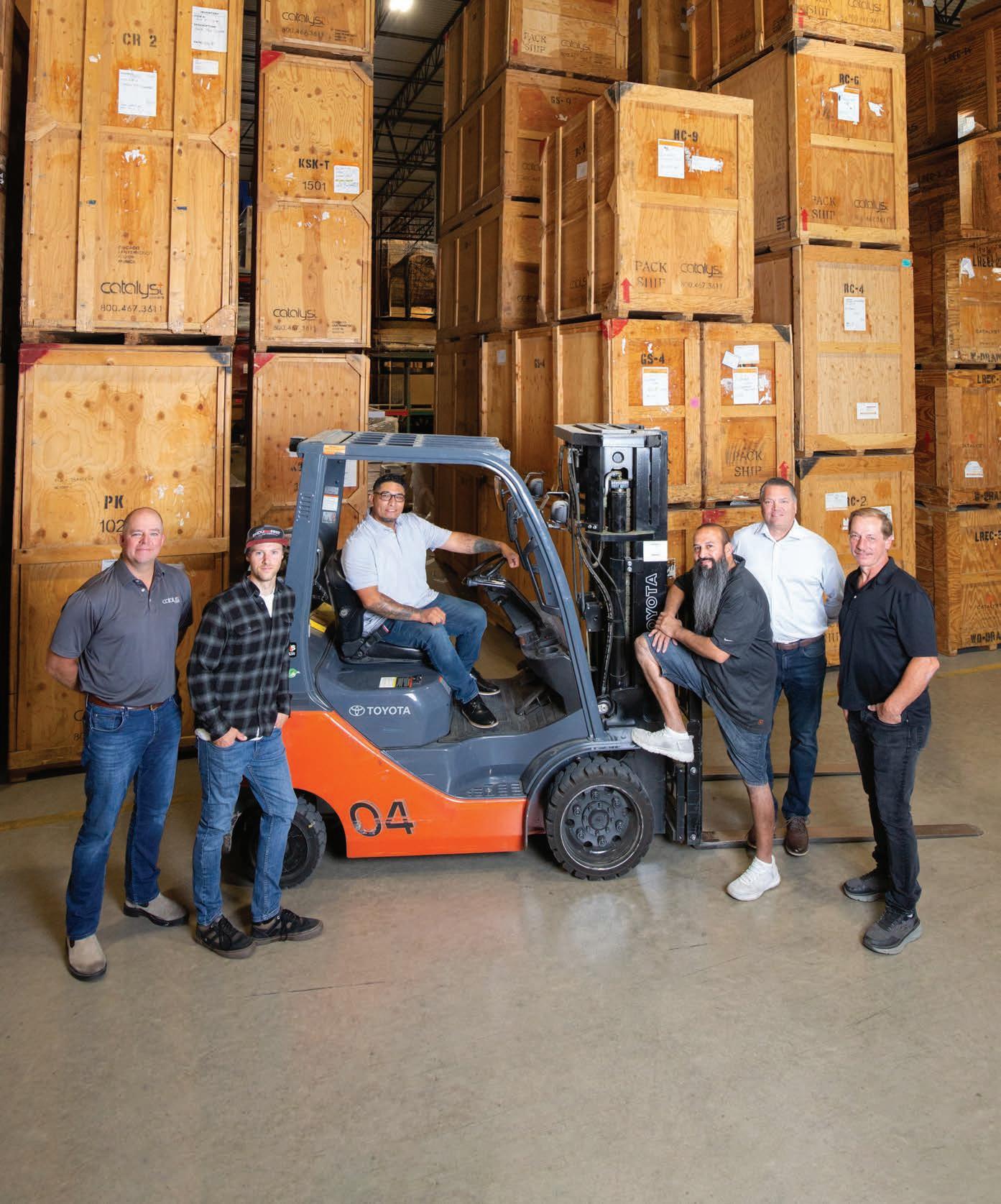
Today, Catalyst’s 104-person team—46 of whom are in production—handles everything in-house to meet client demands for speed and budget efciency. “We have all the inventory needed to create the designs we’re known for,” shares Jef Seeger, Vice President of Production. “We use our proprietary building block system, Innerspace, and add elements like LED screens, lighting grids, SEG graphics, and our own custom panel system and furnishings.”
Catalyst’s 144,000-square-foot facility is a testament to precision and efciency. The workfow moves seamlessly from asset inventory through to ft and staging, culminating in 16 shipping bays. “Nothing leaves our facility without being set up and reviewed by the entire account team—project manager, account manager, account executive, and warehouse personnel,” Seeger explains. Yet, beyond logistics, what truly sets Catalyst apart is its client-frst approach. HR Manager Ashley Mitchell calls it the “red carpet, white glove” service—a level of care that makes every client feel prioritized and valued. At the core of Catalyst’s operations are its technological systems. The company’s project management system, ShowHow, alongside Airtable for inventory management, allows real-time communication between team members and tracking of every project and asset.
“We know the exact location of every piece of equipment,” Seeger says. This digital infrastructure ensures projects run smoothly from start to fnish. Catalyst also uses Journyx to manage job costing, tracking employee time, expenses, and equipment to streamline accounting and payroll processes. By automating these critical functions, Catalyst ensures projects stay on budget and on schedule. Looking ahead, lessons learned from efciency pioneers like McDonald’s will remain invaluable, guiding us toward a future where efciency, creativity, and sustainability coexist to meet the evolving demands of our clients.
by
Photo
Brad Meese
Rookie on the Exhibit Show Floor, part 4
THE BLUEPRINT FOR EXCELLENCE
BY DANELLE DODDS
The Rookie on the Exhibit Show Floor Series began in Q2 of 2024, continued in Q3 and Digital for part 2 and 3. For the previous entries please visit Exhibit City News website.
The strength of a tradeshow is grounded in its foundation. Without a well-crafted framework, the whole thing could crumble. For the millions of highly trained trade professionals who construct, build, and support the exhibit show industry, their every move must be as precise as each measurement and cut.
The performance pressure for new tradespeople can be as tricky as building a load-bearing wall. But every blueprint starts with a frst draft. The legions of skilled trade professionals all had their frst days on the job. We tapped Robert Smith, Executive Director and Chief Administra-
tion Ofcer for the Eastern Atlantic States Carpenters Technical Centers (EASCTC), for his insight. The United Brotherhood of Carpenters and Joiners of America (UBC) represents more than half a million men and women of skilled construction and tradeshow professionals. For over 140 years, the organization has carved a path of representation, training, and education. As one of North America’s largest building trade unions, their expertise in the feld of labor and journeypersons is surpassed only by their commitment to fostering the next generation of professionals.
Smith gave us the brass tacks on how fedging tradespeople can lay the groundwork for a successful career in their early days.
CLEAR COMMUNICATION: THE GLUE THAT HOLDS EVERYTHING TOGETHER
Communication holds the entire structure together. Misunderstandings and errors often stem from cracks in communication, causing a once-solid plan to wobble. Here’s how to keep those lines of communication straight and strong:
» Measure Twice, Cut Once: Poor listening is like misreading a blueprint. Even the best-laid plans can go awry without fully understanding project requirements or instructions. To avoid costly mistakes, practice active listening by asking clarifying questions and taking detailed notes.
» Nail Your Message: Clear communication is the binding that holds a project together. Without it, ideas can scatter like sawdust in the wind. The project may falter if you can’t effectively convey your thoughts or address problems. Think of your words as the nails that keep everything in place. Practice precise and purposeful communication to prevent shaky exchanges.
» Breaking Down the Walls: In the fast-paced environment of a tradeshow, some might hesitate to ask for guidance, fearing it shows weakness. Seeking help is like checking your level before laying the foundation. It ensures everything starts right. Asking for advice isn’t a sign of weakness; it’s a tool to reinforce your work.
» Lost in Translation: Misunderstanding a client’s needs can lead to costly errors. Review client briefs thoroughly with your lead or foreman. Getting a clear picture ensures you’re building
according to the client’s vision. Keep lines of communication open to align your efforts with the client’s expectations.
» Mind the Gaps: When unsure about a task or procedure, not seeking clarification is like cutting a board without measuring it first. It can throw the whole project off balance. Make it a habit to ask questions and confirm details.
INDUSTRY KNOWLEDGE: THE NUTS AND BOLTS OF SUCCESS
Just as a carpenter must be familiar with the materials, understanding the nuances of the trade is crucial. Here’s how to shore up your industry knowledge and avoid costly mistakes:
» Solid Foundations: Setting up and breaking down tradeshow displays is a skill. Engage in on-the-job training, shadow experienced carpenters, and attend workshops.
» Tools of the Trade: Not knowing your tools can leave you feeling hammered. Gain hands-on experience and participate in training sessions to familiarize yourself with different tools and materials. Understanding your equipment is vital to working with precision and efficiency.
» Stay Up to Code: Ignorance of safety protocols and building codes can get you nailed. Operating without understanding safety parameters is risky and unsustainable. Participate in safety training programs, follow regular updates on industry standards, and engage in daily safety meetings at the show site.
» Keeping Your Tools Sharp: Just as you must sharpen your tools regularly, you need to keep your knowledge of design trends current. Exposure to various tradeshows and eyeing industry aesthetic developments helps ensure your work is solid, stylish, and relevant.
PROJECT MANAGEMENT
ESSENTIALS: NAILING THE DETAILS
Managing a project is like erecting a booth; every detail matters, and one misstep can lead to a crooked result. Here’s how to ensure your projects stand tall and strong:
» Material Issue: Just as careful budgeting ensures nothing goes to waste, proper material handling and efficient cutting techniques are key. Plan wisely to prevent waste and keep everything on track.
You’ll construct a future as strong and reliable as the projects you help create.”
» Cap Costs: Managing your budget is like laying a solid foundation: get it right, and everything else follows. To avoid financial pitfalls, keep a close eye on costs, choose materials carefully, and track your budget daily with the team lead or foreman.
» Quality Check: Quality control is the backbone of your reputation. Perform regular checks, pay attention to detail, and take pride in your work. Overlooking mistakes or defects can undermine the entire structure of your project.
» Orderly Conduct: Think of staying organized as the scaffolding that supports your work. Maintain a tidy workspace, provide adequate storage at show sites, and ensure everyone has the right tools for the job to prevent delays and errors.
SAFETY FIRST: THE FOUNDATION OF EVERY PROJECT
Safety isn’t just a priority—it’s the foundation of every project. Without it, everything else crumbles:
» Safety Hazards: Attend OSHA safety training, conduct regular inspections, and adhere to safety protocols.
MASTERING CUSTOMER SERVICE: LAYING THE VARNISH
A project isn’t complete until the customer is satisfed. Technical skills alone won’t cut it; attention to detail and a customer-frst mindset are equally important. Here’s how to ensure your customer service skills leave a lasting impression:
» Don’t Let Time Chip Away: In the world of tradeshows, time is more precious than gold. Failing to meet deadlines or causing delays can tarnish your reputation. Use effective time management techniques and set realistic deadlines.
» Polishing Your Reputation: Your behavior and appearance speak volumes, much like the final coat of varnish on a finely crafted piece of furniture. Training in professional etiquette and wearing appropriate attire set the right tone.
» Reinforce Customer Care: Overlooking client concerns is like fitting a joint poorly—it causes friction and misalignment. Practice empathy and active listening, focusing on client satisfaction.
» Leveling Up: Unexpected challenges are as common as knots in wood. Your ability to solve problems on the spot is what sets you apart. Develop problem-solving skills through experience, creative thinking, and guidance from your team lead. Mastery in this area is the hallmark of a true craftsperson.
ADDITIONAL CHALLENGES: BUILDING STRONG HABITS
The fnal touches to a project can make all the diference. Strengthening your work habits ensures a solid, lasting career:
» Carve Out the Lead: Taking the lead is like creating your own path. Don’t wait for someone else to hand you the map. Encourage selfmotivation, delegate tasks, and recognize initiative to drive progress.
» Collaborative Structure: Working well with others is essential to project success. Teamwork is the interlocking joints that hold a plan in place. Each member fits together to give the framework strength and stability. To
keep the structure intact, participate in teambuilding exercises and cultivate a positive work environment.
» Framework Flexibility: Even the best-laid plans may need to be changed. Onsite revisions can happen regularly. How you adapt to those changes will be a mark of your professionalism. Practice flexibility and adapt to new challenges as they arise.
» The Devil’s in the Details: Attention to detail is the grain that gives your work character. Focus on precision and consistently refine your skills to maintain high standards.
» Understand the Scope: When you’re first starting out, it can be easy to underestimate a project’s workload. An accurate assessment is a level that keeps your work straight. Plan realistically and monitor progress to ensure you’re staying on track.
» The Sharp Edge: Improper tool use can cause damage or accidents. Stay trained in tool safety, maintain your tools, and participate in regular demonstrations to keep your edge.
» A Strong Foundation: Just as a structure needs a solid foundation, your body needs strength and stamina for demanding work. Regular exercise and healthy habits support your physical conditioning.
» Code Compliance: Code compliance and knowledge of building regulations are critical. Attend regular building and venue updates and training sessions and collaborate with venue staff to ensure alignment.
» Balancing Confidence: Confidence is crucial, but too much can cause cracks in your progress. Foster humility and embrace continuous learning. Keep an open mind and absorb the advice of the professionals around you.
» Precision of Words: Putting your foot in your mouth will trip you up. Saying the wrong thing to the wrong person can cause unnecessary onsite concerns. Always consult the foreman or lead if you have questions before addressing a customer.
» Hitting the Mark: Punctuality and a strong work ethic are timeless. Manage your deadlines with commitment and positivity to maintain a stellar reputation.
» Damaged Goods: Accidents happen. The key is to handle them swiftly and responsibly. Always inform your lead or foreman as soon as the damage occurs. Time is essential if something needs to be repaired or reshipped before the show opens. Keeping damage under wraps can lead to onsite issues and unhappy clients.
By refning your skills and approaches, you’ll excel on the tradeshow foor and build a career with a solid and enduring foundation. Embrace each challenge as an opportunity to grow, and you’ll construct a future as strong and reliable as the projects you help create. Do you have additional advice? Share your insight here to keep building the conversation!
Truck Driver Shortage Challenges Tradeshow Logistics Industry Faces Delays and Rising Costs
as Driver Numbers Dwindle
by Mark Hebert
The tradeshow industry is grappling with logistical challenges due to a nationwide truck driver shortage. This shortage, impacting various U.S. sectors, has caused delays, increased costs, and complicated logistics for companies transporting materials to and from tradeshow venues.
In 2020, the U.S. trucking industry was valued at $732.3 billion, but it is struggling to meet growing demand. The truck driver shortage reached 80,500 drivers in 2022 and was projected to climb to 162,000 by 2030, creating serious obstacles for the tradeshow industry. Timing is critical for tradeshows, where precise scheduling is necessary to ensure materials arrive at venues on time.
Several factors contribute to the driver shortage. The industry faces an aging workforce, high turnover, and job demands that deter younger drivers. Long hours, time away from home, and tight schedules make recruitment difficult. Additionally, strict regulations on driving hours and working conditions, though import -
ant for safety, have reduced the number of available drivers, straining the supply chain further.
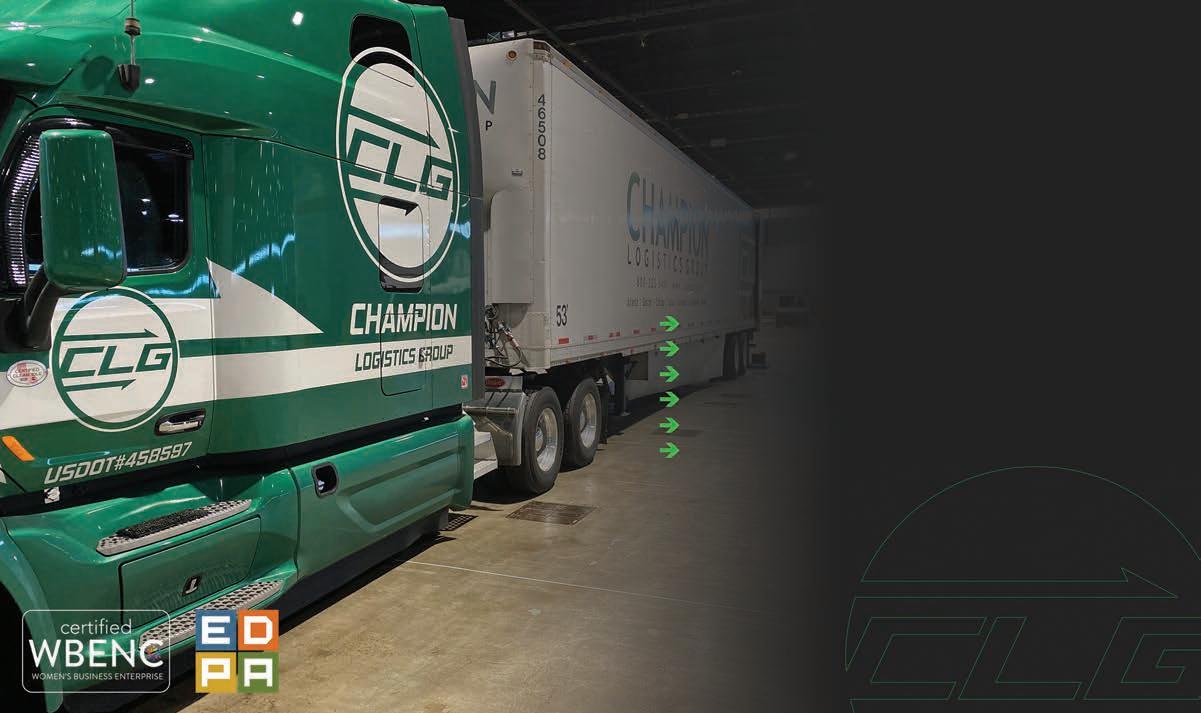
The Scope of the Challenge Champion Logistics Group, a veteran in tradeshow logistics, has mitigated the driver shortage by building a pool of vetted drivers. “We’ve spent decades carefully selecting and vetting our drivers, particularly those specializing in tradeshow logistics,” says C.J. Berg of Champion Logistics Group. This has helped Champion maintain reliable service on major routes to cities like Las Vegas, Orlando, Anaheim, and Chicago. However, Berg notes that the shortage has made it harder to cover less-frequented routes. “Driver shortages have impacted the secondary lanes that Champion doesn’t support as frequently,” Berg explains.
To tackle these challenges, Champion has implemented strategies like raising driver wages and ofering incentives to attract and retain skilled professionals. The company also formed a procurement team to source and vet new drivers. “By thoroughly evaluating potential partners, we
can maintain the high service standards our clients expect,” Berg adds.
Luke Carof, National Logistics Director at Willwork, another key player in the tradeshow logistics industry, emphasizes the importance of strong partnerships and proactive planning. “Willwork partners with trusted logistics brokers who understand the industry’s need for punctual and reliable service to meet deadlines,” says Carof.
Adapting Strategies
Both Champion and Willwork have employed strategies to ensure the driver shortage does not disrupt their clients’ events. Champion focuses on operational efciency, keeping drivers consistently on the road with minimal downtime and ofering consolidation options to clients to mitigate rising costs. “We’ve focused on keeping our drivers consistently on the road with minimal downtime,” Berg says.
Willwork’s approach revolves around proactive planning and strong internal communication. “Our main strategy to curb the impact of logistics challenges is functioning proactively. This allows us to plan for any obstacle we may face and gives every team member the opportunity to make suggestions and stay informed,” Carof explains.
These forward-thinking strategies are essential in an environment where driver wages account for 34% of overall freight trucking costs. Logistics providers face increasing pressure to meet client expectations despite limited driver availability.
Client Expectations and Future Outlook
A major challenge of the driver shortage is the potential shift in client expectations. Companies must adapt quickly to meet these demands. However, Carof notes that Willwork’s clients remain confdent in the company’s ability to deliver. “Because of our strong partnerships and procedures, our clients trust us to deliver their event’s success. We work hard to prevent any disruptions from afecting their expectations,” he says.
While Champion and Willwork have navigated the current landscape, the broader tradeshow industry faces uncertainty. As the shortage continues, logistics companies will need to explore new strategies, including alternative transport options like rail, air freight, and possibly autonomous vehicles.
For now, companies like Champion and Willwork focus on tactical solutions to keep operations running smoothly. “We’re committed to adapting our operations to meet the evolving demands of the industry,” Berg concludes.
The truck driver shortage remains a challenge, but companies like Champion and Willwork are using proactive strategies to prevent disruptions to their clients’ events. By emphasizing strong partnerships, efciency, and forward-thinking, they set a standard for managing industry-wide challenges.
As the shortage persists, collaboration and innovation in tradeshow logistics will be crucial to maintaining industry resilience amid ongoing supply chain issues.
AE&ES Celebrates 10 Years of Innovation and Leadership Transition in the Tradeshow Industry
by Mark Hebert
For AE&ES, based in Las Vegas, the past decade has been a journey of growth, transformation, and service to the tradeshow and event industry. Specializing in event production, logistics, and exhibit design, the company helps clients execute memorable experiences from concept to completion. Founded by Gary Bordman, AE&ES has become a recognized leader, certifed as a Service-Disabled Veteran Owned Small Business (SDVOSB) in 2022. AE&ES’ story is about more than milestones—it’s about leadership, legacy, and a vision that transcends one generation.
“I never imagined this company would become what it is today,” says Bordman. Bordman started AE&ES with the principles of discipline, integrity, and commitment, values he learned in his time in the United States Air Force and from growing up in the carnival business. “It’s not just about the work we do, it’s about how we do it—building relationships and showing up for our clients every time,” he explains.
Veteran-Owned and Veteran-Led AE&ES’ certifcation as an SDVOSB opened new doors, including membership in the NFL Business Connect program. Yet for Bordman,
the real key to the company’s success has been a commitment to excellence and the expertise gained from his CSEP certifcation in special events.
“Being veteran-owned gives us a unique identity, but what has kept us successful is our dedication to the work and the relationships we’ve built over the years,” Bordman says.
As AE&ES looks to the future, the company is undergoing a leadership transition, with Stefanny Avera, the company’s Chief Operating Ofcer and Gary Bordman’s daughter-in-law, stepping into a more prominent role. Having worked closely with Gary for years, Stefanny is now guiding the company forward.
A Leadership Transition:
The Heart of AE&ES Remote yet deeply involved in daily operations, Stefanny has embraced her leadership role, focusing on refning operations, driving sales growth, and fostering a collaborative
company culture. “My role is really about continuity,” Stefanny explains. “Gary laid such a strong foundation, and my goal is to honor that while bringing fresh ideas to navigate the evolving needs of the tradeshow industry.”
Stefanny’s leadership centers on adaptability and teamwork. “The challenges we face today aren’t the same as when AE&ES started, but the principles remain,” she says. “We’re here to serve, solve problems, and ensure our clients succeed. That’s the mission Gary started, and it’s the mission I plan to continue.”
A Bright Future at IAEE Expo! Expo!
As AE&ES prepares to exhibit at IAEE Expo! Expo! in December, the company is positioning itself for its next chapter. The event presents an opportunity to expand its network, showcase its capabilities, and build on its legacy. “This is a big moment
for us,” Stefanny says. “It’s about showing what AE&ES can do now, but also about where we’re headed.”
The leadership transition has brought a renewed sense of energy to the company. While Gary remains a guiding force, ofering his experience and wisdom, Stefanny is ready to step into her expanded role. “I’ve seen this company grow from nothing,” Gary refects. “Now, it’s in the hands of someone I trust completely, someone who’s ready to take it even further.”
Continuing a Legacy
As AE&ES celebrates a decade of success, the future looks bright under Stefanny’s leadership. The company is well positioned to continue thriving in a rapidly changing industry. No matter how the landscape shifts, the core values that Gary instilled— service, integrity, and a dedication to excellence—will remain. “I’m proud of where we’ve come from,” Stefanny says. “And I’m excited about where we’re going.”
The story of AE&ES is not just about business—it’s about people. It’s about Gary’s vision, Stefanny’s leadership, and a team that has been there every step of the way. Above all, it’s a reminder that success is measured by the relationships you build and the impact you leave behind.
ACE
ACE
ACE
ACE
ACE
ACE
ACE
Looking for the Optimal Warehouse Space? Two turns off the freeway, max!
By Melissa Skipworth
My client is an exhibitor in Las Vegas, and his clients are largely resort casinos. That means there will be lots of back and forth to the Strip. Imagine the trafc, then imagine you are the driver of the semi as you maneuver down through side streets trying to make it to the drop-of location. No fun!
As a commercial realtor, my role involves guiding clients in purchasing or leasing commercial spaces that align with their business needs. Here are key considerations to keep in mind:
1. Location
» Proximity to customers and clients
» Accessibility for employees and suppliers
» Foot traffic (if retail)
» Nearby amenities (restaurants, banks, etc.)
» Public transportation access
» Parking availability
» Access to freeways and major streets
2. Space Requirements
» Square footage needed (current and future growth)
When leasing a space, it’s essential to consider both your current needs and future growth. Confrm that the space can accommodate your business’ expansion over the lease term and that the location allows for easy reconfguration or expansion as needed.
How much warehouse space will you need? How much fex space? Flex space can give you
room for clean stylish break rooms, ofces and sometimes even living space. How important is having a yard to park trailers and stage shipments? How many docks with bay doors will you need for your shipping and receiving department needs?
A distinction between 10 foot and 12 foot bay doors can make a world of a difference depending on what you are building and shipping. If your bay doors are just two inches too small, you could have a terrible time with oversized equipment, freight, or custom fabrications.
When looking at older buildings you will want to make sure the sprinkler systems are up to code to maximize ceiling heights. If buildings have outdated sprinkler systems you may have 20 foot high ceilings but you will have to cut your stack rack height to 10-12 foot high, maximum.
Heavy power will also be something you will need to factor adding on because most buildings, no matter the age, may not have substantial three-phase power distribution needed for business operations.
Market Insights
The commercial real estate market varies across the country, with each region presenting its own opportunities and challenges. Despite rumors of an impending market crash and potential impacts on regional banks, Las Vegas commercial real estate markets remain strong. The scarcity of available developable land has led to high land prices, yet
developers continue to build across the valley.
When comparing similar modern industrial warehouse space Las Vegas, Orlando, and Chicago, rental pricing per square foot is very similar. According to the Cushman & Wakefeld 2024 Q2 Industrial Commercial Real Estate Report for Las Vegas, Chicago, and Orlando, Chicago stands out with an average price of $0.59 per square foot per month for industrial warehouse space. In contrast, Orlando averages $0.79 per square foot per month. Las Vegas tops the list at $1.11 per square foot per month. Vacancy rates in all three cities remain relatively low, indicating robust demand for industrial space. Specifcally, Chicago has a vacancy rate of 4.5 percent, Las Vegas at 6.6 percent, and Orlando at 7.4 percent.
Other Considerations
Chicago’s and Orlando’s lower average monthly price per square foot is attributed to having more older industrial buildings. These buildings tend to have lower ceiling heights and require more updating because of older systems like their sprinklers, for example. In Orlando there is a lot of industrial space made out of metal siding which may not be ideal for harsh weather conditions. Moreover, in Las Vegas, you will also need to watch out for outdated sprinkler systems and lower ceiling heights in older buildings. However, Las Vegas also ofers an incredible amount of modern industrial warehouse space among its additional advantages, such as tax breaks for qualifying companies and
no state income tax. This makes Las Vegas an attractive location for businesses looking to optimize their operational costs. Note: the article vs report PSF for Chicago and Orlando is based on annual whereas Las Vegas Q2 report is based on monthly so for the article the Chicago and Orlando annual
price per square foot have been converted to monthly price per square foot (PSF).
Melissa Skipworth is a commercial realtor. Her liscense and broker information is as follows: S.191667.LLC at The Woodcock Real Estate Group a part of the Berkshire Hathaway HomeServices Commercial Division.
Why Choose Aluvision?
by Aluvision Staf
Events and tradeshows ofer unique opportunities for brands to make lasting frst impressions, highlight their products, and connect with potential new customers. As an exhibit house or experiential agency, the pressure is on your team to design event spaces that are creative and efcient. Selecting the right modular system is crucial to your success.
Aluvision’s modular exhibit solutions provide a practical, cost-efective means to create uniquely branded spaces that are as functional as they are appealing.
WHAT’S GOING ON?
Investing in reusable aluminum frame systems creates opportunities for cost savings and higher ROI. With Aluvision at the core of your concepts, you can endlessly reconfigure booths of various sizes and shapes, from simple setups to complex, multilevel structures. Utilizing Aluvision means limitless design possibilities, including straight, curved, and angled walls, floor and ceiling elements, suspended banners
from glass, hard panel, and SEG fabrics to specialty treatments like Aluvision’s wooden shutters and louvers. The system also allows for seamless integration of Aluvision’s high-tech LED tiles and various lighting solutions, from ambient lighting to award winning spotlights.
PLUG & PLAY
and lightboxes; the durable aluminum frames provide a robust yet versatile canvas for your creativity, waiting to be molded into something spectacular.
Uniquely refect various brands with the same system which champions a plug-andplay model of fexibility. As your clients’ needs and event programs evolve, so too, can your buildouts.
ONE STRUCTURE, LIMITLESS FINISHING OPTIONS
Through Aluvision’s accessories and engineering ingenuity, easily incorporate a wide range of decorative inflls,
The Aluvision system is designed with efciency in mind. An innovative connection system streamlines the I&D process, helping to reduce labor needs and ofering better setup control. The frames attach quickly and efortlessly using Aluvision toolless Quick Tighteners, which ensure structural integrity and ease of adaptation.
SUSTAINABLE PRODUCTS & PROCESSES
The durable Aluvision frame system is mainly produced out of recycled aluminum, and all Aluvision profles and frames are anodized during the manufacturing process. Anodization not only provides a cleaner fnish requiring less maintenance; it also protects the
profles against corrosion and scratches, ensuring longevity. The reusability of Aluvision components helps you to reduce waste and environmental impact. Their lightweight, compact design also lowers transportation fuel costs, further shrinking your carbon footprint. And the frames are recyclable when they reach end-of-life.
COST-EFFECTIVE
Aluvision’s fexibility, reusability, and durability make it a cost-efective choice over time. Built to withstand frequent use and transport, Aluvision components require fewer replacements and less maintenance. Reduced storage, transportation, and drayage costs also contribute to signifcant long-term savings, making Aluvision a smart investment in your event design strategy.
FUTUREPROOF & GLOBAL
Aluvision’s inherent scalability and compatibility allow your inventory to grow with your business. Start small with a limited stock and expand over time to match your evolving needs. If you have clients with international programs, you can rely on Aluvision’s global partner network. With topnotch production facilities in Atlanta, GA (USA) and Kortrijk (Belgium), a parts depot in Las Vegas, NV (USA), and partners in over 60 countries worldwide, choosing Aluvision opens a vast network with a proven track record of delivering high-quality modular exhibits for businesses of all sizes.
Enterprise Resource Planning, or ERP, might sound like a buzzword, but it’s the backbone of how businesses operate efectively in today’s fast-paced world. At its core, ERP is about your enterprise, your resources, and your planning capabilities. But what does that mean in practice?
Think about all the resources you need to run your business. Now, imagine being able to plan and manage those resources seamlessly, ensuring that every part of your operation is working in harmony. That’s the essence of ERP. Over the years, ERP systems have evolved from simple accounting tools into comprehensive platforms that manage nearly every aspect of a business.
In the early days, the GLAPAR days, ERP was mostly about the basics—tracking income and expenses with tools like the General Ledger (GL), Accounts Payable (AP), and Accounts Receivable (AR). Back then, a Lotus spreadsheet was often the goto tool for managing fnances. It was enough to keep track of where the money was coming from and where it was going. As businesses grew and became more complex, so did their needs. The second stage of ERP introduced tools like Sales Orders (SO), Purchase Orders (PO), and Inventory Control (IC). These additions allowed companies to manage sales con-
Understanding ERP
THE BACKBONE OF MODERN BUSINESS
BY RICK KOSTOPOULOS, NEWGEN BUSINESS SOLUTIONS
tracts, purchasing agreements, and inventory with greater precision. It was a game-changer, allowing businesses to track not just money, but also the goods and services fowing through their operations.
In more recent years, ERP systems have expanded to include even more advanced features like Customer Relationship Management (CRM), Bill of Materials (BOM), Project Accounting, and Case Management. These tools allowed businesses to manage relationships, track projects, and handle complex transactions—all within a single system. However, as ERP systems have evolved, so too have the challenges. Diferent industries have unique needs,
whether you’re a manufacturer, a distributor, a retailer, or even a medical professional. This is where verticalization comes into play—customizing ERP systems to ft the specifc needs of an industry. In the early days, this customization was difcult due to rigid technologies, leading to a reliance on outside systems and creating data redundancies and maintenance headaches. Today, the goal is to eliminate these inefciencies by using modern, fexible technologies that allow for proper verticalization. When done right, a well-designed ERP system can create strong operational efciencies, efectively becoming the holy grail of business management.
But not everyone is there yet. Some businesses still struggle with outdated systems that are cobbled together, leading to a constant cycle of upgrades, broken syncs, and reactive problem-solving. Don’t let outdated systems and consultants keep you in a constant state of fxing and reacting. Re-activity is a mode that no one wants to sustain, break|fx|sync.
Instead, the key to success is proactivity—using an ERP system that is properly aligned with your business, can grow with your business, and meets the specifc needs of your industry. Run your business. Don’t let consultants run you, breaking|fxing|syncing, breaking|fxing|syncing.
Rick Kostopoulos, an expert in ERP, has spent years helping businesses find the right solutions. His company, NewGen Business Solutions, developed ConventionSuite, an event services package built on Oracle NetSuite, the world’s #1 Cloud ERP. Recognized as Oracle NetSuite Partner of the Year in 2023, NewGen has helped countless businesses streamline their operations with a comprehensive system that includes everything from CRM and project management to payroll and inventory. NetSuite is trusted by over 37,000 companies worldwide for a reason—it works. If you’re ready to move from a reactive to a proactive approach, it might be time to consider what a tailored ERP solution can do for your business.
Rising Costs for Shipping and Logistics
BY RAY SMITH
If it means saving $500 or $1,000 in broker fees, Hank Duran, president of Las Vegas-based HD Team Transport, is not in the least averse to knocking door to door at warehouses searching for shippers in need of his trucking service. After a 40-year career, the wave of rising freight transportation costs combined with plummeting shipping rates is crushing Duran’s business and has him gasping for air.
The freight transportation industry is dealing with soaring fuel prices and insurance premiums, disruptions to the supply chain that hinder equipment repair, an excess of tractor-trailers awaiting orders, and ferce competition that’s driven shipping rates down 40 percent. You can throw in higher fees, taxes and increased regulations.
“It’s really tough to make it out there,” Duran says in his warehouse ofce, a bare-bones operation tucked amongst houses built around the industrial complex. “I wouldn’t recommend someone green going into this business.”
He shares his 12,000-square-foot warehouse with DCE, a London-based exhibition design and production company, and splits the $15,000-monthly lease.
“Nowadays, to be honest, you’ve got to team up with people. You get two or three companies that intermingle, they have diferent names, but you work together
and share the bed with them,” Duran relates. “It’s the only way you can do it.”
INFLATION BUG
Blame it on the post-pandemic economy. Blame it on the presidential administration. Blame it on American capitalism. Whatever you blame—there’s no getting around rampant infation that has crippled small businesses, as well as corporate giants.
Prices have increased signifcantly on nearly every product and service—except shipping rates—which have fallen back to 1970s and ’80s prices. Just a few years ago, Duran was getting $1,200 to $2,000 for a one-way load from Las Vegas to Los Angeles. Now it’s $850 to $1,200.
Business was great until the middle of 2023, when it started “going down the dumps,” Duran says. “2024 is horrifc.”
Shipping rates have dropped dramatically, largely due to the surplus of trucks and trailers availability. “You have an abundance of truck drivers fghting for the same load, so shippers are taking advantage of it. They’re having a blast,” Duran, the owner of two tractor-trailers says. “There’s no regulations in the trucking industry to regulate prices.”
Navigating today’s infationary economy is really quite simple, says Jef Cribbs, president of Orange, Calif.-based Fairgrounds Transportation.
“Basically, we use predictive technology based on the capacity of carriers,” he explains. “When a carrier’s transit time fuxes of their anticipated schedule, we have alternative choices to keep the freight of that provider’s truck. There are also a couple of other small integrations used to speed up processes.”
Fuel surcharges also fuctuate with industry trends, based on the Department of Energy fuel index. “In heavy contract negotiations, companies will often implement their fuel (surcharge) or set a gap that is broader than the DOE,” Cribbs adds.
ALG Worldwide Logistics uses the government’s weekly fuel surcharge report to keep up with infated fuel costs, says Dwight Boutwell, ALG station manager in Ontario, Calif. Also on the rise: labor, taxes and rent.
“But I would imagine all businesses incur these costs and pass along the increases as best we can to our clients,” he says.
STIFF COMPETITION
Unless you’re backed by sufcient capital to purchase 30 tractor-trailers at about $200,000 each, it’s going to be tough to compete with the likes of Yellow Freight, Knight-Swift Transportation, England, J.B. Hunt, FedEx and UPS, Duran says.
They’ve got a feet of 2,000 to 3,000 trucks, they’re self-insured, and they are their own broker. Smaller companies need millions of dollars in liability insurance and lack economies of scale for parts and service.
That’s why freight transportation has seen a number of mergers, acquisitions and space-sharing agreements in recent years. It’s changed the structure of competition, with larger companies acquiring smaller ones and middle-market lines growing through acquisition.
Freight consolidation streamlines logistics, making operations more efcient and efective. Cutting down on shipments can reduce costs and speed up delivery times, giving a company an edge over competitors dealing with higher costs and slower deliveries.
Hank Duran, President of HD Team Transport
Companies are racing to stay ahead of competition, continuing the consolidation trend. From 1996 to 2022, the top 20 carriers’ share of container capacity skyrocketed from 48 percent to 91 percent, according to a report by Unicargo.
“While the benefts of freight consolidation are clear, tackling logistics can be overwhelming, especially for inexperienced businesses,” the report states. “This is where teaming up with a seasoned freight forwarder is helpful.”
“Many freight transportation brokers are closing their doors,” add Cribbs. “We are continuing to grow by creating a competitive advantage as it relates to cost and faster transit times. Putting the right carrier on the right lane at the right cost is something we are experts in.”
MONEY PIT
Wear and tear can take its toll on big rigs making long hauls, and repairs are part of the business. “You’re constantly replacing hoses, brakes, alternators, and fat tires. A semi-truck owner-operator can expect annual maintenance and repair costs to weigh in at around $15,000,” Duran says.
A Diesel Exhaust Fluid (DEF) flter system costs about $700, and Duran notes that his trucks aren’t running like they did in the past. “We get 350,000 miles, versus a million miles before,” he says.
A new tire will cost him $600, and an oil and transmission fuid change and lube job run another $600.
In addition to maintenance, he has to plan for these other expenses: fuel and highway tolls, Department of Transportation annual registration, state licensing and business permits, insurance premiums, cost of fnding loads, heavy vehicle use tax, International Fuel Tax Agreement, vehicle inspection fees, and various unplanned expenses and unexpected downtime.
LOOKING AHEAD
What does the future hold for the trucking industry?
Artifcial intelligence and automation are changing the game in the complex
landscape of logistics. Cribbs of Fairgrounds Transportation recalls spending hours planning routes manually. “Now it’s like having a digital copilot,” he says.
“Just, basically, tasks we used to do manually. Amazing how simplifed it can be with AI automation. We have a lot of improvements here in store as well,” the logistics expert foresees.
Automation has already improved efciency in the warehouse. Robots are handling inventory, eliminating mistakes and working tirelessly with no complaints or company benefts.
Boutwell of ALG Worldwide has witnessed technological improvements in electronic logs, satellite tracking, and anti-theft mechanisms.
“I believe technology will be extremely benefcial for our industry, even though as a 50-year veteran of the business, I struggle mightily trying to keep up with the ever-changing technological world,” Boutwell admits.
There may also come a day when self-driving trucks hit the highways, providing a safer and more efcient means of transportation. Testing is already underway. “A bit scary if you think about it,” Cribbs says.
Duran can see that happening. He doesn’t place much faith, however, in the green energy movement. For one, he believes the electrical grid remains incapable of handling high demand for recharging millions of electric vehicles. Then there’s opposition to lithium mining, essential for EV batteries, from environmental groups such as those combating Thacker Pass Mine in Nevada.
Boutwell, in agreement with Duran’s line of thinking, says, “I certainly hope we aren’t mandated to fully electric vehicles because I personally don’t believe they will be efcient and cost efective.”
As for fuel prices, Duran would prefer to see the U.S. government open drilling in states like Pennsylvania and Texas, instead of shutting down the Keystone Pipeline and buying oil from Venezuela and other countries. “Prices will come down when we’re energy-independent,” he asserts.
HOPE REMAINS
Trucking companies adhere to a myriad of regulations, including emission standards, hours of service, and safety standards. While it’s costly and inconvenient to comply, they’re subject to fnes and penalties for not adhering to them.
Duran claims to lose money taking a load to San Francisco in 10 hours, having to sleep (or at least rest) for 10 hours, by law, before his next drive. That means he can’t make it to Los Angeles in time to pick up another load. Still, the biggest hit on his balance sheet are fuel costs and labor. Drivers want $25 to $30 an hour now—the days of $20 an hour are gone. Meanwhile, he’s paying around $5.30 a gallon for diesel fuel in California, a little less in the east, though prices have still doubled from this year in places like Louisiana. Insurance has skyrocketed. What was once $1,200 to $1,400 a month for liability coverage is now $3,000, plus cargo insurance and workers compensation.
Despite all these challenges, Duran tempers his somewhat lugubrious outlook on the industry. He wouldn’t advise young entrepreneurs to start a trucking business, not with behemoths like Yellow and Swift gobbling up smaller operators, but there’s still a niche for someone willing to work hard and build a private customer base. It’ll take fexibility and adaptability and coming up with creative alternatives to standard business practices.
“You have to have your own contracts,” Duran says. “Physically go dig up your clients. Go to warehouses and ask if they need a truck. Your invoice goes straight to the shipper.”
Without a doubt, the road ahead looks rough and filled with potholes for the trucking industry. But in the end, stores need products to fill their shelves. Heavy equipment can’t be delivered by a drone. Amazon isn’t the ultimate shopping solution for every consumer. The industry is projected to experience a continued rebound in shipping demand with significant advancement in logistics technology.
Everyone is Talking About the Power of Rental
by Steelhead
In event marketing, speed and adaptability drive tangible results.
Today’s most forward-thinking brands aren’t just embracing change—they’re leading it. Modern, savvy event marketers have long chosen custom exhibit rentals for their tradeshow programs.
The era of owning cumbersome, infexible tradeshow booths is over. The question isn’t whether you should rent your next exhibit—it’s why wouldn’t you?
FLEXIBILITY THAT DRIVES RESULTS
Let’s face it—everything around us is changing faster than ever. Whether it’s the latest AI tech, shifting consumer behaviors, or new event trends, staying ahead of the curve is non-negotiable for event marketers.
Why get bogged down with the hassle of owning a booth when you need to be agile, ready to pivot at a moment’s notice?
Imagine this: instead of worrying about storing, shipping, and maintaining a booth, you can focus on what
really matters—engaging your audience and delivering a standout brand experience.
Renting your exhibit allows your brand to pivot and adapt at the speed of our modern world, keeping you ahead of the competition.
Forget the old-school mindset of buying a booth and using it for years. Today’s business environment demands more. Your goals evolve, budgets shift, and attendee expectations change with each event. Owning a booth locks you into a static, outdated presence that no longer serves your brand’s needs.
UNMATCHED CREATIVITY
Look around any tradeshow foor. Notice the brands that stand out don’t just show up— they show of.
Why settle for the same booth year after year when each tradeshow presents a unique moment in time?
Renting your exhibit opens the door to unlimited creativity. Without the constraints of ownership, you can work with design experts to craft environments that resonate with the specifc moment, audience, and goals of each event.
Whether you’re debuting a new product, rebranding, or simply looking to make a splash, a custom rental exhibit gives you the freedom to express your brand in fresh, exciting ways. This approach sets you apart in a crowded marketplace.
The most successful marketing campaigns capitalize on the here and now; your tradeshow booth should be no diferent.
PROVEN SUSTAINABILITY
Renting your exhibit can reduce your environmental footprint, but not all rentals are created equal. The truth is, it’s not just about renting that determines its sustainability—it’s about how the rental process is managed.
So, how can you be sure your supplier truly understands sustainability? Do they walk the talk, or is it just greenwashing lip service?
Look for tangible proof, such as certifcations. A B-Corp certifcation, for example, means that your supplier is committed to using sustainable materials AND actively minimizing environmental impact.
This commitment to sustainability benefts the planet and enhances your brand’s reputation. Today’s consumers are more eco-conscious than ever and aligning your event marketing strategy with gen-
Change is the only constant in marketing, as it is in life.
uinely sustainable practices helps build trust and loyalty.
Partner with a certifed tradeshow supplier to make a real diference and lead your brand toward a more sustainable future.
THE ACCESS MODEL: YOUR SECRET WEAPON
At the heart of the rental revolution is the Access Model, a concept reshaping industries across the board. Just as services like Spotify, Uber, and Airbnb have transformed how we access music, transportation, and lodging, the Access Model revolutionized event marketing.
Renting isn’t just about hopping on the sharing economy trend; it’s about the freedom and creativity that come with it.
You’re not tied down by ownership—you’re free to innovate, experiment, and make every event better than the last. This model gives you access to epic exhibits without the baggage, keeping your brand agile, creative, and sustainable.
Rental exhibits are the smart, strategic solution for brands looking to make a lasting impact. They provide the fexibility to adapt, the creativity to stand out, and the sustainability to do it responsibly.
Ready to make moves? Contact Steelhead Productions and discover how custom exhibit rentals can transform your brand: exhibithappy.com.
Technology Trends Revolutionizing Logistics Expert Insights from Industry Leaders
by Mark Hebert
The logistics landscape for tradeshows is undergoing signifcant changes as technology continues to reshape how materials are delivered, tracked, and managed. To gain a deeper understanding of these advancements, we spoke with leaders from Willwork Global Event Services and Champion Logistics Group. Their insights shed light on how innovations like real-time tracking, AI-driven route optimization, and specialized transport solutions are infuencing the tradeshow industry—and what trends might emerge soon.
Real-Time Tracking and Coordination
For companies in the tradeshow logistics sector, the ability to track shipments in real time is critical, especially when coordinating multiple locations and meeting tight deadlines. CJ Berg, Director of Sales and Marketing at Champion Logistics Group, explained how GPS-enabled trucks have become an essential tool in their operations:
“Our client-services team can now monitor shipments in real time, adjust routes to avoid delays, and provide precise delivery updates to on-site personnel. This ensures on-time arrivals, reduces waiting times, and improves
communication throughout the entire tradeshow shipment process.”
Similarly, Luke Carof, National Logistics Director at Willwork, described how their use of digital tools like Smartsheet and Apple AirTags helps keep logistics on track across multiple ofces and warehouse locations. “Every step in the production process is done with logistics in mind,” Carof explained, adding that their centralized logistics program helps streamline communication and planning well ahead of any event.
Artifcial Intelligence and Route Optimization
AI is another technology transforming logistics, particularly when it comes to optimizing transportation routes. Berg outlined how Champion uses AI-driven algorithms within their Oracle-based transportation management platform to ensure efciency:
“AI selects the most efcient routes using real-time data, maximizing vehicle space and assigning the best drivers for shipments headed to the same tradeshows. AI also analyzes market rates and predicts future costs, helping us minimize expenses.”
This integration of AI helps Champion reduce delivery times and transportation
costs, a key concern for many exhibitors who depend on the timely arrival of materials for setup. By using these tools, companies can adjust routes dynamically based on real-time conditions, which has become a signifcant advantage in a fast-paced tradeshow environment.
Adapting to New Logistics Technologies
As logistics technology continues to evolve, some companies are developing their own systems to meet the unique demands of the tradeshow industry.
According to Carof, Willwork focuses on staying at the forefront of logistics technology:
“We strive to always be on the cutting edge of logistics technologies. Our own operations are constantly adapting, and we work to develop new, functional technologies to drive processes forward.”
While both Willwork and Champion Logistics acknowledge the importance of established technologies, they also see the value in customization. Adapting these technologies to suit the specifc needs of tradeshow logistics—where timing and coordination are critical—allows them to improve delivery accuracy and reduce labor demands.
Specialized Equipment for Safe Transport
In the tradeshow industry, transporting high-value or fragile materials safely is a top priority. Berg emphasized the role of specialized equipment like air ride trucks and less-than-truckload (LTL) services in ensuring that delicate items reach their destinations securely. These services are essential for tradeshows, where exhibitors often need to move sensitive materials, from large displays to intricate electronic components.
Champion Logistics has also developed its Tradeshow Portal, which provides clients with real-time updates on shipments, easy access to critical documents, and 24/7 availability for communication. This transparency helps exhibitors monitor the movement of valuable goods, ensuring they are fully informed throughout the process.
Future Trends: What’s Next?
Looking forward, both companies see further technological advancements as essential to keeping pace with industry demands. Berg noted that Champion Logistics is focused on improving how information is shared between contractors, exhibitors, and carriers, particularly during key move-in and move-out phases of tradeshows. “The timely delivery of information is becoming just as important as the timely delivery of goods,” Berg said, pointing to the need for more efcient communication tools.
Carof also sees AI and automation continuing to play an increasing role in tradeshow logistics. “These technologies will dictate the entire process of the future of production and management,” he said, noting that ongoing integration of real-time tracking, AI, and automation will likely defne how logistics evolve over the coming years.
As the industry moves forward, both
companies suggest that autonomous vehicles and drones—already in use in other sectors—could soon become practical tools for moving materials to and from tradeshows. While these technologies are not yet fully deployed for this purpose, they could ofer new ways to streamline operations and reduce manual labor.
Conclusion: Keeping Pace with Change in Tradeshow Logistics
As technology advances, tradeshow logistics companies are fnding new ways to meet the growing demands of the industry. The insights from Willwork and Champion Logistics demonstrate how real-time tracking, AI, and specialized equipment are already making a diference—and point to what might come next. By adopting and adapting these innovations, tradeshow organizers and exhibitors can expect more efcient, precise logistics that better support the complexities of modern events.
With 25 years of experience in trade show logistics, our team is ready to help you excecute transportation and logistics, so you can focus on running your business.
Expert Show Shipping
24/7 Customer Service
On-Site Reps
SHOP TO SHOWFLOOR
An In-Depth Look into Today’s World of I&D and Event Labor
Tamashii Nations by Foster Display Group Pg. 60
Nissei ASB by ColorCraft Pg. 62
Photo by Gary Prochorchik / Exposures LTD
Tamashii Nations by Foster Display Group at San Diego Comic-Con
By Kerstan Szczepanski
Gary Prochorchik / Exposures LTD
The Tamashii Nations booth at San Diego Comic-Con, designed by Artpresto and Foster Display Group, was created to be a multifunctional space that met the exhibitor’s and attendees’ needs.
Bandai Namco Toys and Collectibles America required a modular solution that could adapt to diferent foor plans across multiple shows—with an essential requirement being the incorporation
Photography by
By the Numbers
Booth Size: 40’ x 60’
Height: 20’ at the max
Modularity: Aluvision
Wall System and Highmark Techsystems
Double Deck Booth
Tradeshow: San Diego
Comic Con
PROJECT TEAM AND CREDITS
Client: Bandai Namco Toys and Collectibles America
Brand: Tamashii Nations
Designer: Artpresto and Foster Display Group
Builder: Foster Display Group
Graphic Design: Artpresto
Project Manager: Jeff Pascarella, Foster Display Group
Production Manager: Tino Sacino, Foster Display Group
I&D: Octane
Photography: Exposures, LTD
of a double-deck structure. This double deck served as a live-streaming area and a point of sale with merchandise storage, ensuring that the booth could handle both promotional and commercial activities efectively.
For attendees, the booth offered an immersive environment filled with engaging elements. The Giant LED video wall was a major draw—capturing attention with dynamic content—while a massive Ultraman inflatable provided a popular photo opportunity. Built-in displays showcased Bandai’s highlighted products, allowing visitors to explore the latest offerings in a visually striking setting. The Tamashii Nations booth was functional and a standout experience at the event.
Jef Pascarella from Foster Display Group emphasizes the booth’s versatility: “For the exhibitor, a modular solu-
tion that would allow them to exhibit at several shows while maintaining fexibility to exhibit in diferent foor plans was needed. Most importantly, we needed to incorporate a double-deck structure for their live-streaming and a point of sale area with storage for merchandise.”
“For the attendees,” Pascarella continues, “an immersive environment gave the option to view several of Bandai’s highlighted products. Whether you are watching the Giant LED video wall, taking photos of the massive Ultraman infatable, or perusing all of the new products showcased in built-in displays, there is a little bit of everything for everyone.”
This thoughtful approach to design and execution made the Tamashii Nations booth a highlight of San Diego Comic-Con, demonstrating how modularity and creativity can come together to create a memorable exhibit.
Nissei ASB by ColorCraft at NPE
By Kerstan Szczepanski
For Nissei ASB’s exhibit at NPE: The Plastics Show held in Orlando Fla. in May, ColorCraft faced the signifcant challenge of integrating three fully functioning plastic molding machines into the booth space without compromising the brand’s identity or overwhelming the exhibit. The machines’ large footprint required meticulous space management to prevent crowding and to maintain clear pathways for attendee interaction and demonstrations. The design needs to
balance functionality with aesthetics while ensuring the machinery’s operational needs were seamlessly met.
Davis Hughes, VP of Sales, ColorCraft, says, “To address the challenge of incorporating three fully functioning molding machines within the exhibit, we designed a layout that divided the space into two distinct sections: a branded, themed environment and an area containing the operational machinery. This layout emphasized the balance that responsible manufacturing organizations maintain
by
Photo
Padgett and Company
By the Numbers
Booth Size: 80’ x 100’
Equipment: 3 fully
functioning plastic molding machines
I&D Crew: 10-person team
Install Duration: 10 days
Dismantle Duration: 5 days
Shipping: 8 trucks used
between operations and sustainability.”
This themed section was designed to engage attendees with interactive displays and brand experiences. It presented Nissei ASB’s advanced technology in a calming, visually appealing setting, allowing visitors to explore the brand’s oferings in a more relaxed atmosphere, setting the stage for deeper engagement.
The layout for the operational area ensured smooth trafc fow and easy access for demonstrations. ColorCraft implemented a robust power distribution sys-
tem with concealed cable management to handle the molding machines’ signifcant power requirements while maintaining a clean and professional appearance.
The functional molding machines provided a hands-on demonstration by producing plastic cups throughout the show, which attendees could use for refreshments. To emphasize Nissei ASB’s commitment to sustainability, recycling bins were strategically placed, and all excess cups were collected for recycling. This setup highlighted the recyclability and reusability of Nissei ASB’s products, aligning with modern environmental concerns.
The Nissei ASB booth at NPE successfully balanced the demands of
PROJECT TEAM AND CREDITS
Design, Production, Shipping, I&D: ColorCraft
Photography: Padgett and Company
showcasing heavy machinery with the need for a cohesive brand experience.
The innovative layout and emphasis on sustainability resonated with attendees, providing an engaging and educational experience that reinforced Nissei ASB’s position as a technology and responsible manufacturing leader.
ColorCraft’s execution of this complex project demonstrated their ability to integrate technical and creative solutions seamlessly, ensuring the exhibit was functional and visually striking.
“My staffing experience using Christy was unsurpassed, she was able to find me quality, competent administrative assistants on an ongoing basis and a warehouse manager with 24 hrs. notice. As an owner of a tradeshow supply business relying on Christy allowed me to focus on my clients during the frenetic tradeshow season!”
Alison Wainwright Las Vegas Mannequins
Coca-Cola and Cold Water
SECRETS OF BEING A UNION STAGEHAND
BY CHRIS KAPPES
British rock and pop singer Rod Stewart has a fear of falling of the stage. This is not an unfounded phobia, it’s a mishap he’s experienced numerous times due to blinding stage lights and stepping past taped lines on the stage foor. Leave it to lifelong stagehand Charlie Noble to fnd a solution: mop the stage foor with Coca-Cola and cold water to make it sticky. “The artist rider says to do it with Coke and hot water, but the sugar dissolves in Coke, so I use cold water instead. Rod’s high-top kicks stick like glue,” laughs Noble.
Noble, stagehand General Foreman for the Las Vegas Convention Center (LVCC) and a member of IATSE 720 (International Alliance of Theatrical Stage Employees), has learned these and other secrets of the trade over his 47 years of working in television, theater, and tradeshows.
IATSE 720, established in 1939, is a union representing stagehands, riggers, audio-visual technicians, and more. Working in partnership with the teamsters and electrical unions, Noble and his stagehand team at the LVCC ensure the smooth setup, operation, and dismantling of live tradeshows and events. For Noble, the path to becoming the General Foreman—and the only
member to carry two union cards (IATSE 720 and IATSE 39)—has been a crazy ride.
“I went from a highly recruited left-handed baseball pitcher in high school to zero college scholarship opportunities after tearing my rotator cuf,” he explains. “So, I did what a lot of kids do in the Bayou: I went to work on an oil rig. From there, I went to work doing Mardi Gras balls, carnivals, and building sets.”
These experiences, and a “willingness to volunteer for what others wouldn’t,” became the motto for Noble and fueled what followed. In his early twenties, Noble was named the stage manager for the famous Saenger Theater in downtown New Orleans, where he became a favorite among performing artists. “Fats Domino, an artist from New Orleans, didn’t have a ride home after one performance, so I took him home instead. This became our routine over a ten-year period when he performed for Jazz Fest,” shares Noble.
During his theater stint, Noble stage-managed 330 productions of Phantom of the Opera and was a regular backstage visit for top music acts like The Jacksons, Queen, Led Zeppelin, Village People, ZZ Top, Aerosmith, and others, who often stopped by
to chat and enjoy his famous Cajun-style cooking, whipped up outside the theater.
Noble’s career continued to evolve over the next 20 years with stagehand management of shows for The Tonight Show starring Johnny Carson, Wheel of Fortune, Jeopardy, three Super Bowls, and a massive Rolling Stones concert inside the New Orleans Superdome.
Looking for yet another adventure, Noble found it in the mid-1990s as the lead stagehand for Microsoft’s global corporate event tour and the DOTA 2 event in Shanghai China. DOTA 2 is a multiplayer online battle arena video game. Both events required his supervision of 125 trucks transporting elaborate staging. Noble called this tour a “head-scratcher every day.”
Today, Noble calls himself the “PR guy,” working with unions in all four LVCC buildings to manage jurisdictions and ensure exhibitors—“our clients” as he says—are serviced. “I review clients’ requests and do whatever I can to support exhibitor needs. Our team of 10 to 20 professionals review, prepare, and
submit rigging drawings to the LVCC engineering department for approval. Depending on the size of the show, like the Consumer Electronics Show, we may have a labor call of several hundred stagehands that I supervise,” he said.
A “handshake and a hug” is Noble’s formula for success. “Nothing is etched in stone,” he says. “Honesty is key. You need to have the DNA of the hospitality industry, and it doesn’t hurt to have a touch of Louisiana in yah.”
Noble’s legacy as a stagehand isn’t just built on hard work or legendary moments with rock stars—it’s about the knowledge and camaraderie that defne the profession. Stagehands like him bring creativity, resourcefulness, and grit to every event, making the magic happen behind the scenes. As technology evolves and the entertainment world shifts, Noble’s old-school wisdom combined with a modern approach serves as a bridge for the next generation of stagehands. In the end, it’s not just about knowing how to make a stage sticky; it’s about knowing how to make every show a success.
UNION JOBS MATTER
Our industry has the opportunity to improve the lives of American workers by ensuring that the use of local Union Labor in tradeshows and events.
Unions provide fair wages, health benefts, and retirement programs to employees. They also provide a voice in the workplace, skills and safety training, and jobs with dignity.
These hard-working skilled laborers make our shows and displays successful, and they do it with the highest level of hospitality, welcoming us to their homes.
Union workers support their local communities in not only creating an atmosphere within the show foors but by supporting large and small businesses. By spending their paychecks within their communities, they multiply the economic impact our industry brings to their towns and cities.
Please insist that your contractors use local Union Workers and continue to support the hard working people who support you.
Thank you, IATSE 835
Killer Tech & The Drive to Save Humanity: A Visionary’s Call to Protect Our Future
By Kim Kelley, for Mark Stross
In a world where digital devices and platforms dominate every aspect of life, technology has brought convenience, innovation, and opportunities like never before. However, as the digital age advances, so do its dangers. Mark Stross, America’s Technologist and a leader in the tech industry, is raising awareness about these risks. His mission? To ensure technology serves humanity, not the other way around.
As the Chief Technology Ofcer (CTO) of ANC for over 20 years, Stross has been at the forefront of digital innovation, developing transformative technologies for some of the world’s most prominent venues, including sports stadiums, train stations, and the World Trade Center. His book Killer Tech & The Drive to Save Humanity is a wake-up call, urging readers to understand the hidden costs of the digital age and ofering solutions to help reclaim control of their digital lives.
THE HIDDEN COSTS OF DIGITAL ADDICTION
Today, people are spending more time online than ever before. From social media to streaming services, smartphones have become central to our daily routines. However, Stross emphasizes that this
convenience comes with a steep price.
“We’re witnessing an epidemic of digital addiction,” he says. “People are glued to their screens, not realizing how tech companies use sophisticated methods to keep them hooked.”
mation. “We have a right to know what’s happening with our data, and we should have the ability to delete it whenever we want,” Stross asserts.
retool and acquire new skills to stay relevant in an AI-dominated world. But more than that, Stross calls for ethical AI development. “AI should enhance humanity, not harm it. That means building in safeguards and accountability right from the start.”
This addiction doesn’t just afect adults—children are also increasingly vulnerable.
“Our kids are growing up in a world where their selfworth is measured in likes and follows,” Stross explains. “They’re constantly comparing themselves to others, which is severely impacting their mental health.” Stross stresses that safeguarding children’s innocence in the digital space is crucial and that stronger measures need to be implemented to ensure their protection.
CALLING FOR A DIGITAL BILL OF RIGHTS
One of Stross’ most urgent proposals is the creation of a Digital Bill of Rights. Stross envisions it, as a way for individuals to control their data. It would enforce clear guidelines for ownership, transparency, and consent—holding tech companies accountable for how they use personal infor-
“If we can create transparent ledgers for cryptocurrency, why can’t we do the same for our personal data?”
This vision isn’t just about protecting privacy—it’s about preserving human dignity in the digital era. “We need to move from user agreements to human agreements,” he states. “Platforms must start respecting us as people, not products.”
THE FUTURE OF AI AND AUTOMATION
While Killer Tech focuses on current challenges, Stross also looks to the future, particularly how artifcial intelligence (AI) will reshape industries and our lives. While AI has the potential to revolutionize various felds, Stross cautions that it must be handled responsibly.
“AI will replace jobs. That’s inevitable,” Stross says. “But the question is: are we ready for that shift?” In his book, Stross outlines the steps individuals and businesses must take to prepare for automation. He highlights the need to
A CALL TO ACTION
At its core, Killer Tech & The Drive to Save Humanity is a call to action. The book challenges readers to rethink their relationship with technology and take control of their digital futures. “We can no longer aford to be passive consumers of technology,” Stross says. “We must demand better—better privacy protections, ethical standards, and accountability from the companies shaping our digital world.”
Stross’ message is clear: While technology is here to stay, it’s up to us to ensure that it serves humanity, rather than controlling us. By raising awareness, having meaningful conversations, and advocating for change, we can create a safer, more ethical digital world for ourselves and future generations.
Killer Tech & The Drive to Save Humanity is available on Amazon, Barnes & Noble, and as an audiobook. For more insights, visit MarkStross.com.
Speaking About Graphics
WHAT GOES INTO GOOD GRAPHIC DESIGN WITH INSIGHTS FROM BRIAN BAKER
BY PAT FRIEDLANDER
Brian Baker, VP of Creative at Highmark TechSystems and YOURspace Inc., has spent decades leading the process involved in exhibit and event graphics.
“It needs to be a very intentional process,” he says. “The whole purpose of graphics is to facilitate face-to-face interaction. Exhibit graphics aren’t meant to tell the whole story—people do that! And bear in mind: there is a big diference between event graphics and print or digital graphics.”
BRIAN EXPLAINS THIS AND MORE:
Print and digital graphic design assets must tell the story because no personal interaction is possible. There is (or should) be a CTA (a call to action) as part of the design. But again, this is a
far cry from human interaction. As designers, we often have hard conversations with agencies when we tell them that the graphics they created for print and digital media might not—for so many reasons—work in a face-to-face environment.
it said that objectives need to be S.M.A.R.T.: Specifc, Measurable, Actionable, Relevant, and Time-bound. Many people skip establishing objectives for graphics, yet this is the most important part of the process.
Second, the designer and the customer must agree on the scope. Event graphics can either enable interaction or interfere with it. Going back to number one, clarity about objectives helps defne the focus and the scope. Event graphics don’t tell the story; they attract attendees to the space and motivate them to talk to the people stafng the environment.
What do I mean when I say that there needs to be an intentional process?
First, like every marketing initiative, we must establish objectives which are in alignment with our overall strategy and narrative. You’ve heard
Third, both parties must agree on a timeline. This gives rise to several scenarios: if the event graphics designer is coming up with the graphics content and images, then input from the customer must come as soon as possible upon the project’s launch. Depending on the brand, the designer needs access to as many relevant assets as possible: TV advertising, promotional activity, print and digital ads, and social media, for starters. The challenge for event graphics is that they must ft the objectives of the event yet remain consistent with the brand’s other touchpoints. This requires not simply including your favorite images in the event space but also choosing graphics that further the objectives (back to number one).
If, on the other hand, the graphics are being designed by an agency, the sooner the images are available to the event graphics designer, the better. Sometimes, print and digital designers don’t un-
derstand the physical scale of event graphics, and their image banks (while they work well for print and digital) often don’t work well in large formats, resulting in additional time and efort spent on fnding or creating appropriate content. Again, time is of the essence.
Fourth, trust your designers to deliver the most cost efective budget. Since time is of the essence and going beyond the deadlines for show-ready graphics results in going beyond the stated budget, designers need as much information as possible. This includes other graphic reference material, corporate standards, logos, images, as well as your ideas and constraints. Please don’t make us guess: disclose your budget. Share your thoughts with the designer, but realize designers have experience and insight. Today, many formats and delivery methods for graphics need to be a part of the budget discussion. Your designers will know the most compelling and cost-efective way to achieve your objectives and keep to your budget.
EVENT GRAPHICS ARE HERE AND NOW
Fifth, schedule regular meetings between the internal customers and design and production teams. Set a day and time that works for everyone and emphasize the importance of communication. Everyone from the top decision maker to the designer needs to be on exactly the same page.
The conversations that graphics facilitate are very here-and-now; they occur in real-time, and attendees can access information beyond the event. So, make sure your graphics are relevant, and are in perfect alignment with what you are trying to communicate to your audience at the specifc event. On the other hand, avoid content that is overly specifc to a certain event or temporary messaging because it shortens the useful lifespan of (costly) graphics.
GRAPHICS ARE FOR CONVERSATION, NOT JUST DECORATION
Just because there is an empty space on an event structure wall doesn’t mean graphics need to appear in that space. The same applies
to a phrase used too often: “graphic opportunity.” With a bit more subtlety, I believe what that means is, “Hey, there’s a space here—let’s put up some graphics.”
Graphics are part of the overall strategy to make the most of the exhibit and event environment and facilitate conversation. Unless graphics do that, there’s a problem, and the event graphics are not functioning correctly.
Others want to tell the whole story about the company or product via graphics. They ask, “How will they [the attendees] know what we do if we don’t tell them [via graphics]?” I answer: “If attendees can read the graphics and learn whatever they can, why do they attend events built around face-to-face communication?” The role of the staf is to have the one-on-one conversations that the graphics spark. Don’t dilute the importance of graphics for helping to meet your objectives.
Lastly, it’s important to consider hierarchy, which plays an important role in absorbing information as someone approaches a space. The highest graphic should be the simplest, and they become more specifc as they get closer to the level of the attendees in the space. When planning graphics in an environment, think holistically from top-tobottom. The typical format for hierarchy is:
» Corporate ID/hero brand (highest level)
» Theme/tagline/positioning statement
» Product group/industry segment
» Product or service/specifics
When it comes to graphics in an environment or event, less really is more. Fewer graphics will draw more attention, and less copy will make them easier to absorb. Remember: it’s all about face-to-face interactions. Graphics are meant to help enable those conversations in the event environment.
Brian Baker
The Vibrant Moscone Center
By Kerstan Szczepanski
Located in the heart of San Francisco’s vibrant South of Market (SoMa) district, the Moscone Center (747 Howard Street) stands as the largest convention center in the city and one of the premier venues on the West Coast. Originally opened in 1981, the Moscone Center has expanded over the years to encompass over 2 million square feet of total space, including more than 700,000 square feet of fexible exhibit space spread across its three main halls: Moscone North, Moscone South, and Moscone West.
The center’s most recent renovation, completed in 2019, added over 300,000 square feet of new functional space, including an expansive lobby, meeting rooms, and state-of-the-art technology throughout the facility. These upgrades have solidifed Moscone’s status as a cutting-edge venue.
Architecturally, Moscone is a seamless blend of modern design and functionality. The center is divided into three main buildings. The interconnected nature of the buildings, along with advanced technological infrastructure, allows for a high degree of fexibility, making it an ideal location for complex, multi-faceted events.
Environmental sustainability is a core value of the Moscone Center.
The venue is LEED Gold certifed and features a rooftop solar array, energy-efcient lighting, water conservation systems, and a comprehensive recycling and composting program. These green initiatives refect San Francisco’s commitment to environmental responsibility and ensure that the Moscone Center remains at the forefront of sustainable event spaces.
The Moscone Center is not just about the events held within its walls; it’s also about the experience of being in one of the most dynamic neighborhoods in San Francisco. Just steps away from the center, attendees can explore the San Francisco Museum of Modern Art (SFMOMA), Yerba Buena Gardens, and Union Square’s bustling shops and restaurants.
The Moscone Center hosts many major events yearly, including the Apple Worldwide Developers Conference (WWDC), Dreamforce by Salesforce, and the Game Developers Conference (GDC). These high-profle events draw tens of thousands of attendees from around the globe, contributing to San Francisco’s reputation as a hub of innovation and culture.
The Moscone Center stands out as a premier destination for world-class events in a city known for its history, diversity, and forward-thinking spirit.
EAT
The Grove - Yerba Buena (690 Mission Street) offers a casual, cozy atmosphere perfect for a quick, satisfying bite. Start your day with their famous Grove Club sandwich, or savor the tomato soup and grilled cheese for a classic combo done right. The laid-back vibe and rustic decor make it an easy spot to unwind between sessions.
Benu (22 Hawthorne Street) is where you go when you’re ready to experience a truly unforgettable meal. With three Michelin stars, Benu is a fine dining gem just steps away from the Moscone Center. Chef Corey Lee’s menu is a masterful blend of modern American and Asian influences. Expect dishes that push the boundaries of flavor and presentation.
SLEEP
The InterContinental San Francisco (888 Howard Street) offers everything you need for a luxurious stay just a short walk away, from spacious, modern rooms with floor-to-ceiling windows to a state-of-the-art fitness center and indoor lap pool. After a long day of networking and panels, unwind with a drink at Bar 888 or enjoy a meal at Luce, the hotel’s Michelin-starred restaurant.
Hotel Zelos San Francisco (12 4th Street) offers a boutique experience that blends historic charm with contemporary style. The rooms are stylish and comfortable. The hotel’s on-site restaurant, Dirty Habit, is a great spot to grab a cocktail or a small plate in a hip, urban setting. With its prime location and trendy vibe, Hotel Zelos is ideal for travelers who want both convenience and a touch of luxury.
PLAY
The Metreon (135 4th Street) is your go-to entertainment hub just minutes from the Moscone Center. Whether you’re looking to catch the latest blockbuster at the AMC theater, grab a quick bite from one of the many eateries, or do a little shopping, The Metreon has you covered.
Photo courtesy of San Francisco Travel Association
YOUR PARTNER ACROSS THE AMERICAS
We bring Our Services closer to you.
With new offices in key locations, we are now more connected than ever.
Bringing People and Business to California
In 1890, the population of the state of California was 1.9 percent of the United States. Over the next 30 years, the number of people in the state tripled, and, by 2020, California would be 12 percent of the total population of the country. The gold rush of 1849 started the migration west; but it was two international expositions in San Francisco that showcased the state to 20 million people and planted the seed for innovation and growth.
Lighting the Way
1894 The California Midwinter International Exposition, held January 27 through July 5, was the frst World’s Fair to open in the middle of winter and the frst to be held west of the Mississippi. The fair was the brainchild of Michael H. de Young, the founder and publisher of the San Francisco Chronicle.
In May of 1893, as millions of people streamed onto the Chicago Fairgrounds, and tens of thousands viewed the California exhibit, de Young wondered if a similar fair could bring people and jobs to his hometown. His main concern: Chicago had years to plan, construct, and sell space in the exposition; he had seven months. Funding for the fair proved to be no problem. Convincing exhibitors onsite in Chicago to come to California was also an easy sell—it was a new market, the weather would be beautiful, and de Young ofered to pay the shipping costs from Chicago to San Francisco for many of international exhibitors that committed to the show. One unexpected hurdle, however, was the controversy over the site location and the battle to build in Golden Gate Park. Groundbreaking did not begin until August 24. Amazingly, the Fair opened fve months later, with pre-show festivities starting on January 15.
ifornia delegation volunteered to design and build a similar, but smaller, attraction: J Kirk Firth’s Wheel had sixteen cars, each rotating 10 people 120 feet into the air.
A National Commissioner for the 1893 Chicago’s World’s Fair, de Young travelled east to Chicago as the fnancial Panic of 1893 spread west. People lost jobs and banks failed across the country, including in San Francisco. By 1894, unemployment nationwide would climb to 18 percent and the depression would last until 1897.
Situated on 200 acres, the exposition attracted over two million people, with businesses from 38 nations, fve states, and 36 California counties. Defying the depression, the exposition brought dollars and jobs to the area. It employed several hundreds of thousands of people (including construction personnel and the staf working the show) and the event made a proft of $66,851. Companies displayed textiles, machinery, mining equipment, bicycles, shoes, fruit, furniture, clothing, crystal, and pottery.
In Chicago, de Young could not convince George Ferris to move his giant Ferris Wheel west, but a member of the Cal-
In 1894 electricity was still a relatively new phenomenon. The illuminated silhouette of the expo at night was unlike anything previously seen in California. Two of the more memorable attractions were the Electric Fountain and Bonet’s Electric Tower.
The Electric Fountain had water that shot 90 feet upwards and was foodlit by colored lights from below.
Bonet’s Electric Tower was a steel structure, 272 feet high, housing the most powerful searchlight in the world. It was a third the size of the Eifel Tower and at night, the tower blazed with the light of 3,200 sparkling incandescent bulbs. An electric elevator carried passengers to three observation areas, stopping at 91 feet, 147 feet, and 210 feet. The searchlight atop the tower was so bright that one reporter wrote, he “could read a newspaper at midnight ten miles away.”
BOB MCGLINCY
The California Midwinter International Exposition
Showcasing
“The Jewel City” 1915 The Panama-Pacifc International Exposition is often overlooked and underappreciated, although it is one the fve most impressive World Fairs in U.S. history. It hosted 28 countries, 32 states, and attracted almost 19 million visitors, at a time when war pummeled Europe. The show celebrated the building of the Panama Canal and the rebuilding of San Francisco after the devastating 1906 earthquake. The site of the exposition covered “a mudhole with a view,” located in an area now known as the Marina District.
The place was a 10-month mini-metropolis, two and half miles long, a half mile wide, and covering 435 acres. The entrance to the fair was adjacent to The Jewel Tower—a 450-foot-tall structure, with 125,000 faceted pieces of glass and tiny mirrors. These glittering “jewels” moved with the wind, twinkling day and night.
The show had something for everyone: celebrities, daredev-
ils, culture, history, sculptures, scientifc lectures, women’s studies, technology, innovations, 300 parades, and 2,000 concerts. It showcased car, camel, horse, aeroplane races; nighttime aerial displays; military and baby parades; and dog shows. It had lagoons, Japanese tea gardens, the original Liberty Bell, and the single largest collection of fne arts in the world. There were exhibits, displays, pavilions, and over 80,000 products. There was so much to see, it was said, people “walked until their feet hurt.”
The frst long distance, intercontinental phone call occurred on January 15th, with a reenactment of the original connection between Alexander Graham Bell and Thomas Watson. Only this time, almost 40 years after the frst successful call, instead of being in adjacent rooms at the same laboratory, Watson was in San Francisco and Bell in New York City. Subsequent intercontinental calls had people in New York listening to the live sounds of the Pacifc Ocean and New Yorkers reading local newspapers to fairgoers.
Exhibiting companies included: International Harvester; Waltham Watch; Hearst (demonstrating the largest color printing press in the world: a two-story press capable of producing over one million newspaper pages an hour); Sperry Flour (with international chefs cooking and ofering free tastings); US Steel; Kodak (displaying two-color Kodachrome photographs); Union Oil (which became Unocal 76 and was acquired by Chevron in 2005); Columbia Graphophone Co. (which became EMI and Columbia Records). The
Underwood Typewriter company displayed an enormous working typewriter: a machine twenty-one feet long, ffteen feet high, and weighing fourteen tons. GE (showing “The Home Electrical”), Heinz, and Westinghouse were there, with motion pictures entertaining audiences in their pavilions.
Henry Ford constructed a working factory, where exposition attendees could watch a single car being assembled every 10 minutes—18 Model Ts in three hours, every day, Monday through Saturday. Upon completion, the cars were driven out of the building and paraded around the fairgrounds. Thomas Edison worked on his friend’s assembly line one afternoon, unnoticed by the public.
Second in popularity to the temporary Ford factory was a fve-acre working replica of the Panama Canal. Foreshadowing future amusement park rides, there was a moving platform which transported seated visitors around the “canal” as they listened to recorded messages via telephone receivers.
Other popular attractions included: a working Levi factory, an automated U.S. Post Ofce, and an incubator pavilion. Santa Fe Railroad displayed a replica of the Grand Canyon. Union Pacifc built a miniature Yellowstone Park, complete with working geysers. Both railroads promoted travel and sold tours. Finally, for entertainment in the fair’s amusement area, “The Zone,” there was the “Aeroscope”—“a long metal arm terminating in a two-story house and capable of lifting 120 people 265 feet in the air.”
The exposition was open from February 20–December 4, 1915. It made a proft of $2,401,911.
In a 150 years, 75 percent of all international expositions failed to make a proft, but these frst two San Francisco shows made money. Between 1915 and 1940, four more World’s Fairs occurred in California, including another in San Francisco. These combined events attracted over 30 million attendees. Like conventions today, these expositions created jobs, stimulated the economy, and promoted their hometowns—but none equaled the grandeur, nor the success, of the 1915 show. What was the legacy of the Pan-Pacifc Exposition?
To quote Burton Benedict, a former Dean at UC Berkley, “It celebrated the rebuilding of San Francisco; it asserted the importance of California and the American West; it turned American attention toward the Pacifc and South America.” It can also be argued that the technology and innovation of Silicon Valley today, started with the World’s Fairs in San Francisco.
Tradeshows Today – Still Bringing in Business
Four convention centers in California have exhibit foors with a half million to more than a million square feet of space: Moscone, San Diego, Los Angeles, and Anaheim. In 2019, tradeshows and business events in the state supported 329,000 jobs and generated an economic impact of $41.1 billion.
Tradeshows work. They work very well!
Decision 2024 What it Means for the Business Events Industry
by Tommy Goodwin, Exhibitions & Conferences Alliance
While it hasn’t unfolded the way anyone predicted, the 2024 campaign is barreling towards election day. Although policy issues have taken a backseat on the campaign trail, what happens at the ballot box on November 5th will impact the industry in 2025 and beyond. Here’s how.
Taxes
Taxes will be the issue on Capitol Hill in 2025. With much of the 2017 Tax Cuts and Jobs Act set to expire next year, the stage is set for a tax reform battle. Experts say that keeping these popular tax breaks will cost the country $4.6 trillion, and political pressure inside the Beltway is building to ofset at least part of amount. What does that mean? Everything in the tax code is on the table.
This includes raising corporate tax rates, changing how private equity profts are taxed, or even taxing association events. Any of these could have a signifcant impact on our industry. What’s more, some of these proposals cross traditional political
party lines. Some Republican lawmakers support increasing corporate rates, while a few Democrats are wary of targeting private equity.
That’s why Exhibitions & Conferences Alliance (ECA) will be all in on tax reform next year. Regardless of who controls the White House and Congress, we will ensure that the industry’s voice is heard during this critical debate.
International travel
Nearly three years after post-pandemic international travel resumed, we are still unable to fully welcome all international exhibitors and attendees back to the U.S. due to ongoing visa delays. While ECA helped secure $50 million for the State Department in March for visa backlogs, it still takes more than one year to get a frst-time visa interview in countries like Mexico and India.
Neither party has a good track record here. While many accused the Trump administration of hollowing out the State Department, the Biden administration has been far too slow in restor-
ing visa processing times to pre-pandemic levels. In 2025, ECA will be calling on Congress to break the bipartisan deadlock on visitor visa reforms to ensure delays like this never happen again.
Workforce
There is bipartisan consensus in Washington, DC that the government must do more to help build America’s next generation of skilled workforce. ECA supports legislation that would allow (a) Pell Grants to be used for high-quality, shorter-term job training programs and (b) 529 savings plans to cover the costs of workforce training and credentialing programs like third-party certifcations.
Congressional leaders on both sides of the aisle want to send workforce development legislation to President Biden for his signature by the end of 2024. If they are unsuccessful, ECA will push for Congress to act in 2025 to help close the skills gap and provide workers with the job training and credentials they need to secure in-demand, good-paying jobs in our industry.
Sustainability
Vice President Kamala Harris and Former President Donald Trump have very diferent sustainability agendas. While Harris and the Democrats want new decarbonization legislation and bigger role for Washington, DC regulators, Trump and the Republicans propose greater federal deregulation.
However, a Trump victory wouldn’t end the government’s role in the green transition. Rather it would merely shift policymaking to the state and local level in big industry markets like California, Illinois, and New York. We have already seen this with the new California zero-emission forklift regulation, which will phase out large spark-ignition engine forklifts between 2026 and 2038.
That’s why industry stakeholders should accelerate their decarbonization eforts to stay ahead of new government regulations (at any level) and maintain control of their path to net zero.
To learn more about ECA’s work on these policy issues and more, please visit ECAadvocacy.org.
The African Way
By Taubie Motlhabane, CEO, Cape Town International Convention Centre (CTICC) and Sven Bossu, CEO, International Association of Convention Centers (AIPC)
In the week of August 18th, the frst ever AIPC Africa Academy was held at the Cape Town International Convention Centre (CTICC). The 25 participants covered all functional areas—from sales to operations—allowing the exchange of knowledge on the full convention centre value chain. The content of the fve-day program was a mix of lectures and workshops, with both international and local speakers sharing their insights. It was also a unique opportunity to get a better understanding of the South African market landscape.
The events industry in South Africa is in good shape and is continuously increasing the quality of its services, which has resulted in global recognition of South African event players. While there are regional diferences, South Africa has some world-class infrastructure, meeting the requirements of the most demanding customers.
Yet, the country does face a number of real and perceived challenges. These challenges
are mainly related to “hardware”—the quality and reliability of energy supply, communication networks, or transport infrastructure—are not consistent throughout the country.
The perceived challenges are a diferent story. Often based on completely incorrect information and amplifed by mainstream and social media, the wildest stories go viral (e.g., civil war going on in South Africa). Ensuring that all local industry players bring a consistent and positive story about the country is therefore of key importance, but not necessarily a straightforward endeavour.
During a panel debate with three South African event organizers, other challenges became clear. Similar to long haul destinations like Australia for example, South-Africa is seeing lower attendance fgures when it comes to international meetings, mainly related to travel costs, combined with an increased awareness around sustainability. This means that in order to attract more meetings and
international delegates, even more attention needs to go to the client. This is something which can only be achieve if all parties involved—from venues to Professional Conference Organizers (PCO)— collaborate closely.
Interestingly, there was also a consensus that clients need more guidance when it comes to making their events successful both in engagement and on the fnancial front. Instead of asking a 120 percent service level at a 60 percent cost, it would be in the interest of all parties involved to make sure that there is a realistic view on expected outcomes and the services required for making this happen. Venues play a key role in this. As much as there is an emerging demand for unique experiences in unique locations, if you have an exhibition that requires space size of 2,500 squared meters, it will not ft in a museum. Convention centres are often the logical option.
Sustainability is another interesting topic where clients and service providers need to come to clear agreements. For example, opting for water stations without cups, whereby delegates are expected bring their own refllable bottle, might sound nice but does not
work as well as it sounds. Once again, the goal should be to come to a win-win for all parties involved, without jeopardizing the customer experience.
Next to challenges, there are of course opportunities as well. Values such as inclusiveness and community engagement are becoming ever more important, due to the rise of value-driven generations. The events industry has an opportunity to become an employer of choice, if—and that is the key success factor—the employers walk the talk.
Another opportunity, specifically for PCOs, is to become a regional or even global centers of expertise and excellence. Technology now allows one to leverage the expertise of South African event professionals on a global scale, with the relatively low labor cost as a clear advantage. South African companies are already doing graphic design, registration, and more for event organizers globally. This is expected to expand going forward and it can be of signifcant beneft for the South African events industry on diferent levels—from revenue generation to becoming a global knowledge hub.
In short, the South African events industry is active and agile, seizing the opportunities as they come along and making full use of all the assets it has. This makes it a fascinating environment and provides a world of opportunities for upcoming talent. Events like the AIPC Academy are therefore necessary to bring all stakeholders together and learn from each other. We look forward to the next edition.
Exhibitors Speak Out on Industry Hot Topics
by Jessica Sibila, CTSM, CMP, Executive Director – The Exhibitor Advocate
In the dynamic world of exhibitions, staying informed about the latest trends and challenges is essential for suppliers, exhibitors, and organizers alike. At The Exhibitor Advocate, we’re committed to amplifying the voice of exhibitors and fostering a vibrant marketplace. In our second year since incorporation, we’ve been hard at work addressing several pressing issues impacting the industry.
KEY ISSUES
WE’RE TACKLING
High Cost of Show Services
Our forthcoming research with Evolio Marketing highlights a persistent concern among exhibitors—the high cost of show services. Early findings suggest that these costs not only burden exhibitors but also have unforeseen effects on show organizers. Stay tuned as we unveil these insights, which could be crucial for suppliers looking to optimize their offerings and show organizers in boosting revenue.
Transportation Package Rates
We’ve recently discovered a troubling trend where exclusive and non-exclusive services are bundled together, potentially leading to unfair competition. This practice raises concerns about fairness and legality under anti-competitive statutes. Rest assured, The Exhibitor Advocate is actively working with industry partners to ensure equitable opportunities for all exhibitors.
Measuring ROI
While high costs remain a top concern, exhibitors are also struggling with evaluating their success and return on investment (ROI). The need to measure participation value against expenditure is more pressing than ever. We’re excited to introduce new tools and resources by year’s end to help exhibitors efectively measure ROI. Become a member of The Exhibitor Advocate to have frst access to these valuable educational oferings.
2024 Ann. Survey of Exhibition Rates
In partnership with Tradeshow Logic
and Evolio, we’re gathering data from 2024 tradeshows and events for our upcoming survey. If you were surprised by the 2023 data or want your city included, share your exhibitor show kit with us. Help us provide the most comprehensive industry data available.
Engage with The Exhibitor Advocate
Your experiences are critically important. What challenges are you facing in the industry? How have you succeeded despite these challenges? We invite you to share your story with us at info@ exhibitoradvocacy.com.
By becoming a member of The Exhibitor Advocate, you gain access to the latest information on exhibitor experiences and can contribute to ensuring the industry’s future sustainability. Join us in making exhibitions and events a valuable marketing channel for all stakeholders. Together, we can address industry challenges and create a thriving exhibition community. Let’s continue to empower exhibitors and enhance the industry for the benefit of everyone involved.
FIVE IN FIFTEEN SAN DIEGO, CA
5 places to go within a fifteen-minute walk of San Diego Convention Center
Getting to Know 'America’s Finest City’
BY KERSTAN SZCZEPANSKI
What to do when there’s no breakout meeting or the panels are done for the day? Where to go when you need a little time away from the hubbub of convention chaos? Exhibit City News’ 5 in 15 offers five places to go to eat, relax, or simply stay that are a fifteen minute or less walk from the convention center.
In San Diego, that means enjoying the vibrant Gaslamp Quarter and the sun-soaked waterfront, all conveniently close to the San Diego Convention Center.
Eat Lionfsh Modern Coastal Cuisine (435 Fifth Ave) provides a modern take on coastal cuisine. This chic restaurant
specializes in fresh, sustainable seafood and contemporary American dishes, ofering everything from creative sushi rolls to responsibly sourced steaks. The stylish interior and inventive menu make Lionfsh a top choice for a memorable dining experience after a day at the convention.
Water Grill (615 J Street) is where you want a top-notch
dining experience that balances seafood and steak. This elegant restaurant ofers a wide selection of fresh, sustainably caught seafood alongside prime steaks, all prepared with meticulous attention to detail. Whether you’re celebrating a successful day at the convention or simply looking for a delicious meal, Water Grill provides an upscale set-
Altitude Sky Lounge
ting just an eight minute walk from the convention center.
Sleep
Hilton San Diego Gaslamp Quarter (401 K Street) is located directly across from the San Diego Convention Center. It ofers modern accommodations with all the amenities you need for a comfortable stay. With its rooftop pool, ftness center, and close proximity to the dining and nightlife of the Gaslamp Quarter, you’ll have everything you need at your fngertips. It’s the perfect base for both business and pleasure during your convention stay.
Play
Altitude Sky Lounge (660 K Street) sits atop the San Diego Marriott Gaslamp Quarter. After a day packed with meetings, this rooftop bar ofers a more relaxed evening with stunning panoramic city views, including Petco Park and the San Diego Bay.
Whether sipping a cocktail or enjoying the sunset, Altitude provides the perfect setting to unwind and take in the San Diego skyline.
The Shout! House (655 Fourth Ave) will give you a lively night out. The Shout! House is a dueling piano bar where the audience is as much a part of the show as the performers. Expect a night flled with music, laughter, and plenty of audience participation. It’s an ideal spot for groups looking to let loose and enjoy some interactive entertainment after a day of networking.
These fve spots ofer a mix of dining, relaxation, and entertainment, all within a 15-minute walk from the San Diego Convention Center. Whether you’re looking for a fne meal, a casual drink with a view, or a night of lively fun, you’ll fnd it all conveniently close to where you’re staying and working in America’s Finest City.
The Shout! House
Hilton San Diego Gaslamp Quarter Water Grill
Making Dreams into Physical Spaces
BY THEA ENGST
Premier Displays & Exhibits specializes in making spaces for tradeshows, events, and hospitality into unforgettable works of art and function. The team utilizes their in-house woodworking, welding, paint, powder coating, 3D printing, laser jets, water jets, and new graphic designs departments in their new facility in Vegas to fulfll custom customer needs. “If you dream it, we can make it!” says General Manager Efrain
Dominguez refecting the team’s innovative spirit.
Dominguez, who has spent a decade shaping Premier’s success, sat down with Exhibit City News to share insights on the company’s growth, his recent promotion to General Manager, and the passion that drives him to push the boundaries of what’s possible.
Starting as an engineer in Premier’s sheet metal department, Dominguez quickly became a jack-of-all-trades.
“I did a little bit of everything,” he recalls. He mastered complex machinery and software, skills that would lay the foundation for his rise as the company grew—and so did his role.
Dominguez’s natural ability and love for tinkering and problem-solving didn’t go unnoticed. “It’s kind of cool—I get paid to do what I love,” he says with a smile. As he refned his skills and gained new ones, Dominguez worked
his way through multiple departments, ever-learning and evolving with the company he loves so much. Today, he balances roles as a leader, innovator, and problem-solver as a key player in Premier’s creative process.
These days, Dominguez is often found setting up advanced equipment and overseeing intricate builds. “I love how we do everything. It gives us the freedom for creativity as far as how a specifc build
is going to look and what angle you’re going to attack something from. “Days in this industry aren’t often the same though, and it’s just one aspect that,” he says. Every day brings new challenges, which is exactly what keeps an active learner like Dominguez engaged and inspired.
Because in this industry don’t often repeat themselves, it’s just one aspect that keeps an active learner and lifelong tinkerer like Dominguez happy. “My days are always diferent,” he said, “sometimes I’m in the ofce answering emails and taking meetings, and some days I never sit down because I’m on the foor checking on new equipment or following up on an ongoing project— nothing in this role is dull.”
As General Manager, Dominguez admires the way Premier actively promotes from within as they did with him. The company promotes continuous learning. “It’s true what they say, you never stop learning. I love that I can say I know how to operate a laser, press break, waterjet, letter bender, 3D printer, and now large format printer. Getting to learn each of those pieces of equipment feeds the curious side
of me that asks the question: ‘I wonder how that works?’
Although roles change within the organization, I’m happy to be a part of the ever-evolving technology and creativity that I fnd with Premier.”
The company encourages professional growth and supports all the aspects and knowledge that each employee brings to the table, making his day-to-day easier. He’s able to bring creative ideas to the Chris Bullard, CEO, without fear of being reprimanded, and he’s able to lean on his knowledgeable staf for their perspective.
“For a while, I kind of felt that imposter syndrome because I started doing this and I looked around the table and I saw these guys that have been doing this for years and years. But everybody’s up to trying it and hearing me out.” Dominguez says. “Chris is very open to trying something new and his whole thing is, ‘let’s try it, let’s see what happens!’” In fact, the 3D printer addition was Dominguez’s fruitful idea, and has given Premier to new capabilities in more ways than one.
As far as Premier’s present, Dominguez says, “We just completely and ofcially moved into our building in Vegas. Even now though, there’s room for expansion and we’re prepared for it.” Because if there’s one thing this company (and Dominguez) won’t stop doing, it’s growing. They’ve recently added a graphic designs department, “We’ve been sending that out for a while [to other companies] but we now keep that in
house,” Dominguez says.
At the end of the day, Premier continues to turn ambitious ideas into functional works of art. From building custom bars at the Plaza Hotel to mounting Formula One race cars on private walls, and designing showstopping displays for tradeshows worldwide, the company is constantly pushing boundaries—and with Dominguez at the helm, that momentum shows no signs of slowing.
For Dominguez, his time at Premier can be summed up in one word: growth. Whether he’s encouraging his team to expand their skills or overseeing the addition of new departments, Dominguez is always looking forward. Dominguez said one thing he wanted readers to walk away with after reading this article about the company he’s helped shape for the last decade, he laughs: “We build some cool stuf! And it’s high-quality. If they can think it, we can make it.”
People on the Move
by Kerstan Szczepanski
Gary Coombs has been appointed Chief Operating Ofcer at the IMEX Group. In the newly created role, Gary will lead on implementing the processes and structures needed to support the strategic direction of the global tradeshow business. As part of IMEX’s senior management team, he is also a member of the board.
Gary says of his new role, “‘Achieve together’ is one of our company values and we simply wouldn’t be able to deliver our shows without the best in class structures, culture and processes in place to support the hard work our team puts in every day. I’m excited to help our talented and passionate team continue to drive forward the business and lead the way.”
BlueHive Exhibits of Worcester, Massachusetts has named Caitlyn Correia (above) as its next CEO continuing her family’s tradeshow legacy into its third generation and frst generation as a women-owned and run business. After graduating with an MBA from Endicott College in 2012, Correia has held a variety of positions across the company including roles in the shop, accounting, account management, operations, and marketing.
of the company as Co-founder until transitioning into a future advisory role. Scullin and Aamodt co-founded ESG together more than 24 years ago and have grown the company into one of the most innovative and widely known event and production agencies with clients all over the world. “It has been and continues to be the journey of a lifetime since we started ESG more than 24 years ago,” says Scullin.
Jef Miller (right), President and CEO of Travel Portland, will retire in December after nearly 19 years. Under his leadership, Travel Portland generated $5.6 billion in visitor spending in 2023.
Visit Orlando announced hospitality and meetings industry veteran Lisa Messina will join Visit Orlando as Chief Sales Ofcer. “Lisa Messina is a powerhouse in the meetings and conventions industry, has a tremendous reputation and a diverse hospitality background,” says Casandra Matej, President and CEO of Visit Orlando.
Says Correia, “I’m incredibly excited about our future as an organization and my promise is to continue to work hard every day for my employees.” She has served as an active member of the EDPA (Experiential Designers and Producers Association), the leading non-proft organization in the tradeshow industry, having held the position of Vice President (2022) for the Northeast chapter. Correia was also a member (2022-2024) of YPO New England (Young Presidents Organization).
Event Strategy Group (ESG), a leading event agency, announced that Renee Scullin (above) has been named President. Scullin replaces Norm Aamodt, who will continue as an active member
The New York Convention Center Operating Corporation (NYCCOC) has announced that Alan Steel will retire at the end of March 2025. Steel has led the Javits Center since his appointment as President and CEO in 2012. “Alan Steel’s selfess leadership guided the Javits Center through a transfor mative era, from its physical renaissance to navigating the challenges of the pandemic, leaving a lasting legacy for generations to come,” states Javits Board Chair Lee Perlman. The retirement of Alan Steel marks the end of an era.
dent of Exhibitor Group in 2023, and he spearheaded numerous initiatives that impacted the industry and the business, including the expansion of the EXHIBITORLIVE conference, the introduction of innovative educational programs, and the enhancement of the Exhibitor team supporting this work. Says DuBois. “I am incredibly proud of what we have achieved together as a team. I have been fortunate to work with some of the most talented and passionate individuals in the industry, and I am confdent that Exhibitor Group will continue to thrive and innovate in the years to come.”
Sho-Link Incorporated announced the appointment of Colleen Johnson as President as of July 1, 2024. Johnson replaces Scott Rudell, who shared his confdence in Johnson: “Having collaborated on numerous achievements during our time together, I am fully convinced that she will channel her creativity, knowledge, and passion into the future of Sho-Link.” Johnson, who most recently served as Corporate Vice President, joined Sho-Link in 1994. Her previous roles include Business Vice President and Director of Administration.
The STAR Group announced the retirement of David DuBois, President of Exhibitor Group, efective July 1, 2024. DuBois joined STAR Group as Presi-
eMerge Americas, the premier global technology conference and expo shaping the future of tech, is excited to announce the appointment of Greg Topalian (left), Chairman of Clarion Events North America and founder of On Deck Ventures LLC, as a Partner and Strategic Advisor. As the Chairman of Clarion Events North America, Greg has been instrumental in leading and scaling some of the most infuential tradeshows and events across various sectors.
Says Melissa Medina, CEO and President of eMerge Americas, “Greg’s extensive experience in the events industry, coupled with his deep understanding of
market dynamics, will be invaluable as we aim to elevate eMerge Americas to new heights.”
“I am honored to join eMerge Americas as a Partner and Strategic Advisor,” says Topalian. “This expo and conference has established itself as a leading platform for innovation and entrepreneurship, and I am excited to contribute to its continued success. I look forward to working with the eMerge team to create an even more dynamic and impactful event that fosters meaningful connections and drives the tech industry forward.”
Aluvision has welcomed four new members to their team. Ann Goossens has joined as their new Ofce Manager. Nicole Shafer (right) has joined as the Production Planner. Ron Lee is a new Technical Designer. Danielle Jackson joins as a new Logistics Coordinator.
Knapp has been promoted to Project Manager at Queen Exhibits. Mickey Moe has been promoted to Director of Operations at Catalyst Exhibits. Keith Metcalf was announced as Project Manager at Rockway Exhibits. Paula Stark has been hired as a Payroll Specialist at Employco USA. Victoria Stratton is starting a new position as Account Manager at Willwork Global Event Services.
Impact XM has promoted Frank Verrilli (below) to Senior Vice President of New Business Development. Impact XM announced the addition of Christine Cenicola as Senior Vice President, People & Culture. Ben Olson has joined Impact XM as Senior Director, Strategy.
Tyler Orwig has been promoted to Senior Vice President of Group Sales at Visit San Antonio. Mario Bass returns to Visit San Antonio as Executive Vice President & Chief Strategy Ofcer. Te Pae Christchurch Convention Centre has welcomed Troy Williams as their new Director of Building Services.
WS Display has made multiple changes. Mike Morrison has been promoted to Vice President of Sales. Rick Moreno has moved up to Western US Regional Sales Manager. Roger Freeman has joined as Midwest and Northeast US Regional Manager. Vince Vaughn has been hired as Southeastern US Regional Manager.
and Conference (IBEX) announced that after a thorough search it has appointed Mary Velline to fll the position of Show Director.
Christine Glover has started a new position at Freeman Company where she is a Director of Organization Operations. Lauren Bruggeman (above right) has started a new position as 3D Experience Designer at Spiro. Vincent Gentile has recently joined BlueHive as the Exhibits Coordinator for BlueMed, the pharmaceutical division. Shaina Gillmann has started a new position as Senior Client Services Manager at Access TCA. Chris Takas joined Super Color Digital, LLC as Vice President of Sales & Marketing. Kelvin D. Moore has been promoted to the position of Senior Vice President at Georgia World Congress Center Authority (GWCCA) and General Manager for the Savannah Convention Center.
Robert Day III has joined Impact XM as Senior Project Manager. Julie Walker has joined Wise Owl Productions as Account Manager. Abigail
Mike Tinney is retiring after 38 years in the industry, the last eight with Willwork Global Event Services. Cindy McElvaney has started a new position at Pinnacle as Senior Account Manager. Elisabeth (Beth) Coffey has joined Fern Expo as Senior National Sales Manager. Kailey Songster has joined Fern Expo as an Account Manager in the Strategic Accounts Group. Sherica Santiago is now an Account Manager at Fern Expo. Matt Harris has been promoted to Senior Account Manager at Fern Expo. Kentucky Venues announced the return of Paul Herberg as the Executive Director of Human Resources. The International BoatBuilders’ Exhibition
Kubik announced the addition of Nadra Mohy el Dine as the new Managing Director of Kubik EMEA. Karen Harrison has been announced as Project Manager at Displayit. Erick Gustafson has returned to Access TCA as Senior Exhibit Designer after working the past year with Derse as Senior Environments Designer.
Rodney Johnson was announced as VP Account Operations for Sparks as of July 2024. Crystal Anderson has become Director of Business Development at Everything Tradeshows. Brittany Harris has been announced as Vice President of Strategic Accounts for 3D Exhibits, a Sparks Company. Melissa Powers is the new Vice President of Account Operations at Sparks. Kylie Colquitt was announced as Field Services Coordinator at Czarnowski Collective.
David Hautau has joined ET GLOBAL as Account Manager Key Account. Michael Pugrad was announced as National Operations Director for All Exhibit Solutions. Candice Batts has joined The Deondo Company as a key addition to the NOOK Event Pods team. Maya Roffler has also joined The Deondo Company, as an addition of the NOOK Event Pods team.
Exhibitus announced the appointment of Matthew (Matt) Beck as Vice President of Creative. CenterPoint Marketing has appointed Mary Ellen Nixon (above left) as Vice President of Client Experience.
ColorCraft announced the addition of Tim Blaise as Division President, Branded Interiors. Jefrey Barton has joined Superior Logistics as an Account Executive. Condit Exhibits is pleased to announce the addition of Misty Faircloth as an Exhibit & Environment Sales Representative.
President. Willwork. June 15, 1989 – December 31, 2014
Presidential Lifetime Achievement Award recipient, 2016
Mr. Nixon” to some, “Bill,”
“Willie,” or “Coach” to others, he was a man who performed common roles uncommonly well. He lettered in three sports in high school and later in college. He was a track champion and a middleweight boxing champion. At the age of 17, he enlisted in the Army and served in Germany. He would return home, go to school on the GI Bill, get married, start a family, and serve his town as a teacher, coach and community leader. His varsity basketball teams won 11 championships in 24 seasons, and at one point posted 38 consecutive wins. He believed in excellence and instilled that belief in others, impacting the lives of thousands.
A life lived, a life shared Bill was born in Brockton, Massachusetts. At the time, the city was one of several “shoe capitals” in New England with over 100 manufacturing facilities. His parents, Francis and Mary, worked in those factories, where they became shop stewards. Brockton later would be called the “City of Champions” because of Rocky Marciano and Marvin Hagler, and because of the quality of its high
school sports programs and the local legends it produced.
Bill was an only child, and excelled in both team and individual sports. At Brockton High, he lettered in football, basketball, and track—all sports he would later coach. He was a halfback on the undefeated football team; he was guard on the basketball team that made it to the Massachusetts Class A post-season semifnals, and in track, he set a record running the 440-Dash. Upon graduating in 1946, he enlisted in the Army, along with 19 friends and classmates. He served in Germany as part of the post-war reconstruction and enrolled in Stonehill College in the fall of 1949. He graduated in four years with a B.A. in Liberal Arts and would earn a Master’s in Education from Bridgewater State College in 1958. While at Stonehill, in addition to being a star athlete in multiple sports, he played semi-pro football for three years, served as class president for two, and in 1953, he was the intercollegiate middleweight boxing champion.
In 1953, Bill married his long-time love, Helen Nichols. They moved to Easton, Massachusetts that year, and went on to raise eight children: Bill, Jim, Deborah, Linda, Susan, Mary, Paula, and Tara.
A devout Catholic, Bill and his family attended church regularly, followed by a traditional Sunday supper. He and Helen were married for 55 years, until Helen’s untimely death in 2007.
In 1954 Bill commenced his career at Oliver Ames High School. For the next 40 years he would teach history and coach four diferent sports, starting with freshman football and J.V. basketball. During his tenure, his basketball teams won 599 games, 11 championships, and had a winning percentage of .742. He coached football for 28 seasons, track for six, and baseball for three seasons (including one league championship). More important than winning, Nixon believed in instilling character and values in the athletes and students in his charge. He started one of the frst girls’ basketball camps in the country, Summers at Stonehill College, and recruited professional NBA players like Calvin Murphy and Sam Jones to help teach teamwork and other fundamental skills.
He was President of the Easton Teachers Association as well as Chairman of their negotiating committee and active in community afairs, youth athletics, and regularly attended town meetings.
Halls of Fame and other honors
Bill Nixon was inducted into the Massachusetts Basketball Hall of Fame in 2001. He was inducted into the Oliver Ames High School Hall of Fame in 2004. Prior to that, he entered the Stonehill College Hall of Fame in 1991. That same year he received the Easton Educators Association Award for Outstanding Service. He was the recipient of the Easton Lions Club Special Appreciation Award in 1995 and received the Easton School Committee Paul Revere Bowl.
In 2008, the new Oliver Ames High School Gymnasium was named in his honor.
In 2016, President Barack Obama presented him with the Presidential Lifetime Achievement Award.
The Willwork years
Bill Nixon Jr. began recruiting tradeshow workers in Boston in 1983. He founded his frst company in 1987 and named it “Willwork” for two reasons: the individuals were chosen because they were willing to work—and because many of them had worked for his father and were known as “Willie’s Workers.”
His father, Bill Nixon Sr., ascended to the corner office as President of the
company in June of 1989. He brought his optimism, charisma, wit and charm with him, and he helped to establish an enjoyable, energetic culture. He oversaw the office, managed profitability, reviewed A.R., A.P., and collections, met with employees, distributed the mail, and handed out paychecks. He retired at the end of 2014 but would continue to come into the office on a daily basis (when not playing golf) until the pandemic hit. In 2019, Exhibit City News instituted the ACE Award for exceptional show-floor individuals with 30-plus years in the industry and named it the “William F. Nixon Sr. Lifetime Achievement ACE Award.”
Willwork creates labor and technology solutions for experiential marketing applications, including tradeshow exhibits, corporate events, brand activations and themed retail environments. Training is one of the foundations of the company.
Bill Nixon Sr. was a frm believer in giving back to the community. In addition to providing jobs and creating opportunities for individuals, Willwork helps local charities including organizations that support people experiencing homelessness. Survived by his children, grandchildren, a great grandchild, and the thousands
whose lives he greatly impacted, Bill Nixon Sr. will be missed, but not forgotten.
Remebrances
Jimmy Nixon: “My father was a coach, a teacher, and a mentor. He didn’t drink, smoke, or swear because he was gentleman and a man’s man. He was an extremely tough guy with the big soft heart of a lion. Everything my dad did was with passion and commitment. My mother also embodied these same qualities and together they raised eight children on a teacher’s salary through grit and hard work—and they instilled loyalty, fairness, and integrity in each one of us.”
Fran Hill: “All the accolades will never be enough to describe a life so well lived. The corner ofce will never be the same.”
Drew Powers: “A great infuence on my life and many others. An amazing array of accomplishments and an amazing legacy that changed our industry.”
Nancy Stango: “Mr. Nixon was a mentor and dad to everyone he worked with. He will be truly missed by so many—a tribute to him! His memory will live on in all of our hearts.”
Russ Muscato: “A standout human being who did a tremendous amount for me throughout my life.”
Richard Diess
June 6, 1953 – May 17, 2024
It is with great sadness that we announce the passing of Richard Diess, a beloved member of the exhibit and experiential industry. Richard’s impact on the industry spanned over 40 years, during which he earned a reputation for his honesty, loyalty, and leadership.
Richard, born on June 6, 1953, and a resident of Newport Beach, California, passed away on May 17, 2024, at the age of 70. He was under the care of Pacifc View Mortuary & Memorial Park.
Richard’s journey in the tradeshow industry began in 1979 when he started selling Scanamurals, large format graphics printed, on fabric. His innovative approach led him to found Advanced Exhibit Methods (AEM) in 1981, initially focusing on Scanamural graphics. Over the years, he expanded the company to include portable displays and structural systems such as Octanorm, transforming AEM into a full-service systems house for mid-size exhibitors. His dedication to helping his clients “look bigger” at tradeshows and events was a hallmark of his career.
AEM handled up to 400 shows annually across various industries, from cofee to pharmaceutical waste management.
Richard’s commitment to maintaining a fresh approach to design and functionality helped exhibitors stand out on the show foor. Even during economic downturns, he saw the potential for growth and emphasized the importance of faceto-face marketing.
Born in Portland and raised in Oregon, Texas, Louisiana, and Southern California, Richard attended the University of California, Irvine, and UCLA, studying chemistry and biology. His diverse background contributed to his innovative thinking and success in the tradeshow industry.
Colleagues and friends alike remember Richard for his remarkable ability to build lasting relationships and his commitment to excellence in every project he undertook. Scott Sokol, refecting on his friendship with Richard, said, “Richard was literally one of my frst contacts in the exhibit and experiential industry over 30 years ago. He was the most honest and loyal businessperson I have ever known. A valued friend, colleague, business owner, and industry leader, he will be extremely missed. Our industry has lost a great one!”
Mike Boone shared his memories, highlighting Richard’s joyous nature: “He was always a delight to be standing next to, and always, with a twinkle in his eye. Happy with his life and who was in it. He will be sorely missed by us all.”
Richard cherished family time, sports, and helping others. His unyielding spirit and generous heart will be deeply missed and forever remembered.
Richard is survived by his two sisters, Karen Diess Tilley (John) and Susan Diess McDermott (Joseph Rayball); niece, Alyson Cornelius (Douglas); nephew, Kirk Tilley (Jessica); nieces Shannon Tilley and Erin Tilley. He also was a great uncle to Henry and Adeline Cornelius.
A celebration of Richard’s life was held on Friday, July 26, at the Citrus Café in Tustin, California. In lieu of fowers, the family requests donations be made to a charity of your choice in Richard’s memory, refecting his spirit of giving and support for the community.
Anthony D. Harris
March 15, 1956 – July 22, 2024
With deep sadness, we announce the passing of Anthony D. Harris, who passed away unexpectedly on Monday, July 22, 2024, at his home in Alabama.
Born on March 15, 1956, Anthony, known afectionately as Tony, was the frst employee to join EES and played a vital role in the company’s success. His infectious laughter, generous spirit, and iconic courage left a lasting impact on everyone who knew him.
Jefrey Crume, Business Manager at Pilot Chemical Company, shared: “Tony was one of the most gracious, selfess people I have ever had the pleasure of knowing. He helped us plan for NYSCC Suppliers’ Day for many years. My deepest sympathies to his family and friends. His big smile and gentle personality will be missed.”
SJ Telesca, an Experiential Event Enthusiast & Leader, refected: “A huge loss for the industry. He was so supremely talented and kept us all entertained. One of my favorites—miss you, my man! Too soon.”
Tony is survived by his cousin, Sherwood McFadden, along with a wide circle of friends who became family. He will be deeply missed by all who have the privilege of knowing him.
James John Croneberger
March 15, 1958 – May 30, 2024
James John Croneberger, known to many as Jim, passed away peacefully at his home in Utah on May 30, 2024, at the age of 65, after a courageous battle with cancer.
Born in 1958 to Carl and Dolores Croneberger in Berkeley Heights, New Jersey, Jim graduated from Governor Livingston High School in 1976. He earned a Bachelor of Science in Business Administration with a focus on Marketing from the University of Arizona in 1984,
after completing coursework that included Advertising Theory, Consumer Behavior, and Marketing Research. Jim furthered his education by studying in the master’s program at Wharton Business School in 1984, where he focused on Business, Management, Marketing, and Related Support Services.
Jim’s career in the tradeshow industry began after he moved to Delaware in 1984 to work for Display Arts Studios, all while studying nights at Wharton. His career then took him to New Jersey in 1985, where he worked for Maltbie Associates, and later to Phoenix in 1986, where he
joined Exhibitgroup/Giltspur.
During his decade at Giltspur, Jim’s dedication and expertise led to numerous successes, including securing major accounts like Hewlett-Packard, GTE, Sprint, and Pfzer. In 1995, he reached a high-water mark with a sales volume of $7 million, achieving top sales performance in the nation for Exhibitgroup and Giltspur.
In 1997, Jim founded Mice Marketcraft, a company specializing in exhibit design and production for tradeshows. Under his leadership, the company thrived for nearly a decade. He later owned MarketCraft Studios from 2013 to
2016 and continued his career as a contract Sales Consultant in Las Vegas under the title of “Hired Gun” from 2016 until his passing.
Jim’s professional accomplishments were matched by his warmth, generosity, and dedication to his family. He was known for his dry sense of humor and love of classic cars, particularly his GTO. Refecting on their memories, Rob Roland shared, “Godspeed and smooth tailwinds Jim.” Jim was preceded in death by his father, Carl, and his older brother, David. He is survived by his loving wife, Lisa; his daughter, Shahla; his mother, Dolores; his siblings, Barbara, Joseph, and Stephen; and his cherished grandson.
By Kerstan Szczepanski
MIDWEST RSNA
CHICAGO, IL
DECEMBER 1–4
The Radiological Society of North America (RSNA) Annual Meeting is the world’s largest gathering of radiology professionals. Held at McCormick Place in Chicago, this event attracts over 50,000 attendees and over 700 exhibitors from around the globe. RSNA ofers an extensive program of educational sessions, scientifc presentations, and networking opportunities, making it a must-attend event for those in the feld of radiology. www.rsna.org
GNYDM
NEW YORK CITY, NY
NOVEMBER 29
–DECEMBER 4
The Greater New York Dental Meeting (GNYDM) is one of the largest dental congresses in the world. Hosted at the Jacob K. Javits Convention Center in New York City, the event typically draws over 30,000 attendees and 1,600 exhibitors. It ofers a comprehensive program of seminars, workshops, and exhibits focused on the latest in dental technology and practice. www.gnydm.com
CHICAGO, IL
OCTOBER 16–18
Shoptalk is one of the retail industry’s most important events, bringing together over 8,000 retail innovators, including over 750 exhibitors, at McCormick Place in Chicago. The event is known for its focus on the future of retail, with sessions covering technology, consumer trends, and business models. Attendees will have the opportunity to connect with leading retailers, startups, and industry experts. www.shoptalk.com
Color Printing
• Rack cards
• Brochures
• Booklets
• Everything else
By Kerstan Szczepanski
MIDWEST Performance Racing Industry
INDIANAPOLIS, IN DECEMBER 12–14
The Performance Racing Industry (PRI) will host the world’s premier auto racing tradeshow at the Indiana Convention Center and Lucas Oil Stadium in Indianapolis on December 12–14. The show encompasses all forms of racing and attracts 68,000 attendees from across the globe, including professional race teams, retail shops, warehouse distributors, engine builders, fabricators, dealers, installers, jobbers and media. The expo will feature 1,100 exhibitors across more than 3,400 booths. www.performanceracing.com
• Delivery in Las Vegas, FedEx/UPS to all cities
• Be a HERO use Horizon Print Solutions and make it EZ
• Everything for your show or event from a top quality 25 year supplier!
Meeting & Event Supplies
• Lanyards & Credentials
• Binders, Tabs and inserts
• Tote Bags & Inserts
• Tickets & Programs
Promotional Products
• Giveaways
• Table Drapes & Signage
• Branded Apparel
• Gifts & Awards
TRADESHOW ROUND-UP Q4
By Kerstan Szczepanski
SOUTHEAST
Super Computing
ATLANTA, GA
NOVEMBER 17–22
Super Computing (SC24) is the leading conference for high-performance computing, networking, storage, and analysis. It will be hosted at the Georgia World Congress Center in Atlanta. The event draws over 14,000 attendees, including researchers, scientists, and industry professionals, with more than 350 exhibitors showcasing cutting-edge technology.
SC24 ofers a comprehensive program of technical sessions, workshops, and tutorials. sc24.supercomputing.org
by Jo
Photos
Ramsey, SC Photography
WEST
SEMA/AAPEX
LAS VEGAS, NV
SEMA NOVEMBER 5-8, AAPEX 5-7
SEMA and AAPEX are two of the automotive industry’s biggest events, held concurrently in Las Vegas. SEMA, hosted at the Las Vegas Convention Center, focuses on specialty automotive products, attracting over 70,000 attendees and 2,400 exhibitors. AAPEX, located at The Venetian Expo, showcases the latest in automotive aftermarket parts and accessories, drawing in 160,000 professionals. Together, these shows are the go-to events for automotive innovation and networking. www.semashow.com / www.aapexshow.com
By Kerstan Szczepanski
Based on reader feedback and industry trends, we’ve made the strategic decision to move the most comprehensive tradeshow calendar in the industry from our print edition to the web. This change will allow us to better serve our readers by:
» Remaining nimble in the current climate when show dates change
» Freeing up space in our print edition to give you the content you want: corporate profiles, trends and news you can use
Order Defined
Order Defined specializes in tradeshow and event services, offering custom fabrication, project management, and booth design. Led by Alyson, with over 20 years of industry experience, the company provides tailored solutions for tradeshows, corporate events, and pop-ups. Focused on creating order in the fast-paced event world, Order Defined ensures seamless, highquality execution for every client.
Event Design and Production
CorpCom
Since 1985, CorpCom has been a trusted exhibit, event, and décor partner in the US and abroad.
Partnering with CorpEvents New England- Professional Labor Resource, we provide a one-stop event experience from initial concept to successful completion.
» Custom Rental Exhibits
» Portable Exhibits
» Graphic Design/Production
» Professional I&D Labor
» Show Service Management
» Floor Plan Design
» Event Logistics
» Furniture Rental
/ Massage / Wellness Spa
Facial
I&D
I&D Labor
Las Vegas Power Professionals
LitHeart
Horizon’s affiliation with American Solutions for Business in 2021 is Rocket Fuel for out already Award-Winning level of Service & Resources to the Print Marketplace. When a client requires a project in a single market or in every city across the U.S., Horizon is poised to meet national, regional, and complex requirements at an unprecedented caliber of efficiency and intelligence.
QUARTER 1 (JANUARY-MARCH)
Print & Digital
• Passing of the Torch
• Women in Business
• Changing Age Dynamics of the Industry
• Labor and Hiring Concerns
• ExhibitorLIVE Preview
• Day in the Life
• Wow Booth Feature
• Tradeshow Calendar & Service Guide
• Associations & Advocacy Features
Digital only
• Maximizing ROI
• Recruiting Talent
• Retaining Talent
• Recruiting for the Industry
• Budgeting Tips for Exhibitors
• Advocacy Updates
Focus City: New York, NY
QUARTER 3 (JULY - SEPTEMBER)
Print & Digital
• Tradeshow Technology
• Tradeshow Trends
• Furniture
• AV / Lighting / Graphics / Photography
• ExSys Awards
• Event Management Software
• General Contractors
• Day in the Life
• Wow Booth Feature
• Tradeshow Calendar & Service Guide
• Associations & Advocacy Features
Digital only
• AI Considerations
• Randy Coverage
• Insurance/Legal/Contracts/Regulations
• Fall Show Updates
• Show Services
Focus City: Washington DC
QUARTER 2 (APRIL - JUNE)
Print & Digital
• 2024 ECN ACE Awards for I&D
• Sustainability
• Design
• Flooring
• Importance of a Brand
• Experiential Marketing
• Day in the Life
• Wow Booth Feature
• Tradeshow Calendar & Service Guide
• Associations & Advocacy Features
Digital only
• Sustainability
• Sustainability
• Social Media and New Age Marketing
• Measuring Marketing Success
• Tradeshow Marketing/Traffic
• Innovative Design
Focus City: Orange County, CA
QUARTER 4 (OCTOBER - DECEMBER)
Print & Digital
• 2024 ACE Awards
• Warehousing/Material Handling
• Shipping and Logistics
• Healthcare
• Security/Safety
• Labor
• Day in the Life
• Wow Booth Feature
• Tradeshow Calendar & Service Guide
• Associations & Advocacy Features
Digital only
• Industry Predictions
• Show Management
• Awards Coverage
• Randy Coverage
• Post-Show Analysis
• Industry and Tradeshow Predictions 2026
Focus City: Nashville, TN
Deadline / Space reservation: 8th day, or closest business day, of month prior to print issue. We would love to hear from you! Share the coverage you would like to see in future
For nearly 40 years, Access has been a trusted name in the face-to-face industry, known for building experiences that ignite emotions, stimulate thought, and drive engagement. Our environments are designed to educate audiences and inspire innovation. Above all, we are committed to ensuring your brand approaches events with a well-planned budget and a go-to-market strategy. We are here to build with you and for you.
Environment designed and built with clear LED wall displays, revealing animated campaign videos. Photos courtesy of Padgett Photography.
Our Superpower? beMatrix Rental Service Centers!
It doesn’t take super intelligence to see how renting frames from beMatrix is the smart choice, and we don’t need super speed to make sure you get your frames in time for your next show! San Diego Comic Con and countless other shows are right around the corner, but do you have the inventory you need? Our new Las Vegas Rental Service Center has the beMatrix frames and hardware you need when needed.
By renting with beMatrix, you get a ton of perks. Save space by not having to worry about long-term inventory storage, reduce transportation costs by getting access to hardware closer to your event, and gain access to tons of beMatrix products for way less than the cost to purchase them outright.
You can also take advantage of:
y 1-week minimum rental time frames.
y No maximum rental time frames.
y Minimal investment required.
y Variable expenses: Expand your inventory during peak season without capital investment.
You can learn more about our Rental Program by scanning the QR code, or by reaching out to our staff at CustomerService@beMatrix.com.