A RO U N D
H
Y
B
T H E
R
I
D
TA B L E
N
O
N
F
I
C
T
I
O
N
The Vocabulary of Illness G EO RG E B E N N E T T F E L LOW E M M A Z I M M E R M A N’S RECOLLECTIONS OF LONG COVID
L
“
ook how beautiful the water is.
Look how beautiful it all is” — my sister’s words, like cupped hands before me. A beg. Midsummer had returned for the first weekend in September. Lake Michigan, aqua and crystalline. Before us, suburban parents with sunscreen backs stood watch over the surf. Their children ran, sand-bucket fists or empty palms, along the shore. To carry oneself with such freedom — I hardly remembered. I watched an old man with sun-spotted skin plod wearily into the water, body tensing in the waves, then relaxing again. Many decades his junior, and I could hardly weather the waves. My limbs, too weak. I could hardly carry myself the two blocks from door to sand. I could, however, climb out of bed this morning. And it struck me that I should be grateful for this pittance — a day with lighter symptoms; a tease of summer; the earth, grainy between my toes. “There will be more days like this,” my sister pleaded. “You must be around to see them.” She was my older sister and had known me before I knew this world. The two of us in our youth, all wide eyes, and matching dresses. Bruised knees and grass-stained jeans. Limbs like newborn calves. So bemused we had been by the simplest of abilities. To reach, to grab. To run and climb. She had watched me
8 • T H E
CHRISTIAN HARRISON
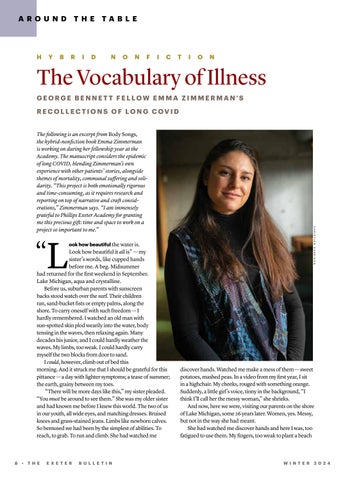
The following is an excerpt from Body Songs, the hybrid-nonfiction book Emma Zimmerman is working on during her fellowship year at the Academy. The manuscript considers the epidemic of long COVID, blending Zimmerman’s own experience with other patients’ stories, alongside themes of mortality, communal suffering and solidarity. “This project is both emotionally rigorous and time-consuming, as it requires research and reporting on top of narrative and craft considerations,” Zimmerman says. “I am immensely grateful to Phillips Exeter Academy for granting me this precious gift: time and space to work on a project so important to me.”
E X E T E R
B U L L E T I N
discover hands. Watched me make a mess of them — sweet potatoes, mashed peas. In a video from my first year, I sit in a highchair. My cheeks, rouged with something orange. Suddenly, a little girl’s voice, tinny in the background, “I think I’ll call her the messy woman,” she shrieks. And now, here we were, visiting our parents on the shore of Lake Michigan, some 26 years later. Women, yes. Messy, but not in the way she had meant. She had watched me discover hands and here I was, too fatigued to use them. My fingers, too weak to plant a beach
W I N T E R
20 24