4 NEWS
13 DEC 2023 | EXEPOSÉ
Students provide mixed reactions to ELE 2 Anabel Costa-Ferreira and Harry Craig Editor-in-Chief and Deputy Editor
A
FTER a term of the new ELE2 system being in place, Exeposé contacted students to enquire how they had found this change. At the start of this academic year, ELE and eBART were replaced by ELE 2, adjoining the sites used for course materials and assessment submission. While the new update has been welcomed by many, some students drew on concerns about how they’ve adapted to this change. It is particularly interesting to note that the concerns surrounding ELE 2 are focused largely on the assessment submission process as opposed to the course material element. As with ELE 1, the main purpose of ELE 2 is to provide a platform for students to access their module information and course materials. Opinion on this has been split, with students particularly liking that assessment submissions are now in the same place as their module tasks. One student told Exeposé that “having coursework submissions and weekly tasks all in one place can be very helpful.” Similarly, another student shared that they liked the tick-box system to see their module reading. Rob Freathy, Dean for Taught Students at the University of Exeter, said he was “delighted that students generally prefer ELE 2 for course materials”, and that “we believe this will further improve as academic colleagues became more familiar with the new platform.” There was, however, discontent following problems earlier in the term with lecture recordings. Students initially struggled to find these, as they are stored in a different place on module pages, and are
now available on the right-hand block drawer. Hubs informed students of this change via email on the 17th October, which appears to have resolved difficulties in finding these recordings. ELE 2 has also replaced eBART, which students formerly used to submit assessments. Many students shared concerns with Exeposé that the process of assessment submission had become more complicated than before, making it not only “harder to submit” but claimed it was “confusing our professors”. One student detailed an issue with a recent submission, with Turnitin unable to read the document, and whilst the problem was fixed, the general uncertainty with a new system has naturally caused anxiety when problems such as these arise. However, several students did praise the updated format of ELE 2. Freathy told Exeposé that, this term, the University set up around 3500 assessments and received 57,000 submissions through ELE 2. Introducing the new system, Freathy stated that ELE2 “offers a wide range of marking and feedback tools to help course tutors provide richer and more helpful feedback.” In particular, he noted the improvement to the assessment dashboard, with students now able to view all their assessment information, including submission deadlines and feedback dates. One student responded to Exeposé and shared that it was “good to see examination/coursework in the same place as the module content” and that, in particular, the “due in X-days feature is really helpful for keeping up with assignments.” One of the major issues students have had with the new assessment submission system is that, unlike eBART, ELE 2 no longer sends emails to notify students when they have received feed-
back on their assessment. Numerous students have said that this has caused them disruption, referring to the lack of emails as “incredibly inconvenient” and stating that “it’s much harder to find feedback”. One student told Exeposé that “you have to constantly check if you’ve got a mark back — an anxiety-inducing process”. Similarly, another noted that it is no longer possible to see the break-down of marks as per the mark scheme, stating that “I found it really useful with eBART to determine if, for example, my analysis was a 1st but perhaps my structure was at a 2:2.” When asked about the lack of email notifications, the University said that “to reduce unnecessary email traffic, we decided not to send email notifications when feedback is available. However, we’re happy to review this, if students would prefer both the dashboard and email notifications, so please let us know if you have strong views either way.” Similarly, students have also experienced problems with Turnitin when submitting their assessments through ELE 2. One student told Exeposé that they “cannot see the Turnitin score or report until a week after you submit”. The University responded to this by stating that “visibility to the Turnitin similarity score for students is set according to individual Faculty/Department policy.” They continued by acknowledging that some students have experienced issues with Turnitin feedback, noting that “in some cases we’ve had reports that this setting has not been enabled when the assessment has been set up.” They urged anyone who previously had access to this and can no longer see it to check with their course tutor or Hub. Students have also had mixed reac-
Image: Harry Craig
tions to the fact that they are no longer able to access other courses beyond their own modules. One student in particular noted the disadvantages of only seeing modules they were enrolled in, as “others may have information that’s useful to you.” In response to this, the University explained that, while they were once “an outlier in the sector in allowing students to access almost all courses in its virtual learning environment”, Exeter had “now, like other universities, restricted access to only the courses on which students are enrolled.” Freathy shared that this “enables us to better understand how individual cohorts of students are engaging with our online materials, what resources are proving most useful, and where we can make improvements year-by-year.” He also stated that “we will also be able to identify where students may be struggling because they haven’t engaged sufficiently with the resources available.” When speaking to a lecturer about how they’ve adapted to the new system, they stated that while they “have
not yet engaged with all the new marking tools offered by ELE 2, it does seem to promise a smoother marking process and new varieties by which students can receive feedback on their assessments.” In particular, they praised that “it is great that everything now, including submission and assessment, can be found in the same place with the rest of the module materials on ELE.” While there have been challenges for staff, as expected with most new systems, they stated that “colleagues at the department and from professional services have been working very hard to offer support and troubleshoot issues as they emerge, and I hope that with more time taken to adapt to ELE 2 we can begin to make more use of the advantages it offers.” In acknowledgement of the issues raised by students, the University recognised that while “there have been some teething issues as academics, Hub staff and students get used to it, we’re working closely with the Students Guild and Students Union to deliver the best possible student experience.”
Reclaim the Night march returns to Exeter in protest of sexual violence Livvy Mason-Myhill and Oliver Lamb Editor-in-Chief and News Editor
A
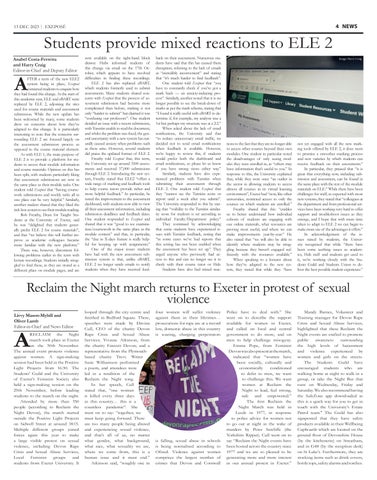
RECLAIM the Night march took place in Exeter on the 30th November. The annual event protests violence against women. A sign-making session had been held in the Positive Light Projects from 16:30. The Students’ Guild and the University of Exeter’s Feminist Society also held a sign-making session on the 29th November, before leading students to the march on the night. Attended by more than 350 people (according to Reclaim the Night Devon), the march started outside the Positive Light Projects on Sidwell Street at around 18:15. Multiple different groups joined forces again this year to make a large visible protest on sexual violence, including Devon Rape Crisis and Sexual Abuse Services, Local Feminist groups and students from Exeter University. It
looped through the city centre and finished in Bedford Square. There, speeches were made by Davina Cull, CEO of the charity Devon Rape Crisis and Sexual Abuse Services; Yvonne Atkinson, from the charity Fawcett Devon; and a representative from the Plymouthbased charity Trevi. Writer Susie Williamson performed a poem, and attendees were led in a rendition of the Reclaim the Night song. In her speech, Cull stated that, “one woman is killed every three days in this country… this is a countless pandemic”. She went on to say: “together, we must keep going forward. There are too many people being abused and experiencing sexual violence, and that’s all of us, no matter what gender, what background, what race, what sexuality we are, where we come from, this is a human issue and it must end.” Atkinson said, “roughly one in
four women will suffer violence against them in their lifetimes… prosecutions for rape are at a record low, domestic abuse in this country is soaring, charging perpetrators Image: Livvy Mason-Myhill
is falling, sexual abuse in schools is being normalised according to Ofsted. Violence against women comprises the largest number of crimes that Devon and Cornwall
Police have to deal with.” She went on to describe the support available for women in Exeter, and called on local and central government to do more, and on men to help challenge misogyny. Emma Pope, from Feminist Devon was also present at the march, indicated that “women have been socially, culturally and economically conditioned to defer to men, we want to challenge this. We want women at Reclaim the Night to lead, feel strong, safe and empowered.” The first Reclaim the Night March was held in Leeds in 1977, in response to police advice for women not to go out at night in the wake of murders by Peter Sutcliffe (the Yorkshire Ripper). Cull went on to say “Reclaim the Night events have been hosted across the country since 1977 and we are so pleased to be generating more and more interest in our annual protest in Exeter.”
Mandy Barnes, Volunteer and Training manager for Devon Rape Crisis and Sexual Abuse Services, highlighted that these Reclaim the Night events are crafted to promote public awareness surrounding the high levels of harassment and violence experienced by women and girls on the streets. The Students Guild have encouraged students who are walking home at night to walk in a group, or take the Night Bus that runs on Wednesday, Friday and Saturday. We also recommend having the SafeZone app downloaded as this is a quick way for you to get in touch with the University’s Estate Patrol team." The Guild has also signposted that they have safety products available in their Wellbeing Cupboards which are located on the ground floor of Devonshire House (by the kitchenette) on Streatham, and in G48 (by the reception desk) on St Luke’s. Furthermore, they are stocking items such as drink covers, bottle tops, safety alarms and torches.