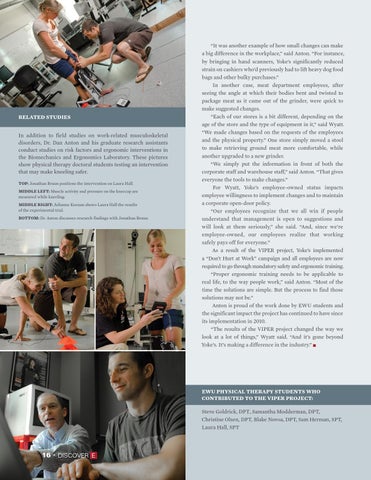
RELATED STUDIES In addition to field studies on work-related musculoskeletal disorders, Dr. Dan Anton and his graduate research assistants conduct studies on risk factors and ergonomic interventions in the Biomechanics and Ergonomics Laboratory. These pictures show physical therapy doctoral students testing an intervention that may make kneeling safer. TOP: Jonathan Braun positions the intervention on Laura Hall. MIDDLE LEFT: Muscle activity and pressure on the kneecap are measured while kneeling. MIDDLE RIGHT: Julianne Keenan shows Laura Hall the results of the experimental trial. BOTTOM: Dr. Anton discusses research findings with Jonathan Braun.
“It was another example of how small changes can make a big difference in the workplace,” said Anton. “For instance, by bringing in hand scanners, Yoke’s significantly reduced strain on cashiers who’d previously had to lift heavy dog food bags and other bulky purchases.” In another case, meat department employees, after seeing the angle at which their bodies bent and twisted to package meat as it came out of the grinder, were quick to make suggested changes. “Each of our stores is a bit different, depending on the age of the store and the type of equipment in it,” said Wyatt. “We made changes based on the requests of the employees and the physical property.” One store simply moved a stool to make retrieving ground meat more comfortable, while another upgraded to a new grinder. “We simply put the information in front of both the corporate staff and warehouse staff,” said Anton. “That gives everyone the tools to make changes.” For Wyatt, Yoke’s employee-owned status impacts employee willingness to implement changes and to maintain a corporate open-door policy. “Our employees recognize that we all win if people understand that management is open to suggestions and will look at them seriously,” she said. “And, since we’re employee-owned, our employees realize that working safely pays off for everyone.” As a result of the VIPER project, Yoke’s implemented a “Don’t Hurt at Work” campaign and all employees are now required to go through mandatory safety and ergonomic training. “Proper ergonomic training needs to be applicable to real life, to the way people work,” said Anton. “Most of the time the solutions are simple. But the process to find those solutions may not be.” Anton is proud of the work done by EWU students and the significant impact the project has continued to have since its implementation in 2010. “The results of the VIPER project changed the way we look at a lot of things,” Wyatt said. “And it’s gone beyond Yoke’s. It’s making a difference in the industry.”
EWU Physical Therapy Students who contributed to the VIPER Project: Steve Goldrick, DPT, Samantha Modderman, DPT, Christine Olsen, DPT, Blake Novoa, DPT, Sam Herman, SPT, Laura Hall, SPT
16 » DISCOVER E