Volume 12 Number 2 May 2012 Published by European Wound Management Association
MY FOOT
The EWMA Journal ISSN number: 1609-2759 Volume 12, No 2, May, 2012 Electronic Supplement May 2012 www.ewma.org
EWMA Council Jan Apelqvist President
The Journal of the European Wound Management Association Published two times a year
Zena Moore
Immediate Past President
Editorial Board Sue Bale, UK, Editor Jan Apelqvist, Sweden Martin Koschnick, Germany Zena Moore, Ireland Marco Romanelli, Italy Rytis Rimdeika, Lithuania José Verdú Soriano, Spain Rita Gaspar Videira, Portugal Salla Seppänen, Finland
Corrado M. Durante
Gerrolt Jukema
Patricia Price
EWMA Journal Editor
Sue Bale
Barbara E. den Boogert-Ruimschotel
Mark Collier
Javorka Delic
Eskild W. Henneberg
Dubravko Huljev
Nada Kecelj-Leskovec
Martin Koschnick
Recorder
Treasurer
Secretary
EWMA web site www.ewma.org Paulo Alves
Editorial Office please contact: EWMA Secretariat Nordre Fasanvej 113 2000 Frederiksberg, Denmark. Tel: (+45) 7020 0305 Fax: (+45) 7020 0315 ewma@ewma.org Layout: Birgitte Clematide
Luc Gryson
Printed by: CS Grafisk A/S, Denmark Copies printed: 12.000 Prices: The EWMA Journal is distributed in hard copies to members as part of their EWMA membership. EWMA also shares the vision of an “open access” philosophy, which means that the journal is freely available online. Individual subscription per issue: 7.50€ Libraries and institutions per issue: 25€ The next issue will be published in October 2012. Prospective material for publication must be with the editors as soon as possible and no later than August 1st, 2012. The contents of articles and letters in EWMA Journal do not necessarily reflect the opinions of the Editors or the European Wound Management Association. All scientific articles are peer reviewed by EWMA Scientific Review Panel. Copyright of published material and illustrations is the property of the European Wound Management Association. However, provided prior written consent for their reproduction, including parallel publishing (e.g. via repository), obtained from EWMA via the Editorial Board of the Journal, and proper acknowledgement and printed, such permission will normally be readily granted. Requests to reproduce material should state where material is to be published, and, if it is abstracted, summarised, or abbreviated, then the proposed new text should be sent to the EWMA Journal Editor for final approval. All issues of EWMA Journal are CINAHL listed.
2
Sebastian Probst
Elia Ricci
Rytis Rimdeika
Robert Strohal
Salla Seppänen
CO-OPERATING ORGANISATIONS’ BOARD Christian Thyse, AFISCeP.be Christian Münter, ICW Tommaso Bianchi, AISLeC Aleksandra Kuspelo, LBAA Roberto Cassino, AIUC Susan Knight, LUF Aníbal Justiniano, APTFeridas Loreta Pilipaityte, LWMA Gerald Zöch, AWA Corinne Ward, MASC Jan Vandeputte, BEFEWO Hunyadi János, MSKT Vladislav Hristov, BWA Suzana Nikolovska, MWMA Els Jonckheere, CNC Alison Johnstone, NATVNS Lenka Veverková, CSLR Kristin Bergersen, NIFS Nastja Kucišec-Tepeš, CWA Louk van Doorn, NOVW Martin Koschnick, DGfW Arkadiusz Jawie´n, PWMA Bo Jørgensen, DSFS Severin Läuchli, SAfW (DE) Anna Hjerppe, FWCS Hubert Vuagnat, SAfW (FR) Pedro Pacheco, GAIF Goran D. Lazovic, SAWMA J. Javier Soldevilla, GNEAUPP Mária Hok, SEBINKO
José Verdú Soriano
F. Xavier Santos Heredero, SEHER Sylvie Meaume, SFFPC Susanne Dufva, SSIS Jozefa Košková, SSOOR Leonid Rubanov, STW (Belarus) Guðbjörg Pálsdóttir, SUMS Javorca Delic, SWHS Serbia Magnus Löndahl, SWHS Sweden Alison Hopkins, TVS Jasmina Begi´c-Rahi´c, URuBiH Zoya Ishkova, UWTO Barbara E. den Boogert-Ruimschotel, V&VN Georgina Gethin, WMAI Skender Zatriqi, WMAK Nada Kecelj Leskovec, WMAS Mustafa Deveci, WMAT
EWMA JOURNAL SCIENTIFIC REVIEW PANEL Paulo Jorge Pereira Alves, Portugal Caroline Amery, UK Jan Apelqvist, Sweden Sue Bale, UK Michelle Briggs, UK Stephen Britland, UK Mark Collier, UK Rose Cooper, UK B. E. den Boogert-Ruimschotel, Netherlands Javorka Delic, Serbia Corrado Maria Durante, Italy Bulent Erdogan, Turkey Madeleine Flanagan, UK Milada Francu ˚, Czech Republic Peter Franks, UK Francisco P. García-Fernández, Spain
Luc Gryson, Belgium Marcus Gürgen, Norway Eskild W. Henneberg, Denmark Alison Hopkins, UK Gabriela Hösl, Austria Dubravko Huljev, Croatia Gerrolt Jukema, Netherlands Nada Kecelj, Slovenia Klaus Kirketerp-Møller, Denmark Karsten Knobloch, Germany Zoltán Kökény, Hungary Martin Koschnick, Germany Severin Läuchli, Schwitzerland Maarten J. Lubbers, Netherlands Sylvie Meaume, France Zena Moore, UK
Christian Münter, Germany Andrea Nelson, UK Pedro L. Pancorbo-Hidalgo, Spain Hugo Partsch, Austria Patricia Price, UK Sebastian Probst, Schwitzerland Elia Ricci, Italy Rytis Rimdeika, Lithuania Zbigniew Rybak, Poland Salla Seppänen, Finland José Verdú Soriano, Spain Robert Strohal, Austria Carolyn Wyndham-White, Switzerland Gerald Zöch, Austria
5 Editorial
Science, Practice and Education 7 A structured approach to s urgical treatment in deep infection in diabetic foot Cedomir S Vucetic, Javorka B Delic, Zoran S Vukasinovic, Goran Dz Tulic, Ivan K Dimitrijevic, Cedo Dj Vuckovic, Vesna K Kalezic
15 Endothelial progenitor cells, a unipotent stem cell, involved in neovascularization of wound healing in diabetic foot ulcer Jacqueline Chor Wing Tama, Chun Hay Ko, Ping Chung Leung, Kwok Pui Fung, Clara Bik San Lau
ELECTRONIC SUPPLEMENT May 2012
23 Bacteriophages for the treatment of severe infections: – a ‘new’ option for the future?
Daniel De Vos, Gilbert Verbeken, Thomas Rose, Serge Jennes, JeanPaul Pirnay
31 Developing evidence-based ways of working: – Employing interdisciplinary team w orking to improve patient outcomes in diabetic foot ulceration – our experience Kristien Van Acker
36 Exploring the characteristics of a venous leg ulcer that contribute to the emotional distress experienced by patients Jessica Walburn, John Weinman, Suzanne Scott, Kavita Vedhara
39 Development of a wound healing index for chronic wounds Juan Carlos Restrepo-Medrano, José Verdú Soriano
Cochrane Reviews 49 Abstracts of Recent Cochrane Reviews Sally Bell-Syer
EWMA 56 EWMA Journal Previous Issues and other Journals 58 EWMA Teacher network Zena Moore
58 Austrian Diabetic Foot Symposium, EWMA 2012 60 EWMA Update, The Patient Outcome Group Patricia Price
62 We want to make a difference! – EWMA future projects Jan Apelqvist
64 EU ‘Week For Life’ Jan Apelqvist
66 EWMA focus on multidisciplinarity in wound management Jan Apelqvist
68 EWMA participation in EU Conference on Antimicrobials Resistance – it’s time to take joint action! Rytis Rimdeika
70 Eucomed, Woundcare reflections on the EU 2020 strategy Hans Lundgren
Organisations 72 EWMA Corporate Sponsors 73 Conference Calendar 74 10th DFCon Global Diabetic Foot Conference. EWMA President Jan Apelqvist receives Diabetic Foot Award. Diabetic Foot Experts Attend Global Meeting to Share Ideas on Amputation Prevention 75 AAWC, The Association for the Advancement of Wound Care Terry Treadwell
The May 2012 edition of the EWMA Journal Electronic Supplement consist of all the accepted abstracts for the EWMA 2012 Conference in Vienna. It is divided into Oral presentations and Poster presentations and it is possible to download individual abstracts as well as the entire supplement (including all the abstracts) at www.ewma.org/english/ewma-journal/ electronic-supplement.html
76 AWMA, The Australian Wound Management Association national conference Bill McGuiness
78 DEBRA International John Dart
80 EPUAP, News from the European Pressure Ulcer Advisory Panel – Latin American Activities on Prevention of Pressure Ulcers Michael Clark
82 EWMA Cooperating Organisations
WWW.EWMA.ORG 3
Customised V.A.C. Therapy, for fewer blocks to wound healing. ®
No two wounds are alike, so treatment options require maximum flexibility. Introducing V.A.C. VeraFlo™ Therapy, a customized approach to wound healing, now available with the new V.A.C.Ulta™ System. V.A.C. VeraFlo™ Therapy unites proven V.A.C.® Therapy power with automated distribution and removal of wound irrigation solutions, addressing a variety of wound types. Together with specialized wound dressings and a streamlined user experience, it all combines to help remove the blocks to wound healing.
Note: Specific indications, contraindications, warnings, precautions and safety information exist for KCI products and therapies. Please consult a physician and product instructions for use prior to application. ©2010 KCI Licensing, Inc. All Rights Reserved. The MEGA BLOKS blocks are used with the permission of MEGA Brands Inc. All other trademarks are proprietary to KCI Licensing, Inc., its affiliates and/or licensors. This material intended for healthcare professionals. DSL#10-0299.EMEA (Rev. 2/12)
Editorial t is a great pleasure for me to introduce the theme of this issue of the EWMA Journal: The diabetic foot. This is not only because it is my area of expertise but also because it gives EWMA an opportunity to highlight some of the many important activities that have been initiated by the diabetic foot organisations in Europe and internationally, as well as the activities that EWMA is currently supporting.
I
The diabetic foot will also be covered thoroughly during the EWMA 2012 Con ference in Vienna. In addition to a key session on the diabetic foot, an Austrian Diabetic Foot Symposium will be held on Thursday 24 May. The symposium is arranged in collaboration with AWA1, DFSG1 and IWGDF1 and will focus on implementation of the IWGDF guidelines on management of the diabetic foot and offer international examples of the organisa tion of treatment. The diabetic foot counts for a substantial number of hard to heal ulcers treated in pri mary and secondary care settings throughout the world. Due to the high risk of amputa tions, long healing rates and risk of adverse
events, treatment of the diabetic foot is a costly process which calls for involvement of many different disciplines and care set tings2,3. Without a well defined organisation of treatment, patients are often lost in the system. These challenges are similar with regards to all patients suffering from hard to heal ulcers. Thus the diabetic foot case illustrates the general need for interdisciplinary care as well as the need for a fundamental change in the health care system with regards to health economics and reimbursement strategies. In this issue of the EWMA Journal you will find two scientific articles on treatment of the diabetic foot as well as a background arti cle on the effect of interdisciplinary teams on patient outcomes in diabetic foot ulceration. Throughout the journal you will also find information about different initiatives aiming to support improved prevention and treatment of the diabetic foot. We hope you will enjoy reading this issue. Jan Apelqvist, EWMA President
1 Austrian Wound Association (AWA), Diabetic Foot Study Group (DFSG) and The International Working Group on the Diabetic Foot (IWGDF) 2
Apelqvist, J, Larsson, J: What is the most effective way to reduce incidence of amputation in the diabetic foot?, Diabetes/metabolism research and reviews, Diabetes Metab Res Rev 2000; 16 (Suppl 1); pp. 75-S83
3 Driver Vickie R, Fabbi M, Lavery L A, Gibbons G: The cost of diabetic foot: The economic case for the limb salvage team, Journal of vascular surgery, September Supplement 2010
EWMA Journal
2012 vol 12 no 2
5
ETHICAL COLLABORATION IN HEALTHCARE
CERTIFIED
Licensed by Eucomed
Science, Practice and Education
A structured approach to surgical treatment in deep infection in diabetic foot ABSTRACT Background: It is generally acknowledged that chronic wounds can take months or years to heal. Patients often need to undergo many therapeutic procedures to support and promote the best en vironment for healing, including the prevention and early treatment of bacterial load and infec tion. This is especially pertinent to the manage ment of patients with diabetic foot ulceration, who are prone to osteomyelitis as the most com mon complication. Aim: The aim of this study is to test a surgical pro tocol applied in the treatment of bone infection and chronic wounds related to bone infection. Methods: In management of ulcers III-V level, Wagner classification, surgical treatment was ap plied. Surgical debridement and soft-tissue recon struction were carried out. Results: Surgical treatment included 23 patients with ulcers. Ulcers were classified according the Wagner classification as level III 8 (34.5%), level IV 8 (34.5%) and level V 7 (30.4%). Sur gical treatment included: surgical debridement 23 patients (100%), bone resection 11 patients (47.8%), disarticulation 2 patients (8.7%), per fusion 2 patients (8.7%), antibiotic instillation 3 patients (13%), suture or approximation of the wound border lines 14 patients (60.9%). Dura tion of the treatment after operation until the wound healing and the end of the secernation were reached was overall 7.5 weeks (2-16 weeks). Conclusion: Surgical treatment includes the ex ploration of the changed bone and minimal re section which spares the bone. It is advisable to undertake surgical treatment without delay and additional diagnostic procedures. Surgical treat ment, followed by local and systemic application of antibiotics, achieves shorter healing time and more successful patient outcomes. Key words: chronic wounds, osteomyelitis, dia betic foot ulcers, local antibiotics
INTRODUCTION It is generally acknowledged that chronic wounds can take months or years to heal. Patients often need to undergo many therapeutic procedures to support and promote the best environment for healing, including the prevention and early treatment of bacterial load and infection. This is especially pertinent to the management of patients with diabetic foot ulceration, who are prone to osteomyelitis as the most common complication. Chronic wounds have been defined as having multiple physiological impairments to healing, including: inadequate angiogenesis, impaired innervation, direct pressure, microcirculatory ischemia and impaired cellular migration, all of which may contribute to extensive morbidity1. The therapeutic possibilities are huge, often with big limitations and also including the amputa tion surgery. Chronic bone and joint infection is followed by appearance of fistulas, skin defects, metaplasia, and sometimes by malignant altera tion, permanent or periodical secretion. Bone and joint infection appearance on the skin cannot be treated separately from general treatment of bone and joint infection (fig.1, 2, 3). Current treatment options for diabetic foot ulcers (DFU) include of floading to reduce pressure on the wound, wound care to prevent infections, and wound debride ment to remove necrotic debris and re-stimulate the wound healing process2. Approximately 2-2.5% of patients with dia betes mellitus have complication on their feet3,2. If there are infected ulcers on feet, the level of osteomyelitis is high, 66% 4. Among outpatients with diabetic foot the level of osteomyelitis ap pearance is 10-20% 5,6. Diabetic foot ulcrs have osteomyelitis as the most common complication. It is also possible that osteomyelitis appears as a complication in soft tissue infection without the initial ulcers. Reduced circulation, tissue trophic and neuropathy result
1,2 Cedomir S Vucetic, MD PhD 3Javorka
B Delic, MD, S Vukasinovic, MD PhD, 1,2 Goran Dz Tulic, MD PhD, 2,5 Ivan K Dimitrijevic, MD PhD, 1Cedo Dj Vuckovic, MD PhD 2,6 Vesna K Kalezic, MD PhD 2,4Zoran
1Institute for Orthopaedic Surgery and Traumatology, Clinical Center of Serbia, Belgrade 2School
of Medicine, niversity of Belgrade, U Belgrade, Serbia
3Institute for Dermato- Venereal Diseases, Belgrade 4Institute of Orthopaedic Surgery Banjica, Belgrade 5Clinic for Psychiatry, linical Center of Serbia, C Belgrade 6Clinic
for endocrinology, diabetes and metabolic diseases, Clinical Center of Serbia, Belgrade Correspondence: cedomir.vucetic@ gmail.com Conflict of interest: none Acknowledgement This work is supported by grant number III 41004, Ministry of Education and Science Republic of Serbia.
EWMA Journal
2012 vol 12 no 2
7
in the foot being vulnerable to infection. The early detec tion of the clinical signs of infection in the diabetic foot includes the evaluation of the foot for bone infection. The possibility of bone infection is significantly greater if there is a several weeks’ presence of soft tissue infection or fistula. Plain film radiography of the foot can usually show the bone exposure and signs of osteomyelitis. Primary phase or acute state can show bone demineralisation, diffuse lytic changes on the bone, localised circular changes or confluent changes, with or without sclerotic parts of the bone. Chronic osteomyelitis form comes with sequestra and with more expressive sclerotic and osteolitic parts of the bone. There are several clinical signs of osteomyelitis: swelling and the ’sausage’ look of the finger; probe-to-bone test; deep ulcer. Laboratory indicators of infection are higher sedimen tation of erythrocytes (SE), higher number of leukocytes, C-reactive protein (CRP), procalcitonin, bacteriologi cal smear examination, bone biopsy for bacteriological and histological examination, repeated radiographic ex amination, bone scintigraphy (99mTc diphosphonate), labelled autologous leucocyte scanning (111In oxine or 99mTc-HMPAO), antigranulocyte scintigraphy (AGS), computed tomographic (CT), and magnetic resonance imaging (MRI)3,7,8.
Therapeutic strategies: Literature describes various approaches to osteomyelitis healing in diabetic foot. Surgical exploration of infected part of the bone and bone resection until reaching the healthy part are marked as the traditional surgical ap proach. The advantages of this surgical approach are radi cally removing the bone changed by infection and faster healing. The disadvantages are more bone removed than necessary, possible disturbance of the foot biomechanics, and greater surgical procedure. Conservative surgery in osteomyelitis healing in dia betic foot is an approach in which only the sequestra are removed with very limited bone removal. The advantage of this kind of healing is greater savings but the risk is longer healing times. Healing supported by the use of dressings and followed by systemic antibiotic therapy, can achieve the wanted result of healing even in 85% of osteomyelitis. Healing by antibiotics alone prolongs healing time to/by 12-24 weeks3.
AIM: The aim of this study is to evaluate the surgical proto col applied in treatment of bone infection and chronic wounds, which are related to bone infection in the treat ment of diabetic foot ulcers.
8
a
b
c
d
e
f
g
h
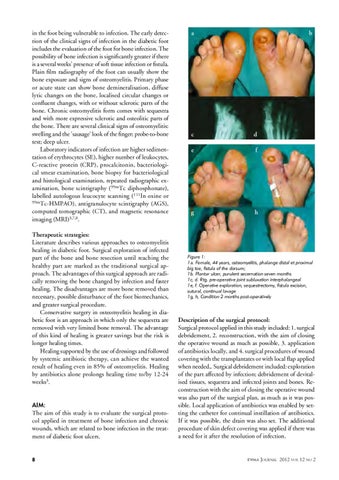
Figure 1: 1a. Female, 44 years, osteomyelitis, phalange distal et proximal big toe, fistula of the dorsum; 1b. Plantar ulcer, purulent secernation seven months 1c, d. Rtg. pre-operative joint subluxation interphalangeal 1e, f. Operative exploration, sequestrectomy, fistula excision, sutural, continual lavage 1g, h, Condition 2 months post-operatively
Description of the surgical protocol: Surgical protocol applied in this study included: 1. surgical debridement, 2. reconstruction, with the aim of closing the operative wound as much as possible, 3. application of antibiotics locally, and 4. surgical procedures of wound covering with the transplantates or with local flap applied when needed,. Surgical debridement included: exploration of the part affected by infection; debridement of devital ised tissues, sequestra and infected joints and bones. Re construction with the aim of closing the operative wound was also part of the surgical plan, as much as it was pos sible. Local application of antibiotics was enabled by set ting the catheter for continual instillation of antibiotics. If it was possible, the drain was also set. The additional procedure of skin defect covering was applied if there was a need for it after the resolution of infection.
EWMA Journal
2012 vol 12 no 2
Science, Practice and Education
a
b
c
d
Figure 2: 2a. Male, 67 years. Condition after the amputation of IV finger and resection of the V MT bone 2b. Rtg after the second operation resection of IV and V MT bone 2c. condition one week after the operation, debridement and approximation of wound’s lines with local instillation of antibiotics 2d. condition 5 weeks after the operation
METHODS Ulcers on diabetic foot level III-V, according to Wagner, were surgically treated. The applied osteomyelitis treat ment at diabetic foot is the synthesis of surgical treatment which intends to save as much as possible while carrying out necessary debridement and providing the necessary conditions for wound healing. Practically, that meant the use of minimally invasive surgery, which included debri
dement and soft-tissue reconstruction. When there were clinical signs of infection and ulcers which reached the fasciae and tendons with secernation, these demanded use of incision, necrectomy, detritus debridement and possi ble exploration. If there was no rapid calming of clinical signs of infection during the first week of the treatment, or if there was clinically obvious infection of a chronic nature, clinical exploration with sparing removing of in fected part of the bone and soft-tissue reconstruction was done (fig.2). In cases of chronic forms of osteomyelitis after the resection of part of the bone or after the debride ment, we applied perfusion drainage or local instillation of antibiotics (fig.1e, 2c). The antibiotics were given lo cally for not more than two weeks, followed by parenteral systemic antibiotic therapy for 2-6 weeks. Osteomyelitis with smaller ulcers can be healed in two weeks. When there is also a skin defect, it is often necessary to carry out the additional skin transplant. In diabetic foot, we can see a difference between chronic and acute infection and also a difference in intensity between the low-intensive infec tion and high-intensive infection (tempestuous reaction). Acute infection appears suddenly, after a minor injury or without a noticeable injury. Locally, only some signs of inflammation can be noticed, swelling, pain, colour, induration, with or without recurrence. Acute infection can be of low-intensity, when there is a clinical presence of local changes, but without noticeable significant systemic changes. Acute infection of high-intensity is followed by tempestuous local changes and systemic response (febric ity, sepsis). Local changes are colour and swelling of entire foot, secernation or present abscess, and often also skin necrosis. It is possible that infection develops fast over sev eral hours or days. Chronic infection of low-intensity looks like a typical ulcer with smaller secernation, but without the usual clinical signs of infection; it is long-lasting and can be treated non-operatively. Chronic infection of high intensity can turn over to the acute form and vice versa, just as the infection of low-intensity can have the char acteristics of high-intensity infection and vice versa, too (table 1).
Selecting patients for the study: The inclusion criteria were: diabetes mellitus type 1 and 2; patient’s age-over 18, foot ulcers level III, IV and V;
Table 1. Infection clasification in diabetic according the intensity and form criteria Chronic infection Acute infection Low intensity
it appears suddenly, after the minor injury, only some signs of inflammation smaller secernation
looks like basical ulcer with smaller secernation, without typical clinical signs of infection, long lasting, can be treated non-operatively
High intensity
febrility, sepsis, colour and swelling of entire foot, abscess or present secernation, often skin necrosis
without local swelling and colour, with ulcer or fistula with great purulent secernation.
EWMA Journal
2012 vol 12 no 2
9
treatment which includes surgical procedures, positive smear of the wound. The exclusion criteria were: inflammatory changes with necrosis or foot gangrene, which were the indication for below-knee amputation. The diagnosis of bone infection was based on clinical findings, radiographic changes on bones and microbiological findings of bones and tissue from the operating room. The indication for surgical treatment was based on clinical findings, the duration of ulceration and failure of previous treatment, operative or non-operative.
RESULTS In the study 23 patients were selected – 23 patients with ulcers, which were surgically treated. Of the patients, 19 were male (82.6%) and four were female (17.4%). The average age was 55 years and the age range included pa tients aged 44-78. Ulcers were classified according to the Wagner classification as level III eight patients (34.5%), level IV eight patients (34.5%) and level V seven patients (30.4%). The clinical classification of the wounds showed there were 20 patients with chronic wounds (87%), 15 with low-intensity infection (65.2%) and five with highintensity infection (21.7). There were three patients (13%) with acute wounds, one with low-intensity (4.4%) and two with high-intensity (8.7%). Surgical treatment included: surgical debridement 23, bone resections 11 (47.8%), dis articulation two (8.7%), perfusion two (8.7%), instillation of antibiotics three (13%), and suture or aproximation of wound’s border lines 14 (60.9%). Additional comorbid ity, which may cause changes on foot or which may have influence on present changes on foot, was recorded in eight patients (34.8%), two with terminal renal insufficiency (8.7%), three with neuropathic changes Scharcot (13%) and one with pes excavatus (4.4%). Healing duration af ter the operation until the wound healing and the end of wound secretion was on average 7.5 weeks, (2-16 weeks). Wound healing and bone infection cleansing seem to have an improved outcome. DISCUSSION Surgical technique in diabetic foot has some characteris tics, which should be considered. Generally, surgical in terventions on foot should be done in the operating room, just as every other type of bone surgery. Incisions, smaller debridements and necrectomies could be done as smaller surgical procedures. During the surgical exploration, the soft tissue should not be divided and, generally, every ma nipulation should be very sparing, so the vascularisation can be saved. During the debridement, the incision should follow the demarcation line, avoiding bleeding as much as possible. When the wound is closing, no kind of tension is 10
a
b
c
d
Figure 3: 3a. female, 54 years, osteomyelitis phalanges medialis et proximalis, dig.II ulceratio four months 3b. Rtg, inter-phalangeal joint subluxation 3c. operation: resection of proximal inter-phalangeal joint, debridemant, sutural, fixation with filli-K. 3d. condition 4 weeks after the operation
allowed. If there is no skin defect, the wound lines should be approximated. The flaps, which are formed, must have very wide basis. It is also important to consider whether wound drainage is necessary. Therapeutic approach in diabetic foot includes surgery, if there is a presence of ulcers and radiographic changes on bones (fig.1c, 2b, 3b). The chronic ulcers with changes on bones and joints can be persistent because of the bone infection or because of the pressure of the fragments, or both. These three situations need surgery as active therapy. Surgical treatment should include the resection of the part of the bone, which is infected or which protrudes out and presses the skin (fig.3). Surgical debridement and resec tion of part of the bone very often can enable the primary wound to close or make conditions better for surgical re construction of soft-tissues (fig.2). We based the diagnosis of bone infection on clinical findings, radiographic changes on bones and microbiologi cal findings of bones and tissue from the operating room. We based the indication for surgical treatment on clinical findings, the duration of ulceration and failure of previous treatment, operative or non-operative. This study showed that the applied procedure shortens the healing, avoids complications, often results in a smaller scar, prevents the recurrence and often corrects the inadequate anatomical relation. This procedure also means more radical treat EWMA Journal
2012 vol 12 no 2
Science, Practice and Education
ment, a larger procedure for the surgeon and also for the patient. Sometimes it is also necessary to repeat the surgical treatment. A large study reporting the surgical experience is needed to appraise the structured approach suggested in this study. Observations we have made in this series match the findings of other authors; after surgical treatment for osteomyelitis, low rate of recurrence was achieved9; early and aggressive soft tissue reconstruction is in the patient’s best interest and is crucial for resolution of the chronic non-healing wound10. Diabetic foot infections are a ma jor cause of morbidity. Infection is the common sequel of diabetic foot ulceration that leads to delayed wound healing11. We believe that bone biopsy remains the gold standard for the detection of osteomyelitis12-15. Realis ing that deep ulcers with detritus and secretion should be surgically treated, our opinion is that exploration and debridement should be done according to the clinical findings, even without the former confirmation of osteo myelitis diagnosis. It is best to take the bone tissue for histopathological and microbiological examination during the surgical treatment. This is important because there are recommendations which say that surgical percutane ous bone biopsy specimen after a 14-day antibiotic-free period represents the gold standard of care for diabetic foot osteomyelitis14. It is known that infection is the cause of great complications - major amputations are thought to be primarily due to arterial inflow and minor due to bone infection1. Radiology data revealed that 55% of the am putated limbs showed the presence of osteomyelitis com pared with 38% of the limbs of non-amputees (p=0.39)1. Osteomyelitis may underlie a diabetic ulcer and is often treated by resection of the infected bone and always by antibiotics, the mode and length of treatment depending on the adequacy of the debridement16. Considering that the surgical treatment is a must when there is a serious infection, necrosis, and long-termed secretion, it should not be delayed. On the contrary, surgical treatment should be used to enable 1 – the more complete exploration, 2 – debridement, 3 – taking the tissue samples for HP and microbiological examination, 4 – local antibiotic applica tion and 5 – reconstruction of the soft tissue covering on foot. The findings of other authors can be the confirma tion for this. Debridement is indicated when necrotic tis sue is present. Topical antibiotics should be considered if there is no improvement in healing after 14 days. Systemic antibiotics are used in patients with advancing cellulitis, osteomyelitis, or systemic infection17. Ray resection tech nique is recommended for localized necrosis, infection, and osteomyelitis and is an accepted procedure allowing removal of the diseased toe and metatarsal and limits softtissue dissection. Defects from the toe amputation can be primarily closed, covered with a split-thickness skin graft, or closed in delayed primary fashion with the use of a mini-external fixation device18. The observed group of EWMA Journal
2012 vol 12 no 2
patients with ulcers and bone infection, which was surgi cally treated, had shown a significantly shorter period of healing. Diabetic motor neuropathy is expressed as the loss of function and the contracting of the intrinsic muscles of the foot, leading to the classic claw toe deformity. The mean wound healing time was 25.6 +/- 6.2 days resec tion arthroplasty for toe deformities with chronic infected ulcers in diabetic patients is a good alternative treatment to toe amputation19. Prolonged time of healing has been described in chronic wounds. That some parameters can also show 50% reduction in the wound area at four weeks after treatment is a reliable indicator of healing1. The application of the simple clinical evaluation of the presence of bone infection may also be of interest to other authors, as may the active surgical approach with tissue reconstruction after the sanation of the infection. Simple clinical evaluation and laboratory findings without using expensive imaging methods may be important indicators of osteomyelitis - 1 ESR > or =65 mm/h together with a wound size > or =2 cm and also a sensitivity of 83%, specificity of 77%, and positive predictive value of 80%20. Osteomyelitis affects up to 32% of full-thickness pressure ulcers. Seven steps in this structured approach of care include: 1. acknowledgment of osteomyelitis risk in patients with Stage IV pressure ulcers, 2. clinical evalu ation for local or systemic signs of infection upon initial presentation, 3. radiographic evaluation, 4. surgical de bridement to remove all nonviable tissue and/or scarred and infected bone, 5. obtaining pathology reports from sterile bone biopsy and deep microbial cultures, 6. targeted systemic antimicrobial therapy, and 7. tissue reconstruc tion following resolution of infection21. Experiences with local application of antibiotics - surgical debridement, im plantation of gentamicin polymethylmethacrylate beads and long-term intravenous antibiotics - show the certain advantage of this kind of healing. In the instillation group the rate of recurrence of infection was just 10%, whereas it was 58.5% in the control group22.
CONCLUSION The results of surgical treatment on diabetic foot, type Wagner III-V with bone infection, show significantly shorter duration. The applied surgical treatment includes: 1. choosing the patients by clinical findings, laboratory parameters, inflammation and radiographies; 2. surgical debridement with sparing resection of modi fied bone; 3. local application of antibiotics at chronic infection and higher-intensity infection, 4. intention for carrying out the approximation of wound border-lines and reconstruction of the softtissue defect;
11
Science, Practice and Education
5. local application of antibiotics no longer than two weeks and parentelal application no longer than six weeks, 6. the use of general methods of healing the complica tions of diabetic foot; relief and metabolic balance.
7. Jeff G. van Baal. Surgical treatment of the infected diabetic foot. CID 2004;39 S123-9
Surgical treatment includes exploration of the exposed bone and sparing resection. It is better to do the surgical treatment without delay and additional diagnostic pro cedures. Surgical treatment, with local and systemic an tibiotic application achieves shorter and more successful healing. Earlier treatment of diabetic foot ulcers which have lasted for several months or even several years can be ended in few weeks. m
11. Nagoba BS, Gandhi RC, Wadher BJ, Rao A, Hartalkar AR, Selkar SP. A simple and effective approach for the treatment of diabetic foot ulcers with different Wagner grades. Int Wound J. 2010 Jun;7(3):153-8. Epub 2010 Apr 23.
Reference: 1. Glinka MS, Margolis DJ, Tal A, Hoff tad O, Boulton AJM, Brem H. Preliminary development of a diabetic foot ulcer database from a wound electronic medical record: A tool to decrease limb amputations. Wound Repair Regen. 2009 Sep–Oct; 17(5): 657–665. doi: 10.1111/j.1524-475X.2009.00527.x PMCID: PMC2835515 2. Nouvong A, Hoogwerf B, Mohler E, Davis B, Tajaddini A, Medenilla E. Evaluation of Diabetic Foot Ulcer Healing With Hyperspectral Imaging of Oxyhaemoglobin and Deoxyhaemoglobin Diabetes Care. 2009 November; 32(11): 2056–2061. doi: 10.2337/dc08-2246 3. Hartemann-Heurtier A. Senneville E. Diabetic foot osteomyelitis. Diabetes & Metabolism 34 (2008) 87-95. 4. Grayon ML, Gibbons GW, Balogh K, Levin E, Karchmer AW. Probing to bone in infected pedal ulcers. A clinical sign of underlying osteomyelitis in diabetic patients. JAMA 1995;273:721-3. 5. Shone A, Burnside J, Chipchase S, Game F, Jeffcoate W. Probing the validity of the probe-to-bone test in the diagnosis of osteomyelitis of the foot in diabetes. Diabetes care (letter) 2006;29:945. 6. Lavery LA, Armstrong DG, Peters EJ, Lipsky BA, Probe-to-bone test for diagnosing diabetic foot osteomyelitis: reliable or relic? Diabetes care 2007;30:270-4.
8. Robinson AHN, Paspula C. Brodsky JW. Surgical aspects of the diabetic foot. JBJS Br 2009;91-B 1-8. 9. Sánchez JA, Martínez JLL, Herrero CH, Vilorio NC, Marrero YQ, Morales EG, Herrero MJH. Does osteomyelitis in the feet of patients with diabetes really recur after surgical treatment? Natural history of a surgical series. Diabet Med. 2011 Dec 8. doi: 10.1111/j.1464-5491.2011.03528.x. 10. Capobianco CM, Stapleton JJ, Zgonis T. Soft tissue reconstruction pyramid in the diabetic foot. Foot Ankle Spec. 2010 Oct;3(5):241-8. Epub 2010 Jul 7.
12. Miller AO, Henry M. Update in diagnosis and treatment of diabetic foot infections. Phys Med Rehabil Clin N Am. 2009 Nov;20(4):611-25. 13. Lipsky AB.Medical treatment of diabetic foot infections.CID 2004;39:S 104-14. 14. Lesens O, Desbiez F, Vidal M, Robin F, Descamps S, Beytout J, Laurichesse H, Tauveron I. Culture of per-wound bone specimens: a simplified approach for the medical management of diabetic foot osteomyelitis. Clin Microbiol Infect. 2011 Feb;17(2):285-91. doi: 10.1111/j.1469-0691.2010.03194.x. 15. Iori I, Pizzini AM, Arioli D, Favali D, Leone MC. Infected pressure ulcers: evaluation and management. Infez Med. 2009 Sep;17 Suppl 4:88-94. 16. Vuorisalo S, Venermo M, Lepäntalo M.Treatment of diabetic foot ulcers. J Cardiovasc Surg (Torino). 2009 Jun;50(3):275-91. 17. Bluestein D, Javaheri A. Pressure ulcers: prevention, evaluation, and management. Am Fam Physician. 2008 Nov 15;78(10):1186-94. Minimum-incision ray resection. Oznur A, Roukis TS. Clin Podiatr Med Surg. 2008 Oct;25(4):609-22. 18. Oznur A, Roukis TS. Minimum-incision ray resection. Clin Podiatr Med Surg. 2008 Oct;25(4):609-22. 19. Kim JY, Kim TW, Park YE, Lee YJ. Modified resection arthroplasty for infected non-healing ulcers with toe deformity in diabetic patients. Foot Ankle Int. 2008 May;29(5):493-7. 20. Ertugrul BM, Savk O, Ozturk B, Cobanoglu M, Oncu S, Sakarya S. The diagnosis of diabetic foot osteomyelitis: examination findings and laboratory values. Med Sci Monit. 2009 Jun;15(6):CR307-12. 21. Rennert R, Golinko M, Yan A, Flattau A, Tomic-Canic M, Brem H. Developing and evaluating outcomes of an evidence-based protocol for the treatment of osteomyelitis in Stage IV pressure ulcers: a literature and wound electronic medical record database review. Ostomy Wound Manage. 2009 Mar;55(3):42-5. 22. Timmers MS, Graafland N, Bernards AT, Nelissen RG, van Dissel JT, Jukema GN. Negative pressure wound treatment with polyvinyl alcohol foam and polyhexanide antiseptic solution instillation in posttraumatic osteomyelitis. Wound Repair Regen. 2009 Mar-Apr;17(2):278-86.
ww
VIS rna IT lof wo NO und car W e.c om :
w.j ou
JWC is read by a wide audience, including doctors, nurses, podiatrists, physiotherapists and occupational therapists involved in wound care.
SUBSCRIBE TODAY and receive special rates online by visiting www.journalofwoundcare.com/EWMA
/EW
MA
volume 20. number 11. november 2011
journal rnall off wound d care
WC
?? ?? ?
volume 20. number 10. october 2011
journal of wound care
C
Journal of Wound Care is a leading international MEDLINE-listed wound care journal, with a loyal global audience and contributors from every continent. Every month, JWC provides a truly global perspective on wound care, from the latest in evidence-based practice to cutting-edge research from the US, Europe and elsewhere.
WC
?? ?? ?
C
journal of wound care
C
As a member of EWMA, you need access to the latest international developments in wound management and prevention.
WC
?? ?? ?
volume 20. number 9. september 2011
The patient experience of complex wounds treated with NPWT Ultrasound assessment of necrotic tissue in pressure ulcers with undermining Chronic plantar ulcer secondary to congenital indifference to pain Manuka honey as an effective treatment for chronic pilonidal sinus wounds Silver and nanoparticles of silver in wound dressings Efficacy of a PHMB-containing biocellulose dressing in the treatment of biofilms
Quantitative estimation of exudate volume for full-thickness pressure ulcers
JWC_20_11_cover.indd 1
A proposed method of evaluating orbital exenteration wounds Modelling the cost-effectiveness of bioelectric stimulation therapy in chronic VLUs The effect of temperature and humidity on the permeability of film dressings 03/11/2011 14:44
Evaluation of the skin stripping of wound Complex lower extremity wounds treated with skin grafts and NPWT dressing adhesives The effect of simulated leg-length discrepancy on plantar pressure distribution
JWC_20_10_cover.indd 1
Wound healing through synergy of hyaluronan and an iodine complex Innovation in tissue viability documentation for acute services Necrosis in breast cancer patients with skin metastases receiving bevacizumab 04/10/2011 15:22
A chronic wound with EPA has a 90% probability it won’t heal1 28% of non healing wounds have EPA1 There are no visual cues to detect EPA2,3
UNTIL NOW
NOW YOU CAN DETECT EPA IN 15 MINUTES Come and see us at EWMA stand 35.
Also, don’t miss out on our Symposium - Testing for EPA,
The arrival of wound diagnostics - Thursday 24th May, 16.00-17.00 Room E1.
For more information, contact us on EPA@systagenix.com or visit our website
SYS/GLO/862/0412
www.systagenix.com
References 1. Serena T. et al. Protease activity levels associated with healing status of chronic wounds. Poster, Wounds UK 2011. 2. Snyder R. et al. A survey: The importance of proteases in wound healing and wound assessment. Poster, Wounds UK 2011. 3. International consensus. The role of proteases in wound diagnostics. An expert working group review. London: Wounds International, 2011.
Askina Calgitrol Paste ®
®
A soft paste wound dressing containing 100% ionic silver: More intimate contact between the wound and active antimicrobial silver ions, particularly valuable in difficult to manage wounds. ■ ■
NEW
■ ■ ■ ■
Easy to apply on deep wounds and sinuses No activation needed Sustained controlled delivery of silver ions Antimicrobial efficacy against a broad spectrum of microorganisms, including MRSA Safe for use Non staining
B. Braun Hospicare Ltd. | Collooney | Co. Sligo | Ireland www.bbraun.com | www.woundcare-bbraun.com
Science, Practice and Education
Presented at EWMA 2011 Brussels · Belgium
Endothelial progenitor cells, a unipotent stem cell, involved in neovascularization of wound healing in diabetic foot ulcer
Abstract Foot ulceration associated with diabetic complica tions is prevalent in patients with diabetes world wide, leading to limb amputation. Reduction of peripheral blood flow and decrease in local neo vascularization are critical factors contributing to slow healing or non-healing wounds among these patients. Presumably, mature endothelial cells are regarded as the sole candidate for participation in angiogenesis in wound healing. In recent decades, endothelial progenitor cells (EPCs) have been rec ognized and are being investigated as the main cellular effectors responsible for postnatal neo vascularization and playing a vital role in wound healing. In this review, the role of EPCs involved in the neovascularization in wound healing will be evaluated. The process of EPCs from bone mar row to blood circulation requires a complex and sequential event including mobilization, homing, adhesion, transendothelial migration, differentia tion and finally incorporation to newly formed blood vessels. However, deficiency of circulating EPCs and functional defects of EPCs have been reported in diabetes, which adversely affect inter fering neovascularization of wound healing. Cellbased therapy using EPCs would be a promising therapeutic strategy for treating diabetic patients with non-healing wound. Besides, the establish ment of traditional Chinese medicine (TCM) in treating diabetic foot ulcer may develop new per spectives of EPCs’ involvement in diabetic wound healing. Introduction According to the data provided by World Health Organization, about 346 million people world wide have diabetes mellitus. The prevalence of diabetes has been increasing and represents a ma jor health burden for the 21st century. Diabetes mellitus is associated with various complications including cardiovascular disease, neuropathy, retinopathy, nephropathy and impaired wound
healing in lower extremities. Annually about 1% to 4% of those with diabetes eventually develop a foot ulcer and the annual incidence of amputation is 0.21-1.37%[1]. The pathophysiology of diabetic foot ulcer and impaired wound healing has been well described. The factors of delayed wound healing are con tributed to by progressive loss of sensory, motor and autonomic nervous system in diabetic pa tients leading to the loss of protective mechanisms upon injury in lower extremities. Development of peripheral vascular disease reduces the blood cir culation to the dermal area, thus minimizing the supply of nutrients for normal wound repair[2]. Wound healing is a well-orchestrated, in tegrated and complex process that involves he mostasis, inflammation, angiogenesis and tissue granulation[3]. The coordination of multiple cells including platelet, monocytes, macrophages, lym phocytes, endothelial cells, fibroblasts and kerati nocytes is essential for normal wound healing. However, the abnormal wound healing in diabe tes is characterized by diminished level of growth factors, cytokines and chemokines; elevated in flammatory response with enhanced proliferation of inflammatory cells; inhibition in angiogenesis with decreased proliferation, migration and tube format Restoring the blood flow to the wound site is the prerequisite for successful wound healing. It is generally believed that neovascularization is solely aroused by the formation of new blood ves sels from pre-existing blood vessels (angiogenesis). Over the past decades, the emergence of EPCs has provided a new perspective in the involvement of postnatal vasculogenesis in neovascularization. In 1997, Asahara et al. first isolated and identified circulating EPCs from human peripheral blood for postnatal neovascularization which is defined as the de novo formation of blood vessels with the recruitment and incorporation of EPCs. The find ings showed that EPCs differentiated into mature endothelial cells in vitro and incorporated actively
Jacqueline Chor Wing Tam1,2 Chun Hay Ko1,2 Ping Chung Leung1,2 Kwok Pui Fung1,2,3 Clara Bik San Lau1,2,3 1
Institute of Chinese Medicine, The Chinese University of Hong Kong, Shatin, New Territories, Hong Kong 2
State Key Laboratory of Phytochemistry and Plant Resources in West China, The Chinese University of Hong Kong, Shatin, New Territories, Hong Kong
3 School of Biomedical Sciences, The Chinese University of Hong Kong, Shatin, New Territories, Hong Kong
Correspondence: claralau@cuhk.edu.hk Winner of the EWMA 2011 First Time Presenters prize at EWMA 2011 conference in Bruxelles. Conflict of interest: none
EWMA Journal
2012 vol 12 no 2
15
1st International Course on The Neuropathic Osteoarthropathic Foot (Charcot) Advanced Postgraduate Course, Rheine, Germany
15-17 November, 2012
The international course will be based on the expertise gathered from 10 consecutive years of providing national courses on the Diabetic Foot. The main focus are practical sessions in small groups to train the diagnostic and treatment skills necessary for the interdisciplinary treatment of Charcot patients. The course will be held at the Mathias-Spital in Rheine.
into sites of angiogenesis in ischemic animal models[5]. After that, a growing body has proposed that bone mar row (BM)-derived EPCs can functionally participate in neovascularization in wound healing and limb ischemia[6, 7]. It has been estimated that EPCs contribute up to 25% of endothelial cells of newly formed vessels in animal mod els[8]. Substantial evidence has demonstrated the role of BM-derived EPCs in neovascularization[9,10,11]. In general, it is now well accepted that recruitment of EPCs in BM and the mature endothelial cells in pre-existing blood ves sels are essential in tissue vascularization in wound healing.
Origin of EPCs EPCs are adult hemangioblast-derived cells in BM. Im mature stem cells originally exist in a quiescent state as sociated with BM stromal cells. Under specific stimula tion and activation, stem cells will differentiate into EPCs preceding the mobilization of EPCs in peripheral blood for neovascularization. During their development, EPCs gradually lose stem cell characteristics and progressively gain mature endothelial cells characteristics. EPCs isolation and characterization Numerous methods have been adopted for the isolation of EPCs[12,13,14]. EPCs are often characterized by the combination of different cell surface markers, including CD34, CD133, CD146, platelet endothelial cell adhesion molecule-1 (PECAM-1), vascular endothelial cadherin (VE-cadherin), vascular endothelial growth factor recep tor 2 (VEGFR2) and von Willebrand factor (vWF)[15,16]. However, there is no defined set of markers which can identify EPCs population uniquely. The reasons may be attributed to the various origins of EPCs precursors during extraction and isolation. The multiple precursors include haematopoietic stem cells, myeloid cells, multipotent BM progenitors or tissue resident stem cells. Moreover, EPCs may exist in different differentiation stage in the lineage
References 1. Bartus C.L., Margolis D.J. Reducing the incidence of foot ulceration and amputation in diabetes. Curr Diabetes Rep 2004: 4: 413-418.
The courses are open to anyone involved in the treatment or management of Neuropathic Osteoarthropathic Foot patients.
2. Bowering C.K. Diabetic foot ulcers: pathophysiology, assessment, and therapy. Can Fam Physician 2001: 47: 1007-1016.
Number of participants: 25-50
5. Asahara T., Murohara T., Sullivan A., Silver M., Van Der Zee R., Li T., Witzenbichler B., Schatteman G., Isner J.M. Isolation of putative progenitor endothelial cells for angiogenesis. Science 1997: 275: 964-967.
Language: English
3. Diegelmann R.F., Evans M.C. Wound healing: an overview of acute, fibrotic and delayed wound healing. Front Biosci 2004: 9: 283-289. 4. Brem H., Tomic-Canic M. Cellular and molecular basis of wound healing in diabetes. J Clin Invest 2007: 117: 1219-1222.
6. Asahara T., Masuda H., Takahashi T., Kalka C., Pastore C., Silver M, Kearne M., Magner M., Isner J.M. Bone marrow origin of endothelial progenitor cells responsible for postnatal vasculogenesis in physiological and pathological neovascularization. Circ Res 1999: 85: 221-228.
www.charcotfootcourses.org EWMA Journal
2012 vol 12 no 2
Science, Practice and Education
of EPCs development. It is likely that various markers are present at EPCs at different points during their dif ferentiation cascade from immature progenitors to ma ture endothelial cells. In line with this point of view, it has been suggested that EPCs can be divided into two distinct cell populations, which appear in cell culture se quentially. They are named early EPCs and late outgrowth EPCs (LOG EPCs). The technique to separate these two cell populations is according to their adherence ability in culture. Many studies demonstrated that only cells that adhere early in culture (within 48 hours) are early EPCs while cells adhering in the culture plate later than 48 hours are believed to be LOG EPCs[17]. The two cell populations are shown to have morphological difference in cell culture. Early EPCs have rounded or spindle-like morphology with random dispersion on the culture plate whereas LOG EPCs appear as cobblestone-like clusters with elongated cells at the periphery and form colonies in culture[18]. Apart from their difference in morphol ogy, it is interesting to note that the two cell populations have been shown to have different roles in neovasculari zation and vascular repair. Early EPCs mainly produce angiogenic growth factors, which support the proliferation and promote the functioning of LOG EPCs and mature tissue-resident endothelial cells for neovascularization. LOG EPCs demonstrate high proliferative activity and are directly incorporated into the endothelium of newly formed blood vessels[19]. Thus, LOG EPCs are consid ered to be the true endothelial progenitor candidates in vascular developmental biology while early EPCs are proangiogenic cell population, which support the local neo vascularization indirectly.
The involvement of EPCs in neovascularization of wound healing The recruitment and incorporation of EPCs in the for mation of new micro-vessels in wounds requires coordi nated and multi-disciplined steps. It involves sensing the
7. Takahashi T., Kalka C., Masuda H., Chen D., Silver M., Kearney M., Magner M., Isner J.M., Asahara T. Ischemia- and cytokine-induced mobilization of bone marrow-derived endothelial progenitor cells for neovascularization. Nat Med 1999: 5: 434-438. 8. Tepper O.M., Galiano R.D., Capla J.M., Kalka C., Gagne P.J., Jacobowitz G.R., Levine J.P., Gurtner G.C. Human endothelial progenitor cells from type II diabetics exhibit impaired proliferation, adhesion, and incorporation into vascular structures. Circulation 2002: 106: 2781-2786. 9. Kalka C., Masuda H., Takahashi T., Kalka-Moll W.M., Silver M., Kearney M., Li T., Isner J.M., Asahara T. Transplantation of ex vivo expanded endothelial progenitor cells for therapeutic neovascularization. Proc Natl Acad Sci USA 2000: 97: 3422-3427. 10. Majka S.M., Jackson K.A., Kienstra K.A., Majesky M.W., Goodbell M.A., Hirschi K.K. Distinct progenitor populations in skeletal muscle are bone marrow derived and exhibit different cell fates during vascular regeneration. J Clin Invest 2003: 111: 71-79. 11. Kopp H.G., Ramos C.A., Rafii S. Contribution of endothelial progenitors and proangiogenic hematopoietic cells to vascularization of tumor and ischemic tissue. Curr Opin Hematol 2006: 13: 175-181.
EWMA Journal
2012 vol 12 no 2
ischemia signal from distanced tissues, migration of EPCs from BM to circulation, homing in of circulating EPCs to the target sites, the integration of EPCs into blood vessels and the in situ differentiation of EPCs into mature and functional endothelial cells[20]. Bone marrow is a major reservoir of adult progeni tor cells which exist in a quiescent state. In the course of tissue damage or tissue hypoxia, the quantity of cir culating EPCs is greatly increased by the mobilization of EPCs. The EPCs mobilization can be switched on by up-regulation of endogenous factors in blood including vascular endothelial growth factor (VEGF)[21] and fibrob last growth factor-2[22]. These stimulating factors activate matrix metalloproteinase-9, resulting in the translocation of EPCs to a permissive zone ready for mobilization into blood circulation[23]. A quantity of evidence strongly supported the EPCs recruitment and homing to target sites via the stromal cell derived factor-1a (SDF-1a)/chemokine receptor type 4 (CXCR4) axis[24]. SDF-1a expression is up-regulated under hypoxic conditions and it binds exclusively to CXCR4. Accordingly, experimental studies demonstrated that blockage of either SDF-1a or CXCR4 significantly reduced the adhesion of EPCs to mature endothelial cells monolayer in vitro[25] and the in vivo homing of circulating EPCs to ischemic limb in hindlimb ischemic model[26]. Integration of circulating EPCs to blood vessels in volves the participation of integrins. It has been proposed that adhesion of EPCs is similar to the adhesion mecha nisms of leukocyte on endothelium[27]. One of the in tegrins, leukocyte b2-integrins, has been demonstrated to be involved in EPCs adhesion mechanisms. In vitro adhesion assay revealed that b2-integrins mediated the adhesion of peripheral blood derived EPCs to endothelial cell monolayers[28]. Moreover, a growing body showed the essential role of b2-integrins in EPCs homing to ischemic tissues and for the neovascularization capacity in vivo[29]. After that, subsequent step of transendothelial migration
12. Hill J.M., Zalos G., Halcox J.P., Schenke W.H., Waclawiw M.A., Quyyumi A.A., Finkel T. Circulating endothelial progenitor cells, vascular function and cardiovascular risk. N Engl J Med 2003: 348: 593-600. 13. Thomas R.A., Pietrzak D.C., Scicchitano M.S., Thomas H.C., McFarland D.C., Frazier K.S. Detection and characterization of circulating endothelial progenitor cells in normal rat blood. J Pharmacol Toxicol Methods 2009: 60(3): 263-274. 14. Sekiguchi H., Li M., Jujo K., Yokoyama A., Hagiwara N., Asahara T. Improved culture-based isolation of differentiating endothelial progenitor cells from mouse bone marrow mononuclear cells. Plos one 2011: 6(12): e28639. 15. Hristov M., Schmitz S., Schuhmann C., Leyendecker T., Von Hundelshausen P., Krotz F., Sohn H.Y., Nauwelaers F.A., Weber C. An optimized flow cytometry protocol for analysis of angiogenic monocytes and endothelial progenitor cells in peripheral blood. ISAC 2009: 75A: 848-853. 16. Mazzolai L., Bouzourene K., Hayoz D., Dignat-George F., Liu J.W., Bounameaux H., Dunoyer-Geindre S., Kruithof. E.K.O. Characterization of human late outgrowth endothelial progenitor-derived cells under various flow conditions. J Vasc Res 2011: 48: 443-451.
17
10th Scientific Meeting of the
Diabetic Foot Study Group of the EASD
28-30 September 2012 Berlin-Potsdam, Germany
Conference theme Advancement of knowledge on all aspects of diabetic foot care Main subjects during conference: Epidemiology Basic and clinical science Diagnostics Classification Foot clinics Biomechanics, Osteoarthropathy Orthopaedic surgery Infection Revascularisation
Uraemia
Wound healing/outcome
is vital for migration of EPCs from blood vessels to active site of neovascularization in wound area. However, less is known about the transendothelial migration of EPCs. Sev eral in vitro studies provided the relation of high expression of CD99 or PECAM in EPCs, which could facilitate the migration of EPCs through endothelial monolayer[30,31]. Although the role of EPCs in the involvement of neo vascularization in wound healing is extensively investi gated, the genetic cascades regulating the maturation to functional endothelial cells in the adult system are largely unknown. During embryonic development, vascular en dothelial growth factor (VEGF) and its receptor play a cru cial role in stimulating hemangioblast differentiation into endothelial lineage[32]. VEGF can strongly up-regulate the expression of endothelial cell markers on progenitor cells and thus increase the number of cell population capable of repairing the endothelial monolayer and improving vascular function. Besides, VEGF also initiates ex vivo endothelial differentiation of various adult progenitor precursor population[33].
EPCs alterations in diabetes Incomplete and prolonged wound healing is caused by compromised neovascularization, reduced cell recruitment and defects in collagen matrix formation. Wound healing requires the combined effort of inflammatory and noninflammatory cells. EPCs are involved in a large propor tion of the non-inflammatory cells that migrate to the skin for normal repair. Within the spectrum of diabetes, sub stantial in vitro studies demonstrated a significant EPCs reduction and dysfunction in type 1 and type 2 diabetes. Fadini et al. confirmed for the first time that type 2 dia betes was associated with severe depletion of circulating CD34+/VEGFR2+ EPCs, with the lowest level of circulat ing EPCs in ischemic foot lesions[34]. Tepper et al. found that EPCs isolated from type 2 diabetic patients exhibited decreased proliferation and adherence to endothelial cells. They were less likely to participate in tubule formation,
17. Sieveking D.P., Buckle A., Celermajer D.S., Ng M.K.C. Strikingly different angiogenic properties of endothelial progenitor cell subpopulations. J Am Coll Cardiol 2008: 51: 660-668. 18. Yoder M.C., Mead L.E., Prater D., Krier T.R., Mroueh K.N., Li F., Krasich R., Temm C.J., Prchal J.T., Ingram D.A. Redefining endothelial progenitor cells via clonal analysis and hematopoietic stem/progenitor cell principals. Blood 2007: 109: 1801-1809. 19. Shantsila E., Watson T., Tse H.F., Lip G.Y.H. New insights on endothelial progenitor cell subpopulations and their angiogenic properties. J Am Coll Cardiol 2008: 51: 669-671. 20. Hristov M., Weber C. Progenitor cell trafficking in the vascular wall. J Thromb Haemost 2009: 7(Suppl. 1): 31-34. 21. Kalka C., Masuda H., Takahashi T., Gordon R., Tepper O., Gravereaux E., Pieczek A., Iwaguro H., Hayashi S.I., Isner J.M., Asahara T. Vascular endothelial growth factor165 gene transfer augments circulating endothelial progenitor cells in human subjects. Circ Res 2000: 86: 1198-1202.
www.dfsg.org EWMA Journal
2012 vol 12 no 2
Science, Practice and Education
suggesting that hyperglycemia destructed EPC biology[35]. Loomans et al. obtained nearly identical results in type 1 diabetic patients[36]. Moreover, many phenotypes of EPCs appeared to be altered in diabetes. Egan et al. revealed a significant decreased expression of the surface antigen in EPCs by flow cytometry including CD31, CD34, CD133, VEGFR2, VE-cadherin, vWF and CXCR4[37]. However, these established observations have no detailed mechanistic explanation of the EPCs defects in diabetes. Circulating EPCs reduction in diabetes can theoretically account for decreased survival; change in the mobilization mechanism from BM; altered extravascular homing and deranged dif ferentiation. There is evidence that EPCs from diabetic pa tients displayed a reduced survival followed by an increased rate of apoptotic cell death. Abundant in vivo animal stud ies provided the evidence that diabetes led to an inability of EPCs to mobilize from BM to peripheral circulation under ischemia conditions[38]. In support of the hypothesis of EPCs deranged differentiation, one study observed that peripheral blood mononuclear cells were more prone to differentiate into pro-inflammatory phenotype than into EPCs phenotype in high glucose level[39]. Taking all these findings together, diabetes seems to alter EPC biology, thus inhibiting EPCs recruitment and incorporation to the active site of vasculogenesis in diabetic wound healing.
Promising cell-based therapy in diabetic wound healing Among the various type of stem or progenitor cells, EPCs are one of the representatives that have been moved from experimental models to clinical trials. EPCs have been tested in patients with acute and chronic ischemic heart disease, and the outcomes were very promising. Assmus et al. allocated patients with acute myocardial infarc tion (AMI) to receive intracoronary infusion of either BM-derived or PB-derived progenitor cells. The results demonstrated the patients with AMI had regeneration enhancement in global left ventricular ejection fraction
from 51.6+9.6% to 60.1+8.6% (p=0.003) and regional wall motion in the infarct zone from -1.5+0.2 SD/chord to -0.5+0.7SD/chord (p<0.001). Moreover, patients were found to have reduced end-systolic left ventricular volumes from 56.1+20ml to 42.2+15.1ml (p=0.01). Intracoro nary infusion of progenitor cells offered safe and effective post-infarction remodeling processes to AMI patients.[40] Stamm et al. implanted autologous AC133+ BM cells into the heart of infarct border zone in patients with myocardial infarction and coronary artery bypass grafting. Patients were healthy with enhanced global left ventricular func tion and improvement in infarct tissue perfusion after 3-9 months after surgery. This clinical study presented the success of BM-derived EPCs transplantation for myo cardial regeneration through modulation of angiogenesis. [41] Cell based therapy would be a promising therapeutic strategy for treating diabetic patients with non-healing wounds. Some specifications of EPCs, such as its BMderived character, stability in the lineage development, ability to home to sites for active neovacularization and large scale ex vivo culture and manipulation, make EPCs an ideal candidate in cell-based therapy for treating dia betic non-healing wounds with vascular defects. Indeed, a better understanding of the genetic pathways and underly ing mechanisms of EPCs in normal and diabetic wound healing would allow the researchers to develop efficient approaches for correcting EPCs deficits, hence enhancing the local neovascularization in the wound area.
EPCs perspective in alternative therapy The role of EPCs in neovascularization has been evalu ated in different aspects such as EPCs recruitment and mobilization in ischemia, in vivo investigation of EPCs in diabetes and in vitro EPCs’ response in culture with addi tion of cytokines or chemokines. Diabetic complications such as foot ulcer impose major health burdens worldwide. In recent decades, clinical trials and experimental studies
22. Fontaine V., Filipe C., Werner N., Gourdy P., Billon A., Garmy-Susini B., Brouchet L., Bayard F., Prats H., Doetschman T., Nickenig G., Arnal J.F. Essential role of bone marrow fibroblast growth factor-2 in the effect of estradiol on reendothelialization and endothelial progenitor cell mobilization. Am J Pathol 2006: 169: 1855-1862.
28. Chavakis E., Aicher A., Heeschen C., Sasaki K., Kaiser R., El Makhfi N., Urbich C., Peters T., Scharffetter-Kochanek K., Zeiher A.M., Chavakis T., Dimmeler S. Role of beta2-integrins for homing and neovascularization capacity of endothelial progenitor cells. J Exp Med 2005: 201: 63–72.
23. Rafii S., Lyden D. Therapeutic stem and progenitor cell transplantation for organ vascularization and regeneration. Nat Med 2003: 9: 702-712.
29. Chavakis T., Bierhaus A., Al-Fakhri N., Schneider D., Witte S., Linn T., Nagashima M., Morser J., Arnold B., Preissner K.T., Nawroth P.P. The pattern recognition receptor (RAGE) is a counterreceptor for leukocyte integrins: a novel pathway for inflammatory cell recruitment. J Exp Med 2003: 198: 1507–1515.
24. Ceradini D.J., Gurtner G.C. Homing to hypoxia: HIF-1 as a mediator of progenitor cell recruitment to injured tissue. Trends Cardiovasc Med 2005: 15: 57-63. 25. Ceradini D.J., Kulkarni A.R., Callaghan M.J., Tepper O.M., Bastidas N., Kleinman M.E., Capla J.M., Galiano R.D., Levine J.P., Gurtner G.C. Progenitor cell trafficking is regulated by hypoxic gradients through HIF-1 induction of SDF-1. Nat Med 2004: 10: 858–864. 26. Walter D.H., Haendeler J., Reinhold J., Rochwalsky U., Seeger F., Honold J., Hoffmann J., Urbich C., Lehmann R., Arenzana-Seisdesdos F., Aicher A., Heeschen C., Fichtlscherer S., Zeiher A.M., Dimmeler S. Impaired CXCR4 signaling contributes to the reduced neovascularization capacity of endothelial progenitor cells from patients with coronary artery disease. Circ Res 2005: 97: 1142–1151.
30. Imbert A.M., Belaaloui G., Bardin F., Tonnelle C., Lopez M., Chabannon C. CD99 expressed on human mobilized peripheral blood CD34+ cells is involved in transendothelial migration. Blood 2006: 108: 2578-2586. 31. Voermans C., Rood P.M.L., Hordijk P.L., Gerritsen W.R., Van Der Schoot C.E. Adhesion molecules involved in transendothelial migration of human hematopoietic progenitor cells. Stem Cells 2000: 18: 435-443. 32. Ferrara N., Carver-Moore K., Chen H., Dowd M., Lu L., O‘Shea K.S., Powell-Braxton L., Hillan K.J., Moore M.W. Heterozygous embryonic lethality induced by targeted inactivation of the VEGF gene. Nature 1996: 380: 439–442.
27. Urbich C., Chavakis E., Dimmeler S. Homing and differentiation of endothelial progenitor cells. In D. Marme & N. Fusenig (Eds.). New York: Springer: Tumor angiogenesis; 2008. p. 309-324.
EWMA Journal
2012 vol 12 no 2
19
Science, Practice and Education
have been conducted using traditional Chinese medicine (TCM) in improving diabetic wound healing in Prince of Wales Hospital (Hong Kong) and the Chinese University of Hong Kong respectively. In 2001, Wong et al. first dem onstrated TCM in combination with simple debridement as an alternative treatment of diabetic foot ulcer. Two herbal drinks were orally taken by the patients. The first herbal preparation consisted of Radix Astragali, Rhizoma atractylodis marcocephala, Radix stephaniae tetrandrae, Radix polygoni multiflori, Radix rehmanniae and Radix smilax china which was aimed at muscle strengthening and swelling control. Another herbal preparation contained Radix rehmanniae, Fructus corni, Rhizoma dioscoreae, Cortex moutan, Rhizoma alismatis, Rhizoma smilacis gla brae, Radix astragli and Fructus schisandrae which pro moted regeneration. The results showed that about 85% of diabetic patients avoided limb amputation. The con sumption of herbal preparations in patients appeared to offer improvement in the local circulation as exemplified by improved warmth and color of the toes. In addition, granulation tissue formation at the ulcer bed was observed as a sign of improvement[42,43]. In our previous clinical study, the herbal extracts exhibited significant wound healing effect in diabetic patients. In order to simply and modify the TCM formula, individual herbs were tested for the fibroblast viability in CRL-7522 fibroblast cell line and primary fibroblasts from a diabetic foot ulcer patient. The results supported the previously reported clinical ef ficacies of the two herbal preparations and indicated the individual herb with compromised primary fibroblast vi ability effect[44]. With the results of our expertise, Tam et al. presented the first scientific evidence towards the efficacy of a Chinese herbal formula (NF3) with Radix
33. Dimmeler S., Aicher A., Vasa M., Mildner-Rihm C., Adler K., Tiemann M., Rutten H., Fichtlscherer S., Martin H., Zeiher A.M. HMG-CoA reductase inhibitors (statins) increase endothelial progenitor cells via the PI 3-kinase/Akt pathway. J Clin Invest 2001: 108: 391–397. 34. Fadini G.P., Miorin M., Facco M., Bonamico S., Baesso I., Grego F., Menegolo M., Vigili de Kreutzenberg S., Tiengo A., Agostini C., Avogaro A. Circulating endothelial progenitor cells are reduced in peripheral vascular complications of type 2 diabetes mellitus. J Am Coll Cardiol 2005: 45: 1449-1457. 35. Tepper O.M., Galiano R.D., Capla J.M., Kalka C., Gagne P.J., Jacobowitz G.R., Levine J.P., Gurtner G.C. Human endothelial progenitor cells from type II diabetics exhibit impaired proliferation, adhesion, and incorporation into vascular structures. Circulation 2002: 106: 2781-2786. 36. Loomans C.J.M., De Koning E.J.P., Staal F.J.T., Rookmaaker M.B., Verseyden C., De Boer H.C., Verhaar M.C., Braam B., Rabelink T.J., Van Zonneveld A.J. Endothelial progenitor cell dysfunction: a novel concept in the pathogenesis of vascular complications of type 1 diabetes. Diabetes 2004: 53: 195-199. 37. Egan C.G., Lavery R., Caporali F., Fondelli C., Laghi-Pasini F., Dotta F., Sorrentino V. Generalised reduction of putative endothelial progenitors and CXCR4-positive peripheral blood cells in type 2 diabetes. Diabetologia 2008: 51: 1296-1305. 38. Fadini G.P., Sartore S., Schiavon M., Albiero M., Baesso I., Cabrelle A., Agostini C., Avogaro A. Diabetes impairs progenitor cell mobilization after hindlimb ischemiareperfusion injury in rats. Diabetologia 2006: 49: 3075-3084.
20
astragali and Radix rehmanniae in the ratio of 2:1 in en hancing wound healing in a chemically induced diabetic foot ulcer rat model (p<0.01). The study illustrated NF3 enhanced wound healing process through the actions of tissue regeneration, angiogenesis and anti-inflammation. NF3 significantly stimulated Hs27 fibroblast prolifera tion (p<0.05), HUVEC migration and tube formation (p<0.05-0.001) and inhibited nitric oxide production of macrophage (p<0.01)[45]. This provides the possibility that EPCs may also contribute to the improvement of neovascularization in diabetic wound healing with the use of TCM. The investigation of EPCs in diabetic wound healing with TCM treatment may open up a new era of EPC biology and development regarding the use of TCM.
Conclusion In this review, neovascularization (vasculogenesis and angiogenesis) is the prerequisite and essential process in wound healing. EPCs which represent indispensable can didates are particularly responsible for neovascularization in diabetic wound healing. The pathophysiology of dia betic non-healing wound results from diminished levels and functional impairment of circulating EPCs, affect ing the recruitment and incorporation of EPCs to newly formed blood vessels in active site of neovascularization. Conventional treatment in diabetic wounds in combina tion with cell-based therapy or TCM intervention may be a possible approach for correcting EPCs deficits and will eventually develop into efficient and feasible clinical therapies that prevent wound progression, limb amputa tion and promote rapid healing in patients with diabetes. m
39. Loomans C.J.M., Van Haperen R., Duijs J.M., Verseyden C., De Crom R., Leenen P.J.M., Drexhage H.A., De Boer H.C., De Koning E.J.P., Rabelink T.J., Staal F.J.T., Van Zonneveld A.J. Differentiation of bone marrow-derived endothelial progenitor cells is shifted into a proinflammatory phenotype by hyperglycaemia. Mol Med 2009: 15: 152-159. 40. Assmus B., Schachinger V., Teupe C., Britten M., Lehmann R., Dobert N., Grunwald F., Aicher A., Urbich C., Martin H., Hoelzer D., Dimmeler S., Zeiher A.M. Transplantation of progenitor cells and regeneration enhancement in acute myocardial infarction (TOPCARE-AMI). Circulation 2002: 106: 3009-3017. 41. Stamm C., Westphal B., Kleine H.D., Petzsch M. Kittner C., Klinge H., Schumichen C., Nienaber C.A., Freund M., Steinhoff G. Autologous bone-marrow stem-cell transplantation for myocardial regeneration. Lancet 2003: 361: 45-46. 42. Wong M.W.N., Leung P.C., Wong W.C. Liimb salvage in extensive diabetic foot ulceration – a preliminary clinical study using simple debridement and herbal drinks. Hong Kong Med J 2001: 7: 403-407. 43. Leung P.C., Wong M.W.N., Wong W.C. Liimb salvage in extensive diabetic foot ulceration: an extended study using a herbal supplement. Hong Kong Med J 2008: 14: 29-33. 44. Lau T.W., Chan Y.W., Lau C.P., Chan C.M., Lau C.B.S., Fung K.P., Leung P.C., Ho Y.Y. Investigation of the effects of Chinese medicine on fibroblast viability: implications in wound healing. Phytother Res 2007: 21: 938-947. 45. Tam J.C.W., Lau K.M., Liu C.L., To M.H., Kwok H.F., Lai K.K., Lau C.P., Ko C.H., Leung P.C., Fung K.P., Lau C.B.S. The in vivo and in vitro diabetic wound healing effects of a 2-herb formula and its mechanisms of action. J Ethnopharmacol 2011: 134: 831-838.
EWMA Journal
2012 vol 12 no 2
New reasons to share a smile! Visit our booth at the EWMA Conference to learn more about how Safetac minimises pain
Much has happened in a year, and we can’t wait to share the most exciting news with you at this year’s EWMA! Come to our bobth to learn about our new and revolutionary products. Mepitel® Film, a gentle transparent breathable film dressing for skin protection, is the world’s first film with Safetac®, and one of many new reasons for patients and clinicians to smile!
EWMA 2012 VIENNA
Presenting New Science In Pressure Ulcer Prevention Learn more about new science in pressure ulcer prevention when attending the Mölnlycke Health Care Satellite Symposium at the European Wound Management Association Conference, Vienna, 2012.
Thursday 24th May, 13:15 to14:15 in Room E1 Despite the widespread use of prevention strategies, pressure ulceration remains a significant clinical and economic challenge to health care providers, as well as impacting negatively on the quality of life of patients, their families and carers. Chaired by Professor Michael Clark (President of the European Pressure Ulcer Advisory Panel), the goals of this symposium are to emphasise the importance of developing new strategies that will reduce the clinical, economic and social burden of pressure ulcers; and to present new scientific and clinical data relating to the use of five-layered soft silicone dressings as an adjunct to standard preventative interventions. Speakers – Professor Michael Clark, Paulo Alves, Professor Cees Oomens.
Is the chemistry right?
EWMA 2012
: Visit our symposium ay sd ; Hall E2 on Wedne :30 pm 23/05/12 at 12:30 –1
When it comes to NPWT, the foam makes all the difference. A comparative study 1,2 by HARTMANN shows that for NPWT products, the type of foam used really does matter. Significant differences in the body's inflammatory response show that different foams can accelerate efficient wound healing. Could this make NPWT even more economical? Vivano. Safety. And Simplicity.
You can find more information at our trade fair booth or at www.vivanosystem.info Source: 1 Croizat et al., Journal of Investigative Dermatology (2011) 131: S134. 2 Walch et al., Wound Repair and Regeneration (2011) 19: A91.
Science, Practice and Education
Presented at EWMA 2011 Brussels · Belgium
Bacteriophages for the treatment of severe infections: A ‘new’ option for the future?
Introduction The worldwide emergence of “Superbugs” and a dry antibiotic pipeline threaten a return to the pre-antibiotic era, i.e. prior to the 1940s when millions of people died of bacterial infection1. In hospitals in both high-income and lowincome countries, the majority of nosocomial outbreaks are caused by a small group of patho gens – Enterococcus faecium, Staphylococcus aureus, Klebsiella pneumoniae, Acinetobacter baumanni, Pseudomonas aeruginosa and Enterobacter species, hereafter referred to as “the ESKAPE bugs.” These ESKAPE bugs are increasingly prevalent in our hospitals and increasingly resistant to many of our antimicrobial agents threatening patients’ lives and confronting society with huge socioeconomic costs1. While extensively drug resistant Acinetobacter baumannii, often associated with military opera tions (Iraq, Afghanistan), NDM-1 containing Enterobacteriaceae, pan-resistant Pseudomonas aeruginosa clones and methicillin resistant Staphylococcus aureus (MRSA) are mainly prevalent in our hos pitals, it seems that the community as a whole is threatened by these worrisome pathogens. This was demonstrated by the EAHEC 0104:H4 epi demic in Germany in 20112-5. Some infectious agents are indeed not confined to human beings but actually deeply settled in our environment. Beside the overuse, and misuse of antibiotics in human medicine it seems also more and more evi dent that the animal food production sector serves as a major antibiotic consumer and consequently a reservoir for multi-drug resistant (MDR) bacteria. Our ever growing and crowded cities also seem to play a role in the emergence of these ESKAPE bugs6-8. Taking all this into account it is evident that the situation is alarming. A reflection on the biological role of natural, as well as (semi-)synthetic antibiotics, in nature as secondary metabolites and their use as antimi
crobial agents in human, veterinary and agro-bio industry reveals that we still have much to learn about these molecules. The lack of fundamental knowledge on the actual role of antibiotics (sec ondary metabolites often functioning as signalling molecules) in nature and their effect on living sys tems (bacteria) in relation with the whole ecologi cal setting means that we actually disequilibrate our natural environment as a consequence of the mis/over use of those molecules. This biological phenomenon of antibiotic resistance is typically an emergent characteristic of a dynamic, highly complex and self-organizing system that evolves at the edge of chaos9-10. Antibiotics are typically studied and developed through models in which the bacteria are in a planktonic (free living and growing) life style, but most of the infections seem to be due to bacte rial infectious foci, which mainly harbour bacteria that exhibit a biofilm life style11. It was shown by gene expression analysis that planktonic and bio film lifestyle modes have distinct differential gene expression profiles. This affects, amongst other features, the bacterial sensitivity to antibiotics12-13. These bacterial biofilm-related findings imply that the mechanical barrier function of the biofilm is not the main reason why bacteria residing in a biofilm lifestyle mode do not respond as expected to antibiotics. Some antibiotics can diffuse into the biofilm complex and reach the bacteria, but as a consequence of the changed bacterial physi ology and biochemical pathways in the biofilm modus some antibiotics cannot interfere with the biofilm bacteria in the same way as they would do with free living and proliferating planktonic bacteria. In a biofilm the bacterial growth rate is dramatically slowed down while the mechanical barrier protects them essentially from the immune system. Antibiotics were developed only taking into account the bacterium’s planktonic lifestyle, but we know today that biofilms play a major role
1Daniel
De Vos, PhD
1Gilbert
Verbeken, MSc Rose, MD 2Serge Jennes, MD 1Jean-Paul Pirnay, PhD 1,2Thomas
1Laboratory for Molecular and Cellular Technology, 2Burn
Wound Centre, Queen Astrid Military Hospital, Brussels, Belgium Correspondence: daniel.devos2@mil.be Conflict of interest: none
EWMA Journal
2012 vol 12 no 2
23
THE EWMA UNIVERSITY CONFERENCE MODEL (UCM) in Vienna
ienna
EWMA 2012 23 -25 May
The EWMA UCM programme offers students of wound management from institutes of higher education across Europe the opportunity to take part of their academic studies whilst participating in the EWMA Conference. The opportunity of participating in the EWMA UCM is available to all teaching institutions with wound management courses for health professionals. The UCM programme at the EWMA 2012 Conference in Vienna will focus on increasing the networking o pportunities between the students from various UCM groups participating in the programme this year. In addition to the main conference programme, UCM Lectures as well as assignments and workshops for mixed groups will be arranged specifically for the UCM students. EWMA strongly encourages teaching institutions and students from all countries to benefit from the possibilities of international networking and access to lectures by many of the most experienced wound management experts in the world. Yours sincerely
Zena Moore, Chair of the Education Committee, Immediate Past President
Participating institutions:
Donau Universität Krems Austria
Escola Superior de Enfermagem de Lisboa Portugal
Haute École de Santé Geneva, Switzerland
HUB Brussels Belgium
KATHO university college Roeselare Belgium
Lithuanian University of Health Sciences Lithuania
University of Hertfordshire United Kingdom
Universidade Católica Portuguesa Porto, Portugal
in most infectious states11. New strategies, based on fun damental biofilm research to cope with this problem are under development. Recently, a review on bacterial bio films was published in this journal by Antonio Fonseca14. Apart from the overuse and misuse of antibiotics there are thus several additional reasons for the antibiotic crisis which is partly a consequence of our current socio eco nomic society15. The pharmaceutical industry is not eager to develop new antibiotics due to the long term resourceintensive research and development costs while knowing that eventually resistance will emerge and the return on investment will decrease. As the industry antibiotic pipe line is virtually dry and infectious diseases steadily on the increase, experts struggle to find acceptable solutions 1618. The use of bacteriophages, bacterio specific viruses, is currently being (re)considered as a sensible option. Last year several reports of clinical applications in animals and humans were published 19-24. With our actual knowledge we can consider that bacteriophages are not harmful for eukaryotic organisms, such as humans. Eukaryotic or ganisms include fungi, plants and animals (including hu mans). They typically have a specific membrane-bound nucleus with its specific biochemical enzyme systems and organelles in contrast to the prokaryotic bacteria. Thus bacteriophages are bacterio-specific viruses that naturally cannot infect and replicate in a eukaryotic cell. In order to enter their host cell they need specific outer membrane receptors beside the specific bacterial biochemical machin ery for replication. Bacteriophages (meaning bacteria eat ers) are in fact the bacteria’s natural predators. As such they keep bacterial populations growth under control. Wherever bacteria are present there are bacteriophages (or phages in short) which are generally present in at least a ten times higher order of magnitude than the bacteria themselves and consequently constitute the most abun dant biological lifelike constituents of the biosphere of this planet25. This observation shows us that actually we live in an ocean of phages and have done since the dawn of the human species and that natural phages are in principle harmless to us. Ecologically they are key as bacterial con trollers and it is this ‘natural function’ of bacteriophages that phage therapy is exploiting. In combination with or as substitute for antibiotics they could be a therapeutic option in the eradication or control of bacterial colonisa tions/infections. Indeed applying a specific natural lytic bacteriophage, targeted against a specific pathogenic bacte rium, on for example an infected wound, should result in the lysis of the targeted bacterium after the amplification of the phage in the bacterial cell. As a result the wound would be cleared by the phage of its noxious bacteria. In fact the bacteriophage could be considered as a self am
For further information about the EWMA UCM, please visit the Education section of the EWMA website www.ewma.org or contact the EWMA Secretariat at ewma@ewma.org EWMA Journal
2012 vol 12 no 2
Science, Practice and Education
plifying drug at the place of infection. Once the bacteria are eradicated (through lysis) or brought to a low enough density that the host’s immune system can take over the situation, the bacteriophages will also be eliminated by the host’s immune system. However today there is a lack of standardized evidencebased clinical research. This rediscovered antibacterial therapeutic approach, first proposed by d’Herelle almost a century ago, was only further developed, mostly empiri cally, in the former Soviet Empire 17-18, 26-29. Since the early beginning of phage therapy this approach was con tinuously used in medical practice and empirically adapted so that today in countries like Georgia, phage therapy is considered an established medical practice not requiring any further questioning. To reintroduce it however in our actual medical practice requires clinical studies in accord ance with current standards. But documenting a “lifelike” entity is not the same as documenting a chemical static substance, what an antibiotic in fact is. Also there is the aspect related to Intellectual Property Rights (IP) that after all looks to be the thorniest problem. Phage therapy could provide a sustainable solution for the multi-drug resistance crisis. Phage therapy is the use of natural exclusively lytic bacterio-specific viruses as antibacterial agent. In fact by setting up a screening system for the circulating noxious bacteria and their respective phages it will always be pos sible to obtain the right lytic phage against any emerging pathogen. This way of working, taking into account the co-evolution of the couplet bacterium/phage, makes it just a fitting solution for a sustainable antibacterial phage therapy industry. We think that phage therapy will surely have its (exclusive) application setting(s) and in addition could be used in combination (synergy) with antibiot ics30. Studies show that phages can enhance antibiotic’s activity by interaction with the bacterial biofilm modus. The search for a specific phage or phage cocktail against a specific bacterium will not take the time nor require the costs of searching and developing a new antibiotic. The search for a potent natural phage and the preparation of classic galenic preparation (physiological water, basic oint ment…) containing phages is practical and feasible in the time frame of days to weeks, in contrast to new antibiotics which require many years of research and development. If an infection is caused by a pan-resistant bacterium it is realistic to select a specific phage for clinical use, in contrast to the search of a new antibiotic. The clinical development of phage therapy however faces major obstacles, typical of the current medico-phar maceutical environment, that hamper progress18, 28-29, 31 n The lack of a specific adapted regulatory frame in the medicinal product regulations (mainly based on the classic static chemical drugs)
n
It is difficult to obtain IP, and as a consequence difficult to find investors n The absence of well-defined, safe and targeted phage preparations (technically feasible, but due to the above mentioned reasons there are currently no dedicated therapeutic phage centres) n The societal false perception of viruses as ‘enemies of life’.
Aim and Method It was our aim to evaluate the potential of phage therapy and to bring it eventually to the patient. A multidisciplinary team of biologists, medical doctors and pharmacists was established and worked simultane ously, from the start, on different aspects, ranging from the regulatory to the in vitro and in vivo (clinical) experiments of this antibacterial treatment. n An exhaustive analysis of the current relevant drug or medicinal products regulatory frameworks was per formed to analyse whether they could cater for phage therapy. n A small-scale production process for the preparation of quality controlled and well-defined phage cock tails for clinical use was set-up. The elaboration of this project involved several research groups and a clinical team. Parts of the quality control tests would be outsourced. The final goal was to use this bacteri ophage cocktail as a topical treatment against MDR P. aeruginosa and MRSA infected wounds in a pilot trial in burn wound patients with the agreement of a Belgian Medical Ethical Committee. n To foster national and international interactions and to promote phage therapy in Europe, an interna tional organization ‘Phages for Human Applications Group – Europe’ (P.H.A.G.E.) was created. Results and discussion An analysis of the regulatory framework and multiple dis cussions with several experts as well as the relevant com petent authorities revealed that clinical phage therapy ap plications in the EU are possible, but that the regulatory frame is not well-adapted 28-29. Although the development of phages as classical medicinal products like an antibiotics, including Good Manufacturing Practices (GMP) production, pre-clinical and phase I, II and III clinical trial and marketing is pos sible, it is, in our opinion, not the most appropriate route Such a developmental path would cost millions of Euros and take many years (± 10 years for biologicals). These investments are not compatible with the apparent lack of Intellectual Property (IP) protection (at least for natural
EWMA Journal
2012 vol 12 no 2
25
phages). Phages, as natural entities, belong to mankind as a whole, and cannot be patented in the classical sense. Also the idea of phage therapy itself first put forward by Felix d’Herelle who coined the name of bacteriophages meaning ‘bacterium eating entities’, cannot, in principle, be patented since it belongs to the common knowledge and has done for almost a century. This situation does not stimulate the industry to invest, since the actual paradigm is “no IP, no investment”15 -18. To overcome this embarrassing situation, new views and consequent ways of (pharmaceutical) industrial mod els have to be developed29. Established pharmaceutical companies are not likely to invest substantial amounts of money and time in the development of potentially interesting products that will need to be adapted (evolve) even more quickly than flu vaccines, to be effective. This fast adaptation is needed to exploit the main advantage of phages over classical ‘static’ drugs such as antibiotics, namely their ability to rapidly (in a matter of days to weeks) evolve to target emerging patho genic strains. This is possible by continuously screening bacteria and their phages, as is also done in Georgia. This “Sur-mesure” or tailor-made pathway for the future im plementation of phage therapy is proposed and discussed by Pirnay et al 29. This view is also what was proposed to the Innovation Task Force (ITF) at EMA. The discussion is still ongoing. Non profit institutions like hospitals that would like to develop phage therapy are not necessarily disheartened by the IP issues and the uncertainty of large profits, but are generally unable to generate the necessary funding and are furthermore most likely better served by a tailor-made (e.g. to a patient or an outbreak) approach29. This means that in a timeframe of days to weeks a specific phage can always be found to target a specific emerging pathogen. It is this specific power of phage therapy, namely its coevolutionary aspect, which guarantees an efficient anti bacterial agent when needed. As a result of this conundrum, until now, only local and sporadic phage applications were performed in the Western World, often under the umbrella of the Declara tion of Helsinki. In Poland, an EU member state, a specific national adaptive regulation, based on the Declaration of Helsinki, was issued to regulate phage therapy. A medical doctor is allowed to apply phage therapy where proven therapeutic methods do not exist or have been ineffective (e.g. MDR infections) and provided that the patient or his legal representative signs an informed consent. In France, Dr. Alain Dublanchet, a veteran of phage therapy, occasionally applies phages in desperate osteomyelitis cases and with success 24, 29 In Australia, phage therapy was recently applied under the umbrella of “com passionate use” for the successful treatment of refractory P. aeruginosa urinary tract infection in a cancer patient24. 26
Figure 1. BFC-1 transmission electron micrographs (. a) P. aeruginosa bacteriophage 14/1, a member of the Myoviridae family. Bar: 100 nm. b) PNM bacteriophages (Podoviridae) freed from a burst P. aeruginosa bacterium. Bar: 500 nm. c) Bacteriophage 14/1 attaching to the P. aeruginosa cell wall. Bar: 200 nm. d) ISP bacteriophages (Myoviridae) attaching to S. aureus. Bar: 500 nm. Ref. 26 Merabishvili et al 2009.
In Belgium a basic clinical safety trial was performed with the approval of a leading Medical Ethical Committee. Clinical trials of course need safe and well-defined phages. Therefore a phage cocktail (BFC-1) that targeted the most prevalent MDR P. aeruginosa and MRSA bac teria was produced. The cocktail consisted of two phages against P. aeruginosa and one against S. aureus (Fig. 1). It was produced on a small scale and in accordance with basic clinical-pharmaceutical standards (sterility, apyrogenic ity, pH, cytotoxicity, adequate shelf life and stability). In addition, the phages in BFC-1 were proven to be exclu sively lytic and characterized at the genomic and proteomic level. This specific production process was published by Merabishvili et al.32 and is actually used as a basic discus sion document for future adaptations in the regulatory documentation process. BFC-1 was applied, in a small pilot study, in the burn unit of the Queen Astrid Military Hospital (9 patients, 10 applications) (Fig. 2). This was one of the first uncon cealed phage applications in modern Western medicine. As expected, no adverse events or side effects were observed based on clinical as well as laboratory-measurable param EWMA Journal
2012 vol 12 no 2
Science, Practice and Education
Figure 2.a. The final product, a bacteriophage cocktail ready for use in a human clinical trial. (Ref 26)
status of phages (e.g. are they (classical) drugs?), exchange information on applications and services and subsequently to efficiently interact with authorities like the European Medicines Agency (EMA). In February 2011 we officially interpellated the EU parliament: ‘what is the status of phage as antibacterial agent’ which brought the discussion to the European level. The question was put on the agenda by the Belgian Christian democrat Ivo Belet and his colleague Cather ine Trautmann from the Socialist faction in France. The Commission’s view was that the current regulatory frame work was sufficient for “phage therapy”, a standpoint we clearly don’t share. Indeed if we consider the phage as a static chemical substance we cannot develop phage therapy as it should be developed in a sustainable efficacious way and tailor made as discussed by Pirnay et al29. Concerning the “false perception of viruses as enemies of life” obstacle, which we feared when starting our clinical trial, we found – to our surprise – that it was easily re solved through clear and scientific communication with the members of the ethical committee as well as the medi cal and nursing staff of the hospital.
Figure 2.b. Application of BFC-1 on an infected burn wound using a syringe spray. (Ref 26) Actually phages could be applied by a spray or a galenic ointment formulation. Before application on wounds the wound bed should always be cleaned, debrided and rinsed with bicarbonated physiological water in order to provide a neutral pH environment. This is to allow the phages to be stable. Too acidic or alkaline environments cause phage degradation (protein denaturation). Studies are warranted in order to optimize applications and frequency of application as well as the type of the most suited galenic formulation in function for the site of use.
eters. This small pilot safety trial, showing the innocuity of phages when applied to burns, was discussed in a review by Kutter and colleagues27. In addition, we successfully applied (systemically, through a wound drain) large quan tities of BFC-1 (300 ml of 105 phage particles), under the Declaration of Helsinki, in a critical pelvic trauma patient with MDR P. aeruginosa and MRSA osteomyelitis. Over the years, it has become clear that, in order to de velop phage therapy, an adapted regulatory framework and eventually even a change in (medical/pharmaceutical) mentality and developmental models needs to be achieved. Especially the natural evolutionary and sustainability as pects of the approach, not compatible with our current bio/pharmaceutical business models where IP issues are at the core, have to be taken into consideration when devel oping phage therapy. The P.H.A.G.E. network allowed us to discuss fundamental and practical issues such as the EWMA Journal
2012 vol 12 no 2
Conclusion Natural phages are not straightforward inanimate and sta ble substances, but rather lifelike evolvable natural biologi cal entities. The major obstacle hampering the further de velopment of phage therapy at large, in wound treatment as well as in other clinical settings (otitis, osteomyelitis, diabetic foot, diarrhoea, impetigo…) in our current medi cal/pharmaceutical environment is mainly related to the intellectual IP issues. The existing relevant regulatory frameworks and busi ness models are not compatible with a dynamic sustainable phage therapy concept. And this point of view is not com patible with the current economic models that reduce the pharmaceutical industry to ‘common button’ producers, when their main societal role should be ‘providing people with adequate products for a better health’. Therefore a suitable environment should be worked out 28-29. We need to radically redesign our (pharmaceutical) economic mod els to cater for more dynamic and sustainable approaches that fit an eventual future green economy. We are actually bouncing against our own ‘limits’ of growth 33-34. Any future sustainable phage therapy concept should, based on scientific grounds, fully acknowledge the po tentialities of the co-evolutionary aspect of the couplet phage/bacterium in its ecological environment, in casu the human being29. Only then the inherent (positive) char acteristics of phages as natural biological bacterium con trollers can be put to use. Indeed, bacteria will inevitably
27
Science, Practice and Education
become resistant to phages, but due to the continuously ongoing arms race between the two protagonists, specific phages able to infect the formerly resistant bacterial strains will quickly emerge29. In fact phage therapy fits well in the new emerging field of Darwinian – evolutionary – medicine (in contrast to a classical mechanistic – man as a machine – view) where the insights of evolution are fully taken into account. Viruses, among which phages are included, were involved in the origin of life itself and play a major role in biological evolution 35-36. Hopefully they will play a role in the future control of bacterial disease. We feel that our plea for a more realistic approach, taking into account the co-evolutionary aspect of the bacterium and its phage is scientifically sound. Let’s hope that the political and economic factors will adapt. m References 1. Rice LB. Federal funding for the study of antimicrobial resistance in nosocomial pathogens: no ESKAPE. J Infect Dis 2008: 197(8): 1079-81. 2. Levy SB, Marshall B. Antibacterial resistance worldwide: causes, challenges and responses. Nat Med 2004: 10 (12): S122-9. 3. Kumarasamy K, Toleman MA, Walsh TR, Bagaria J, Butt F, Balakrishnan R, Chaudhary U, Doumith M, Giske CG, Irfan S, Krishnan P, Kumar AV, Maharjan S, Mushtaq S, Noorie T, Paterson DL, Pearson A, Perry C, Pike R, Rao B, Ray U, Sarma JB, Sharma M, Sheridan E, Thirunarayan MA, Turton J, Upadhyay S, Warner M, Welfare W, Livermore DM, Woodford N. Emergence of a new antibiotic resistance mechanism in India, Pakistan, and the UK: a molecular, biological, and epidemiological study. Lancet Infect Dis 2010: 10(9): 597-602. 4. Brzuskiewicz E, Thurmer A, Schuldes J, Leinbach A, Lieregang H, Meyer FD, Boelter J, Petersen H, Gottschalk G, Daniel R. Genome sequence analyses of two isolates from the recent Escherichia coli outbreak in Germany reveal the emergence of a new pathogen type Entero-Aggregative-Haemorrhagic-Escherichia coli (EAHEC). Arch Microbial 2011: 193: Epub ahead of print. 5. Pirnay JP, De Vos D, Cochez C, Bilocq F, Pirson J, Struelens M, Duinslaeger L, Cornelis P, Zizi M, Vanderkelen A. Molecular epidemiology of Pseudomonas aeruginosa colonization in a burn unit: persistence of a multidrug-resistant clone and a silver sulfadiazine-resistant clone. J Clin Microbiol 2003: 41(3): 1192-202. 6. Kümmerer K, Henninger A. Promoting resistance by the emission of antibiotics from hospitals and households into effluent. Clin Microbiol Infect 2003: 9(12):1203-14.
7. Kümmerer K. Resistance in the environment. J Antimicrob Chemother 2004: 54(2): 311-20. 8. Allen HK, Donato J, Wang HH, Cloud-Hansen KA, Davies J, Handelsman J. Call of the wild: antibiotic resistance genes in natural environments. Nat Rev Microbiol 2010: 8(4): 251-259. 9. Martinez JL, Baquero F. Interactions among strategies associated with bacterial infection: pathogenicity, epidemicity, and antibiotic resistance. Clin Microbiol Rev 2002: 15(4): 647-79. 10. Baquero F, Coque TM, Canton R. Antibiotics, complexity and evolution. ASM News. 2003: 69(11): 547-52. 11. Costerton JW, Stewart PS, Greenberg EP. Bacterial biofilms: a common cause of persistent infections. Science 1999: 284(5418): 1318-22. 12. Whiteley M, Bangera MG, Burngarner RE, Parsek MR, Teitzel GM, Lorry S, Greenberg EP. Gene expression in Pseudomonas aeruginosa biofilms. Nature 2001: 413(6858): 860-4. 13. Beloin C, Valle J, Latour-Lambert P, Faure P, Kzreminski M, Balestrino D, Haagensen JAJ, Molin S, Prensier G, Arbeille B, Ghigo JM. Global impact of mature biofilm lifestyle on Escherichia coli K-12 gene expression. Mol Microbiol 2004: 51(3): 659-74. 14. Fonseca AP. Biofilms in wounds: an unsolved problem? EWMA Journal. 2011: 11(2): 10-23. 15. Pirnay JP, De Vos D , Zizi M , Heyman P. No easy way to exterminate ‘superbugs’ at the dawn of the third millennium. Expert Rev Anti Infect Ther 2003: 1(4): 523-25. 16. Bush K , Courvalin P , Dantas G , Davies J , Eisentstein B , Huovinen P , Jacoby GA , Kishony R , Kreiswirth BN , Kutter E , Lerner SA , Levy S , Lewis K , Lomovskaya O , Miller, JH , Mobashery S , Piddock LJV , Projan S , Thomas CM , Tomasz A , Tulkens PM , Walsh TR , Watson JD , Witkowski J , Witte W , Wright G , Yeh P, Zgurskaya HI. Tackling antibiotic resistance. Nat Rev Microbiol 2011: 9(11): 894-96. 17. Maura D, Debarbieux L. Bacteriophages as twenty-first century antibacterial tools for food and medicine. Appl Microbiol Biotechnol 2011: 90(3): 851-9. 18. Thiel K. Old dogma, new tricks-21st. century phage therapy. Nature Biotechnol 2004: 22(1): 31-6. 19. Markoishvili K, Tsitlanatze G, Katsarava R, Morris JG Jr, Sulakvelidze A. A novel sustained-release matrix based on biodegradable poly(ester amide)s and impregnated with bacteriophages and an antibiotic shows promise in management of infected venous stasis ulcers and other poorly healing wounds. Int J Dermatol. 2002: 41(7): 453-8. 20. Marza JA, Soothill JS, Boydell P, Collyns TA. Multiplication of therapeutically administered bacteriophages in Pseudomonas aeruginosa infected patients. Burns 2006: 32(5):644-6. 21. McVay CS, Velasquez M, Fralick JA. Phage therapy of Pseudomonas aeruginosa infection in a mouse burn wound model. Antimicrob Agents Chemother. 2007: 51(6): 1934-8. 22. Rhoads DD, Wolcott RD, Kuskowski MA, Wolcott BM, Ward LS, Sulakvelidze A. Bacteriophage therapy of venous leg ulcers in humans: results of a phase I safety trial. J Wound Care. 2009: 18(6):237-43. 23. Kumari S, Hariai K, Chibber S. Bacteriophage versus antimicrobial agents for the treatment of murine burn wound infection caused by Klebsiella pneumoniae B5055. J Med Microbiol. 2011: 60(Pt2): 205-10. 24. Khawalkaled A, Morales S, Dillon B, Alavidze Z, Ginn AN, Thomas L, Chapman SJ, Dublanchet A, Smithyman A, Iredell JR. Bacteriophage therapy for refractory Pseudomonas aeruginosa urinary tract infection. J Med Microbiol 2011: 60(11): 1697-700. 25. Hendrix RW. Bacteriophages: evolution of the majority. Theor Popul Biol 2002: 61(4): 471-80. 26. D’Herelle F. Sur un microbe invisible antagoniste des bactéries dysentériques. C R Acad Sci 1917: 165: 373-5. 27. Kutter E, De Vos D, Gvasalia G, Alavidze Z, Gogokhia L, Kuhl S, Abedon ST. Phage therapy in clinical practice: treatment of human infections. Curr Pharm Biotechnol 2010: 11(1): 69-86. 28. Verbeken G, De Vos D, Vaneechoutte M, Merabishvili M, Zizi M, Pirnay JP. European regulatory conundrum of phage therapy. Future Microbiol 2007: 2(5): 485-91.
Are you interested in submitting an article or paper for EWMA Journal? Read our author guidelines at www.ewma.org/english/authorguide
29. Pirnay JP, De Vos D, Verbeken G, Merabishvili M, Chanishvili N, Vaneechoutte M, Zizi M, Laire G, Lavigne R, Huys I, Van den Mooter G, Buckling A, Debarbieux L, Pouillot F, Azeredo J, Kutter E, Dublanchet A, Gorski A, Adamia R. The Phage paradigm: prêt-à-porter or sur-mesure? Pharm Res 2010: 28(4): 934-7. 30. Comeau AM, Tétart F, Trojet SN, Prère MF, Krish HM. Phage-antibiotic synergy (PAS): beta-lactam and quinolone antibiotics stimulate virulent phagegrowth. PLoS One 2007: 2(8): e799. 31. Villarreal LP. Overall issues of viruses and host evolution. In: Villareal LP, ed. Viruses and the Evolution of Life. W. A., USA: ASM press; 2005 p. 1-28. 32. Merabishvili M, Pirnay JP, Verbeken G, Chanishvili N, Tediashvili M, Lashki N, Gionti T, Krylov V, Mast J, Van Parijs L, Lavigne R, Volckaert G, Matheus W, Verween G, De Corte P, Rose T, Jennes S, Zizi M, De Vos D, Vaneechoutte M. Quality-controlled small-scale production of a well-defined bacteriophage cocktail for use in human clinical trials. PLoS One. 2009: 4: e4944. 33. The Group of Lisbon. Limits to Competition. Cambridge, Mass., USA: The MIT Press; 1995. 34. Sachs JD. Common Wealth: economics for a crowded planet. London, UK: Penguin, 2008. 35. Buckling A, Rainey PB. Antagonistic coevolution between a bacterium and a bacteriophage. Proc Biol Sci 2002: 269(1494): 931-6. 36. Villarreal LP, Witzany G. Viruses are essential agents within the roots and stem of the tree of life. J Theor Biol 2010: 262(4): 698-710.
28
EWMA Journal
2012 vol 12 no 2
ed by
™ Hydrofiber® dressing with strengthening fiber
STRENGTH • ABSORBENCY • CONFIDENCE
More to love about AQUACEL® dressings
To find out more about AQUACEL® EXTRA™ dressing, please visit www.convatec.com As compared to original AQUACEL® dressing.
a
NEW AQUACEL® EXTRA™ dressing: • 9x stronger1a • 39% more absorbent1a • Manages a wide range of exudate levels
Reference: 1. Preliminary assessment of the physical properties of AQUACEL® EXTRATM and AQUACEL® Dressings. Scientific Background Report. WHRI3461 TA214. 2011, Data on File, ConvaTec Inc. AQUACEL and Hydrofiber are registered trademarks of ConvaTec Inc. AQUACEL EXTRA and Tried. True. Trusted. are trademarks of ConvaTec Inc. © 2012 ConvaTec Inc. AP-011601-MM [AM/EM]
AQUACEL Dressings TRIED. TRUE. TRUSTED. ®
TM
“Highly absorbent – easy to use.”
NEW
Vliwasorb adhesive The self-adhesive superabsorber ®
optimal treatment, especially of difficult-to-dress areas of the body better quality of life thanks to optimal exudate management
9503885 0412 e
high absorption and binding capacity
www.Lohmann-Rauscher.com
Science, Practice and Education
Developing evidence-based ways of working:
Presented at EWMA 2011 Brussels · Belgium
Employing interdisciplinary team working to improve patient outcomes in diabetic foot ulceration – our experience
1. History and Introduction The treatment of wounds is an ancient area of “specialization in medical practice”. Its origins trace to ancient Egypt and Greece. The most pro found advances in the field came with the devel opment of microbiology and cellular pathology in the 19th century. In the 1870s, R.W Johnson, the cofounder of Johnson & Johnson, began the production of gauze and wound dressings with Iodine. In the late 19th century P.L. Friedrich introduced the importance of wound excision, a procedure that reduced the risk of infection and thus surgery was on board…. The diabetic clinic at the Deaconess Hospital in Boston can be considered as one of the first to instigate a multidisciplinary approach in diabetic wound care, bear in mind that the discovery of insulin was still a few years ahead! The teaching of diabetic foot care was considered so important that by 1928 they had assigned one graduate nurse and two pupil nurses to that duty.1 From the moment we use the term “speciali zation in different fields of wound care” we are already speaking about multidisciplinarity.
2. Definition of a multidisciplinary team We have found some different explanations/defi nitions of a multidisciplinary team: “…A group of people with different kinds of training and experience working together, usually on an ongoing basis. Professionals often use the word “discipline” to mean a field of study such as medicine, social work, or education…” (www. dwp.gov.uk department for work and pensions). “A group composed of members with varied but complementary experience, qualifications, and skills that contribute to the achievement of the organization’s specific objectives” (Oxford Dictionary).
EWMA Journal
2012 vol 12 no 2
“A multidisciplinary team is composed of members from different healthcare professions with specialized skills and expertise. The members coordinate and communicate with each other to provide quality patient care. Coordination and teamwork among clinicians results in greater ef ficiency and improved clinical outcomes” (Journal of Healthcare Quality, March/April 2004).2
Kristien Van Acker Diabetologist, Md, PhD
In our further work we try to clarify why the use of some words will play a major role and why perhaps the terminology of multidisciplinarity is not our favourite in our context of teams concern ing wound care.
Chimay, Rumst, Vice Chair DFP, IDF, Consultant Trop Inst Antwerp, Belgium
3. Why we should use interdisciplinary in the context of wound care?
Conflict of interest: none
Correspondence: stiebertje.viroin@ gmail.com
A two-step approach
a. Difference between professionals and disciplines. We are privileged that an expert as respected as Paul Gorman wrote several articles and books about multidisciplinary teams. He helped us to understand the differences and nuances between professionals and disciplines.3 It’s fascinating to question why we have devel oped different disciplines in medicine. As human beings we have learnt that specialization enables us to know more about things. Receiving greater depth of knowledge will give us greater control over that part of our world and our environment. At the same time, other people have specialist knowledge about other things. Coming together we will have an even greater area of knowledge. Knowledge, but also status, reward and power, are divided by the boundaries of professions and dis ciplines. To demonstrate this Paul Gorman gave us the following examples: doctors get paid better than nurses and in some environments, have more status and power. Gender too plays a crucial role
31
in the way professions operate internally and the way they interact with each other. This lead to defining the mis sion statements of the professional bodies (e.g. podiatry, chiropody and nursing); in history we see the development of professional bodies, acting as gatekeepers to the profes sions. Those bodies control the right to practice and will protect the public from charlatans, and this can only be seen as an advantage. However an individual, namely a pa tient, is not approached on a daily basis by the professional bodies but by medical teams. For this reason, it’s preferable to speak in terms of multidisciplinary teams (MTs) instead of multi-professional teams. In MTs members of staff, like auxiliaries, receptionists, and all the others also have a central role. Another important point is that the patients and their relatives have also a central place, which is not in the case in a multi- professional team.
b. Difference between multidisciplinary (MTs) and interdisciplinary teams (ITs) In 2007 Rebecca L Jessup from Australia was one of the first to adopt the concept of interdisciplinary teams and their skills and behavior4. According to Paul Gorman, MTs utilize the skills and experience of individuals from different disciplines, with each discipline approaching the patient from its own perspective. More often than not, this approach involves separate individual consultations. These may occur in a “one-stop-shop” fashion with all consultations occurring as part of a single appointment on a single day. It is com mon for this team to meet regularly, in the absence of the patient, to “case conference” findings and discuss future directions for the patient’s care. MTs provide more knowl edge and experience than disciplines operating in isolation. ITs, however, integrate separate discipline approaches into a single consultation, i.e. the patient-history taking. The team, together with the patient, conducts assessment, diagnosis, intervention and short- and long-term man agement goals at the one time. The patient is intimately involved in any discussions regarding their condition or prognosis and the plans about their care. Individuals from different disciplines, as well as the patient themselves, are encouraged to question each other and explore alternate avenues, stepping out of discipline silos to work toward the best outcome for the patient. In these processes, family members and partners will also be involved in the plans about the care of their family member. Those who have experience in this approach will immediately recognize a personal expression: “working in the order of chaos!” The energy and general demands are huge but the rewards are great, and perhaps the most important benefit is the rich ness of the contacts of team members with the patients and their family with, in return, the confidence the patient gives back even when prognosis is poor.
32
4. What can be considered as “practical” golden rules For teambuilding and working in an interdisciplinary team?5-9 No-one anywhere can start such an Interdisciplinary Team Project without a respectable time of preparation and a clear concept of the project management in which he/she has to take at least four characteristics into account: defi nite duration, examine the logic relationship with other activities in the project, study the resource consumption of this team (information, energy, know how, time and financial resources) together with the associated costs. This means that at the very least, for long-term success, a person must develop a business plan and management skills. The initiative taker will define roles and boundaries. Everyone needs clarity on his/her own role and it has to be clear to each member what other team members do. The team coordinator has to be aware of power dynam ics within the group, i.e. are certain members competing for control? Or do some have more status than others? The process of “taking decisions” must be analyzed on a constant basis in the team; how, who and when is im portant. Team members must learn to value each other’s contributions and look at how the group communicates. In addition, they have to be aware that “different profes sionals have different views” and that this is the added value of the concept. Implementation of feed-back loops for self-evaluation is helpful in detecting some barriers and is of utmost im portance to the success of ensuring members do not un derestimate the value of listening to service users (patients). Often small details are huge barriers to team success. Some of the biggest barriers include unclear goals, unhealthy communication, playing it ‘safe’, individual goals and poor leadership. 5. Interdisciplinary teams in diabetic foot wound care a. Rationale and evidenced based data One example of where building an interdisciplinary team is useful and effective is the diabetic foot team. We refer to the International Consensus of the Diabetic Foot, audited by Karel Bakker and first launched in 1996 and the fourth edition recently launched at the International Diabetic Foot Meeting in May 2011 in Noordwijkerhout10. In this consensus the following statements can be found: “If you have a foot problem, you should obtain foot care from a multidisciplinary foot team. A multidisci plinary approach has been shown to bring about a 45-85% decrease in amputations”. This sounds impressive, so what are the references and the associated evidence? The first publication on multidisciplinary diabetic foot clinics was published in 1986 by Mike Edmonds in which EWMA Journal
2012 vol 12 no 2
Science, Practice and Education
he illustrated the improved survival of the diabetic foot and the role of a specialized foot clinic.11 In 2005 Lavery LA published the outcome of a study of 2738 persons with diabetes carried out over 28 months. Stratification into low and high-risk groups was performed with the implementation of preventive or acute care protocols. The outcome was impressive: a 47% decrease of the in cidence of amputations; 38% reduction in foot-related hospital admissions; 22% reduction of average hospital days and 70% reduction in SNF (skilled nursing facilities) admissions.12 This model has been widely replicated; the group of Gerry Ryman13 illustrated a significant reduc tion in total and major amputation rates in a defined U.K. population measured over an 11-year period (1995-2005) following improvements in foot care services including multidisciplinary teamwork. Expressed as incidence per 10,000 people with diabetes, total amputations fell 70%, from 53.2 to 16.0, and major amputations fell 82%, from 36.4 to 6.7. This was also the result of a continuous pro spective audit.
b. How to establish a diabetic foot clinic Some years ago, the IWGDF convened a roundtable meet ing to discuss the principles of organizing a diabetic foot clinic. We published these data in the Time to Act in the year of the “Diabetic Foot”, 200514. The idea of the work ing group was to make a distinction between three mod els: The minimal model or basic model, the intermediate model, and the centres of excellence also called tertiary referral centres model. In practice, the gradual process towards excellence is initiated by a dedicated individual, a “local champion”, working in a very small team. More often than not, this person drives the project for many years and he or she assumes much of the responsibility from the start.
Please visit the IWGDF website for more information: www.iwgdf.org
In Table 1 we present the three models and refer to the publication of Time to Act for more details. By ac cepting the concept of this “Three Level Model”, we are aware that referral patterns between these levels of care in this global organization must be clearly defined. This will only be possible if the organization in the country has a well-established centre of excellence. Good structures will have a positive influence on reducing delays in referrals!
c. The importance of feedback loops and benchmarking: Quality control Delivery of good diabetic foot care is also dependent on the need for feedback and self reflection if we are to witness improvements in the performance of the teams which in turn lead to improvements in the delivery and outcome of the medical care15. To evaluate the input, or the in tervention (e.g. “multidisciplinary diabetic foot clinic”) and the process itself we have to register the outcome parameters for our evaluation. There are many examples of such processes. One of the modern techniques used is benchmarking. One of the first important studies to compare differ ences by centre is the EURODIALE16-18. In this study (a prospective cohort study of 1232 consecutive individuals) we learned that treatment of many patients is not in line with current guidelines and there are large differences be tween countries and centres. At study entry, 77% of the patients had inadequate or no offloading. During followup, casting was used in 35% (0-68% variation between countries!) of the plantar fore- or midfoot ulcers. Vascular imaging was performed in 56% (14-86%) of patients with severe limb ischemia; while revascularization was (only) performed in 43%. At the current moment only two countries, namely Germany and Belgium, are known to have this quality control system. In the disease-management programme in Germany, providers are obliged to refer high-risk feet, ulceration and suspicion of diabetic osteoarthropathy to specialized diabetic foot clinics at predefined interfaces.
Table 1: The Different Models of Diabetic Foot Care according to the IWGDF. Minimal Model Doctor/nurse or podiatrist
Intermediate Model Staff Doctor or General Physician Surgeon Podiatrist and/Nurse Orthotist Aim Prevention and basic Prevention and basic curative care for curative care all types of patients and advanced assessment and diagnosis Patients Own patients From the regional catchment area of the hospital with possibly some referrals from outside the region Setting Small regional hospital, Hospital health centres
EWMA Journal
2012 vol 12 no 2
Maximal Model Diabetologist/surgeon/rehabilitation specialist/microbiologist/dermatologist/ Psychiatrist/nurse/educator/podiatrist/ casting technician/secretarial staff... Prevention and specialized curative care provide training for other centres National, regional or even international reference centre Reference centre (Third line centre)
33
Science, Practice and Education
An interdisciplinary Diabetic Foot Team in action: Order in the Chaos. Diabetic Foot Clinic – Kristien Van Acker
Standards of Quality for Specialized Diabetic Foot Clinics according to the Criteria of the Diabetic Foot Working Group of the German Diabetes Association (DDG) are based on Structural quality (equipment, documentation, and staff); Structural- and Process quality (interdiscipli nary cooperation by contract); Process quality (clinical pathways/standard operation procedures (SOP); Hygiene plans, (MRSA management plan); Audit (active and pas sive); and Quality of performance (treatment results of 30 consecutive patients). In Belgium, some opinion leaders together with Scien tific Institute of Public Health, Epidemiology in Brussels developed an “Initiative for Quality of Care Promotion and Epidemiology in Belgian Diabetic foot clinics”, the socalled IQED centres. This prospective study is designed to describe, evaluate and improve the Quality of Care in the Belgian diabetic foot clinics (DFC) by collecting data and providing benchmarking. In this study Off-loading was used in 75% (variation from 42% to 100%) of the ulcer patients, but a total contact cast was only used in 2.4%. Of the patients with peripheral arterial disease, 42.8% un derwent revascularization and 59.4% were hospitalized19.
34
6. General conclusions and the concept of interdisciplinary teams for integrated wound care In many countries and societies care facilities have come a long way in developing their wound care programs, especially where there is more effort towards an inter disciplinary approach. They have moved away from the approach of just having a single wound treatment nurse and established a more integrated care approach. The most successful teams are those that have a wound care team involving all key departments within the facility. In hos pitals it starts with the medical director who facilitates the necessary patient medical work-ups as, for example, a therapy to apply specific services such as modalities and wound debridement, and dietary services to ensure that those with wounds have adequate nutritional intake. On the other hand, well skilled home nurses who provide primary patient care including wound dressings are also important key players. But in this advanced situation the key pitfall will be a good referral system and communica tion between the first, second and tertiary line teams. Ultimately, highly coordinated treatment plans are ef fective in reducing average wound healing times, thereby lessening patient suffering and costs of care. EWMA Journal
2012 vol 12 no 2
Negative Pressure Wound Therapy In this philosophy we must consider today integrating all the different “thematic” teams. Personally, I believe in an integration of teams specialized in wound care of dia betic foot ulcers, pressure ulcers, venous ulcers and others. This is already the case in some countries, such as the U.S. Finally, I would like to conclude that all worldwideknown diabetic foot clinics, the so called ‘Centres of Excellence’, were created one step at a time, beginning with the basic model. This paper has reported the experi ence of building one. This may be of use to those clinical personnel who are considering the effectiveness of their ways of working and the associated patient outcomes. We have reported improved patient outcomes following the implementation of this evidence-based model and would encourage others to consider employing this approach. ‘A journey of a thousand miles begins with one step…’ Lao Tzu, China, 6th century m
ATMOS S 042 NPWT * We counteract the barriers for you! –
1. Joslin EP. The treatment of Diabetes Mellitus. Lea and Febiger: Philadelphia, PA, 2nd edn, 1917: 423-427; 4th edn, 1928: 785-802.
user friendly, self-explanatory, reliable
2. Bernard J. Horak, PhD FACHE CPHQ; Joyce Pauig, RN; Ben Keidan, MD; Jennifer Kerns, MD. JHQ 141 - Patient Safety: A Case Study in Team Building and Interdisciplinary Collaboration. NAHQ, March/April 2004. 3. Paul Gorman. “Managing multidisciplinary teams in the NHS”. 1989. ISBN 0 7494 2787 6. Marston Lindsay Ross International Ltd, Oxfordshire. 4. Jessup RL. Interdisciplinary versus multidisciplinary care teams: do we understand the difference? Australian Health review, August, 2007. 5. Logan K RN. Diabetes-The role of the multidisciplinary team in patient self management. Standards of medical care in diabetes-2008. Diabetes Care. 2008. 3 Suppl S12-S54. 6. Multidisciplinary care. A model for achieving best practice cancer care. A Victorian Government Initiative. www.health.Vic.gov.au/cancer 7. Fay D, BorrillC, Amir Z, et al. Getting the most out of multidisciplinary teams: a multi-sample study of team innovation in health care. Journal of occupational and Organizational Psychology, 2006 8. Gorman P. Excellent information is needed for excellent care, but so is good communication. West j Med. 2000;172: 319-20. 9. Jenkins VA, Fallowfield LJ, Poole K. Are members of multidisciplinary teams in breast cancer aware of each other’s informational roles? Quality in Health Care, 2001; 10: 70-75. 10. Nicolaas Schaper, William van Houtum, Andrew Boulton. Supplement: Proceedings of the 6th International Symposium on the Diabetic Foot, May 10–14, 2011, Noordwijkerhout, The Netherlands.Diabetes/Metabolism Research and Reviews, February 2012,Volume 28, Issue Supplement S1, Pages 1–237 11. Mike Edmonds . Improved survival of the diabetic foot: the role of a specialized foot clinic. Q J Med. 1986;232:763-771 12. Lavery LA, Wunderlich RP, Tredwell JL. Disease management for the diabetic foot: effectiveness of a diabetic foot prevention program to reduce amputations and hospitalizations. Diabetes Res Clin Pract. 2005 Oct;70(1):31-7. 13. Singhan K, Fiona N, Neil Baker, et al. Reduction in diabetic amputations over 11 years in a defined U.K. population. Diabetes Care. 2008;31:99-101. 14. Time to Act. Put feet first, prevent amputations: diabetes and foot care. Joint publication of the International Diabetes Federation and the International Working Group on the Diabetic Foot.2005 15. Edmonds ME. The Diabetic Foot, 2003. Diabetes Metab Res Rev. 2004; 20 Suppl 1/ S9-S12.
ATMOS S 041 Wound
16. Prompers L, Huijberts M, Apelqvist J, et al High prevalence of ischaemia, infection and serious comorbidity in patients with diabetic foot disease in Europe. Baseline results from the Eurodiale study. Diabetologia. 2007 Jan;50(1):18-25. 17. Prompers L, Huijberts M, Apelqvist J, et al Optimal organization of health care in diabetic foot disease: introduction to the Eurodiale study. Int J Low Extrem Wounds. 2007 Mar;6 (1):11-7.
Now the choice is yours – the combined talent from ATMOS for the small budget!
18. Prompers L, Huijberts M, Apelqvist J, et al. Delivery of care to diabetic patients with foot ulcers in daily practice: results of the Eurodiale Study, a prospective cohort study. Diabet Med. 2008 Jun;25(6):700-7. 19. Billiet, A., Debacker, N., Beele, H., Daubresse, C., Deschamps, K., Deweer, S., Lauwers, P., Matricali, G., Nobels, F., Randon, C., Wanyama, S. (2009). Resultaten. In: Billiet A., Debacker N., Nobels F., Van Acker K., Van Casteren V. (Eds.), IKED-voet Initiatief voor kwaliteitsbevordering en epidemiologie bij multidisciplinaire diabetes voetklinieken. (pp. 11-40). Brussels:Wetenschappelijk Instituut Volksgezondheid.
EWMA Journal
2012 vol 12 no 2
ATMOS MedizinTechnik GmbH & Co. KG
MedizinTechnik
Ludwig-Kegel-Str. 12, 14-16, 18 79853 Lenzkirch / Germany Tel: +49 7653 689-374 | Fax: +49 7653 68986-374 ApplicationSolutions@atmosmed.de www.atmosmed.com
*Currently not available in all countries
Science, Practice and Education
Exploring the characteristics of a venous leg ulcer that contribute to the emotional distress experienced by patients
Dr Jessica Walburn1 John Weinman1 Suzanne Scott2 Kavita Vedhara3 1Institute of Psychiatry, Department of Psychology, King’s College London 2Dental Institute, epartment of Dental D Practice and Policy, King’s College London 3Institute of Work, Health and Organisations, University of Nottingham
Correspondence: jessicawalburn@ hotmail.com Conflict of interest: none
Background Venous leg ulcers (VLUs) are a common chronic wound whose prevalence increases with age. A number of studies across quantitative and quali tative literature have found that living with an ulcer can have a detrimental impact on healthrelated quality of life (HRQoL) and elicit emo tional distress. Jones, Robinson, Barr & Carlisle, (2006) reported that anxiety and depression were positively associated with pain and malodour in a survey of 190 patients with VLUs. This study explored the negative emotions associated with living with an ulcer and investigated the factors that underpinned this distress. Methods Design: A cross sectional design was used whereby a series of in-depth semi-structured interviews were conducted to explore distress, the lived ex perience of having an ulcer, coping strategies, pa tients’ beliefs about their ulcer and its treatment, and the impact on HRQoL. Participants: This study had 14 participants being treated in primary care leg ulcer clinics (Edgware Community Hospital, Ravenscroft Medical Cen tre, Vale Drive Primary Care Centre, Forest Pri mary Care Centre) diagnosed with a VLU without type II diabetes and taking part in a prospective quantitative study investigating the determinants of healing. At the time of interview four partici pants had an open ulcer. Analysis: A thematic analysis of the interviews was conducted using Framework Analysis (Ritchie & Spencer, 1994). Framework analysis involves the organisation and interpretation of informa tion using a matrix or chart (Ritchie, Spencer, & O’Connor, 2006). This approach was selected as it easily enables comparison across participants and themes. The quality and consistency of the analysis was assessed by two independent researchers.
Presented at EWMA 2011 Brussels · Belgium
Results All participants described experiencing distress associated with their ulcer. This was expressed in terms of feeling depressed, angry, anxious, ashamed and embarrassed. Dominant themes associated with distress included: symptomatol ogy – pain, exudate and malodour; uncertainty related to ulcer duration and outcome; intrinsic revulsion at the appearance of the ulcer; dislike of the compression bandages used to treat the ulcer because of how they looked and how they limited general mobility and other activities; social impact of the ulcer relating to concerns about the reactions of others to the appearance and smell of the ulcer; strategies used to camouflage the com pression bandage (e.g., always wearing trousers in warm weather) and manage the malodour (e.g., avoidance of unnecessary contact with others); negative perceptions of the appearance of the ulcer scar; concern about ulcer recurrence. Discussion These findings highlight the range of negative emotions experienced by patients associated with having a VLU and are consistent with previous research. Although patients described a variety of factors related to their distress, appearance-related issues and concerns about the reactions of others were particularly significant. Quantitative research is now required to establish the prevalence of these concerns in a larger sample. In terms of improv ing patient well-being, this research highlights the variety of factors that could be contributing to emotional distress for patients living with a venous leg ulcer. Thank you to the patients and staff of Edg ware Community Hospital, Ravenscroft Medical Centre, Vale Drive Primary Care Centre, Forest Primary Care Centre (Barnet and Enfield PCTs) for taking part and assisting with this research. m
References Jones, J.E., Robinson, J., Barr, W. & Carlisle, C. (2008). Impact of exudate and odour from chronic venous leg ulceration. Nursing Standard, 22(45), 53-4, 56, 58, 60-1.
36
Ritchie, J. & Spencer, L. (1994). Qualitative data analysis for applied policy research. In A. Bryman & P.G. Burgess (Eds.). Analysing Qualitative Data (pp.173-194). London: Routledge.
Ritchie, J., Spencer, L. & O’Connor, W. (2006). Carrying out Qualitative Analysis. In J. Ritchie & J. Lewis (Eds.). Qualitative Research Practice: A Guide for Social Science Students and Researchers (pp. 219-262). London: Sage Publication.
EWMA Journal
2012 vol 12 no 2
Finally closed. sorbion – the future in modern wound care.
12 0 2 A M EW s at Visit u 33 stand 16 and xl
May 24, 2012 | 11:15 – 12:15 am | Room E1 Health Economics – The key driver for decision making in wound care? Roy Lilley (Chair) Independent health policy analyst, writer, broadcaster and commentator, Surrey, United Kingdom Prof. Julian Guest Kings College London, United Kingdom Prof. Jan Apelqvist University Hospital of Malmö, Sweden
Prof. Matthias Augustin Universitätsklinikum Hamburg-Eppendorf, Germany www.sorbion.com
AG-BS-1671-03 / 12
Dr. Bernhard Lange-Asschenfeldt Charité Universitätsmedizin Berlin, Germany
Treatment of Venous Leg Ulcers in a new light.
Discover an innovative range of wound management, medical skin care and compression products which reliably cover all stages of wound healing. Especially developed for the
Cutimed® PROTECT
successful treatment of chronic, difficult-to-heal-wounds, such as venous leg ulcers, our range offers a complete selection of effective and patientfriendly products.
Cutimed® Sorbact®
Cutimed® A D VA N C E D W O U N D C A R E
Cutimed® Siltec
On request, we will provide you with further information on indications and treatment options. Contact us: www.cutimed.com
JOBST® Comprifore
JOBST® UlcerCARE
Science, Practice and Education
Development of a wound healing index for chronic wounds SUMMARY Objectives: to systematically review the litera ture on healing measurement tools. To develop a scale for measuring progress towards healing for chronic wounds. Material and methods: the study was conducted in two phases: Phase 1: Systematic review in major data bases of health sciences (MEDLINE, CINAHL, WIDEN, SCIELO, LILACS, COCHRANE, IME) from the start of the database until 2009. Search strategy: instrument, tool, ulcer, chronic wound, healing, assessment, validation, reliability, and the same in Spanish, with their corresponding formulations using Booleans AND, OR and trun cation term for some of them. The search took place initially in the thesauri and if the word did not exist, in free text. Study design not was taken. GRADE system was used to quality appraisal. Phase 2: modified Delphi study with a group of experts in chronic wounds, to reach consensus on variables that could measure the dimension of “progress towards healing”. In the first round started with all variables of the wound and the patient found in the different instruments of the systematic review. In the second round sent the items that had obtained the highest score. Finally sent the final version and experts were asked to rate on a scale of 1 to 4 to obtain the content validity index (CVI). Those variables that had obtained more than 80% CVI were included. Results: the systematic review revealed a number of 8 healing tools as set out in 20 articles (10 arti cles about PUSH, 3 PSST, 1 DESIGN, 1 PWAT, 1 Sessing Scale, 1 Scale Sussman, 1 WHS, COD ED 1, and finally, a literature review to collect 4 of the above). Regardless of the number of items per scale, scale PSST has the best research on validity and reliability. However, most are for pressure ul cers. Only 4 papers studied validity and reliability of scales (PUSH, PSST, DESIGN and CODED). The only scale that has been validated for venous ulcers has also been the PUSH, in English and Portuguese. The only scale found in Spanish is coded, developed in the Basque Country in 2000,
but only presents a partial survey. That is why they decided to develop a “de novo” scale for all types of chronic wounds. The scale developed, receives the provisional name of “RESVECH V1.0. Expected results of the assessment and evolution in the healing of chronic wounds”. CVI scores obtained by the experts above 80% on all items compose. Is defined, pending the study of validity and reli ability, 9 items: size of the lesion, depth/tissue concerned, edges, maceration, perilesional, tun neling, type of tissue in the wound bed, exudate, infection/inflammation, frequency of pain (in last 10 days). The scale is scored numerically and can score ranging from 0 to 40 points, wound healed and the worst possible lesion respectively. Also accompanied by operational definitions of each item and its value-form. Conclusions: we get a scale with, a priori, content validity by expert’s assessment. Key words: Wound healing assessment, measure ment tools, nursing, chronic wounds.
INTRODUCTION From the beginning, medicine has always had two basic aims: relieving pain and healing wounds. Because of this, throughout the years the health sciences have little by little stimulated their abil ity to create new options for treatment and care1. Historically, wounds and strategies for healing them quickly have been linked to human progress, and this gave rise to an almost infinite range of treatment methods. It would be nearly impos sible to mention the great number of products and agents put forward as beneficial for healing wounds, from the most ordinary to the most eso teric of substances thought to speed up the heal ing process. For example: gentian violet, scarlet red, Peruvian balm, cod liver oil and zinc sulfate, among many others2. Most of the times the ul timate goal was to prevent the occurrence of the much-feared infection. But when it did occur, fire was used to purify and cauterize wounds. The discovery of healing in a moist environment by
Juan Carlos Restrepo-Medrano PhD, MSc Nurs, BSc Nurs Universidad de Antioquia. Medellín, Columbia
José Verdú Soriano PhD, MSc Nurs, BSc Nurs, DUE -RN Universidad de Alicante. Alicante, Spain Correspondence: jcrm6@alu.ua.es This paper received the GNEAUPP-Convatec SL Sergio Juan Jordán Memorial Award for the best scientific paper presented at the 8th National Symposium on Pressure Ulcers and Chronic Wounds. Santiago de Compostela. November 2010. First published in GEROKOMOS 2011; Vol. 22, no 4 Conflict of interest: none
EWMA Journal
2012 vol 12 no 2
39
Dr. Winter3,4 was a revolution that led to a wide range of advanced products for healing purposes. Despite all the above and the breakthroughs in healthcare systems, diagnostic methods and the assessment and wound healing have not developed in the same way through time. Healing is a process that has not been prop erly approached in the case of wounds, especially chronic wounds (CW). These lesions have not generally been of interest to health-care professionals, who have always considered them to be normal and inevitable in certain conditions5, an attitude responsible for a certain kind of lethargy in carrying out studies and research in this field. Nonetheless, in recent years interest around these lesions has gradually grown, focusing not only on appropriate treatment but also on optimal preventive care6. CW require continuous, direct care to prevent them from occurring and/or healing them, which involves per severance on the part of both direct and indirect caregiv ers. Adopting such an approach considerably increases the care burden and leads to remarkably higher direct and indirect costs in health-care services. The World Health Organization (WHO) considers the presence of some of these CW a measure of patient care quality7. Such is the case of pressure ulcers (PU), which are thought to show poor-quality patient care. Few tools have been developed to measure the progress of chronic wound healing, and these have generally focused on a specific type of wound: PU. Some of the tools pro posed for assessing the healing process of PU are: – the PSST scale (Pressure Sore Status Tool)8,9,10, – the PUSH scale (Pressure Ulcer Scale for Healing)11, – the Sussman scale (Sussman Wound Healing Tool)12, – the Sessing scale 13, – the WHS scale (Wound Healing Scale)14, – the PWAT scale (Photographic Wound Assessment Tool )15, – the CODED scale16 – the DESIGN scale17. Little research has been carried out with these tools, and the methods used have varied enormously, to the extent that it becomes difficult to establish their validity and reliability. Some are widely used, even for wounds they were not designed for, perhaps owing to the power of individuals or scientific groups who wanted to see them become a reality. Such is the case of PUSH, developed by the NPUAP. In practice therefore, clinicians are using these scales to assess changes in wounds, but evidence needs to be gath ered to show that a scale has been validated and to make it possible not only to evaluate the process of CW healing 40
but also the effectiveness of our intervention. Given the foregoing, a reliable, valid tool would be needed to assess and describe the current status of the CW and determine whether it is progressing toward healing or worsening.
OBJECTIVE n Systematic review of the literature on tools for meas uring healing to determine whether there is a valid, reliable index or scale for all types of CW. n Adapting and/or developing a scale to measure the healing process of all types of CW. MATERIAL AND METHOD This study was carried out in two phases: Phase 1: This stage involved a systematic review of publi cations in the scientific literature that deal with the subject of scales and/or tools for measuring wound healing. The most relevant health and social science databases were used: MEDLINE (PubMed), CINHAL, Web of Science, LILACS, Sociological Abstracts, CUIDEN, EMBASE, PsycInfo and ISI Web of Knowledge. The words included in the search strategy were: instrument, tool, ulcer, chronic wound, healing, assessment, validation, reliability, and their equivalents in Spanish, using Boolean AND, OR opera tors and the truncation term for some of them. In order to find articles more precisely, the initial search for a term was conducted in database thesauri and, when this was not possible, it was used as free text. The search was limited to paper titles and abstracts. The search period went from the start of each database up to December 2009. The inclusion criteria for selecting articles required that the development or analysis of a wound healing tool and/or scale be included in the objectives or hypothesis (the study design was not taken into account for inclusion). The exclusion criteria were: articles with no abstract available, editorials, papers presented at conferences, book reviews and animal studies. Articles were initially selected by pertinence of the title and abstract. The full text of articles chosen in this manner was analyzed to decide whether they should be included in the review. The GRADE system was used to evaluate the quality of publications. Information of interest for the study was extracted by means of an ad hoc chart that collected information on the general characteristics of the studies, the scale analyzed and the main results. Phase 2: After completing the systematic review and es tablishing the scales found in the literature, it was decided whether it would be feasible to adapt a tool to make it valid
EWMA Journal
2012 vol 12 no 2
Science, Practice and Education
and reliable for all CW or whether it would be better to develop a de novo tool. If it were decided to adapt a scale or tool already de veloped, the method of translation/back-translation of the tool would be used and subsequently its cultural adapta tion to the Spanish language.
n
In the case of developing a de novo index, the prior studies found would be taken into account to define the variables that could describe CW healing. This first draft of the index would undergo a content validity process involving a consensus of experts using a modified Delphi method. A group of 10 CW experts would evaluate the question naire to determine whether the tool would respond to the construct of “progress toward healing”. A modified two-round Delphi method was used to obtain the value of the content validity index (CVI). The experts scored the list of items twice, first the initial ver sion of 12 items and then a final version with the items included and their rating categories. This method ensures that the scores will be based on the judgment of each expert and not be influenced by external factors, such as power relations, personal sympathies, desire to please or not to feel in a minority, for example. This is achieved by scoring the items in two rounds.
A CVI of 0.80 or higher in any of the three above areas was considered indicative of high content validity18, and the minimum value required would be 0.62 according to Lawshe19 for a panel of 10 experts.
The content validity was determined by a panel of experts as described by Polit and Hungler18 based on two criteria: pertinence, i.e., the item evaluates what it purports to evaluate; and relevance, defined as the item’s significance in evaluating healing. The following scale was used: n Pertinence: 1) not pertinent 2) somewhat pertinent, 3) pertinent, 4) very pertinent n Relevance: 1) not relevant, 2) somewhat relevant, 3) relevant, 4) very relevant. Three calculations are made to determine content validity with this method: n
Content validity index for each item in the tool (CVI-i), calculated with the following formula: Number of experts agreeing on the value of relevance or pertinence of each item (values between 3 and 4) Total number of experts
n
General content validity index for the tool (CVI-total): Sum of all experts’ individual CVI Number of experts
RESULTS Phase 1 The article search and selection process is summarized in Figure 1. Eight wound healing scales were identified in the 20 articles included in the review (10 articles on PUSH, three on PSST, one on DESIGN, one on PWAT, one on the Sessing Scale, one on the Sussman Scale, one on WHS, one on CODED and, finally, a literature review that included four of the above). The main characteristics of the scales found were: PSST which evaluates 13 wound categories8,9,10; the PUSH tool developed by the NPUAP that combines only three wound categories11; the Sussman Wound Healing Tool12, a scale of 10 dichotomous categories; the Sessing Scale which is a modified classification system with six categories13;
Articles identified: 59
Articles with no abstract available: 6
Editorials, conference papers, book reviews, different languages: 6
Articles on scales other than healing: 23
Articles aimed at animal wounds: 4
Repeated articles: 3
Total articles excluded: 39
Content validity index for each expert (CVI-e), by the following formula: Number of items scored between 3 and 4 by an expert Total number of items
EWMA Journal
2012 vol 12 no 2
Articles included in the study: 20 Fig. 1. Literature review process. Articles included and excluded.
41
EWMA DOCUMENTS EWMA Documents on Debridement and Antimicrobials EWMA are producing two documents in 2012: The EWMA Document on Antimicrobials aims to meet the on-going discussion across Europe concerning the consequences of a biological mutation of infections and the subsequent potential resistance to current wound treatment. The document will describe the related aspects of antiseptic, antibiotic treatment and other relevant treatment methods.
The EWMA document on Debridement aim to provide an updated overview of the various debridement options. It will offer a clarification of the principal role of debridement and define the possibilities and limitations for standard and new debridement options.
Outcomes in controlled and compara tive studies on non-healin g wounds Recomm
In May 2010 the following EWMA Document was published: Outcomes in controlled and c omparative studies on non healing wounds – Recommendations to improve q uality of evidence in wound m anagement The document is written by members of the EWMA Patient Outcome Group, based on common discussions in the group. The document has been summaried in a pixi version.
endations to improve the of evidence in quality wound mana gement
A EWMA Patie
nt Outcome Gr oup Document
EWMA front cover.in dd 5
20/5/10 13:14:2 6
In 2012-2013 the Patient Outcome Group is working on a set of clinical study guidelines on non healing wounds. With these guidelines the group aims to support the recommendations included in the 2010 POG document on evidence and outcomes. The guidelines will include a checklist with relevant research questions, frequent mistakes and links to other relevant sources of information. Other EWMA documents e.g. Position Documents can be downloaded from www.ewma.org
For further details contact: EWMA Secretariat, Nordre Fasanvej 113, 2000 Frederiksberg, Denmark Tel: +45 7020 0305 Fax: +45 7020 0315 ewma@ewma.org
Science, Practice and Education
the Wound Healing Scale, combining the four classifica tion stages with eight modifiers14. The only scale found in Spanish was CODED, developed in the Basque Country in 2000, but only a partial study was found16. The most re cent is the DESIGN scale, consisting of seven categories17. The PUSH tool is the most commonly used by clinicians, although the PSST is the one appearing most often in studies of its measurement properties and application in clinical practice which accredit its quality8,9,10,11, but its complexity in clinical use is evidenced by practitioners themselves. Table 1. Content validity of each item Item 1. Wound size 2. Depth/tissues involved 3. Edges 4. Perilesional maceration 5. Tunneling 6. Type of tissue in the wound bed 7. Exudate 8. Infection/inflammation (biofilm signs) 9. Incidence of pain
Content validity 1 0.90 0.80 0.80 0.90 0.90 1 0.90 0.90
The PUSH tool, in contrast to PSST, is a much quicker, more reliable scale to monitor the status and progress of wounds through time, but the procedures used in develop ing it are not clear in the literature. Even so, it has been commonly used in the USA since it first appeared. In Spain the GNEAUPP translated this tool into Span ish and adopted it20 after authorization by the NPUAP, but no studies on the adaptation, validity and reliability of this tool have yet been carried out in Spain. The DE SIGN scale is the most recent tool for assessing the healing process, but there is only one published study that looks at its validity and reliability17, involving inter-observer reliability and in comparison with PSST to determine its validity. Although the reliability and validity of this tool are highly rated, the authors themselves point out the need for more studies on the scale in other contexts and other types of wounds. So far there is no record of any such studies. Regardless of the number of articles per scale, PSST is the one with the best research on validity and reliability. Nev ertheless, most are measurement tools exclusively for PU. Validity and reliability studies have been carried out for only four scales (PUSH, PSST, DESIGN and CODED). The only scale validated also for venous ulcers is PUSH, in English and Portuguese11,21, which leads to the conclu sion that there is no scale suitable for the reliable, valid assessment of healing in all CW.
EWMA Journal
2012 vol 12 no 2
Phase 2 It was decided to develop a healing progress index. There fore, the systematic review was used also to determine what items should be included in developing the new scale. Existing scales were reviewed and some of their items were included in the initial drafts. This resulted in a lengthy list of items related to the healing process, and it was decided that the new scale should include only those items that would potentially change throughout the healing process. The outcome was a pencil-and-paper tool consisting of 12 variables: size/area/dimension, depth/tissues involved, edges, perilesional area, tunneling, wound history, baseline conditions, type and amount of tissue, exudate, infection/ inflammation (biofilm signs), treatment and pain. As men tioned in the section on Material and Method, the experts scored the item list twice, first in the initial 12-item version and then in a final version with 9 items and their rating categories. The CVI-i results are summarized in Table 1. The CVI-e results demonstrated high content validity for the most part, with scores of 0.80 or higher; some even received the maximum CVI score (Table 2). The CVI-total score was above 0.90, which indicates that the questionnaire items measure a specific domain, based on the scientific literature related to the evaluation of CW healing, guaranteeing the general content validity. The final outcome based on the foregoing and the CVI with scores above 0.80 given by the experts for all the items making up the de novo scale for all types of CW, was an index with the provisional name of “RESVECH V1.0. Re sults expected from the assessment and healing progress of chronic wounds”, pending a study of validity and reliabil ity (Annex 1). It contains nine items: wound dimensions, depth/tissues involved, edges, perilesional maceration, tunneling, type of tissue in the wound bed, exudate, infec tion/inflammation (biofilm signs), pain frequency (in the past 10 days). The scale is scored numerically between 0
Table 2. Individual validity index for each expert (CVI-e) Content validity Number of items Expert panelist scored between CVI-3 (according to formula) 3 and 4 Expert 1 8 0.80 Expert 2 8 0.80 Expert 3 8 0.80 Expert 4 9 1 Expert 5 8 0.80 Expert 6 8 0.80 Expert 7 8 0.80 Expert 8 8 0.80 Expert 9 9 1 Expert 10 9 1
43
Science, Practice and Education
(wound healed) and 40 points (worst possible condition). Additionally, operational definitions are provided for each item, as well as the way of assessing them (Annex 1).
CONCLUSIONS The systematic review confirmed that there is little re search on multidimensional tools for measuring healing and more research is needed. The RESVECH 1.0 index showed face value for the clarity and ease of understanding of each item by the ex perts who took part in the study. The overall content valid ity index (CVI-total) was 0.98, greater than the required minimum of 0.62 according to Lawshe for a panel of ten experts, which ensures the content validity according to the scientific literature relative to items for assessing the healing process. The validation process evidenced that this is a short scale, and it is pending further analysis according to experts and study population, comparing it with a disciplinary theory. The index entitled “RESVECH V1.0. Results expect ed from the assessment and healing progress of chronic wounds” is the first measurement tool applicable to chron ic wounds of all types and of any etiology that can be used from the time the chronic wound is detected until healing process is complete. It may undergo different types of vali dation procedures to determine whether it measures what it purports to measure, which emphasizes the significance of continuing the improvement process. In general, it can be concluded that the quantitative analy sis of the questionnaire shows that its content is valid both in terms of pertinence and relevance.
BIBLIOGRAPHY 1. Calderón W. Historia de la cirugía plástica mundial. Cirugía Plástica. Santiago. Sociedad de Cirujanos de Chile 2001; 19-27. 2. Ladin D. Understanding wound dressings. Cl Plast Surg 1998; 25: 433-41. 3. Winter GD. Formation of the Scab and the rate of epithelisation of superficial wounds in the skin of the young domestic pig. Nature 1962; 293 (4812): 293-4. 4. Winter GD, Scales JT. Effect of air drying and dressings on the surface of a wound. Nature 1963; 197 (4862): 91-2. 5. Grupo de Trabajo sobre Úlceras Vasculares de la AEEV. Consenso sobre Úlceras Vasculares y Pie Diabético de la AEEV. Guía de Práctica Clínica. Marzo 2004. 6. Grupo Nacional para el Estudio y Asesoramiento en Úlceras por Presión y Heridas Crónicas. Mesa de debate: “Las úlceras por presión, un reto para el sistema de salud y la sociedad. Repercusiones a nivel epidemiológico, ético, económico y legal”. Madrid. Barcelona. Logroño: GNEAUPP, 2003. 7. Gutiérrez FF. Prevenir las úlceras por presión es garantizar la calidad asistencial. Enfermería Científica 1993; 140: 7-10. 8. Bates-Jensen B. New pressure ulcer status tool. Decubitus 1990; 3 (3): 14-5.
44
RESVECH SCALE V1.0 (SEE ANNEX 1.) Scale of results from assessment and progress of wound healing Operational definitions of variables and instructions for use Below is a clear, systematic explanation of the items making up the scale and the correct way to respond to them according to your patient’s wound. Indicate the score for each item in the box correspond ing to the time of measurement (e.g., Measurement 0, Date ___________). 1. Ulcer dimensions
1.1. Dimensions: Indicate the measurements as length x width, as follows: n Length: Cephalocaudal measurement (from head to feet) n Width: Perpendicular to length Express both measurements in cm. Then multiply length x width to obtain the area in cm2. Length Width
Assign a score from 0 to 6 according to the area. For example, an area of de 44 cm2 would be scored as 4.
9. Bates-Jensen BM, Vredevoe DL, Brecht ML. Validity and reliability of the Pressure Sore Status Tool. Decubitus 1992; 5 (6): 20-8. 10. Bates-Jensen BM. The pressure sore status tool: an outcome measure for pressure sores. Top Geriatric Rehabil 1994; 9 (4): 17-34. 11. Thomas DR, Rodeheaver GT, Bartolucci AA, Franz RA, Sussman C, Ferrell BA, Cuddigan J, Stotts NA, Maklebust J. Pressure ulcer scale for healing: derivation and validation of the PUSH tool. The PUSH Task Force. Adv Wound Care 1997; 10 (5): 96-101. 12. Utility of the Sussman Wound Healing Tool in predicting wound healing outcomes in physical therapy. Adv Wound Care 1997; 10 (5): 74-7. 13. Ferrell BA, Artinian BM, Sessing D. The Sessing Scale for assessment of pressure ulcer healing. Journal of the American Geriatric Society 1995; 43: 37-40. 14. Krasner D. Wound Healing Scale, version 1.0: A proposal. Adv Wound Care 1997; 10 (5): 82-5. 15. Houghton PE, Kincaid CB, Campbell KE, Woodbury MG, Keast DH. Photographic assessment of the appearance of chronic pressure and leg ulcers. Ostomy/Wound Manage 2000; 46 (4): 20-30.
17. Sanada H, Moriguchi T, Miyachi Y, Ohura T, Nakajo T, Tokunaga K, Fukui M, Sugama J, Kitagawa A. Reliability and validity of DESIGN, a tool that classifies pressure ulcer severity and monitors healing. J Wound Care 2004; 13 (1): 13-18. 18. Polit DF, Hungler BP. Investigación científica en Ciencias de la Salud: principios y métodos. 6ª. ed. México: McGraw-Hill Interamericana, 2000, pp. 398-401. 19. Lawshe CH. Quantitative approach to content validity. Personnel Psychology 1975; 28: 568. 20. Grupo Nacional para el Estudio y Asesoramiento en Úlceras por Presión y Heridas Crónicas (GNEAUPP). Instrumentos para la monitorización de la evolución de una úlcera por presión (Documento VII. GNEAUPP). En: Documentos GNEAUPP. 21. Santos VLCG, Sellmer D, Massulo MME. Transcultural adaptation of the Pressure Ulcer Scale for Healing (PUSH) to the Portuguese language, in patients with chronic leg ulcers. Programme and Abstract Book of the 15th Biennial Congress of the World Council of Enterostomal Therapists 2004; (5): 16-19.
16. Emparanza JL, Aranegui P, Ruiz M y cols. A simple Severity index for pressure ulcers. Journal of Wound Care 2000: 9 (2): 86-90.
EWMA Journal
2012 vol 12 no 2
ANNEX 1. RESVECH SCALE V1.0 Items
Measurement and dates: 0
1. 0. 1. 2. 3. 4. 5. 6.
1
2
3
Wound dimensions: Area = 0 cm2 Area < 4 cm2 Area = 4 - < 16 cm2 Area = 16 - < 36 cm2 Area = 36 - < 64 cm2 Area = 64 - < 100 cm2 Area ≥ 100 cm2
2. 0. 1. 2.
Depth/tissues involved: Intact skin healed Dermis-epidermis involved Subcutaneous tissue involved (adipose tissue not reaching the muscle fascia) 3. Muscle involved 4. Bone and/or attached tissues involved (tendons, ligaments, joint capsule or black scab blocking view of the tissues underneath) Edges: Not distinguishable (no wound edges) Diffuse Delimited Damaged Thickened (“aged”, “everted”)
Theory & Practice 4 Day Course, 8 - 11 October 2012 Pisa, Italy
4. Perilesional maceration: 0. No 1. Yes 5. Tunneling: 0. No 1. Yes
7. 3. 0. 1. 2. 3.
Exudate: Dry Moist Wet Saturated Leaking exudate
This 4 day theoretical course & practical training gives participants a thorough introduction to all aspects of diagnosis, management and treatment of the diabetic foot. Lectures will be combined with practical sessions held in the afternoon at the diabetic foot clinic at the Pisa University Hospital.
8. Infection/inflammation (biofilm signs): 8.1. Increasingly painful Yes = 1 No = 0 8.2. Erythema around the wound Yes = 1 No = 0 8.3. Edema around the wound Yes = 1 No = 0 8.4. Rising temperature Yes = 1 No = 0 8.5. Increasing exudate Yes = 1 No = 0 8.6. Purulent exudate Yes = 1 No = 0 8.7. Tissue is friable or bleeds easily Yes = 1 No = 0 8.8. Wound stationary, no progress Yes = 1 No = 0 8.9. Tissue compatible with biofilm Yes = 1 No = 0 8.10. Odor Yes = 1 No = 0 8.11. Hypergranulation Yes = 1 No = 0 8.12. Wound increasingly larger Yes = 1 No = 0 8.13. Satellite lesions Yes = 1 No = 0 8.14. Pale tissue Yes = 1 No = 0
NDORS SE E ED UR
· BY
· CO
Lectures will be in agreement with the International Consensus on the Diabetic Foot & Practical Guideline on the Management and Prevention on the Diabetic Foot.
E U R OP EA
IAT IO N
Type of tissue in the wound bed: Necrotic (dry or moist black scab) Necrotic tissue and/or slough in the bed Granulation tissue Epithelial tissue Closed/healed
N
OC
6. 4. 3. 2. 1. 0.
·
W
OU
SS
3. 0. 1. 2. 3. 4.
Management of the Diabetic Foot
ND
· M A NA GE M E
NT
·A
This course is endorsed by EWMA.
ADD UP THE SCORES OF ALL SUB-ITEMS! 9. 0. 1. 2. 3.
Frequency of pain (in past 10 days): Never When changing dressing Often All the time
www.diabeticfootcourses.org
TOTAL SCORE (Max. = 40, Min. = 0) EWMA Journal
2012 vol 12 no 2
Science, Practice and Education
2. Depth/tissues involved: State the score for the greatest
defined as softening in the area between the edge and outward from the wound (toward healthy skin). Indicate
7.2. Dry: The wound bed is dry; there is no visible moisture and the primary dressing is not stained; the dressing may be stuck to the wound. Note: This may be the environment of choice for ischemic wounds. 7.3. Wet: Small amounts of fluid are visible when the dressing is removed; the primary dressing is very stained but there is no exudate flowing; the frequency of changing the dressing is appropriate for the type of dressing. 7.4. Saturated: The primary dressing is wet and exu date is leaking through it; the dressing needs to be changed more often than usual for this type of dressing; perilesional skin may be macerated. 7.5. Leaking exudate: The dressing is saturated and exudate is leaking from the primary and secondary dressings toward clothing or further; the dressing needs to be changed much more often than usual for this type of dressing.
5. Tunneling: Sinuous paths in the wound. Indicate
8. Infection/inflammation: Indicate if more than three or
whether or not these are found in the wound.
four of the following signs or symptoms of inflammation are present: 8.1. Increasing pain 8.2. Perilesional erythema 8.3. Perilesional edema 8.4. Rising temperature 8.5. Increasing exudate 8.6. Purulent exudate 8.7. Tissue that is friable or bleeds easily 8.8. Stationary wound that does not progress 8.9. Tissue compatible with biofilm 8.10. Odor 8.11. Hypergranulation 8.12. Increasing size of the wound 8.13. Satellite lesions 8.14. Pale tissue
involvement. 3. Edges: The edges are understood as the tissue bordering
the wound bed. Indicate the score that best defines the edges of your wound: • Not distinguishable: No borders seen, which may be the case of a wound that is in the process of healing. • Diffuse: It is difficult to distinguish them. • Delimited: Clearly visible edges distinguishable from the bed. Not thickened. • Damaged: Well outlined edges, not thickened, that may show maceration, lesions, etc. • Thickened, aged or everted: Well outlined edges but thickened or turned in towards the bed. 4. Perilesional maceration: Perilesional maceration is
6. Type of tissue in the wound bed: This refers to the
type of tissue present in the wound bed. Mark the worst tissue found with an “x”, according to the following scale from lesser to greater: necrotic-slough-granulation tissueepithelial tissue-closed-healed. 6.1. Necrotic: This refers to devitalized, black or brown tissue firmly adhered to the wound bed or its edges, which may be harder or softer than the surrounding tissue (skin); dry black scab. 6.2. Slough: Yellow or whitish tissue adhering to the wound bed in the form of strands, filaments or thin layers. It falls apart or is very difficult to re move with pincers. 6.3. Granulation tissue: Pink or shiny, moist and granular tissue. 6.4. Epithelial tissue: In ulcers or superficial wounds; new pink tissue or shiny skin growing from the edges or in islands around the ulcer/wound. 6.5. Closed/healing: The wound is completely covered with epithelium (new skin).
9. Pain: In the wound area, divided in two
Frequency: 9.1. Never 9.2. When changing the dressing 9.3. Often 9.4. All the time
7. Exudate: This is assessed when changing the dressing,
which may be: 7.1. Moist: Small amounts of fluid are visible when removing the dressing; the primary dressing may have slight spotting; the frequency of changing the dressing is appropriate for the type of dressing. Note: This is often the objective in the treatment of exudate.
46
Intensity: Mark intensity on the VAS scale, according to the following criteria: 0 = No pain, and 10 = Greatest possible pain m
EWMA Journal
2012 vol 12 no 2
diabetic ulcer non healing for 8 weeks
no social life
68 years
despair of wound deterioration
no walks with grandchildren
Activates healing naturally Hyaluronic Acid & Iodine Promotes granulation Provides antimicrobial protection Highly effective in diabetic ulcers* 49 % wounds completely healed 19 % wounds significantly improved
www.hyiodine.com
*SOBOTKA, L et al. Complex approach to the treatment of diabetic foot ulcers. presented at EWMA 2006, May 19-20, Prague,
Cochrane Reviews
ABSTRACTS OF RECENT COCHRANE REVIEWS Publication in The Cochrane Library Issue 2, 2012
Aloe vera for treating acute and chronic wounds Anthony D Dat, Flora Poon, Kim BT Pham, Jenny Doust Citation example: Dat AD, Poon F, Pham KBT, Doust J. Aloe vera for treating acute and chronic wounds. Cochrane Database of Systematic Reviews 2010, Issue 10. Art. No.: CD008762. DOI: 10.1002/14651858.CD008762. Copyright © 2012 The Cochrane Collaboration. Published by John Wiley & Sons, Ltd.
ABSTRACT Background: Aloe vera is a cactus-like perennial succulent belonging to the Liliaceae Family that is commonly grown in tropical climates. Animal studies have suggested that Aloe vera may help accelerate the wound healing process. Objectives: To determine the effects of Aloe veraderived products (for example dressings and topical gels) on the healing of acute wounds (for example lacerations, surgical incisions and burns) and chronic wounds (for example infected wounds, arterial and venous ulcers). Search methods: We searched the Cochrane Wounds Group Specialised Register (9 September 2011), the Cochrane Central Register of Controlled Trials (CENTRAL) (The Cochrane Library 2011, Issue 3), Ovid MEDLINE (2005 to August Week 5 2011), Ovid MEDLINE (In-Process & Other Non-Indexed Citations 8 September 2011), Ovid EMBASE (2007 to 2010 Week 35), Ovid AMED (1985 to September 2011) and EBSCO CINAHL (1982 to 9 September 2011). We did not apply date or language restrictions. Selection criteria: We included all randomised controlled trials that evaluated the effectiveness of Aloe vera, aloe-derived products and a combination of Aloe vera and other dressings as a treatment for acute or chronic wounds. There was no restriction in terms of source, date of publication or language. An objective measure of wound healing (either proportion of completely healed wounds or time to complete healing) was the primary endpoint.
Data collection and analysis: Two review authors independently carried out trial selection, data extraction and risk of bias assessment, checked by a third review author. Main results: Seven trials were eligible for inclusion, comprising a total of 347 participants. Five trials in people with acute wounds evaluated the effects of Aloe vera on burns, haemorrhoidectomy patients and skin biopsies. Aloe vera mucilage did not increase burn healing compared with silver sulfadiazine (risk ratio (RR) 1.41, 95% confidence interval (CI) 0.70 to 2.85). A reduction in healing time with Aloe vera was noted after haemorrhoidectomy (RR 16.33 days, 95% CI 3.46 to 77.15) and there was no difference in the proportion of patients completely healed at follow up after skin biopsies. In people with chronic wounds, one trial found no statistically significant difference in pressure ulcer healing with Aloe vera (RR 0.10, 95% CI -1.59 to 1.79) and in a trial of surgical wounds healing by secondary intention Aloe vera significantly delayed healing (mean difference 30 days, 95% CI 7.59 to 52.41). Clinical heterogeneity precluded meta-analysis. The poor quality of the included trials indicates that the trial results must be viewed with extreme caution as they have a high risk of bias.
Sally Bell-Syer, MSc Managing Editor Cochrane Wounds Group Department of Health Sciences University of York United Kingdom sembs1@york.ac.uk Conflict of interest: none
Authors’ conclusions: There is currently an absence of high quality clinical trial evidence to support the use of Aloe vera topical agents or Aloe vera dressings as treatments for acute and chronic wounds. Plain language summary: Aloe vera for treating acute and chronic wounds Aloe vera is a cactus-like, succulent plant which grows in tropical climates. Aloe vera is widely used in a variety of cosmetics including creams and toiletries. Some studies conducted in animals have suggested that Aloe vera may help wound healing. Aloe vera can be applied topically as a cream or gel, or can be impregnated into a dressing and applied to the wound. The authors of this Cochrane Review wanted to find evidence on whether Aloe vera encourages wound healing in people with acute wounds (for example lacerations, surgical incisions and burns) and chronic wounds (for example infected wounds, arterial and venous ulcers). The review found that there was not enough research evidence to answer this question.
EWMA Journal
2012 vol 12 no 2
49
Hydrocolloid dressings for healing diabetic foot ulcers Jo C Dumville, Sohan Deshpande, Susan O’Meara, Katharine Speak Citation example: Dumville JC, Deshpande S, O’Meara S, Speak K. Hydrocolloid dressings for healing diabetic foot ulcers. Cochrane Database of Systematic Reviews 2011, Issue 5 . Art. No.: CD009099. DOI: 10.1002/14651858.CD009099. Copyright © 2012 The Cochrane Collaboration. Published by John Wiley & Sons, Ltd. ABSTRACT Background: Foot ulcers in people with diabetes are a prevalent and serious global health issue. Wound dressings are regarded as important components of ulcer treatment, with clinicians and patients having many different types to choose from including hydrocolloid dressings. There is a range of different hydrocolloids available including fibrous-hydrocolloid and hydrocolloid (matrix) dressings. A clear and current overview of current evidence is required to facilitate decision-making regarding dressing use. Objectives: To compare the effects of hydrocolloid wound dressings with no dressing or alternative dressings on the healing of foot ulcers in people with diabetes. Search methods: We searched The Cochrane Wounds Group Specialised Register (searched 4 January 2012); The Cochrane Central Register of Controlled Trials (CENTRAL) (The Cochrane Library 2011, Issue 4); Ovid MEDLINE (1950 to December Week 3 2011); Ovid MEDLINE (In-Process & Other NonIndexed Citations, January 03, 2012); Ovid EMBASE (1980 to 2011 Week 52); and EBSCO CINAHL (1982 to 30 December 2011). There were no restrictions based on language or date of publication. Selection criteria: Published or unpublished randomised controlled trials (RCTs) that have compared the effects on ulcer healing of hydrocolloid with alternative wound dressings or no dressing in the treatment of foot ulcers in people with diabetes. Data collection and analysis: Two review authors independently performed study selection, risk of bias assessment and data extraction. Main results: We included four studies (511 participants) in the review: these compared hydrocolloids with basic wound contact dressings, foam dressings and alginate dressings. Meta-analysis of two studies indicated no statistically significant difference in ulcer healing between fibrous-hydrocolloids and basic wound contact dressings: risk ratio 1.01 (95% CI 0.74 to 1.38). One of these studies found that a basic wound contact dressing was more cost-effective than a fibrous-hydrocolloid dressing. One study compared a hydrocolloid-matrix dressing with a foam dressing and found no statistically significant difference in the number of ulcers healed. There was no statistically significant difference in healing between an antimicrobial (silver) fibroushydrocolloid dressing and standard alginate dressing; or an antimicrobial dressing (iodine-impregnated) and a standard fibrous hydrocolloid dressing.
50
Authors’ conclusions: Currently there is no research evidence to suggest that any type of hydrocolloid wound dressing is more effective in healing diabetic foot ulcers than other types of dressing. Decision makers may wish to consider aspects such as dressing cost and the wound management properties offered by each dressing type e.g. exudate management. Plain language summary: Hydrocolloid dressings to promote foot ulcer healing in people with diabetes when compared with other dressing types Diabetes, a condition which leads to high blood glucose concentrations, is a common condition with around 2.8 million people affected in the UK (approximately 4.3% of the population). Dressings are commonly used to treat foot ulcers in people with diabetes. There are many types of dressings that can be used, which also vary considerably in cost.This review (four studies involving a total of 511 participants) identified no research evidence to suggest that any type of hydrocolloid wound dressing is more effective in healing diabetic foot ulcers than other types of dressing.
Alginate dressings for healing diabetic foot ulcers Jo C Dumville, Susan O’Meara, Sohan Deshpande, Katharine Speak Citation example: Dumville JC, O’Meara S, Deshpande S, Speak K. Alginate dressings for healing diabetic foot ulcers. Cochrane Database of Systematic Reviews 2011, Issue 5 . Art. No.: CD009110. DOI: 10.1002/14651858.CD009110. Copyright © 2012 The Cochrane Collaboration.Published by John Wiley & Sons, Ltd. ABSTRACT Background: Foot ulcers in people with diabetes mellitus are a common and serious global health issue. Dressings form a key part of ulcer treatment, with clinicians and patients having many different types to choose from including alginate dressings. A clear and current overview of current evidence is required to facilitate decision-making regarding dressing use. Objectives: To compare the effects of alginate wound dressings with no wound dressing or alternative dressings on the healing of foot ulcers in people with diabetes mellitus. Search methods: We searched The Cochrane Wounds Group Specialised Register (searched 4 January 2012); The Cochrane Central Register of Controlled Trials (CENTRAL) (The Cochrane Library 2011, Issue 4); Ovid MEDLINE (1950 to December Week 3 2011); Ovid MEDLINE (In-Process & Other NonIndexed Citations, January 03, 2012); Ovid EMBASE (1980 to 2011 Week 52); and EBSCO CINAHL (1982 to 30 December 2011). There were no restrictions based on language or date of publication. Selection criteria: Published or unpublished randomised controlled trials (RCTs) that have compared the effects on ulcer healing of alginate dressings with alternative wound dressings or no dressing in the treatment of foot ulcers in people with diabetes. Data collection and analysis: Two review authors independently performed study selection, risk of bias assessment and data extraction. EWMA Journal
2012 vol 12 no 2
Cochrane Reviews
Main results: We included six studies (375 participants) in this review; these compared alginate dressings with basic wound contact dressings, foam dressings and a silver-containing, fibrous-hydrocolloid dressing. Meta analysis of two studies found no statistically significant difference between alginate dressings and basic wound contact dressings: risk ratio (RR) 1.09 (95% CI 0.66 to 1.80). Pooled data from two studies comparing alginate dressings with foam dressings found no statistically significant difference in ulcer healing (RR 0.67, 95% CI 0.41 to 1.08). There was no statistically significant difference in the number of diabetic foot ulcers healed when an anti-microbial (silver) hydrocolloid dressing was compared with a standard alginate dressing (RR 1.40, 95% CI 0.79 to 2.47). All studies had short follow-up times (six to 12 weeks), and small sample sizes. Authors’ conclusions: Currently there is no research evidence to suggest that alginate wound dressings are more effective in healing foot ulcers in people with diabetes than other types of dressing however many trials in this field are very small. Decision makers may wish to consider aspects such as dressing cost and the wound management properties offered by each dressing type e.g. exudate management. Plain language summary: Alginate dressings for healing foot ulcers in people with diabetes mellitus Diabetes mellitus, a condition which leads to high blood glucose concentrations, is a common condition with around 2.8 million people affected in the UK (approximately 4.3% of the population). Wound dressings are widely used to treat foot ulcers in people with diabetes. There are many types of dressings that
can be used, which also vary considerably in cost. This review (six studies involving a total of 375 participants) identified no research evidence to suggest that alginate wound dressings are more effective in healing diabetic foot ulcers than other types of dressing. More, better quality research is needed.
Publication in The Cochrane Library Issue 3, 2012
Interventions for treating phosphorus burns Loai Barqouni, Nafiz Abu Shaaban, Khamis Elessi Citation example: Barqouni L, Abu Shaaban N, Elessi K. Interventions for treating phosphorus burns. Cochrane Database of Systematic Reviews 2010 , Issue 11. Art. No.: CD008805. DOI: 10.1002/14651858.CD008805 Copyright © 2012 The Cochrane Collaboration. Published by John Wiley & Sons, Ltd. ABSTRACT Background: Phosphorus burns are rarely encountered in usual clinical practice and occur mostly in military and industrial settings. However, these burns can be fatal, even with minimal burn area, and are often associated with prolonged hospitalisation. Objectives: To summarise the evidence of effects (beneficial and harmful) of all interventions for treating people with phosphorus burns.
Royal Alliance
B. Braun Wound Care Prontosan® and Askina® – a powerful team B. Braun Wound Care products focus on every type of wound at each phase of wound healing. By providing innovative solutions such as Prontosan® Wound Irrigation Solution, bacterial biofilm can be efficiently removed thereby clearing the way for application of advanced wound dressings from the Askina® range, to assist in the complex task of tissue repair. B. Braun Medical AG | Infection Control | Sempach | Switzerland B. Braun Hospicare Ltd. | Collooney | Co. Sligo | Ireland | www.woundcare-bbraun.com
Search methods: We searched the Cochrane Wounds Group Specialised Register (searched 30 September 2011); the Cochrane Central Register of Controlled Trials (CENTRAL) (The Cochrane Library 2011, Issue 3); Ovid OLDMEDLINE (1947 to 1965); Ovid MEDLINE (1950 to September Week 3 2011); Ovid MEDLINE (In-Process & Other Non-Indexed Citations 29 September 2011); Ovid EMBASE (1980 to 2011 Week 38); EBSCO CINAHL (1982 to 23 September 2011) and Conference Proceedings Citation Index - Science (CPCI-S) (1990 to 30 September 2011). Selection criteria: Any comparisons of different ways of managing phosphorus burns including, but not restricted, to randomised trials. Data collection and analysis: We found two non-randomised comparative studies, both comparing patients treated with and without copper sulphate. Main results: These two comparative studies provide no evidence to support the use of copper sulphate in managing phosphorus burns. Indeed the small amount of available evidence suggests that it may be harmful. Authors’ conclusions: First aid for phosphorus burns involves the common sense measures of acting promptly to remove the patient’s clothes, irrigating the wound(s) with water or saline continuously, and removing phosphorus particles. There is no evidence that using copper sulphate to assist visualisation of phosphorus particles for removal is associated with better outcome, and some evidence that systemic absorption of copper sulphate may be harmful. We have so far been unable to identify any other comparisons relevant to informing other aspects of the care of patients with phosphorus burns. Future versions of this review will take account of information in articles published in languages other than English, which may contain additional evidence based on treatment comparisons. Plain language summary: Interventions for treating phosphorus burns Phosphorus is a chemical element sometimes used in a military or industrial context. Phosphorus burns resulting from military or industrial injuries are chemical burns that can be fatal. Although rare, these burns are serious, often very deep and painful, and can be associated with lengthy periods of time in hospital for patients. The usual procedure for dealing with phosphorus burns is to remove any affected clothing and wash the wounds with water or saline solution. In addition, copper sulphate can be used to make the particles of phosphorus more visible and easier to remove, however, copper sulphate is poisonous and can in itself be fatal if absorbed into the body. This review found two retrospective studies (88 patients) that compared burns treated with or without copper sulphate. The review found no evidence that using copper sulphate improves the outcome of the burn, indeed, based upon the limited available evidence, the review authors suggest that copper sulphate should not be used in the treatment of phosphorus burns. No other studies were identified that could be used to assess other treatments for this type of burn.
52
Publication in The Cochrane Library Issue 4, 2012
Hyperbaric oxygen therapy for chronic wounds Peter Kranke, Michael H Bennett, Marrissa Martyn-St James, Alexander Schnabel, Sebastian E Debus, Irmgard Roeckl-Wiedmann Citation example: Kranke P, Bennett MH, Martyn-St James M, Schnabel A, Debus SE, Roeckl-Wiedmann I. Hyperbaric oxygen therapy for chronic wounds. Cochrane Database of Systematic Reviews 2004 , Issue 2 . Art. No.: CD004123. DOI: 10.1002/14651858.CD004123.pub2 Copyright © 2012 The Cochrane Collaboration. Published by John Wiley & Sons, Ltd. ABSTRACT Background: Chronic wounds are common and present a health problem with significant effect on quality of life. Various pathologies may cause tissue breakdown, including poor blood supply resulting in inadequate oxygenation of the wound bed. Hyperbaric oxygen therapy (HBOT) has been suggested to improve oxygen supply to wounds and therefore improve their healing. Objectives: To assess the benefits and harms of adjunctive HBOT for treating chronic ulcers of the lower limb. Search methods: For this first update we searched the Cochrane Wounds Group Specialised Register (searched 12 January 2012); the Cochrane Central Register of Controlled Trials (CENTRAL) (The Cochrane Library 2011, Issue 4); Ovid MEDLINE (1950 to January Week 1 2012); Ovid MEDLINE (In-Process & Other Non-Indexed Citations, 11 July 2012); Ovid EMBASE (1980 to 2012 Week 01); and EBSCO CINAHL (1982 to 6 January 2012). Selection criteria: Randomised controlled trials (RCTs) comparing the effect on chronic wound healing of therapeutic regimens which include HBOT with those that exclude HBOT (with or without sham therapy). Data collection and analysis: Three review authors independently evaluated the risk of bias of the relevant trials using the Cochrane methodology and extracted the data from the included trials. We resolved any disagreement by discussion. Main results: We included nine trials (471 participants). Eight trials (455 participants) enrolled people with a diabetic foot ulcer: pooled data of three trials with 140 participants showed an increase in the rate of ulcer healing (risk ratio (RR) 5.20, 95% confidence interval (CI) 1.25 to 21.66; P = 0.02) with HBOT at six weeks but this benefit was not evident at longer-term followup at one year. There was no statistically significant difference in major amputation rate (pooled data of five trials with 312 participants, RR 0.36, 95% CI 0.11 to 1.18). One trial (16 participants) considered venous ulcers and reported data at six weeks (wound size reduction) and 18 weeks (wound size reduction and number of ulcers healed) and suggested a significant benefit of HBOT in terms of reduction in ulcer area only at six weeks (mean difference (MD) 33.00%, 95% CI 18.97 to 47.03, P < 0.00001). We did not identify any trials that considered arterial and pressure ulcers.
EWMA Journal
2012 vol 12 no 2
Cochrane Reviews
Authors’ conclusions: In people with foot ulcers due to diabetes, HBOT significantly improved the ulcers healed in the short term but not the long term and the trials had various flaws in design and/or reporting that means we are not confident in the results. More trials are needed to properly evaluate HBOT in people with chronic wounds; these trials must be adequately powered and designed to minimise all kinds of bias. Plain language summary: Hyperbaric oxygen therapy for treating chronic wounds Chronic wounds, often associated with diabetes, arterial or venous disease, are common and have a high impact on the well-being of those affected. Hyperbaric oxygen therapy (HBOT) is a treatment designed to increase the supply of oxygen to wounds that are not responding to other measures to treat them. HBOT involves people breathing pure oxygen in a specially designed chamber (such as that used for deep sea divers suffering pressure problems after resurfacing). This review update of randomised trials found that HBOT seems to improve the chance of healing diabetes-related foot ulcers and may reduce the number of major amputations in people with diabetes who have chronic foot ulcers. In addition this therapy may reduce the size of wounds caused by disease to the veins of the leg, but the review found no evidence to confirm or refute any effect on other wounds caused by lack of blood supply through the arteries or pressure ulcers.
Negative pressure wound therapy for skin grafts and surgical wounds healing by primary intention Joan Webster, Paul Scuffham, Karen L Sherriff, Monica Stankiewicz, Wendy P Chaboyer Citation example: Webster J, Scuffham P, Sherriff KL, Stankiewicz M, Chaboyer WP. Negative pressure wound therapy for skin grafts and surgical wounds healing by primary intention. Cochrane Database of Systematic Reviews 2011, Issue 8. Art. No.: CD009261. DOI: 10.1002/14651858.CD009261 Copyright © 2012 The Cochrane Collaboration. Published by John Wiley & Sons, Ltd. ABSTRACT Background: Indications for the use of negative pressure wound therapy (NPWT) are broadening with a range of systems on the market, including those designed for use on clean, closed incisions and skin grafts. Reviews have concluded that the evidence for the effectiveness of NPWT remains uncertain. However, this is a rapidly evolving therapy. Consequently, a systematic review of the evidence for the effects of NPWT on postoperative wounds expected to heal by primary intention is required. Objectives: To assess the effects of NPWT on surgical wounds (primary closure or skin grafting) that are expected to heal by primary intention. Search methods: We searched the following electronic databases to identify reports of relevant randomised clinical trials: the Cochrane Wounds Group Specialised Register (searched 11 November 2011); the Cochrane Central Register of Controlled
Anatomy of a Heelift Extended stitching along top rim supports the forefoot
Designed for the prevention and treatment of heel pressure ulcers.
Available in smooth and convoluted foam interiors
®
Ventilation holes allow added air circulation
• Forefoot support to prevent foot drop • Three sizes to ensure a proper fit
EWMA 2012
Stand # X L6
• Washable/autoclavable The soft foam design and spare elevation pad make it easy to customize the Heelift to meet a patient’s unique needs. • Relieve pressure on the Achilles tendon or ankle • Control hip rotation To request a free sample, demo DVD, or CD please visit
Affixed pad lifts the leg to suspend the heel
Tricot covered stiffener maintains the boot’s structure while the friction-free material allows the boot to easily slide across bed sheets
Europe:
www.heelift.com/w Heelift® Patent No. 5,449,339 & 7,458,948. © 2012, DM Systems, Inc. All rights reserved. EWMA
DARCO (Europe) GmbH
Soft adjustable straps secure the boot in place
Beveled fixed pad reduces pressure on calf
Global: Gewerbegebiet 18, 82399 Raisting Telefon +49 (0) 8807.9228-0 Fax +49 (0) 8807.9228-22 info@darco.de www.darco-online.com
1316 Sherman Ave. Evanston IL 60201 Phone +1 847 328 9540 Fax +1 847 328 7950 info@dmsystems.com www.heelift.com
Cochrane Reviews
Trials (CENTRAL) (The Cochrane Library 2011, Issue 4); Database of Abstracts of Reviews of Effects (The Cochrane Library 2011, Issue 4); Ovid MEDLINE (2005 to October Week 4 2011); Ovid MEDLINE (In-Process & Other Non-Indexed Citations 8 November 2011); Ovid EMBASE (2009 to 2011 Week 44); and EBSCO CINAHL (1982 to 04 November 2011). We conducted a separate search to identify economic evaluations.
Visit EWMA on our Social Media platforms Follow us and get the latest updates about the EWMA 2012 Conference as well as other EWMA activities:
www.facebook.com/EWMA.Wound
www.linkedin.com/company/ european-wound-management-association
Twitter: @ewmatweet Remember to use #EWMA2012, when you tweet about the EWMA 2012 Conference
ienna
EWMA 2012 54
Selection criteria: We included trials if they allocated patients at random and compared NPWT with any other type of wound dres sing or compared one type of NPWT with a different type of NPWT. Data collection and analysis: We assessed trials for their appropriateness for inclusion and for their quality. This was done by three review authors working independently, using pre-determined inclusion and quality criteria. Main results: We included five eligible trials with a total of 280 participants. Two trials involved skin grafts and three acute wounds. Only one of the five trials reported the proportion of wounds completely healed and in this study all wounds healed. All five studies reported adverse events. In the four trials that compared standard dressings with negative pressure wound therapy (NPWT) the adverse event rate was similar between groups (negative pressure 33/86; standard dressing 37/103); risk ratio (RR) 0.97 (95% confidence intervals (CI) 0.33 to 2.89). There was significant heterogeneity for this result, due to the high incidence of fracture blisters in the NPWT group in one trial. One trial (87 participants) compared a commercial negative pressure device VAC® system with a negative pressure system developed in the hospital (GSUC). The adverse event rate was lower in the GSUC group (VAC® 3/42; GSUC 0/45); the RR was 0.13 (95% CI 0.01 to 2.51). Results indicate uncertainty about the true effect of either method on adverse events. The mean cost to supply equipment for VAC® therapy was USD 96.51/day compared to USD 4.22/day for the GSUC therapy (P = 0.01). Labour costs for dressing changes were similar. Pain intensity score was also reported to be lower in the GSUC group when compared with the VAC® group (p = 0.02) Authors’ conclusions: Evidence for the effectiveness of NPWT on complete healing of wounds expected to heal by primary intention remains unclear. Rates of graft loss may be lower when NPWT is used; but evidence to date suggests that hospital-based products are as effective in this area as commercial applications. There are clear cost benefits when non-commercial systems are used to create the negative pressure required for wound therapy, with no reduction in clinical outcome. Pain levels are also rated lower when hospital systems are compared with their commercial counterparts. The high incidence of blisters occurring when NPWT is used following orthopaedic surgery suggests that the therapy should be limited until safety in this population is established. Given the cost and widespread use of NPWT, there is an urgent need for suitably powered, high-quality trials to evaluate the effects of the newer NPWT products that are designed for use on clean, closed surgical incisions. Such trials should focus initially on wounds that may be difficult to heal, such as sternal wounds or surgeries for obese patients. Plain language summary: Negative pressure wound therapy for acute surgical wounds. Negative pressure wound therapy (NPWT) involves applying suction to healing wounds. NPWT has been used for many years for the treatment of chronic wounds, such as leg ulcers and bed sores. More recently, the device has been modified for use on clean surgical wounds, including skin grafts. We undertook a review of studies that have compared NPWT with other wound treatments. We found five trials which showed that evidence to support the use of NPWT to promote faster healing and to reduce complications associated clean surgery remains unclear.
m EWMA Journal
2012 vol 12 no 2
Fra
Wounds Respond to
gil
raum
eS F kin s Bu nd rns u Skin Te a r s E B W o
atic W ess ounds Full/Partial Thickn
l/ ul
un Wo
Pa
a rti
lT
kn hic
ess
nds Wo u
Tr a u m a t i c Wo u n ds Fra gil e
PolyMem’s unique formulation has the ability to reduce patients’ total wound pain experience while actively encouraging healing1,2,3
d
Wo u n d s B E s
S k i n Te a r s B u r n s F r a g i l e S kin
References: 1. Sessions R. Examining the Evidence for a Drug free Dressing’s Ability to Decrease Wound Pain. Poster Presentation. Clinical Symposium on Advances in Skin & Wound Care. October 2008. Las Vegas, NV USA. 2. Stenius M. Fast Healing of Pressure Ulcers in Spinal Cord Injured (SCI) People Through the Use of PolyMem® Dressings. Poster Presentation. EWMA. May 2008. Lisbon, Portugal. 3. Tamir J, Haik J. Polymeric Membrane Dressings for Skin Graft Donor Sites: 4 Years Experience on 800 Cases. Poster Presentation. Clinical Symposium on Advances in Skin & Wound Care. October 2008. Las Vegas, NV USA.
FERRIS MFG. CORP. | 16W300 83rd St., Burr Ridge, IL 60527 USA | International: +1 630.887.9797 |
WWW.POLYMEM.EU
Unless otherwise indicated, all trademarks are owned by or licensed to Ferris. © 2010, Ferris Mfg. Corp., 16W300 83rd Street, Burr Ridge, IL 60527 USA MKL-383-I, REV-4, 0910
Bur
EWMA Journal
Previous Issues
Volume 12, no 1, January 2012 How to rate the wound d ebridement trauma? Jan Stryja Ensuring equitable wound management education within the Australian context Jan Rice Low wound prevalence and cost burden: The impact of a multidisciplinary wound specialist team Alison Hopkins, Fran Worboys, John Posnett The results of a comprehensive wound audit in a UK primary care trust Alison Hopkins, Fran Worboys Pressure ulcer programme of research – PURPOSE Nixon J, Wilson L.M, Coleman S, Gorecki C, Muir D, Pinkney L, Keen J, Briggs M, McGinnis E, Stubbs N, Dealey C, Nelson A The skin’s own bacteria may a ggravate inflammatory and occlusive changes in atherosclerotic arteries of lower limbs Waldemar L. Olszewski, Piotr Andziak, M. Moscicka-Wesolowska, Bozenna Interewicz, Ewa Swoboda, Ewa Stelmach Problem with the post burn wound pain: Chronic profiles Laima Juozapaviciene, Rytis Rimdeika, Aurika Karbonskiene
Other Journals EWMA wishes to facilitate the exchange of information on wound healing in a broad perspective with this section on International Journals. Italian
Preliminary survey of the prevalence of chronic skin wounds in the region of Marche Pierangeli M., Grassetti L., Torressetti M., Bottoni E., Calamita R., Gioacchini M., Tartaglione C., Di Benedetto G. M., Scalise A. Systematic review of the literature about wound management Stiavetti E., Poli S., Romanelli M. Extreme wound care: is it always the best choice? Presentation of a case report Palombi M., Fratto D., Cataldo F., Sortino A., Martinelli F., Palombi L. English
Finnish
Haava, no. 1, 2012 www.shhy.fi Haava 1-2012 Infection or Inflammation? Ansa Iivanainen, Esa Soppi Criterions of Wound Infection Tiina Pukki, Ansa Iivanainen (ed.) Cost- effective Wound Care Kielo Turtiainen SIRO – Do we have the surgical side infections in Finland? Outi Lyytikäinen Antibiotics in Management of Infected Wound Kirsi Skogberg Wound Management Challenging the Skills of Hand hygienia Carina Einimö Wound Infection was Heal but the Patient was Succumb Tiina Pukki Wound Management in Home Care Gunilla Lindholm Succeeded Treatment of Infected Wound Päivi Sinkkonen Diary of the Treatment of Patient with Erysipelas Mirja Pakkanen Infection of trauma wound – traumatic experience Eija Luotola Individuality in Dermatologic Nursing
Volume 11, no 2, May 2011 The fight against biofilm infections: Do we have the knowledge and means? Klaus Kirketerp-Møller, Thomas Bjarnsholt, Trine R. Thomsen Biofilms in wounds: An unsolved problem? António Pedro Fonseca Diabetic foot ulcer pain: The hidden burden Sarah E Bradbury, Patricia E Price Topical negative pressure in the treatment of deep sternal infection following cardiac surgery: Five year results of first-line application protocol Martin Šimek Wounds Research for Patient Benefit: A five year programme of research in wound care Karen Lamb, Nikki Stubbs, Jo Dumville, Nicky Cullum Volume 11, no 1, January 2011 Who will take on Ali Barutcu, Aydin O. Enver, Top Husamettin, Violeta Zatrigi Diabetic foot ulcer pain: The hidden burden Sarah E Bradbury, Patricia E Price The reconstructive clockwork as a 21st c entury concept in wound surgery Karsten Knobloch, Peter M. Vogt Anaemia in patients with chronic wounds Lotte M. Vestergaard, Isa Jensen, Knud Yderstraede A survey of the provision of e ducation in wound management to undergraduate nursing students Zena Moore, Eric Clarke Caring for Patients with Hard-to-Heal Wounds – Homecare Nurses’ Narratives Camilla Eskilsson
Advances in Skin & Wound Care, vol. 25, no 5, 2012 www.aswcjournal.com Eradication of Methicillin-Resistant Staphylococcus aureus in Pressure Ulcers Comparing a Polyhexanide-Containing Cellulose Dressing with Polyhexanide Swabs in a Prospective Randomized Study T. Wild, et al. Systematic Review and Meta-analysis on the Use of Honey to Protect from the Effects of Radiation-Induced Oral Mucositis J. J. Song, P. Twumasi-Ankrah, R. Salcido Estimates of Evaporation Rates from Wounds for Various Dressings/Support Surface Combinations C. Lachenbruch, C. VanGilde Exploring the Effects of Pain and Stress on Wound Healing K. Y.Woo
Volume 11, no 3, October 2011 Challenges facing district nurses in the prevention of pressure ulcers Lynne Watret Clinical application of stem cells in wound h ealing: A near future? Benoit I Hendrickx Understanding the Patient Experience: Does empowerment link to clinical practice? Patricia Price The Influence of Egyptian Propolis on Induced Burn Wound Healing in Diabetic Rats – Antibacterial Mechanism Emad T. Ahmed, Osama M. Abo-Salem, Ali Osman PURSUN UK: The Pressure Ulcer Research Service User Network for the UK Delia Muir Perspective of the European Patients’ Forum Developing Collaboration Nicola Bedlington
Acta Vulnologica, vol. 10, no 1, 2012 www.vulnologia.it
Spanish
Helcos, vol. 23, no. 1, 2012 Quality assessment of the spanish clinical practyice guidelines of pressure ulcers Hernandez Martinez-Esparza E; Verdú-Soriano J. Diaper rash. Local treatment with barrier products and quality of life Rueda Lopez J; Guerrero Palmero A; Segovia Gomez; Muñoz BUeno AM; Bermejo Martinez M; Rosell Moreno C. Pressure ulcer prevention and muscular and skeletal injuries. Patient with stoke Luque Moreno C; Peña Salinas M; Rodriguez Pappalardo F; López Rodriguez L.
The EWMA Journals can be downloaded free of charge from www.ewma.org
56
EWMA Journal
2012 vol 12 no 2
EWMA English
Int. Journal of Lower Extremity Wounds vol. 11, no 1, 2012 http://ijlew.sagepub.com Wound Physicians: Lymphedema Is Not a Problem That Will Go Away if Ignored Miltos K. Lazarides and Raj Mani Reporting an Alliance Using an Integrative Approach to the Management of Lymphedema in India5 Terence J. Ryan and Saravu R. Narahari From Lymph to Fat: Liposuction as a Treatment for Complete Reduction of Lymphedema Håkan Brorson Multidisciplinary Lymphedema Treatment Program Maria-Christina Papadopoulou, et.al. Interdisciplinary Lymphology: The Best Place for Each Discipline in a Team Ethel Foeldi and Evangelos P. Dimakakos The Madura Foot: Looking Deep Sandhya Venkatswami, Anandan Sankarasubramanian, Shobana Subramanyam Diabetic Foot Screening: New Technology versus 10g Monofilament Michelle C. Spruce and Frank L. Bowling Management of Neglected Femoral Neck Fractures and Nonunions using a Novel Triple Surgery Combination: An Indian Experience Amit Kapoor, Lakshmi Venkatesh Deety, Vinith Zachariah John, Sathish Devadoss, and A. Devadoss Custom-Made Orthesis and Shoes in a Structured Follow-Up Program Reduces the Incidence of Neuropathic Ulcers in High-Risk Diabetic Foot Patients Loredana Rizzo, et.al.
English
English
The foam sclerotherapy: Observational study using air and CO2-O2-sclerosing Hesse Histological changes after the circular varicose vein treatment endoluminal thermal ablation (closure fast) Brachmann Prevalence of local complications and risk factors of Beinvarikose in German general practices Mueller-Buehl Through the eyes of Laplace: The Role of wall tension in varicose veins Korff Controlled studies comparing endovenous Therapppie of varicose veins. If the stripping surgery still competitive? Mumme Schiller’s illness and his funeral, Part 2 (medical history) Hach Acute bilateral thrombosis of deep leg and pelvic veins Diedrich
English
Leczenie Ran Issue 1, vol. 9, 2012 Biofilm Based Wound Care: strategy for the treatment of chronic wounds affected by the infection caused by microorganisms in the form of biofilms Marzenna Bartoszewicz, Adam Junka Role of heat shock proteins in burns and systemic inflammatory response Beata Sosada, Marek Kawecki, Mariusz Nowak High Voltage Stimulation for the treatment of hard-to-heal wounds and oedemas Krzysztof Materniak, Anna Nowak-Wró¿yna, Marek Kawecki, Mariusz Nowak Brachysyndactyly–hypospadiasis and other untypical correlation of the congenital hand deformities Anna Chrapusta, Jacek Puchaa Patient with diabetic foot syndrome in the surgical ward Katarzyna Cierzniakowska, Maria T. Szewczyk, Arkadiusz Jawieñ, Karolina Szymañska, Paulina Moœcicka EWMA Journal
2012 vol 12 no 2
Wound Repair and Regeneration, vol. 20, no 2, 2012 www.wiley.com Enhancing Braden pressure ulcer risk assessment in acutely ill adult veterans Linda J. Cowan, et.al. The relationship between skin stretching/contraction and pathologic scarring: The important role of mechanical forces in keloid generation Rei Ogawa, et.al. Role of cytokines in lavage or drainage fluid after hemithyroidectomy in wound healing: Involvement of histamine in the acceleration and delay of wound healing Miku Arai, et.al. Impaired cutaneous wound healing in transforming growth factor-b inducible early gene1 knockout mice Keijiro Hori, et.al. Selective release of cytokines, chemokines, and growth factors by minced skin in vitro supports the effectiveness of autologous minced micrografts technique for chronic ulcer repair Ginevra Pertusi, et.al. Pyrvinium, a potent small molecule Wnt inhibitor, increases engraftment and inhibits lineage commitment of mesenchymal stem cells (MSCs) Sarika Saraswati, et.al.
International Wound Journal, vol. 9, no 2, 2012 www.wiley.com Wound management innovation cooperative research centre – a new model for inter-disciplinary wound research S Prowse, Z Upton Prevalence of lymphoedema and quality of life among patients attending a hospital-based wound management and vascular clinic G Gethin, D Byrne, S Tierney, H Strapp, S Cowman Split-thickness skin graft donor site management: a randomized controlled trial comparing polyurethane with calcium alginate dressings L Higgins, J Wasiak, A Spinks, H Cleland Multimodal therapy as an algorithm to limb salvage in diabetic patients with large heel ulcers EB Goudie, C Gendics, JC Lantis II Elevated uric acid correlates with wound severity ML Fernandez, Z Upton, H Edwards, K Finlayson, GK Shooter Comparative study of the microvascular blood flow in the intestinal wall during conventional negative pressure wound therapy and negative pressure wound therapy using paraffin gauze over the intestines in laparostomy S Lindstedt, J Hansson, J Hlebowicz Development of an evidence-based protocol for care of pilonidal sinus wounds healing by secondary intent using a modified reactive Delphi procedure. Part one: the literature review CL Harris, S Holloway Development of an evidence-based protocol for care of pilonidal sinus wounds healing by secondary intent using a modified Reactive Delphi procedure. Part 2: methodology, analysis and results CL Harris, S Holloway Improving wound score classification with limited remission spectra J Schmidt, A Hapfelmeier, W-D Schmidt, U Wollina
Phlebologie, no 2, 2012 www.schattauer.de
German
Wund Management, vol. 6, no 2, 2012 English abstracts are available from www.mhp-verlag.de How to equip an obesity centre P. Pick Antimicrobial therapy of intra-abdominal infections due to resistant bacteria in patients with morbide obesity C. Eckmann, P. Kujath, H. Shekarriz Chronic wounds and nutrition U. Bonacker The role of a point-of-care protease test in wound diagnostics R. Strohal, J. Dissemond, G. Hastermann, K. Herberger, S. Läuchli, G. Luch, D. Mayer, T. Neubert, M. Storck
Scandinavian
Wounds (SÅR) vol. 20, no 1, 2012 www.saar.dk Growth Factors for the Treatment of Chronic Wounds Rasmus Lundquist Interesting Alternative for Debridement of Wounds Helen Skovgaard-Holm, Helle Simonsen The History of Wound Infection Svend Norn, Henrik Permin, Poul R. Kruse, Edith Kruse Haderslev Makes the Processes More Efficient which have had Positive Benefits in both Economy and quality Jens Fonnesbech Prevention of Pressure Ulcer in the Municipality of Køge – A success! Birgit Andersen ”Tele Wounds” for Copenhagen – A pilot project Jens Fonnesbech
57
EWMA
EWMA Teacher network
T
he EWMA Education Committee is currently work ing to establish a network for wound management teachers in Europe. This initiative arose from PanEuropean surveys and focus group interviews of education providers and teachers of wound management. These activi ties unearthed a desire by teachers for greater support in their teaching of wound management.
The primary objectives of the network will be: To increase collaboration on objectives, structure and content of future wound management education and training in Europe; n To explore the possibilities for establishing a sustain able life-long learning training programme for nurse teachers. n
The EWMA 2012 conference which takes place in Vienna 23-25 May will host the initial meeting of the Teacher Net work. This meeting will take place on Wednesday 23 May 2012, 11:45-13:45. Meeting Agenda 1) Welcome and introduction of participants 2) Approval of agenda 3) Rationale and background for establishing the network 4) Reflection and input for the network concept • When reading the email invitation, what did you have in your mind that a network might be? • EWMA’s vision of what the network might be 5) Establish agreement on key objectives for the network 6) Establish short and long-term action plan to meet the objectives 7) Agree on the establishment of communication forum 8) Next meeting EWMA hopes that the meeting will attract teachers from many different countries and institutions, as active participa tion by all relevant institutions is crucial in ensuring that all views and needs are addressed. Teachers interested in joining the meeting or network dur ing the EWMA 2012 Conference are kindly asked to sign up by email to the EWMA Secretariat, ewma@ewma.org or come to the EWMA secretariat office during the Vienna conference in May. Zena Moore
58
ienna
EWMA 2012 23 -25 May
Austrian Diabetic Foot Symposium Through the EWMA 2012 conference in Vienna, EWMA, in collaboration with the Austrian Wound Association (AWA), The International Working Group on the diabetic Foot (IWGDF), The Diabetic Foot Study Group (DFSG) of The European Association for the study of Diabetes, has arranged a symposium focusing on the im plementation of multidisciplinary diabetic foot treatment. During the presentations the symposium will set out some of the basic principles of the IWGDF consensus guidelines, following which the pro gram will proceed with a session aiming to present examples of implementation of the multidiscipli nary treatment model from various different re gions across Europe. To wrap up the day an over view of the current treatment results in Europe will be given. This presentation will be followed by a panel discussion aiming to give recommen dations for future strategies towards optimizing diabetic foot treatment in Austria. The symposium is an integrated part of a larger project with the overall objective to support and contribute actively to the implementation of the IWGDF’s “Global consensus guidelines on the management and prevention of the Diabetic Foot” in Austria in order to allow diabetic foot pa tients access to best practice standards of diabetic foot care at specialised multidisciplinary diabetic foot care clinics. The Symposium takes place Thursday 24 May 2012, 08:00-15:30. The symposium is in English with simultaneous translation into German.
EWMA Journal
2012 vol 12 no 2
International Consensus on the management and prevention of the diabetic foot 2011
Content: n Definitions & Criteria n Epidemiology of the diabetic foot n Psycho-social and economic factors n Pathophysiology of foot ulceration n Diabetic neuropathy n The diabetic foot ulcer management and outcomes n Interventions to enhance the healing of chronic ulcers of the foot in diabetes n Infection in the diabetic foot n Peripheral arterial disease and diabetes n Footwear and offloading n Neuro-osteoarthropathy n Amputations in people with diabetes n How to prevent foot problems n How to organize a diabetic foot clinic n Implementation of guidelines n P.E.D.I.S. a diabetic foot ulcer classification system
And: n Practical guidelines on the management and prevention of the diabetic foot 2011 n Specific guidelines on wound and wound bed management 2011 n Specific guidelines for the treatment of diabetic foot infections 2011 n Specific guidelines for the diagnosis and treatment of pad in a diabetic patient with a foot ulcer 2011 n Specific guidelines on footwear and offloading 2007
Plus many pictures and three video’s.
Now available at: http://shop.idf.org Price Euro 20.00 (+ shipping)
OUTCOME G RO NT IE
· UP
· PAT
EWMA
·
OU
The Patient Outcome Group
SS
N
OC
IA T I O N
E U R OP EA W
ND
· M A NA GE M E
NT
·A
Pratricia Price Chair of the EWMA Patient Outcome Group
1Gottrup F, Apelqvist J, Price P: Outcomes in controlled and comparative studies on non-healing wounds: Recommendations to improve the quality of evidence in wound management, Journal of Wound Care, Vol 19, Iss 6, 6 June 2010, pp 237-268
F
ollowing the publication of the EWMA document on evidence and outcomes within wound management1, the EWMA Patient Outcome Group (POG) received a great deal of interest and support from both European and international stakeholders. The level of in terest supports the need for further activities to develop and disseminate the key messages intro duced in this document. In order to assist in the development of high quality evidence across a range of research types used in wound management, the POG is cur rently working on a set of clinical study recom mendations covering the main types of non heal ing wounds. Each document will include a short checklist to assist in the development of relevant research questions and identify frequent mistakes made by novice researchers at each stage of the research process including planning, conduct ing and reporting RCTs and cohort studies. To ensure consistency with existing standards and regulations, a wide range of links will be included to ensure that researchers can navigate their way
through the substantial amount of information available on relevant topics. The new documents are expected to be ready for publication in 2012-2013. Concurrent with these activities, the EWMA POG is in the process of refining the objectives for the group and prioritising future goals. The focus will still be on addressing the various com mon challenges that clinicians and industry face by providing a forum for discussion, exchanging knowledge and generating ideas for the benefits of EWMA’s work and objectives. Current members of the EWMA Patient Outcome Group are: Clinicians: Patricia Price, Chair Martin Abel Jan Apelqvist Matthias Augustin Industry representatives:
Brigitte Espirac Finn Gottrup Luc Gryson Deborah Klestadt
Harald Kuhlmann Hans Lundgren Robert Strohal
Say hello to SNaP.
®
My partner in healing. The SNaP® Wound Care System combines the portability of advanced wound dressings with the proven efficacy of negative pressure therapy in a discreet design that won’t get noticed. m
Small, silent, lightweight design disappears under clothes
m
Demonstrated non-inferiority in wound healing outcomes for patients completing at least 4 weeks of therapy1
m
The SNaP ® System interferes significantly less with overall activity, sleep and social interactions than the V.A.C.® System1
Active healing that’s out of sight. www.spiracur.com Spiracur Inc. 1180 Bordeaux Drive Sunnyvale, CA 94089 +1.408.701.5300 1. Armstrong, D. G., W. A. Marston, et al. “Comparison of Negative Pressure Wound Therapy with the SNaP® Wound Care System vs. V.A.C.® Therapy System for the Treatment of Chronic Lower Extremity Ulcers: A Multicenter Randomized Controlled Trial.” Wound Rep Reg 2011; 19; 173-180. Spiracur, SNaP and SNaP & Design are registered trademarks of Spiracur Inc. The SNaP® Wound Care System is protected by one or more U.S.patents, with other U.S. and certain foreign patents pending. ©2012 Spiracur Inc. All rights reserved.
EWMA
We want to make a difference! – EWMA future projects EWMA has a number of projects in which we are obliged to participate or on which we have an opinion.
Jan Apelqvist EWMA President
Telemedicine or E-Health is becoming more and more important as a way of securing the multidisciplinary approach to care as well as the patients’ self-management. EWMA will address this issue this year as well as next year and there will be a session on this in Copenhagen next year. The focus will be on sharing information within multidisciplinary teams, collecting scientific data and further ing the education of health care personnel, patients and relatives. EWMA will develop the existing focus on home care and how to improve the quality of life for patients with a wound by securing that the right treatment is given to the patient at all times.
n
One of EWMA’s key objectives is to assist/ facilitate the creation of new national wound management associations. Russia and its neighbouring countries have for a long time been at the heart of EWMA’s work to meet this objective. Prof. Rytis Rimdeika, mem ber of EWMA Council, has been appointed by the EWMA Council to head this process and much progress has already been made – for example, there will be special focus on this area during the conference this year in Vienna, Austria, where a large number of activities in Russian are planned. EWMA wishes to continue these efforts and will follow up on the activities in numerous ways including, amongst others, a Russian spoken symposium at EWMA 2013, Copenhagen, Denmark.
For a long time the challenge has been to raise awareness of wounds in the political arena. How ever, the wider focus on the increasing elderly population and the demographic challenges across Europe have increased the focus on the burden of wounds; not only to patients but to the whole health care system. EWMA is participating actively in these discus sions. Most recently, we were invited to speak in the European Parliament as one MEP is particu larly concerned about the burden of wounds and the need for increased political focus. (Read about this on page 64). Some of the focus areas of EWMA for the next year will be: n EWMA is becoming more involved in the EU’s institutions and through this involve ment being heard and actively participating in working groups
62
n
n
EWMA will participate in EU applications as part of larger consortiums
n
EWMA has decided to set down a Patient Panel/Focus Group. As a multidisciplinary organisation, EWMA believes that the pa tient is a valuable resource in the multidisci plinary team. We need to increase the focus and thereby better understand the potential of this. EWMA will increase the focus on multidisciplinary teams with a project fo cussing on how to organise the treatment; how to work together across disciplines, specialities and health care sectors. Read EWMA’s point of view on multidisciplinary teams on page 66.
EWMA Journal
2012 vol 12 no 2
100th Anniversary
Conference & Exhibition
100 years on The
future of podiatry 11-13 October 2012 Glasgow, SECC
2012 is the 100th anniversary of organised podiatry in the UK. This year’s conference will be a special celebratory event, bringing members together in Glasgow to celebrate this unique and exciting occasion. The conference committee is producing an exceptional programme of events that will offer delegates a one-off experience and a conference not to be missed! We are extremely excited to announce that the hugely popular physicist and BBC television presenter, Professor Brian Cox OBE, will be attending the conference as a special guest, with a keynote presentation on Thursday morning. Don’t miss the opportunity to present at this year’s conference by submitting an abstract of your scientific research, practical innovations and areas of general practice for poster or oral presentation. The top scoring papers will be presented in the relevant concurrent sessions on their topic and will also be published in the Journal of Foot & Ankle Research (JFAR). Cash prizes will be awarded for the best papers.
Oral submissions deadline Poster submissions deadline
29 April 2012 31 August 2012
To submit an abstract or for further information visit www.scpconference.com or call 020 88327311
EWMA Document on Antimicrobials The document form will be developed from a Health Technology Assessment, where elements of health economics and patient perspectives will be represented as well as a comprehensive technological review. The document will include political, organisational and economic points of view in addition to the clinical discussion regarding when to use which categorised product. Furthermore, as EWMA is a multidisciplinary organisation, we will take all specialities into consideration. This is also reflected in the composition of the author group. The document will result in recommendations. We expect that one of the main focus areas of the document will be antimicrobial resistance. Members of the working group are: n Finn Gottrup, Surgery, Bispebjerg Hospital, Denmark n Jan Apelqvist, Endocrinologist (health economy), University Hospital of Malmö, Sweden n Zena Moore, Nursing, Royal College of Surgeons in Ireland, Ireland n Sebastian Probst, Nursing, Zurich University of Applied Sciences, Switzerland n Rose Cooper, Microbiology, Cardiff Metropolian University (UWIC), Wales n Thomas Bjarnsholt, Microbiology/biofilm, Copenhagen University, Denmark n Edgar Peters, Infection, University Medical Center, Amstersdam, The Netherlands Finn Gottrup
Supporting Companies AWCS group
EU ‘WEEK FOR LIFE’
Prof. Jan Apelqvist, Mr. Alojz Peterlé, Dr. Bernard Thill and Mr. Vittorio Prodi
On 26 March 2012 EWMA was invited by Mem ber of the EU Parliament, Mr Vittorio Prodi, to present in a seminar during the ‘week for life’ event under the theme: Europe against Cancer – the spirit of care. The invitation was based on the strong profile of EWMA within multidisciplinar ity and organisation of treatment. EWMA President, Jan Apelqvist, described the importance of a multidisciplinary approach to wound management and applied this approach to any kind of treatment. The EWMA presentation also related wound management to the organisa tion of palliative care for cancer patients, stressing that the multidisciplinary approach is essential with regards to the quality of life of the patient as well as efficiency within the health care system. The primary message of EWMA was the im portance of removing barriers for collaboration between different specialists and groups of staff. Failure to remove these barriers is likely to cause an expensive treatment of poor quality. MEP Prodi expressed his gratitude for the pres ence of EWMA at the meeting and confirmed his great interest in wound management.
64
EWMA Journal
2012 vol 12 no 2
EWMA
EWMA Document on Debridement EWMA’s communication strategy was discussed at the latest EWMA Council meeting in March. The Council decided that it would be possible to make some small changes to the overall communication which EWMA has with its members. These include: EWMA Journal as a member magazine, EWMA Newsletter, the EWMA website and the communicative activities at the EWMA conference. Technology and the number of communication tools available is ever increasing and improving. This offers EWMA many new opportunities to communicate more efficiently with the EWMA stakeholders. EWMA Journal is primarily designed to be a membership journal, with a specific focus on promoting activities and sharing wound relevant news, scientific knowledge and clinical experience between the target groups: EWMA members, EWMA Cooperating Organisations, other partner organisations, sponsoring companies and health administrators/decision-makers. At the same time this meets another EWMA objective of facilitating the spread of knowledge on wound care and educating new generations of wound care professionals. EWMA Council has decided to reduce the number of issues of the EWMA Journal to two per year, published in May and October. This decision will support the unique profile of the EWMA Journal with the objective of supplementing existing wound journals rather than competing with them. Finally, a reduction in the number of issues of the EWMA Journal from 2013 give capacity for activities covering other communication tools.
The EWMA document on Debridement will provide an updated overview of the various debridement options. It will offer a clarification of the principal role of debridement and define the possibilities and limitations for standard and new debridement options. The document is expected ready for publication by the end of summer 2012 and will be written by an author group consisting of: Robert Strohal, Editor, Jan Apelqvist, Co-editor, Joachim Dissemond, Julie Jordan O’Brien, Alberto Piaggesi, Rytis Rimdeika and Trudie Young. A key session on Debridement at the EWMA 2012 Conference in Vienna will present the main topics of the document: Key session: Debridement Wednesday 23 May 16.45-18.00 • R. Strohal: The position of debridement in wound healing: An introduction • T. Young: Bedside options for debridement • R. Rimdeika: Surgical debridement and technical solutions • J. Apelqvist: Challenges and health-economy • R. Strohal: The process of debridement and a clinical algorithm Robert Strohal
The EWMA Debridement Document is supported by:
The EWMA Journal will continue to reflect EWMA’s knowledge and expertise with respect to wound management activities across Europe. Sue Bale
EWMA 2012: Russian sp
oken Symposium in Vien
ienna
EWMA 2012 23 -25 May
EWMA Journal
2012 vol 12 no 2
na
Following the success of the Russian symposium during EWMA 2009 in Helsinki, a full day symposium in Russian will take place on Wednesd ay 23rd May, 10:00-19 :00. The symposium includes 25 presentations from Ru ssia, Ukraine and B including a round table elarus, discussion with represen tat ive s from the national wound management org anisations. Among the top ics are: Pediatric Wounds, Burns , Evidence-based approac h and Chronic Wounds. The symposium is organ ized by EWMA and AWA. It is held in Russian with simultaneous translation into English. A number of sessions on Thursday 24 May will als o be translated from English into Russian .
65
EWMA
EWMA focus on multidisciplinarity in wound management EWMA is a multidisciplinary association working to secure the best possible treatment of the patient, provided in a cost efficient manner to the benefit of society. For these reasons, it is important for EWMA to stress the significance of securing a multidisciplinary approach to wound management throughout Europe. The key messages of EWMA are: n The multidisciplinary approach to wound manage ment improves healing rates, prevents adverse events and increases patients’ quality of life1,2,3,4,5 n Outcome studies support that the multidisciplinary approach reduces the overall cost to society4,5,6 n Multidisciplinary wound centers secure a high level of expertise within the group of staff, resulting in a fast and correct diagnosis and treatment of the pa tient1,3 n Existing barriers for collaboration between different specialists and groups of staff must be defined and removed.
Multidisciplinarity – a definition Multidisciplinary collaboration is established with the objective of producing outcomes that cannot be achieved without collaboration. A multidisciplinary approach brings together experts from the various relevant disciplines to collectively address a complex problem7,8. Within wound management in general the relevance of multidisciplinarity lies in the need to integrate knowledge of different aspects of treatment such as wound healing, tissue repair, wound care, long term scarring and specialist knowledge about the various etiologies. The multidisciplinary approach to wound manage ment is often expressed in the establishment of wound healing expert groups in hospitals or wound healing cent ers3.
References: 1. Apelqvist, J, Larsson, J: What is the most effective way to reduce incidence of amputation in the diabetic foot?, Diabetes/metabolism research and reviews, Diabetes Metab Res Rev 2000; 16 (Suppl 1); pp. 75-S83. 2. McCabe, C.J., R.C. Stevenson, A.M. Dolan: Evaluation of a diabetic foot screening and protection programme, Diabetic Medicine, January 1998, vol. 15; Issue 1; pp. 80–84. 3. Gottrup, F, Holstein, P, Jørgensen, B, Lohmann, M, Karlsmark, T.: A New Concept of a Multidisciplinary Wound Healing Center and a National Expert Function of Wound Healing, Arch. Surgery. July 2001; vol.136; pp. 765-772
66
The Diabetic Foot Example Diabetic foot ulcers represent a large percentage of the chronic wounds. Due to the total situation of the diabetes patient, these ulcers are characterised by a complexity that necessitates a multifactorial approach in which aggressive management of infection and ischemia is of major impor tance. For the same reason, a process-oriented approach in the evaluation of prevention and management of the diabetic foot is essential. Thus, correct diagnosis and treatment requires a multi disciplinary team including diabetologists, orthopedic surgeons, vascular surgeons, diabetes nurses, wound care nurses, podiatrists and orthotists. A close co-operation with primary health care is also important1. The negative consequences of diabetic foot ulcers on quality of life include not only morbidity but also disability and premature mortality. Costs for healing ulcers are high. For ulcers resulting in amputation they are even higher, due to prolonged hospitalisation, rehabilitation, and need for home care and social service. One of the most important steps to reduce cost in the management of the diabetic foot is to avoid amputations. A cost-effective management should not only be focused on the short-term cost until healing but also on the longterm cost related to increased re-ulceration rate and life long disability caused by foot ulcers and amputations. A multidisciplinary approach including a preventive strategy, patient and staff education, and multifactorial treatment of foot ulcers has been reported to reduce the amputation rate significantly and in some cases by more than 50%1,4,5,9. Currently various barriers for collaboration between differ ent specialists and groups of staff exist. Failure to remove these barriers is likely to result in an expensive treatment of poor quality. Jan Apelqvist
4. Kadriye A, Mehlika I, Karakaya J, Gürlek A: Change in amputation predictors in diabetic foot disease: effect of multidisciplinary approach, Endocr (2010) 38: 87-92 5. Driver Vickie R, Fabbi M, Lavery L A, Gibbons G: The cost of diabetic foot: The economic case for the limb salvage team, Journal of vascular surgery, September Supplement 2010 6. Matricali G A, Dereymaeker G, Muls E, Flour M, Mathieu C: Economic aspects of diabetic foot care in a multidisciplinary setting: A review, Diabetes/metabolism research and reviews, review article Diabetes Metab Res Rev 2007; vol 23; pp. 339-347.
7. Gottrup F, Nix DP, Bryant RA.: The Multidisciplinary Team Approach to Wound Management In: Acute and chronic wounds. Current management concepts. (Third edition). Eds. Ruth A. Bryant, Denise P. Nix. Mosby (Elsevier), St. Louise, 2007; pp. 23-38. 8. Davey L, Solomon JM, Freeborn SF: A multidisciplinary approach to wound care, Journal of Wound Care. 1994; vol. 3; pp. 249-252. 9. Ragnarson-Tenvall G, Apelqvist J. Prevention of diabetes-related foot ulcers and amputations: a cost-utility analysis based on Markov model simulations. Diabetologia. 2001; vol. 44; pp. 2077-2087
EWMA Journal
2012 vol 12 no 2
23rd Conference of the European Wound Management Association
EWMA 2013
GAN
CO
G
OR
EN
15 -17 May · 2013 · Copenhagen · Denmark
ISATION AND ENH P
A
OPERA ION IN CO T
tract deadline: 1 January 2013 New abs
Organised by the European Wound Management Association in cooperation with the Danish Wound Healing Society · www.saar.dk
WWW.EWMA.ORG / EWMA2013
EWMA
EWMA participation in EU Conference on Antimicrobials Resistance – it’s time to take joint action!
O
n 14 March 2012 Rytis Rimdeika, Member of the EWMA Council, represented EWMA at a high level EU presidency Conference: Combating Antimicrobials Resistance – Time for Joint Action. EWMA was selected amongst leading expert groups across Europe to take part in the conference. The conference was held in the Bella Centre in Copenhagen, Denmark, which coincidentally is also the venue of the next EWMA conference in 2013. The conference was jointly hosted by the Ministry of Health and the Ministry of Food, Agriculture and Fisher ies of Denmark and by the EU-Commission. Participation in the conference is linked to the EWMA Document on Antimicrobials which is expected to be ready for publica tion by the end of 2012. EWMA considers the conference invitation a signifi cant accomplishment as regards reaching out to national authorities as well as to the European Union. This is part of EWMA’s long term strategy – to place wound manage ment high on the political agenda both nationally and in the EU Institutions. The conference was opened by Her Royal Highness Crown Princess Mary of Denmark. Key speakers at the first session were Dr. Margaret Chan, Director-General of the World Health Organisation (WHO) and Dr. Marc Sprenger, Di rector of the European Centre for Disease Preventions and Control (ECDC). All the speakers spoke of the dangers of excessive use of antimicrobials in medicines for both humans and animals. The microbial resistance to antibio tics is emerging in all the countries of the EU and beyond. Research has indicated a link between the consumption of antibiotics in animals and resistance development in humans. Overuse of antibiotics in medicine, both in pri mary health sector and hospitals is exacerbating the prob lem. This calls for collaboration between the human and veterinary sectors across the EU and non-governmental organisations to combat the growing problem of antibiotic overuse. The sharing of innovative ideas and the exchange of best practices are needed. The two day conference consisted of theoretical lectures and practical workshops. Presentations were given by many well-known specialists in veterinary and human medicine and public health and by politicians. Best practices and initiatives to reduce antimicrobial resistance in Denmark, the UK and France were presented to the audience. The Workshops were focused on three topics: Stop the overuse of antibiotics both in humans and animals; reduce the 68
use of Critically Important Antimicrobials (CIA), and the surveillance and collection of compatible data. Participants of the conference stressed the need for surveillance and reduction of irrational use of CIAs – Fluoroquinolones, Cephaslosporins (these two groups widely used in both human and veterinary medicine), Cholestin (used only in veterinary) and Carbapenems (authorised for human use). Antimicrobial resistance against the CIAs is particu larly worrying, as they are “the last resort” treatment for a number of very serious diseases. A strictly prudent use of CIAs should therefore be implemented internationally as resistant microbes can spread worldwide through the global movement of persons and food products of animal origin. Participants of the conference outlined these final state ments and conclusions: 1. Antibiotics in animal health should only be used in context of biosecurity, good nutrition, good housing and vaccinations being in place. 2. Good examples of best practice are extremely impor tant for promoting the prudent use of antibiotics. 3. Guidelines should be established for the prudent use of antimicrobials in the primary health sector and the hospital sector. Better control of use of antibiot ics in long care institutions is also important. 4. It is very important to raise awareness among the publics regarding the overuse and improper use of antibiotics and the risks for the individual arising from that over / improper use. 5. Clear legal framework both in the EU and at na tional levels is needed to fight the problem. 6. Collection, analysis and real time reporting of data is essential for the understanding of the problem and the planning of means to combat the problem. The dangers of excessive use of antimicrobials have been known for decades. Raising awareness and taking action against microbial resistance is not new to the European Union, but taking further action within the Union and be yond is now necessary in order to effectively meet the chal lenges of that growing resistance. And non-governmental international organisations such as those in the wound management field like EWMA and its cooperating part ners will play an important role in helping to implement the very important tasks required for a positive outcome. In other words – it’s time to take joint action! Rytis Rimdeika EWMA Journal
2012 vol 12 no 2
ogie
bol e l h P o t per
ext pa
your n Submit
er.de
ir
ttau a h c s @ e is.weich
Woundcare reflections on the EU 2020 strategy – Eucomed Advanced Wound Care Sector Group (AWCS) perspectives
T
he Eucomed Advance Wound Care Sector Group is currently involved in many activities and initiatives at the European Union level. A number of these are where AWCS and EWMA are currently working together. These are listed below.
Hans Lundgren Chair of the Eucomed Advanced Wound Care Sector Group Correspondence: Hans.Lundgren@ molnlycke.com
To begin with I will elaborate on the EU 2020 goals and strategy which are highly relevant to the work we are currently conducting. The Eucomed / AWCS group is involved in the projects italicized.
EU 2020 Goal & Strategy The five targets for the EU in 2020 (and how to measure progress) Policies and Commission initiatives are driven by these overall goals: 1. Employment • 75% of the 20-64 year-olds to be em ployed 2. R&D / Innovation • 3% of the EU’s GDP (public and private combined) to be invested in R&D / innova tion 3. Climate change / Energy • greenhouse gas emissions 20% lower than 1990 • 20% of energy from renewables • 20% increase in energy efficiency 4. Education • reducing school drop-out rates below 10% • at least 40% of 30-34 year-olds complet ing third level education 5. Poverty / Social exclusion • at least 20 million fewer people in or at risk of poverty and social exclusion
70
The seven flagship initiatives (new engines to boost growth and jobs) Smart growth: 1. Digital agenda for Europe 2. Innovation Union 3. Youth on the move Sustainable growth: 4. Resource efficient Europe 5. An industrial policy for the globalisation era Inclusive growth: 6. An agenda for new skills and jobs 7. European platform against poverty
Digital agenda for Europe This is a strategy to ensure a flourishing digital economy by 2020. It outlines policies and actions to maximize the benefit of the Digital Revolution for all. One of the planned actions of the Dig ital Agenda is Information and Communication Technology (ICT) for Social Challenges. This is where the Commission aims to increase access to online medical data2 and assisted living pro grammes3 and the uptake of eHealth solutions1 through EU wide standards,. AWCS and EWMA are involved in e-health solu tions and access to online medical data as well as assisted living programmes.
Innovation Union This aims to increase the innovation potential of Europe by removing obstacles to innovation and revolutionizing the way the public and private sec tors work together4. The first pilot partnership is the European Partnership on Active and Healthy Ageing (AHAIP)5 which aims to bring together stakeholders from the supply and demand sides4 to identify and overcome barriers to innovation in the health sector with the intended goal of adding two quality years to the lives of European citizens by 2020. EWMA Journal
2012 vol 12 no 2
EWMA
AWCS and EWMA are involved in the organisation of care and the referral of patients between different sectors. As part of the Active and Healthy Ageing Partnership AWCS and EWMA are following the proceedings closely and are very involved.
Patient Safety Campaign The Council Recommendations on patient safety includ ing the prevention and control of HCAIs (Health Care Acquired Infections) were adopted in 2009 and provide non-binding recommendations for Member States regard ing patient safety. As part of the recommendations, the European Commission is mandated to review the progress made by member states since 2009. The implementation of the recommendations is being evaluated through a ques tionnaire6 sent out to member states in April 2011, which includes a general safety section and a portion dedicated specifically to HCAIs. A report on the responses must be published by 2012. Additionally, a Joint Action on Patient Safety and Qual ity of Care is being organized to assist the Commission with implementation of certain aspects of the Council Recommendations, particularly concerning coordination and exchange of best practices within the member states. For example, AWCS / EWMA will aim to ensure the adop tion of patient safety recommendations for the prevention of wounds/infections and to make sure that exchange of best practice with regards to wound care is considered within the Joint Action. This can be seen as a follow up on the activities conducted in 2011, where EWMA and AWCS submitted questions for the member states’ ques tionnaire on patient safety.
Activities/initiatives where AWCS/EWMA are currently involved 1. Wound treatment in patient’s own home by collaboration between hospital and home care: A Health Technology Assessment In December 2011, the Danish National Board of Health published an HTA with the above title. The HTA concluded, amongst other things, that patients with pressure ulcers which are treated by a wound care nurse from the hospital wound care centre, are healed equally well in their own home as at the hospital. 2. Transcontinental Wound Registry (TWR) The AWT (Academy of Wound Technology), to gether with supporting partners from the industry,
EWMA Journal
2012 vol 12 no 2
has started a pilot project of a worldwide registry on wound healing and tissue repair. Nine facilities, with expertise in wound management and located in Europe, the USA and Asia, are participating in a 52 week pilot phase. The TWR pilot phase results will be presented at the WUWHS meeting on Yokohama in September 2012. 3. Innovation in the sector of demographic ageing A first step has been taken through the contact with AAL (Ambient Assisted Living) which has a seat at the European Innovation Partnership: Pilot on Ac tive & Healthy Ageing. For advanced wound care, potential topics are telemedicine, monitoring devices and patient specific data. 4. Collaboration between the industry and academia Since June 2007, Eucomed AWCS has held twenty meetings in partnership with EWMA, which reflects the spirit of the Innovation Partnership. 5. European Innovation Partnership on Active and Healthy Ageing (AHAIP) Adoption of the Strategic Implementation Plan (SIP) and call for stakeholders to populate the five task forces. A letter has been sent from Mr Prodi inviting EWMA to become a member of the Task Force responsible for implementing actions in the area of developing, disseminating and promoting successful innovative integrated care models for chronic diseases amongst older patients. 6. Questionnaire about Patient Safety sent out by the European Commission AWCS/EWMA have the opportunity to support the European Commission with questions related to wound care. The engagement raises awareness in the Commission of AWCS/EWMA’s interest in this dossier and provides an avenue for future discus sions with the Commission – particularly the use of adequate wound care treatments to increase patient safety through prevention and control of infections. 7. Joint Action on Patient Safety and Quality of Care The Joint Action is being organized by HAS (Haute Autorité de Santé) in France and there are more than 40 Associated Partners (EPF, European Patient’s Forum is one) participating, in addition to the 17 Collaborating Partners. In order to take a seat in this Joint Action, AWCS/EWMA need to highlight any substantial public health issue. We think the ongoing debate on antibiotic-resistance is a potential opening to raise awareness on issues of patient safety related to wound care, specifically in terms of surgi cal wounds, pressure ulcers and diabetic foot ulcers. Therefore EWMA has taken the initiative to write a EWMA Antimicrobial Document. m
71
Corporate Sponsors Corporate A KCI Europe Holding B.V. www.kci-medical.com
Wound Management Smith & Nephew Medical Ltd www.smith-nephew.com/wound
ConvaTec Europe www.convatec.com
Lohmann & Rauscher www.lohmann-rauscher.com
Sorbion AG www.sorbion.com
Covidien (UK) Commercial Ltd.
Mölnlycke Health Care Ab www.molnlycke.com
Systagenix Wound Management www.systagenix.com
Paul Hartmann AG www.hartmann.info
Ferris Mfg. Corp. www.PolyMem.eu
Corporate B ArjoHuntleigh www.ArjoHuntleigh.com www.drawtex.com
3M Health Care www.mmm.com B. Braun Medical www.bbraun.com Abbott Nutrition www.abbottnutrition.com
Absorbest www.absorbest.se
Advanced BioHealing, Inc. www.AdvancedBioHealing.com
AOTI Ltd. www.aotinc.net
72
BSN medical GmbH www.bsnmedical.com www.cutimed.com
Chemviron www.chemvironcarbon.com
Curea Medical GmbH www.curea-medical.de
Flen pharma NV www.flenpharma.com
Nutricia Advanced Medical Nutrition www.nutricia.com
Organogenesis Switzerland GmbH www.organogenesis.com
Phytoceuticals www.1wound.info
Argentum Medical LLC www.silverlon.com
Söring www.soering.com
Laboratoires Urgo www.urgo.com
Welcare Industries SPA www.welcaremedical.com EWMA Journal
2012 vol 12 no 2
Organisations
Conference Calendar Conferences
2012
Days
City
Country
Chronic Wounds Initiative (ICW) Annual Congress
May
9-10
Bremen
Germany
Congress of the Swiss Association for Wound Care (French section)
May
10
Morges
Switzerland
22nd Conference of the European Wound Management Association
May
23-25 Vienna
Austria
13th European Federation of National Associations of Orthopaedics and Traumatology (EFORT) Congress
May
23-25 Berlin
Germany
German Society of Wound Healing and Wound Treatment (DGfW) Annual Meeting
Jun
14-16 Kassel
Germany
The 2nd Euro-Asian Forum of Association for Wound management
Jun
24-29 Sarajevo
Bosnia and Herzegovina
International Lymphoedema Framework 2012 Conference (ILF)
Jun
28-30 Montpellier
France
4th Congress of the World Union of Wound Healing Societies Better care – Better Life
Sep
The Annual Spring Symposium on Advanced Wound Care (SAWC/WHS)
Sep
12-14 Baltimore
USA
15th Annual European Pressure Ulcer Meeting (EPUAP)
Sep
18-21 Cardiff
United Kingdom
SAfW Symposium Swiss Association for Wound Care (SAfW) Symposium (German section)
Sep
31st Annual meeting of the European Bone and Joint Infection Society
Sep
20-22 Montreux
Switzerland
The 12th Annual Leg Club Conference
Sep
26-27 Worcester
United Kingdom
11th National Congress of Italian Association for the Study of Cutaneous Ulcers (AIUC)
Sep
26-29 Rimini
Italy
10th Scientific Meeting of Diabetic Foot Study Group (DFSG)
Sep
28-30 Berlin-Potsdam
Germany
National Congress of the Belgian Federation of Wound Care (BEFEWO)
Oct
Uccle
Belgium
4th Scientific Congress of the Polish Wound Management Association (PWMA)
Oct
3-6
Bydgoszcz
Poland
1st National Multidisciplinary Congress for Wound Professionals
Oct
8-9
Ede
Netherlands
Pisa International Diabetic Foot Courses
Oct
8-11
Pisa
Italy
Croatian Wound Association (CWA) Symposium
Oct
24-26 Primosten
Croatia
Sympoisum APTFeridas 2012
Oct
25-26
Portugal
Nov
14-16 Sevilla
Spain
The Neuropathic Osteoarthropathic Foot (Charcot Foot Course)
Nov
15-17 Rheine
Germany
Danish Wound Healing Society (DSFS) Annual Meeting
Nov
22-23 Kolding
Denmark
Nov
23-24 Belgrade
Serbia
GNEAUPP Biennial Meeting
International Congress for Wound Management of the Serbian Wound Healing Society SWHS
Theme
Wound healing – different perspectives, one goal
Pressure Ulcers and Chronic Wounds
Chronic Wounds, Current Treatment – Outcomes
2-6
20
Yokohama
Zürich
Japan
Switzerland
2013 The French and Francophone Society of Wounds and Wound Healing annual conference
Jan
20-22 Paris
France
23rd Conference of the European Wound Management Association
May
15-17 Copenhagen
Denmark
For web addresses please visit www.ewma.org
EWMA Journal
2012 vol 12 no 2
73
10th DFCon Global Diabetic Foot Conference Contact: Pam Landaiche pam@DFCon.com
EWMA President Jan Apelqvist receives Diabetic Foot Award EWMA is proud to announce that the EWMA President, MD, PHD Jan Apelqvist, received the “2012 Edward James Olmos Award for advocacy in amputation prevention” at the Diabetic Foot Global conference in Los Angeles 15-17 March 2012. Motivating the choice of Jan Apelqvist as this years winner the conference co-chairs Dr. David G. Armstrong and George Andros said that: “Dr. Phd Jan Apelqvist Senior Consultant, Department of Endocrinology, Skåne University Hospital, Malmö, Sweden is one of the world’s most distinguished experts on the diabetic foot, diabetes-related complications and wound management, a noted researcher, a skilled clinician, a prolific author and a respected educator.”
2012 Edward James Olmos Award for Advocacy in Amputation Prevention winner Jan Apelqvist, MD, PhD of Malmö, Sweden (seated9. Also pictured are (previous honorees and the actor for whom the award was named): Benjamin A. Lipsky, Peter R. Cavanagh, Gary W. Gibbons, Edward James Olmos; Karel Bakker, Andrew J.M. Boulton, Joseph L. Mills Sr., and conference co-chairman George Andros.
The next DFCon meeting is set for March 21-23, 2013, again at the Renaissance Hollywood Hotel in Los Angeles. For further information, visit www.DFCon.com.
In his speech of thanks Dr. Jan Apelqvist stressed the role of the whole team from the Diabetic foot unit at the Endocrinological department in Lund and Malmö, Sweden. He also expressed his understanding of the value of the award as being not primarily the honoring of various experts – but rather the fact that the diabetic foot care gains attention through this award.
Diabetic foot experts attend global meeting to share ideas on amputation prevention Diabetes and diabetic foot experts from around the globe met March 15-17, 2012, at the tenth DFCon Global Diabetic Foot Conference in Los Angeles to share ideas on how to prevent lower limb amputations due to the complications of diabetes.
Specialists from 39 U.S. states and 35 foreign countries attended DFCon 2012. Portal Education broadcast educational sessions of the meeting live worldwide, and video of the education will be streamed on the DFCon website at www.DFCon.com.
DFCon conference co-chairmen Drs. David G. Armstrong and George Andros lead a panel discussion on the opening day of DFCon 2012.
74
EWMA Journal
2012 vol 12 no 2
Organisations
The Association for the Advancement of Wound Care AAWC Association for the Advancement of Wound Care
Terry Treadwell, MD President, AAWC www.aawconline.org
EWMA international Partner Organisation
Greetings from your wound care colleagues at the Association for the Advancement of Wound Care, the AAWC, in the United States. This is an exciting time for us in that we are helping celebrate the 25th Anniversary of the Symposium on Advanced Wound Care, our multidisciplinary wound care conference which is being held in Atlanta, Georgia, USA, this month. This conference has had a great impact in providing multi-specialty wound care education to practitioners in the United States. We know that education is indispensable for us to be able to help people with wounds. In an attempt to determine the educational needs of the healthcare providers practicing wound care, an exam asking basic questions about wound care was developed and given in selected areas around the United States in 2011 which one hundred ninety-five practitioners including nurses, physicians, physical therapists, and nurse practitioners took. Deficiencies were most apparent in the areas of wound infection, compression therapy, and diabetic foot ulcer management. It was very eye-opening to see the lack of knowledge of the people who take care of patients with wounds. It is obvious that we must strive to correct these educational deficiencies in our colleagues. In my last communication to you, I mentioned the AAWC’s involvement in providing web-based educational modules for our members. This program has been well received and is due for expansion this
EWMA 2013 15 -17 May 2013
year; however, it is obvious that many other types of educational programs must be developed and distributed to educate those who take care of patients with wounds. In addition to education, it is important for us to take advantage of opportunities to help wound care providers in countries with few resources. The Global Volunteers program of the AAWC directed by Dr. Tom Serena has been instrumental in sending volunteers to selected locations around the world to teach local healthcare providers the basics of good wound care. The program has recently added a site in Haiti where volunteers can visit, work, and teach in addition to our sites in India and Cambodia. This program is available to all of you who wish to volunteer and work with us. The AAWC has recently partnered with the Debra Foundation to provide assistance and support to patients and families suffering from epidermolysis bullosa. Involvement with this program will give our members a chance to share their knowledge to help patients with this terrible disease and to provide support to their families. We strive to accomplish both of these goals—to provide wound care education to wound care providers here and around the world and to serve wound patients and their families who will benefit from our knowledge and service. Won’t you join us in this project?
COPENHAGEN Denmark Danish DanishWound Wound WWW.EWMA2013.ORG Healing Society Healing Society
EWMA Journal
2012 vol 12 no 2
75
Organisations
AWMA The Australian Wound Management Association Dr Bill McGuiness President www.awma.com.au www.awma2012.com
The Australian Wound Management Association national conference The Australian Wound Management Association (AWMA) national conference is held every two years in different capital cities in each state. The principal aim of the conference is to establish an agenda that the Association will prosecute over the next two years. The 9th conference was recently held at The Sydney Convention Centre using the theme “Harbouring Wound Care – integument, integrity and innovation” Some 700 delegates from seven different countries attended. It was the first national conference held since AWMA assumed a single national identify and logo. The aim to be recognised as a national peak body for wound care was established at the 2010 conference and culminated at the above conference with the launch of the new logo. More details can be found at our web site (www.awma.com.au). The scientific program for the 2012 conference (www.awma2012.com) was designed to focus on four integrated concepts: n Principles don’t’ change only resources n Resources are garnished by demonstrating efficacy via evidence n Ethical practitioners change patients situation by adopting best practice and lobbying government for resources n Wound care in 2020. On day one participants were reminded via a number of plenary and concurrent sessions that principles such as keeping the wound bed clean, maintaining a moist interface and controlling oedema were essential platforms for wound management. Recent research and innovations regarding the reduction of biofilms, lymphatic drainage and proteolytic indicators supported this theme. Maintaining the principles in resource poor countries was also visited by presentations from clinicians working with disadvantaged cohorts both internationally and within the Australasian context.
EWMA international Partner Organisation
76
Using evidence to garnish resources was a common theme on the second day of the conference. It built on the recent release of the Pan Pacific Pressure Injury Guidelines and the Australian and New Zealand Venous Leg Ulcer Guidelines in October
2011. Plenary sessions by Dr Zena Moore, Prof David Leaper and Prof Keith Harding set the scene to explore a definition of evidence, the use of evidence in practice and research required in the future. It also encouraged participants to become active lobbyists to ensure that government provided required resources to implement best practice. To support this theme a preconference workshop was dedicated to the development of a consensus paper on conservative sharp debridement in the Australian context. The day also introduced the 2012 AWMA wound awareness campaign; “hop into compression” aimed at obtaining subsides for compression therapy. To strengthen the campaign AWMA is joining forces with the Australian Lymphology Association. The final day was devoted to future trends in wound care. Presentations about new research being undertaken by the Australian Wound Innovation CRC provided some exciting insights into new technologies and interventions on the horizon. New approaches to service delivery models and alternative models for education were also explored. The final session was dedicated to some crystal ball gazing and exploring the impacts on wound care in 2020. In true Australian tradition the conference was not all work. Several social activities ensured that participants had the correct work-life balance. The dinner cruise also hosted the inaugural “AWMAs got talent contest” which is set to become a regular forum for state to state rivalry in the future. The AWMA 2012 to 2014 agenda is now set. Increasing awareness that wound management principals don’t change-only resources, effective lobbying for resources via the generation of new evidence and an active campaign to influence government, in particular for subsidised compression therapy. The next conference will be held at the Gold Coast, Queensland in 2014 so I would encourage all EWMA members to joins us in the sun and set the AWMA agenda for 2014 to 2016.
EWMA Journal
2012 vol 12 no 2
See the complete details online including continuing education statements, learning objectives, session descriptions, faculty credentials, information for submitting oral and poster abstracts, and registration information.
2-K041
Organisations
DEBRA International DEBRA International John Dart DEBRA House www.debra.org.uk www.debrainternational.org debra@debra.org.uk or john.dart@debra.org.uk
DEBRA International actively seeks collaboration with health care professionals and industry and would welcome contact with any EWMA members who are interested in our work.
EWMA international Partner Organisation
DEBRA International is the international association of epidermolysis bullosa (EB) patient support groups and, since the characteristic feature of EB is severe wounds that are frequently very hard to heal, the synergies with the work of EWMA are obvious. Consequently, we were delighted to be invited to become an International Partner Organisation and to have had the opportunity to present our clinical work at at the last two annual conferences and to have this chance to describe our current activities. The Centre of Expertise in Austria, the EB House in Salzburg, will be hosting a session on EB at the Vienna EWMA conference and there will be a DEBRA International stand in the exhibition area so we look forward to seeing many of you then. DEBRA International is currently working in over 40 countries, through national EB patient groups, with strong representation in Europe, North and South America and Australasia and with a growing membership in Asia. The objectives of the organisation are to do together those things that are best achieved on a regional or world level and to assist member groups to do better those things that can only be done nationally and locally. Our current priority areas of work are: n funding and facilitating research to develop innovative treatments including gene, cell, protein and small molecule therapies; DEBRA International is unusual in that it has a single
system of international peer review used by all of the National DEBRAs that fund research so that best use can be made of the € 3-5 M invested each year by member groups. A research planning conference is held every three years, involving the leading research teams worldwide, to identify opportunities and barriers to therapy development. n Identifying potential partners in industry and venture capital, whose involvement will be needed to successfully translate the promising work in a number of potential therapies from the laboratory into the clinic. n the generation of best clinical practice guidelines in various areas of importance to people with EB; a guideline on best practice in dental care has been completed and guidelines on cancer management, pain management, nutrition, physical therapies and wound care are in preparation. n the establishment of a clinical training programme for professionals interested in establishing, or improving, a specialist EB clinical service in their own countries, including an online, modular course coupled with mentoring. n creating stronger clinical networks of specialist EB centres to promote sharing of expertise and facilitate clinical trials n creating an international database of patients with EB to understand better the natural history of different types of EB and the costs of living with the condition.
Submit your paper to EWMA Journal Published by EUROPEAN WOUND MANAGEMENT ASSOCIATION
www.ewma.org
78
EWMA Journal
2012 vol 12 no 2
Call for Papers Journal of Tissue Viability Journal of Tissue Viability is a quarterly journal concerned with all aspects of the occurrence and treatment of wounds, ulcers and pressure sores including patient care, pain, nutrition, wound healing, research, prevention, mobility, social problems and management. The Journal particularly encourages papers covering skin and skin wounds but will consider articles that discuss injury in any tissue. Articles that stress the multi-professional nature of tissue viability are especially welcome. We seek to encourage new authors as well as well-established contributors to the fi eld - one aim of the journal is to enable all participants in tissue viability to share information with colleagues. We are excited to invite you to publish in Journal of Tissue Viability, an international, peer reviewed journal.
ISSN: 0965-206X
Official Journal of the Tissue Viability Society.
For more information visit: www.journaloftissueviability.com
Editor in Chief: D. Bader, Southampton, UK
TYPES OF PAPERS
International editorial board:
• Clinical Study • Basic Research Study • Case Report • Review Articles • Letters to the Editor
ABSTRACTED & INDEXED IN: • BioInfoBank Library • Medline • PubMed • Science Direct • Scopus
C. Dealey, UK L. Edsberg, USA A. Gefen, Israel S. Hagisawa, Japan A. Nelson, UK J. Nixon, UK H. Partsch, Austria M. Romanello, Italy L. Schoonhoven, Netherlands L. Stockton, UK J. Swaine, Australia T. Young, UK
Submit your paper online now! http://ees.elsevier.com/jtv
EPUAP European Pressure Ulcer Advisory Panel
Michael Clark President, EPUAP www.epuap.org
News from the European Pressure Ulcer Advisory Panel The European Pressure Ulcer Advisory Panel (EPUAP) will hold its 15th Annual Meeting in Cardiff, Wales over September 18th - 21st 2012. The theme of this year’s meeting will be ‘Identifying research gaps and clinical needs in pressure ulcer prevention and management’. Who cares about pressure ulcers? – We do!’ During the conference several areas will be explored including: n The new PUCLAS classification on line tool n Microclimate and moisture lesions n Incontinence-associated dermatitis (IAD) n Pressure ulcer guideline implementation: clinical drivers versus financial drivers n International guideline adaptation – the Belgian, Netherlands & UK experience n Superficial versus deep infection in pressure ulcers, diagnosis and management n Pain and pressure ulcers Important new sections of the conference will provide an opportunity for EWMA and the EPUAP to collaborate together upon a joint session. The conference will close with a live link to the Cardiff Complex Wound Clinic when delegates will be able to interact with complex wound management in action. Cardiff has been chosen as the venue for the EPUAP 2012 conference venue for two main reasons – the first President of the EPUAP, Professor Keith Harding has been based in Cardiff throughout the majority of his professional life in wound healing and it was fitting on our 15th anniversary to visit the city where many development and initiatives in wound management began. Secondly there is vibrant research, clinical and commercial activity in Wales related to pressure ulcers and wider wound healing with the Welsh Government recognising wound healing as a major success in the country’s bio-science activities. So the 2012 EPUAP
80
conference is coming to a city that has been long associated with the EPUAP and will help contribute to the growing awareness of wounds as a strength of Wales. One topic that will be discussed during the Cardiff conference is the EPUAP’s role in promoting a Stop Pressure Ulcer Day across Europe. In recent years we have seen ’Stop Pressure Ulcer’ Days occurring in Spanish and Portuguese speaking countries and last year organisations in Europe and Latin America created a Declaration in Rio speaking out against people developing pressure ulcers (www.silauhe. org/es/?file=kop1.php).
In 2012 there will again be a Stop Pressure Ulcer Day to be held on November 16th 2012. The European Pressure Ulcer Advisory Panel applauds the efforts of such events to bring pressure ulcers to the public, the professionals and our politicians and has decided to participate in this even in 2012. During the Cardiff 2012 conference there will be a meeting with other interested wound organisations to help co-ordinate the Stop Pressure Ulcer Day. Let’s take the opportunity to remind colleagues, the public and our politicians about the need to reduce the burden of pressure ulcers across Europe. To find more information on the project please visit the website: www.epuap.org/news/stop-pressure-ulcer-day/
EWMA Journal
2012 vol 12 no 2
Organisations
Latin American Activities on Prevention of Pressure Ulcers
Last October, the executive of the Ibero Latin-American Society for Ulcers and Wounds (Sociedad Iberolatinoamericana sobre Úlceras y Heridas, SILAUHE) gave a “green light” to two projects, both directly related to the Prevention of Pressure Ulcers: Firstly, the “Declaration of Rio de Janeiro”, requires, as a universal right of all people, prevention of these episodes and discussion of the lines of action to undertake. Secondly, the announcement of a “World Day for Prevention of Pressure Ulcers”, scheduled for next November 16th. On this topic, SILAUHE would like to invite all scientific organizations and Health Care Officials from Latin America and Europe, to adopt this event as yours, as formal recognition that the problem of Pressure Ulcers is evident and important as regards the implications for the quality of life of
EWMA Journal
2012 vol 12 no 2
people who suffer from ulcers, the increased risk of morbidmortality and the high economic impact on society; and in particular, to bring to everyone’s attention that today it is possible, with the right treatment, to prevent almost all cases. It is hoped that these two projects have resonance and impact on the first World Prevention of Pressure Ulcers Day, and we hope that, in the future, we will have many more issues and projects and that many national and international organizations in the field of health and human rights, scientific societies and society as a whole will participate as partners or stakeholders in the fight against pressure ulcers. Written by Jose Verdú Soriano, on the executive of GNEAUPP, trustee at EPUAP and a member of EWMA Council
81
Cooperating Organisations AFIScep.be
Danish Wound DSFS Healing Society Danish Wound Healing Society www.saar.dk
French Nurses’ Association in Stoma Therapy, Wound Healing and Wounds www.afiscep.be
FWCS
AISLeC
Finnish Wound Care Society www.suomenhaavanhoitoyhdistys.fi
Italian Nurses’ Cutaneous Wounds A ssociation www.aislec.it
GAIF
AIUC Italian Association for the study of Cutaneous Ulcers www.aiuc.it
Associated Group of Research in Wounds www.gaif.net
GNEAUPP APTFeridas Portuguese Association for the Treatment of Wounds www.aptferidas.com
ICW
AWA
Chronic Wounds Initiative www.ic-wunden.de
Austrian Wound Association www.a-w-a.at
LBAA
BEFEWO
Latvian Wound Treating O rganisation
Belgian Federation of Woundcare www.befewo.org
LUF
BWA
The Leg Ulcer Forum www.legulcerforum.org
Bulgarian Wound Association www.woundbulgaria.org
LWMA
CNC
Lithuanian Wound Management Association www.lzga.lt
Clinical Nursing Consulting – Wondzorg www.wondzorg.be
CSLR
MASC
Czech Wound Management Society www.cslr.cz
Maltese Association of Skin and Wound Care www.mwcf.madv.org.mt/
CWA
MSKT
Croatian Wound Association www.huzr.hr
Hungarian Wound Care Society www.euuzlet.hu/mskt/
DGfW
MWMA
German Wound Healing Society www.dgfw.de
Associated Organisations
Macedonian Wound Management Association
International Partner Organisations AWMA
ILF
Lindsay Leg Club Foundation www.legclub.org
Australian Wound Management Association www.awma.com.au
International Lymphoedema Framework www.lympho.org
LSN
AAWC
NZWCS
The Lymphoedema Support Network www.lymphoedema.org/lsn
Association for the Advancement of Wound Care www.aawconline.org
New Zealand Wound Care Society www.nzwcs.org.nz
Leg Club
Debra International
Dystrophic Epidermolysis Bullosa Research Association www.debra.org.uk
EFORT For more information about EWMA’s Cooperating Organisations please visit www.ewma.org
82
National Advisory Group for the Study of P ressure Ulcers and Chronic Wounds www.gneaupp.org
SOBENFeE Brazilian Wound Management Association www.sobenfee.org.br
European Federation of National Associations of O rthopaedics and Traumatology www.efort.org
EWMA Journal
2012 vol 12 no 2
Organisations
NATVNS
STW Belarus
National Association of Tissue Viability Nurses, Scotland
Society for the Treatment of Wounds (Gomel, Belarus) www.burnplast.gomel.by
NIFS Norwegian Wound Healing Association www.nifs-saar.no
NOVW Dutch Organisation of Wound Care Nurses www.novw.org
PWMA Polish Wound Management Association www.ptlr.pl
SAfW Swiss Association for Wound Care (German section) www.safw.ch
SAfW Swiss Association for Wound Care (French section) www.safw-romande.ch
SAWMA Serbian Advanced Wound Management Association www.lecenjerana.com
SEBINKO Hungarian Association for the Improvement in Care of Chronic Wounds and Incontinentia www.sebinko.hu
SUMS Icelandic Wound Healing S ociety www.sums-is.org
SWHS Serbian Wound Healing Society www.lecenjerana.com
SWHS Swedish Wound Healing Society www.sarlakning.se
TVS Tissue Viability Society www.tvs.org.uk
URuBiH Association for Wound Management of Bosnia and Herzegovina www.urubih.ba
UWTO Ukrainian Wound Treatment Organisation www.uwto.org.ua
V&VN Decubitus and Wound Consultants, N etherlands www.venvn.nl
SEHER The Spanish Society of Wounds www.sociedadespanolaheridas.es
SFFPC
WMAI Wound Management A ssociation of Ireland www.wmai.ie
The French and Francophone Society f Wounds and Wound Healing www.sffpc.org
WMAK
SSiS
WMAS
Swedish Wound Care Nurses Association www.sarsjukskoterskor.se
SSOOR Slovak Wound Care Association www.ssoor.sk
Wound Management Association of Kosova
Wound Management Association Slovenia www.dors.si
WMAT Wound Management A ssociation Turkey www.yaradernegi.net
Other Collaborators DFSG
Eucomed
Diabetic Foot Study Group www.dfsg.org
Eucomed Advanced Wound Care Sector Group www.eucomed.org
EADV
ICC
European Academy of Dermatology and Venereology www.eadv.org
EBA European Burns Association www.euroburn.org
EPUAP European Pressure Ulcer Advisory Panel www.epuap.org ETRS
ETRS European Tissue Repair Society www.etrs.org
EWMA Journal
2012 vol 12 no 2
International Compression Club www.icc-compressionclub.com
MSF Médecins Sans Frontières www.msf.org
WAWLC World Alliance for Wound and Lymphedema Care www.wawlc.org
WUWHS The World Union of Wound Healing Societies www.wuwhs.org
83
5 Editorial
Science, Practice and Education 7 A structured approach to s urgical treatment in deep infection in diabetic foot Cedomir S Vucetic, Javorka B Delic, Zoran S Vukasinovic, Goran Dz Tulic, Ivan K Dimitrijevic, Cedo Dj Vuckovic, Vesna K Kalezic
15 Endothelial progenitor cells, a unipotent stem cell, involved in neovascularization of wound healing in diabetic foot ulcer Jacqueline Chor Wing Tama, Chun Hay Ko, Ping Chung Leung, Kwok Pui Fung, Clara Bik San Lau
23 Bacteriophages for the treatment of severe infections: – a ‘new’ option for the future?
Daniel De Vos, Gilbert Verbeken, Thomas Rose, Serge Jennes, JeanPaul Pirnay
31 Developing evidence-based ways of working: – Employing interdisciplinary team working to improve patient outcomes in diabetic foot ulceration – our experience Kristien Van Acker
36 Exploring the characteristics of a venous leg ulcer that contribute to the emotional distress experienced by patients Jessica Walburn, John Weinman, Suzanne Scott, Kavita Vedhara
39 Development of a wound healing index for chronic wounds Juan Carlos Restrepo-Medrano, José Verdú Soriano
Cochrane Reviews 49 Abstracts of Recent C ochrane Reviews Sally Bell-Syer
EWMA 56 EWMA Journal Previous Issues and other Journals 58 EWMA Teacher network Zena Moore
58 Austrian Diabetic Foot Symposium, EWMA 2012 60 EWMA Update, The Patient Outcome Group Patricia Price
62 We want to make a difference! – EWMA future projects Jan Apelqvist
64 EU ‘Week For Life’ Jan Apelqvist
66 EWMA focus on multidisciplinarity in wound management Jan Apelqvist
68 EWMA participation in EU Conference on Antimicrobials Resistance – it’s time to take joint action! Rytis Rimdeika
70 Eucomed, Woundcare reflections on the EU 2020 strategy Hans Lundgren
Organisations 72 EWMA Corporate Sponsors 73 Conference Calendar 74 10th DFCon Global Diabetic Foot Conference. EWMA President Jan Apelqvist receives Diabetic Foot Award. Diabetic Foot Experts Attend Global Meeting to Share Ideas on Amputation Prevention 75 AAWC, The Association for the Advancement of Wound Care Terry Treadwell
76 AWMA, The Australian Wound Management Association national conference Bill McGuiness
78 DEBRA International John Dart
80 EPUAP, News from the European Pressure Ulcer Advisory Panel – Latin American Activities on Prevention of Pressure Ulcers Michael Clark
82 EWMA Cooperating Organisations