A JOCKEY’S VISION For jockey Jerome Lermyte, “going to the races is like going to Disneyland.” By: HAYLEY MORRISON
J
erome Lermyte stakes his life on the sport of horse racing come every race day. The 28-year-old jock is sitting in the grandstand of Woodbine Racetrack in Toronto, Ontario, overlooking the lush turf and tapeta track where morning workouts are near completion. A long way from his home country of France, Lermyte is the newest addition to the Canadian jockey colony and has been riding a steady contingent of horses for Woodbine’s top trainer Mark Casse. A competitor at heart, Lermyte went to jockey school at the young age of 14 and began race-riding a couple years later. In 2009, after five years of riding at various tracks across France, he began travelling, riding in Germany, Mauritius, Qatar, South Korea, Spain, Switzerland, Macau, Hong Kong, Australia, the U.S. and Canada. Given the exposure to different cultures, Lermyte sees racing through a very panoramic lens and has a greater understanding of how fans perceive his job and the sport in general. “It’s a very tough sport, and I’m sure a lot of people don’t realize it. It’s not just about getting a good start, going around and the finish. There’s a lot behind it – the morning work, the study before the races, the pressure…” He is keenly aware that something needs to be done to improve the level of engagement with fans, and uses Hong Kong racetracks Shah Tin and Happy Valley as examples for North American racetracks to follow. “In Hong Kong, the crowd is amazing all of the time. You see beer stands, food stands, there is a band playing, it’s very enjoyable. On a Wednesday night, it’s the place to be, everybody is there.” Fans are drawn to Hong Kong racing venues because of the events organized on site. But the cost of attending is also important, and many North American tracks tend to be expensive. “A dollar a beer is going to attract 19
Thoroughbred Today
more people than a ticket for entrance.” These are simple suggestions, but good food for thought given the continued decline in attendance and demise of several tracks across North America. In a recent ESPN podcast from In The Gate featuring Gary West and Darren Rovell, both commentators discuss the state of racing and how it must adapt to remain viable. West, a son of a jockey and a frequent contributor in the sport, specifically notes the importance of addressing racing’s audience. “There are many general managers and people working in executive positions at racetracks who couldn’t even calculate the cost of a trifecta ticket. They don’t know anything about their sport or their product and nothing about the betters in the grandstand. Horse racing needs to reach out to those people as well.” Although the betting public remains a pivotal machine in keeping racing afloat, the livelihood is also dependent on the initial interaction new racing fans have with the once herald sport of kings. “Pretty often, people have the wrong idea. But when they finally come to the races they realize that it’s actually a beautiful sport.” As the French jock sees it, there are several essential elements that need to be addressed, noting that greater connection between the fans and the athletes needs to be established. “Jockeys are not trendy enough. When you think about football, basketball or hockey
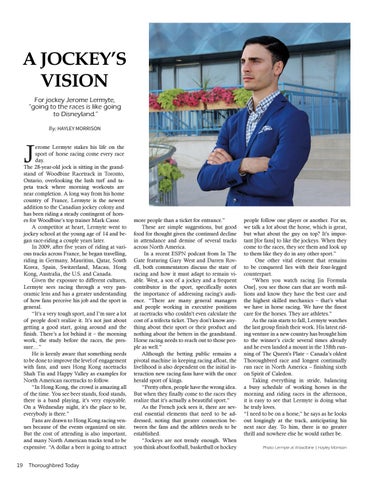
people follow one player or another. For us, we talk a lot about the horse, which is great, but what about the guy on top? It’s important [for fans] to like the jockeys. When they come to the races, they see them and look up to them like they do in any other sport.” One other vital element that remains to be conquered lies with their four-legged counterpart. “When you watch racing [in Formula One], you see those cars that are worth millions and know they have the best care and the highest skilled mechanics – that’s what we have in horse racing. We have the finest care for the horses. They are athletes.” As the rain starts to fall, Lermyte watches the last group finish their work. His latest riding venture in a new country has brought him to the winner’s circle several times already and he even landed a mount in the 158th running of The Queen’s Plate – Canada’s oldest Thoroughbred race and longest continually run race in North America – finishing sixth on Spirit of Caledon. Taking everything in stride, balancing a busy schedule of working horses in the morning and riding races in the afternoon, it is easy to see that Lermyte is doing what he truly loves. “I need to be on a horse,” he says as he looks out longingly at the track, anticipating his next race day. To him, there is no greater thrill and nowhere else he would rather be. Photo: Lermyte at Woodbine | Hayley Morrison