ISSN: 1871-417X EUROPEAN CULTURAL HERITAGE REVIEW SUMMER 2012
EUROPA NOSTRA represents a rapidly growing citizens’ movement for the safeguarding of Europe’s cultural and natural heritage. Our pan-European network is composed of 250 member organisations (heritage associations and foundations with a combined membership of more than 5 million people), 150 associated organisations (governmental bodies, local authorities and corporations) and also 1500 individual members who directly support our mission. TOGETHER, • we form an important lobby for cultural heritage in Europe; • we celebrate excellence through the European Heritage Awards organised by Europa Nostra in partnership with the European Union; and • we campaign to save Europe’s endangered historic monuments, sites and cultural landscapes.
We are the Voice of Cultural Heritage in Europe.
SIZA VIEIRA AND THE CHIADO FIRE WORLD HERITAGE, TRAINS AND GRAFFITI WITH JOSÉ MANUEL DURÃO BARROSO,
PORTUGAL SPECIAL
PLÁCIDO DOMINGO, ANDROULLA VASSILIOU AND MANY MORE
CALL FOR ENTRIES EUROPEAN UNION PRIZE FOR CULTURAL HERITAGE/
the Art of know-how
EUROPA NOSTRA AWARDS 2013
BECAUSE THE FUTURE Europa Nostra Heritage Tours Contact Barbara Zander, Heritage Tours Co-ordinator OF THE HERITAGE REQUIRES Tel: +31 70 302 40 54 CONFIDENCE AND RESPONSIBILITY bz@europanostra.org
The European Union Prize for Cultural
Outstanding heritage achievements
Heritage was launched in 2002 by
are awarded in the following
the European Commission as part of
categories:
the implementation of the Culture
1. Conservation
Programme. Europa Nostra, the Voice
2. Research
of Cultural Heritage in Europe, was
3. Dedicated Service by Individuals or
selected to run this Awards Scheme
Organisations
on the basis of its long experience
4. Education, Training and Awareness-
in publicly recognising individual or
Raising
joint excellence in the field of Cultural Heritage at a European level.
Criteria for the assessment of entries include excellence in the work executed
A UNIQUE CULTURAL PROJECT
The European Union Prize for Cultural
and preliminary research conducted,
Heritage / Europa Nostra Awards
as well as respect for artistic, cultural
are granted annually to identify
and social value, setting, authenticity
and promote best practices in the
and integrity. Entries can be on a
conservation of tangible cultural
scale ranging from small to large,
heritage, to stimulate the trans-frontier local to international, and should exchanges of knowledge and experience display a standard of work considered throughout Europe, to enhance public
outstanding in a European context.
awareness and appreciation of Europe’s cultural heritage, and to encourage
The European Union Prize for Cultural
further exemplary initiatives through
Heritage / Europa Nostra Awards
the Power of Example.
consist of two award levels. Up to six
EUROPA NOSTRA
ESAD –School of Decorative Arts
entries are awarded a Grand Prix,
Elena Bianchi: Heritage Awards Coordinator
IAO – Institute of Arts and Crafts
which includes a monetary award of
T. + 31 70 302 40 58 eb@europanostra.org
€ 10 000. Up to twenty-five entries
Download an entry form: www.europanostra.org
Arts and Crafts Workshops Departament of Conservation and Restoration
Fundação Ricardo do Espírito Santo Silva Rua de São Tomé, 90 · 1100-564 Lisboa Tel.: 00 351 21 881 46 00 · geral@fress.pt
www.fress.pt
Palácio de Seteais (detail of decorative painting) – restoration made by FRESS
Museum of Portuguese Decorative Arts
CLOSING DATE : 1 OCTOBER 2012 For further information:
receive an Award.
Published by EUROPA NOSTRA The Voice of Cultural Heritage in Europe European Cultural Heritage Review (June 2012) ISSN:1871-417X President Plácido Domingo Executive President Denis de Kergorlay Secretary-General Sneška Quaedvlieg-Mihailović
Editor in Chief Wolter Braamhorst Concept TV Culture Articles written by TV Culture (except where noted)
Production MYRA, Istanbul, Turkiye myra.com.tr Design Supervisor Rauf Kösemen Coordination Damla Özlüer
Websites europanostra.org myra.com.tr tvculture.nl cnc.pt
EUROPA NOSTRA INTERNATIONAL SECRETARIAT Lange Voorhout 35 NL - 2514 EC The Hague T +31 (0) 70 302 40 50 F +31 (0) 70 361 78 65 info@europanostra.org
All rights reserved. No part of either publication may be reproduced in any material form, including electronic means, without the prior written permission of the copyright owners.
Special Thanks Teresa Tamen Sneška Quaedvlieg-Mihailović
Periodical Design Tülay Demircan, Banu Y. Ocak
Proofreaders Athina Mitropoulos
Page Layout Gülderen Rençber Erbaş
Photography TV Culture Europa Nostra Wiki Commons Siza Vieira Guimarães Municipality GECoRPA
Technical Controls Harun Yılmaz
Every effort has been made to trace the copyright holders of old material.
Paper and Printing Imprensa Nacional Casa da Moeda
Where these efforts have not been successful, copyright owners are invited to contact the editor.
Plácido Domingo Photograph Getty Images, Frazer Harrison
The views expressed are those of the authors and not necessarily those of Europa Nostra.
SPONSORS_Heritage_AF.pdf
5/11/12
12:10:45 PM
ANÍBAL CAVACO SILVA
PRESIDENT OF THE PORTUGUESE REPUBLIC
MAIN PARTNERS
CONGRESS PARTNERS
CONGRESS SUPPORTERS
CONGRESS ASSOCIATES
MEDIA PARTNERS
JOSÉ MANUEL DURÃO BARROSO
PRESIDENT OF THE EUROPEAN COMMISSION
EUROPA NOSTRA CONGRESS IN LISBON 2012
HIGH PATRONAGE
Take a look at the Gulbenkian Foundation Calouste Gulbenkian Museum • Modern Art Center Classical Music Season • Summer Jazz Festival • Park Av. Berna 45 - Lisboa • www.gulbenkian.pt The Calouste Gulbenkian Foundation is proud to support Europa Nostra’s Congress 2012 in Lisbon
Welcome by the President Portugal is a country very close to my heart. I vividly remember my concert in Portugal five years ago. I was not only singing from Verdi’s Otello, but also performing the famous Fado song Foi Deus. The Portuguese people embrace music, history and culture so naturally that it is always a pleasure to be here. If you walk through the old quarters of Lisbon, you can easily escape from the hustle and bustle of a metropolis. With the uneven cobbled streets under your feet, the delicious traditional food in simple small restaurants and a heartfelt song emanating from an upstairs window, you feel you have entered a different world. Allow me a romantic remark: time seems to move slower here. You walk at a different pace. You can take a step back and celebrate life. As President of Europa Nostra, I am therefore delighted to present to you this Portugal Special of our magazine. In 2012, the European Union highlights the importance of active ageing and of enhancing solidarity between generations. This aspect of social cohesion and continuity is closely connected to Europa Nostra’s ideals and values and you will find many fine examples of such commitment in this Portugal Special. Cultural heritage is something we receive on loan from previous generations. We therefore need to take care of it and hand it over – preferably in better condition – to the next generations. A great symbol of this are the Olympic Games, this year held in London. As a great lover of culture as well as sports, I am delighted that London has decided to combine the sport events with a strong cultural programme, a true Cultural Olympiad. In this way we can celebrate the best of Humanity: arts, heritage and sports in a spirit of openness, inclusion and togetherness. The World Heritage is another important symbol, reflecting the best of Humanity. This year, UNESCO - one of Europa Nostra’s key partners - celebrates the 40th anniversary of the UNESCO World Heritage Convention. In this Special, we will discover the remarkable World Heritage – tangible and intangible - of Portugal: from the iconic Belém tower in Lisbon to prehistoric rock art in the Côa Valley, from the beauty of Sintra to the emotions of Fado music. We will also travel to many other inspiring heritage sites in Portugal like the University of Coimbra, the Fronteira Palace, the city of Guimarães - European Capital of Culture for 2012 - and the magnificent Douro Valley. We will meet people and organisations who work tirelessly behind the scenes - like the Calouste Gulbenkian Foundation, the Fundação Ricardo do Espírito Santo and the Centro Nacional de Cultura - to keep Portugal’s cultural heritage safe and relevant. That last word - relevance - is particularly important. Cultural heritage is never static. It is a living heritage. Like a song, it needs to be sung. Like music, it will always be reinterpreted. In these times when we need to find ways out of an unprecedented economic and financial crisis, we need to realize that our cultural and natural heritage is Europe’s unique resource. Europe’s diverse culture and heritage is one of our largest comparative advantages on the global scene; our crude oil, our gold reserve, our magic wand. Cultural heritage can indeed serve as a flywheel for Europe’s economy. It is Europe’s bread and butter as much as it is Europe’s heart and soul. We are pleased that the President of the European Commission Mr. José Manuel Barroso and the European Commissioner for Education, Culture, Multilingualism, Sport, Media and Youth, Mrs. Androulla Vassiliou kindly accepted to answer our questions on these important matters. I sincerely hope that the many interesting stories and interviews published in our Portugal Special will move and inspire you to support our cause and to join our movement.
t
d n
Plácido Domingo, President of Europa Nostra - The Voice of Cultural Heritage in Europe
03
of Love 18 Labour The Ricardo do Espírito Santo Silva Foundation
22 A Time Machine
of Stone The World Heritage rock art of the Côa Valley
Setúbal 32 Saving A man’s quest to save a town
OPINION FEATURE FEATURE
Steam Ahead! 14 Full Railway Museum at Entroncamento
LIVING HERITAGE
Graffiti 10 Lisbon A heritage nightmare?
HERITAGE IN DANGER
Palace 06 Fronteira A museum that is a home...
TREASURE
CONTENTS
Business 42 Family A World Heritage lunch in the Douro Valley
CULINARY
SHORT STORY
to Portugal 38 AbyVisit Hans Christian Andersen
FEATURE
50 Rebirth Álvaro Siza Vieira and the 1988 Lisbon Fire
How to Be Unique for Millions The future of Portuguese tourism
Creative Europe’ Puts Culture at the Heart of EU Policies Interview with Androulla Vassiliou
The Center of the World The Jerónimos Monastery and the Belém Tower / 26
World Heritage Ambition Coimbra University/ 46 ‘You are Part of It’Guimarães: European Capital of Culture 2012 / 54 The Day That Shook the World The Great Earthquake of Lisbon / 66 Amid the Rocky Mountains of the Moon The World Heritage cultural landscape of Sintra / 70 Lisbon - What the Tourist Should See / 74
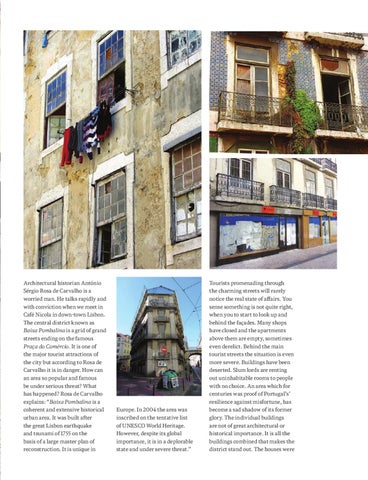
Portugal Then and Now / 78 Before & After The Museu do Oriente in Lisbon / 84 Treasure or Trauma? The challenges of Modernist architecture /86 Living the Dream The famous resort of Cascais in historical pictures / 90 The Music of Life The story of Fado / 94 Perfect Harmony The restoration of the Mafra organs / 100 SOS Lisbon Heritage in danger in the old city centre / 106
FEATURE
110
Culture is a Sound Investment for Europe Interview with José Manuel Durão Barroso
FEATURE
102
FEATURE
62
HERITAGE IN DANGER
under Threat 58 Azulejos Museu Nacional do Azulejo
‘Culture is an Instrument for Happiness’ The Centro Nacional de Cultura (CNC) / 114 Remembering Helena Vaz da Silva / 116 The Power of Giving The Calouste Gulbenkian Foundation / 118 Saving Memories The struggle to rescue Casa do Passal / 120 Postcard from Brussels / 123
TREASURE
06
Fronteira Palace A museum that is a home
The magnificent Fronteira Palace is a green oasis on the outskirts of the concrete jungle of Lisbon. It is both a museum and a home.
While his hands are fiddling to light a cigarette, he adjusts his position to be more comfortable. A backache forces him to lie sideways on the couch and so the interview faintly feels like an audience with a Roman emperor. The jacket of his three piece suit is casually thrown on a chair, as Fernando Mascarenhas – the 11th Marquis of Fronteira, 9th Marquis of Alorna, 13th Count of Torre, 13th Count of Assumar and the
12th Count of Coculim – settles down after lunch to talk about his Fronteira Palace, a museum that is also a home. The living room is casual in atmosphere, and mementos from the long history of the most influential family in Portugal can be seen on every wall and on every surface. The magnificent palace, which was built in 1640 as a hunting pavilion to Dom João de Mascarenhas, the 1st Marquis of Fronteira,
07
the family. The Fronteira Palace is famous for the garden that boasts one of Portugal’s largest collections of blue azulejos (tiles) still in their original setting. The Room of Battles on the first floor of the palace shows his forefather leading an army in the Portuguese Restoration War (1640-1668), captured for posterity in a sea of glazed blue tiles. The Marquis lives in the palace, but he did not grow up here.
is a green oasis between the concrete jungle of Lisbon and the Monsanto Forest Park. The Marquis, who is sensitive as well as creative, recently took up the art of jewellery making, combining silver with semi-precious stones. The collection has proven to be popular with the Portuguese elite, but, as the Marquis makes a point of pointing out, he makes jewellery in all price ranges. Creativity and bold choices run in
“When I was about 2 or 3 years old, my parents separated. I stayed with my mother and grandparents in Lisbon. My father lived here in the palace but he used the downstairs rooms only. I would go and visit my father on birthdays and such. I would go for dinner with my father and my uncle in A Gôndola (Lisbon’s oldest Italian restaurant, across the street from the Gulbenkian Museum ed.), which is still popular today. My father died in a car accident when I was 11 and two years later, we moved here. It was a completely different area then. It was not
Garden with pond The Marquis (photo by Camille Hermant)
built up and there were no large buildings in the neighbourhood. It was a green, rural district with small farms. Most, if not all of that is gone now. The Battle Room looks much better now than when I was growing up, but the landscape looks much worse.” “I have lived in many places. I lived on our farm for four years, in Paris and elsewhere. After the democratic revolution (25th of April 1974 ed.) my mother and my stepfather stayed here, while I went to live in London. As a young man, a Marquis, who was a property owner with political views leaning towards the left, I wanted to see what happened first. I returned after three months.”
TREASURE
08
Europa Nostra Member Organisations in Portugal: Fundação das Casas de Fronteira e Alorna The Foundation for the Houses of Fronteira and Alorna www.fronteira-alorna.pt Associação Portuguesa das Casas Antigas - The Portuguese Old Houses Association www.ap-casas-antigas.pt Associação Portuguesa dos Amigos dos Castelos The Portuguese Association of Friends of Castles www.amigosdoscastelos.org.pt Centro Nacional de Cultura - The National Centre for Culture www.cnc.pt GECoRPA - Conservation and Restoration of Architectural Heritage www.gecorpa.pt
He also explains that ‘the House of Fronteira is more important than my own feelings.’ He did not always think that way.
Associate Organisations: You Must Art Advisory & Services www.mustartadvisory.com
Fernando Mascarenhas is very open about his life and feelings. Together with the American anthropologist George E. Marcus he published Ocasião: The Marquis and the Anthropologist, A Collaboration in 2005 in which he intimately discloses his personal life and his experiences of living as a nobleman in Portugal. In this book, he describes his palace as containing ‘quite a bit of history and just a little surplus money.’
“When I was a child I felt the pressure of the family history and responsibility. It bothered me. I needed to create a certain distance from it though, to become an individual and to earn the respect of the family.” Could he have stepped away from it? He lights another cigarette and pours a glass of water, maybe to buy some time as he mulls over the question. “I could have done it. I could have moved away from it. There was a moment that I seriously contemplated that. I even wanted to sell the house, but I did not want to let it go cheaply. There were two or three occasions
after the revolution, when the Brazilian embassy was interested as well as the President of the Republic, but the offers were not satisfactory. Now the situation is different. I have no children and I have created a foundation (he has put 90% of his personal assets in this foundation ed.) to secure the palace for the future. The foundation connects the house, the farm and the family.” “In 1987 we opened the palace for the first time, for groups only. It was a little weird. My private rooms were separated only by a glass door and people would look in. We have now solved that problem of course. Also the terrace is closed in the afternoon, so I can use it. I rent some of the public rooms out for catered events in the evening, but I am really not too fond of it. Being open to the public comes with its challenges. We had a camera crew here not so long ago and they decided that they needed
09
The Battle Room Left the Venus Fountain Right the King’s pond
built the garden, but I have also added a garden of my own.”
to repaint some of the walls in the garden, without telling us. That horrible blue is finally fading a little bit. On the other hand the tourists are necessary. People come to visit the palace that is a house and I think that is part of the attraction.” The beautifully adorned and often tiled rooms in the public wing of the palace are a magnificent testimony to the Baroque era. “We still make discoveries. We are now researching fresco paintings on the wall and ceiling of one of the rooms. We have uncovered many levels of paint that we did not know about. It is important to add new elements to the history of the family. The 5th Marquis added this wing of the palace. The 1st Marquis
The palace is famous for its interiors, but the official highlight is the sculptured garden with well trimmed hedges and imposing statues, culminating in the Knight’s Lake and the King’s Gallery, with sculptures and blue tiles. The entire garden is tiled around its edges with different symbolic representations. You can see the four elements, representations of the gods and planets, the months and seasons and the zodiac. There are no Christian religious motives to be found. There is a chapel however, but its meaning is a riddle. The garden is created in the spirit of the Baroque. It is subtle with a visual language for the initiated. There is a man’s garden and there is a woman’s garden for instance; the Venus garden has lots of fish and fishermen around a pool, with
references to vanity and images of a world where everything is upside down, including cats and dressed– up monkeys. One statue in the women’s garden is particularly noteworthy and could easily compete with the world famous Manneke Pis statue in Brussels of a little boy peeing, which dates from roughly the same period. The life size statue of Venus has water flowing out of her breasts, which she holds up delicately. The fountain is slightly mocking the more serious themes of the rest of the garden. It is not only very down to earth in its presentation: it seems to encourage the visitor to take life as it comes. It suits the palace and its current owner perfectly.
OPINION
10
Bairro Alto Sunday morning
Lisbon Graffiti A heritage nightmare?
Above Oriente subway station Below graffiti on derelict building
gone mad, drunk with misplaced creativity and armed with spray cans. The result is a house covered in sprawling scribbles and colours.
Waking up on Sunday morning and opening your windows to a brand new day can be a harrowing experience in Bairro Alto, an old neighbourhood in the centre of Lisbon. Your house may not look the same as it did the night before. Creatures of the night have
The problem is growing. Graffiti is Portugal’s heritage nightmare. Everywhere you look old façades are covered with it. Ancient tiles are sprayed with slogans. The yellow colour of the famous city trams can hardly be seen below the layers of spray paint. Some of the graffiti is political: a cry for change or for solidarity with Greece.
Other graffiti is pure vandalism, such as spray painting your name on a 16th century church. Sometimes the ‘artists’ even go further. The old tiles of the famous tiled buildings of Lisbon have a value. Desperate for money, these criminals pry the tiles loose to sell them. There is also another side to the story. Young artists – unable or unwilling to present their work elsewhere – are frustrated with the artistic establishment. They use the city as their gallery, its walls as their canvas.
11
OPINION
12
Advertisement for the film José & Pilar
Every modern city has problems with graffiti, but in Lisbon it got seriously out of control. The city, the police and the people of the city are now tackling the problem in a new way. Instead of stopping the problem, which would surely be impossible, they are seeking to control it. Teams of cleaners check the calm Sunday streets for new and unwanted ‘art’ and clear away the worst of it. Contacts have been established with young artists to assign them walls and buildings where their art has a positive effect on the surroundings. Old and abandoned structures are changed into artworks, making the areas more attractive and interesting, while they wait for renovation of demolition.
A graffiti display in Lisbon was even listed among the top 10 best street art in the world by the Guardian newspaper in the United Kingdom. The Cronos project –
which was started in partnership with the municipality – invites artists to bring colour to derelict buildings (www.cronolisboa.tk). It is just one of the many initiatives. Film studios are even using the urban talent to advertise their upcoming releases on vacant buildings. In the subway and on the streets you can often see exhibitions of graffiti-related works of art. The world famous Oriente Station designed by Santiago Calatrava, has a wall covered with tiles and adorned with graffiti art. One wall depicts the famous explorer Vasco da Gama. History and graffiti are hereby harmoniously combined; it is as if the problem has gone full circle.
.com.tr
for a catchy design...
FEATURE
14
Full Steam Ahead! The Railway Museum at Entroncamento The dust covers are being removed slowly and a glimpse of gold can be seen, a delicate door with the royal coat of arms that leads to a luxurious cabin.
Left carriage of the Presidential train before restoration Carriage of the Presidential train during restoration
The fully restored Royal train is well protected while the historical train depot is being transformed to an exhibition hall. The train will be one of the top attractions of Portugal’s Museu Nacional Ferroviårio (National Railway Museum) in the city of Entroncamento. The special Presidential train will be housed in the room next to the Royal train. The enormous terrain of 4.5 hectares is filled with nineteen rail-tracks, historic railroad buildings, train construction and repair sites. The collection consists of 340 vehicles dating from 1856 to 1973 and an unbelievable 36,000 items, varying from tools and lamps to furniture, timetables, charts, tickets, cutlery, jackets and hats, to name but a few. Entroncamento is one of the most important railway centres of the country and the site is a well-chosen location for what has become one of the largest museums of Portugal. It was officially inaugurated in 2007. The Locomotive Roundhouse,
which shows a selection of restored locomotives, is a recreation of the old roundhouse that had been demolished in 1976. It was re-opened to the public in 2008. The Foundation that is the force behind the National Railway Museum is also responsible for the National Railway Documentation Centre, which functions as an archive and a place of scientific study and research. The museum in Entroncamento is just the head office. Several local branches of the museum can be found across the country. Ricardo Cardoso, the driven director
of the museum lives out his dream. He enthusiastically shows me around the historical buildings that are being transformed into exhibition spaces. Stepping over tins of paint and electric equipment, he guides me through the freshly painted galleries of the museum. The impressive historical train depot is also almost
15
16 FEATURE
Europa Nostra’s Industrial and Engineering Heritage Committee (IEHC) was founded on the initiative of individual Europa Nostra members after Europa Nostra’s Annual Congress in 2008 in Newcastle where Industrial Heritage (IH) was a central theme. The IEHC consists of 10 members (all volunteers) from 7 European countries: Belgium, Netherlands, United Kingdom, Germany, France, Spain and Italy. The IEHC seeks to promote the values of Europe’s shared industrial and technical heritage on behalf of Europa Nostra and to encourage projects seeking to safeguard, restore and interpret this heritage, in all its aspects. These goals are enshrined in the IEHC’s “Greenwich Declaration”. http://www.europanostra.org/ industrial-and-engineering-heritage/ IEHC’s Secretariat: rienko.wilton@ planet.nl
Electric generating station Presidential train after restoration Locomotive roundhouse
finished. One side of the hall is filled with rail bicycles that are so easily associated with Hollywood westerns. The tracks on the far side of the building are still empty, awaiting the newly restored Presidential train. Outside, on our way to the workshops of the museum, Cardoso has to raise his voice as a high speed train leaves Entroncamento main station. The museum is located in the middle of
the rail-tracks used continuously both by day and night. “Normal commuter rail and high speed trains are almost a part of our museum. Isn’t that wonderful? The connection between a museum and today’s reality could not be more immediate. You actually have to cross the modern rail roads to get from one side of the museum to the other.”
“The idea of industrial heritage is relatively new to Portugal. Some of the carriages of the Presidential train for instance were re-used for other trains for as long as they could function. Only two carriages were kept in good condition: the dinner-carriage and the Presidential carriage. The vehicle for the journalists was in the worst state. It had been severely damaged by sun, wind,
17
rain and birds. The Presidential train was used very rarely, lets say for one trip a year. Parts of the Royal train were also re-used in the Presidential train. The Presidential train is still in a specialised workshop in the north of Portugal, but the restoration is almost done. It is a very exciting process.” His colleague Maria José Teixeira joins us on our tour of the facilities. Teixeira is responsible for the management and the project development. She explains that the museum’s road to completion is long and not without its problems. “We have many buildings and collections and it is a challenge to get the funds together to make it all happen the way we would like it to happen. We have developed the site since 2007 and we expect
Rail bicycles
to be finished by 2015. Most of the exhibition spaces will be open this fall. Let me give you an example: we want to transform one of our historical buildings into an educational centre about energy. It is an electric generating station with many industrial details and impressive machinery and voltage boosters; it is an amazing building with many possibilities. However, to bring together the funds to allow for such an extensive restoration and rehabilitation is not a simple task that can be accomplished over night.” We pass a rusty old locomotive basking in the evening sun. Cardoso: “We leave this locomotive here. It is a reminder to the visitors of what would happen to the trains if we did not restore them.”
But the visitors do not have to worry about that too much. The history of the Portuguese railroads is in good hands. As the sun sets over the tracks, it is clear that the museum will become one of Portugal’s main tourist attractions.
LIVING HERITAGE
18
Labour of Love The Ricardo do Espírito Santo Silva Foundation A craftsman of the Ricardo do Espírito Santo Silva Foundation is weaving a beautiful piece of cloth, surrounded by a sea of colours. It is not just any piece of cloth, as he is using traditional methods of making tapestries handed down over the centuries.
Ricardo do Espírito Santo Silva
Room after room is filled with students and skilled professionals working on different aspects of restoration of works of art and furniture. A woman in a white laboratory coat is carefully repairing the gold leaf decorations on an old leather book. In another room, a girl is disassembling a modern work of art to repair some structural damage. All the walls are covered with moulds and drawings of intricate decorations. Laughter emanates from a room where a wooden cabinet is put back together again.
19
The Foundation is an excellent example of cultural heritage conservation that combines the traditional skill-based education with a sustainable business model. “Every piece you see here is restored by our own people,” director Conceição Amaral explains, as she shows me around the Museum of Portuguese Decorative Arts in the 18th century Azurara Palace in Alfama in the centre of Lisbon. “The palace was bought by Ricardo do Espírito Santo Silva to house his collection. He was a banker and a businessman, but he had the heart of a poet and an artist. He brought together a large collection of Portuguese decorative arts. In 1953, two years before his death, he bequeathed the building and the collection to the Portuguese
state.” She looks at his portrait with a slight sense of melancholy. “He was a remarkable man, a patron of literature and passionate art collector,” she says with a soft voice. The founder of the Foundation looks at the camera with a sensitive confidence in front of part of his treasures. “The collection itself is static, we do not buy. We have much more art and furniture than we can display and we still have much to restore. When there is time, our technicians and teachers work on our own collection.” The Foundation is a mixture of different activities, all related to arts and crafts. It is a true museum-school dedicated to disseminating knowledge and preserving expertise in the field. The Museum of Portuguese Decorative Arts recreates the atmosphere of an 18th century aristocratic home. It is a varied collection that contains pieces that range from an exuberant 18th century carriage to a simple chamber pot designed for vomiting, from the magnificent
16th century Triumphal Procession with Giraffes tapestry to a portable writing desk with delicate inlays. Besides the museum, the Foundation oversees two schools where traditional arts and crafts are taught; the Escola Superior de Artes Decorativas (ESAD) and the Instituto de Artes e Ofícios (IAO). The foundation also offers
LIVING HERITAGE
20
Interior museum Photo by Espírito Santo Silva Foundation
18 workshops in woodwork, metalworking, bookbinding and decoration, decorative painting, gilding, textiles and upholstery. It is one of the very few places in Portugal where these traditional methods are used and studied professionally. The Department of Conservation and Restoration offers services and organises restorations that few other organisations can match. No wonder that at the moment they are working on six large external projects in churches, museums and private collections, including one in Brazil. “Before you can restore a church,” Nazaré Tojal (director of the Conservation and Restoration Department) explains, “the altars, the
paintings, the sculptures, the lamps and the furniture have to be carefully removed. That is not an easy task. You need specific knowledge, not just for the restoration and conservation of objects, but you also have to think about all the other aspects. Each restoration requires a special technical team to be assembled.” “These large emblematic projects are important to us to promote what we do and how we do it,” Conceição Amaral adds. The Foundation does not rely on public money. Although partially financed by the bank of its founder, it has to be able to largely support itself. They not only
restore and repair for museums and municipalities, but also for private owners. They also create traditionally-made replicas of furniture to be sold in their own shop. They are even creating some new arts and crafts workshops for tourists. The Ricardo do Espírito Santo Silva Foundation is a thriving example of the importance of personal passion and dedication for the preservation of cultural heritage. The vision of Ricardo do Espírito Santo Silva (1900-1955) and his successors help to preserve Portuguese decorative arts and secure its future. www.fress.pt
Tm
TOMORROW’S WORLD On land, at sea and in the air, the demands of global commercial transportation will continue to challenge both business and society. You can be sure one company with a long-term commitment to quality, safety and environmental care has the vision to deliver – Volvo Group. Find out more on www.volvogroup.com
TmrrowsWrld_216x279.indd 1
2012-04-27 13.35
A Time Machine of Stone
FEATURE
22
The World Heritage rock art of the C么a Valley
Mountain goat looking both ways
23
The Portuguese government stopped the already advanced plan to build a hydroelectric facility in the Côa Valley in 1995. That decision not only saved a unique archaeological site for generations to come but it also created an economically viable and sustainable future for the Côa Valley villages and towns. The site was classified as a World Heritage Site by UNESCO in 1998. All across Europe, governments still build dams to create a better future for the local communities, thereby potentially destroying cultural heritage sites of international importance. Even though much better solutions are available and viable alternatives are presented, governments in some cases push ahead as planned. A sad example of this can be seen in the case of Allianoi in Turkey, where an ancient Roman spa-town was flooded. You can see all that happened during the Allianoi campaign on the Europe Nostra website (www.europanostra.org/ allianoi).
It may be the first animated cartoon in human history. Tens of thousands of years before Eadweard Muybridge first documented the movement of a horse and pioneered the medium of film, the people in the Côa Valley in the northeastern part of Portugal etched a mountain goat with two heads and interlocking horns. If you look closer, the animal appears to simultaneously look in two directions, indicating movement. It is a remarkable image from a remarkable site, probably one of the most enigmatic places in the world and certainly one of the oldest locations for human art in Europe. The images are scratched, incised or chiselled on the surface of the rock, often on top of one another.. Perhaps the most difficult dimension in these works of art
is time itself. The images can be recognised as mountain goats, horses, deer or (very rarely) humans but the deeper meaning is elusive. We have to bridge tens of thousands of years to try to get into the heads of the artists and the communities that lived here. Why were these engravings made? Why were they made here? Why were they made over such a long period of time? Why are there so very few images of fish and men? The answers to these questions are as varied as the scientists involved. Perhaps they were drawn for simple practical and artistic reasons or they may be part of shamanistic rituals and religious beliefs. Our interpretations of the images reflect more about our own times and attitudes than of the people who created them. “There are almost no images of
Côa Valley The rock art can be difficult to see (photo by Lusitana)
The Allianoi Initiative and its leader Dr Ahmet Yaraş won an European Union Prize for Cultural Heritage/Europa Nostra Award in 2012 in the category Dedicated Service. The jury states: “The relentless struggle by the Allianoi Initiative and its devoted leader, Dr Ahmet Yaraş to protect one of the most important remains of the Roman medicine and bath culture from destruction, has strongly moved the Jury. The Jury believes that the long lasting public campaign to save this major heritage complex from oblivion represents a powerful example to the world of how authorities should deal with their national cultural heritage.”
FEATURE
24
Côa Museum
trees, boats, rivers or even the ground. We do not know why,” explains António Batarda of the Côa Museum, as he points to the bright green sign above the door. “If you look at that emergency exit sign, you know what it signifies, what it means, what the pictogram represents but no one could have understood that 20,000 years ago. It is the same vice versa. We can study the drawings but we do not know exactly what they mean. We do not understand the context.” More than 30,000 individual drawings, 10,000 motives and 70 sites have been catalogued so far and new discoveries are being made almost every week. The Côa Museum is the largest open-air palaeolithic rock art site in the world and the surrounding areas contain still more evidence of ancient human presence. Just across the border in Spain, the Siega Verde Archaeological Site and Interpretation Centre works closely together with the Côa Museum. All the experts agree on
one thing: there is much more to be discovered in this area. While the global importance of the site is now well established, this was not always the case. Just over thirty years ago, this rock art was virtually unknown to the outside world. The scribblings along the Douro, Côa and Águeda river were seen daily by the people who lived in the region but they were not considered valuable in any way. António Batarda says that “the area was not well developed; education was basic and nobody realised the immense value and history of these rock drawings.” The story of what happened next is closely related to fundamental changes in Portuguese government policies. In the latter part of the 20th century, the government decided to build a hydroelectric dam in the river. Similar to other
countries around the world, the idea of building dams in rivers was thought to bring prosperity to less economically developed areas. The project was halted when the significance of the rock art was discovered. This was a brave and costly decision however because the dam project was about to commence. As a result, the Côa Valley Archaeological Park was established in 1996 and on 2 December 1998, the site became classified by UNESCO as a World Heritage Site. A few years ago, the village of Vila Nova de Foz Côa was a sleepy town nestled between the Côa river hills. The archaeological park had to be visited by landrover. Along the river an official guide would help you discover the rock art, which is not always
25
easy to discern. How much of it must have disappeared over the past millenniums before anyone realised its value, as people hacked away at the rocks to provide stones for houses and roads. Selected sites are open to the public but visits now start at the new and impressive C么a Museum. The building suits its surroundings perfectly. Although the rock art is in the open air, the museum is built like a cave. The architects may have associated rock art with the famous caves of Lascaux in France. Ant贸nio Batarda explains that most visitors find the museum and the way the rock art is presented an eye-opener. It is not an easy task to make the rock art attractive to the general public since it is often difficult to recognise and
understand. The museum uses all the modern technology at their disposal to tell a wider and engaging story. The real open-air sites are still the main attraction of the museum but you have to strain your eyes to be able to see a picture emerge through what at first glance can look like random
scribbles. Seeing them blown up to a gigantic scale and separated from the other layers, makes the art accessible and intriguing. Travelling 25,000 years back in time is an amazing experience.
Museum presentation
ww.arte-coa.pt www.igespar.pt www.coasiegaverde.com
Museum projection
TREASURE
26
The Centre of the World The story of the Jerónimos Monastery and the Belém Tower
IGESPAR (Institute for Managing the Architectural and Archaeological Heritage in Portugal) is a public institute within the Ministry of Culture, responsible for managing, safeguarding, conserving and enhancing Portugal’s architectural and archaeological heritage. The Jerónimos Monastery, the Belém Tower, the National Pantheon, the Monastery of Batalha, the Monastery of Alcobaça, the Convent of Christ and Côa Valley Archaeological Park are all under its responsibility. www.igespar.pt
27
Photo by Massimo Catarinella Photo by Christian Thiele
Does she know a nice value-formoney fish restaurant nearby, a young tourist asks Isabel Cruz Almeida, the director of the Jerónimos Monastery and the Belém Tower, mistaking her for a guide. The stylish and erudite manager of the two most iconic heritage sites in Portugal recommends a small restaurant with an easy smile and clear directions. “We are part of a community here,” she explains while she shows me around the magnificent buildings. “We are in very good contact with our neighbours. So I actually know all the good fish restaurants. We are the most visited cultural heritage site in Portugal, so we have an obligation to keep the visitors content.” The long and fascinating story of the Jerónimos Monastery and the Belém Tower could easily fill a library. Isabel Cruz Almeida is very clear about what she thinks is the most essential message of these extraordinary buildings. We are back in her office, sitting together with her colleague Helena Lopes. Both women enthusiastically
Director Isabel Cruz Almeida
discuss the multi-layered history of the monuments under their responsibility, sometimes even finishing one another’s sentences. Strangely enough, every corner of the office seems to be filled with rhinoceroses, from small metal representations to large fluffy ones. Isabel Cruz Almeida laughs. “The first image of a rhinoceros in Portugal can be found on the Belém Tower. It’s really extraordinary. We made an exhibition about it some time ago and since then people feel the
need to keep giving me new ones. It has become quite a collection. The rhinoceros can be seen as a symbol for the importance of the Belém Tower and the Jerónimos Monastery. If you are looking for a site to pinpoint the beginning of globalisation, this is it. Animals and plants came here from across the globe. These monuments are not just important because they are beautiful, but because they are linked to the great discoveries. They are a focus point for the contribution of Portugal to the story of the world.” Helena Lopes adds: “All those great stories and explorations begin here. The Jerónimos Monastery and the Belém Tower symbolise that.” Isabel Cruz Almeida continues: “The tower stands for the spirit of discovery, similar to the Statue of Liberty in New York. The tower is the hope and the future of a nation.” Helena Lopes: “It was also a laboratory for new technologies, used for trying out smaller artillery that could be loaded from the back.” Isabel Cruz Almeida: “What is important
TREASURE
28
The unique unsupported vault spanning 19 metres, was designed by Juan de Castilho Belém Tower
is that the whole world is now coming back to the tower and the monastery, such as African immigrants but also people from Singapore, India and Brazil. It is sometimes an emotional encounter, with deep, personal meaning for the visitors.” The history of the monastery reads as an adventure novel with many different moments of potential disaster. Together with the Belém Tower it is one of the most prominent monuments in the Manueline-style of architecture (Portuguese late-Gothic) in Lisbon. It was classified in 1983 as a UNESCO World Heritage Site, along with the Belém Tower. The construction of the monastery and church began on 6th January 1501 on the orders of King Manuel I (1469-1521). It would take almost 100 years to finish it. Manuel I selected the religious order of Jerónimos to occupy the building because the monks were thought to have a direct line to the Almighty. For every voyage undertaken, the monks were expected to pray for a safe return of the merchant ships. The vessels sailed from the nearby harbour in the Tagus River to the rest of the world. At that time, Portugal had the world in the palm of her hand. The merchants took unimaginable riches from across the globe to the motherland and the
On 1st June 2012 the ceremony of the European Union Prize for Cultural Heritage/Europa Nostra Awards was held in the inner courtyard of the Jerónimos Monastery in the presence of the President of Europa Nostra Plácido Domingo, The European Commissioner Androulla Vassiliou, the President of the Republic of Portugal Aníbal António Cavaco Silva en the Crown Prince and Princess of Spain; H.R.H. Felipe de Borbon y Grecia, Prince of Asturias and H.R.H Letizia Ortiz Rocasolano, Princess of Asturias.
of Portuguese Independence in 1640, the monastery regained much of its importance. It survived the famous 1755 earthquake without much damage.
monks were not forgotten. 5% of all the gold the explorers brought back was at their disposal to enhance their home. Their monastery became one of the most impressive heritage treasures of Portugal, a temple of power and beauty. In 1604, Philip of Spain ruled over Portugal and changed the monastery into a royal burial place, prohibiting everyone but the royal family and the monks from entering the building. After the restoration
Isabel Cruz Almeida explains: “The history of the monastery is fascinating and complicated, but I think a crucial moment occurred in 1833 when the religious orders were dismantled in Portugal. The monastery became an orphanage. This saved the building and its treasures. Many other monasteries, convents and churches across Portugal were robbed, but Jerónimos was protected by the fact that it was an orphanage.” The tower and the monastery are still strong symbols for the international reputation of Portugal, culminating in the signing of the Treaty of Lisbon in the Jerónimos Monastery on 13th December 2007, the basis for the reform of the European Union.
29
Luís de Camões Luís de Camões (1524-1580) is Portugal’s most celebrated poet. The Lusiads (Os Lusiadas), his most famous work, is a masterpiece comparable to Homer’s Iliad. Today, Portugal is not the global power it once was, but the stories of the men who discovered the world under the hardest of circumstances will forever trigger our imagination. His tomb in the Jerónimos Monastery is opposite that of Vasco da Gama. The great explorer and the great chronicler brought together in the same space for eternity. Both tombs were placed in the church in 1880. The work The book is a celebration of the valour and strength of the Portuguese explorers, mainly focussing on the legendary seafarer Vasco da Gama, who discovered the route to India. The epic poem is written in 1102 stanzas divided in 10 cantos. Lusitania was the Roman name for Portugal and the Lusiads of the title should therefore be interpreted as the country’s sons. His classical education mixed with his first hand experience of the life of an explorer gives The Lusiads the vivid urgency and deeper level of understanding and contemplation necessary to create a masterpiece. The work was mainly written en route to the East. Legend has it that once, after a shipwreck, the writer had to swim with one arm outstretched to keep his poem dry and safe. The book was published in 1572.
Cover page The Lusiads Luís de Camões in prison in Goa
The man He was born to a noble family in Lisbon, but soon moved with the family to Coimbra to escape the bubonic plague that was ravishing the capital. His uncle had been appointed Chancellor of the famous Coimbra University and helped him to get a decent education. His obvious talent and outgoing personality gave him an undeniable
charisma. His rather short-fused temper and romantic fervour however would keep landing him into trouble. When he returned to Lisbon at 18, he fell in love with the 13 year old Caterina, the daughter of a high-ranking courtier. He dedicated poems to her using the anagram of Natercia. But the relationship was not approved. His play King Seleucus, which could be
TREASURE
30
Luís de Camões statue Statue of Adamastor at Santa Catarina viewpoint in Lisbon
interpreted as a political critique, also did not go down well with the royal court and he decided that it would be better to go to Ceuta in Morocco. There, he would lose his right eye in battle. In 1552, back in Lisbon, he got into another fight, but this time with the wrong person. He got off relatively lightly but ended up in jail and was sent to the East. During the next years, misfortune and hardships seem to have been his closest companions. Life in the colonies for someone like him was hard. He ended up in jail again in Goa in India and later travelled to the Moluccans and Macau. He was shipwrecked on the Mekong River, but managed to keep his precious manuscript dry by swimming ashore using one hand. Back in Goa he fell in love with a local girl named Barbara. His famous poem Endecha of Barbara is a passionate testimony of his love for her. Later he got stranded for months in Mozambique on his way back to Portugal. Amazingly, it was during these turbulent, difficult and adventurous years that he managed to write his great epic. According to some, Barbara managed to follow
the man she loved to Portugal and cared for him in his old age when he lived poorly in a small house, on a small pension. He died on 10th June 1580, the year when Portugal became annexed to Spain. Portugal’s National Day is celebrated annually on the same day to commemorate his death. The Lusiads can be found on www. gutenberg.org The Espírito Santo Silva Foundation has recently restored a first edition of The Lusiads (1572) and produced 55 facsimile copies. www.fress.pt One of the most captivating creatures in The Lusiads is the giant Adamastor, a personified symbol of nature’s power to stop the Portuguese from rounding the Cape of Storms, now known as Cape of Good Hope. According to legend, Table Mountain in Cape-town is what remains of his petrified body. Adamastor may be the inspiration for the legend of the ghost-ship The Flying Dutchman, the mysterious ship that would spell death and doom for all who had the misfortune to see her. Camões vividly describes what Vasco da Gama saw when he encountered the giant Adamastor in Canto V of The Lusiads: ...I spoke, when rising through the darken’d air,
Appall’d, we saw a hideous phantom glare; High and enormous o’er the flood he tower’d, And ‘thwart our way with sullen aspect lower’d: An earthy paleness o’er his cheeks was spread, Erect uprose his hairs of wither’d red; Writhing to speak, his sable lips disclose, Sharp and disjoin’d, his gnashing teeth’s blue rows; His haggard beard flow’d quiv’ring on the wind, Revenge and horror in his mien combin’d; His clouded front, by with’ring lightnings scar’d, The inward anguish of his soul declar’d. His red eyes, glowing from their dusky caves, Shot livid fires: far echoing o’er the waves His voice resounded, as the cavern’d shore With hollow groan repeats the tempest’s roar. Cold gliding horrors thrill’d each hero’s breast, Our bristling hair and tott’ring knees confess’d Wild dread, the while with visage ghastly wan, His black lips trembling, thus the fiend began...
Sandra Wilikens
director wealth management
R.E. : F. Peene, Fortis Bank SA/NV , Montagne du Parc 3, 1000 Brussels, RPM/RPR Brussels, VAT BE 0403.199.702.
You think your private and business assets deserve the very best ? So do we
AT BNP PARIBAS FORTIS PRIVATE BANKING,
Private and business are closely intertwined for every entrepreneur. Management buyouts or passing on family businesses are choices that impact your private wealth too. BNP Paribas Fortis Private Banking helps you build the necessary WE HELP YOU TO SHAPE bridges between the two. Because we want to help you find the best solutions in both the short and the longer term. THE RIGHT STRATEGY FOR BOTH YOUR PRIVATE AND YOUR BUSINESS ASSETS. AT THE SERVICE OF YOUR ASSETS. THROUGHOUT BELGIUM
bnpparibasfortis.be/privatebanking
A4_Private_Bankin_ Sandra_Eng.indd 1
25/04/12 16:21
HERITAGE IN DANGER
32
Saving Setúbal A man’s quest to save a town
33 Associação Portuguesa das Casas Antigas is a member of the European Historic Houses Association. The European network works closely with Europa Nostra in the “European Heritage Alliance 3.3.” which was launched in June 2011 in Amsterdam by more than 25 European and international networks and organisations active in the wider field of cultural heritage. Europa Nostra acts as the facilitator of this newly created alliance. The European Historic Houses Association is an umbrella organisation gathering together 18 national associations of historic houses representing more than 50.000 monuments. www.uehha.org
Hugo O’Neill at Castelo de São Filipe
Centuries ago some members of the O’Neill family adopted Portugal as their new place of residence. The ancient Irish family is still important in their home country but the head of the family Hugo O’Neill and his charming wife Carmen live on a cosy and beautiful estate on the outskirts of the city of Setúbal, half an hour south of Lisbon. As the President of the Association of Portuguese Historical Home Owners (Associação Portuguesa das Casa Antigas), O’Neill is a man with a mission. “The state of some of the buildings in the city is a disgrace,” he explains, while we drive around in Setúbal. “The potential of the city is enormous, if people would just see it.” At first glance, Setúbal has everything to be a success: an
old city centre with cobble-stone streets, a charming harbour with fishing boats, a stunning coastline with imposing rock formations, not to mention the beautiful vistas from the Castelo de São Filipe, a 16th century fortress turned into a luxury hotel. As Carmen O’Neill points out, the city’s peninsula has the most unspoiled and undiscovered beaches and nature reserves of the country. So what went wrong? Setúbal was once an important centre of Portugal’s fishing industry, particularly sardines, but all the factories are now closed and the economy is no longer blossoming. Tourism could save the town, but it is not happening. O’Neill has a clear opinion on the matter. “The Portuguese authorities do not care enough
for public or private cultural heritage. They have no clue about how important it is for the local economy. The Napoleonic laws that are still in use today in Portugal dictate that everybody inherits. This often makes it unclear whom a building belongs to. Sometimes it is owned by so many parties that you do not even know who to approach. If the historical houses, like these 17th century Dutch buildings, were restored to their former splendour, it would boost cultural tourism.” We are walking through the almost deserted streets of the city centre. The salt industry was once so important, that Dutch merchants moved to Setúbal to do business and they built houses in a specific Dutch style. Most of these iconic monuments however are now derelict and victims to wind, rain and pigeons. “As soon as you take a closer look, you see the problems,” O’Neill explains. “If you look around you see that most people are old age pensioners. The young people have moved out. Many of the houses are abandoned, derelict or poorly maintained. 20,000 people should be living here, but only 5,000 remain. Most of the current inhabitants do not have the means or opportunity to move elsewhere. In many countries, like France for instance, you are allowed to deduct
HERITAGE IN DANGER
34
the maintenance of a classified house, but not in Portugal. We are far removed from the system used in the northern part of Europe. We cannot easily access European funds.” We slowly drive down through the narrow streets to one of the most celebrated heritage sites of Setúbal. The Monastery of Jesus was designed by Diogo de Boitaca
Hallway Monastery de Jesus
and is one of first examples of the famous Manueline style of architecture. (Lisbon’s Jerónimos Monastery and Belém Tower are both from a later date.) The monastery is not in a good state: the pigeons have taken over and although some restoration work has been done recently, the
monumental inner courtyard is a sad sight to behold. “Setúbal is so important for the history of Portugal,” O’Neill says with a sad smile as he looks at one of ceilings in the derelict monastery where a painting has all but vanished. “The Phoenicians and the Romans had settlements here. This is where the western world started. This is where the
35
world was divided between the Spanish and the Portuguese. Now, there is not much left.” The church was restored a few years ago but the city square opposite the main entrance looks like an industrial wasteland. The ancient church and monastery look lost between the public displays of disinterest and discontent, captured in graffiti. It is time to look at the city from a wider perspective. We drive up the hill to the Castelo de São Filipe. It is a location where you can imagine the world lying at you feet. The stairs are wide and low, so horses and carriages could go up to the castle. Standing on the terrace, O’Neill points to the far distance, as if even the future can be seen from up here. “You can turn this heritage into something that generates money for the local economy. Take
Madrid for instance. Setúbal is their closest beach. With a high speed train people could come here to spend their weekends and holidays. Cultural heritage has an incredible return on investment. What we want to do is start a real estate fund, very similar to Stadsherstel in the Netherlands (see the article in Heritage in Motion 2011: The Dutch Special ed.). The Associação Portuguesa das Casa Antigas of which I am president, thinks that such a financially sustainable structure would help investment in cultural heritage in Portugal. And on the European level, we think that the role of private owners should be enhanced by opening the way for their participation in the management of funds made available by the European Union for the restoration and preservation of built heritage. We believe that each country needs an inventory of classifiable
patrimony. We also need a unified fiscal policy, allowing private owners to deduct the costs of maintenance of classified houses from their taxes and exempting material needed for the maintenance of VAT. We believe that with better rules and regulations we can not only restore a city like Setúbal and other pieces of threatened cultural heritage in private or public hands, but we can also boost the local economy and create much needed jobs. Who could be against that?”
Monastery of Jesus inner courtyard Wooden ceiling painting in the monastery
WWW.EXPONATEC.COM
EXHIBITION
HERITAGE
MUSEUM
20 – 22 NOVEMBER 2013
CONSERVATION
INTERNATIONAL TRADE FAIR FOR MUSEUMS, CONSERVATION AND HERITAGE
Koelnmesse GmbH, Messeplatz 1, 50679 Köln, Germany Tel. +49 221 821-2210, exponatec@koelnmesse.de
120412EXP13_EuropaNostra_230x300.indd 1
12.04.12 15:25
R
12 15:25
www.cm-cascais.pt
A Visit to Portugal
SHORT STORY
38
by Hans Christian Andersen Andersen’s official photograph as a writer
On staying in Setúbal
In 1866, Hans Christian Andersen (1805-1875) – the world-renowned writer of fairy-tales like ‘The Little Mermaid’ and ‘The Emperor’s New Suit’ – travelled to Portugal where he stayed with his old friend George O’Neill, who he had met in Copenhagen. Andersen’s travelogue gives an interesting insight into 19th century Portugal as well as in the mind of Andersen. Listening to the stories and seeing the sites of Portugal, his imagination could easily take over and Andersen becomes a fairy-tale writer instead of a man describing his experiences.
“I soon felt myself at home… The father (my friend George O’Neill) passed whole days, with the exception of Sunday, in his office, but we saw him towards the evening, always glad and in good spirits. We then talked in Danish together about old times at home, and the guitar came down from the wall, his son (also named George) took his place at the piano, while my friend sang with fine full voice from Martha and Rigoletto. There was also a talented young lady in the house, the teacher of the children, born and reared in Portugal, though of German descent. A romantic hue tinged the history of her parents. The mother was, as far as I remember, from Hanover and had left Europe when a very little child, with her parents and grandparents, The ship which should carry them to America lost its course and they died of starvation, one after the other. The child lay and slept upon the dead bodies. The parents and grandparents were corpses. The sailors mutinied against the captain, arguing that he did not know how to command the ship until they threw him alive into the sea, despite his prayers. The old lady could never forget this moment of her childhood’s experience. The ship was stranded upon the coast of Portugal and she was saved. This was her entrance into Portugal, where she has continued to reside and remains still as an old lady. (…) I spoke with the old lady, her charming,
39
Hugo O’Neill - President of the Association of Portuguese Historical Home Owners (Associação Portuguesa das Casas Antigas) - remembers the family stories of Andersen’s visit well. “My great great grandfather studied in Denmark and stayed friends with Andersen for more than 40 years. When he came to visit he did not stay in the house we live in now, but in another one that then belonged to my family, not far from here. The story goes that Andersen was a bit of a bore, who overstayed his welcome. My father was very courteous to his old friend, but the whole family was hoping he would leave soon. He was to be introduced to the Portuguese king and my family taught him a sentence in Portuguese to impress the King. I am told it was something very rude. They had a bit of a laugh at his expense, I am afraid.”
beautiful daughter, and intelligent sons; the mother’s history appeared romantic to my mind, and was heightened by all the surroundings.”
On feeling safe “It is as peaceful and as secure here as in Denmark,” they (the O’Neill family ed.) said to me, “as if you had landed in Copenhagen; the robbers who for many years had ravaged the country are all hung. We have a ferocious watchdog, and loaded fire-arms in the sleeping-rooms: you can have the same if you want.” The first night I awoke as the canopy of my bedstead fell down over me; it was a sort of assault, not what I expected. The rats ran in the garret overhead in the old house, making a noise like footsteps. I was up several times this first
night, and looked out into the garden. There stood a rose-bush, nothing more, but at the first glance, in the twilight, it looked like a lurking figure, The wind made it nod … and I looked out over the ground, down in the valley. From the carriage road went men with gleaming torches: what did it mean? Very likely
they lighted themselves home, along the uneven path. From a neighbour’s house sounded a frightful growl. It was a lion, which was kept by the family, a lion from Africa but it was chained, they told me, bound as any other ferocious house animal. The wind blew violently the first night; it roared all night as in the autumn at
Hugo O’Neill in front of the present family estate A young Andersen painted in 1846 by August Grahl
SHORT STORY
40
Praça do Comércio
home... The old house creaked and the trees bent themselves to the wind. How much it reminded me of home and yet I was miles away from my father-land.”
On Lisbon
Café established in 1829
“After all the descriptions I had read of Lisbon, I knew that I had formed a certain impression of this city, but how different it appeared before me in reality, how light, how handsome! I was obliged to exclaim. Where are the dirty streets that I had read about, the thrown out carcases, the wild dogs? ... I saw nothing of all this, and when I spoke about it, they told me that it belonged to an older phase of the city, some thirty years ago; many remembered it full well. Now, there are broad, clean streets, friendly houses, where
walls are decorated with shining squares of porcelain with drawings blue on white. The doors and the balconies are painted green or red, which colours appear everywhere, even upon the casks of the watercarriers. The public promenade, a long narrow garden in the centre of the city is lit with gas in the evening. Music is heard here, and from the blossoming trees is shed a fragrance almost too strong; it is as if one stood in a spice shop or a confectionery, just when vanilla ices were prepared and presented. In the principal streets there is life and commotion: light cabriolets roll by; heavy peasant wagons, of antediluvian appearance, move slowly, drawn by oxen… A little further on is Gold Street Rua do Ouro: all the goldsmiths live here, and bazaar after bazaar displays
chains, decorative orders, and similar glorious things. From this street one comes to the largest square of the city, a Praca do Comércio; it extends even to the open marble-paved shore of the Tejo River, where the ships lie. On both sides, the city rises in terraces to considerable heights.” “In the elevated and most frequented part of the city, Camoens’ monument is to be erected. The spot is already laid out with trees and flowers, the pedestal alone is raised because the statue was rejected and a new one is in progress. I inquired whether Camoens’ slave would be there also? I imagined him sitting at the base, stretching out his hand, as he had done in Camoens’ lifetime when he sat on the streets and begged for his poor forsaken master, who nearly died of starvation. Such representation, one answered me, “would be an everlasting reproach against the nation,” who had not thought of its great poet while he lived. What the monument will be I do not know; his own work will always be his best monument. It did more for Portugal’s name than bloody battles and the discovery of new lands did.”
41
Andersen himself had no clue about how his long visits could be trying for his hosts. Although he mentions the risk of staying too long in his book on Portugal, it seems clear that Andersen’s estimation of what ‘too long’ meant was very different from that of his friends. As Benjamin Franklin used to say: “Guests, like fish, begin to smell after three days.” A famous anecdote talks about Andersen’s visit to fellow writer Charles Dickens in 1857. It was to be a traumatic experience for the Dickens’ family when the ‘bony bore’ as Dickens’ daughter called him, stayed for five weeks. After the visit, Dickens broke off all contact with Andersen. Andersen on the other hand had enjoyed his visit tremendously and did not know what he had gone wrong.
CULINARY
42
Family Business A World Heritage lunch in the Douro Valley “My uncle, the man who started it all, is 78 and is feeling a bit under the weather today,” explains João Roboredo Madeira when I shake his uncle Celso Madeira’s hand in the town of Almendra in the famous Douro Valley.
“He was an engineer, built sea ports and worked on large projects across the globe before he began with CARM. I have a commercial background too, just as my uncle. I am responsible for the Portuguese market and my cousin Filipe de Albuquerque Madeira handles all the foreign markets and the administration.”
It is clear that the renowned wine and oil company CARM Casa Agrícola Roboredo Madeira is a family business. In 2001, the Alto Douro Valley Region where the company is located, was classified as World Heritage by UNESCO in the category Cultural Landscapes. It is an extraordinary place with small towns and villages, where
43
agricultural standards leave little room for small farms. Roboredo: “Our grandfathers on both sides of the family were small farmers. When my uncle started with CARM, we bought olives from local farmers but then we also started to produce them ourselves. We were the first to use the cold press process in the Douro Valley area. The little farms have now all but disappeared. The olive oil cooperations in which all the farmers worked together have closed down. The cooperation factory in Almendra is now a derelict building.” nothing much ever seems to happen, all situated between quiet hills with vineyards and olive trees. Behind the picturesque façade lies an international world of trade and business. The Douro Valley is one of key producers of quality port, wine and olive oil. The modern
We are driving through the valleys of the Douro river on our way to Lagar, a restaurant in an old olive factory: a fitting environment for a World Heritage lunch cooked with ingredients produced within the Douro region. It is February, a quiet time when the region looks more yellow than green. Most of
these sandy hills will turn into green and lush vineyards. The rest is taken up by endless rows of olive trees. Not many people know that they have to be tortured with professional precision. “This region is very dry. We have a little more rain than the Sahara desert, but not much; 155 mm a year makes it a semi-desert. You can fry an egg on a stone at midday, no problem. The olive trees do not have an easy life here. You have to grow them on the limit of what they can bear. If you cross the line they will die. If you stay too far under the limit the quality will suffer. It is a delicate balancing act to achieve the very best results.” João Roboredo’s favourite restaurant turns out to still have many of the historical elements of the old factory. It is a charming heritage place with strings of garlic and wild boar sausages hanging
CULINARY
44
from wooden beams in front of a well-used fireplace. We start with local bread floating in CARM’s best olive oil. “The secret of a great olive oil,” Roboredo confides, “is not only choosing the right olives and picking them at the right moment. You have to be very fast in making the oil. The acidity changes very quickly after the olives are harvested. So the longer you wait, the higher the acidity. Our olive oil has very little acidity, only 0.1 percent. Portuguese olive oils are among the best in the world. In 2010 three of the best olive oils were from the Douro region. The olive oil you buy in the supermarket is very different from the oil that we produce here. High quality oil tastes more bitter, almost peppery in its after-taste. We produce a 100,000 litres of oil of which 20,000 litres is of the very best quality. ”
And what would a World Heritage lunch be without wine... “Twelve years ago we started with wine. This south part of the river is close to Spain. There were no vineyards in this area thirty or forty years ago but now all the big companies are here. Our farm owns as far as the eye can see from where it stands. We have been buying as much land as we could: it has now become impossible to buy anything. In the future we can go higher up the hills or more towards the north. The vineyards are naturally organic. It is a micro-climate with very few diseases. Being sustainable and organic is not something that we have to work at; it comes quite naturally in this region. We have many different wines: two whites, two reds, a reserve and a grand reserve. We put them on oak, so they develop a deep, multi-layered taste. Our new brand is called
Maria de Lourdes. It’s a personal and well-balanced wine, named after our beloved family member. We also have a sulphite free wine, which is very special.” A selection of local delicacies are brought in. There is Chouriço, a pork sausage and Alheira, which is a sausage made of pork and bread. No meal in Portugal is complete without dried fish, but the Lagarada de Bacalhau is a wonderful combination of fish, potatoes, green olives, lots of olive oil and a truckload of garlic. The main dish is Nabiças à Pobre with veal, greens, potatoes and more garlic. A double desert is necessary. We have to taste the homemade Doce da Casa, surprisingly made of potato, as well as the Queijo de Ovelha with Doce de Abóbora (sheep cheese with sweet pumpkin and almonds). It’s quite simply a
45
The Alto Douro Wine Region was inscribed on the UNESCO World Heritage list in 2001 as a cultural landscape. Wine has been produced by traditional landholders in the Alto Douro region for some 2,000 years. Since the 18th century, its main product, port wine, has been world famous for its quality. This long tradition of viticulture has produced a cultural landscape of outstanding beauty that reflects its technological, social and economic evolution. Source: http://whc.unesco.org/en/ list/1046
desert to die for, accompanied by Aquardente, a fire water that is actively trying to kill you. In the afterglow of a World Heritage lunch, João Roboredo tells me about the growing market for high quality wines and oils. European culture has a lot to
offer to the world and in these challenging economic times, it would be wise to look at the unique heritage products Europe produces and the global market that wants to buy them. “Our growing markets are the Middle East, China and the
emerging economies. Some countries do not have a tradition of wine and sometimes you see them mix a vintage wine with Coca Cola. But the amount of people across the globe who appreciate high quality wines and oils is certainly growing. You can get our wines in the best restaurants in Tokyo. And wines and olive oils from the Douro region are, in my biased opinion, simply the best in the world.”
LIVING HERITAGE
46
World Heritage Ambition Coimbra University A large collection of what at first glance looks like phone books are stacked on her desk. The amount of documentation necessary to grant a site UNESCO World Heritage status is staggering, but Coimbra University is confident that they can make it happen. They are already on the tentative list and the goal is within reach. Established in 1290, Coimbra University is one of the oldest universities in continuous operation in the world and the oldest university of Portugal.
Vice Rector Clara Almeida Santos shows me around the impressive collection of buildings, from the Faculty of Arts to the magnificent 18th century Joanina Library, which contains 250,000 volumes. The painted roofs and the ornamental
arches are a grandiose testimony to the history of this most legendary of Portuguese universities but even the most beautiful buildings can have their problems: the gigantic tables are covered with a thick layer of protective material, bats are hiding in the rafters and their bowel movements tend to be uncontrolled. “One of the goals of the World Heritage status,� Clara Almeida Santos explains, “is that we want to become an even more
internationally orientated university than we already have been for the last 700 years. We have a strong historical connection with Brazil. Students from more than 70 countries are taught here. Coimbra University is one of great centres of education in Europe and its research facilities in the field of medicine, for instance, are of the highest level. It is also a historical university that attracts hundreds of
47
thousands of visitors and tourists each year. In the beginning we really did not know how to deal with that. I have heard that twenty years ago the cleaning ladies had to show people around because there was nobody else to do it. Now of course we welcome tourists.” The visit leads us to the new Science Museum of the University of Coimbra, housed in beautifully restored rooms and auditoriums. As fascinating as the museum collection is however, the real
reason behind the visit to Coimbra is the portico of the Via Latina. The central square of the university contains a stunning collection of monuments. The Via Latina extends across the main façade between the Paço Reitoral (Rector’s Palace) and the 18th century tower and serves as an entrance to the Gerais Building, formerly the Queen’s chambers, the Sala do Exame Privado (Ceremonial Hall)
and other connecting rooms. The intensive restorative work on the building is related to the World Heritage Candidature Management Plan. In 2009 the restoration won an European Union Prize for Cultural Heritage/Europa Nostra Award. Engineer Fernando Maques joins us and is still proud of what has been achieved. With enthusiasm he shows us the group of sculptures created by Claude Laprade. They date back to 17001701 and include two striking telamones (sculptural supports ed.) holding a bell-shaped arch. The group of sculptures was later moved to this location and a bust of Joseph I (José I) - the monarch at the time of the University reforms in the 18th century - was added. Statues representing Justice and Fortitude can be seen on either side. The process of restoration was quite complicated, Fernando Marques tells us “The 18th century stairway entrance is a striking feature of the Paço Real das Escolas building. Due to its particular architectural and artistic features – with the use of white limestone from the Ançã region about twenty kilometres from Coimbra – conservation work was very
University campus with Via Latina on the left
LIVING HERITAGE
48
The famous 18th century Joanina Library Restoration Via Latina
difficult, both in terms of research and planning, as well as the actual execution of the work. Pigeon droppings, rain water, black crusts of dirt and stains had to be carefully removed.” “The award is important to us,” Clara Almeida Santos says. “It once again shows how important this university is, not just for Portugal, but for the world. It is a truly unique place of learning. It is not just a university with a great
history, but also a university with a great future. It has world class facilities and world class research.” History is an almost tangible presence when you walk on the campus of Coimbra University. Walking through the rooms, halls and corridors of these timeless monuments makes you feel close to Portugal’s rich past. I suspect the World Heritage status may be just around the corner.
The 40th Anniversary of the adoption of the UNESCO World Heritage Convention 2012 is a exciting year of activities for UNESCO. It include conferences, workshops, exhibits and a targeted communication campaign to celebrate the 40th Anniversary of the adoption of the UNESCO World Heritage Convention. Special attention will be given to sustainable development and the role of local communities. The UNESCO World Heritage List includes 936 properties forming part of the cultural and natural heritage, which the World Heritage Committee considers to have an outstanding and universal value. These include 725 Cultural Sites, 183 Natural Sites and 28 Mixed Sites in 153 States. As of March 2012, 189 States Parties have ratified the World Heritage Convention. UNESCO is a Europa Nostra partner.
Europa Nostra_2012_FINAL_PT.pdf 1 27-04-2012 9:16:34
FEATURE
50
Rebirth Álvaro Siza Vieira and the 1988 Lisbon Fire Álvaro Siza Vieira (1933) is one of Portugal’s most celebrated architects. He impressed the international community with his poetic modernism. His buildings can be found all over the world; from the Netherlands to Cape Verde, from South America to his native city of Porto. His long list of honours includes every major international award. In 1992, he was awarded with the renowned Pritzker Prize. We are visiting his offices in Porto not to talk about a new architectural project, but to discuss a labour of love that he began in 1988, which was the result of a terrible disaster.
51
“I was outside the country the moment it happened. I just heard that the centre of Lisbon had been destroyed by a large fire. When I arrived back in the country, I found out that 18 buildings were lost. After some days I got a call from the mayor, inviting me to the project. I was surprised and frightened. Frightened because it was a very difficult and demanding assignment. It would mean years of just doing Chiado and nothing else. Some architects wanted a competition to decide who would do the work. I did not agree. It was not a matter of great ideas. It was a matter of discussions and negotiations. So in the end I decided to accept.”
Under Siza Vieira’s kind and reflective manner beats a strong and passionate heart for the community that lived in Chiado and had to start again from scratch. “The municipality had wisely decided that the atmosphere in the area had to stay the same. Some did not see it that way. They saw it as an opportunity for modern architecture in the centre of Lisbon, but I did not agree. Normally in an old city centre you find buildings from different periods. A new building has to fit into this mosaic of styles and contexts, an accumulation of different times. Chiado is different. The area has a great unity. It was all built in the 18th century. You can almost see
Chiado after the fire Model of the reconstruction Interior after the fire
the district as one large prefab building. It is like the buttons on a jacket; you cannot use very different ones all of a sudden. To work in old cities is always very stimulating because new architecture is in juxtaposition with old historical buildings. Two good things can work very well together but in Chiado it would have been criminal to do that. Criminal! Continuity instead of rupture was needed.” He sits back and lights a cigarette, then leans forward to make a point. “The big challenge was not the architecture, but the relationship between this area and the area surrounding it, the connection between the high part and the low part of town, to connect Baixa with Chiado. That
FEATURE
52
Reconstructed street Siza Vieira drawings
was the task in my opinion. That’s why it was important to design a subway station in the heart of it. Another idea I had was to build new stairways. I was all excited about this idea of connecting the different areas in this way, only to find out a few days later that the stairs had existed already, before the great
earthquake of 1755. So much for originality.” He smiles. “The largest problem was the juridical side of it. The houses were not expropriated. We would talk to the owners and make a plan. The buildings belonged to many different owners. Some houses had ten or more owners,
who sometimes lived outside the city or even the country and it was difficult to get a hold of them.” “My biggest fear was that the area would change into a cultural and social desert. The mayor agreed and made an elevated walkway so people could see what
We ask him what he thinks of the future of Portuguese architecture and the quality of workmanship. He takes some time to reflect on it, then says: “Portugal has changed. The attitudes have changed and I worry about it sometimes. We resisted change for a long time. The quality of the builders was fantastic. The builders were well respected. It was a shame to make something of poor workmanship. If it was bad, the construction company would destroy it before the architect could even see it. Portugal used to be a land of handicrafts, now it is more of the same. It is hard to find quality. If you built well, it saves on maintenance later. There is more and more distance between the brains and the hands. There are many layers between the architects and the people who do the actual building. Sometimes the architect makes the outside image of a building and someone else designs the interior. The stature of architects is changing as well. The main thing that everybody concentrates on is the image. The architectural result is usually what we call rupture, something very alien to its surroundings. I like to see architecture as continuity. A rupture must have a real reason, the result of special moment in history for instance. To invent rupture often does not work.� New stairways
was going on. We did not stop the flow of people coming into the area. I opened an office in the area with a director I could trust, so we kept close contact with the neighbourhood. Of course you run into trouble. Part of the buildings had to be offices but it was difficult time for renting out office space. We
had planned a large hotel, but we could not get it done. The mayor changed and the energy changed. A bookshop opened up that stayed open till late and that helped vitalize the area. Other shops would close their door at seven, which would not help. However, all in all, it was a great and interesting project.�
Looking at the pictures of the Lisbon fire and reflecting on the dramatic hole it left in the city, you realize how different this historic neighbourhood could have looked today. Instead, the area is alive and well and the tourists and locals enjoy it as if nothing ever happened. For the world famous architect in charge of repairing the disaster and mending the heart of Lisbon, this may be the biggest compliment of all.
53
CITY DREAMS
54
‘You Are Part of It’ Guimarães: European Capital of Culture 2012
Preparation opening ceremony
Guimarães in the north of Portugal is, together with Maribor in Slovenia, the 2012 European Capital of Culture. Guimarães is one of the country’s most important historical cities. Its city centre was inscribed on the UNESCO World Heritage list in 2001.
55
The Palace of the Dukes of Braganza, the medieval castle, St. Anthony Convent of the Capuchins, the Plaza de Santiago and the 12th century Chapel of San Miguel are but a few of the ancient city’s attractions.
a year filled with the cultural diversity that so characterizes Europe. We will host activities in the fields of music, photography, the arts, architecture, literature, philosophy, theatre, dance, and street art and performance.”
Francisca Abreu, Deputy Mayor for Culture and a member of the board of the Fundação Cidade de Guimarães (City of Guimarães Foundation) is a charming and decisive woman. She welcomes me in the 17th century Palácio Vila Flor, which is the nerve centre of the Capital of Culture organisation.
The austere office is a witness to the dedication of the team. This is a place of work, not play. At the other side of the room João Serra, President of the City of Guimarães Foundation is sitting behind a computer ploughing his way through an endless mountain of emails. Guimarães has always been a popular destination but the organisation expects to welcome a record number of visitors in 2012. Culture and cultural heritage are at the heart of the event. Tens of millions of Euros are invested to make it year to remember. At the launch on the 21st of January, the President of the European
“The city is the birthplace of the Portuguese nationality, closely connected to the first king, the Cidade Berço (cradle city ed.) of the country. It is very fitting to be European Capital of Culture. Our fellow Europeans will witness
Largo do Toural open air ceremony 21st January 2012 Knights are back in the centre
Commission José Manuel Barroso said that ‘without culture, Europe has no direction’. The activities should not stop when the year is over. The plans of Guimarães are long term, as Abreu explains: “When you have made the bid to the European Union to become European Capital of Culture, it feels like the bulk of the work is done. Preparing for it is the heaviest task. We have worked on it for many years. The
CITY DREAMS
56
Praça da Oliveira, photo by Feliciano Guimarães
most exciting moment is when you actually win it. You cannot do this alone; the Mayor of Guimarães, the population of the city, the Minister of Culture and the European Union must all be aligned.” “Tens of years ago we started to work on the regeneration of the old city centre. Many houses were derelict. Some houses belonged to 10 different people. We worked with a diverse team of architects and social workers to make the public spaces and buildings an active part of the city again. When I was a student, we would not go to the city centre. Now it is a lively place where people meet and go out. Since the mid 90s we took this regeneration idea to other areas of the city.” “We had some projects on the back burner for several years. We
did not have the money or the opportunity to realize them. We included some of these ideas of urban regeneration in the overall long-term plan. Guimarães is well known in Portugal for being one of the core-locations in the traditional craft of leather-making. It was also a centre for the making of cutlery. This historical area around the ‘Leather-worker’s River’ just outside the city centre needed rejuvenation. Capacity building is the key word in our plans. You have to develop the skills of the people and to rejuvenate these areas in a sustainable way. One of the important things we have done is to transform this old industrial
neighbourhood into an alternative campus outside the campus of the University of Minho. A design institute will start this September with the first courses. We created a Centre for Life Sciences. We attract students in arts and technology to develop activities. Young people are vital for the city. Almost 50% of our population is younger than 30 years old. We will start new industries and artists in residence programs. We have planned a new museum; not in the 19th century meaning but with an interactive approach. We are renewing the old traditional craftsmanship with new artists and ideas. The European Capital of Culture is really only the beginning!”
T T W
At t or e the plus des
ww
TIVOLI 230x300 Lazer UK_AF.pdf
1
4/17/12
1:33 PM
Tivoli Lisboa
Tivoli PalĂĄcio de Seteais Tivoli Victoria
THE BEST WAY TO MIX PLEASURE WITH BUSINESS At the different Tivoli Hotels & Resorts you’ll find the best reasons to have your meeting or event. From the Algarve to Coimbra and not forgetting Lisbon and Sintra, you can find the best beaches, the charm of the city or the historic wealth of World Heritage. All of this plus the best wining and dining in our top quality restaurants. Just choose the date and destination. We will take care of every detail so that your event will be truly memorable.
www.tivolihotels.com
HERITAGE IN DANGER
58
Azulejos under Threat Museu Nacional do Azulejo
On the 1st of June 2012 Europa Nostra organised in Lisbon the public Forum on “Saving Europe’s Endangered Heritage” at the premises of the Calouste Gulbenkian Foundation. The Forum was organised in cooperation with the Centro Nacional de Cultura and the Calouste Gulbenkian Foundation.
59
The Museu Nacional do Azulejo (The National Tile Museum) may be the most important museum of tiles in the world. Visitors from all over the globe come here to visit the most beautiful examples of Portuguese decorative art. However, the original tiled surfaces of the ancient monastery where the museum has found its home are under threat. It is obvious the museum has a serious problem of humidity that needs to be addressed.
Tiles are everywhere. Tiles are stacked up to the ceiling. Boxes of tiles are waiting to be sorted, priceless tiles and ordinary tiles. Tiles that tell stories, tiles that welcome you into the house, tiles that remember forgotten battles and ancient gods, tiles for the kitchen, the bathroom, the bedroom; tiles, tiles, tiles.
Laboratory tests have shown that traditional Portuguese tiles can survive several hundreds of years, unless the conditions of the architectural structures in which they are inlaid prove to be defective. In this case, tiles act as indicators for what is damaging the building: this can be detected through chips falling off, the presence of fungi or lichen proliferating under the glaze, or even salty crystals shattering vitreous
Entrance to the museum Director Maria Ant贸nia Pinto de Matos and curator Alexandre Nobre Pais
60
Tile damage
HERITAGE IN DANGER
Tiles with water damage in the background Water damage Tile chips falling off
surfaces that otherwise could last for generations. The director of the museum Maria Antónia Pinto de Matos and curator Alexandre Nobre Pais show me around. “If you look at old pictures of the building, you can see that boats could come up right to the doorstep,” she explains. “Now the museum is a few blocks from the water, but underground the water is still close.” Nobre Pais adds: “We think there is an underground waterway that is causing the problem. Damp and moisture just climbs up through the walls with terrible consequences.” The problem is not obvious at first, but checking the walls behind the displays, it becomes clear that the paint is falling off and the walls are bleeding salty crystals. “We have tried many things,” she says while she points at the marble floor. At close inspection there are holes every few centimetres. “We had these deep incisions drilled so the moisture can escape. It works like a drain and it helps against the problem. It can be a difficult and sometimes costly procedure and we cannot do it everywhere.” Nobre Pais leads us into the beautiful church of the
monastery. The walls are covered with impressively large biblical imagery, all created in blue tiles. “Look closer”, he says while pointing at the wall. “We just saw this yesterday. The surface of these tiles is being pushed out and chips just fall off. The thicker tiles seem safe, but these thinner tiles can’t keep the damp out. As you can see, it is a progressive and urgent problem. Soon this image will be lost forever.” Once it is pointed out, you can see the moisture creeping up on the walls everywhere. In one storage room, the paint is just distant memory and at another location a large part
of the wall seems to try a daring escape. “This is a large problem and it needs a large solution. We cannot solve this on our own. We do not have the budget or the funding,” Pinto de Matos says with a wry smile. The real problem lies deep underground. The old monastery cannot just be lifted from its wet foundations and put elsewhere. The underground water flows cannot be easily diverted to where they cannot do harm. But in the meantime some solution will have to be found to save the original tiled surfaces of the monastery. Is help on its way?
The Best in Heritage, in partnership with Europa Nostra
27 - 29 September 2012, Dubrovnik, Croatia
In sear ch for E xcellence In professionalizing our activities, we are more and more aware of the necessity of specific criteria and norms, to measure the impact and to evaluate our performance. Museums and other Heritage institutions are competing with other sectors which aspire to, and compete for, the same public. The question of professional quality is becoming increasingly important. Good, experienced professionals can judge quite well the quality of a project, a museum or a kindred heritage institution. Active award schemes have now become an obvious accumulation of this professional judgment. Eleven years ago, it appeared to professor Tomislav Šola, director of European Heritage Association, that they deserve an annual survey; an event which would be a different, efficient, highly useful conference. It seemed a justifiable exercise to unite and capitalize on this enormous expense of expertise and energy invested into the evaluation of hundreds of candidates world-wide, into a new project which would bring together the prize winners: the best museum, heritage and conservation projects. A Conference like no other As professor Šola explains: “The focus we seek provides an insight into the professional trends and tendencies that govern heritage management today. Therefore, we also function as a benchmarking tool for modern curators and managers, as even heritage becomes a competitive domain. The fact that the Best in Heritage conference is somewhat diverse, touching upon different fields of experience and expertise, produces a very inspirational effect which is greatly valued by the participants.”
Who is taking part? After a comprehensive list of awards received in the previous year is formed and posted on-line, a short list of the most innovative, professionally advanced and inspiring projects is comprised and the candidates invited to Dubrovnik. In the 2012 edition, 27-29 September, twenty five projects from twenty countries will be featured in a packed three-days programme. They come from different continents and diverse environments thus contributing to the versatility of the programme. Professor Šola adds: “We wanted to become a reliable point of reference, not only by the quality we offer, but also in regularity of time and space: Dubrovnik, the last week of September. The city is still a lively but not overcrowded place and the weather usually stable and warm. Part of our strategy is to create a lively, social atmosphere during the conferences so that contacts are abundant and friendly. We have witnessed many alliances and common productions being forged as the result of this getting together in an inspirational place and context.“ Support and partnership The Best in Heritage project was developed through the patronage of ICOM, and with funding from the Ministry of Culture of the Republic of Croatia. Over a very short time, many patrons, and supporters joined, however it was the partnership with Europa Nostra, in association with European Commission, that connected the pro fessional and civil agents, bringing museums, heritage and conservation together into the broader heritage scene. www.thebestinheritage.com
FEATURE
62
How to Be Unique for Millions The future of Portuguese tourism
63
Dr. Frederico Costa, the executive director of Turismo de Portugal (Portuguese National Tourist Authority) takes time to talk about tourism and cultural heritage. In a country where there are more tourists than inhabitants - 13 versus 10 million – developing a long term strategy for the development of tourism is not a luxury. It is his work but, as becomes clear during the conversation, also his passion.
cultural heritage tourism. Tourism is a very competitive business and our wonderful weather and beaches are simply not enough. Investing in culture is one of the best ways forward. Turismo de Portugal is a government office. We also develop sites. The new Coach Museum in Lisbon is supported by us and that is just one of the many examples where we invest in cultural tourism in Portugal.”
“Tourism is extremely important for Portugal. It is 10% of our GDP and of our employment. It was up 10% in 2011. Tourism is one of the solutions to the crisis, especially
As Portugal is already extremely popular with tourists, is the selection of Guimarães as European Capital of Culture still important?
“It is very important! Normally Guimarães welcomes about 400,000 visitors a year. This January we already had 125,000 visitors. It has an enormous impact on our economy, on the restaurants, the hotels, the rental car companies, the local employment.” Is there something like too much tourism? “Too much tourism exists, but not in the cultural heritage locations in my opinion. Heritage sites exist because people want to see them. You have to make the right investments, but it is not a mass
FEATURE
64
Miradouro da Graça by Filipe Rocha
market. You should not increase tourism beyond capacity. You have to look at sustainability as well. Take the famous castle of Lisbon. Fifteen years ago, there were so many cars trying to make their way up, it had a negative impact. Now you have to go on foot, whether you like it or not. The site could not cope with the amount of cars but that has now changed. Lisbon is still the main destination for cultural heritage with the Jerónimos Monastery and the Belém Tower and of course Sintra. However, we are looking at other possibilities. We are developing a project connecting all the Roman heritage of Portugal: a variety of monuments and sites linked to the formation of Portugal as an entity. Connecting and combining different locations in one story works.” Travelling through Portugal you cannot help but notice that some
of the country villages and towns have lost their young population and feel like ghost towns on a Sunday. He acknowledges the fact, but explains that this situation can be turned around if the right measures are taken. “I think the story you tell is important. When you have a good narrative, when it’s well organised and consistent in its message, it can work. You need anchors; locations and sites that make the story come alive, the ‘if these walls could talk’ feeling. The little town of Óbidos is a good example. They have a castle and attractive white houses. However, the city had decided that they would make their name in chocolate. ‘Chocolate’, I said. ‘Are you crazy? Chocolate is in Switzerland’. A good story and an interesting history is not enough, you also need imagination. They were right. It worked like a charm. The Óbidos Chocolate Festival is very successful and the city is thriving again. The
cultural heritage places have to become an experience. Telling people ‘this is a beautiful rock’ is not enough. I lived in the USA and England where they are really good at what I would like to call ‘creating a big noise around an old rock’. The most western part of Europe is not in England, it is in Portugal but when you go most westerly part of England, you can buy the t-shirts and the mugs, not in Portugal. We are working on this ‘English’ approach, but maybe we should not develop it too much. The charm of Portugal should not be lost. The simple experience is important too. I strongly believe in it. You want to have this sense of discovery when you visit a cultural heritage site. You do not want to have the feeling you are part of mass tourism. In Tomar, 100
65
kilometres north of Lisbon, there is the Convent of Christ (Inscribed on the UNESCO World Heritage list in 1983 ed.). You can easily compare it with the Jerónimos Monastery in Lisbon, but it only receives a fraction of the amount of visitors. It is my fault, you could say. It is outside the tourist routes and it could be promoted more.
But the fact that this unique site is more quiet, is also its strength.” “Culture is the treasure trove of Europe. Brazil is doing very well economically and the Brazilians are discovering Europe. Brazil may have better beaches, but we have a history that is theirs as well. Our diversity is our strength. It is
not hard to convince my political colleagues of the importance of investing in culture. Portugal is a small country with a huge history on a very concentrated piece of land. Lots of things happened and started here. At the same time it seems to have remained unchanged and eternal. That is its biggest asset, its magical charm.”
PANORAMA
66
1 November 1755:
The Day That Shook the World The Great Earthquake of Lisbon The great earthquake and tsunami of 1755 destroyed large parts of the city of Lisbon. It was a disaster of unbelievable magnitude that shook the empire to its foundations. In North Africa the quake destroyed large parts of Algiers, Tangier, Rabat, Fez and Marrakesh and killed tens of thousands of people. In Lisbon an estimated 30,000 people lost their lives. Within minutes, the prosperous city was turned upside down and inside out. As the quake had destroyed Lisbon on a church holiday, the disaster was interpreted as an act of God. After the earthquake
67
The Prime Minister, Sebastião José de Carvalho e Melo (better known as The Marquis de Pombal, a title he acquired later) rose to the occasion. He did not see it as a religious judgement and put all his efforts to rebuild the city as quickly as possible. He was outraged by the fact that the Jesuits thought the best line of action was praying and would – for the rest of his life – remain a fierce enemy of the religious order. The earthquake also had an influence on philosophy. The writer-philosopher Voltaire used the earthquake in his Poème sur le désastre de Lisbonne (Poem on the Lisbon disaster) to make a point of doubting the goodness of God. Jean-Jacques Rousseau wrote a scathing rebuttal. Rousseau on his turn blamed the severity of the disaster on too many people living too close together. Today the aftermath of the great earthquake can still be seen. The famous ruins of Carmo church (now the Archaeological Museum) are a testimony to the disaster that changed Lisbon, Portugal and the world. Rev. Charles Davy was an eyewitness of the Lisbon earthquake in 1755. His personal account* is an eerie description of the horrors he and the inhabitants of Lisbon unexpectedly had to face. “It was on the morning of this fatal day (i.e. 1st of November ed.), between the hours of nine and ten, that I was set down in my apartment, just finishing a letter, when the papers and table I was writing on began to tremble with a gentle motion. This rather surprised me, as I could not perceive a breath of wind stirring. Whilst I was reflecting with
myself what this could be owing to, but without having the least apprehension of the real cause, the whole house began to shake from the very foundation, which at first I imputed to the rattling of several coaches in the main street, which usually passed that way at this time, from Belém to
the palace; but (…) I found it was owing to a strange frightful kind of noise under ground, resembling the hollow distant rumbling of thunder. All this passed in less than a minute. (...) Upon this I threw down my pen---and started upon my feet,
Carmo Church Ruin
PANORAMA
68
Maquette Carmo church
Excerpt of Poem on the Lisbon Disaster, or: An Examination of that Axiom ‘All Is Well’ * by Voltaire (1755) Unhappy mortals! Dark and mourning earth! Affrighted gathering of human kind! Eternal lingering of useless pain! Come, ye philosophers, who cry, “All’s well,” And contemplate this ruin of a world. Behold these shreds and cinders of your race, This child and mother heaped in common wreck, These scattered limbs beneath the marble shafts— A hundred thousand whom the earth devours, Who, torn and bloody, palpitating yet, Entombed beneath their hospitable roofs, In racking torment end their stricken lives. To those expiring murmurs of distress, To that appalling spectacle of woe, Will ye reply: “You do but illustrate The iron laws that chain the will of God”? Say ye, o’er that yet quivering mass of flesh: “God is avenged: the wage of sin is death”? What crime, what sin, had those young hearts conceived That lie, bleeding and torn, on mother’s breast? Did fallen Lisbon deeper drink of vice Than London, Paris, or sunlit Madrid? In these men dance; at Lisbon yawns the abyss. * translated by Joseph McCabe (New York: G.P. Putnam’s Sons, 1912)
remaining a moment in suspense, debating whether I should stay in the apartment or run into the street, as the danger in both places seemed equal. (…) But in this moment I was roused from my dream, being instantly stunned with a most horrid crash, as if every edifice in the city had tumbled down at once. The house I was in shook with such violence, that the upper stories immediately fell. My apartment, which was the first floor, did not then share the same fate, yet everything was thrown out of its place in such a manner that it was with no small difficulty I kept my feet, and expected nothing less than to be soon crushed to death, as the walls continued rocking to and fro in the most frightful manner, opening in several places; large stones falling down on every side from the cracks, and the ends of most of the rafters starting out from the roof. To add to this terrifying scene, the sky in a moment
became so gloomy that I could now distinguish no particular object; it was an Egyptian darkness indeed, owing, no doubt, to the prodigious clouds of dust and lime raised from so violent a concussion, and, as some reported, to sulphurous exhalations, but this I cannot affirm. It is certain however that I found myself almost choked for nearly ten minutes. I hastened out of the house and through the narrow streets, where the buildings had either fallen down or were continually falling, and climbed over the ruins of St. Paul’s Church to get to the river’s side, where I thought I might find safety. Here I found a prodigious concourse of people of both sexes, and of all ranks and conditions, among whom I observed some of the principal canons of the patriarchal church, in their purple robes and rochets, as these all go in the habit of bishops. Several priests had run from the altars
Film crew working
in their sacerdotal vestments in the midst of their celebrating Mass; ladies were half dressed, and some without shoes; all these, whom their mutual dangers had here assembled as to a place of safety, were on their knees at prayers, with the terrors of death in their countenances, every one striking his breast and crying out incessantly, Miserecordia meu Deus! (...) All of a sudden I heard a general outcry, ‘The sea is coming in, we shall be all lost.’ Upon this, turning my eyes towards the river, which in that place is nearly four miles broad, I could perceive it heaving and swelling in the most unaccountable manner, as no wind was stirring. In an instant there appeared, at some small distance, a large body of water, rising as it were like a mountain. It came on foaming and roaring, and rushed towards the shore with such impetuosity, that we all immediately ran for our lives as fast as possible; many were actually swept away, and the rest above their waist in water at a good distance from the banks. For my own part I had the narrowest escape, and should certainly have been lost, had I not grasped a large beam that lay on the ground, till the water returned to its channel, which it did almost at the same instant, with equal rapidity. (…) Perhaps you may think the present doleful subject here concluded but alas! The horrors of the 1 November are sufficient to fill a volume. As soon as it grew dark, another scene presented itself little less shocking than those already described: the whole city appeared in a blaze, which was so bright that I could easily see to read by it. It may be said without exaggeration that it was on fire at least in a hundred
different places at once, and thus continued burning for six days together, without intermission, or the least attempt being made to stop its progress. (...) The whole number of persons that perished, including those who were burnt or afterwards crushed to death whilst digging in the ruins, is supposed, on the lowest calculation, to amount to more than sixty thousand; and though the damage in other respects cannot be computed, you may form some idea of it when I assure you that this extensive
and opulent city is now nothing but a vast heap of ruins. The rich and the poor are at present upon a level. Some thousands of families which but the day before had been easy in their circumstances, are now scattered about in the fields, wanting every convenience of life, and finding none able to relieve them.” *Modernization of the English text by by Prof. Arkenberg, Cal. State Fullerton. Originally published in Eva March Tappan, ed., The World’s Story: A History of the World in Story, Song and Art, 14 Vols., (Boston: Houghton Mifflin, 1914), Vol. V: Italy, France, Spain, and Portugal, pp. 618-628.
69
COUNTRY DREAMS
70
Amid the Rocky Mountains of the Moon* The World Heritage cultural landscape of Sintra The name Sintra can probably be traced back to Cynthia (another name for Artemis), Goddess of the Moon. The Sintra Mountains are also known as the Mountains of the Moon after their Roman name Lunae Mons. Sintra is a legendary and delightful place, located just a short distance from Lisbon. It has been and still is the favourite mountain retreat for the inhabitants of Lisbon during the hot days of summer. It is such a magical area that over the centuries it has inspired artists across the globe.
*LuĂs Vaz de CamĂľes The Lusiads, Canto III (1572)
71
It is no wonder that in the 19th century it became a centre of European Romantic architecture. In medieval times King Manuel I – who reigned from 1495 to 1521 - had ordered the construction of a monastery for the Order of Saint Jerome. For centuries Pena (meaning rock or boulder) housed a maximum of eighteen monks. The monastery was severely damaged by lightning and shortly thereafter ruined by the Great Lisbon Earthquake of 1755. By 1828, only one monk remained with one lay brother. A few years later, the mysterious ruins made a strong impression on King consort Ferdinand II (1816-1885), who was an art collector, opera lover and maecenas. He bought the old monastery, the nearby Moorish Castle and large plots of land surrounding both. He built a grand and colourful palace on the remains of the monastery to create a summer retreat for the royal family. After the death of his wife Queen Maria II of Portugal, Sintra became more and more important for Ferdinand. Late in his life
he found new happiness with the opera singer Elisa Hensler, Countess of Edla (1836 – 1929). The couple kept a low profile and spent most of their time in Sintra. The estate and especially the gardens were their great passion. The Countess had a chalet built that was covered in cork, the same low-cost local material with which the nearby Capuchos Convent was adorned. The couple created fairytale like parks using the existing rocky features with wonderful follies and exotic species of trees. The ideas behind the parks of the Pena were very influential on European landscape design. After Ferdinand II’s death the Countess sold the palace to King Luís. In 1889 Pena was purchased by the Portuguese State. After the Republican Revolution of 1910 it was transformed into a museum. The palace would become one of Portugal’s most visited monuments. In 1995, the palace and the rest of the cultural landscape of Sintra were classified as a World Heritage Site by UNESCO.
The cultural landscape is much more than the properties Ferdinand II had acquired, António Lamas, Chairman of the board of Parques de Sintra - Monte da Lua explains: “Besides the park and palace of Pena and the imposing Moorish Castle, it also consists of the gardens and palace of Monserrate and the Convent of Capuchos. We control about 45 % of the total area designated by UNESCO. Luckily there are not too many owners. 90% is owned by ten owners. The cultural landscape of Sintra is an extraordinary
Ferdinand and Elisa
COUNTRY DREAMS
72
Folly
example of the interaction between man and nature on a monumental scale. In the 19th century the granite boulders could be seen easily. There was hardly any forest. It was Ferdinand II who initiated the replanting of trees. It caused a natural regeneration of the area and the plants, birds and other animals came back. It is a delightful paradise, combining landscapes and gardens with palaces and country houses. Sintra is one of the biggest cultural heritage destinations of the country. We had over a million visitors last year.”
Lisbon Technical University and had a long experience with cultural heritage management. The Parques de Sintra - Monte da Lua is a private company. However, all the shares are owned by the state and the municipality of Sintra.
António Lamas was appointed in 2006. He was a professor at the
“When I started the company was in a bad shape. Much money
was invested without anything to back it up. The approach had to change. We had to look at it from an economical point of view. The shareholders thought that the company should survive on visitors alone. I did not agree because in the case of a listed heritage site there is an obligation for the taxpayers to support it. The region should also contribute as the site supports a huge economy based on Sintra, but no money is coming back to us. So we have no tax money, no local money: now I see it as a blessing most of the time. I think in the end it was a good thing that we had to do it the way we did. We are totally dependent on visitors now. The company is a model for others. One of the things we did was to build up expertise. There was a limited technical staff and no architects working directly for the company. That made us dependent and vulnerable. Now we have the expertise and the technical know-how to conduct most of what needs to be done ourselves. The subcontracts are prepared in house and supervised by our own teams.”
73 Lo! Cintra’s glorious Eden intervenes In variegated maze of mount and glen. Ah me! what hand can pencil guide, or pen, To follow half on which the eye dilates Through views more dazzling unto mortal ken Than those whereof such things the bard relates, Who to the awe-struck world unlocked Elysium’s gates? *Lord Byron(1788-1824), Childe Harold Pilgrimage, Canto XVIII, written in 1809
António Lamas is a practical man. A man who likes to think in opportunities, possibilities and sustainable solutions. Running Sintra is not an easy task. One of the biggest threats at the moment is the pressure to build new houses and apartments in the surrounding area. “We buy as much ground as possible if the price is right, but our resources are limited,” he says. “We have to increase the amount of visitors to be able to make new investments. We do not need more visitors in July and August, when we are really at the maximum of what we can handle, but we would like more visitors in the other months. We do not buy advertisements or spend a lot of money of publicity. We try to be smart,” he says with a knowing smile. “When we opened the Rose Garden in Monserrate, the Prince of Wales came. It generated a lot of free publicity. If you
restore a site, you should explain what you are doing. It encourages the visitors to become actively involved or follow a course. We are always open for restoration, so to speak. We show what we do and how we do it. You have to renew and stay alert. The recent excavations at the Moorish Castle created a lot of interest. We are researching a neolithic settlement there. We found a 7,000 year old vase. It shows the long lasting history of Sintra.” António Lamas has surrounded himself with a young and dedicated team of architects, technical staff and managers to make the impossible happen. Sintra is now making a healthy profit. Every year new projects are undertaken to keep Sintra at the top of everyone’s list. The Mountains of the Moon will enchant and delight visitors for many generations to come. http://www.parquesdesintra.pt/en
74 SHORT STORY
Lisbon - What the Tourist Should See by Fernando Pessoa
Statue of Pessoa next to the Brasileira café
Fernando Pessoa (1888-1935) is Portugal’s most celebrated poet, next to Luís Vaz de Camões. In the end of 1925, he wrote a guidebook to Lisbon in English. This is not so remarkable perhaps if we take
into account that he grew up in South Africa. The book was found in the 1980s in a disorderly state in his papers. Pessoa’s Lisbon What the Tourist Should See, first published in 1992, is a fascinating and surprisingly up-to-date account of what the 20th century poet thought of his beloved city and its main attractions. The guide includes all the sites in and around Lisbon, including the Belém Tower, the Jerónimos Monastery and Sintra. The book is very serious in its goal and execution, giving the opening hours of museums and often supplying historical
details about obscure paintings, sculptures and other works of art. The bars and restaurants of the capital are completely absent in the guide. Even the poet’s favourite cafés remain unmentioned. These excerpts show how much he wanted to share the love for the city with people from across the globe. “For the traveller who comes in from the sea, Lisbon, even from afar, rises like a fair vision in a dream, clear-cut against a bright
75
right to the centre of the city (...) We shall now ask the tourist to come with us. We will act as his cicerone and go over the capital with him, pointing out to him the monuments, the gardens, the more remarkable buildings, the museums - all that is in any way worth seeing in this marvellous Lisbon (…)
blue sky which the sun gladdens with its gold. And the domes, the monuments, the old castles just up above the mass of houses, like faroff heralds of this delightful seat, of this blessed region.
Landing is easy and quick enough; it is effected at a point of the bank where means of transport abound. A carriage, a motor-car, or even a common electric trail, will carry the stranger in a few minutes
We now reach the largest of Lisbon squares, the Praça do Comércio, formerly Terreiro do Paço, as it is still commonly known; this is the square which is known to Englishmen as Black Horse Square and is one of the largest in the world. It is a vast space, perfectly square, lined on three sides by buildings of a uniform type, with high stone arches. All the chief public offices are installed here - the Ministries (except that of Foreign Affairs), the Postal and Telegraphic Offices, the Customs House, the Attorney General of the Republic, the Emigration Office, the Administrative Court, the central office of the Red Cross,
Fernando Pessoa
SHORT STORY
76
The famous Brasileira in 1911 Fernando Pessoa strolling in Lisbon
etc. The fourth, or South, side of the square is formed by the Tagus itself, very wide in this part and always full of shipping. In the centre of the square stands the bronze equestrian statue of King José I, a splendid sculpture by Joaquim Machado de Castro, cast in Portugal, in a single piece, in 1774. It is 14 metres high. The pedestal is adorned with magnificent figures depicting the rebuilding of Lisbon after the great earthquake in 1755. From the Praça do Comércio we can go on to the centre of city by any of the three streets which go North from there - Rua do Ouro on the left, Rua Augusta (the one with the arch) in the middle, and Rua da Prata on the right. Let us choose Rua do Ouro, which, owing to its commercial importance is the main street of the city. There are several banks, restaurants, and shops of all kinds in this street; many of the shops, especially towards the upper end of the artery will be found to be as luxurious as their Parisian equivalents. Almost at the upper end of the street, on the left-hand side as we go up, there is the Santa Justa Elevator, so called because the
transversal street in which it is built is called Rua de Santa Justa. This is one of the ‘sights’ of Lisbon and always compels great admiration from tourists from everywhere. It is due to a French engineer, Raoul Mesnier, to whom other interesting projects are also due. The elevator is all built in iron, but it is extremely distinctive, light and safe. There are two lifts, worked by electricity. It goes up to Largo do Carmo, where there are the ruins of Carmo Church, now the Archeological Museum (…) where there are tombs, statues, inscriptions, heraldic and otherwise, earthware, coins, (…) medals and other objects, among which two mummies figures. On our way back to the Baixa, that is to say, the central and low part of the city, we pass by one of the most picturesque quarters of Lisbon - Alfama, the old fishermen’s quarter, which still retains a great part of its ancient aspect. The tourist who can spend a few days in Lisbon should not omit to visit
this quarter; he will get a notion no other place can give him of what Lisbon was like in the past. Everything will evoke that past here - the architecture, the type of streets, the arches and stairways, the wooden balconies, the very habits of the people who live there a life full of noise, of talk, of songs, of poverty and of dirt. The tourist who has time to spare should not miss going up to the castle which is built on an eminence which commands a view of the Tagus and of a great part of the city (Castelo de São Jorge, St. George’s Castle ed.). The castle has three chief doors, known as Trason, Martim Moniz, and São Jorge doors. The three are very ancient. The castle itself
Praça do Comércio Praça do Comércio gallery
is remarkable enough. It was built by the Moors and formed, so it seems, part of the defences of Lisbon, with its thick walls, its battlements and its towers. There did kings dwell; and it was the scene of many a remarkable event in the political history of Portugal. Nowadays, though surrounded and choked by a great number of houses, full of barracks,
modified, spoilt and mutilated by earthquakes and misuse, it is still worth seeing for what it once was. The view from the castle is marvellous. It may be visited by requesting permission to so from the day-officer of the barracks. The tourist who is visiting Portugal should not limit his sightseeing to the capital, though he
will find in it, as we have shown, many and many things to evoke both his artistic and his historic sense. Anyone new to Lisbon is at once stuck by the unparalleled beauty of the Tagus basin, one of the views that may be had from the top of its seven hills, of its gardens and monuments, of its old streets and latest arteries. But the suburbs are worth seeing for themselves. They also are full of beauties - not only natural, for the landscape is admirable round Lisbon, but also historical, for a great number of buildings to be seen there are strongly evocative of the past.” * *All citations are from Pessoa’s original English text Traditional Lisbon tram
77
FEATURE
78
Lisbon and Sintra Then and Now Nothing stays the same. Lisbon and Sintra both have changed over time but some buildings and sites have remained remarkably unchanged.
Rua do Benformoso is an unassuming street near Martim Moniz subway station in Lisbon. It is a lively area where many people from around the world have found a new home. The well-known Portuguese watercolour painter Alfredo Roque Gameiro (18641935) painted the street, probably at the end of the 19th century. The artist has his own museum in the town of Alcanena. The watercolour shows life in the street as it is. It is painted almost like a photograph and it may have well been based on one; the old cobbled streets, a street sweeper with a cart, cats playing and brightly coloured buildings. Today, the area seems more run-down. The central white building on the left has undergone some major changes. Satellites have replaced flowerpots. Interestingly, the pink building on the left and the yellow building in the distance have kept their colour.
79
Tram near cathedral
Rua Augusto Rosa Walking downtown towards the SĂŠ de Lisboa (Cathedral of St. Mary Major on the Rua Augusto Rosa) or taking the famous 28 tram, we can almost take the same photograph as was taken in the beginning of the 20th century. The Cathedral has undergone major restorations since the photo was taken. Someone has planted a tree, which has grown to obstruct the view of the building behind it. The Rua de SĂŁo Mamede to the right is now home to the o Museu do Teatro Romano, a new archaeological museum built on the ruins of the ancient Roman theatre.
FEATURE
80
The Chalet and Garden of the Countess of Edla were recently reopened to the public after an extensive restoration. The wonderful Alpine design of the building is a testimony to the creative minds of King Ferdinand II (1816-1885) and his second wife Elisa Hensler, Countess of Edla (1836-1929). The building is covered in cork decorations. The external plasterwork is painted in such a way that it imitates a wooden structure. The delicate ornamental elements that adorn the rooms, make the chalet a perfect conversation piece. Originally the view from the Palace of Pena and vice versa must have been stunning. Nowadays trees are blocking the panorama. Discussions are being held between the different parties involved about what could be done about this. Should the old and sometimes monumental trees be felled to
81
recreate the original design? The building had been rarely used since the Countess had sold the Palace of Pena after the death of Ferdinand. However, she still retained the right to stay at the chalet whenever she wanted until 1910. It was still used occasionally after that. The building was in need of restoration, but most of the characteristic elements were still in reasonably good shape. All that changed in 1999 when a fire almost completely destroyed the building. Luckily several surveys had been undertaken before that fatal moment, helping the architects and the technical staff to reconstruct the building. The red discolouration on the outside wall on the first floor is a reminder of the intense heat of the destructive fire. The team decided not to restore it, but to show it to the public as a reminder of the vulnerability of the monument. The restoration of the chalet is on-going.
FEATURE
82
83
The Palace and Gardens of Monserrate, Sintra The Palace of Monserrate was converted for the Cook family in 1856 by the English architect James T. Knowles. It was built on the foundations of an earlier structure by Gerard de Visme. It is a remarkably English building, a mixture of eclectic styles so popular in the 19th century. The oriental influences bring the seaside palace of George IV in Brighton in the United Kingdom to mind. The estate covers more than 15 hectares and its landscapes and gardens are beautifully designed. It was not a real palace in the sense that people lived and grew up here. Monserrate was meant as a show piece; a magnificent décor for parties or for lunch-breaks during walks in the gardens and hills. Technical director Luísa Cortesão explains: “There are rooms upstairs and servants quarters but they were probably not used as bedrooms. People came here to eat and rest, to listen to music, to read and study. There is a great kitchen downstairs. I think it was a place to show to your friends, to impress them, to enjoy the long summer evenings. The restoration is not yet finished. We had to
install many things to prepare the building for the necessary modern needs. Some of the rooms and ceilings were in serious need of restoration. Many of the walls are decorated with plasterwork inspired from the orient. You cannot just scrub them clean. You have to be very precise and careful.” It was the economic crisis of 1929 that forced the Cook family to sell off the many properties they owned in Sintra. Monserrate was sold in 1946 to Saúl Sáragga who auctioned off the content of the
palace. In 1949 the building and the surrounding grounds were sold to the Portuguese State. In 1995 Monserrate was inscribed as part of the cultural landscape of Sintra on the UNESCO World Heritage list. The building has been and still is under extensive restoration.
Interior Monserrate Cook family at Monserrate
BEFORE & AFTER
84
Before & After The Museu do Oriente in Lisbon The Museu do Oriente in Lisbon – home to a world renowned collection of Oriental art - is housed in a converted storage facility from the 1940s. We ask Carlos Monjardino, Chairman of the Board of Directors of the Fundação Oriente about the museum and the choice of restoring industrial heritage instead of building a new museum.
85
Is there enough interest with the Portuguese in their Asian cultural heritage? Do the young Portuguese know much about their history around the globe in general and in Asia specifically? The Portuguese are very proud of their historical past, particularly in what concerns the overseas exploration during the 15th and 16th centuries. Although being a small country, Portugal succeeded in establishing the first global empire, leading the way to globalization, as we know it today. The Portuguese youth learns Portugal’s history in school, which includes the so-called Age of Discoveries, so I think they have a notion of our history around the globe. However, I believe that nowadays, there is a growing interest in our Asian cultural heritage among the young Portuguese, which obviously results from the rising importance of Asian countries in the world. With an investment of 30 Million Euros… would it not have been cheaper to use a non-heritage building to house the collection? Why was it decided to house the museum in 2008 in a former warehouse? What were the biggest challenges during the restoration? It probably would have been cheaper to house the collection in a different type of building but, as a Foundation, one of our aims is the conservation and restoration of the architectural heritage. The Edifício Pedro Álvares Cabral, where the Museu do Oriente is housed, is a notable port building dating back to the 1940s, listed as Municipal Heritage. Our intention was also to preserve this remarkable building, representative of the Portuguese architecture of that period.
In fact, in addition to the natural limitations imposed when installing a museological program in a pre-existing structure, we also faced several challenges mainly due to the specific characteristics of the building: • Throughout most of its already long existence, the structure was used for the storage of dried cod and the persistent odeur did become a cause for some concern in early project phases. • The low ceiling levels and the existence of too many pillars made it difficult to adapt to the generous spaces recommended for a public facility • The almost total lack of natural lighting, certainly determined by its functional purpose as a warehouse. Despite facing these sorts of constraints, I believe that the final result was very successful, as the several awards already won by the Museum prove. What, in your opinion, are the pieces of the collection which excite you the most or trigger the strongest emotion? My favourite artworks of the collection are, on one hand, the Namban pieces (‘Southern Barbarians’, the term the Japanese used to refer to Portuguese and Spanish traders ed.), namely the helmet and the folding screens,
and, on the other hand, some pieces of porcelain, which I find of great historical significance to Portugal. I understand that many religions are represented in the museum, from rare crucifixes to Hindu and Buddhist treasures: is the message of multiculturalism important for the museum to show to its visitors? The Museu do Oriente is a meeting point of different cultures and religions, aiming at a reflection and a better understanding of the relationship between the western and eastern cultures throughout history. Multiculturalism is, no doubt, one important message that the Museu do Oriente wants to show to its visitors, in order to contribute towards the acceptance of ‘difference’, promoting tolerance and the intercultural dialogue. Why do you think it is important that the museum has a wider scope, including a cultural centre and a restaurant, for instance…? Nowadays, we cannot think of a Museum as static cultural equipment, merely a display of collections. I believe that a Museum must offer other kind of facilities to keep the space alive and dynamic and to be attractive to different publics. The Museu do Oriente, for instance, is equipped with a library, a restaurant, a shop, and a conference centre which comprises an auditorium, foyer and six meeting rooms.
HERITAGE IN DANGER
86
Church
Treasure or Trauma? The challenges of Modernist architecture
Lisbon is a city of monuments. From the magnificent Belém Tower to the Castle of São Jorge, from the 18th century Aqueduct to the Basílica da Estrela. Walking through the ancient streets of the cities, you will discover one heritage treasure after the other. Lisbon however has many faces, not all equally attractive.
Nobody would dispute the value of a 17th century church of an 18th century palace but how about the buildings of a more recent date? Iconic buildings like the Oriente Station – designed for the 1998 World Fair by Santiago Calatrava – seem to be above discussion. Other buildings – especially in the Modernist tradition - are under more criticism. Driving through Lisbon, it quickly becomes clear how much Modernist architecture has influenced the city. Imposing apartment buildings and factories, massive churches and public buildings: the architecture of the 1950s and 1960s certainly have left their mark on Lisbon. For some of these buildings the wrecking ball is impatiently waiting. How to decide what to keep and what to let
go? Time to talk to João Teixeira, Vice-President of the European Council of Spatial Planners, a man with a clear vision on how cities work and how buildings interact with their environment. “There is no bad building from the historical period. There is no architect’s opinion on the quality of monuments from the 19th or 16th century. However, buildings of the 20th century are in a different category. Times change and aesthetics change. We, as a society, are now evaluating what the 1950s and 1960s have brought us. These exchanges of opinion have become more public than ever before. If a king or a dictator takes the decision, there is no discussion. Now there is.”
87
Teixeira drives me around an industrial area of Lisbon where many Modernist buildings are in a derelict state. “One of the first things you have to do is look at the surroundings. A building by itself may not be valuable, but in combination with other buildings it can be important. Even in a medieval city, it is not just the cathedral you have to look at. You also have to evaluate what is standing next to it, you have to consider the whole urban landscape.” We pass the Gulbenkian Foundation and Museum. The buildings were designed by Alberto Pessoa, Pedro Cid and Rui Athouguia in 1969. The buildings are treasured by the people who work there and the many visitors who visit them. “Now imagine this great building without its gardens. Imagine it with other buildings from the same period in a poor suburb and in a bad state of maintenance. You would appreciate it differently. When you classify what you want to
maintain, what to keep, you have to look at the local environment.” The church we are visiting next is not an uplifting sight. It is hard to imagine that the design would have ever visually excited or religiously inspired people, but it must have done at some point. Teixeira: “I bet you that when a decision is reached to demolish it, there will be designers from the Modernist school who will defend it rigorously. The Modernist movement has left
such an indelible mark on the 20th century. Take Le Corbusier for instance (Le Corbusier (18871965) was a pioneer of modern architecture ed.). He was the big influence, even before World War I. He is a master of Modernism. Unfortunately for every master there are ten, probably many more, untalented architects and city planners working in the Modernist tradition.” We get out of the car to ‘admire’ a collection of apartment buildings
University of Lisbon by Ivendrell
88
Oriente Station by Jonas Tesch
in what some architects call the Brutalist style: imposing, cold and massive. Teixeira sighs: “The problem of Modernism is not its architecture. It is the underlying vision of life in the city, the urban concept. A Modernist city is made for cars, not for people. It was symbolic for the modern way of life. New technical developments allowed for huge concrete slabs, for bigger windows and large glass surfaces. People are not the main objective of these designs. People were seen as just a small component of a city.” We pass some sad-looking derelict Modernist buildings covered with
graffiti. “Don’t get me wrong, I am not against Modernist architecture. I am against bad architecture and bad urban design. If Modernism is for instance combined with good city planning and a local touch, the results can be satisfying. The building of the Reitoría (Rector’s Office) and the faculty of Law of the university of Lisbon is quite a good example of that.” “The bottom-line for any urban design should be quality. A building must have a language
and a coherent design. It should also have an aesthetic with a good use of colours, materials and volumes. The integration and the perception of the building is equally important. We should study the existing methodology of classification of buildings and look at a wider European perspective. To be able to classify a building as a monument you need to combine the input of experts with the input of the local population. I think that is the key to wise decisions.”
FEATURE
90
Living the Dream The famous resort of Cascais in historical pictures Cascais is a town with a long history. It was once a traditional, small fisherman’s village, a short distance from Lisbon. Then it was discovered by the Portuguese royal family and soon thereafter by the rich and famous.
Regatta in the 1950s
91 The small Castro Guimarães is a good example of a seaside resort villa. It was commissioned in 1900 by George O’Neill, but apparently lost in a bet to Manuel de Castro de Guimarães
When the railway arrived in 1889, Cascais became the town one had to see and to be seen in. It is one of those romantic seaside resorts where buildings originally constructed to accommodate tourists have become tourist attractions themselves. Neighbouring Estoril even built a casino and luxury hotels. During World War II, royals from Spain, Italy and Bulgaria found their way to neutral Portugal and its most glamorous resort Cascais.
FEATURE
92
Village square
Today, it is a thriving tourist town, cool and breezy, with an optimistic vibe. Looking at the historical photographs of the tourists and the buildings, a slight sense of nostalgia can easily be felt; a young group of friends, looking proudly at the camera, a family enjoying the beach, a little boy and girl playing in the surf, a open market, a rowing competition. Thanks to the Historical Municipal Archive of Cascais we can look back into the past, from the 19th century to the late 1950s. Comparing the old pictures with the new creates some surprising results. www.cm-cascais.pt
93
Procession in town Men on the beach Market day Poster Very early picture
LIVING HERITAGE
94
The Music of Life The story of Fado
Rui Vieira Nery (Instituto de Etnomusicologica, Centro de Estudos de Música e Dança) opens the door to his Art Deco apartment with some difficulty. He’s walking on crutches due to an accident in China. His apartment is filled to the brim with books and mementos and even a few cats. Rui Vieira Nery is one of the foremost experts on Fado, the Portuguese musical tradition that conquered the world.
95
collection. Here are my memories. Use them well.’ We consulted with the wise men and women of the community. There was an intense exchange between academics and grass roots practitioners and experts.”
The ingredients of Fado reflect the challenges of life: love, jealousy, treason, homesickness, suffering, life and death. At the same time the music is exotic enough to inspire and delight audiences across the globe. “Since last November Fado is inscribed on the UNESCO World Heritage list of intangible heritage. It is the result of six years of work. I was the chairman of the scientific board. It seems like a long time, but I think it went at the right pace. The purpose of UNESCO’s convention for immaterial heritage is entirely different from that of their standard cultural heritage programme. Immaterial heritage is something that lives in a community, in the heart of musicians and their audiences. We interviewed many older artists and recorded their recollections. It was a bottom-up and not a topdown approach. When we started the application procedure, there were some people who wanted us to describe pure Fado, but we refused. We are not a panel of judges, deciding what is real Fado and what is not. If you look at how it evolved, there is no formula, no historically correct way. The focus point of the application is the Fado museum. Its collection is derived from donations. People would come to us and say ‘Here is my
Rui Vieira Nery is a musicologist trained in Baroque music. “My mother loved and listened to classical music. And my father - who is in his nineties now - is known as one of the best guitar players of his generation, so I also grew up listening to Fado. I did not need to discover Fado as a subject for study, it came very naturally to me. When I started working on Fado, classically trained musicologists were not supposed to work on that kind of music. It was outside their normal subjectmatter. The people playing Fado were even more suspicious. Does he really care for Fado? Some of the elderly people grilled me for hours to check if I knew what I was talking about. In one case after being questioned for about an hour, they said ‘you are one of ours’. I could even detect this uncertainty with the great Amália Rodrigues (he wrote a book about her ed.). She was surprised that I wanted
Lisbon 1946, photo by Toni Frissell Fado painting by José Malhoa
LIVING HERITAGE
96
Amália Rodrigues graffiti by Môsieur J.
to study her and that I wanted to waste my time on Fado music. For a long time Fado was not a worthy subject for research. It was not seen a high culture. It was not seen as an authentic artistic tradition. The idea at the time was
that only rural traditions could be authentic. Fado was seen as a sort of despicable urban compromise.” “Fado started in the early 19th century in Brazil. The royal family lived in exile in Rio de Janeiro and when they returned in 1821
they took aspects of Brazilian culture with them. Lisbon adopted Fado and transformed it into a distinctive local genre. It was played in the popular bars, brothels and markets in a ring around the harbour. It was very proletarian. The Queen of the
Fado Museum by Stefan Didam
genre was the prostitute Maria Severa Onofriana (1820-1846 ed.). She died young but her music was appreciated by her lover, the Count of Vimioso.” “Thanks to the curiosity of the middle classes, Fado started to expand its popularity in the 1840s and 1850s. The labour movements embraced the music with socialist political Fado songs. They thought that if people like these songs so much, let’s use that politically. The melodies in Fado are independent from the lyrics. The people knew the songs already and now new militant lyrics were added.” “The dictatorship started in 1926 and by 1927 rigorous rules and regulations were established for venues. There was censorship and
the political Fado disappeared. You could only sing approved songs; no political songs and no songs attacking the church. New restaurants called Casas de Fado opened up. You often had to wear a tie to get in. A woman alone would not be admitted. Playing Fado music becomes a profession. The genre stabilised in the 1930s, combining specific rules with locations and rituals. Fado was traced back to mythical origins with roots in the era of the navigators. It became a symbol of the immortal soul of Portugal. The fascist regime did not know what to do with Fado. It was morally doubtful and ethnically unclear. Many intellectuals of the regime attacked Fado. They tried to replace it with traditional rural music but Fado was just too
popular. When they could not get rid of it, they tried to control it.” Rui Vieira Nery is not just scientifically interested in Fado. He is also a great Fado lover and his apartment contains a museumsize collection of Fado records and CD’s. He gets up with some difficulty to change the CD. As he is contemplating his choices, he explains: “After World War II, everything changes again. It is used as a weapon, as an ally for propaganda, a promoter of national pride and old traditions and values. It was a perfect fit for a paternal dictatorship. Fado music was seen as a symbol of the melancholy character of the Portuguese. You must not forget that Portugal was very isolated in Europe because of the dictatorship.”
97
LIVING HERITAGE
98
He decides we are going to listen to the most famous Fado singer of all; Amália Rodrigues. While Amália sings, Rui Vieira Nery talks.
played on the radio. Fado survived and by the 1980s singers like Mísia and Cristina Branco brought new success. They started abroad on the World Music circuit. Fado “Starting in the mid 1940s Amália concerts became popular with Rodrigues went around the world. young people of all social strata. Her individual success defined he They embraced it as a national genre. Much of the success today identity in a new globalised world. is connected to her. She had such They also listened to the old an impact. She was captivating recordings. There is a big boom and extraordinary. She even sang in Fado and there is no indication the poetry of Luís Vaz de Camões’ that its popularity is diminishing. The Lusiads, which was seen as Some younger Fado singers scandalous by some conservatives. perform the ‘classical’ Fado From the 1970s Carlos do Carmo repertoire. Others re-invent the also had a decisive influence on the genre combining it with African evolution of the genre.” and Brazilian music, with Punk and Reggae. Fado is here to stay.” “Fado suffered greatly after the democratic revolution of 25th April http://www.museudofado.pt 1974. People saw the genre as a docile vehicle for the ideology of the fallen dictatorship. In the traditional community it never stopped, but it was no longer
Suggestions for futher reading: Saudade: An Anthology of Fado Poetry which contains an article about the history of Fado by Rui Vieira Nery was published by the Calouste Gulbenkian Foundation, edited by Mimi Khalvati and selected by Vasco Graça Moura. Rui Vieira Nery’s A History of Portuguese Fado is due to come out in 2012 , published by the Lisbon Imprensa Nacional.
99
TREASURE
100
Perfect Harmony The restoration of the Mafra organs
101
Nobody had heard them play in perfect harmony for almost 200 years. The organs in the Basilica of the Mafra National Palace are unique, not just because there are six of them, but because they were originally built to be played together. The restoration project took seven years and the process was monitored by an International Scientific Committee of organ experts to guarantee quality and complete reversibility of all the interventions. Each organ was the object of a historical and technical study. The restoration was led by Dinarte Machado, an experienced Portuguese organ builder. All six organs needed intensive repairs and one had to be completely reassembled. The tuning of the instruments was another difficult challenge but in May 2010 the restored six organs were ready for their first official performance.
Finally, the magnificent sound of the organs could be heard again, playing Portuguese Baroque and other pieces of historical music. The incredible wall of sound produced by the six instruments simply blew the audience away. The organs will not only perform historical music though, new works will be played as well. This collection of organs is unique in Europe. It is a prime example of the craftsmanship of the Portuguese organ makers. They were commissioned to replace the ones that had been originally installed in the same location in the 1750s. They were designed by two of the most important Portuguese organ builders of the beginning of the 19th century; António Xavier Machado e Cerveira and Joaquim António Peres Fontanes. In 1807 all six organs were ready. It is not just the organs and the church that are significant; it is the location as well. The basilica constitutes a small part of the Mafra National Palace, a complex so
large that it almost dwarfs the city of Mafra, located a half hour’s drive from Lisbon. It consists not only of the basilica, the monumental royal palace, the monastery and the hospital but also of a teaching and research facility equipped with laboratories and libraries in the best traditions of the 18th century.
Basílica de Mafra Location of the 6 organs
The restoration of the Mafra organs is so well done that they won a European Union Prize for Cultural Heritage/ Europa Nostra Award in the category Conservation in 2012. The jury states: “We appreciate the restoration of this unique ensemble of majestic organs which was entrusted to the organ maker Dinarte Machado and closely followed by a scientific committee. This project has resulted not only in the restoration of the organs but has also provided an example for future generations of the perfect integration of moveable items into immovable architecture. It gives a real sense of coherence, enriched in this case by the harmony between the material and nonmaterial aspects of heritage.” Conceição Epistle S. Pedro de Alcântra before and after
FEATURE
102
Culture is a Sound Investment for Europe Interview with José Manuel Durão Barroso President of the European Commission
Opening ceremony European Capital of Culture Guimarães
25th Anniversary of the accession of Portugal to EU, Lisbon, Mosteiro dos Jeronimos, June 2010
José Manuel Durão Barroso (1956) has been President of the European Commission for more than seven years. Exclusively for this Portugal Special , the former Prime Minister of Portugal takes some moments out of his busy schedule to sit down and talk about the future of Europe and the role of cultural heritage.
When you took office in 2004, you were the first President of the European Commission who started his mandate by putting a strong emphasis on the role which should be given to culture within the wider context of the building of Europe (cf. your speech at the first Berlin Conference ‘A Soul for Europe’ held in November 2004). Can you recall the ‘cultural vision’ which you expressed at that time? I continue to be deeply convinced that culture, including cultural heritage, is at the heart of the European project. It is more important than ever to promote among our citizens a good understanding of our various cultures, as Europe is increasingly becoming an intercultural melting pot of people from different backgrounds, cultures and lifestyles. In these difficult times, it is essential that we do not lose sight of our shared cultural values,
103
as Europeans, and I believe culture can play a role in contributing to our common well-being. Culture offers an insight into today’s diverse societies and shows us what can be achieved when people meet and inspire each other. As well as having a core or intrinsic value, culture also contributes to the development of a more cohesive society and to the creation of millions of jobs in a more economically sustainable Europe. This is why the questions of what Europe can do for culture, and what culture can do for Europe, have not lost their relevance in the current climate. has generated up to 10 euros from Today, when Europe is confronted with an unprecedented economic and financial crisis, do you still keep the same faith in our culture and our heritage being Europe’s key resource? Speaking about EU’s Cultural Agenda, what would you like your Commission to achieve by the end of your second term as the EC’s President? I fully understand that decisionmakers have to take tough budgetary decisions in order to improve their economic performance. Culture, the arts and heritage are often the first to suffer when times are hard. But I believe it is counter-productive and shortsighted to target culture. Culture produces many positive spill-over effects for other businesses and for society as a whole. It also strengthens social and territorial cohesion. For example, European Capitals of Culture such as Lille, Liverpool or Essen have successfully invested in culture to create jobs and transform areas which were badly in need of a facelift; in some cases it is estimated that every euro of public funding invested in the Capitals
tourism and business expansion. Furthermore, culture drives creativity and innovation: artists greatly contribute to society not only by being creative, but also by inspiring others to be creative. Together with Commissioner Vassiliou, I am determined to make the strongest possible case for our new ‘Creative Europe’ programme, which aims to increase the firepower of our cultural and creative sectors as drivers of smart, sustainable and inclusive growth. These sectors and their related industries are a key part of our exit strategy from the crisis. In a nutshell: spending on culture is not a luxury, but a sound investment. Europa Nostra welcomes the new Article 3(3) which was introduced by the Treaty of Lisbon. Do you think that this gives renewed legitimacy and opportunity for more resolute EU action in favour of culture and heritage, in line with your own political commitment, as expressed in your Berlin speech in 2004 ?
Never before have culture and cultural heritage been dealt with so prominently in an EU Treaty as in the Treaty of Lisbon. Article 3(3) states that “The Union shall respect its rich cultural and linguistic diversity, and shall ensure that Europe’s cultural heritage is safeguarded and enhanced.” Therefore, since the entry into force of the Treaty in 2009, the European Union is encouraged to promote these principles more actively. And it does, through its support for the current Culture and MEDIA programmes – which will be integrated into the new ‘Creative Europe’ programme from 2014 – and also through its active implementation of the UNESCO Convention on the promotion and protection of the diversity of cultural expressions. Cultural heritage indeed constitutes for Europe today an important resource for achieving the Europe 2020 objectives, in terms of job creation and also in terms of contribution to a sustainable and inclusive economy and society in Europe. Yet,
Signature of the Treaty of Lisbon, Mosteiro dos Jeronimos, December 2007
104 FEATURE
Europa Nostra finds that this is still not always duly recognised by EU decision-makers. Why is this so? What can we do to improve this situation? You, the EU Institutions, and we, the civil society organisations in Europe? As I just said, we have to convince decision-makers all over Europe that cultural heritage is important and contributes to the development of a more sustainable society and cohesive Union. As preservation of cultural heritage is our shared responsibility, one of our crucial challenges is to win the support of all actors: decisionmakers, citizens, regional and local authorities, businesses and the civil society sector. In addition, we have to address specific challenges at European level. For example, we need more robust and comparable data if we want to assess the social and economic impact of culture in the
José Manuel Durão Barroso
European Union. Such knowledge is important at all levels of governance to develop effective cultural policies and invest Europe’s capital in an efficient way.
favourite heritage places in your own country, Portugal, but also elsewhere in Europe, which in your view symbolize the soul, the spirit and the idea of Europe.
In addition to contributing to the Europe 2020 objectives, our cultural heritage has a fundamental value for our society, and in particular for our quality of life and sense of identity, belonging and community for citizens. What is the importance which you attach to cultural heritage in your own professional and personal life?
I could name many places, but I feel it is too early, at this stage in the development of the European Heritage Label, to share my personal views on potential sites. But as we speak about heritage and Portugal, I’m happy to see that the recently restored majestic organs of the Basilica of Mafra are among the winners of the 2012 EU Prize for Cultural Heritage/Europa Nostra Awards.
If we want to embrace the future and deliver more sustainable growth, we need to understand our past and use our assets in the field of culture effectively. Our heritage helps us understand our histories and the ancestry that links us together. In this sense it reaffirms how we think about ourselves and it helps us to have a clearer vision of our shared identity. Cultural heritage is the link with our past: by really understanding, protecting and promoting our past we can better shape our future together. Europa Nostra welcomes the recent launch of an important EU programme related to heritage - the European Heritage Label. Can you share with us some of your
Next year, Europa Nostra will be celebrating its golden jubilee, 50 years of continuous action to raise the profile of cultural heritage in Europe. We very much hope that you will be able to be our special guest at the European Heritage Awards ceremony which will take place at the Herodian Theatre at the foot of the Acropolis, on 14th June 2013. What special message would you like to pass to Europa Nostra and its large membership from all over Europe, on the occasion of our forthcoming jubilee? Thank you very much for the invitation! I encourage Europa Nostra to continue to work with the same professionalism and deep commitment to cultural heritage that I have witnessed over the years. This collective energy coming from your members, who are working day after day to protect, restore, research, educate and communicate about our joint European heritage at local, regional and national level is a unique asset. It inspires us all to make our own contribution.
OPINION
106
SOS Lisbon Heritage in danger in the old city centre
107
Architectural historian António Sérgio Rosa de Carvalho is a worried man. He talks rapidly and with conviction when we meet in Café Nicola in down-town Lisbon. The central district known as Baixa Pombalina is a grid of grand streets ending on the famous Praça do Comércio. It is one of the major tourist attractions of the city but according to Rosa de Carvalho it is in danger. How can an area so popular and famous be under serious threat? What has happened? Rosa de Carvalho explains: “Baixa Pombalina is a coherent and extensive historical urban area. It was built after the great Lisbon earthquake and tsunami of 1755 on the basis of a large master plan of reconstruction. It is unique in
Europe. In 2004 the area was inscribed on the tentative list of UNESCO World Heritage. However, despite its global importance, it is in a deplorable state and under severe threat.”
Tourists promenading through the charming streets will rarely notice the real state of affairs. You sense something is not quite right, when you to start to look up and behind the façades. Many shops have closed and the apartments above them are empty, sometimes even derelict. Behind the main tourist streets the situation is even more severe. Buildings have been deserted. Slum lords are renting out uninhabitable rooms to people with no choice. An area which for centuries was proof of Portugal’s’ resilience against misfortune, has become a sad shadow of its former glory. The individual buildings are not of great architectural or historical importance. It is all the buildings combined that makes the district stand out. The houses were
OPINION
108
of the buildings, is making the situation worse. I realize that I am not making myself popular by saying this and I know that voicing my opinions and concerns is a cause for which I will never receive any support from the authorities.” Shop interior
constructed in such a way that they could resist an earthquake. But Rosa de Carvalho is not very optimistic about the structural resilience of the buildings. “The interior structure of most buildings has been changed. I don’t think that they would stand much of a chance if an earthquake hit Lisbon. My main concern is that the appointments in senior management of the government institutions are intertwined with politics. Even competent civil servants aren’t able to guarantee a real independence and autonomy in the decisionmaking. Portugal was never able, in my opinion, to develop a real culture of restoration, supported by independent architects specialized in restoration. The result is devastating for this area. Speculation and ‘urban generation’, which is only interested in keeping the façades
We pass an 18th century building that has trees growing out of the roof. Another structure has become a canvas for urban graffiti. Rosa de Carvalho points at the state of the windows: “Most of them are replaced with vinyl window frames. Look at the roofs. There are restored without any respect for the history of the building, it is a disgrace. Especially now in these economically difficult times I’m afraid they are even less concerned about restoring the area in a proper way. You can see it happening already. The façade is kept and the rest is newly built. I am also worried about the many authentic 19th and 20th century shop interiors in this district. We started a campaign and we managed to save a few of them. I am very proud of that. The Baixa Pombalina also deserves a real campaign. What we need to do
The Pombaline style is named after Sebastião José de Carvalho e Melo, Marquis de Pombal (16991782). The former Portuguese ambassador to Great Britain and Austria was an ambitious man. His rise to power started in earnest when Joseph I of Portugal was crowned king. He became Minister of Foreign Affairs and in 1755 Prime Minister of Portugal. That same year Portugal was hit by an earthquake that destroyed the centre of the ancient city. The Jesuit leader Gabriel Malagrida (1689-1761) described the devastating earthquake as God’s punishment. The Prime Minister had a different opinion and he paraphrased the bible when they asked him what action should be taken: “We bury the dead and heal the living.” He was made Marquis of Pombal in 1770. He ruled Portugal until Joseph I’s death in 1777. The Marquis was a paradox of the Enlightenment combining dictatorial tendencies with practical reforms. He changed the tax system and trade regulations, he demarcated the Douro wine region for production of Port to ensure the wine’s quality. He abolished slavery in Portugal and the Portuguese colonies in India, reorganized the army and the navy and made important contribution to the study of seismology.
is get the UNESCO bid started again. We have to stop the bad restorations and the speculation. The politicians have to show leadership. It is not too late yet.” http://www.facebook.com groups/196197060396922
109
FEATURE
110
‘Creative Europe’ Puts Culture at the Heart of EU Policies Interview with Androulla Vassiliou, European Commissioner for Education, Culture, Multilingualism and Youth
We meet up with the Commissioner in the TV studio of the Berlaymont, the headquarters of the European Commission in Brussels. These are busy times for the Commission and the Commissioner has a lot on her mind. She is however willing to reserve a few minutes in her schedule to talk exclusively for this Portugal Special about the threats and opportunities for cultural heritage in these economically challenging times. The Commissioner strongly feels that culture is at the heart of Europe. Last November, the European Commission published its proposal for the future ‘Creative Europe’ programme. What is the vision behind this new programme? Our vision behind ‘Creative Europe’ can be summed up very simply: We want to ensure our cultural and creative sectors achieve their full potential – in terms of their intrinsic value, their contribution to employment, to the European economy and to a more cohesive society. We want to create the best possible conditions to help them to be as vibrant and successful as possible. ‘Creative Europe’ will do this by helping European artists and cultural professionals to work across borders and pursue international careers, and by enabling their works to reach new audiences in other countries in Europe and beyond. Without this support, it would be difficult or impossible for them to break into new countries. The cultural and creative sectors, which include TV, cinema, music,
Commissioner Vassiliou and Europa Nostra President Plácido Domingo in Amsterdam 2011, photo by Jan-Willem Kaldenbach
literature, publishing, performing arts, fashion, design, heritage and related areas, employs some 8.5 million people in the European Union – but they face many challenges. The programme seeks to respond to these challenges, namely market fragmentation, globalisation, the need to adapt to the digital shift, financial obstacles to mobility faced by cultural and audiovisual professionals, limited circulation of cultural works across borders, lack of comparable data and low private investment. ‘Creative Europe’ will support tens of thousands of professionals every year to ensure that we help to safeguard and promote our cultural and linguistic diversity. We should not forget that our cultural and audiovisual works convey meanings and values which enhance mutual understanding and intercultural dialogue. You have proposed an increase of 37% in the budget for the ‘Creative Europe’ programme. Europa Nostra and many other stakeholders applaud this courageous proposal. What initial responses have you received from the Member States and the European Parliament? I think there is a widespread recognition that ‘Creative Europe’ is a carefully thought through programme, which seeks to maximise the impact of the growth-enhancing cultural and creative sectors in the European economy and society. It seeks to find the right balance between addressing the challenges that are best addressed at European level and the diverse situations that exist in the 27 Member States. It is precisely because we are convinced that culture, the arts and
heritage have so much to offer for us as individuals, for our societies and for our economies, that the Commission has tabled a significant increase on current investment levels. We now count on the support of the stakeholders, the Member States and the European Parliament to have our proposal approved. I appreciate that Europa Nostra is among those who are supportive of our proposal. Can you tell us more about the relevance and impact of the ‘Decalogue for Europe of Culture’ declaration which was adopted in February? The ‘Decalogue for Europe of Culture’, which I signed together with 22 European Ministers of Culture, is an example of the strong political will which exists to promote culture in the European political agenda. The joint declaration reaffirms that culture is at the heart of the European project and of European identity in all its diversity. In highlighting the importance of circulation of works and the value of culture for collective well-being and employment, it also echoes the goals of our existing Culture Programme and future ‘Creative Europe’ Programme.
What is the importance which the European Commission attaches to European activities related to cultural heritage within the future ‘Creative Europe’ programme? The Commission will naturally continue to attach importance to cultural heritage in the new ‘Creative Europe’ programme, which will start in 2014. It is a ‘cross-sectoral’ programme, which encourages collaboration not only between countries, but also between sectors. The challenges and opportunities identified by ‘Creative Europe’ correspond to those that cultural heritage is facing, so the programme will continue to support European cooperation projects and networks in this field. It will also provide funding for the European Capitals of Culture and the European Heritage Label, initiatives which both celebrate our shared cultural heritage. This year, we are celebrating the 10th anniversary of cooperation between the European Commission and Europa Nostra within the framework of the EU Prize for Cultural Heritage/Europa Nostra Awards. How do you expect the Prize to evolve and develop in the period 2014-2020?
111
FEATURE
112
EN Executive President Denis de Kegorlay, EU Commissioner Androulla Vassiliou and EN President Plácido Domingo with the Dutch award winners 2011
The EU Prize for Cultural Heritage/ Europa Nostra Award is the most prestigious of its kind in Europe. We attract the foremost experts for the jury and the selected winners set a global benchmark for state-ofthe-art cultural heritage projects in conservation, research, dedicated service and education, training and awareness-raising. The Prize is also an effective means for raising awareness among decision-makers and the public about the value of cultural heritage for European society and the economy and our responsibility for protecting it for future generations. We will continue to support the EU Prize for Cultural Heritage through the ‘Creative Europe’ programme. The EU Cultural Agenda emphasises the need to ‘mainstream’ culture and cultural heritage in all relevant EU policy and funding programmes. Europa Nostra and its partner organisations, grouped within the European Heritage Alliance, are therefore encouraging the inclusion of cultural heritage in other EU programmes, such as Horizon 2020 and under the regional cohesion policy. As the Commissioner in charge of culture, how do you intend to obtain the commitment of your colleagues within the European Commission to contribute in a more substantive
way to the ‘mainstreaming objective’? I agree that cultural heritage policy must be fully integrated with other policy areas at European level – and that is one of our objectives. Mainstreaming in this way will allow us to identify the best ways of protecting cultural heritage and promoting it as a resource for sustainable development and for the well-being of Europe’s citizens. I work closely with my fellow Commissioners to ensure that culture is taken on board in other EU policies and programmes. The fruits of this close cooperation are perhaps best exemplified by the ‘Elements for a Common Strategic Framework’ for 2014-2020, which was adopted by the Commission in March and which highlights the many funding opportunities available for culture in the context of the EU Cohesion Policy. Europa Nostra welcomes the recent launch of the European Heritage Label. Can you share with us some of your favourite heritage places in your own country, Cyprus, but also elsewhere in Europe? The European Heritage Label will highlight sites that celebrate the history and development of the European project and the European
Union. I am convinced it will encourage more people, especially the younger generation, to think about the European dimension of our shared history. I am sure that it will also be good for tourism and the economy. The first sites to receive the new Label will be announced in 2013. I do not wish to pre-judge the selection process but I can mention some of my favourite sites in Cyprus: the ancient Greek theatres in Paphos and Limassol, and the Venetian walls of Nicosia. In April, I visited the former home of Robert Schuman in Scy-Chazelles, France. I am sure that most of your readers will know that Schuman was one of the founding fathers of the European project, so I expect this will be one of the first nominations for the new European Heritage Label. Next year, Europa Nostra will mark its 50th anniversary with two key public events: in June 2013 in Athens and in autumn 2013 in Brussels. Would you like to convey a special message to our large panEuropean network on the eve of this milestone? Your role, in building bridges between cultural heritage and the communities where it is located, is crucial. Europa Nostra helps to bring cultural heritage alive and helps to symbolise the soul of Europe. I would like to congratulate you on all you have accomplished during the past half century and to express my appreciation, on behalf of the Commission, for our very fruitful partnership. I know that we can count on your inspiration and creativity to help the cultural heritage sector tackle the challenges ahead. I am sure these are just the first 50 years of a very long and successful contribution to Europe’s cultural heritage and to the European integration process.
PARTNER
114
Culture is an Instrument for Happiness* The Centro Nacional de Cultura (CNC)
The Centro Nacional de Cultura (CNC) is at the heart of the Portugal’s cultural activities. It was founded more than 65 years ago as a meeting place for intellectuals to discuss and exchange ideas. During the dictatorship, the organisation was viewed suspiciously by the authorities and rightly so. The CNC was becoming a powerful force in the process towards democracy. In the late seventies, after the 25th April 1974 revolution, the organisation began to reach out to general public under the team leadership of Helena Vaz da Silva. A multitude of activities were developed to combine tourism, nature and culture and to promote and defend Portuguese cultural heritage. The CNC organises very successful Sunday Walks, but also training courses, international meetings, exhibitions, publications, artistic competitions, prizes, grants and cultural services for schools. ‘Making things happen’ is one their key activities and this is best illustrated in the important role the CNC plays internationally. The CNC represents an array of international organisations. They are Europa Nostra’s representative in Portugal and the main partner for the European Union Prize for Cultural Heritage/Europa Nostra Awards Ceremony on 1st June 2012. The CNC holds the Portuguese representation of the International Yehudi Menuhin Foundation, the European Cultural Foundation, the Ana Lindh EuroMediterranean Foundation and Culture Action Europe to name but a few. They also run a website portal, a gallery, a restaurant and artists residences. The creation of heritage routes is one the initiatives the CNC have
115
recently developed to combine culture, tourism and nature. As Director-General, Teresa Tamen explains: “We produced a nationwide plan to identify alternative routes in Portugal without traffic. These routes will enable pilgrims to walk peacefully and safely to Fatima or Santiago de Compostela, enjoying the landscape and the silence. We are collaborating on a network to create these alternative routes, not necessarily religiously inspired, across Europe.” The Chairman of the Board of the CNC Guilherme d’Oliveira Martins is an icon in the world of cultural heritage. He was the man behind the Council of Europe’s Framework Convention on the Value of Cultural Heritage better known as the Faro Convention (2005**). “When the Council of Europe invited me to lead the convention, I asked them if it was because I had been Minister of Education. No, they said, it is because you have been Minister of Finance,” he says with a smile in the offices of the CNC in the centre of Lisbon. “The financial aspects are important if you want to accomplish something.” Guilherme d’Oliveira Martins
knows was he is talking about. He is the President of the Portuguese Court of Auditors. “Culture is one of the answers to the economic crisis. Innovation and creativity are the ingredients of the new economy. We also need to develop a new relationship with the environment and solve ecological challenges. Culture is not only an answer to the crisis, but also – as Yehudi Menuhin said – an answer to the challenges of peace. We need dialogue between cultures. We need to invest in art education. We need to create cultural heritage awareness. These are important issues, not just for Portugal but for Europe as a whole.” * quote by Helena Vaz da Silva ** For more information on the Faro Convention: http://conventions.coe. int/Treaty/EN/Treaties/Html/199.htm www.cnc.pt www.e-cultura.pt
PARTNER
116 Helena Vaz da Silva in East Timor, 2001
Remembering Helena Vaz da Silva by Graรงa Morais
Helena Vaz da Silva in the 80s Taken on a CNC Sunday walk
Helena Vaz da Silva (1939-2002) was a unique example in the Portuguese cultural scene. She had an aware and open spirit, with a peculiar ability to understand the main trends of modernity in culture and art. She has always been able to connect intuition, information, knowledge and understanding of the world and life. Curiously, she started working very young, sitting at the very same desk in the advertising agency where Fernando Pessoa had worked. It almost seemed like an omen. Intelligent and sensitive, with a sharp critical sense, she was
one of the first cultural and most influential journalists in Portugal, undertaking her job not only as a mere observer of events, but always seeking to be active rather than neutral in her interventions. She looked simultaneously for creation, innovation and protection of cultural heritage, because from her point of view they all meant the same. Her writing and action were thus always a demanding exercise of criticism and civic mobilization. She actively participated in the defense of political freedom and thus struggled for civil rights, throughout the sixties and seventies.
With the dawning of democracy after the Revolução dos Cravos (Carnation Revolution) of 25th April, 1974, she knew, better than anyone else, that people were searching to reinvent democracy through cultural creativity. Dignity itself was at stake. At a time that cultural journalism had not yet gained a significant strength, Helena Vaz da Silva was a pioneer. She sought for alternatives and knew how to connect the power of social movements and the renewal of arts. Culture requires discovery. Cultural citizenship required the search for alternatives and the ability to discover a true and multifaceted human development. She never ceased hoping. By the late seventies she made her way towards social innovation and cultural creativity in the magazine Raiz e Utopia (Root and Utopia). Raiz (Root) focused on the need to preserve memory and historical heritage, while Utopia aimed at a demand for criticism and dissatisfaction, in the sense of wishing for a more human and better society. Centro Nacional de Cultura (National Culture Centre) was an institution that gained a reputation in Portugal for being the focus of intellectual and civic resistance since 1945. This was particularly evident under the direction of Sophia de Mello Breyner Andresen, during the dictatorship, when the Portuguese Society of Writers was banned and shut down in 1965. After the revolution of 25th April 1974, Helena found it a place to promote dialogue, debate and modern creation. Then, inspired by the title of a tale by José Régio, a poet who
cherished the so-called second modernism in the late twentiesDavam grandes passeios aos domingos (And they went for big Walks on Sundays) – she launched these walks, turning them into an opportunity for conviviality while studying, defending and safeguarding cultural heritage, paying great attention to the connection between tradition/ memory and contemporaneity.
117
receive, the duty of sharing. In that trip to Japan, each one of us was truly marked by that universalistic experience of respect and communication. Looking today at those drawings, I can still feel signs of the heart and soul of two sister nations uniting.
Rather than confining herself to the discovery of the heritage around her, Helena Vaz da Silva went looking for traces of the Portuguese culture worldwide. This is when I had the opportunity of to get to know Helena better. On those trips, which aimed at deepening the historical and cultural ties between Portugal and regions where cultural diversity can be found, Helena would always take a writer and a plastic artist who would produce a travel journal. And so I was honored to be part of an unforgettable Portuguese Cultural Embassy to Japan. I could feel how special Helena was, leading a group of very heterogeneous people, eager for knowledge and exchanging experiences. The pictorial and literary record of that trip brings wonderful memories to my mind. The Portuguese presence in Japan is touching. In each of the words we heard there that had Portuguese origin, there was much more than a language or a historical reminiscence: we could feel a true exchange of hospitality and affections. Helena certainly had that remarkable human quality of making people feel comfortable about themselves and with one another. In fact, culture stimulates interaction, the ability to give and
Shortly after Helena passed away, I paid tribute to her by producing a serigraphy which can be seen in the libraries of schools all over the country, where I tried to picture Helena on a boat, travelling around the world. This spirit of adventure and travel was very much alive in this remarkable woman, whose example and experience still keep us moving on. In the myriad of activities that she undertook at Centro Nacional de Cultura, UNESCO, the European Parliament, the Council of Europe, heading the European Heritage Journeys, in European networks such as Europa Nostra, Helena has always been a pioneer, able to enlighten new ways and new experiences.
Serigraphy by Graça Morais
PARTNER
118
The Power of Giving The Calouste Gulbenkian Foundation
The story of the man behind the Gulbenkian Foundation – one of the largest foundations in the world - reads like an international adventure novel.
Calouste Gulbenkian
Calouste Gulbenkian (1869 -1955) was born in Istanbul in the Ottoman Empire as the son of a renowned Armenian family with a long tradition as patrons of the art and welfare work. He had a good head for business and when he fled to Egypt to escape the anti-Armenian pogroms, it did
not take long before he began to establish a name for himself. His natural diplomatic flair helped to resolve impossible problems and to find solutions where others could not see them. He saw himself as a business architect, bringing together different interests for the common good. Gulbenkian played a leading role in establishing the early oil industry. He seemed to be able to bring together very different parties with often conflicting interests, from international oil companies to governments. He did not forget his own share either and earned the nickname Mr. Five Percent. It allowed him to amass
a great fortune. Gulbenkian was a true international, at home in many countries and cultures. His behind-the-scene role in shaping the international oil industry was essential in bringing together the Ottomans, British, Persians, French and Armenians in politically volatile times. He lived for 23 years in London, 20 years in France and the last 13 years of his life in Lisbon. Gulbenkian collected art with the same dedication and persistence with which he lead international negotiations. He acquired more than 6,000 ‘children’, as he would like to call his works of
119
art. They date from antiquity to the early twentieth century. He left nearly all of his fortune to the Foundation that he wished to create. The statutory aims of the Calouste Gulbenkian Foundation are to work in the fields of welfare, the arts, education and science. The Foundation is active internationally, not only playing a role in tackling major issues facing society today but also to honour Gulbenkian’s wishes. The Gulbenkian Complex in Lisbon is a conglomerate of buildings. The main office, built in 1969, contains a large auditorium, a temporary exhibition space and an auditorium. The Calouste Gulbenkian Museum, the Art Library and the Modern Art Centre show the vast collection of the founder and exhibitions from across the globe. The entire complex is set in the beautifully landscaped Gulbenkian Park. We ask Elisabete Caramelo, Head of the Communication Department, how active the Foundation is in the field of cultural heritage, taking into account the broad scope of the organisation which includes science, education, welfare as well as art. “Cultural Heritage is very important to us. We support a large amount of activities, from
Gulbenkian Foundation roof top view Garden of Gulbenkian Foundation
the preservation of Armenian Culture to restoration projects in Africa, South America and Asia. One of the projects we are funding is the complete inventory of all Portuguese historical heritage around the world. It is an incredibly inspiring and all encompassing work. The project is directed by José Mattoso and enjoys the support of a wide-ranging team of specialists. They identify and create an inventory of the architectural and urban heritage around the world that is either of Portuguese origin or was influenced by the Portuguese presence. The research is published in three volumes, organised according to geographical areas; South America, Africa and Asia. We make all the information available on-line as well (www.hpip. org). We will share this information
with as many people as possible. We want to share it with the world.” The impressive inventory is an example for other countries in Europe. The Gulbenkian Foundation was created to bring out the best in people, to give an opportunity to excel. Its commitment to making the world a better place shows the power of example and the strength of the vision of one man and his legacy.
Orquestra Geração (Generation Orchestra) Inspired by the National System of Children and Youth Symphony Orchestras in Venezuela, of which the Simón Bolívar Orchestra is the most prominent example, the Gulbenkian’s Generation Orchestra is a case in point of how music can be used to advance social inclusion. The orchestra is mostly made up of 10 to 13 years old pupils who learn to express themselves through music and to develop the self-confidence and knowledge they will need for growth encompassing balance and hope and moving away from exclusion and marginality. More youth orchestras have been launched across Portugal. On 1st June 2012, the Generation Orchestra performed at the European Union Prize for Cultural Heritage/Europa Nostra Awards Ceremony in the Jerónimos Monastery in Lisbon. www.gulbenkian.pt
PARTNER
120
Saving Memories The struggle to rescue Casa do Passal “The decision-making process is difficult,” explains the President of GECoRPA (Portuguese Association of Companies dealing with Heritage Conservation) Vítor Cóias.
“The house is owned by the Sousa Mendes Foundation but its leadership has been disputed by the grandchildren. It will be resolved in the end, but it does not help the process at this moment. Things are not moving. While decisions are being postponed, it rains inside. The building could collapse.” It is clear that Vítor Cóias is frustrated about the progress being made in the case of the Casa do Passal.
Aristides de Sousa Mendes (1885-1954) saved thousands of people during World War II when he was working as a Portuguese diplomat in Bordeaux. He defied the orders of his government and issued visas to refugees. Between 16th - 23rd June 1940, he frantically gave Portuguese visas, free of charge, to over 30,000 people seeking to escape the Nazis; 12,000 of them were Jews. He considered it his duty as a human
121
Aristides de Sousa Mendes with family Sousa Mendes
being. But the Salazar government was not amused. He was fired and abandoned by most of his colleagues and he died in poverty. He was forced to sell his villa – Casa do Passal – to make ends meet. The house had been the first
shelter for many of the refugees he had saved. For 25 years, Aristides de Sousa Mendes is celebrated as a true hero and has posthumously received many honours. The Casa do Passal was classified as a Portuguese National Monument
by IGESPAR in 2011. The building is in a bad shape. “His house should be a museum to commemorate what Sousa Mendes did; a place of memory and remembrance, a house
PARTNER
122
GECoRPA (Portuguese Association of Companies dealing with Heritage Conservation) is concerned about the quality of construction work in Portugal and elsewhere in Europe when it comes to rehabilitation. Vítor Cóias explains: “It is a sector with a low level of qualifications, with a lack of technological knowledge and with workers who usually have a low level of education. We devised a qualification system that can greatly help the sector. More than 50% of the construction work nowadays deals with existing buildings, not new construction. Our qualification system, for example, can help select the bidders for heritage conservation work. There are plenty of cases where mistakes were made, not just by the construction companies, but also by the designers, the survey makers, the foremen. It is a very detailed system and it will encourage people working in the industry to get proper qualifications. It is not just a Portuguese problem. We are ready to work with Europa Nostra to bring this urgent call for qualifications to the European level. Europe’s cultural heritage deserves skilled people with the right qualifications.”
to celebrate humanity,” says Vítor Cóias. “I read about the house in an interview and I became interested. We decided to sponsor an assessment and survey of the condition of the house. We gathered information about the structural stability and presented the report to the Sousa Mendes Foundation. We expected that action would be taken immediately. We advised them to act quickly to prevent further damage to the building but it did not happen.” He sighs. “The municipality wants to own the house before they do anything. They want to be able
to manage the site and exploit the revenues. The leadership of the Foundation is unclear. It is an unfortunate situation. We cannot get involved as an organisation. The city council and the family should resolve their problems as soon as possible. We could help to raise money, at least enough money to stabilize the building. It is also of vital importance that the public gets involved. Donors and sponsors are needed to rescue the building. The Casa do Passal is important heritage, not just for Portugal, but also to keep the memory of what happened during World War II alive.”
Postcard from Brussels Dear Reader, Since the opening of Europa Nostra’s Brussels Office in March 2010, we have continued to intensify and expand our lobbying activities towards EU decision-makers. I look back on a very busy year in Brussels. We regularly conveyed Europa Nostra’s views on EU policy developments related to heritage. We managed to further enlarge our Brussels-based network. Here are some of our highlights in the past 12 months. 9 June 2011 – Upon the invitation of Europa Nostra, more than 25 European networks, active in the wider field of cultural heritage, gather in Amsterdam and decide to launch the European Heritage Alliance 3.3. The name of the Alliance refers to the important article 3.3 of the Treaty on the European Union [The Union] shall respect its rich cultural and linguistic diversity, shall ensure that Europe’s cultural heritage is safeguarded and enhanced. This is a major step forward in organising “a united heritage front” in Europe. 30 September 2011 – More than 150 private owners of historic buildings from all over Europe gather at the Palais des Académies in Brussels. We are proud that the European Historic Houses joined Europa Nostra and also became an active supporter of the European Heritage Alliance 3.3. My call to join forces and work together on raising the profile of cultural heritage in Europe is received very warmly by conference participants. 3 October 2011 – We celebrate the remarkable renaissance of the Villa Empain, made possible thanks to
the Boghossian Foundation. This exemplary achievement won an EU Prize for Cultural Heritage / Europa Nostra Awards 2011 as well as the Europa Nostra’s Members’ Choice Award, which was introduced for the first time in 2011. The importance of this achievement is confirmed by the presence both of EU Commissioner Androulla Vassiliou and of MinisterPresident of the Region BruxellesCapital, Charles Picquet (see photo). 16 November 2011 – The European Heritage Label is finally adopted. The EU’s arsenal of emblematic action related to heritage has thus been reenforced: in addition to the European Heritage Days and the European Heritage Awards, we now also have a European Heritage Label. Let us hope that civil society will be duly involved in the implementation of the Label! 23 November 2011 – The Commission launches its Creative Europe proposal with an ambitious budget (an increase of 37% !). This new EU programme will replace the current MEDIA & CULTURE programmes. While supporting the higher profile which the Commission seeks to give to culture and creative sectors as part of the implementation of the Europe 2020 growth strategy, Europa Nostra recommends a series of amendments to ensure better recognition of cultural heritage, as a key culture and creative sector with multiple benefits for Europe’s economy, society and environment. 11 January 2012 – Our strong ally, Cristina Guttierez-Cortines, MEP from Spain (EPP), invites me to be the voice of civil society at her seminar at the European Parliament. Together with other speakers, I make a strong plea for a specific and careful
treatment of historic monuments, sites and ensembles when it comes to the implementation of the EU Energy Efficiency Directive. 14 March 2012 – The European Research Community organises a Workshop on Research infrastructures for cultural heritage and global changes. Our Executive Vice-President John Sell is invited to be the Voice of Europa Nostra. We gladly seek to develop synergies between civil society organisations and the research community in Europe. We jointly campaign for adequate reference to cultural heritage in the future EU Research programme (Horizon 2020). Lots of meetings, lots of contacts, lots of policy issues….and lots of challenges, including the big challenge of organising a major European gathering of heritage stakeholders in Brussels in autumn 2013 during the Golden Jubilee Year of Europa Nostra. We all look forward to it! Yours sincerely,
Sneška Quaedvlieg-Mihailović, Secretary General of Europa Nostra
123
Become a Member of Europa Nostra Make Cultural Heritage a European Priority
GIVE US A CALL, SEND US AN EMAIL OR FILL OUT THE FORM BELOW
EUROPA NOSTRA The Voice of Cultural Heritage in Europe International Secretariat Lange Voorhout 35 NL - 2514 EC The Hague
Europa Nostra is a non-profit organisation, which is financially supported by membership fees and donations, by the European Commission and other public bodies, and by private sponsors. Europa Nostra is a registered charity. Donations may be tax deductible.
T +31 (0) 70 302 40 50 F +31 (0) 70 361 78 65 E info@europanostra.org INDIVIDUAL MEMBERSHIP
INDIVIDUAL BENEFACTOR O
O
Junior Member (under 25 years) Junior Members receive only electronic communication
€40
annual contribution O
€80
annual contribution
Member (couple)
€130
annual contribution
O
Sustaining Member
€250
annual contribution
O
Sustaining Member (couple)
€400
annual contribution
O
Life Member
€2500
donation (one-off or in 5 yearly instalments)
O
Life Member (couple)
€4000
Donation (one-off or in 5 yearly instalments)
O
Member
O
Friends Circle
Ambassadors Circle
O
O
5 x €1,000
Annual donation during 5 years
O
€10,000
One-off donation
O
5 x €2,000
Annual donation during 5 years
I wish to make the payment for my contribution in the following way: O bank transfer to the account of Europa Nostra ING Bank (NL) no. 6318 630 IBAN: NL63INGB0006318630 BIC: INGBNL2A O via the TGE system (please send me further details)
Signature:
Address:
Please return this form to: Barbara Zander bz@europanostra.org Tel:+31 70 302 40 54 Fax:+31 70 361 78 65
One-off donation
The President’s Circle
Name:
Email:
€5,000
I wish to receive more information on:
CONTACT FORM Date:
O
Phone:
CALL FOR ENTRIES EUROPEAN UNION PRIZE FOR CULTURAL HERITAGE/
the Art of know-how
EUROPA NOSTRA AWARDS 2013
BECAUSE THE FUTURE Europa Nostra Heritage Tours Contact Barbara Zander, Heritage Tours Co-ordinator OF THE HERITAGE REQUIRES Tel: +31 70 302 40 54 CONFIDENCE AND RESPONSIBILITY bz@europanostra.org
The European Union Prize for Cultural
Outstanding heritage achievements
Heritage was launched in 2002 by
are awarded in the following
the European Commission as part of
categories:
the implementation of the Culture
1. Conservation
Programme. Europa Nostra, the Voice
2. Research
of Cultural Heritage in Europe, was
3. Dedicated Service by Individuals or
selected to run this Awards Scheme
Organisations
on the basis of its long experience
4. Education, Training and Awareness-
in publicly recognising individual or
Raising
joint excellence in the field of Cultural Heritage at a European level.
Criteria for the assessment of entries include excellence in the work executed
A UNIQUE CULTURAL PROJECT
The European Union Prize for Cultural
and preliminary research conducted,
Heritage / Europa Nostra Awards
as well as respect for artistic, cultural
are granted annually to identify
and social value, setting, authenticity
and promote best practices in the
and integrity. Entries can be on a
conservation of tangible cultural
scale ranging from small to large,
heritage, to stimulate the trans-frontier local to international, and should exchanges of knowledge and experience display a standard of work considered throughout Europe, to enhance public
outstanding in a European context.
awareness and appreciation of Europe’s cultural heritage, and to encourage
The European Union Prize for Cultural
further exemplary initiatives through
Heritage / Europa Nostra Awards
the Power of Example.
consist of two award levels. Up to six
EUROPA NOSTRA
ESAD –School of Decorative Arts
entries are awarded a Grand Prix,
Elena Bianchi: Heritage Awards Coordinator
IAO – Institute of Arts and Crafts
which includes a monetary award of
T. + 31 70 302 40 58 eb@europanostra.org
€ 10 000. Up to twenty-five entries
Download an entry form: www.europanostra.org
Arts and Crafts Workshops Departament of Conservation and Restoration
Fundação Ricardo do Espírito Santo Silva Rua de São Tomé, 90 · 1100-564 Lisboa Tel.: 00 351 21 881 46 00 · geral@fress.pt
www.fress.pt
Palácio de Seteais (detail of decorative painting) – restoration made by FRESS
Museum of Portuguese Decorative Arts
CLOSING DATE : 1 OCTOBER 2012 For further information:
receive an Award.
Published by EUROPA NOSTRA The Voice of Cultural Heritage in Europe European Cultural Heritage Review (June 2012) ISSN:1871-417X President Plácido Domingo Executive President Denis de Kergorlay Secretary-General Sneška Quaedvlieg-Mihailović
Editor in Chief Wolter Braamhorst Concept TV Culture Articles written by TV Culture (except where noted)
Production MYRA, Istanbul, Turkiye myra.com.tr Design Supervisor Rauf Kösemen Coordination Damla Özlüer
Websites europanostra.org myra.com.tr tvculture.nl cnc.pt
EUROPA NOSTRA INTERNATIONAL SECRETARIAT Lange Voorhout 35 NL - 2514 EC The Hague T +31 (0) 70 302 40 50 F +31 (0) 70 361 78 65 info@europanostra.org
All rights reserved. No part of either publication may be reproduced in any material form, including electronic means, without the prior written permission of the copyright owners.
Special Thanks Teresa Tamen Sneška Quaedvlieg-Mihailović
Periodical Design Tülay Demircan, Banu Y. Ocak
Proofreaders Athina Mitropoulos
Page Layout Gülderen Rençber Erbaş
Photography TV Culture Europa Nostra Wiki Commons Siza Vieira Guimarães Municipality GECoRPA
Technical Controls Harun Yılmaz
Every effort has been made to trace the copyright holders of old material.
Paper and Printing Imprensa Nacional Casa da Moeda
Where these efforts have not been successful, copyright owners are invited to contact the editor.
Plácido Domingo Photograph Getty Images, Frazer Harrison
The views expressed are those of the authors and not necessarily those of Europa Nostra.
ISSN: 1871-417X EUROPEAN CULTURAL HERITAGE REVIEW SUMMER 2012
EUROPA NOSTRA represents a rapidly growing citizens’ movement for the safeguarding of Europe’s cultural and natural heritage. Our pan-European network is composed of 250 member organisations (heritage associations and foundations with a combined membership of more than 5 million people), 150 associated organisations (governmental bodies, local authorities and corporations) and also 1500 individual members who directly support our mission. TOGETHER, • we form an important lobby for cultural heritage in Europe; • we celebrate excellence through the European Heritage Awards organised by Europa Nostra in partnership with the European Union; and • we campaign to save Europe’s endangered historic monuments, sites and cultural landscapes.
We are the Voice of Cultural Heritage in Europe.
SIZA VIEIRA AND THE CHIADO FIRE WORLD HERITAGE, TRAINS AND GRAFFITI WITH JOSÉ MANUEL DURÃO BARROSO,
PORTUGAL SPECIAL
PLÁCIDO DOMINGO, ANDROULLA VASSILIOU AND MANY MORE